Ripple President Long Unveils Her 2026 Crypto Predictions

bitcoinistPubblicato 2026-01-21Pubblicato ultima volta 2026-01-21

Introduzione

Ripple President Monica Long predicts that by 2026, institutional crypto adoption will shift decisively from pilots to production stage, driven by four key trends: stablecoins, tokenization, custody consolidation, and AI automation. She expects stablecoins like Ripple USD (RLUSD) to become the foundational global settlement layer, especially in B2B payments, citing growing regulatory support and significant idle corporate capital. Tokenization will drive institutional adoption, with over $1 trillion in digital assets on balance sheets and half of Fortune 500 companies formalizing digital asset strategies. Custody services will consolidate as the sector matures, with major banks expanding custody relationships. Finally, AI and blockchain will converge to automate treasury and risk management through smart contracts and privacy-preserving tech like zero-knowledge proofs.

Ripple President Monica Long says 2026 will be the year institutional crypto usage shifts decisively from pilots to production, as regulated infrastructure and clearer rules pull banks, corporates, and market intermediaries deeper onchain. In a January 20 blog post, Long frames the next leg of adoption around four forces: stablecoins, tokenized assets, custody consolidation, and automation powered by AI.

#1 Stablecoins (Ripple USD) As The Settlement Layer

Long’s central prediction is that stablecoins will stop being treated as an “alternative rail” and become foundational to global settlement. “Within the next five years, stablecoins will become fully integrated into global payment systems—not as an alternative rail, but as the foundational one,” she wrote. “We’re seeing this shift not in theory, but in practice, as heavyweights like Visa and Stripe hard-wire these rails into incumbent flows.”

She ties that trajectory to US policy momentum, arguing the GENIUS Act “inaugurated the digital dollar era,” and positioning “highly compliant, US issued stablecoins, including Ripple USD (RLUSD)” as a standard for programmable, 24/7 payments and collateral use in markets. Long also points to “conditional approval from the OCC to charter the Ripple National Trust Bank” as part of Ripple’s compliance strategy.

The near-term demand driver, in her telling, is B2B, not retail. Long cites research claiming B2B payments became the largest real-world stablecoin use case last year, reaching an annualized $76 billion run-rate—up sharply from early 2023 levels. She argues stablecoins can unlock liquidity and reduce working-capital drag, citing “over $700 billion” of idle cash on S&P 1500 balance sheets and “more than €1.3 trillion across Europe.”

#2 Institutional Exposure And Tokenization

Long argues crypto is increasingly used as financial infrastructure rather than just a speculative asset. “Crypto has evolved from a speculative asset into the operating layer of modern finance,” she wrote. “By the end of 2026, balance sheets will hold over $1 trillion in digital assets, and roughly half of Fortune 500 companies will have formalized digital asset strategies.”

She points to a 2025 Coinbase survey she says found 60% of Fortune 500 companies are working on blockchain initiatives, and notes “more than 200 public companies” holding bitcoin in treasury. She also highlights the rise of “digital asset treasury” firms, claiming they grew from four in 2020 to more than 200 today, with nearly 100 formed in 2025 alone.

On market structure, Long forecasts “collateral mobility” as a key institutional use case, with custodians and clearing houses using tokenization to modernize settlement. Her stated expectation is that “5–10% of capital markets settlement” moves onchain in 2026, supported by regulatory momentum and stablecoin adoption by systemically important institutions.

#3 Custody Consolidation Accelerates

Long frames digital asset custody as the institutional on-ramp and predicts consolidation as custody offerings commoditize. “M&A activity in this space is a signal of maturity, not just momentum,” she wrote, citing $8.6 billion in crypto M&A in 2025. She argues regulation will push banks toward multi-custodian setups and predicts “more than half of the world’s top 50 banks” will add at least one new custody relationship in 2026.

She also points to convergence between crypto and traditional finance through deals such as Kraken’s purchase of NinjaTrader and Ripple’s acquisitions of GTreasury and Hidden Road, positioning them as steps toward safer, more integrated institutional workflows.

#4 Blockchain And AI Converge

Long’s final theme is automation: smart contracts paired with AI models running treasury and asset-management processes continuously. “Stablecoins and smart contracts will enable treasuries to manage liquidity, execute margin calls and optimize yield across onchain repo agreements, all in real-time without manual intervention,” she wrote.

She argues privacy tech is critical for regulated deployment, pointing to zero-knowledge proofs as a way for AI to assess risk or creditworthiness without exposing sensitive data.

Long’s overarching claim is that 2026 marks a transition from experimentation to infrastructure: stablecoins as settlement and collateral, tokenization in core market plumbing, custody as a trust anchor, and AI-driven automation as the efficiency layer.

At press time, XRP traded at $1.905.
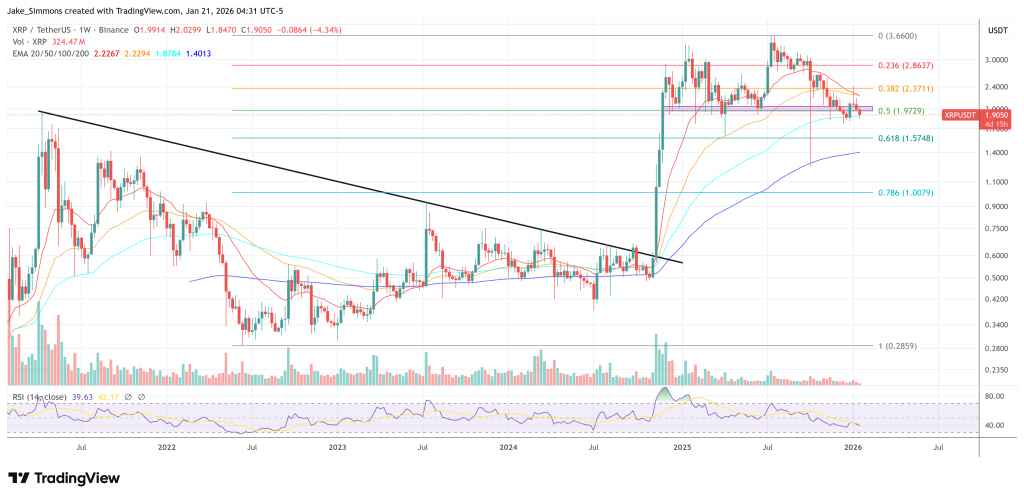
XRP bulls must defend the 100-week EMA, 1-week chart | Source: XRPUSDT on TradingView.com

Domande pertinenti

QWhat are the four key forces that Ripple President Monica Long predicts will drive institutional crypto adoption by 2026?

AThe four key forces are stablecoins, tokenized assets, custody consolidation, and automation powered by AI.

QAccording to Long, what role will stablecoins like Ripple USD (RLUSD) play in the global financial system by 2026?

AStablecoins will become the foundational layer for global settlement, fully integrated into payment systems for programmable, 24/7 payments and collateral use, moving beyond being an 'alternative rail'.

QWhat percentage of Fortune 500 companies does Long predict will have formalized digital asset strategies by the end of 2026?

AShe predicts roughly half (about 50%) of Fortune 500 companies will have formalized digital asset strategies by the end of 2026.

QHow does Long characterize the role of digital asset custody in the institutional adoption of crypto?

AShe frames digital asset custody as the institutional on-ramp and predicts consolidation in the space as custody offerings become commoditized, with more than half of the world's top 50 banks adding new custody relationships.

QWhat convergence does Long highlight as a key driver for automation in treasury and asset management processes?

AShe highlights the convergence of blockchain and AI, where smart contracts paired with AI models will enable real-time, automated treasury management, liquidity management, and risk assessment without manual intervention.

Letture associate

Cook's Curtain Call and Ternus Takes the Helm: The Disruption and Reboot of Apple's 4 Trillion Dollar Empire

Tim Cook has officially announced he will step down as CEO of Apple in September, transitioning to executive chairman after a 15-year tenure during which he grew the company’s market value from around $350 billion to nearly $4 trillion. He will be succeeded by John Ternus, a 50-year-old hardware engineering veteran who has been groomed for the role through increasing public visibility and internal responsibility. Ternus’s appointment signals a strategic shift toward hardware and engineering leadership, with Johny Srouji—head of Apple Silicon—taking on an expanded role as Chief Hardware Officer. This consolidation aims to strengthen Apple’s core technological capabilities. However, Cook’s departure highlights a significant unresolved issue: Apple’s delayed and fragmented approach to artificial intelligence. Despite early efforts, such as hiring John Giannandrea from Google in 2018, Apple’s AI initiatives—particularly around Siri—have struggled with internal restructuring and reliance on external partnerships, including with Google. The transition comes at a critical moment as Apple faces paradigm shifts with the rise of artificial general intelligence (ASI). The company’s closed ecosystem of hardware, software, and services—once a major advantage—now presents challenges in adapting to an AI-centric world where intelligence may matter more than the device itself. Ternus must quickly articulate a clear AI strategy, possibly starting at WWDC, to reassure markets and redefine Apple’s role in a new technological era. His task is not only to maintain Apple’s operational excellence but also to reinvigorate its capacity to innovate and lead in the age of AI.

marsbit19 min fa

Cook's Curtain Call and Ternus Takes the Helm: The Disruption and Reboot of Apple's 4 Trillion Dollar Empire

marsbit19 min fa

Trading

Spot
Futures
活动图片