Crypto Extortion Hits Strait Of Hormuz As Scammers Exploit Shipping Crisis

bitcoinistPubblicato 2026-04-21Pubblicato ultima volta 2026-04-21

Introduzione

An emerging crypto extortion scam is targeting shipping companies with vessels stranded near the Strait of Hormuz, according to maritime risk firm Marisks. Criminals posing as Iranian security officials are sending fraudulent messages offering safe passage in exchange for transit fees paid in Bitcoin or Tether. The scam exploits desperation amid the ongoing regional conflict, which has severely restricted movement through the critical waterway. Victims are instructed to submit documents and pay a cryptocurrency fee to secure transit. However, the messages are not from Iranian authorities. Paying could not only result in financial loss but also potentially violate international sanctions, as any crypto transfer linked to Iranian entities may be considered material support. Legal risks remain even if companies are defrauded. The scheme appears to capitalize on earlier reports that Iran was considering a real crypto-based toll system.

At least one vessel that came under fire while trying to leave the Strait of Hormuz may have been acting on fraudulent instructions — directions that came not from Iranian officials, but from criminals posing as them.

Maritime risk firm Marisks flagged the possibility in a warning issued Monday, though it stopped short of confirming the link.

The warning describes a scam targeting ship owners whose vessels are stuck west of the strait. Unknown groups have been sending messages to these companies, claiming to represent Iranian security services and offering safe passage in exchange for transit fees paid in Bitcoin or Tether (USDT).

Image: Pension Awareness

Fake Officials, Real Consequences

Marisks was direct: the messages are fraudulent. They do not come from Iranian authorities, the firm said.

Tehran has not publicly addressed the situation.

The scam follows a pattern designed to look credible. Recipients are told to submit documents for review. Once verified, they are assigned a fee in cryptocurrency. Pay it, the messages say, and safe transit will be arranged at an agreed time.

It is a structured process — one built to look official enough that desperate ship owners might believe it.

Bitcoin is currently trading at $76,278. Chart: TradingView

The timing is no accident. The Strait of Hormuz has been largely closed since conflict escalated in the Middle East. Before hostilities, the waterway carried roughly 20% of the world’s oil and liquefied natural gas.

Ships have been stranded for days, some under threat of armed intervention. That pressure creates exactly the kind of desperation scammers rely on.

Reports earlier this month indicated that Iran itself had been weighing a real Bitcoin-denominated toll on vessels passing through the strait — charging around $1 per barrel for loaded tankers while letting empty ships through free.

The scam appears to have grown directly out of that reporting, borrowing its credibility from a policy that was already in the news.
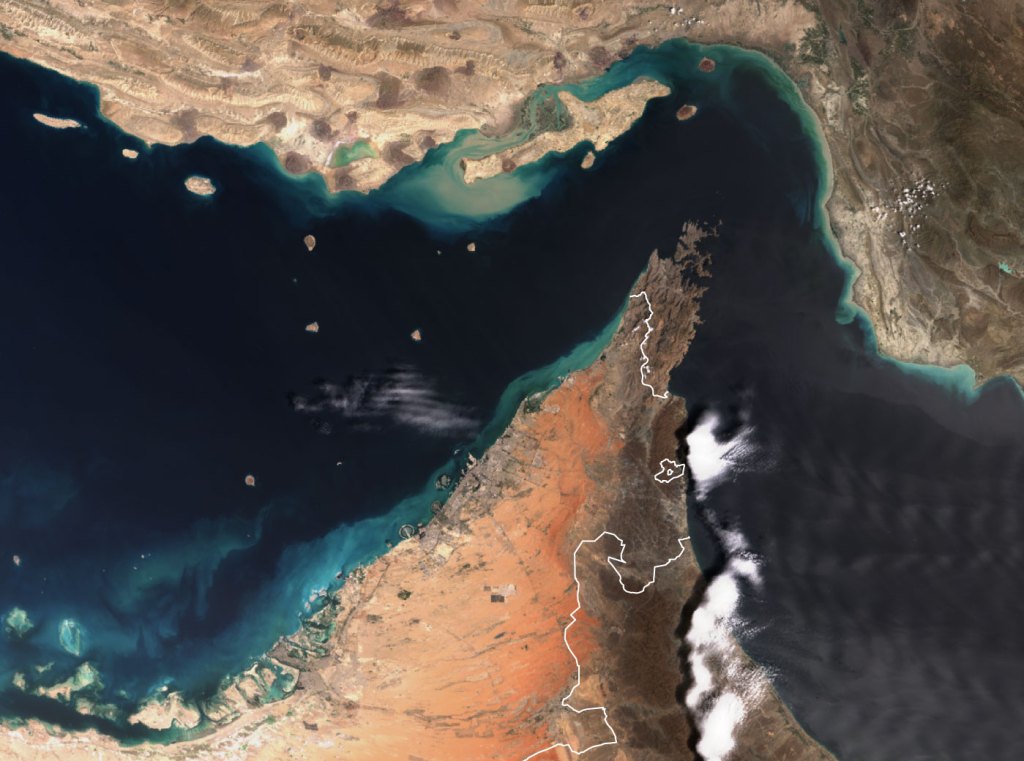
Satellite image of Strait of Hormuz. Source: WSJ

Sanctions Risk Adds To The Danger

For shipping companies tempted to pay, the financial and legal exposure goes beyond losing money to criminals.

According to Chainalysis senior intelligence analyst Kaitlin Martin, any cryptocurrency transfer tied to Iranian-controlled waterways could be classified as material support — a designation that puts companies in potential violation of US and international sanctions.

Entities linked to the Islamic Revolutionary Guard Corps fall under some of the strictest sanctions in force.

That means victims of the scam could face legal scrutiny even after being defrauded. Paying what appears to be a ransom to free a stranded vessel could trigger the same sanctions mechanisms designed to punish deliberate violators.

Featured image from Unsplash, chart from TradingView

Crypto di tendenza

Domande pertinenti

QWhat is the main subject of the scam described in the article targeting ships in the Strait of Hormuz?

AThe scam involves criminals posing as Iranian security officials, sending fraudulent messages to ship owners offering safe passage in exchange for transit fees paid in Bitcoin or Tether (USDT).

QWhich maritime risk firm issued a warning about the possibility of fraudulent instructions to vessels?

AMarisks, a maritime risk firm, issued the warning about the fraudulent messages.

QWhat significant risk do shipping companies face beyond financial loss if they pay the cryptocurrency ransom?

AThey risk violating US and international sanctions, as any cryptocurrency transfer tied to Iranian-controlled waterways could be classified as material support, potentially leading to legal scrutiny.

QWhy is the timing of this scam particularly effective, according to the article?

AThe timing is effective because the Strait of Hormuz has been largely closed due to escalated conflict, leaving ships stranded and under threat, which creates the desperation that scammers rely on.

QWhat real policy proposal by Iran may have lent credibility to this cryptocurrency extortion scam?

AReports indicated that Iran itself had been considering a real Bitcoin-denominated toll on vessels passing through the strait, charging around $1 per barrel for loaded tankers, which the scam appears to have exploited for credibility.

Letture associate

10,000 Scientists Get 1 Year of Free Access: OpenAI Brings the Scientific Research Pipeline into ChatGPT

OpenAI has launched the "ChatGPT for Academic Researchers" program, offering free one-year access to its flagship models for 100,000 university researchers globally, with 10,000 spots available this summer. Selected institutions include prestigious centers like ENS Paris and the IAS at Princeton. The initiative provides an integrated research workspace within ChatGPT, bundling tools like ChatGPT, ChatGPT Work, and Codex, along with expanded Deep Research capabilities, higher usage limits, and specialized tools for life sciences. The suite connects to platforms like Zotero and GitHub, aiming to streamline the entire research workflow from literature review and coding to data analysis and manuscript drafting. OpenAI notes that about 1.3 million people already use ChatGPT weekly for advanced science and math. The program targets building long-term user dependency by embedding these tools into daily research habits. However, access comes with limitations: it does not include API credits or model weights, and eligibility is restricted to verified academic researchers from supported countries. This approach contrasts with Anthropic's "AI for Science" program, which offers API credits but not an integrated workspace. Both companies emphasize preventing misuse by withholding model weights, a point of contention for AI researchers seeking transparency. The core strategy remains clear: provide a powerful, integrated environment to foster user reliance ahead of the post-free period.

marsbit8 min fa

10,000 Scientists Get 1 Year of Free Access: OpenAI Brings the Scientific Research Pipeline into ChatGPT

marsbit8 min fa

What's Going On with Gigadevice? Major Shareholder Cashes Out 44 Billion, Then Announces 20 Billion Buyback

Gigadevice Innovation, a leading Chinese memory chip company, has executed a controversial financial maneuver. The company's controlling shareholder and chairman, Zhu Yiming, sold approximately 44 billion RMB worth of his shares between early May and mid-June 2026, capitalizing on a soaring stock price that peaked at 846.66 RMB on June 29th. Following a subsequent stock crash—plummeting to around 350 RMB in 22 trading days and erasing over 330 billion RMB in market value—Zhu announced a combined "market rescue" plan on July 29th. This plan includes his personal commitment to buy back at least 1 billion RMB in shares and a company proposal to repurchase 1 to 2 billion RMB worth of stock. This sequence of high-selling followed by a low-buying plan has confused and unsettled many of the company's 240,000 retail investors. The stock's dramatic decline was attributed to several factors: the successful IPO of its sister company, Changxin Technologies, which ended Gigadevice's status as a primary investment proxy for the domestic memory sector; a Morgan Stanley report warning of a potential peak in the memory chip cycle; and a severe loss of market confidence triggered by the chairman's massive sell-off. While the sell-off was procedurally compliant, its timing has been criticized. The company's fundamentals appear strong, with preliminary H1 2026 results showing revenue up 177% year-on-year to 11.5 billion RMB and net profit skyrocketing 1099% to 6.9 billion RMB, driven by a boom in memory chips and MCU demand. However, a significant portion (2.05 billion RMB) of this profit came from non-recurring gains like securities investment, and the memory industry is notoriously cyclical. Analysts highlight the company's role in the domestic substitution of niche DRAM and NOR Flash memory, with some maintaining bullish price targets. Yet, the recent events underscore key risks: its fabless model creates dependency on foundries like Changxin, and the chairman's actions have raised serious questions about management's alignment with minority shareholders. The promised buybacks cannot commence until December 13th due to a mandatory six-month cooling-off period following an insider sale, leaving the stock vulnerable in the interim.

marsbit8 min fa

What's Going On with Gigadevice? Major Shareholder Cashes Out 44 Billion, Then Announces 20 Billion Buyback

marsbit8 min fa

Pi Network Price Forecast for August 2026: Will the August 11th Deadline Become a Catalyst for PI's Recovery?

Pi Network Price Forecast for August 2026: Will the August 11 Deadline Catalyze a Recovery? Pi Network (PI) traded at $0.0830 on July 30, up 1.13%, attempting to stabilize above its all-time low. The price is rebounding from the lower Bollinger Band around $0.07172. All key EMAs (20, 50, 100, 200-day) remain in a downtrend above the current price, with the 20-day EMA at $0.08810 acting as the first significant resistance level to confirm a recovery. August presents two key narratives. First, the Pi Core Team launched Protocol 26 with a hard deadline of August 11 for all node operators to upgrade; failure to do so results in disconnection. This is the final precursor to Protocol 27, a major technical upgrade planned for 2026. Second, a community debate challenges the widespread "GCV" (Global Consensus Value) concept, with a member stating there is no official GCV mechanism and that Mainnet apps price services independently. This could pressure price if holders selling on disillusionment. The 10-day price forecast table suggests a range of $0.072-$0.095 for early August amid Protocol 26 deadline pressure, $0.080-$0.110 in mid-August post-deadline clarity, and $0.085-$0.125 in late August, pending broader crypto market direction. The bullish case requires smooth Protocol 26 migration, clear Protocol 27 announcement, resolution of the GCV debate without major holder exits, and a close above the 20-day EMA. The bearish scenario involves node upgrade difficulties, GCV-related selling pressure, continued supply pressure from 775.8 million PI scheduled to unlock by December, and a fall back to or below the $0.07172 support zone.

cryptonews.ru32 min fa

Pi Network Price Forecast for August 2026: Will the August 11th Deadline Become a Catalyst for PI's Recovery?

cryptonews.ru32 min fa

Trading

Spot

Articoli Popolari

Come comprare ONE

Benvenuto in HTX.com! Abbiamo reso l'acquisto di Harmony (ONE) semplice e conveniente. Segui la nostra guida passo passo per intraprendere il tuo viaggio nel mondo delle criptovalute.Step 1: Crea il tuo Account HTXUsa la tua email o numero di telefono per registrarti il tuo account gratuito su HTX. Vivi un'esperienza facile e sblocca tutte le funzionalità,Crea il mio accountStep 2: Vai in Acquista crypto e seleziona il tuo metodo di pagamentoCarta di credito/debito: utilizza la tua Visa o Mastercard per acquistare immediatamente HarmonyONE.Bilancio: Usa i fondi dal bilancio del tuo account HTX per fare trading senza problemi.Terze parti: abbiamo aggiunto metodi di pagamento molto utilizzati come Google Pay e Apple Pay per maggiore comodità.P2P: Fai trading direttamente con altri utenti HTX.Over-the-Counter (OTC): Offriamo servizi su misura e tassi di cambio competitivi per i trader.Step 3: Conserva Harmony (ONE)Dopo aver acquistato Harmony (ONE), conserva nel tuo account HTX. In alternativa, puoi inviare tramite trasferimento blockchain o scambiare per altre criptovalute.Step 4: Scambia Harmony (ONE)Scambia facilmente Harmony (ONE) nel mercato spot di HTX. Accedi al tuo account, seleziona la tua coppia di trading, esegui le tue operazioni e monitora in tempo reale. Offriamo un'esperienza user-friendly sia per chi ha appena iniziato che per i trader più esperti.

365 Totale visualizzazioniPubblicato il 2024.12.12Aggiornato il 2026.06.02

Come comprare ONE

Discussioni

Benvenuto nella Community HTX. Qui puoi rimanere informato sugli ultimi sviluppi della piattaforma e accedere ad approfondimenti esperti sul mercato. Le opinioni degli utenti sul prezzo di ONE ONE sono presentate come di seguito.

活动图片