Ripple expands European footprint with AMINA stablecoin payment partnership

cointelegraphPubblicato 2025-12-12Pubblicato ultima volta 2025-12-12

Introduzione

Ripple Payments has partnered with Swiss bank AMINA to provide its payment infrastructure, enabling more efficient, faster, and lower-cost transactions using the Ripple USD (RLUSD) stablecoin. This collaboration strengthens Ripple’s presence in Europe, leveraging AMINA’s regulatory standing under Swiss and EU frameworks. The partnership addresses friction faced by crypto-native businesses in traditional banking, particularly in cross-border stablecoin transactions. Ripple aims to bridge fiat and blockchain systems, supporting seamless payments. This move is part of Ripple’s broader strategy to integrate blockchain into traditional finance, following recent expansions in Asia-Pacific and regulatory approvals in Singapore and Abu Dhabi for RLUSD.

The payments subsidiary of blockchain services company Ripple has partnered with Swiss bank Amina to provide it with access to its payment infrastructure.

According to a Friday Ripple Payments announcement, the company will allow Amina to “settle transactions more efficiently without relying on traditional payment infrastructure, making transactions faster, lower cost, and with increased reliability and transparency.” This builds on a previous relationship between the companies, with the bank’s integration of the Ripple USD (RLUSD) stablecoin happening back in July.

The move also reinforces Ripple’s presence in Europe, with Amina being a Swiss Financial Market Supervisory Authority-regulated financial institution. The bank’s Austrian subsidiary also holds a license under the European Union’s Markets in Crypto-Assets Regulation (MiCA) granted by Austria’s Financial Market Authority in October.

Amina chief product officer Myles Harrison said “native web3 businesses often run into friction when working with legacy banking systems,” adding that stablecoins can help solve those issues. “This is particularly the case for cross-border stablecoin transactions which traditional banks are yet to widely adopt.”

Related: Community expects first US spot XRP ETF to launch on Thursday

Banks need crypto services for crypto companies

Harrison explained that the bank’s clients “need payment infrastructure that can handle both fiat and stablecoin rails simultaneously,” which traditional banking networks cannot provide for. Ripple Payments, on the other hand, allowed Amina to offer such services, which led to “reducing cross-border friction and helping our crypto-native clients maintain their competitive edge.”
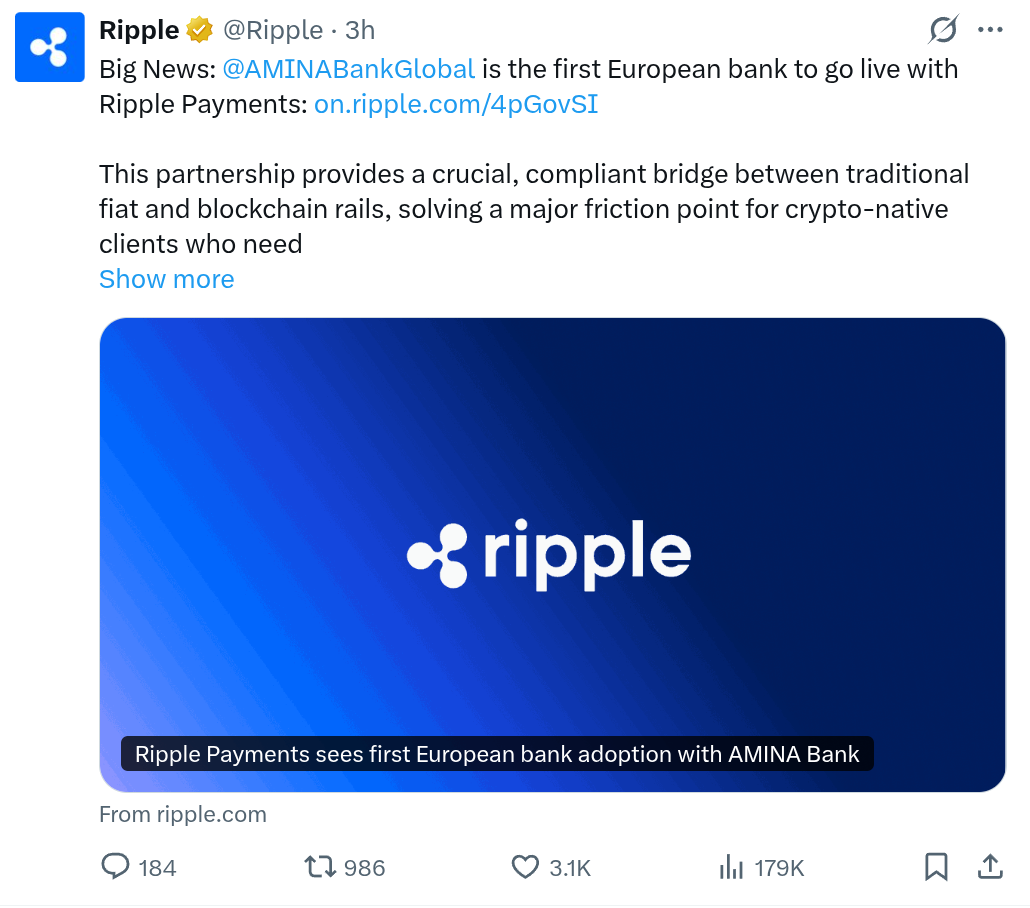
Source: Ripple

Ripple’s managing director for the United Kingdom and Europe Cassie Craddock said that the collaboration lets Amina “serve as the on-ramp for digital asset innovators into traditional financial infrastructure.” He added that Ripple Payments provides a “bridge between fiat and blockchain” that enables seamless stablecoin payments.

Related: Canary Capital filing signals spot XRP ETF set for launch this week

Ripple onboards traditional finance onchain

This is just the latest partnership in which Ripple injected blockchain capabilities into an institution engaged in traditional finance. According to mid-November reports, the company is spending about $4 billion to combine prime trading, treasury tools, payments, and custody to take on traditional finance.

Ripple’s ambitions are also global. Earlier this month, Ripple Labs received approval from Singapore’s central bank to expand its payment activities. This enables the company to offer regulated token services, end-to-end payments and growth across Asia-Pacific.

At the end of November, RLUSD was also cleared for use by institutions in Abu Dhabi after winning recognition as an Accepted Fiat-Referenced Token by the local watchdog.

Letture associate

Robinhood CEO: The Tokenization Wave of U.S. Stocks is Coming, America Must Not Be Left Behind

We are at the early stage of a global supercycle for asset tokenization, a transformative force reshaping finance. Robinhood has actively expanded this frontier outside the US, recently launching Robinhood Chain, a public EVM chain designed for Real World Assets (RWA) and focused on stock tokens. It enables global users to access over 190 US stocks backed 1:1 by underlying securities. However, a key gap remains: these tokenized stocks are not yet available within the United States itself. In the US, the debate around stock tokenization centers on its practical value, given existing low-cost access to equities. Critics question the need, but this misses the core innovation: tokenizing premium financial assets to make them portable, programmable, self-custodied, and tradable 24/7 within an open financial ecosystem. This is more than moving stocks onto a blockchain; it's rebuilding the foundational infrastructure of asset ownership. For US investors, this new infrastructure offers three core advantages: 1. **Real-time clearing and settlement**, enhancing market resilience by eliminating the systemic risks and capital burdens inherent in the traditional T+2/T+1 settlement cycle, as starkly revealed during events like the GameStop volatility. 2. **Native 24/7 trading capability**, allowing all investors to manage risk and react to global news outside standard market hours, a tool previously largely accessible only to institutions. 3. **Greater user control and portability of assets**, enabling instant transfers between platforms and into DeFi. This self-custody model fosters competition among service providers and unlocks new use cases like lending and using tokens as collateral. Realizing these benefits in the US requires more than technology; it necessitates modernizing a century-old securities regulatory framework built for legacy infrastructure. Policymakers must act swiftly to adapt rules for this new paradigm while preserving investor protections. Other jurisdictions are advancing, and the US risks being left behind in shaping the future of asset ownership—a future largely built around American assets and innovation. Tokenizing publicly traded stocks is just the beginning, paving the way for broadening access to other asset classes like private equity. US investors deserve to participate in this innovation.

marsbit26 min fa

Robinhood CEO: The Tokenization Wave of U.S. Stocks is Coming, America Must Not Be Left Behind

marsbit26 min fa

BIT Trading Moment: BTC Buying Pressure Rises but Bearish Sentiment Remains Strong, 50-Month EMA Difficult to Break, SK Hynix Attempts to Stabilize Memory

BIT Trading Hours: BTC Buying Rebounds but Bearish Sentiment Persists; 50-Month EMA Presents Resistance; SK Hynix Attempts to Stabilize the Memory Sector. Bitcoin briefly reclaimed $65,000, its first time since August 10th, showing a temporary decoupling from traditional risk assets pressured by soaring long-term U.S. Treasury yields. Key support is seen at $62k-$63k, with resistance near the 50-month Exponential Moving Average around $65.4k. While on-chain data indicates recovering spot demand, potentially signaling a local bottom, the options market remains skewed bearish. BIT analysis notes significant downside risk remains if historical bear market patterns repeat, with a potential drop to ~$45.5k. Global equity markets faced intense selling pressure, driven by a bond market storm. The U.S. 30-year yield hit a multi-year high above 5.33%, raising global funding costs. The AI sector was at the epicenter of the sell-off, with the Philadelphia Semiconductor Index plunging ~5% as investors questioned the sustainability of massive AI capital expenditures amid high debt costs. Storage stocks like Micron led declines. SK Hynix's announcement of a major share buyback provided some stability to the memory sector during after-hours trading. However, most tech stocks remained under pressure. In Asia, South Korean and Japanese indices fell sharply, heavily impacted by chip stock declines. Chinese robotics company Unitree Tech had a volatile market debut on Shanghai's STAR Market, soaring over 600% at one point before paring gains, making its founder a billionaire. Despite this individual success, the broader robotics sector in A-shares sold off heavily. Key upcoming events include the U.S. 20-year Treasury auction and the release of the Federal Reserve's July meeting minutes, which will be crucial tests for bond market stability and monetary policy expectations.

marsbit28 min fa

BIT Trading Moment: BTC Buying Pressure Rises but Bearish Sentiment Remains Strong, 50-Month EMA Difficult to Break, SK Hynix Attempts to Stabilize Memory

marsbit28 min fa

Trading

Spot
活动图片