BIT Trading Moment: BTC Buying Pressure Rises but Bearish Sentiment Remains Strong, 50-Month EMA Difficult to Break, SK Hynix Attempts to Stabilize Memory

marsbitPubblicato 2026-08-19Pubblicato ultima volta 2026-08-19

Introduzione

BIT Trading Hours: BTC Buying Rebounds but Bearish Sentiment Persists; 50-Month EMA Presents Resistance; SK Hynix Attempts to Stabilize the Memory Sector. Bitcoin briefly reclaimed $65,000, its first time since August 10th, showing a temporary decoupling from traditional risk assets pressured by soaring long-term U.S. Treasury yields. Key support is seen at $62k-$63k, with resistance near the 50-month Exponential Moving Average around $65.4k. While on-chain data indicates recovering spot demand, potentially signaling a local bottom, the options market remains skewed bearish. BIT analysis notes significant downside risk remains if historical bear market patterns repeat, with a potential drop to ~$45.5k. Global equity markets faced intense selling pressure, driven by a bond market storm. The U.S. 30-year yield hit a multi-year high above 5.33%, raising global funding costs. The AI sector was at the epicenter of the sell-off, with the Philadelphia Semiconductor Index plunging ~5% as investors questioned the sustainability of massive AI capital expenditures amid high debt costs. Storage stocks like Micron led declines. SK Hynix's announcement of a major share buyback provided some stability to the memory sector during after-hours trading. However, most tech stocks remained under pressure. In Asia, South Korean and Japanese indices fell sharply, heavily impacted by chip stock declines. Chinese robotics company Unitree Tech had a volatile market debut on Shanghai's STAR Market,...

This article is jointly produced by PANews and BIT U.S. Stocks. BIT U.S. Stocks provides 10,000+ mainboard U.S. stocks and ETFs, supports stablecoin deposits/withdrawals and traditional USD wire transfers, and allows for full shareholder rights including dividends and voting.

Bitcoin On-Chain Buying Pressure Warms Up, Downside Risks Remain

Bitcoin returned above $65,000 yesterday, touching this level for the first time since August 10. Meanwhile, U.S. stock risk assets are still pressured by the surge in long-term Treasury yields. The 30-year Treasury yield once rose to a multi-year high of 5.34%, indicating a temporary divergence between BTC and traditional risk assets.

Most traders focus key support around the $62,000 to $63,000 range. If this level breaks, a drop to $60,000 to $61,000 to sweep liquidity is possible. Resistance above is concentrated around the 50-month Exponential Moving Average near approximately $65,400 and the potential head-and-shoulders bottom neckline area. Analyst Aksel Kibar pointed out that if the head-and-shoulders bottom structure holds, the rebound target could be as high as $76,000; however, if it fails, a drop to $53,000 is possible.

On-chain data research firm CryptoQuant noted that Bitcoin's 30-day apparent spot demand has significantly recovered from negative 206,000 BTC on July 23 to the current negative 5,000 BTC, approaching the critical point of turning positive for the first time since February 26. Historically, after spot demand turns from negative to positive, the median BTC gain over the next 60 days is 18.1%, with a win rate of 78%.

VanEck also believes Bitcoin may be nearing the end of its correction. Its model shows that 8 out of 12 "capitulation indicators" have been triggered, and BTC has already entered its 11th month of adjustment; the average time from peak to trough in the past three cycles (excluding 2011) was about 12.7 months, suggesting September to November could be an important window for the accumulation phase this round. However, VanEck also emphasized that capitulation signals do not have a stable excess return advantage over the next 90 and 180 days. The real thing to wait for is the reconfirmation of capital demand.
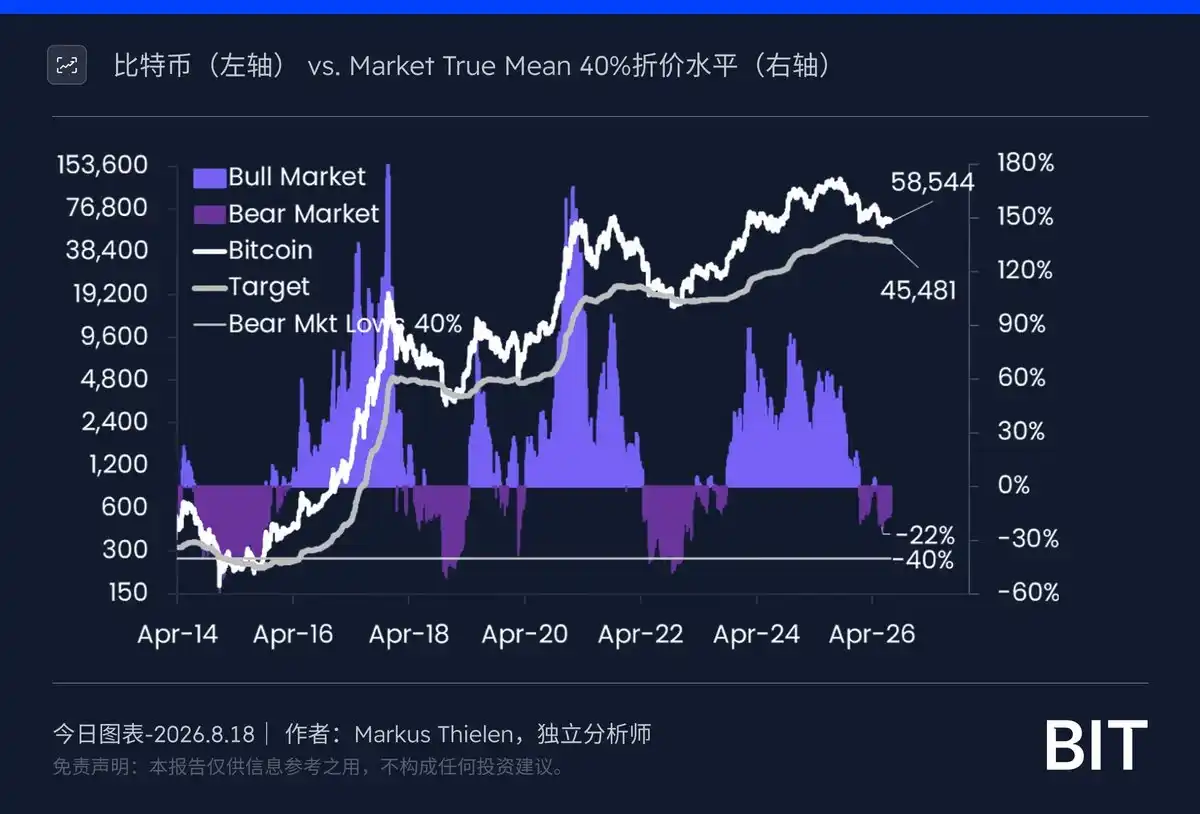
The options market still shows strong bearish sentiment, with put option premiums significantly higher than calls, but open interest and funding rates indicate a gradual unwinding of leverage. BIT's view is that, based on historical data, Bitcoin has traded about 40% below its long-term market average during bear markets. If this pattern repeats, the price could drop to around $45,500. Currently, the potential downside risk from the current price is about 20%, corresponding to an upside potential of about 60%. The risk-reward ratio is gradually improving, but macro risks could still drive another downturn. The real test is whether spot demand can sustainably turn positive and hold above the cost basis.

The key focus for BTC moving forward is two things: whether the Fed meeting minutes are hawkish, and whether the U.S. 20-year Treasury auction goes smoothly. If the bond market remains concerning, BTC may test around $63,000; if interest rate pressure eases, BTC has a chance to challenge the $66,000 to $70,000 range again.

Key Points for Today:

  • Ethereum will conduct the Glamsterdam upgrade fork on the Platåberget testnet on August 20.

  • KAITO (KAITO) unlocks approximately 32.6 million tokens, valued around $11.5 million.

  • LayerZero (ZRO) unlocks approximately 25.72 million tokens, valued around $19.62 million.

  • Upbit 24-hour trading volume ranking: BTC, XRP, ETH, LA, DOS.

  • Bitcoin Spot ETF: +$189 million.

  • Ethereum Spot ETF: +$71.468 million.

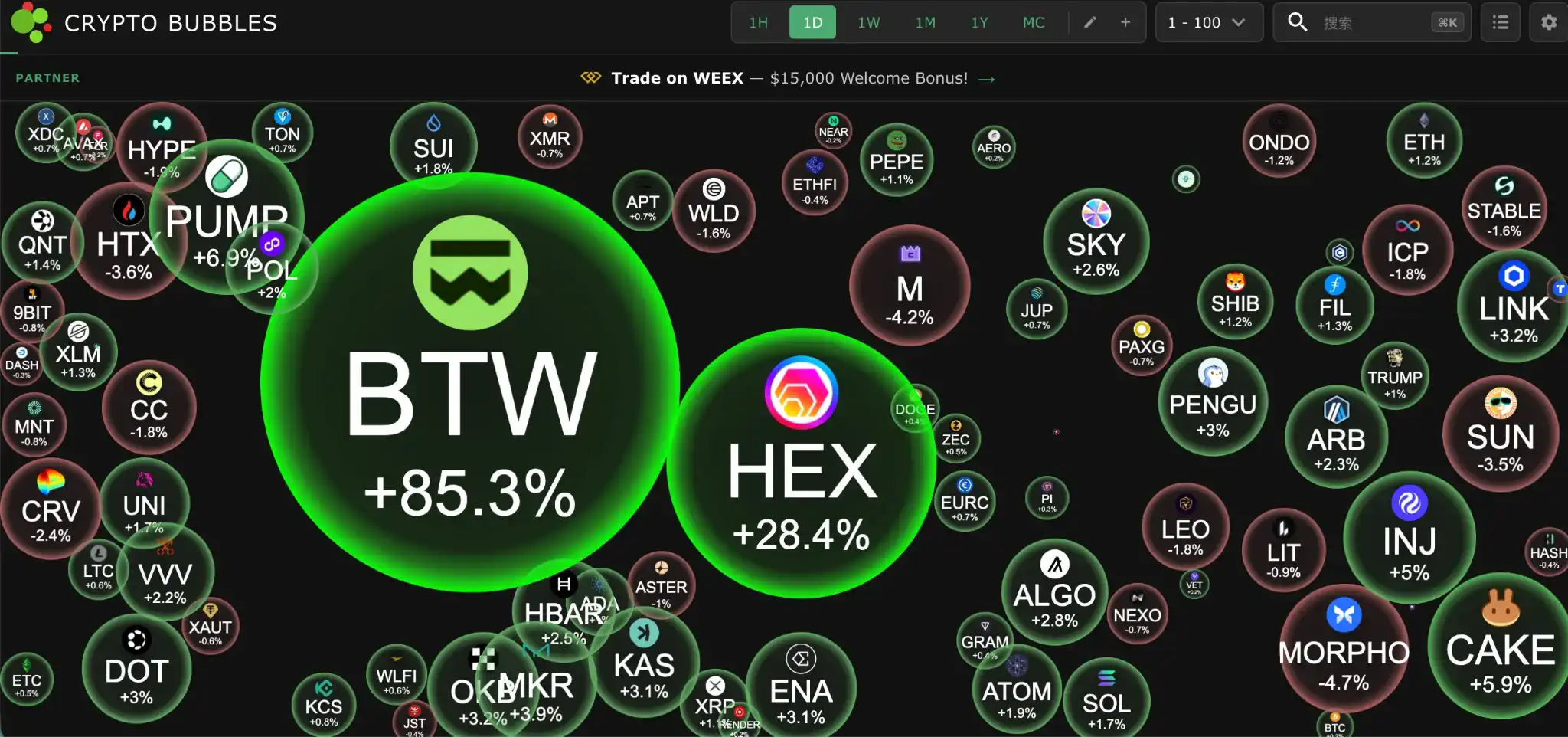
Today's top gainers among the top 100 cryptocurrencies by market cap: BTW up 85.3%, HEX up 28.4%, PUMP up 6.9%, CAKE up 5.9%, INJ up 5%.
Stock Index Futures Test Rebound, AI Sector Remains the Eye of the Storm

U.S. stock index futures showed mixed performance, with Dow futures up 0.06%, Nasdaq 100 futures down 0.04%, and S&P 500 futures up 0.02%.
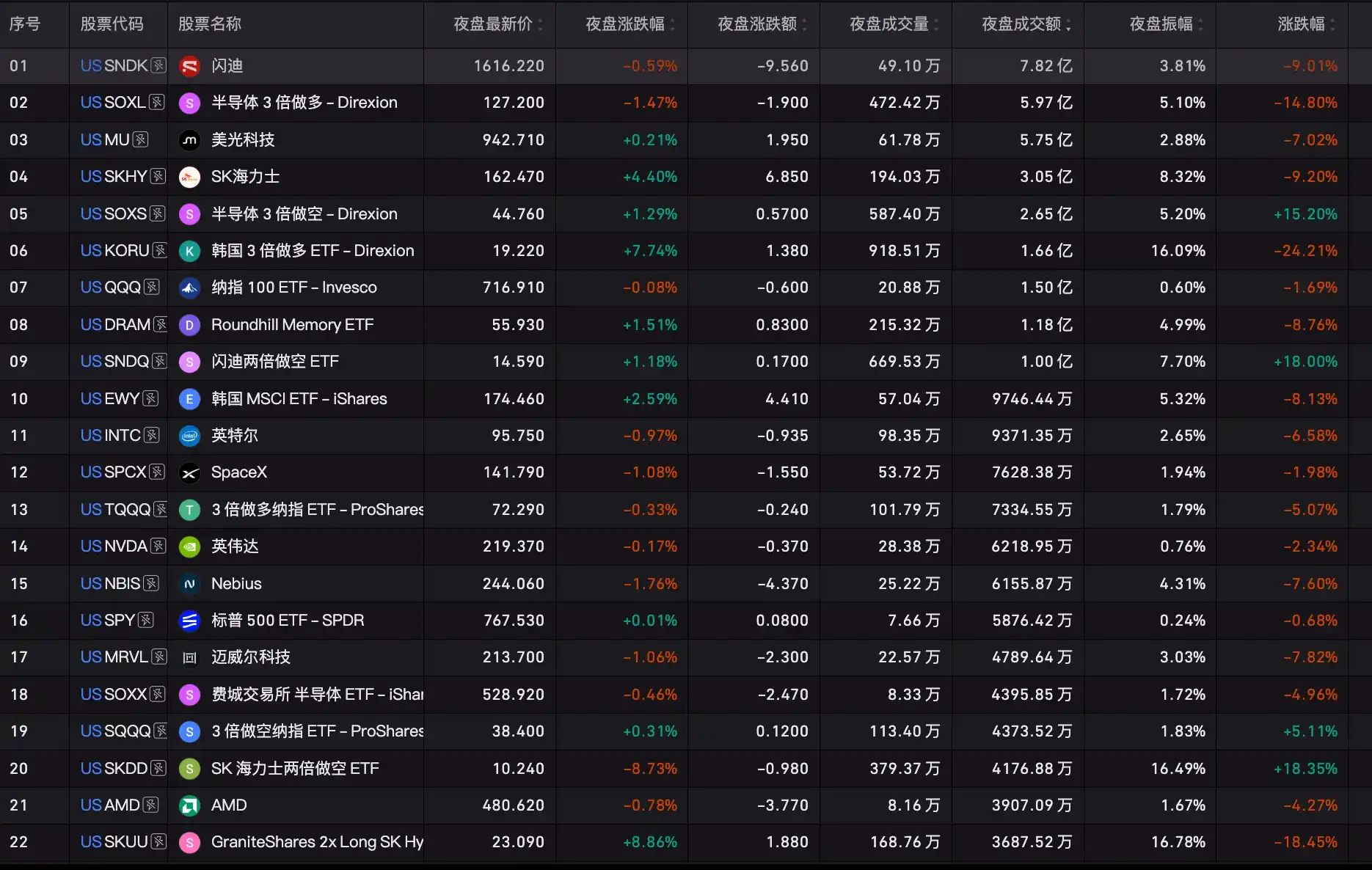
BIT after-hours data shows that SK Hynix was the most watched stock in after-hours trading, rising over 4%. The company announced a stock buyback plan worth 40 trillion won. The repurchased shares will be canceled to enhance shareholder returns. This move temporarily stabilized sentiment in the memory sector. The memory ETF DRAM rose 1.51%, Micron Technology rose slightly by 0.21%, while SanDisk fell 0.59%.

However, most U.S. stocks remained in a downtrend: NVIDIA fell 0.17%, AMD fell 0.78%, Nebius fell 1.76%, and Marvell Technology fell 1.06%.

Bond Market Storm Overwhelms AI Narrative, Funds Turn Defensive
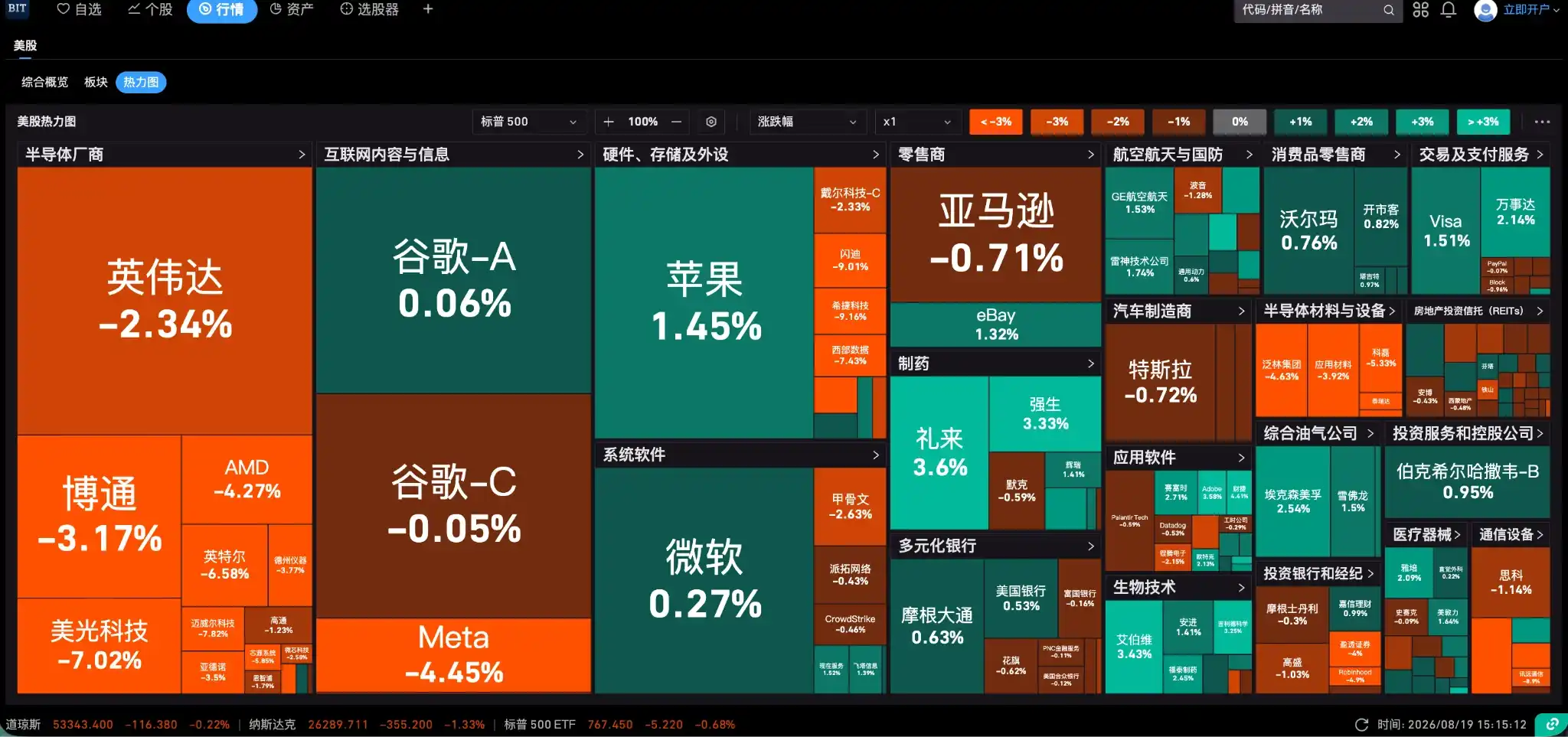
Last night's main theme in U.S. stocks wasn't equities, but bonds. The U.S. 30-year Treasury yield touched 5.338% intraday, hitting its highest level since 2007, while the 10-year yield approached 4.75%. Long-term bond yields in France, Germany, the UK, and Japan also surged simultaneously, raising global funding costs together.

The AI sector became the center of selling. The Philadelphia Semiconductor Index fell about 5% as market logic regarding AI capital expenditures wavered, with concerns shifting from a "growth story" to a "debt story." Goldman Sachs data shows that AI-related bond issuance this year has reached $489 billion, far exceeding the full-year 2025 level. Meanwhile, OpenAI's Q2 operating loss widened to $12.3 billion, and Anthropic's annualized revenue run rate fell short of market expectations, further intensifying investor anxiety over the mismatch between high AI investment and return cycles.

Memory stocks, as the most elastic segment in AI server expansion, led the decline: Micron Technology fell about 7%, Seagate fell over 9%, and SK Hynix ADR fell over 9%. Optical communication and AI cloud service providers faced more intense valuation reassessments: Applied Optoelectronics fell about 15%, Coherent fell over 12%, and CoreWeave fell over 12%. BIT analysis points out that for companies whose business models heavily rely on continuous financing, their valuation elasticity has an inverse amplification effect in the environment of surging long-term rates.

Meta fell 4.45% amid a joint lawsuit from 29 states. In contrast, Apple, which is not deeply involved in the "arms race" of AI data center capital expenditures, was viewed as a tech defensive stock by the market and rose 1.45%. Microsoft, Google, and Amazon performed relatively steadily.

Analysts note that the core of the current bond market turmoil lies in the U.S. fiscal deficit outlook for the next decade. Currently, nearly one out of every five dollars of U.S. government revenue is used to pay interest. This "normalization" is forcing the market to re-evaluate the intrinsic value of high-valuation tech stocks.
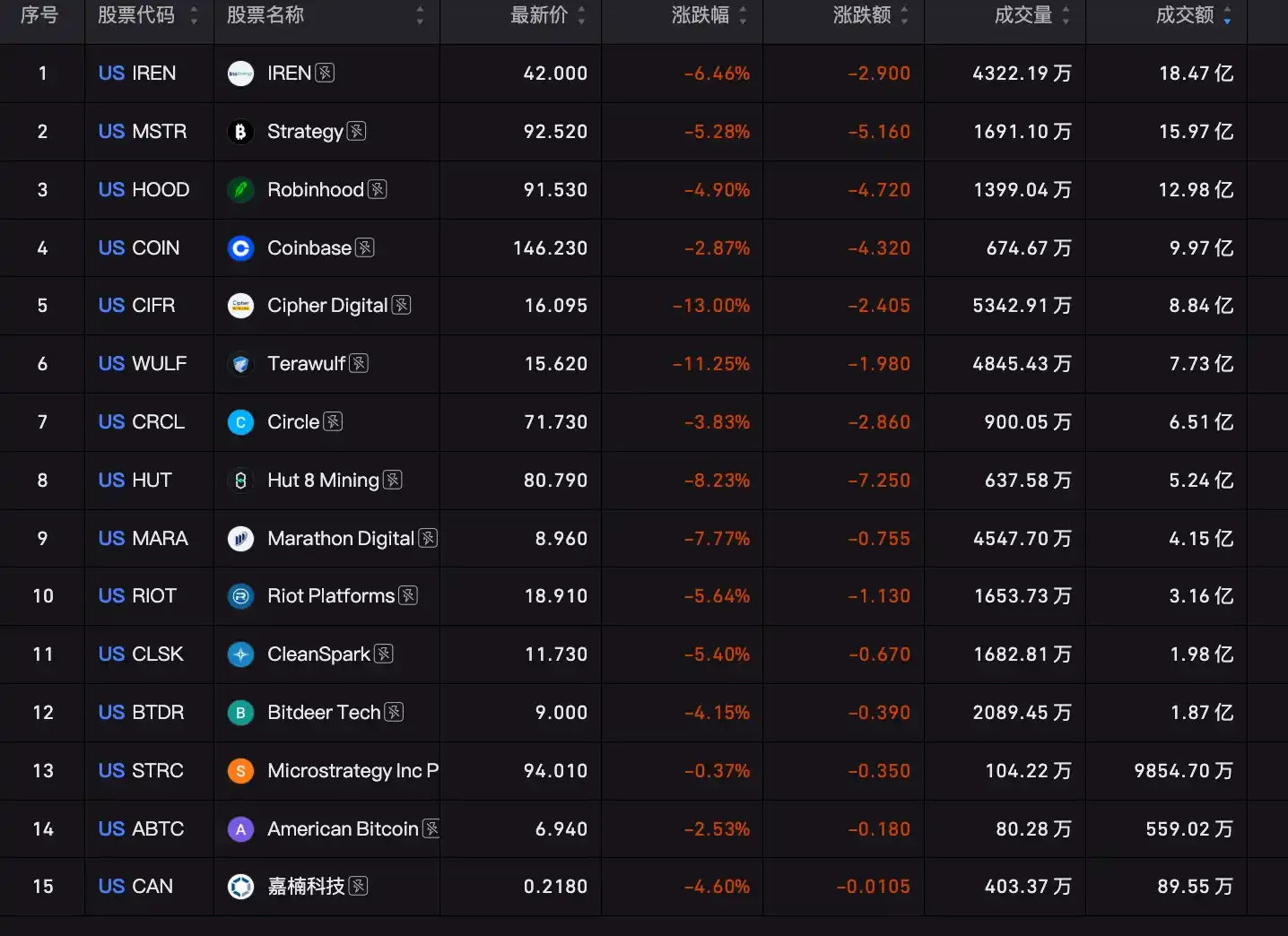
Crypto-related stocks fell sharply. According to BIT U.S. Stocks data, Coinbase fell 2.87%, Robinhood fell 4.9%, Strategy fell 5.28%, and Circle fell 3.83%.

Among mining companies: Cipher Digital fell 13%, TeraWulf fell 11.25%, Hut 8 fell 8.23%, MARA fell 7.77%, IREN fell 6.46%; CleanSpark, Canaan, Riot, and Bitdeer fell between 5% and 6%. VanEck remains optimistic about the long-term value of some miners transitioning to AI data centers, but short-term factors like rising rates, data center scrutiny, and AI capex concerns will pressure the sector.

Seoul and Tokyo Slam the Brakes, Chip Stocks Become Core of Asia-Pacific Sell-off, Unitree Tech IPO Sets New Benchmark for Humanoid Robot Valuations

High global bond yields and oil price inflation concerns directly impacted Asian risk assets. South Korea's KOSPI index closed down 5.80%, with chip stocks being the main drag. SK Hynix closed down about 10%, and Samsung Electronics fell nearly 8%. Although revenue and net profit for listed companies on Korea's main board saw significant growth in the first half (with semiconductor leaders contributing significantly), short-term sentiment was dominated by U.S. bond and stock sell-offs.

The Japanese market also opened low and moved lower, with the Nikkei 225 closing down 3.16% and the Topix index also falling significantly by about 2%. Heavyweight tech giants like SoftBank Group, Tokyo Electron, and memory chip maker Kioxia faced concentrated profit-taking. Tech giants like SoftBank were hit by a double whammy of valuation concerns and bond market volatility.

A-shares opened low and moved lower throughout the day. The Shanghai Composite Index fell about 2.4%, the Shenzhen Component Index fell about 5%, the ChiNext Index fell over 6%, and the STAR 50 Index once fell nearly 7%. Over 5,000 stocks declined across the market. Robotics, computing hardware, semiconductors, and MLCC concepts were heavily hit, with many stocks limit-down. Coal and some shipping and banking sectors showed relative resilience.

Unitree Technology became the strongest narrative and the biggest source of volatility in A-shares. On its first day of listing on the STAR Market, the stock surged 629.44% at open to 1,100 yuan per share, with total market capitalization once reaching 444.9 billion yuan. Subsequently, gains moderated to around 460%, with the stock price around 845 yuan. Chairman Wang Xingxing's shareholding value exceeded 100 billion yuan, making him the new richest person among those born in the 1990s. Lei Jun's Shunwei Capital, Liang Wenfeng's DeepSeek, and Huanfang Quantitative also profited handsomely. Nomura Securities assigned a "Buy" rating, forecasting its 2026-2028 revenue CAGR at 122%. However, the overall robotics sector was hit hard, with stocks like Julong Intelligence, Wuzhou Xinchun, Qinchuan Machine Tool, and many others limit-down. This indicates a rapid switch between "leader frenzy" and "sector pullback" in the market.

In Hong Kong stocks, the Hang Seng Index rose slightly by 0.09%, while the Hang Seng Tech Index fell 1.21%. Tech stocks fell broadly: MINIMAX fell about 8%, Baidu Group fell about 11%, while China Unicom, Huahong Grace, and Cambridge Technology all fell around 12%. Kuaishou Technology released its 2026 Q2 earnings, with revenue of 35.54 billion yuan and adjusted net profit of 3.91 billion yuan, both exceeding market expectations. Average monthly active users reached 800 million, significantly surpassing the estimated 740 million. Among these, Kling AI performed brilliantly, with quarterly revenue exceeding 850 million yuan, a year-on-year increase of over 200%, continuing to lead the commercialization of the global AI video generation industry. Despite solid earnings, Hong Kong-listed internet stocks still faced significant selling pressure amid market risk-off sentiment.

What to Watch Next:

August 19 (Wednesday)

  • Seoul AI Summit held from August 19-21: Tech leaders including Google DeepMind, Google Cloud, Microsoft Research, NVIDIA, LG AI Research, and Hyundai Motor are attending. Market focus is on new collaborations in large models, AI cloud, autonomous driving, AI chips, and enterprise applications. Related signals may catalyze global AI software, cloud computing, chip, and robotics supply chains.

  • World Robot Conference held in Beijing from August 19-23: Unitree, Ubtech, Siasun, Galaxy General, Tiangang, and others will showcase humanoid robots and industrial robot solutions. If mass production progress, order fulfillment, or cost reductions exceed expectations, it could catalyze sentiment in the A-share robotics supply chain (reducers, servos, motors, sensors, controllers, and OEMs).

  • HKEX, Kuaishou (19:00 conference call), Hengrui Medicine, ZTO Express, Kingsoft, Kingsoft Cloud, Weibo earnings: For Kuaishou, focus on e-commerce GMV, advertising recovery, profit margins, and AI video tools; HKEX - watch trading volume, IPO pipeline, and derivatives business; Hengrui Medicine - validates innovative drug overseas expansion and R&D delivery; Kingsoft Cloud - an observation point for elasticity in China-concept AI cloud demand.

August 20 (Thursday)

  • 01:00 U.S. Treasury auctions 20-year bonds: Following last week's surge in yields for 10-year and 30-year bond auctions, the bid-to-cover ratio and foreign demand for this 20-year auction will serve as a "super stress test" for the bond market. If demand is weak, it could directly push the 30-year Treasury yield above the 5.35% level, triggering a severe chain reaction in global fixed income markets.

  • 02:00 Release of Fed's July Monetary Policy Meeting Minutes: The market will scrutinize internal discussion details, especially regarding tolerance for inflation (including energy-driven) and the inclination of some members towards rate hikes. Hawkish wording could push long-end yields higher, increasing pressure on high-valuation assets like AI. If it shows increased focus on economic slowdown, it may moderate the pace of rate increases.

  • 09:00 China's 1-year Loan Prime Rate (LPR) announcement: If July economic data was weak, whether the LPR is cut will serve as a litmus test for policy stance. A rate cut would benefit property-related sectors, consumption, Hong Kong-listed internet stocks, and high-dividend assets. If unchanged, the market may turn to waiting for RRR cuts, fiscal expansion, or further property policy easing.

  • 20:30 U.S. Initial Jobless Claims: Employment data will influence Fed pricing together with the previously weak Non-Farm Payrolls. If claims rise, it will reinforce expectations of economic cooling and a September pause in rate hikes. If the job market remains strong, market confidence in "no action" may decrease.

  • Alibaba (20:00 conference call), Pop Mart, NetEase, Walmart, Ping An Insurance, China Telecom, AIA Group, Li Ning, Futu Holdings earnings: Alibaba is the top focus among China concepts. Watch e-commerce GMV, Cloud Intelligence revenue, AI investment, and commercialization of Tongyi Qianwen. For Pop Mart, focus on IP overseas expansion, store expansion, and gross margin. NetEase validates gaming revenue and AI tools. Walmart is a key bellwether for U.S. consumer resilience.

August 21 (Friday)

  • 07:30 Japan's July Core CPI: If inflation is higher than expected, expectations for a BOJ rate hike in September will heat up, potentially causing volatility in the yen and global yield curves. If inflation cools, it will ease pressure on global carry trade unwinding and reduce upward pressure on global long-term rates.

  • 08:00 South Korea's August 1-20 Export Data: Previous data showed a year-on-year increase as high as 52.3%, driven mainly by memory price increases and AI chip exports. This data is a leading indicator for the global semiconductor cycle and the sustainability of AI capital expenditures, directly impacting sentiment for Samsung, SK Hynix, Micron, TSMC, AMD, NVIDIA, and the A-share semiconductor supply chain.

  • Announcement of Q2 Hang Seng Index Series review results: CICC predicts Zijing Mining International, Zhipu AI, MINIMAX-W, etc., are high on the potential inclusion candidate list. If inclusion expectations materialize, it will bring passive fund allocation and short-term liquidity catalysts. If expectations are dashed, related stocks may face selling pressure.

  • NYMEX September Crude Oil Futures contract rollover: Against the backdrop of Hormuz Strait risks and expectations of U.S. sanctions on Iran, the rollover could amplify volatility in near-month contracts. If the spot premium widens, it indicates tight physical supply. If the spread narrows, upward momentum in oil prices may weaken.

  • ZTE, Zijing Mining, Zhongji Innolight, Yangtze Optical Fibre and Cable, KE Holdings, Sinopec earnings: Zhongji Innolight and Yangtze Optical Fibre will validate AI optical module and fiber demand. Watch ZTE's computing power network and carrier capex. Zijing Mining is driven by gold and copper prices. KE Holdings reflects recovery in China's property transaction chain. Sinopec is directly influenced by oil prices and refining margins.


Crypto di tendenza

Domande pertinenti

QWhat are the key technical resistance and support levels for Bitcoin mentioned in the article?

AThe key resistance level for Bitcoin is concentrated around $65.4K near the 50-month Exponential Moving Average (EMA) and the potential head-and-shoulders bottom neckline. The main support is focused on the $62K to $63K range. If this support fails, the price could test the $60K to $61K range to sweep out liquidity. Analyst Aksel Kibar notes that if the head-and-shoulders bottom pattern holds, the rebound target could be $76K; otherwise, it might drop to $53K.

QHow has the bond market impacted AI and tech stocks according to the article?

AThe surge in long-term U.S. Treasury yields, with the 30-year yield hitting a multi-year high of 5.338%, has increased global funding costs and triggered a sell-off in AI and high-valuation tech stocks. AI is now at the center of the sell-off, with the Philadelphia Semiconductor Index dropping about 5%. The market is questioning the AI capital expenditure narrative, fearing it may be shifting from a 'growth story' to a 'debt story'. Companies with business models heavily reliant on continuous financing, such as those in AI cloud services and optical communication, are facing severe valuation reassessment.

QWhat actions did SK Hynix take, and what was the market reaction?

ASK Hynix announced a share buyback plan worth 40 trillion won. The repurchased shares will be cancelled to enhance shareholder returns. This move provided short-term stability for the memory sector sentiment. In the U.S. stock overnight market, SK Hynix's stock rose over 4%, the memory ETF DRAM rose 1.51%, and Micron Technology rose slightly by 0.21%.

QWhat significant event occurred for Unitree Robotics, and how did the broader robotics sector react?

AUnitree Robotics debuted on the STAR Market, with its stock price surging 629.44% at the opening to 1,100 yuan per share, giving it a peak market cap of approximately 444.9 billion yuan. Chairman Wang Xingxing's holdings exceeded 100 billion yuan, making him the richest post-90s individual. However, the broader robotics sector in the A-share market experienced a significant downturn. Stocks like Julong Intelligent, Wuzhou Xinchun, and Qinchuan Machine Tool fell to their daily limit-downs, indicating a rapid market shift between 'leader frenzy' and 'sector pullback'.

QWhat are the two upcoming events the article suggests are critical to watch for Bitcoin's near-term price direction?

AThe article highlights two critical upcoming events for Bitcoin's near-term price direction: 1) The release of the Federal Reserve's July FOMC meeting minutes, to see if the tone is hawkish. 2) The U.S. 20-year Treasury bond auction, to gauge its success. If bond market pressures persist, Bitcoin could test around $63K. If interest rate pressures ease, Bitcoin may have another chance to challenge the $66K to $70K range.

Letture associate

BONK Crypto Treasury Company Has Only $2.14 Million Cash Left, 70% of Revenue Comes from Founder's Own Platform

BONK Inc. (BNKK), the NASDAQ-listed company associated with the Solana meme coin BONK, reported stark financials for the first half of the year. While revenue skyrocketed 6,218% year-over-year to $5.5 million, the company posted a net loss of $7.88 million and its cash reserves plummeted to just $214,000. Its auditors issued a "going concern" warning, citing cumulative losses of $191.4 million, negative operating cash flow, and critically low liquidity. A critical detail is that $3.92 million, or 71%, of its revenue came from an "affiliate revenue share" with LetsBonk.fun, a meme coin launchpad. This platform is linked to founder Mitchell Rudy, whose entity, Lucky Dog Holdings, beneficially owns approximately 40.2% of common stock and all C Series preferred shares. These preferred shares grant the holder the right to elect half of the company's board. The company's financial structure is further intertwined with Rudy; it sold $50 million worth of stock to his entities, accepting payment in BONK tokens. Fluctuations in the value of these and other held digital assets led to an $8.17 million unrealized loss, the primary driver of the net loss. With operating cash outflows of $4.17 million for the half-year, the remaining cash covers roughly nine days of operations at the current burn rate, highlighting severe financial strain despite top-line growth.

marsbit19 min fa

BONK Crypto Treasury Company Has Only $2.14 Million Cash Left, 70% of Revenue Comes from Founder's Own Platform

marsbit19 min fa

CryptoQuant Noted a Signal of a Bitcoin Reversal

CryptoQuant has highlighted a potential reversal signal for Bitcoin, suggesting the bearish phase might be nearing its end as on-chain metrics show initial signs of spot demand recovery. Their analysis indicates that the 30-day spot demand metric has recovered from -206,000 BTC in late July to approximately -5,000, close to turning positive for the first time since February 2026. Historically, such a reversal has been followed by a median 60-day price gain of 18.1%, with a win rate of 78% (increasing to 87% when valuations are depressed). However, they caution that this is a favorable sign, not a guarantee. Analysts from Bitfinex Alpha note that two of three conditions for a sustainable Bitcoin recovery are already met: improved Federal Reserve rate expectations and relatively accommodative financial conditions, thanks to easing inflation and reduced odds of a near-term rate hike. The missing third catalyst is a capital rotation from traditional markets (like stocks and AI infrastructure) into cryptocurrencies. If this occurs, Bitcoin could reclaim $70,000. Conversely, continued negative flows might see support tested around $57,000. Current headwinds include significant weekly outflows from US spot Bitcoin ETFs (roughly $385 million) and reduced stablecoin supply. Wintermute offers a more cautious outlook, pointing to the same large ETF outflows and ongoing miner selling pressure. They note that Bitcoin has failed to rally despite the improved Fed outlook, which is typically bullish for risk assets. As an example, they cite miner Riot Platforms, which sold a substantial portion of its Bitcoin reserves in Q2 as its mining cost (~$91,000 per BTC) remains far above the current market price, forcing sales for liquidity. This combination of ETF outflows and miner selling is suppressing new demand.

cryptonews.ru21 min fa

CryptoQuant Noted a Signal of a Bitcoin Reversal

cryptonews.ru21 min fa

Is a Strong Ruble Good? Not for the Budget: Treasury Already Short 1.5 Trillion

The Russian budget has lost about 1.5 trillion rubles in revenue since the start of 2026 due to the ruble being stronger than the government's planned exchange rate. The budget was based on an average annual rate of 92.2 rubles per US dollar, but the actual average for the first seven and a half months was just 76.9 rubles. This discrepancy creates a significant shortfall, as every ruble of appreciation against the dollar reduces annual budget revenues by 140–160 billion rubles. When accounting for oil and gas revenues, the sensitivity is even higher, with potential annual losses reaching up to 2.5 trillion rubles. So far this year, the budget has already missed out on roughly 1.7 trillion rubles. The ruble's exchange rate has shown considerable volatility in 2026, ranging from a low near 71 rubles per dollar in May to over 85 rubles by mid-August. Despite this recent weakening, the year's average remains well below the budget target, creating a structural deficit in oil and gas revenues. Forecasts suggest the final average rate for 2026 will be around 80–82 rubles, which would result in a budget shortfall of about 1.6 trillion rubles. A strong ruble reduces import costs and inflation but also cuts the ruble earnings of exporters and threatens the funding of social obligations. The gap between the planned and actual rate is attributed not only to oil price dynamics but also to the fiscal rule mechanism, which can influence the currency's direction. The Ministry of Finance recently halted foreign currency sales under this rule, removing dollar supply from the market and contributing to pressure on the exchange rate. The budget policy is now forced to adapt to a stronger ruble than originally planned.

cryptonews.ru22 min fa

Is a Strong Ruble Good? Not for the Budget: Treasury Already Short 1.5 Trillion

cryptonews.ru22 min fa

Robinhood CEO: The Tokenization Wave of U.S. Stocks is Coming, America Must Not Be Left Behind

We are at the early stage of a global supercycle for asset tokenization, a transformative force reshaping finance. Robinhood has actively expanded this frontier outside the US, recently launching Robinhood Chain, a public EVM chain designed for Real World Assets (RWA) and focused on stock tokens. It enables global users to access over 190 US stocks backed 1:1 by underlying securities. However, a key gap remains: these tokenized stocks are not yet available within the United States itself. In the US, the debate around stock tokenization centers on its practical value, given existing low-cost access to equities. Critics question the need, but this misses the core innovation: tokenizing premium financial assets to make them portable, programmable, self-custodied, and tradable 24/7 within an open financial ecosystem. This is more than moving stocks onto a blockchain; it's rebuilding the foundational infrastructure of asset ownership. For US investors, this new infrastructure offers three core advantages: 1. **Real-time clearing and settlement**, enhancing market resilience by eliminating the systemic risks and capital burdens inherent in the traditional T+2/T+1 settlement cycle, as starkly revealed during events like the GameStop volatility. 2. **Native 24/7 trading capability**, allowing all investors to manage risk and react to global news outside standard market hours, a tool previously largely accessible only to institutions. 3. **Greater user control and portability of assets**, enabling instant transfers between platforms and into DeFi. This self-custody model fosters competition among service providers and unlocks new use cases like lending and using tokens as collateral. Realizing these benefits in the US requires more than technology; it necessitates modernizing a century-old securities regulatory framework built for legacy infrastructure. Policymakers must act swiftly to adapt rules for this new paradigm while preserving investor protections. Other jurisdictions are advancing, and the US risks being left behind in shaping the future of asset ownership—a future largely built around American assets and innovation. Tokenizing publicly traded stocks is just the beginning, paving the way for broadening access to other asset classes like private equity. US investors deserve to participate in this innovation.

marsbit57 min fa

Robinhood CEO: The Tokenization Wave of U.S. Stocks is Coming, America Must Not Be Left Behind

marsbit57 min fa

Trading

Spot

Articoli Popolari

Cosa è BITCOIN

Comprendere HarryPotterObamaSonic10Inu (ERC-20) e la sua posizione nel mondo delle criptovalute Negli ultimi anni, il mercato delle criptovalute ha assistito a un aumento della popolarità delle meme coin, catturando l'interesse non solo dei trader, ma anche di coloro che cercano coinvolgimento comunitario e valore di intrattenimento. Tra questi token unici c'è HarryPotterObamaSonic10Inu (ERC-20), un progetto intrigante che mescola riferimenti culturali nel tessuto delle criptovalute. Questo articolo esplora gli aspetti chiave di HarryPotterObamaSonic10Inu, analizzando i suoi meccanismi, l'etica guidata dalla comunità e il suo coinvolgimento con il panorama crittografico più ampio. Che cos'è HarryPotterObamaSonic10Inu (ERC-20)? Come suggerisce il suo nome, HarryPotterObamaSonic10Inu è una meme coin costruita sulla blockchain di Ethereum, classificata secondo lo standard ERC-20. A differenza delle criptovalute tradizionali che possono enfatizzare l'utilità pratica o il potenziale investimento, questo token prospera grazie al valore di intrattenimento e alla forza della sua comunità. Il progetto mira a creare un ambiente in cui gli utenti coinvolti possono riunirsi, condividere idee e partecipare ad attività ispirate a diversi fenomeni culturali. Una caratteristica notevole di HarryPotterObamaSonic10Inu è la zero tassa sulle transazioni. Questo elemento allettante tende a incoraggiare il trading e il coinvolgimento della comunità, privo di costi aggiuntivi che possono scoraggiare i trader di piccole dimensioni. L'offerta totale della moneta è fissata a un miliardo di token, un numero che segna la sua intenzione di mantenere una circolazione sostanziale all'interno della comunità. Creatore di HarryPotterObamaSonic10Inu (ERC-20) Le origini di HarryPotterObamaSonic10Inu sono avvolte in un certo mistero; i dettagli sul creatore rimangono sconosciuti. Lo sviluppo di questo token non presenta un team identificabile o un piano esplicito, cosa non rara nel settore delle meme coin. Invece, il progetto è emerso organicamente, con il suo progresso fortemente dipendente dall'entusiasmo e dalla partecipazione della sua comunità. Investitori di HarryPotterObamaSonic10Inu (ERC-20) Per quanto riguarda investimenti esterni e finanziamenti, HarryPotterObamaSonic10Inu rimane ambiguo. Il token non elenca alcuna fondazione di investimento conosciuta o un sostegno organizzativo significativo. Invece, la linfa vitale del progetto è la sua comunità di base, che informa la sua crescita e sostenibilità attraverso azioni collettive e coinvolgimento nello spazio crittografico. Come funziona HarryPotterObamaSonic10Inu (ERC-20)? In quanto meme coin, HarryPotterObamaSonic10Inu opera principalmente al di fuori delle strutture tradizionali che governano spesso il valore degli asset. Ci sono diversi aspetti distintivi che definiscono il funzionamento del progetto: Transazioni senza tasse: Senza costi fiscali sulle transazioni, gli utenti possono comprare e vendere liberamente il token senza preoccuparsi di costi nascosti. Coinvolgimento della comunità: Il progetto prospera sull'interazione della comunità, sfruttando le piattaforme social per creare entusiasmo e facilitare il coinvolgimento. Discussioni, condivisione di contenuti e coinvolgimento sono elementi cruciali che aiutano ad espandere la sua portata e a favorire la lealtà tra i sostenitori. Nessuna utilità pratica: Va notato che HarryPotterObamaSonic10Inu non offre un'utilità concreta all'interno dell'ecosistema finanziario. Piuttosto, è classificato come un token principalmente per attività di intrattenimento e comunitarie. Riferimento culturale: Il token incorpora astutamente elementi della cultura pop per attirare interesse, collegandosi a appassionati di meme e seguaci delle criptovalute. HarryPotterObamaSonic10Inu esemplifica come le meme coin operino in modo diverso rispetto ai progetti di criptovalute più tradizionali, entrando nel mercato come costrutti sociali innovativi piuttosto che come asset utilitari. Cronologia di HarryPotterObamaSonic10Inu (ERC-20) La storia di HarryPotterObamaSonic10Inu è segnata da diversi traguardi notevoli: Creazione: Il token è emerso da un meme virale, catturando l'immaginazione di molti appassionati di criptovalute. Le date di creazione specifiche non sono disponibili, sottolineando la sua crescita organica. Inserimento negli scambi: HarryPotterObamaSonic10Inu ha fatto il suo ingresso in vari scambi, consentendo un accesso e un trading più facili da parte della comunità. Iniziative di coinvolgimento della comunità: Attività in corso volte a migliorare l'interazione della comunità, comprese gare, campagne sui social media e generazione di contenuti da parte di fan e sostenitori. Piani di espansione futura: La tabella di marcia del progetto include il lancio di una collezione NFT, merchandising e un sito di eCommerce relativo ai suoi temi culturali, coinvolgendo ulteriormente la comunità e cercando di aggiungere più dimensioni al suo ecosistema. Punti chiave su HarryPotterObamaSonic10Inu (ERC-20) Natura guidata dalla comunità: Il progetto dà priorità al contributo collettivo e alla creatività, garantendo che il coinvolgimento degli utenti sia al centro del suo sviluppo. Classificazione come meme coin: Rappresenta l'epitome delle criptovalute basate sull'intrattenimento, distinguendosi dai veicoli d'investimento tradizionali. Nessuna affiliazione diretta con Bitcoin: Nonostante la somiglianza nel nome del ticker, HarryPotterObamaSonic10Inu è distintivo e non ha alcuna relazione con Bitcoin o altre criptovalute consolidate. Focus sulla collaborazione: HarryPotterObamaSonic10Inu è progettato per creare uno spazio per la collaborazione e la condivisione di storie tra i suoi detentori, fornendo un canale per la creatività e il legame comunitario. Prospettive future: L'ambizione di espandersi oltre il suo presupposto iniziale verso NFT e merchandising delinea un percorso per il progetto per potenzialmente entrare in strade più mainstream all'interno della cultura digitale. Poiché le meme coin continuano a catturare l'immaginazione della comunità crittografica, HarryPotterObamaSonic10Inu (ERC-20) si distingue per i suoi legami culturali e il suo approccio centrato sulla comunità. Anche se potrebbe non adattarsi al modello tipico di un token orientato all'utilità, la sua essenza risiede nella gioia e nella camaraderia coltivate tra i suoi sostenitori, evidenziando la natura in evoluzione delle criptovalute in un'epoca sempre più digitale. Con la continuazione dello sviluppo del progetto, sarà importante osservare come le dinamiche della comunità influenzano la sua traiettoria nel panorama in continuo cambiamento della tecnologia blockchain.

2.4k Totale visualizzazioniPubblicato il 2024.04.01Aggiornato il 2024.12.03

Cosa è BITCOIN

Come comprare BTC

Benvenuto in HTX.com! Abbiamo reso l'acquisto di Bitcoin (BTC) semplice e conveniente. Segui la nostra guida passo passo per intraprendere il tuo viaggio nel mondo delle criptovalute.Step 1: Crea il tuo Account HTXUsa la tua email o numero di telefono per registrarti il tuo account gratuito su HTX. Vivi un'esperienza facile e sblocca tutte le funzionalità,Crea il mio accountStep 2: Vai in Acquista crypto e seleziona il tuo metodo di pagamentoCarta di credito/debito: utilizza la tua Visa o Mastercard per acquistare immediatamente BitcoinBTC.Bilancio: Usa i fondi dal bilancio del tuo account HTX per fare trading senza problemi.Terze parti: abbiamo aggiunto metodi di pagamento molto utilizzati come Google Pay e Apple Pay per maggiore comodità.P2P: Fai trading direttamente con altri utenti HTX.Over-the-Counter (OTC): Offriamo servizi su misura e tassi di cambio competitivi per i trader.Step 3: Conserva Bitcoin (BTC)Dopo aver acquistato Bitcoin (BTC), conserva nel tuo account HTX. In alternativa, puoi inviare tramite trasferimento blockchain o scambiare per altre criptovalute.Step 4: Scambia Bitcoin (BTC)Scambia facilmente Bitcoin (BTC) nel mercato spot di HTX. Accedi al tuo account, seleziona la tua coppia di trading, esegui le tue operazioni e monitora in tempo reale. Offriamo un'esperienza user-friendly sia per chi ha appena iniziato che per i trader più esperti.

4.8k Totale visualizzazioniPubblicato il 2024.12.12Aggiornato il 2026.06.02

Come comprare BTC

Cosa è $BITCOIN

ORO DIGITALE ($BITCOIN): Un'Analisi Completa Introduzione all'ORO DIGITALE ($BITCOIN) L'ORO DIGITALE ($BITCOIN) è un progetto basato su blockchain che opera sulla rete Solana, con l'obiettivo di combinare le caratteristiche dei metalli preziosi tradizionali con l'innovazione delle tecnologie decentralizzate. Sebbene condivida un nome con Bitcoin, spesso definito “oro digitale” a causa della sua percezione come riserva di valore, l'ORO DIGITALE è un token separato progettato per creare un ecosistema unico all'interno del panorama Web3. Il suo obiettivo è posizionarsi come un asset digitale alternativo valido, anche se i dettagli riguardanti le sue applicazioni e funzionalità sono ancora in fase di sviluppo. Cos'è l'ORO DIGITALE ($BITCOIN)? L'ORO DIGITALE ($BITCOIN) è un token di criptovaluta esplicitamente progettato per l'uso sulla blockchain di Solana. A differenza di Bitcoin, che fornisce un ruolo di stoccaggio di valore ampiamente riconosciuto, questo token sembra concentrarsi su applicazioni e caratteristiche più ampie. Aspetti notevoli includono: Infrastruttura Blockchain: Il token è costruito sulla blockchain di Solana, nota per la sua capacità di gestire transazioni ad alta velocità e a basso costo. Dinamiche di Offerta: L'ORO DIGITALE ha un'offerta massima fissata a 100 quadrilioni di token (100P $BITCOIN), sebbene i dettagli riguardanti la sua offerta circolante siano attualmente non divulgati. Utilità: Sebbene le funzionalità precise non siano esplicitamente delineate, ci sono indicazioni che il token potrebbe essere utilizzato per varie applicazioni, potenzialmente coinvolgendo applicazioni decentralizzate (dApp) o strategie di tokenizzazione degli asset. Chi è il Creatore dell'ORO DIGITALE ($BITCOIN)? Attualmente, l'identità dei creatori e del team di sviluppo dietro l'ORO DIGITALE ($BITCOIN) rimane sconosciuta. Questa situazione è tipica tra molti progetti innovativi nel settore blockchain, in particolare quelli allineati con la finanza decentralizzata e i fenomeni delle meme coin. Sebbene tale anonimato possa favorire una cultura guidata dalla comunità, intensifica le preoccupazioni riguardo alla governance e alla responsabilità. Chi sono gli Investitori dell'ORO DIGITALE ($BITCOIN)? Le informazioni disponibili indicano che l'ORO DIGITALE ($BITCOIN) non ha alcun sostenitore istituzionale noto o investimenti di venture capital prominenti. Il progetto sembra operare su un modello peer-to-peer incentrato sul supporto e sull'adozione della comunità piuttosto che su percorsi di finanziamento tradizionali. La sua attività e liquidità si trovano principalmente su exchange decentralizzati (DEX), come PumpSwap, piuttosto che su piattaforme di trading centralizzate consolidate, evidenziando ulteriormente il suo approccio di base. Come Funziona l'ORO DIGITALE ($BITCOIN) Le meccaniche operative dell'ORO DIGITALE ($BITCOIN) possono essere elaborate in base al suo design blockchain e alle caratteristiche della rete: Meccanismo di Consenso: Sfruttando il proof-of-history (PoH) unico di Solana combinato con un modello di proof-of-stake (PoS), il progetto garantisce una validazione efficiente delle transazioni contribuendo all'alta performance della rete. Tokenomics: Sebbene meccanismi deflazionistici specifici non siano stati dettagliati ampiamente, l'ampia offerta massima di token implica che potrebbe soddisfare microtransazioni o casi d'uso di nicchia che devono ancora essere definiti. Interoperabilità: Esiste il potenziale per l'integrazione con l'ecosistema più ampio di Solana, inclusi vari piattaforme di finanza decentralizzata (DeFi). Tuttavia, i dettagli riguardanti integrazioni specifiche rimangono non specificati. Cronologia degli Eventi Chiave Ecco una cronologia che evidenzia traguardi significativi riguardanti l'ORO DIGITALE ($BITCOIN): 2023: Il dispiegamento iniziale del token avviene sulla blockchain di Solana, contrassegnato dal suo indirizzo di contratto. 2024: L'ORO DIGITALE guadagna visibilità poiché diventa disponibile per il trading su exchange decentralizzati come PumpSwap, consentendo agli utenti di scambiarlo contro SOL. 2025: Il progetto assiste a un'attività di trading sporadica e a un potenziale interesse per impegni guidati dalla comunità, sebbene non siano state documentate partnership significative o avanzamenti tecnici fino ad ora. Analisi Critica Punti di Forza Scalabilità: L'infrastruttura sottostante di Solana supporta alti volumi di transazioni, il che potrebbe migliorare l'utilità di $BITCOIN in vari scenari di transazione. Accessibilità: Il potenziale basso prezzo di trading per token potrebbe attrarre investitori al dettaglio, facilitando una partecipazione più ampia grazie a opportunità di proprietà frazionata. Rischi Mancanza di Trasparenza: L'assenza di sostenitori, sviluppatori o di un processo di audit pubblicamente noti potrebbe generare scetticismo riguardo alla sostenibilità e all'affidabilità del progetto. Volatilità del Mercato: L'attività di trading è fortemente dipendente dal comportamento speculativo, il che può comportare una significativa volatilità dei prezzi e incertezze per gli investitori. Conclusione L'ORO DIGITALE ($BITCOIN) emerge come un progetto intrigante ma ambiguo all'interno dell'evolvente ecosistema di Solana. Sebbene tenti di sfruttare la narrativa dell'“oro digitale”, la sua partenza dal ruolo consolidato di Bitcoin come riserva di valore sottolinea la necessità di una chiara differenziazione della sua utilità e struttura di governance. L'accettazione e l'adozione future dipenderanno probabilmente dall'affrontare l'attuale opacità e dalla definizione più esplicita delle sue strategie operative ed economiche. Nota: Questo rapporto comprende informazioni sintetizzate disponibili a ottobre 2023, e potrebbero essersi verificati sviluppi oltre il periodo di ricerca.

528 Totale visualizzazioniPubblicato il 2025.05.13Aggiornato il 2025.05.13

Cosa è $BITCOIN

Discussioni

Benvenuto nella Community HTX. Qui puoi rimanere informato sugli ultimi sviluppi della piattaforma e accedere ad approfondimenti esperti sul mercato. Le opinioni degli utenti sul prezzo di BTC BTC sono presentate come di seguito.

活动图片