Ripple CTO Emeritus Fires Back at XRP Ledger Centralization Claims

bitcoinistPubblicato 2026-02-26Pubblicato ultima volta 2026-02-26

Introduzione

David Schwartz, Ripple's CTO Emeritus, refuted claims by Justin Bons, founder of Cyber Capital, that the XRP Ledger (XRPL) is centralized due to its Unique Node List (UNL) structure. Bons argued that the UNL grants Ripple "absolute power and control," making validators permissioned. Schwartz countered that the UNL does not enable censorship or double-spending, as validators cannot force dishonest actions on individual nodes. He explained that a malicious validator would simply be ignored by honest nodes, comparing a potential attack to a chain halt rather than a security breach. Schwartz emphasized that XRPL was intentionally designed to limit Ripple's control, even under legal pressure, and that abusing power would destroy trust in the network. He also contrasted XRPL's record with Bitcoin and Ethereum, claiming no history of transaction censorship or malicious re-ordering on XRPL.

Ripple CTO Emeritus David “JoelKatz” Schwartz pushed back against claims that the XRP Ledger (XRPL) is effectively centralized, after founder and CIO of Cyber Capital Justin Bons argued that XRPL’s Unique Node List (UNL) structure makes validators “permissioned” and gives Ripple-aligned entities “absolute power & control over the chain.”

The exchange, sparked by Bons’ broader thread calling for the industry to “reject all centralized ‘blockchains’,” quickly narrowed into a technical dispute over what XRPL validators can and cannot do in practice and what “control” means in a system that relies on curated validator lists rather than Proof-of-Work or Proof-of-Stake.

The XRP Ledger Centralization Allegation

In his thread, Bons lumped Ripple alongside Canton, Stellar, Hedera, and Algorand as networks with permissioned or semi-permissioned elements. His XRPL-specific charge was straightforward: because XRPL nodes typically rely on a published UNL, “any divergence from this centrally published list would cause a fork,” which in his view concentrates power in the hands of whoever publishes that list.

Bons framed it as a binary question: “either fully permissionless or it is not” and argued that even partial permissioning is a deal breaker. He also extended the critique into a broader institutional-adoption thesis: banks and incumbents may prefer controlled environments, but “those institutions will be left behind,” while “crypto natives” win by building and using fully permissionless systems.

Schwartz’s opening rebuttal attacked the logic of Bons’ “absolute power” framing. “‘...effectively giving the Ripple Foundation & company absolute power & control over the chain...’” Schwartz wrote, calling it “as objectively nonsensical as claiming someone with a majority of mining power can create a billion bitcoins.”

Bons responded that he wasn’t alleging supply manipulation or fund theft, but insisted majority influence can still matter. “They can not steal funds, either, but they could potentially double-spend & censor,” Bons said. “Which, again, is exactly the same if someone controlled the majority of mining power in BTC.” He then suggested they debate live on a podcast.

Schwartz rejected the equivalence on mechanics, emphasizing that XRPL nodes do not accept censorship or double-spend behavior simply because a validator says so. “That’s not true. XRPL and BTC don’t work the same,” Schwartz wrote. “You count the number of validators that agree with your node and your node will not agree to double spend or censor unless you, for some reason, want it to.”

He continued the point across multiple posts, leaning on a simple intuition: a dishonest validator is not an oracle; it’s just one vote. “If a validator tried to double spend or censor, an honest node would just count it as one validator that it did not agree with.”

What Schwartz Says The Real Attack Looks Like

Schwartz acknowledged there is still a failure mode, but described it as a liveness problem rather than a theft or double-spend scenario. “Validators could conspire to halt the chain from the point of view of honest nodes,” he said. “But that’s the XRPL equivalent of a dishonest majority attack except they never get to double spend. The cure is to pick a new UNL just as with BTC you’d need to pick a new mining algorithm.”

He also argued the empirical record matters, contrasting XRPL with other major networks. “The practical evidence tells this story,” Schwartz wrote. “Transactions are discriminated against all the time in BTC. Transactions are maliciously re-ordered or censored all the time on ETH. Nothing like this has ever happened to an XRPL transaction and it’s hard to imagine how it could.”

Schwartz later laid out a more detailed explanation of XRPL’s consensus model, emphasizing fast “live consensus” rounds—“every five seconds”—where validators vote on whether a transaction is included now or deferred to the next round. In that framing, the system’s key requirement is not blind trust in validators, but agreement on whether a transaction was seen before a cutoff.

He argued XRPL needs a UNL for two reasons: to prevent an attacker from spawning unlimited validators that force excessive work, and to prevent validators from simply not participating in a way that makes consensus impossible to measure. “That’s it. There’s no control or governance here other than coordinating activation of new features,” Schwartz wrote, adding that validators cannot force a node to enforce rules it does not have code for.

Schwartz closed with a longer, unusually candid rationale: that XRPL’s architecture was intentionally built to reduce Ripple’s ability to comply with demands to censor, even if Ripple itself wanted to be trusted.

“We carefully and intentionally designed XRPL so that we could not control it,” he wrote. “Ripple, for example, has to honor US court orders. It cannot say no... We absolutely and clearly decided that we DID NOT WANT control and that it would be to our own benefit to not have that control.”

He added a blunt incentive argument: even if Ripple could censor or double-spend, using that power would destroy trust in XRPL and therefore destroy the network’s utility. “And the best way to be able to say ‘no’ is to have to say ‘no’ because you cannot do the thing asked,” Schwartz wrote.

At press time, XRP traded at $1.3766.
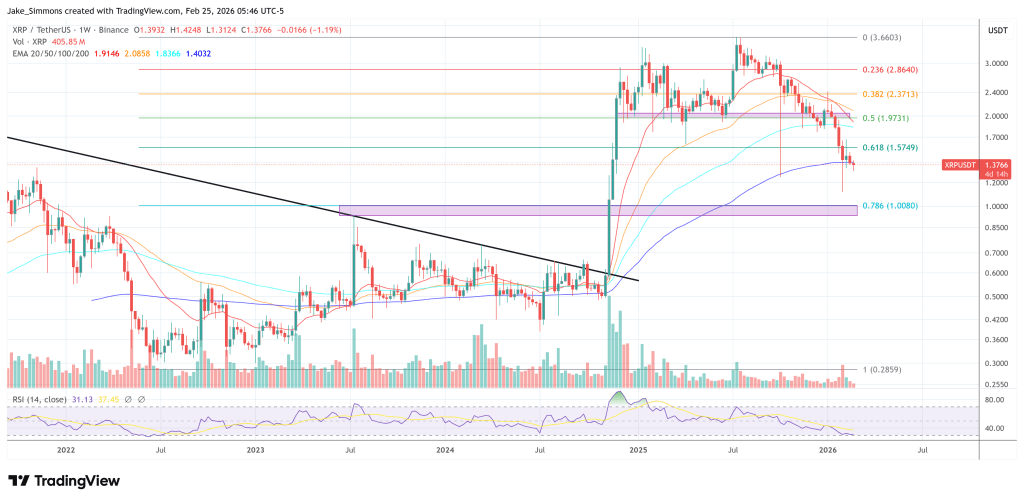
XRP trades below the 200-week EMA, 1-week chart | Source: XRPUSDT on TradingView.com

Domande pertinenti

QWhat was the main argument made by Justin Bons regarding the XRP Ledger's centralization?

AJustin Bons argued that the XRP Ledger's Unique Node List (UNL) structure makes validators 'permissioned' and gives Ripple-aligned entities 'absolute power & control over the chain'.

QHow did David Schwartz counter the claim that Ripple has 'absolute power' over the XRP Ledger?

ASchwartz called the claim 'objectively nonsensical,' explaining that validators cannot force a node to double-spend or censor transactions, and that dishonest validators are merely counted as one disagreeing vote by honest nodes.

QAccording to Schwartz, what is the real failure mode for the XRP Ledger, and how is it resolved?

ASchwartz described the failure mode as a liveness problem where validators could conspire to halt the chain, which is resolved by picking a new UNL, similar to how Bitcoin would require a new mining algorithm.

QWhat two reasons did Schwartz give for why the XRP Ledger needs a Unique Node List (UNL)?

ASchwartz stated the UNL is needed to prevent an attacker from spawning unlimited validators that force excessive work, and to prevent validators from not participating in a way that makes consensus impossible to measure.

QWhat was the key design intention behind the XRP Ledger's architecture, as explained by Schwartz?

ASchwartz stated that the XRP Ledger was 'carefully and intentionally designed' so that Ripple could not control it, even if they wanted to, to avoid being forced to comply with demands to censor and to protect the network's utility.

Letture associate

You Bet on the News, the Pros Read the Rules: The True Cognitive Gap in Losing Money on Polymarket

The article explains that the key to profiting on Polymarket, a prediction market platform, lies not just predicting real-world events correctly, but in meticulously understanding the specific rules that govern how each market will be resolved. It illustrates this with examples, such as a market on Venezuela's 2026 leader, where the official rules defining "officially holds" the office overruled the intuitive answer of who was in practical control. Other examples include debates over the definition of a "token" or what constitutes an "agreement." The core argument is that a "reality vs. rules" gap creates pricing discrepancies that savvy traders ("车头" or "whales") exploit. The platform has a formal dispute resolution process managed by UMA token holders to settle ambiguous outcomes. This process involves proposal submission, a challenge window, a discussion period, and a final vote. However, the article highlights a critical flaw in this system compared to a traditional court: the lack of separation between the arbiters (UMA voters) and the interested parties (traders with financial stakes in the outcome). This conflict of interest undermines the discussion phase, leads to herd mentality, and results in opaque final decisions without explanatory rulings. Consequently, the system lacks a body of precedent, making it difficult for users to learn from past disputes. The ultimate takeaway is that success on Polymarket requires a lawyer-like scrutiny of the rules to identify and capitalize on the cognitive gap between how events appear and how they are contractually defined for settlement.

marsbit13 min fa

You Bet on the News, the Pros Read the Rules: The True Cognitive Gap in Losing Money on Polymarket

marsbit13 min fa

Will the Fed Still Cut Interest Rates? Tonight's Data Is Crucial

The core debate surrounding the Federal Reserve's potential interest rate cuts is intensifying amid geopolitical conflict and rebounding inflation. The key question is whether high energy prices will cause persistent inflation or weaken consumer demand enough to force the Fed to cut rates. Citigroup presents a bullish case for cuts, arguing that oil supply disruptions from the Strait of Hormuz are temporary and will not lead to lasting inflationary pressure. They point to receding bond yields and oil prices as evidence the market is pricing in a short-lived shock. Citi's data also shows tightening financial conditions, a stabilizing labor market, and healthy tax returns, supporting their view that the path to lower rates remains open. Conversely, Deutsche Bank offers a starkly contrasting, more hawkish outlook. They argue the Fed's current policy is already neutral and expect rates to remain unchanged indefinitely. Their view is based on stalled disinflation progress and a shift toward more hawkish rhetoric from key Fed officials like Waller, who cited risks from prolonged Middle East conflict and tariffs. Other officials, including Williams and Hammack, signaled rates would likely stay on hold for a "considerable time." The market pricing has shifted dramatically, now forecasting zero cuts in 2026. The imminent release of the March retail sales "control group" data is highlighted as a critical test. This metric, which excludes gas station sales, will reveal if high gasoline prices are eroding consumer spending in other areas. A weak reading could support the case for imminent rate cuts, while a strong one would bolster the argument for the Fed to hold steady. This data is pivotal for determining the near-term policy path.

marsbit34 min fa

Will the Fed Still Cut Interest Rates? Tonight's Data Is Crucial

marsbit34 min fa

The Second Half of Macro Influencer Fu Peng's Career

Fu Peng, a prominent Chinese macroeconomist and former chief economist of Northeast Securities, has joined Hong Kong-based digital asset management firm Bitfire Group (formerly New Huo Group) as its chief economist. This move, announced in April 2026, triggered an 11% surge in Bitfire's stock price. Fu, known for his accessible macroeconomic commentary and large social media following, will focus on integrating digital assets into global asset allocation frameworks, particularly combining FICC (fixed income, currencies, and commodities) with cryptocurrencies for institutional clients. His career includes roles at Lehman Brothers and Solomon International, with significant influence gained through public communication. However, in late 2024, Fu faced temporary social media bans after a controversial private speech at HSBC on China's economic challenges, though he denied regulatory sanctions. He later left Northeast Securities citing health reasons. Bitfire, a licensed virtual asset manager serving high-net-worth clients, seeks to build trust and attract traditional capital through Fu’s expertise and credibility. The partnership represents a strategic shift for both: Fu enters the crypto sector after a traditional finance peak, while Bitfire aims to leverage his macro framework for institutional adoption. Outcomes remain uncertain regarding capital inflows and compatibility within corporate structure.

marsbit1 h fa

The Second Half of Macro Influencer Fu Peng's Career

marsbit1 h fa

Trading

Spot
Futures

Articoli Popolari

Cosa è XRP 2.0

XRP 2.0: Una Nuova Frontiera nel Paesaggio delle Criptovalute Introduzione a XRP 2.0 Nel mondo in continua evoluzione delle criptovalute, nuovi progetti emergono continuamente, cercando attenzione e adozione. Una tale iniziativa promettente è XRP 2.0, un nuovo progetto di criptovaluta progettato per sfruttare avanzate tecnologie blockchain e metodologie di crittografia robuste. Anche se il nome richiama alla mente l'XRP di Ripple, è fondamentale notare che XRP 2.0 opera in modo indipendente, concentrandosi sul miglioramento della sicurezza delle transazioni, della privacy e della scalabilità. Mentre il panorama finanziario digitale abbraccia sempre di più soluzioni decentralizzate, XRP 2.0 mira a contribuire in modo significativo al web3 e all'espansione generale dei progetti crypto. Cos'è XRP 2.0? Alla sua base, XRP 2.0 è un progetto di criptovaluta che mira a creare un ecosistema di valuta digitale sicuro e decentralizzato. La sua tecnologia fondamentale integra principi di blockchain sofisticati con tecniche di crittografia all'avanguardia. L'obiettivo principale di XRP 2.0 è quello di affermarsi come una piattaforma affidabile ed efficiente in grado di consentire un'esecuzione rapida delle transazioni, dando priorità a migliori protezioni della privacy per i suoi utenti. Il progetto è promosso come una soluzione a molte limitazioni affrontate dalle criptovalute esistenti, proponendo un sistema in grado di gestire un volume maggiore di transazioni con migliorata velocità e privacy. Questa versatilità pone XRP 2.0 come un significativo competitor in un mercato affollato di varie valute digitali. Chi è il Creatore di XRP 2.0? L'identità del creatore dietro XRP 2.0 è stata segnalata come 'Wilbur'. Tuttavia, i dettagli completi riguardanti Wilbur o l'entità associata rimangono sfuggenti. L'anonimato di molti creatori di criptovalute non è un fenomeno raro nel settore, spesso progettato per mantenere un certo grado di privacy e sicurezza. Chi sono gli Investitori di XRP 2.0? Al momento, informazioni specifiche relative alle fondazioni o organizzazioni di investimento a supporto di XRP 2.0 non sono disponibili pubblicamente. Nel settore delle criptovalute, il supporto di investitori rinomati può influenzare significativamente la credibilità e il successo di un progetto, tuttavia la trasparenza riguardo ai sostenitori finanziari di XRP 2.0 non è stata stabilita. Come Funziona XRP 2.0? XRP 2.0 si distingue per l'impiego di una combinazione di tecnologia blockchain e algoritmi di crittografia avanzati che garantiscono transazioni sicure e decentralizzate. La sua struttura innovativa include caratteristiche uniche progettate per promuovere il coinvolgimento degli utenti e ampliare le funzionalità oltre le transazioni convenzionali delle criptovalute. Tra queste caratteristiche, XRP 2.0 incorpora capacità alimentate da intelligenza artificiale, come funzionalità di testo in immagini e testo in voce. Queste aggiunte sono progettate per migliorare l'esperienza interattiva per gli utenti, promuovendo una maggiore applicabilità in vari settori. Unendo progressi tecnologici con design incentrati sugli utenti, XRP 2.0 mira a catturare l'attenzione di una vasta gamma di individui e aziende che cercano di integrare soluzioni di criptovaluta nei loro framework operativi. Cronologia di XRP 2.0 Comprendere XRP 2.0 richiede di esaminare i traguardi che hanno definito il suo percorso fino ad ora: 23 luglio 2023: XRP 2.0 viene introdotto come un nuovo progetto di criptovaluta, mirante a rivoluzionare le capacità di transazione sicura e decentralizzata nel dominio blockchain. 8 settembre 2023: Si verifica il lancio di un altro progetto, XRP20, marcando l'emergere di un token ERC-20 sulla blockchain di Ethereum che resta non correlato a XRP 2.0. 13 novembre 2023: Il ledger XRP subisce un significativo aggiornamento con il rilascio della versione 2.0.0 del software server rippled. È essenziale notare che questo sviluppo è scollegato dal progetto di criptovaluta XRP 2.0. Punti Chiave su XRP 2.0 Per distillare l'essenza di XRP 2.0, emergono diversi fattori critici: Caratteristiche Uniche: L'inclusione di funzionalità come il testo in immagini e testo in voce alimentato da intelligenza artificiale diversifica ulteriormente le potenziali applicazioni di XRP 2.0. Tecnologia Blockchain: Il framework utilizza meccanismi blockchain avanzati e protocolli di crittografia, garantendo un ambiente sicuro e decentralizzato per le transazioni. Scalabilità e Privacy: XRP 2.0 dà priorità a migliori protezioni della privacy nei processi di transazione e alla scalabilità necessaria per accogliere una base di utenti in crescita. Nessuna Affiliazione con Ripple: È importante notare che, nonostante il suo nome, XRP 2.0 non ha alcuna fedeltà o collaborazione con l'XRP di Ripple, distinguendo il proprio framework operativo e obiettivi all'interno dell'ecosistema delle criptovalute. Conclusione XRP 2.0 rappresenta un'ambiziosa venture nell'ambito delle criptovalute, mirante a offrire una combinazione di sicurezza, privacy ed efficienza nelle transazioni digitali. Integrando tecnologie sofisticate e caratteristiche user-friendly, il progetto si propone di ampliare gli orizzonti di ciò che le criptovalute possono realizzare nell'economia digitale odierna. Sebbene l'anonimato del suo creatore e la mancanza di investitori dichiarati possano sollevare domande per alcuni, il focus di XRP 2.0 su funzionalità avanzate e decentralizzazione ne amplifica l'appeal in un mercato crypto sempre più affollato. Man mano che il panorama delle criptovalute continua a evolversi, XRP 2.0 potrebbe emergere come un attore decisivo nell'espansione di soluzioni blockchain sicure e scalabili.

165 Totale visualizzazioniPubblicato il 2024.04.05Aggiornato il 2024.12.03

Cosa è XRP 2.0

Come comprare XRP

Benvenuto in HTX.com! Abbiamo reso l'acquisto di XRP (XRP) semplice e conveniente. Segui la nostra guida passo passo per intraprendere il tuo viaggio nel mondo delle criptovalute.Step 1: Crea il tuo Account HTXUsa la tua email o numero di telefono per registrarti il tuo account gratuito su HTX. Vivi un'esperienza facile e sblocca tutte le funzionalità,Crea il mio accountStep 2: Vai in Acquista crypto e seleziona il tuo metodo di pagamentoCarta di credito/debito: utilizza la tua Visa o Mastercard per acquistare immediatamente XRPXRP.Bilancio: Usa i fondi dal bilancio del tuo account HTX per fare trading senza problemi.Terze parti: abbiamo aggiunto metodi di pagamento molto utilizzati come Google Pay e Apple Pay per maggiore comodità.P2P: Fai trading direttamente con altri utenti HTX.Over-the-Counter (OTC): Offriamo servizi su misura e tassi di cambio competitivi per i trader.Step 3: Conserva XRP (XRP)Dopo aver acquistato XRP (XRP), conserva nel tuo account HTX. In alternativa, puoi inviare tramite trasferimento blockchain o scambiare per altre criptovalute.Step 4: Scambia XRP (XRP)Scambia facilmente XRP (XRP) nel mercato spot di HTX. Accedi al tuo account, seleziona la tua coppia di trading, esegui le tue operazioni e monitora in tempo reale. Offriamo un'esperienza user-friendly sia per chi ha appena iniziato che per i trader più esperti.

1.2k Totale visualizzazioniPubblicato il 2024.12.10Aggiornato il 2025.03.21

Come comprare XRP

Discussioni

Benvenuto nella Community HTX. Qui puoi rimanere informato sugli ultimi sviluppi della piattaforma e accedere ad approfondimenti esperti sul mercato. Le opinioni degli utenti sul prezzo di XRP XRP sono presentate come di seguito.

活动图片