Reserve transparency built through continuous operation: Matrixdock marks two years of independent verification

cointelegraphPubblicato 2026-07-27Pubblicato ultima volta 2026-07-27

Introduzione

Matrixdock has completed its fourth consecutive semi-annual independent reserve audit with Bureau Veritas, marking two years of continuous verification. For the first time, the audit expanded beyond its tokenized gold product (XAUm) to include its new tokenized silver product (XAGm). Bureau Veritas physically verified 508 gold bars and 66 silver bars across three vaults, confirming the reserves match the circulating token supplies with no discrepancies. The audit reinforces Matrixdock's commitment to building a "Reserve Transparency Stack" through layers of ongoing verification, including monthly statements and on-chain tools, to establish long-term trust for its tokenized precious metals as foundational reserve assets in on-chain finance.

July 21, 2026Matrixdock has completed its fourth consecutive semi-annual independent reserve audit with Bureau Veritas. For the first time, the audit extends beyond Matrixdock’s tokenized gold product (XAUm) to include its tokenized silver product (XAGm). More than another audit milestone, this reflects Matrixdock’s broader commitment: building reserve assets that institutions, ecosystem partners, and builders can use with confidence.

Two years of continuous verification. One operating standard.

By completing two years of reserve audits with the same independent auditor, Matrixdock has established a consistent verification process. That continuity gives Bureau Veritas a deeper understanding of Matrixdock’s reserve structure and positions them to better identify inconsistencies should they arise. Recurring audits are a form of proof: a verification process that operates consistently over time.
As tokenized assets become increasingly integrated into financial infrastructure, long-term trust is built through continuous operation.

The reserve transparency stack

Reserve transparency at Matrixdock is built in layers of verification that together give holders ongoing visibility into the assets backing each token. Matrixdock calls this the Reserve Transparency Stack.

Independent verification: Inside the July audit

Bureau Veritas physically verified the underlying precious metal reserves, confirming that reserve holdings remain consistent with Matrixdock’s records.

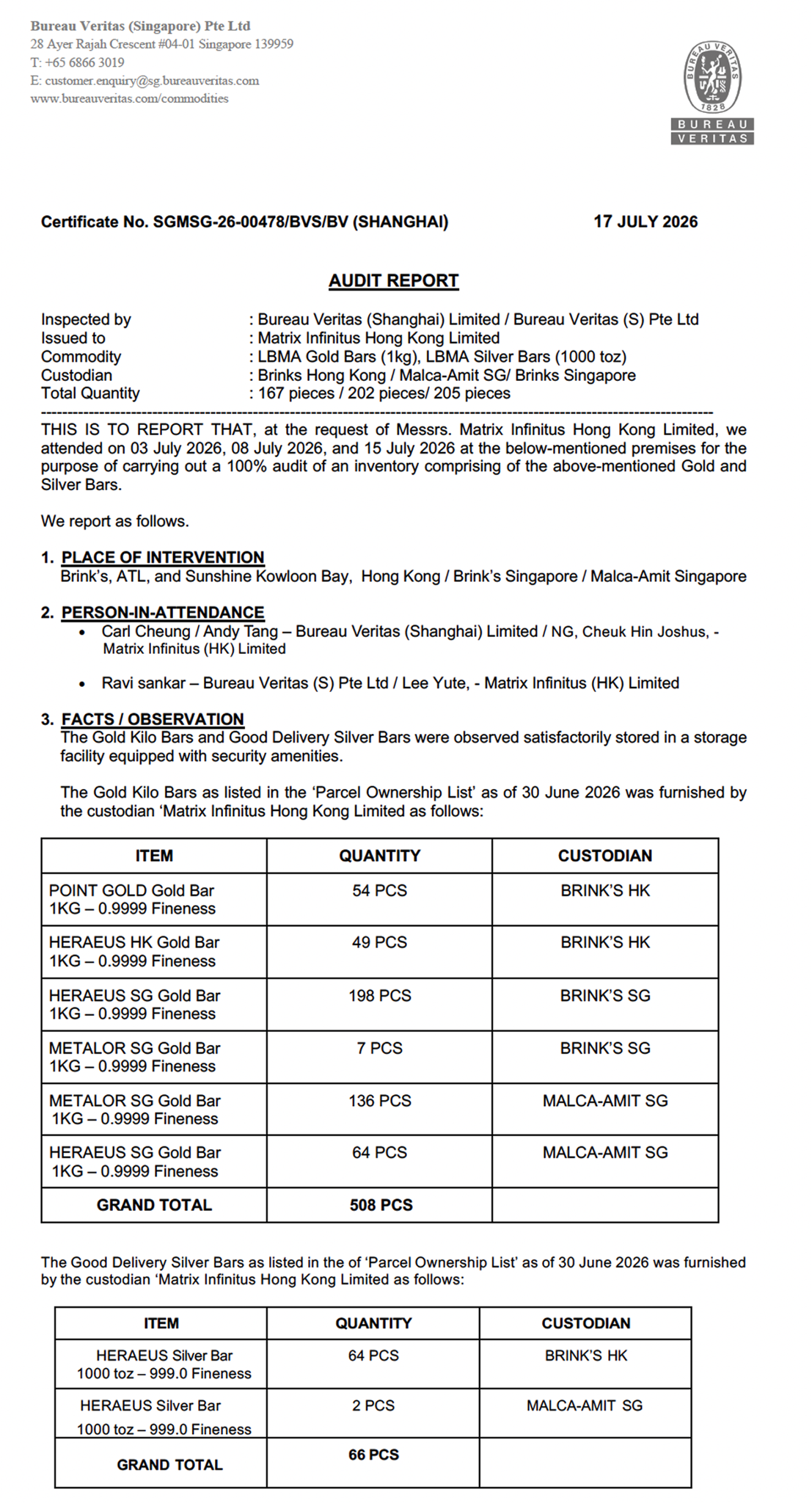
As in previous audit cycles, the inspection was conducted bar by bar covering 574 gold and silver bars from LBMA-accredited refiners across three institutional vault facilities:

  • Malca-Amit Singapore (conducted on 3 July 2026)
  • Brink’s Hong Kong (conducted on 8 July 2026)
  • Brink’s Singapore (conducted on 15 July 2026)

Each bar was individually weighed and measured. 26 gold bars have been added since the H2 2025 audit, and 66 silver bars are included for the first time this cycle.
Gold (XAUm)

  • Total gold audited: 508 bars
  • Equivalent weight: 16331.184 troy ounces
  • XAUm circulating supply: 16331.179 tokens
    • EVM chains (Dune): 11242.657 tokens
    • Sui network (Suiscan): 2677.413 tokens
    • Solana network (Solscan): 1575.248 tokens
    • Stellar network (Stellar expert): 771.552 tokens
  • Approximate market value: USD $66.09 million, based on gold at $4,046.86 per troy ounce

Silver (XAGm) - new to this audit

  • Total silver audited: 66 bars
  • Equivalent weight: 65,934.000 troy ounces
  • XAGm circulating supply: 65998.551 tokens
    • Ethereum network (Etherscan): 33004.219 tokens
    • Sui network (Suiscan): 32990 tokens
  • Current ozPerToken value: 0.999021918
  • Approximate market value: USD $4.04 million, based on silver at $61.24 per troy ounce

Each bar was reconciled against the relevant vault records with no discrepancies identified. As of the audit date, XAUm reserves were consistent with the circulating token supply, and XAGm reserves were consistent with the circulating token supply when applying the applicable ozPerToken value.

Ongoing transparency

A semi-annual reserve audit is one layer of verification. Between audits, holders can check monthly reserve asset statements, on-chain proof-of-reserves for the precious metals products, and the Gold Allocation Lookup tool, which maps specific gold bars to tokens so holders can verify the backing directly. Together, these provide a running record rather than periodic snapshots.

Building the Reserve Layer requires continuous improvement. Looking ahead, Matrixdock is evaluating opportunities to work with global third-party service providers that could strengthen asset-level verification for off-chain reserves while preserving client-level privacy.

Continuous transparency as the reserve layer discipline

Reserve transparency is the foundation that makes reserve assets trusted enough to participate confidently across on-chain finance.

When reserve backing can be verified at any time, a reserve asset can move deeper into on-chain finance: held in treasuries, integrated into financial applications, and used as collateral in lending markets. By reducing uncertainty around backing, verification expands what a reserve asset can do. That is why reserve transparency is a product feature at Matrixdock.

This is the work of building the Reserve Layer for on-chain finance. As tokenized assets evolve from simple representations into financial infrastructure, their quality will be defined by how well their backing holds up to verification, cycle after cycle. The fourth consecutive semi-annual reserve audit reflects Matrixdock’s long-term commitment to building the Reserve Layer.

Read the full Bureau Veritas audit report here.

Domande pertinenti

QWhat is the significance of Matrixdock completing its fourth consecutive semi-annual audit with Bureau Veritas in July 2026?

AIt marks two years of continuous independent verification, establishing a consistent audit process and demonstrating a long-term commitment to reserve transparency. It is also the first audit to include Matrixdock's tokenized silver product (XAGm), expanding the scope of verified assets.

QWhat did Bureau Veritas verify during the July 2026 audit, and how was the verification conducted?

ABureau Veritas physically verified the underlying gold and silver reserves, bar by bar, across three institutional vault facilities in Singapore and Hong Kong. They confirmed the holdings matched Matrixdock's records by individually weighing and measuring 574 gold and silver bars from LBMA-accredited refiners.

QWhat are the key statistics for the audited gold reserves (XAUm) as of the July 2026 audit?

AThe audit covered 508 gold bars, equivalent to 16,331.184 troy ounces, backing a circulating supply of 16,331.179 XAUm tokens. The reserves had an approximate market value of USD $66.09 million based on a gold price of $4,046.86 per troy ounce.

QWhat new product was included in this audit cycle for the first time, and what were its key metrics?

AMatrixdock's tokenized silver product (XAGm) was included for the first time. The audit covered 66 silver bars (65,934.000 troy ounces), backing a circulating supply of 65,998.551 XAGm tokens. The reserves had an approximate market value of USD $4.04 million based on a silver price of $61.24 per troy ounce, with an ozPerToken value of 0.999021918.

QBesides the semi-annual audit, what other tools does Matrixdock provide for ongoing reserve transparency?

AMatrixdock provides a layered 'Reserve Transparency Stack' which includes monthly reserve asset statements, on-chain proof-of-reserves for precious metals products, and the Gold Allocation Lookup tool. These tools allow holders to verify asset backing between audit cycles, offering a continuous record rather than periodic snapshots.

Letture associate

ChangXin's Debut: The Missed 50 Billion Yuan by Country Garden, and the Handover of an Era

On July 27, 2026, Changxin Memory Technologies (CXMT) debuted on the STAR Market, its share price surging 471.59%. With a market cap exceeding ICBC, it became China’s most valuable A-share company, highlighting a dramatic technological and economic shift. In 2021, at the peak of China's real estate boom, developer Country Garden invested 2 billion yuan (20 billion) for a 1.56% stake in the fledgling chipmaker through its venture capital arm. The investment was strategic; CXMT represented a crucial "chain-blocker" in China's semiconductor supply chain. Country Garden’s unique "perpetual capital" model allowed for long-term bets on hard tech, from space rockets to memory chips. However, the property sector’s severe downturn forced Country Garden's hand. Facing immense liquidity pressure to fund construction and deliver pre-sold homes, it sold its entire CXMT stake back to Hefei's state-owned capital for the original 2 billion yuan in December 2024. By the IPO date, that stake was worth roughly 50 billion yuan, a 500 billion opportunity lost. This story encapsulates a pivotal transition. Money accumulated during the property boom was redirected to seed next-generation industries like semiconductors. Yet the old cycle collapsed faster than the new one could mature. While Country Garden accurately foresaw the strategic importance of chip manufacturing, it ultimately misjudged how long its own capital could wait, becoming a poignant symbol of an era's handover from bricks and mortar to silicon and innovation.

marsbit39 min fa

ChangXin's Debut: The Missed 50 Billion Yuan by Country Garden, and the Handover of an Era

marsbit39 min fa

Why Can't Kimi Go to a Nightclub to Celebrate Success?

"Why Can't Kimi Go to a Nightclub to Celebrate Success?" The article discusses the controversy surrounding the Chinese AI company Kimi's decision to hold a celebration at a Beijing nightclub after the successful release of its K3 model. While the event drew criticism on social media for being "flashy" and a sign of losing focus, the author argues this reflects a double standard. The piece contrasts the reaction to Kimi with the perception of similar celebrations by Silicon Valley tech companies. In the U.S., such events are often seen as symbols of ambition and a vibrant culture. The author suggests a "Silicon Valley worship" exists, where Western tech elites are granted the freedom to define success and lifestyle, while Chinese companies face constant scrutiny and must prove their worthiness beyond just technical achievements. Furthermore, the article critiques a deep-rooted "moralism of hardship" in Chinese culture, where success is expected to be earned through visible struggle and austerity, especially for scientists and innovators. Figures like mathematician Wang Hong, who presents an elegant and stylish image, challenge the stereotypical expectation of the disheveled, ascetic academic. The core argument is that Kimi's nightclub celebration itself proves nothing about the company's long-term viability or technical prowess. The backlash, however, reveals unrealistic expectations for Chinese tech firms: to simultaneously embody the disruptive energy of Silicon Valley while maintaining the humble demeanor of a perpetual underdog. The author concludes that a mature tech culture should allow Chinese talent to experience and express the joy of their achievements without judgment.

marsbit1 h fa

Why Can't Kimi Go to a Nightclub to Celebrate Success?

marsbit1 h fa

Trading

Spot
活动图片