Report Review: Kyber Delay Tear NVIDIA Supply Chain, Only a Few Winners in the PCB Chain

marsbitPubblicato 2026-06-23Pubblicato ultima volta 2026-06-23

Introduzione

Research Report Analysis: Kyber's Delay Reshapes NVIDIA Supply Chain, Winners Limited in PCB Sector Jefferies maintained a Buy rating on NVIDIA with a $300 price target (42% upside), but delivered a surprising take on the AI server PCB supply chain. The key finding is that the high-density orthogonal backplane PCB, codenamed "Kyber," is likely delayed to 2028 or even canceled. This prompts a downward revision in the global AI PCB market forecast for 2027/2028 by 5% and 11%, respectively, with CCL (copper-clad laminate) forecasts cut by 8% and 16%. While Kyber's postponement extends the lifecycle of the current Oberon architecture and defers some PCB volume, it does not halt the trend towards higher specifications. Migration to advanced materials like M9/M10-grade CCL and PTFE processes continues. The delay reshuffles the winners' list: upstream material suppliers (glass fabric, CCL) benefit from persistent tight supply and strong pricing power. Copper cable vendors gain a reprieve as the threat from PCB-based interconnects recedes. PCB manufacturers, however, face intensified competition, with mid-tier players most vulnerable to being squeezed out. The report stresses that the market adjustment reflects a timing shift, not a demand destruction. Kyber-related orders are deferred, not canceled. NVIDIA's core GPU competitiveness and the AI server growth trajectory remain intact. The analyst's investment thesis prioritizes "high-value-add" and "supply-constrained" segments: up...

Author:Rita

Trend Highlights

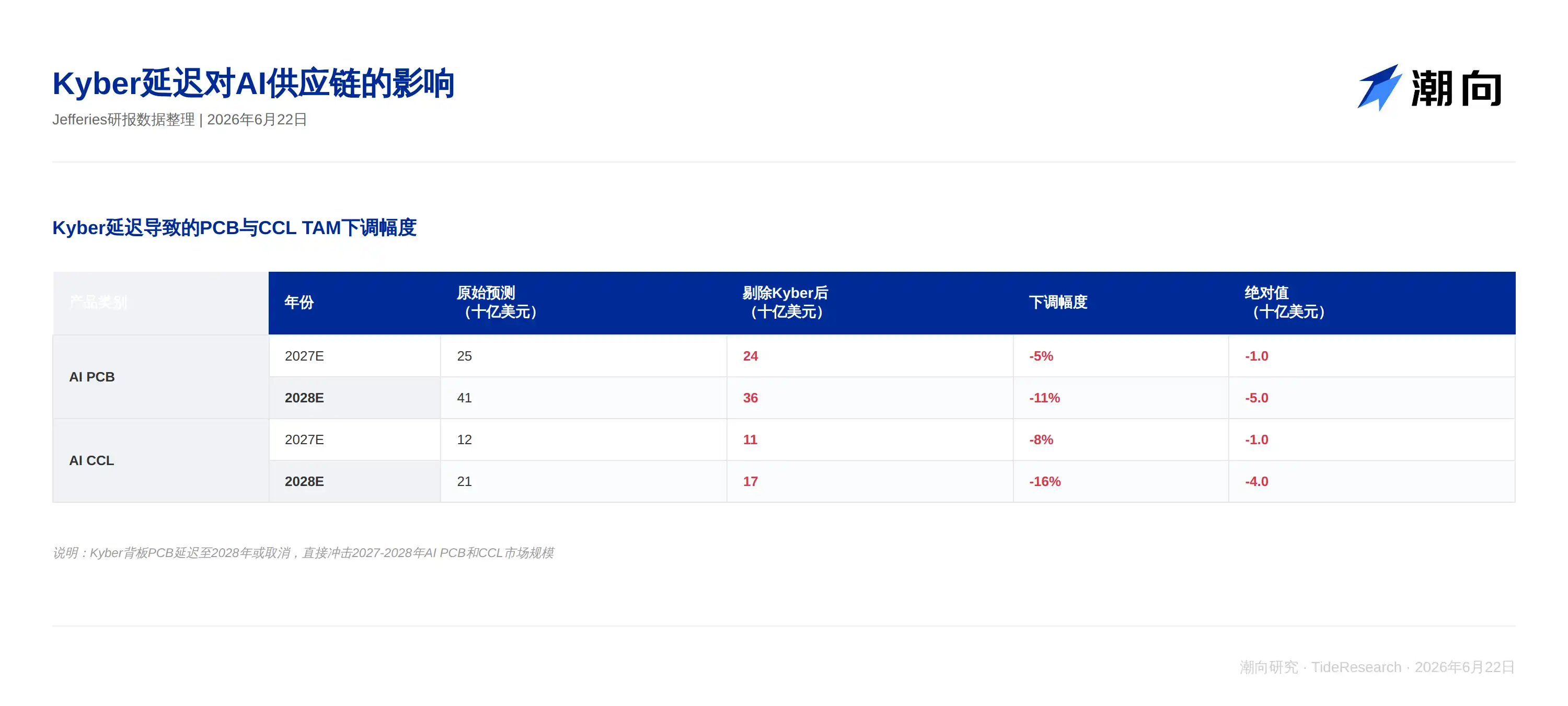
Jefferies issued a research report on NVIDIA on June 22, maintaining a Buy rating and raising the target price to $300 (implying a 42% upside from the current $210.69). The core view is surprising: while bullish on NVIDIA, it pours cold water on the AI server PCB supply chain. The backplane PCB product Kyber is highly likely to be delayed until 2028 or even canceled entirely, leading to a downward revision of the global AI PCB market size by 5% and 11% for 2027/2028 respectively, and the CCL (Copper Clad Laminate) market by 8% and 16% respectively. This adjustment might seem like bad news, but it is reshaping the list of winners in the AI server supply chain.

What the Kyber Delay Means

Jefferies believes the Kyber delay is essentially confirmed. Rubin Ultra was originally planned to use orthogonal backplane PCB (Kyber architecture), but due to bottlenecks in intra-rack connectivity technology, the Oberon architecture will still be used in 2027. Kyber is postponed to 2028 at the earliest, and could be canceled in the worst-case scenario. This change directly impacts the PCB iteration timeline.

However, delay does not mean regression. Switch boards and midplane boards continue to migrate towards high-end materials, with M9/10 grade CCL and PTFE processes becoming industry standards. CoWoP (Chip-on-Wafer-on-Substrate interconnect technology) penetration will begin earliest in 2027. The trend of rising unit value remains unchanged, only the timeframe has been extended.

Therefore, the biggest winners of this delay are not in manufacturing, but upstream. Upstream material suppliers like glass fiber cloth and CCL are already facing tight supply, with strong ability for sustained price increases and cost pass-through. PCB manufacturers face more direct pressure from order contraction. Copper cable suppliers benefit from the extended lifecycle of Oberon, reducing the risk of being replaced by PCB.

Why Focus on Specs, Not Just TAM

On the surface, the Kyber postponement led to significant downward revisions of the AI PCB and CCL market size estimates. But looking closely, this adjustment reflects a reshuffling of the pace of specification upgrades, not a disappearance of demand.

From the data, the original global AI PCB market expectation for 2027 was $25 billion; after excluding Kyber it's $24 billion, a 5% decrease. This is not a "shrinkage" but a "rescheduling." Kyber's order volume won't vanish; it will simply shift from 2027 to 2028. During this shift, the order volume left in 2027 will be used for Oberon upgrades, actually raising the specification standards.

This means the value per PCB doesn't change linearly. Lower-end products are revised down, higher-end products revised up. Within this mixed structure, there is room for total value recombination. Those who will profit are players positioned in high-end specifications and upstream materials, while manufacturers relying entirely on low-end capacity expansion will passively bear the pressure.
Supply Chain Divergence: Who's Out, Who's In the Inner Circle

The most direct impact of the Kyber delay is the acceleration of the elimination race in the PCB industry. Mid-tier manufacturers face the greatest pressure. High-end players have technical depth and customer stickiness, enabling them to follow NVIDIA's upgrade rhythm for spec iterations; low-end capacity has cost advantages, allowing them to quickly follow basic demand. But manufacturers stuck in the middle, unable to handle high-end complexity nor compete on cost, will be squeezed out.

Upstream material suppliers see structural opportunities. Glass fiber cloth and CCL suppliers face industry-wide demand. Kyber's cancellation won't reduce demand for glass fiber and CCL; it will only change the structure. The tight supply situation won't ease in the short term, with pricing power in the hands of material suppliers.

Copper cable suppliers gain a "reprieve" from the Kyber delay. Before Kyber's launch, copper cables faced the risk of gradual replacement by high-speed PCB interconnects. The extended lifecycle of the Oberon architecture means copper cables remain useful.

Why NVIDIA is Still Worth $300

Although Jefferies revised down the TAM expectations for PCB and CCL, it is not pessimistic about NVIDIA's prospects. The Kyber delay does not affect NVIDIA's core GPU competitiveness, nor does it change the growth trajectory of AI server shipments.

Kyber aims to further optimize rack efficiency in 2028 and beyond. Its delay means NVIDIA has one less innovation story for 2027, but it doesn't mean chip sales in 2027 will decline. Specification upgrades (M9/10, CoWoP) are still progressing as planned, and the unit value of AI servers continues to rise.

From a financial perspective, the CY28E NVIDIA EPS estimate is $14.14, leading to a $300 target price based on a 21x P/E ratio. This valuation level considers the certainty of long-term AI demand, not the timeline of a specific product generation.

What the Analysts are Betting On

Jefferies' final judgment points to: Upstream Materials > NVIDIA > Copper Cables > PCB Downstream.

They are bullish on the "high value-added end" and "supply bottleneck end" of the AI industry chain. GPU chips, as the core computing resource, have the highest value and most certain demand. Upstream materials are the bottleneck; scarcity determines premium. Copper cables get breathing room due to the delay. PCB manufacturing is most adversely affected because it is neither the bottleneck nor the core competency, just an executor.

This delay in PCB specification upgrades is not bad news, but a process of realignment. After the realignment, the profitability of players inside the inner circle and those positioned correctly will be higher, while those waiting on the sidelines will be left out.
Disclaimer

This article is a third-party brokerage research report summary and interpretation by Trend Research. The ratings, target prices, earnings forecasts, and related judgments cited are the views of that brokerage's analysts, representing only the position of their affiliated institution. They do not represent the views of Trend Research, nor constitute any investment advice.

Please note three points while reading: First, target prices are analysts' expectations for the next approximately 12 months, representing forecasts not promises, and are subject to frequent adjustments based on performance and market conditions. Second, sell-side research reports are inherently biased towards bullishness, and some covered companies may have investment banking relationships with the brokerage. Third, the value of a research report lies in its mainline logic and its underlying assumptions, not just a specific target price. Focus on the logic, not just the price.

The market carries risks; decisions should be made independently. This article should not serve as the basis for trading any securities.

Data Sources: Jefferies Research Report (Jacky He et al., June 22, 2026) · Prismark · NVIDIA Public Financial Reports

Tide Research · TideResearch · June 2026

Domande pertinenti

QAccording to the report, what is the main impact of Kyber's potential delay or cancellation on the AI server PCB supply chain?

AThe main impact is a reshuffling of winners and losers in the supply chain. While the total market size for AI PCBs and CCL is revised down slightly (5% in 2027, 11% in 2028), the delay acts as a catalyst for industry consolidation. It accelerates the淘汰赛 for mid-tier PCB manufacturers who lack the technical depth for high-end规格 or the cost advantage for low-end products. The primary beneficiaries shift upstream to material suppliers (like glass fiber cloth and CCL providers) and also to copper cable makers, who get a reprieve from potential replacement by PCBs.

QWhy does the Jefferies report maintain a bullish $300 target price for NVIDIA despite the negative implications for the PCB segment?

AJefferies maintains a bullish outlook on NVIDIA because Kyber's delay does not impact NVIDIA's core GPU competitiveness or the overall growth trajectory of AI server shipments. The delay only affects a specific interconnect architecture for future rack efficiency, not the fundamental demand for NVIDIA's AI chips. The analyst's $300 target price is based on long-term AI demand certainty and CY28E EPS expectations of $14.14, applying a 21x P/E ratio. The valuation focuses on NVIDIA's position as the highest-value component in the AI supply chain, which remains unchanged.

QWhat are the key structural opportunities identified for upstream material suppliers due to the Kyber schedule change?

AThe report identifies significant structural opportunities for upstream material suppliers, particularly glass fiber cloth and Copper Clad Laminate (CCL) providers. Their advantage stems from persistent supply tightness in these materials, which grants them strong pricing power and the ability to pass on costs. The demand for these materials is industry-wide and not fundamentally reduced by Kyber's delay; it merely shifts in规格 mix. Therefore, they occupy a bottleneck position in the supply chain with inherent scarcity value.

QHow does the 'delay' of Kyber affect the value proposition of individual PCBs versus the total market size (TAM)?

AThe delay affects the timing and规格 mix more than the ultimate value proposition. While the Total Addressable Market (TAM) numbers are revised down for 2027/2028, this represents a timing shift ('错期'), not a disappearance of demand. Crucially, the average value per PCB may not decline linearly because the orders originally intended for Kyber in 2027 are now allocated to upgrading the Oberon architecture (e.g., adopting M9/10 grade CCL and PTFE processes). This means a re-composition where high-end PCB规格 gain a larger share, benefiting companies positioned in that segment, even within a temporarily adjusted TAM.

QAccording to the analyst's final judgment, how does the report rank the relative attractiveness of different segments in the AI supply chain affected by this news?

AThe analyst's final judgment ranks the relative attractiveness as follows: 1. Upstream Materials (highest) - Due to supply bottleneck and pricing power. 2. NVIDIA (GPU) - Due to its core, high-value position in AI compute. 3. Copper Cable Makers - Benefiting from a prolonged lifecycle of the Oberon architecture, reducing near-term replacement risk. 4. PCB Downstream Manufacturers (lowest) - Facing the most direct pressure from order adjustments and lacking the定价权 or technological moat of the other segments.

Letture associate

Manufacturing's Share Drops Below 25%: Is Hangzhou Unconcerned?

Hangzhou is entering a critical phase of industrial restructuring. While its manufacturing-to-GDP ratio has fallen below 25%, the city is not alarmed. Instead, it is strategically navigating a dual focus: advancing advanced manufacturing and expanding its service sector, particularly producer services. Recently, the city celebrated the IPO of a humanoid robotics company, seen as a milestone in moving beyond its e-commerce era. Simultaneously, it set an ambitious target for its service sector: to exceed 2 trillion yuan in value by 2030, with producer services making up over 60%. Data shows a clear trend: the service sector's share of GDP has risen to 75.3%, while manufacturing's share has declined to around 20.1%. This shift revives the debate on whether a strong service sector weakens a city's manufacturing "foundation." Hangzhou's approach challenges the notion of a fixed manufacturing "red line" near 25%. The city argues that the quality and integration of industries matter more than simple ratios. Its strategy is "using software to drive hardware," leveraging its core strengths in digital economy and producer services—like R&D, software, and supply chain management—to empower and add value to manufacturing. This is embodied by its emerging "AI era" companies, whose innovation in Hangzhou feeds into national industrial chains. The city believes that for a hub like Hangzhou, the key is not merely boosting visible manufacturing output, but strengthening the "invisible" competitive edge provided by high-end producer services, which ultimately determine manufacturing profitability. National policy is also shifting from insisting on a "stable" manufacturing share to acknowledging a "reasonable" range, allowing for quality-focused development. Hangzhou's future industrial blueprint aims for a manufacturing share above 22% of GDP by 2027, coupled with a dominant, high-value service sector. The goal is not to choose between manufacturing and services, but to deeply integrate them, using advanced services as the accelerator for next-generation manufacturing.

marsbit5 min fa

Manufacturing's Share Drops Below 25%: Is Hangzhou Unconcerned?

marsbit5 min fa

SEC Suddenly Proposes "Regulation Crypto": U.S. Token Fundraising May Become Legal Again

On August 18, the U.S. Securities and Exchange Commission (SEC) proposed a landmark set of permanent rules, "Regulation Crypto Assets," specifically designed for crypto asset investment contracts. The 402-page proposal introduces two registration exemption paths and a groundbreaking safe harbor mechanism, representing the SEC's first dedicated crypto-specific regulatory framework. Two exemption tiers are proposed: a "Startup Exemption" allowing a one-time raise of up to $5 million within four years with basic disclosure requirements, and a "Financing Exemption" permitting raises of up to $75 million every 12 months with stricter obligations, including financial statements and ongoing reporting. Both paths require "principles-based narrative disclosure," a flexible approach distinct from traditional IPO forms. The most transformative element is the investment contract safe harbor. It provides a legal path for tokens to "graduate" from being classified as securities. If an issuer completes or permanently ceases its "essential managerial efforts" as promised in the investment contract and meets specific conditions, it can file with the SEC to have the token exit the securities framework. This creates a novel legal lifecycle where a token can begin as a regulated security for fundraising and later become a non-security asset as the network decentralizes. This move is seen as the SEC pragmatically filling a legislative vacuum, as the stalled CLARITY Act in Congress faces significant delays. The proposal aims to offer a compliant pathway for token offerings within the U.S., countering the trend of projects moving overseas. While currently a proposal open for a 60-day public comment period, it signals a major potential shift from an enforcement-heavy approach toward establishing clearer rules for the crypto industry.

marsbit9 min fa

SEC Suddenly Proposes "Regulation Crypto": U.S. Token Fundraising May Become Legal Again

marsbit9 min fa

Late Qing County Magistrates' 'Official Debt' and the Crypto World's 'Exchange Listings': The Cross-Temporal Truth of Financializing Power

This article draws parallels between financialization of power in late Qing Dynasty China and the modern cryptocurrency industry. It opens with a staggering contemporary corruption case involving billions, illustrating how official positions control massive cash flows, akin to toll booths. The core analysis focuses on Du Fengzhi, a late Qing county magistrate. His 22-year journey from passing the provincial exam to finally obtaining a post highlights how bureaucratic "qualification" (like a VC investment) doesn't guarantee immediate benefit. Crucially, upon receiving his appointment, Du had to borrow heavily—"official debt"—to cover travel and networking costs to actually assume his position. Lenders, seeing his future post as a revenue-generating asset, offered loans with exorbitant effective interest rates (e.g., borrowing 4000 taels but receiving only 2000), effectively discounting and financializing his future power. Once in office, Du faced immense pressure from both public tax quotas and his crippling private debt. His diaries reveal aggressive, sometimes extreme, tax collection methods (sealing ancestral temples, pressuring local gentry) to meet these demands. The article argues this created a system where public duty and private financial survival became indistinguishable, with corruption evolving from operational necessity to normalized practice. The piece consistently analogizes this to crypto: VC funding as mere "qualification," the costly "listing" process on exchanges, the role of market makers and KOLs as intermediaries akin to local gentry, and the relentless pressure on funded projects to deliver returns—often leading to perpetual pivots, artificial metrics, and ultimately, the extraction of value from retail liquidity. Both systems, it concludes, are driven by the financialization of future potential, trapping individuals in cycles of debt and obligation with limited alternatives for upward mobility.

marsbit16 min fa

Late Qing County Magistrates' 'Official Debt' and the Crypto World's 'Exchange Listings': The Cross-Temporal Truth of Financializing Power

marsbit16 min fa

U.S. Stock Market Trends (August 19th): AI Hardware Rally Loosens, Long-Term Bond Yields Challenge Tech Valuations

U.S. stocks weakened further on Tuesday, with major indices hitting two-week lows for a third consecutive session. Pressure centered on the AI hardware sector, as the previously rebounding Philadelphia Semiconductor Index fell sharply. Meanwhile, persistently high long-term Treasury yields and rising oil prices fueled by Middle East tensions prompted a cautious reassessment of high-valuation tech assets. Key closing data: The S&P 500 fell 0.69%, the Dow Jones dropped 0.22%, and the Nasdaq declined 1.33%. The 10-year Treasury yield hovered near 4.70%, while the 30-year yield briefly touched a new high since 2007 before settling around 5.28%. WTI crude rose to $84.94. The chip sector led the decline, with the Philadelphia Semiconductor Index dropping about 5%. Losses spread across memory, optical communication, and AI infrastructure stocks. This shift indicates investor focus is moving from chasing AI demand momentum to evaluating valuations and earnings timing. The "Magnificent Seven" stocks showed mixed performance, with pressure more concentrated on AI hardware than software giants. The market is observing whether capital will rotate back to large-cap tech, sustaining the internal AI sector rotation, or if the broader AI trade is entering a cooling phase. Chinese stocks were mostly weaker, with the Nasdaq Golden Dragon China Index down about 1%. Baidu's stock fell sharply post-earnings due to profit pressure from AI investments, while Alibaba gained. Persistently high long-term bond yields and rising oil prices are re-emerging as key anchors for U.S. stock pricing, constraining valuation multiples for AI-related companies. Corporate events, including earnings from Home Depot and AI financing news like Anthropic's reported credit line expansion, continue to highlight cost and capital expenditure pressures. Focus for the coming sessions: 1) Whether the 30-year Treasury yield stabilizes below 5.30%, and 2) The market's ability to absorb the chip sector sell-off, determining if it's a pre-earnings consolidation or the start of a broader AI hardware cool-down.

marsbit21 min fa

U.S. Stock Market Trends (August 19th): AI Hardware Rally Loosens, Long-Term Bond Yields Challenge Tech Valuations

marsbit21 min fa

Galaxy Research: Crypto Lending Contracts for Third Consecutive Quarter, Market Undergoing Orderly Deleveraging

**Galaxy Research Report: Crypto Lending Market Sees Orderly Deleveraging for Third Consecutive Quarter** The crypto asset-backed lending market contracted for a third consecutive quarter in Q2 2026, shrinking by $11.33B (-16.78%) to a total of $56.16B. This represents a 40.13% decline from the Q3 2025 peak. The process is marked by a controlled, "stair-step" decline rather than the sharp, cascading collapses seen in 2022, suggesting a healthier, more orderly deleveraging driven by market retrenchment rather than forced liquidations. Key findings include: * **CeFi vs. DeFi:** Centralized Finance (CeFi) lending ($22.98B) surpassed Decentralized Finance (DeFi) lending ($20.43B) for the first time since Q3 2023, as DeFi loan volumes fell 27.61% quarter-over-quarter. * **Market Leaders:** Tether remains the dominant CeFi lender, holding 58.54% market share. CeFi's top three players (Tether, Maple, Nexo) control nearly 75% of that segment. * **Corporate Debt:** Debt used by companies for digital asset treasury strategies declined by $1.5B to $16.1B, mainly due to a debt buyback by MicroStrategy. * **Rates & Leverage:** Stablecoin borrowing costs edged higher. Analysis of Aave V3 shows e-mode loans, primarily used for leveraged Ethereum staking strategies, carry significantly higher risk (debt-weighted avg. Health Factor ~1.06) compared to standard loans. * **Futures:** Aggregate futures open interest (OI) was relatively stable, down only 3.08% to $103.2B at quarter-end, though it has since rebounded. BTC and ETH futures OI together comprised 65% of the total. In conclusion, the crypto market continues to shed leverage in a measured manner. If this trend persists, the market may avoid the type of disorderly, cascading failures seen in the last cycle, even if lending activity continues to contract.

marsbit41 min fa

Galaxy Research: Crypto Lending Contracts for Third Consecutive Quarter, Market Undergoing Orderly Deleveraging

marsbit41 min fa

Trading

Spot
活动图片