Lumentum Revenue Crosses $1 Billion, Where Does the $7.1 Billion Loss Come From?

marsbitPubblicato 2026-08-12Pubblicato ultima volta 2026-08-12

Introduzione

Lumentum's Q4 FY26 revenue surpassed $1 billion for the first time, marking the eighth consecutive quarter of growth, driven primarily by demand from AI data centers for higher-speed optical interconnects. Revenue grew 109.3% year-over-year, with a strong outlook for the next quarter. The growth is broad-based. The Systems segment (including cloud transceiver modules and optical circuit switches) grew 122.6%, while the Components segment (laser chips, sub-assemblies) grew 102.7%. Non-GAAP gross and operating margins expanded significantly to 50.4% and 36.6%, respectively, indicating improving operational efficiency and product mix. However, the company reported a massive GAAP net loss of $7.162 billion. This was primarily due to a one-time, non-cash $7.757 billion debt extinguishment loss related to the settlement of convertible notes with common stock. Excluding this and other non-cash items, non-GAAP net income was $326 million. The report thus presents two narratives: strong operational growth fueled by AI infrastructure demand, and a significant accounting loss from financial restructuring unrelated to core business performance.

On August 11th, US-based optical communications and photonics components manufacturer Lumentum announced its financial results for the fourth quarter and full fiscal year 2026, ended June 27th. Quarterly revenue surpassed $1 billion for the first time. According to the company's earnings announcement, AI data centers are driving demand for higher-speed, higher-bandwidth connections into the optical link.

Within the same report, there is a figure hard to miss. The company recorded a GAAP net loss of $7.162 billion, almost overshadowing the entire operational narrative of this earnings report. According to the company's announcement, the primary reason is a one-time, non-cash loss on debt extinguishment recognized upon settling a portion of convertible notes with common stock.

Reading this report solely as "AI optical communications surged again" would miss the latter half of the story. It simultaneously lays out three things: how optical interconnect demand translates into revenue, why profitability expanded faster as scale grew, and where exactly that massive GAAP loss was booked.

How Long Has This Revenue Trajectory Lasted?
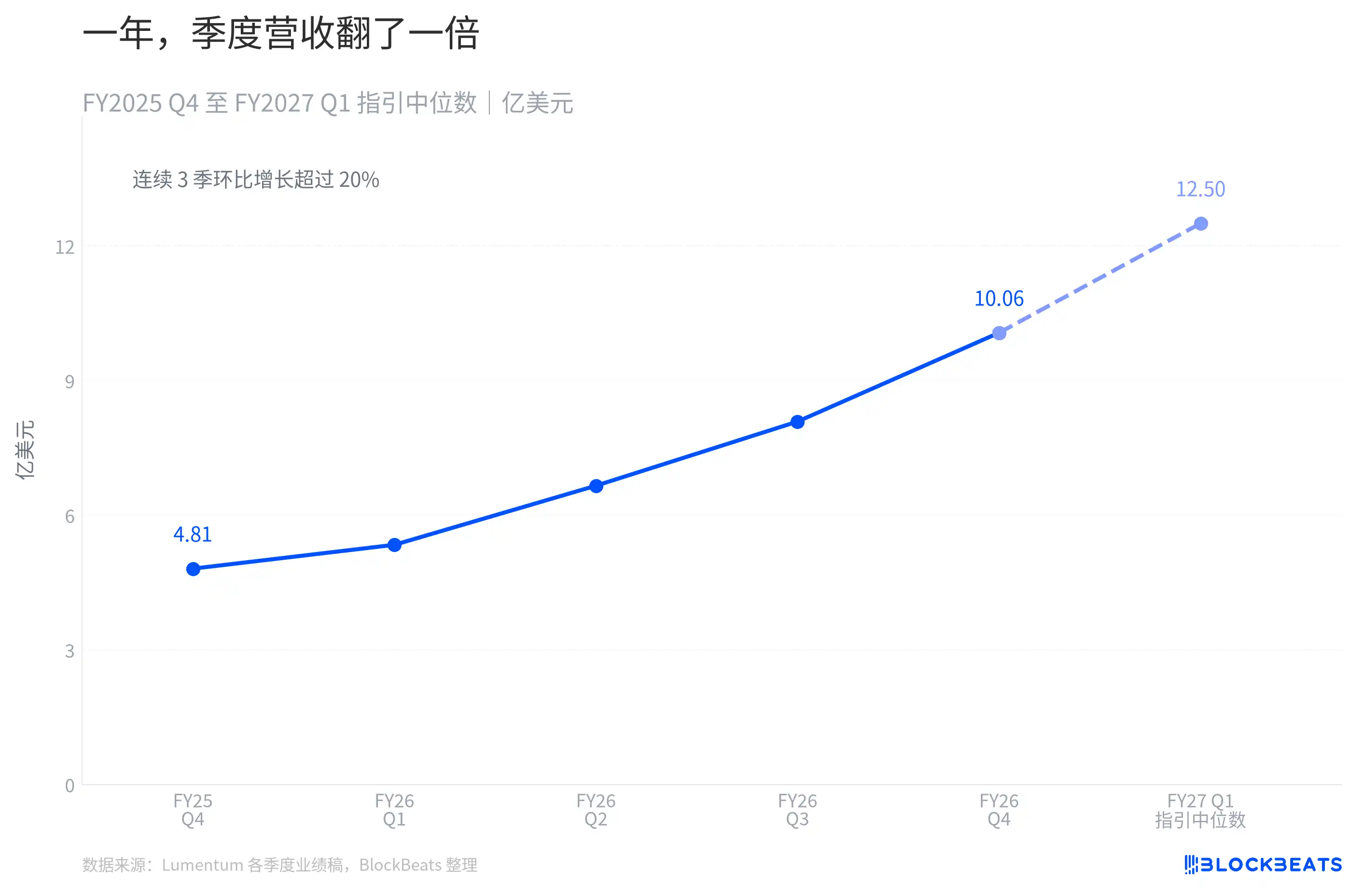
The key in the first chart is not any single particularly high point, but that the upward slope has not broken. Lumentum stated in its presentation materials that the fourth quarter marked the eighth consecutive quarter of revenue growth, with sequential growth rates exceeding 20% for the last three quarters of FY26.

According to the company's quarterly earnings announcements, revenue for the latest quarter increased 109.3% year-over-year.

The mid-point of the company's revenue guidance for the next fiscal quarter is $1.250 billion. This remains the management's forward-looking estimate, not yet recognized revenue, and cannot be taken as an exact substitute for orders. Judging by the continuously rising curve of recent quarters, the $1 billion mark is a milestone within an ongoing growth trajectory.

There's a subtle but important boundary in the report. While management lists optical circuit switching, cloud modules, co-packaged optics, and others as future growth drivers, the company does not break these items down into discrete, directly additive quarterly revenue figures. What readers can confirm from the statements is that revenue is growing; they cannot inversely deduce how much any single new product has contributed.

It's Not Just One Product Line Driving Revenue
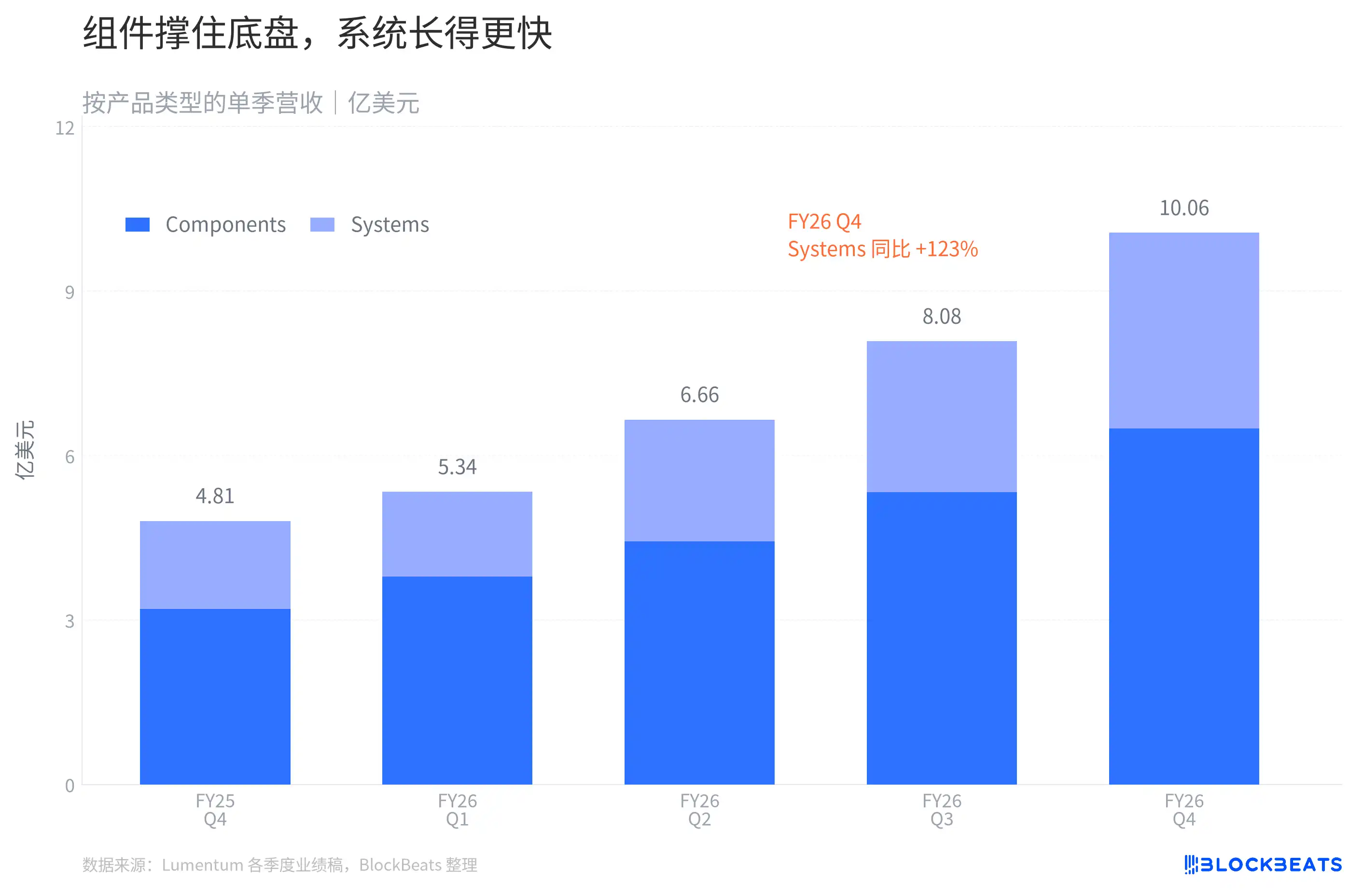
Lumentum categorizes its products into Components and Systems. According to the company's definitions, the former includes laser chips, sub-assemblies, and wavelength management systems, which customers integrate into larger systems. The latter includes cloud transceiver modules, optical circuit switching systems, and industrial lasers, which can be delivered as complete products.

Both lines are expanding. In the fourth quarter, the Systems business grew 122.6% year-over-year, while the Components business grew 102.7%, according to the earnings announcement. Systems grew faster, but Components still constituted nearly two-thirds of total revenue. This explains why the blue base in the chart is not being overshadowed by new business—new delivery forms are adding on top, while the established components base is also amplifying.

Management attributed the growth in Components to scale-out and scale-across of optical components, and the growth in Systems to record cloud transceiver module shipments. According to the Q4 presentation materials, 1.6T transceiver modules have begun shipping, and the ramp of Optical Circuit Switching (OCS) systems is progressing as planned, backed by sustained strong demand under its multi-year, multi-billion dollar purchase agreements. The key term here is "demand," not a line-item breakdown of recognized revenue.

This provides a more accurate reading of the structural change in the chart. It does not prove that a single cloud provider or a single new technology alone supports the growth. It illustrates that Lumentum is positioned on both the component supply and system delivery segments of the value chain, with the latter currently expanding at a faster rate.

Why Profitability is More Telling Than Revenue
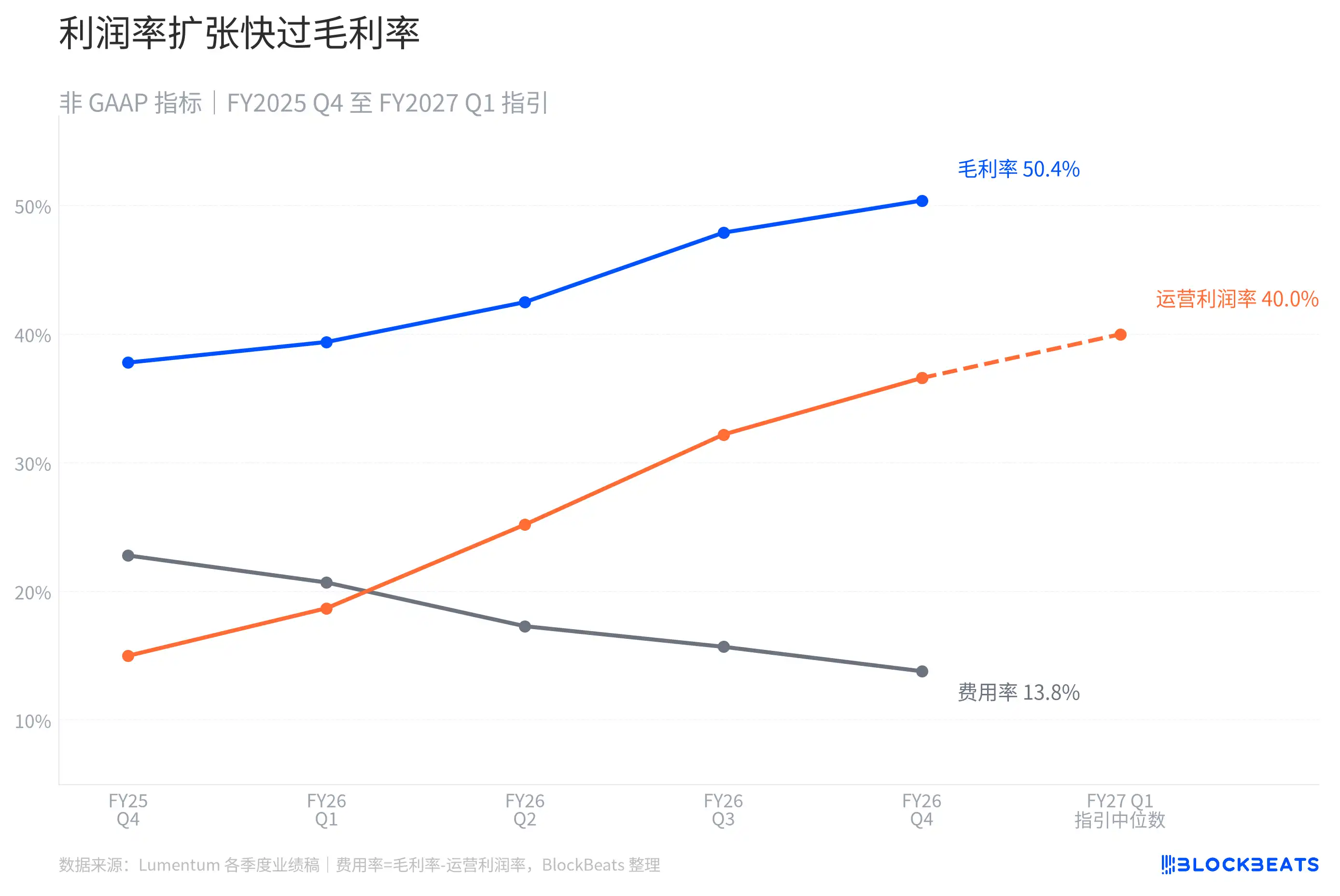
Revenue growth is the most visible, but the movement of profitability margins acts more like a thermometer for manufacturing and product mix. According to the company's quarterly reports, Lumentum's non-GAAP gross margin improved from 37.8% to 50.4%. This means the portion retained after subtracting direct costs from each dollar of revenue has become significantly thicker.

Operating margin climbed even more steeply. It rose from 15.0% to 36.6%, and calculating from the disclosed non-GAAP gross and operating margins, the operating expense ratio declined sequentially. Improving gross margins, combined with a decreasing share of expenses relative to revenue, allowed the orange line to climb faster than the blue one.

This chart is not equivalent to the GAAP income statement. The non-GAAP measure excludes items such as stock-based compensation, acquisition-related costs, amortization of intangibles, restructuring charges, and loss on debt extinguishment, according to the company's announcements. It is suitable for observing the company-defined ongoing operational performance but does not replace GAAP results. The next quarter's guidance of 39.5% to 40.5% for non-GAAP operating margin is also a forward-looking measure.

Putting it in simpler terms, revenue getting larger isn't the only change. The share of R&D, sales, and administrative costs allocated to each dollar of revenue is shrinking. For a company selling high-end optical components and systems, this type of shift often indicates more than just a slight increase in quarterly revenue—it suggests whether growth is beginning to permeate through to the operating results.

The $7.1 Billion Loss Largely Didn't Come from Core Operations
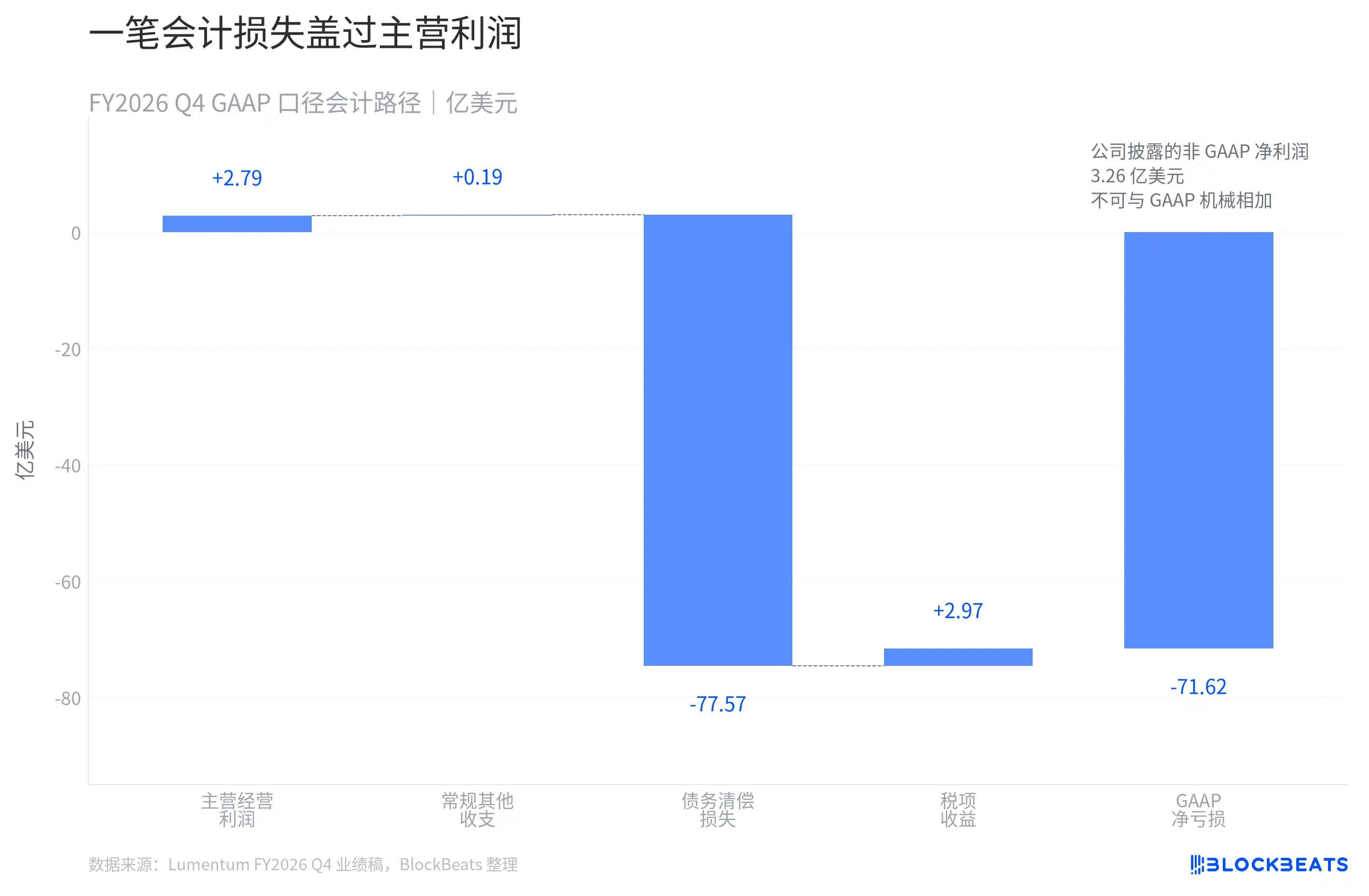
The fourth chart breaks down the most counterintuitive part of the accounts. Lumentum's GAAP operating profit for the quarter was $279 million. Subsequently, a $7.757 billion loss on debt extinguishment plunged the statement into deep negative territory. According to the company's 8-K filing and earnings announcement, this is a one-time, non-cash item stemming from the company settling a portion of its convertible notes with common stock. The majority of it represents an accounting loss arising when the conversion value exceeded the principal amount of the notes.

The usual other income/expense and tax benefit lines in the chart still exist but are insufficient to change the final result of a GAAP net loss of $7.162 billion. In the same announcement, the company reported a non-GAAP net income of $326 million. The two measures cannot be simply added, as the non-GAAP reconciliation includes other items like stock-based compensation, amortization, and tax adjustments.

"Non-cash" does not mean this event is irrelevant to shareholders or the balance sheet. The disclosed loss reflects the accounting treatment for the convertible note settlement; it cannot be directly translated into an equivalent cash outflow for the quarter, nor does it imply that all related settlements had no cash component. It is more akin to booking the change in capital structure into the income statement at once, rather than the core business losing over seven billion dollars in one quarter.

Therefore, Lumentum's latest earnings report requires reading two separate statements: one showing the operational performance driven by AI optical interconnect demand, and another reflecting the accounting impact from the equity conversion of convertible notes.


Domande pertinenti

QWhat were the key drivers behind Lumentum's record-breaking revenue in its FY26 Q4?

AThe key drivers were strong demand from AI data centers for high-speed, high-bandwidth optical connectivity, growth in both the Components and Systems product segments, and increased shipments of cloud transceiver modules, including new 1.6T modules. Revenue has grown for eight consecutive quarters.

QWhat was the primary cause of the massive $7.162 billion GAAP net loss reported by Lumentum?

AThe primary cause was a one-time, non-cash debt extinguishment loss of approximately $7.757 billion. This loss was recognized when the company settled a portion of its convertible notes using its common stock, and it largely stemmed from the accounting treatment when the conversion value exceeded the principal of the notes.

QHow did Lumentum's non-GAAP operating margin trend, and what does this indicate about its operations?

ALumentum's non-GAAP operating margin increased significantly from 15.0% to 36.6%. This indicates that as revenue scaled, the company's operational efficiency improved. The growth in gross margin combined with a decrease in operating expenses as a percentage of revenue suggests that the sales growth is translating positively into profitability.

QWhat is the difference between Lumentum's Components and Systems product segments?

AComponents include laser chips, subassemblies, and wavelength management systems that customers integrate into larger systems. Systems include finished products like cloud transceiver modules, optical circuit switches, and industrial lasers that are delivered as complete solutions. In Q4, Systems grew faster (122.6% YoY) than Components (102.7% YoY), but Components still accounted for nearly two-thirds of total revenue.

QWhy is it important to distinguish between GAAP and non-GAAP results when analyzing Lumentum's latest earnings report?

AIt is crucial because the GAAP results are heavily distorted by a large, one-time accounting loss from debt settlement, which does not reflect ongoing operational performance. The non-GAAP results exclude this and other items like stock-based compensation, providing a clearer view of the company's core business profitability and operational trends driven by market demand.

Letture associate

The Last Mile of Stablecoins: MoneyGram Connects Crypto Wallets to Cash Outlets in Over 170 Countries

Stablecoins have revolutionized cross-border payments with speed and low cost, but a fundamental barrier remains: converting digital money into physical cash in most parts of the world. On August 11th, global remittance giant MoneyGram announced its "MoneyGram Ramps" crypto-cash service is now live on the Solana blockchain. This allows developers, via a simple API, to connect their applications to MoneyGram's network of nearly 500,000 cash agent locations across over 170 countries. Users can now walk into a local MoneyGram agent to convert their USDC into local currency cash or use cash to purchase USDC for their wallets. Solana wallet Rift is the first to integrate the service. MoneyGram, founded in 1940 and historically second only to Western Union in global remittance volume, was privatized in 2023. Since then, it has accelerated its shift into a fintech platform, opening its compliance capabilities, cash network, and settlement infrastructure as services for developers. Its involvement with crypto is not new, having previously partnered with Ripple, Stellar, and Circle, and even issuing its own stablecoin, MGUSD, on Stellar in 2026. The Ramps API solves a critical physical obstacle to stablecoin adoption. While a USDC transfer from New York to Lagos takes seconds and costs cents on-chain, the recipient often lacks a bank account to access the funds. MoneyGram's extensive physical agent network, prevalent in regions like Sub-Saharan Africa, Southeast Asia, and Latin America, bridges this gap, connecting on-chain dollars to the offline cash-based economy. No crypto-native company could replicate this network quickly. MoneyGram chose Solana for its multi-chain expansion due to its extremely low transaction fees (often less than a cent) and fast confirmation times, making it ideal for small-value, frequent remittances. Solana's developer ecosystem is also geared toward consumer-facing applications. This partnership represents a pragmatic path for stablecoins in everyday remittances. Users don't need to understand blockchain or have a bank account; they simply visit a trusted local agent. The underlying settlement shifts from SWIFT to Solana, but the user experience remains familiar. The true path to stablecoin adoption is being paved by an 85-year-old remittance company, using its physical network to solve the "last mile" problem for crypto.

marsbit34 min fa

The Last Mile of Stablecoins: MoneyGram Connects Crypto Wallets to Cash Outlets in Over 170 Countries

marsbit34 min fa

How to Adapt to Frequent Miraculous Comebacks After the New Patch When Trading in Polymarket's LOL Section?

After recent League of Legends (LoL) game updates, major comebacks and unpredictable outcomes have become more frequent, making trading on Polymarket's LoL prediction markets challenging. This article analyzes the causes and offers adaptation strategies. The author, a longtime LoL fan turned Polymarket trader, notes that post-update, a large early-game gold lead no longer guarantees victory. The current meta reduces the decisive weight of economy, emphasizing instead "advantage conversion, resource trading, team composition strength, and teamfight execution." Key systemic changes aiding comebacks include: Bounty/Kill Gold Compensation, Strategic Objective Bounties, and reduced Baron Nashor rewards. Furthermore, the prevalence of mage picks in the bot lane, instead of traditional marksmen (ADC), can lower sustained damage and teamfight reliability in the late game, contributing to throws. For more successful trading, the article suggests: 1. **Choosing the Right Region:** Prioritize major regions (LPL, LCK, LEC, LCS) where matches matter for World Championship qualification or player contracts, leading to more serious play. Avoid or be extremely cautious with regions like CBLOL (Brazil), TCL (Turkey), and North American Challengers, citing high volatility and potential for unreliable outcomes. 2. **Trading Strategies:** * **Placing Orders:** Use limit orders below market price for strong favorites. In close matchups, consider placing equal low-ball bids (e.g., 25-40 cents) on both sides of a match; if both fill for a total under $1, you secure profit regardless of the winner. Exploit team "power spikes" by buying low before their composition peaks and selling high. * **Timely Selling:** The most crucial lesson is to take profits. If you buy the early-leading team at a low price (e.g., 50-60 cents), sell most of your position (e.g., 75%) at 85-90 cents to lock in gains and avoid a potential comeback zeroing your position. * **Position Sizing:** Practice strict risk management. Do not exceed 5-10% of your capital per match and avoid "tilting" or chasing losses after a few bad trades. In summary, adapting to the new meta requires understanding that early advantages are less stable. Success depends on analyzing team compositions, player form, and regional contexts, combined with disciplined order placement, profit-taking, and capital preservation. The next patch in August is expected to revive traditional ADCs, potentially shifting the dynamics again.

Odaily星球日报46 min fa

How to Adapt to Frequent Miraculous Comebacks After the New Patch When Trading in Polymarket's LOL Section?

Odaily星球日报46 min fa

Trading

Spot
活动图片