Reddit Crypto Discussion: Tech Stocks Surge for 8 Months, Is the Crypto Community Starting to 'Accept Fate'?

marsbitPubblicato 2026-06-02Pubblicato ultima volta 2026-06-02

Introduzione

Reddit Crypto Discussion: Has the Community 'Given Up' as Tech Stocks Soar? A recent post on Reddit's r/CryptoMarkets asking if the crypto market feels "dead" compared to surging tech stocks has sparked intense debate. The discussion highlights a community grappling with underperformance: Bitcoin is down ~44% from its October 2025 high and ~20% YTD in 2026, while the S&P 500 and Nasdaq 100 have gained significantly. The debate features classic opposing views. Some users, citing Bitcoin's history, are "cycle believers" who anticipate a return to form, arguing it has "died" many times before. Others counter that crypto's narratives keep shifting without delivering a stable, compelling real-world use case beyond speculation. A prevalent third view pinpoints AI as the core issue: the tech sector's transformative boom is absorbing all attention and capital, while crypto lacks a comparable, impactful utility. Data supports the pessimistic mood. Bitcoin spot ETFs saw their largest monthly net outflow in May 2026 (~$2.3B), indicating institutional de-risking. The Crypto Fear & Greed Index has fallen to "Fear" levels. When asked about the timing of a potential market rotation back to crypto, answers are uncertain. A key practical point raised is the current high-interest-rate environment, which makes stable yields from cash and bonds attractive, reducing incentive to move into volatile assets like crypto. The underlying anxiety, as one user summarized, is "opportunity cost"—the w...

Recently, a post on the Reddit subreddit r/CryptoMarkets quietly gained popularity. The poster, harukasweet, asked only one question:

"The crypto market feels lifeless. Compared to tech stocks, the crypto market has been dormant over the past year. Will the capital rotation happen again? Or have people given up on crypto?"

This post, tinged with expectation and pathos, sparked over a hundred replies. It becomes clear that not only is the Chinese crypto community discussing this issue; the reality that only crypto isn't rising is now stimulating the sentiment of the entire crypto community indiscriminately, regardless of language.

The intensity of the debate isn't due to someone presenting new evidence, but because each side is using the other's failure to prove their own correctness. This atmosphere of mutual criticism in the discussion is itself a microcosm of the current crypto community's sentiment.

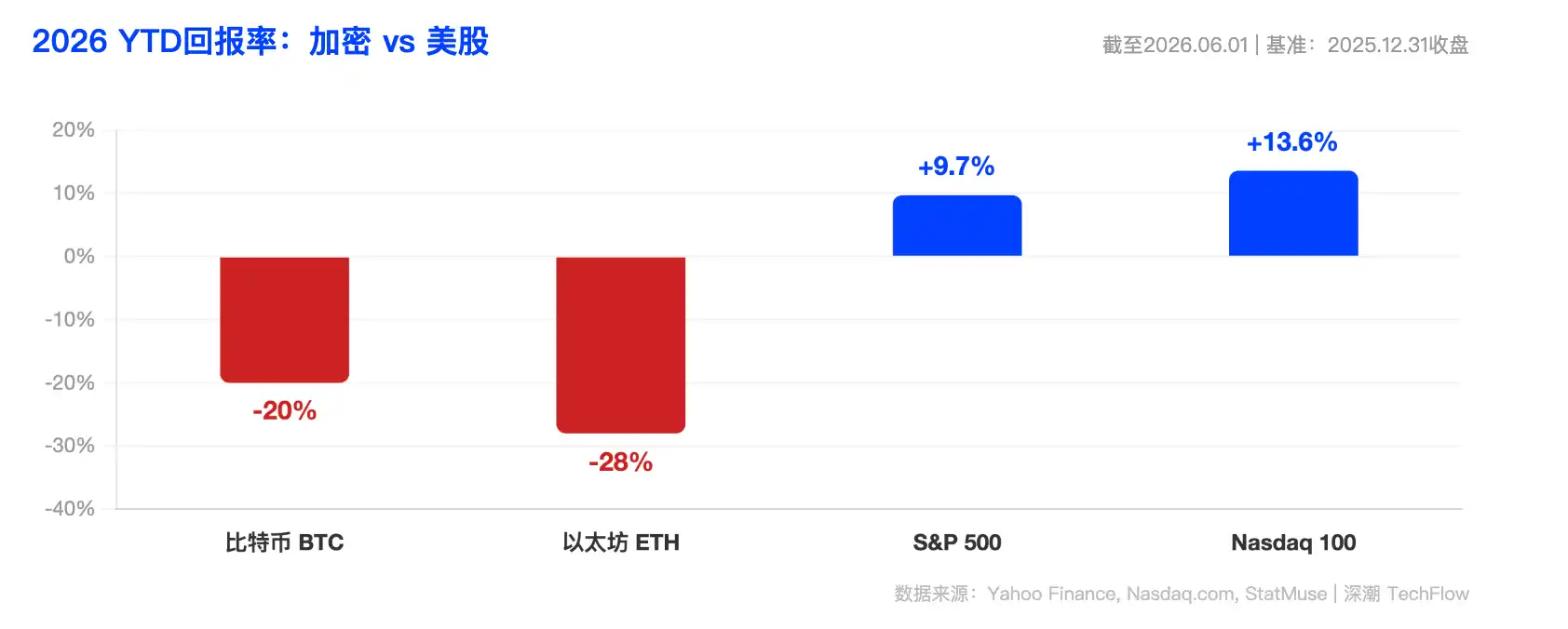
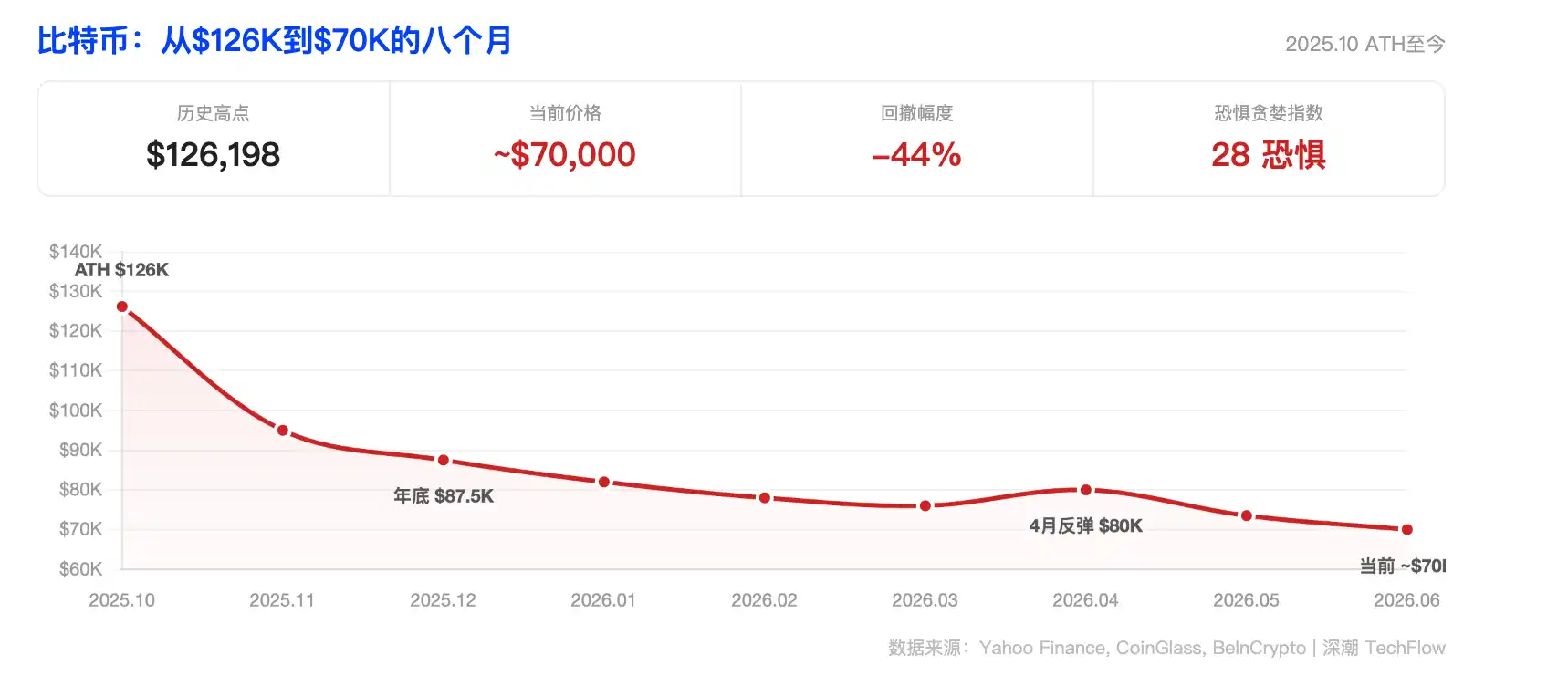
Bitcoin has retreated from its October 2025 all-time high of $126,198 to around $70,000 currently, a drop of about 44%; its Year-to-Date (YTD) decline for 2026 is about 20%. During the same period, the S&P 500 is up about 9.7% YTD. The Nasdaq 100 is up about 13.6%.

With one line rising and the other falling, the gap between them can no longer be described as merely "underperforming."
"Bitcoin Has Died Over 800 Times" vs "The Narrative Really Can't Hold Up This Time"

The most tense exchange in the Reddit discussion occurred between users Giordano86 and think_harder_plz.

Giordano86 is a classic cycle believer: "Be greedy when others are fearful. Markets have cycles. People will soon rotate back into Bitcoin." When someone rebutted, he directly threw out data: "Go look at Bitcoin's 17-year history and tell me you haven't seen cycles. Bitcoin has 'died' over 800 times, it's fine."

Another user, Powerful_Respect_400, was more direct: "I've been here since 2017. The 2017 bull run, the 2021 bull run, 2025... every four years. We might have to wait until 2029."

think_harder_plz's counterattack was equally sharp: Bitcoin's narrative has been constantly "upgrading," from peer-to-peer electronic cash, to digital gold, to an inflation hedge, to an institutional reserve asset. "Every time an old narrative fails, a new one is swapped in." His conclusion: "Cryptocurrency hasn't existed long enough to make such confident assertions. This is the beginning of the end."

Interestingly, another user, keepitcasualbrah, accurately pinpointed the self-contradiction in this statement:

You say in the first part "hasn't existed long enough to conclude," and in the latter part conclude "this is the beginning of the end." This rebuttal gained considerable agreement.
AI Stole the Attention, But What Crypto Truly Lost Was 'Use Cases'

If it were just the old tunes of cycle theory versus end-of-theory, this post wouldn't have triggered so many replies. What truly hit the nerve was the third type of voice: the crypto market is losing not to a bear market, but to AI.

The comment by user optifree1 was heavily cited: "The tech industry is experiencing a once-in-decades productivity revolution, AI is genuinely changing how people work and live. This wave of enthusiasm has sucked away attention from all other markets, and cryptocurrency hasn't yet found any use case with influence close to that of the AI boom."

Crypto's structural issues are indeed evident. Several users corroborated the same judgment from different angles:

The crypto market lacks real use cases for support. User i_am_13th_panic pointed out that despite crypto companies' efforts to expand applications, the only solid use for most cryptocurrencies is "to speculate with it, use it to speculate, or stake it."

User Usually_Sunny raised a sharper paradox: For a currency to be "useful," its value must be relatively stable, but Bitcoin's core investment logic is precisely built on price volatility.

The poster harukasweet also admitted: "Yes, only stablecoins are somewhat useful, DeFi maybe has some use, but too many hacks."

Data Perspective: Institutions Are Pulling Out, Not Just Retail

The Reddit discussion is emotional, but capital flows provide colder validation.

According to BeInCrypto data, Bitcoin spot ETFs recorded approximately $2.3 billion in net outflows in May 2026, the largest monthly outflow for the year and the largest since November 2025. The preceding April and March saw net inflows of about $1.97 billion and $1.32 billion, respectively. Cumulative net ETF inflows have dropped from $58.09 billion in April to $55.79 billion.
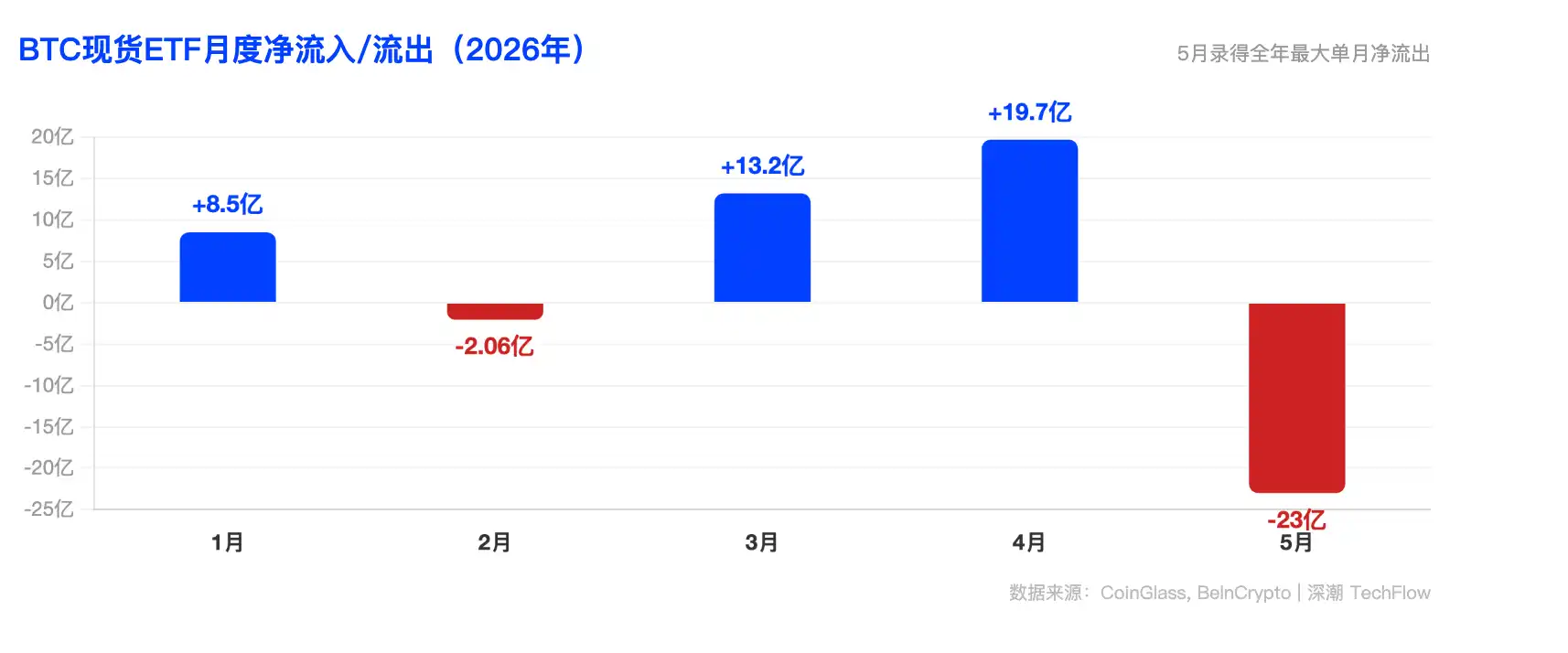
In May, BTC fell only about 3.7%, but the ETF outflow scale was over 10 times the $206 million net redemption in February. Institutions' speed of de-risking is noticeably faster than what the price decline itself suggests.

Meanwhile, the Fear & Greed Index dropped to 28 (Fear), with market sentiment at its lowest level in 2026.

So When Is the Next Rotation Coming?

This is the question the poster harukasweet repeatedly pressed. The answers varied widely, but the honesty was surprisingly high.

User only_linear_joseph's analysis was more pragmatic: Cash and bond yields are now very competitive, which was rare before. As long as the high-interest-rate environment persists, capital has no incentive to flow from fixed income to high-volatility assets. After discussing with the poster, he even self-corrected a contradiction: If inflation remains high, the Fed won't cut rates, and crypto will continue to be left out in the cold.

No one gave a definitive answer. But one comment in the thread perhaps summarizes most people's true state of mind: When asked "what's the hurry," user harukasweet replied with two words: "Opportunity cost."

Every day money isn't in the crypto market is money making gains elsewhere. This is the real source of anxiety in the current crypto community—not "will it come back," but "what am I missing while waiting for it to come back."

Data as of June 2, 2026. This article is an observation of sentiment and does not constitute investment advice.


Domande pertinenti

QWhat are the two main opposing viewpoints regarding Bitcoin's future as discussed in the Reddit thread?

AThe two main opposing viewpoints are the cyclical believers and the 'endgame' believers. Cyclical believers, like user Giordano86, argue that Bitcoin operates on predictable multi-year cycles and will recover as it has in the past. 'Endgame' believers, like user think_harder_plz, argue that Bitcoin's narrative keeps shifting as old use cases fail and that this period might mark the beginning of its decline, citing its relatively short history.

QAccording to the article, what major technological trend is currently diverting attention and capital away from the cryptocurrency market?

AAccording to the article and user comments, the major trend is the Artificial Intelligence (AI) revolution. Users like optifree1 argue that AI is a once-in-a-decades productivity revolution with real-world impact, drawing attention and capital away from cryptocurrencies, which are seen as lacking comparable widespread, practical use cases.

QWhat key structural problem with cryptocurrencies is highlighted by the Reddit users?

AThe key structural problem highlighted is the lack of real-world, practical use cases. Users point out that most cryptocurrencies primarily serve purposes like speculation, trading, or staking. A paradox is noted: for a currency to be broadly 'useful,' it needs price stability, but Bitcoin's core investment thesis is built on price volatility. Only stablecoins are acknowledged as having consistent utility.

QWhat does the data on Bitcoin ETF flows in May 2026 indicate about institutional sentiment?

AThe data indicates a significant shift to negative institutional sentiment. In May 2026, Bitcoin spot ETFs recorded approximately $2.3 billion in net outflows, the largest single-month outflow for the year and the largest since November 2025. This outflow was over 10 times larger than the net redemptions in February, suggesting institutions are de-risking at a pace faster than the modest 3.7% price decline that month would imply.

QWhat does the user 'harukasweet' identify as the true source of anxiety for the current crypto community?

AUser harukasweet identifies 'opportunity cost' as the true source of anxiety. The concern is not just whether cryptocurrency prices will recover, but what potential gains in other markets (like the surging tech stocks) are being missed while waiting for a crypto market revival. This fear of missing out on better-performing assets is the core driver of current community frustration.

Letture associate

Only 153 Venture Capital Firms Invested in July: Is the Crypto VC Industry Experiencing a 'Mass Extinction'?

In July 2026, only 153 unique venture capital firms participated in disclosed crypto funding rounds, marking the lowest monthly count since November 2020. This figure represents an 87% decline from the peak of 1,177 firms in 2022. Overall, the first seven months of 2026 saw crypto projects raise approximately $11.78 billion across 481 rounds. This crypto VC contraction contrasts sharply with the broader venture capital landscape, where global VC investment reached a record $560.4 billion in H1 2026, heavily fueled by major AI company financings. This shift in capital allocation has drawn funds away from the crypto sector. Within crypto, funding is highly concentrated. Trading platforms, prediction markets, and payment sectors absorbed 53% of the total capital. While early-stage deals remain frequent, the largest sums flow to a few late-stage rounds and mergers & acquisitions, which surged to $7.23 billion in Q2 2026. The market is consolidating around top funds like a16z crypto and Dragonfly, which successfully raised new multi-billion dollar funds, while many smaller firms have retreated. Analysts describe this as a "great extinction" for crypto VCs, where capital is becoming more selective, favoring proven business models and assets over early-stage speculation. This raises the bar for project quality, funding efficiency, and viable exit paths.

marsbit18 min fa

Only 153 Venture Capital Firms Invested in July: Is the Crypto VC Industry Experiencing a 'Mass Extinction'?

marsbit18 min fa

Strategy's Loss in the Second Quarter Reaches $8.22 Billion Amid Bitcoin Decline

Strategy, the largest corporate holder of Bitcoin, reported a net loss of $8.22 billion for the second quarter. This loss was primarily driven by an $8.32 billion unrealized loss on its Bitcoin holdings due to a decline in the asset's price during the period. Despite these paper losses, the company increased its Bitcoin holdings to 843,775 BTC, a 25% growth since the start of the year. As part of a new monetization strategy, Strategy sold approximately $218.4 million worth of Bitcoin, mainly to fund dividends for preferred shareholders, with $216 million of that sold after Q2 ended. The company also built a $3.75 billion cash reserve, which it claims is sufficient to cover over two years of dividend and interest payments, aiming to insulate itself from Bitcoin's volatility while meeting obligations. Following the earnings release, Strategy's stock (MSTR) rose 4.7% in regular trading but corrected slightly after-hours. This pattern reflects how the company's accounting results are heavily tied to Bitcoin's price swings, even as its long-term strategy remains unchanged. The report indicates that Strategy is maintaining its core strategy of accumulating Bitcoin while building a financial buffer. This quarterly loss follows a recognizable pattern, with the company posting significant unrealized losses in previous quarters (e.g., $12.4 billion in Q4 2025 and ~$12.5 billion in Q1 2026) due to fair-value accounting. A key technical shift is its new monetization program, which introduces periodic selling pressure on the market, transitioning Strategy from a pure accumulator to a participant that occasionally adds supply. A critical question remains: how long can the cash reserve cover dividend obligations if a Bitcoin price downturn persists beyond two years?

cryptonews.ru38 min fa

Strategy's Loss in the Second Quarter Reaches $8.22 Billion Amid Bitcoin Decline

cryptonews.ru38 min fa

Will Terrorist Durov Ban Russian Officials?

Telegram founder Pavel Durov publicly reacted to being labeled a "terrorist" by Russian authorities, stating the designation came after he refused demands for mass surveillance and censorship on the platform. In a Telegram post, he highlighted that this status formally bans him from "publishing information online." Durov concluded with a statement widely circulated: Russian officials "clearly don't understand who can ban whom on the internet." This remark suggests Durov could potentially restrict official Russian government and officials' channels on Telegram, which continue to operate on the platform despite its formal blocking in Russia. The situation parallels previous, slow-moving state directives, like switching officials to domestic cars, contrasted with the current push to migrate all government communication to the Russian-made messenger MAX by 2030. However, reports indicate many officials still use Telegram via workarounds, fearing surveillance on MAX, while alternatives like BiP and KakaoTalk recently became inaccessible in Russia without a VPN. Durov has not specified any immediate actions against state channels. His statement is an initial response, with further developments depending on the authorities' reaction. The dynamic differs from 2020 when Russian regulators lifted a block on Telegram; now, Durov implies control from within the platform itself over the official accounts that persisted through that earlier blockade.

cryptonews.ru38 min fa

Will Terrorist Durov Ban Russian Officials?

cryptonews.ru38 min fa

DeepSeek V4 Official Version Arrives, New Capabilities Emerge, Value-for-Money King Enters the Fray

On July 31st, DeepSeek officially launched the public API beta for its DeepSeek-V4-Flash model. A key highlight is its performance on multiple Agent benchmark tests, reportedly nearing or even surpassing the level of the V4-Pro preview version from three months ago. Notably, the Flash model achieves this with significantly smaller scale (130B active parameters vs. Pro's 490B), suggesting that post-training optimization and data quality may be as crucial as raw model size. DeepSeek emphasized that the V4-Flash-0731 uses the same model architecture and size as its preview version, with improvements attributed solely to "re-trained post-training." The update also marks the official debut of DeepSeek's self-developed Agent framework, "Harness." The move signals DeepSeek's strategic push to position its cost-effective Flash model as a competitive base for Agent applications—scenarios requiring autonomous planning, tool usage, and complex task execution—where inference speed and cost are critical. By natively supporting OpenAI's Responses API format and adapting for code-generation scenarios, DeepSeek aims not just to be a cheaper alternative but to establish its own ecosystem in the Agent era. This release follows DeepSeek's record-breaking ~$50 billion fundraising round roughly two months prior, underscoring market confidence in its technology and commercialization prospects. The company is reportedly preparing for another funding round at a valuation of approximately $71 billion. The Flash model's advancement represents a step in fulfilling the high expectations that come with this valuation, setting the stage for the impending release of the V4-Pro official version and intensifying competition in the global Agent landscape.

marsbit42 min fa

DeepSeek V4 Official Version Arrives, New Capabilities Emerge, Value-for-Money King Enters the Fray

marsbit42 min fa

Trading

Spot
活动图片