Ransomware Crooks Are Busier Than Ever — But Making Less Money, Researchers Say

bitcoinistPubblicato 2026-02-27Pubblicato ultima volta 2026-02-27

Introduzione

According to a Chainalysis report, ransomware attacks increased by 50% in 2025, with nearly 8,000 incidents recorded. However, total ransom payments fell by 8% to $820 million. This decline is attributed to stricter regulations, improved law enforcement, and more companies refusing to pay. Attackers have shifted focus to small and medium-sized businesses, which pay faster but yield smaller sums. The cost of launching attacks has also decreased significantly, with access to victim systems on the dark web dropping from $1,427 in 2023 to $439 in early 2026. Despite the drop in ransomware revenue, broader crypto crime remains significant, with $370 million stolen in January 2026 alone, mostly through phishing attacks.

The cybercrime business is booming, at least on paper. According to a new report from blockchain analytics firm Chainalysis, the number of ransomware attacks jumped 50% in 2025, with nearly 8,000 separate incidents recorded throughout the year. Yet for all that hustle, hackers walked away with less cash than the year before.

Smaller Targets, Smaller Payouts

Total ransom payments collected in 2025 came in at $820 million — an 8% drop from 2024. Reports say the decline is tied to several factors: tougher rules from regulators, law enforcement cracking down on the networks criminals use to launder money, and a growing number of companies simply refusing to pay.

With big organizations shutting the door, attackers moved on to easier prey. Small and medium-sized businesses became the new focus. “Smaller victims pay faster,” said Corsin Camichel, founder of eCrime.ch, in the Chainalysis report.

But faster doesn’t mean bigger. Those smaller targets yield smaller sums, and that math is catching up with the criminals running these schemes.
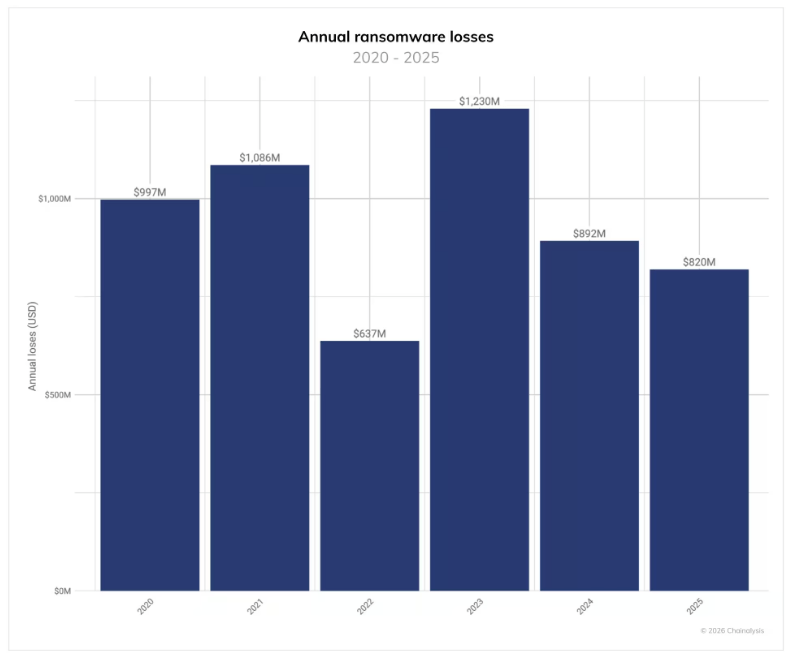
Source: Chainalysis

The gap between how many attacks are being claimed publicly and how much money is actually being collected tells its own story. Attackers are filing more claims than ever, yet the money flowing back to them keeps shrinking.

BTCUSD now trading at $67,800. Chart: TradingView

According to Chainalysis, that gap signals something important — the people running these operations are putting in more work for a worse result.
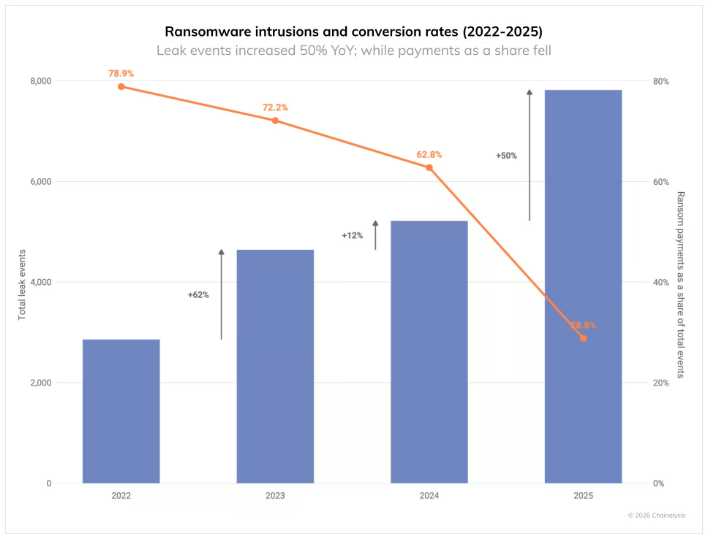
Source: Chainalysis

Ransomware: The Cost Of Breaking In Has Fallen Sharply

Part of what’s fueling the surge in attack numbers is how cheap it has become to launch one. Reports note that the average price for purchasing access to a victim’s system on the dark web fell from $1,427 in early 2023 to just $439 by early 2026.

Artificial intelligence tools and an oversupply of ready-made attack software have made it easier for more people to get into the ransomware game.

The result is a crowded field of attackers competing for the same pool of victims — and driving down their own profits in the process. It mirrors what happens in any flooded market. More sellers, same number of buyers, prices fall.

2026 Has Already Seen Major Crypto Losses

Even as ransomware payments trended downward last year, the broader picture of crypto-related crime remains grim. According to cybersecurity firm CertiK, $370 million in crypto was stolen in January 2026 alone through various exploits and scams.

Phishing attacks were responsible for the bulk of those losses, accounting for $311 million of the total. Ransomware may be generating less revenue for its operators, but the wider world of crypto theft is far from slowing down.

Featured image from Unsplash, chart from TradingView

Domande pertinenti

QAccording to the Chainalysis report, what was the percentage increase in ransomware attacks in 2025 and the total number of incidents?

AThe number of ransomware attacks jumped 50% in 2025, with nearly 8,000 separate incidents recorded.

QWhat was the total value of ransom payments collected in 2025 and how does it compare to the previous year?

ATotal ransom payments collected in 2025 came in at $820 million, which is an 8% drop from 2024.

QWhat are the three main factors cited for the decline in ransom payments?

AThe decline is tied to tougher rules from regulators, law enforcement cracking down on money laundering networks, and a growing number of companies refusing to pay.

QHow much did the average price for purchasing access to a victim's system on the dark web fall between early 2023 and early 2026?

AThe average price fell from $1,427 in early 2023 to just $439 by early 2026.

QHow much cryptocurrency was reported stolen in January 2026 by CertiK, and what type of attack was responsible for the majority of those losses?

A$370 million in crypto was stolen in January 2026, with phishing attacks accounting for the bulk of those losses at $311 million.

Letture associate

This Week's Key Events Preview | U.S. to Release April CPI Data; U.S. Senate Banking Committee to Review "Digital Asset Market Structure Act of 2025"

Weekly News Preview: Key events for May 12-16 include major economic and crypto industry developments. On Tuesday, May 12, the U.S. will release its April CPI data. Additionally, the gaming blockchain Ronin will begin a 10-hour migration to an Ethereum Layer 2, built on OP Stack with EigenDA for data availability. This aims to leverage Ethereum's security and settle RON's annual inflation below 1%. Base's first independent network upgrade, "Base Azul," is scheduled for mainnet activation on Wednesday, May 13, focusing on security, performance, and developer experience enhancements. Thursday, May 14, sees the U.S. Senate Banking Committee voting on the "Digital Asset Market Structure Act of 2025." In other news, Solana DeFi protocol Carrot will shut down, setting a final withdrawal deadline due to impacts from the Drift exploit. The Moscow Exchange will launch futures trading for Solana, Ripple, and Tron indices (RUB-settled) for qualified investors. Multiple service closures are scheduled for Friday, May 15. Dmail Network will begin winding down due to unsustainable infrastructure costs and failed commercialization. Users must export data before this date. Separately, the Cosmos-based lending blockchain UX Chain will fully shut down. Finally, on Saturday, May 16, gaming infrastructure provider Lattice will wind down operations, with its Redstone Layer 2 network ceasing. Users are urged to withdraw assets, especially from contracts like Uniswap pools, before the shutdown.

链捕手48 min fa

This Week's Key Events Preview | U.S. to Release April CPI Data; U.S. Senate Banking Committee to Review "Digital Asset Market Structure Act of 2025"

链捕手48 min fa

Morning Post | Trump Media Group Releases Q1 Financial Report; Top Three DeFi Applications Return Nearly $100 Million in Revenue to Token Holders in 30 Days; Michael Saylor Shares Bitcoin Tracker Info Again

**Title: Daily Briefing | Trump Media Group Releases Q1 Report; Top 3 DeFi Apps Return Nearly $100M to Token Holders; Michael Saylor Signals Potential Bitcoin Buy** **Summary:** Key developments in the past 24 hours include: * **Economic Outlook:** Goldman Sachs has pushed back its forecast for the next two Federal Reserve interest rate cuts to December 2026 and March 2027, citing persistent inflationary pressures from energy costs. This delayed timeline is expected to tighten liquidity flow into risk assets, including cryptocurrencies. * **DeFi & Revenue:** Data from DefiLlama shows that three leading DeFi applications—Hyperliquid, Pump.fun, and EdgeX—collectively distributed $96.3 million in revenue to their token holders over the last 30 days. This trend highlights a shift in the crypto community's focus towards real protocol earnings and sustainable economic models. * **Corporate Bitcoin Moves:** Michael Saylor, founder of MicroStrategy (note: referred to as 'Strategy' in the text, likely a typographical error), has signaled potential upcoming Bitcoin purchases by posting a "Bitcoin Tracker" update, following a pattern that typically precedes the company's official disclosure of new acquisitions. * **Market Integrity:** Prediction market platform Polymarket announced updates to address platform issues, including identifying and banning clusters of accounts involved in "ghost-fill" activities and implementing measures to prevent bulk account creation. * **Regulation:** The Bank of England Governor warned that stablecoin regulation could lead to tensions between US and international regulators. In South Korea, the National Tax Service has launched a pilot program to entrust seized virtual assets to private custody firms for management. * **Meme Token Trends:** GMGN data lists the top trending meme tokens on Ethereum (e.g., HEX, SHIB), Solana (e.g., FWOG, TROLL), and Base (e.g., SKITTEN, PEPE) over the past day. **Financial Note:** Trump Media & Technology Group reported a Q1 loss of approximately $4 billion, primarily attributed to unrealized losses on its Bitcoin and other digital asset holdings.

链捕手1 h fa

Morning Post | Trump Media Group Releases Q1 Financial Report; Top Three DeFi Applications Return Nearly $100 Million in Revenue to Token Holders in 30 Days; Michael Saylor Shares Bitcoin Tracker Info Again

链捕手1 h fa

Telegram Takes Direct Control of TON, Social Traffic Rewrites the Public Chain Narrative

Telegram founder Pavel Durov announced that Telegram will replace the TON Foundation as the core driver and largest validator of The Open Network (TON). Key initiatives include a sixfold reduction in transaction fees, performance upgrades, and improved developer tools within the next few weeks. This marks a strategic shift from Telegram merely providing user access to deeply integrating TON into its platform's core infrastructure. The goal is to transform Telegram's massive social traffic into sustainable on-chain activity. While viral mini-apps like Notcoin have demonstrated Telegram's ability to drive user adoption, TON aims to support frequent, low-value transactions inherent to social platforms—such as tipping, in-app payments, and game rewards. Ultra-low fees and sub-second finality (0.6 seconds) are crucial to making blockchain interactions seamless and nearly invisible within the Telegram user experience. However, Telegram's increased central role raises questions about network decentralization. Durov argues that Telegram's participation will attract more large validators, thereby enhancing decentralization. TON also offers high annual staking rewards (18.8%), aiming to retain capital within its ecosystem. The fundamental challenge for TON is no longer leveraging Telegram's user base, but becoming an indispensable, seamless infrastructure layer for Telegram's everyday applications—moving from an adjacent chain to an embedded utility.

marsbit1 h fa

Telegram Takes Direct Control of TON, Social Traffic Rewrites the Public Chain Narrative

marsbit1 h fa

Trading

Spot
Futures
活动图片





