Telegram Takes Direct Control of TON, Social Traffic Reshapes Public Chain Narrative

Odaily星球日报Pubblicato 2026-05-11Pubblicato ultima volta 2026-05-11

Introduzione

Telegram's founder, Pavel Durov, has announced a major shift in the development of The Open Network (TON). Telegram will now become the core driver of TON, replacing the TON Foundation and becoming its largest validator. The focus will be on technical upgrades over the next few weeks, including slashing network fees by six times to near-zero and improving finality time to 0.6 seconds. This move signifies a deeper integration between Telegram and TON, moving beyond just providing a user base. The goal is to transform Telegram's vast social traffic and built-in features—like Mini Apps, payments, and bots—into sustainable, on-chain usage scenarios. The reduced fees and faster speeds are crucial for enabling the small, frequent transactions typical of social interactions. While this promises stronger execution and product alignment, it raises questions about centralization. Durov argues Telegram's involvement will attract more validators, enhancing decentralization, but the outcome remains to be seen. Additionally, TON's high annual staking reward of 18.8% aims to retain capital within the ecosystem. The key challenge for TON is no longer just leveraging Telegram's entry point, but becoming an invisible, seamless infrastructure layer within Telegram's daily use. Its success hinges on converting viral attention into lasting, embedded utility.

Original | Odaily Planet Daily(@OdailyChina)

Author | Asher(@Asher_ 0210)
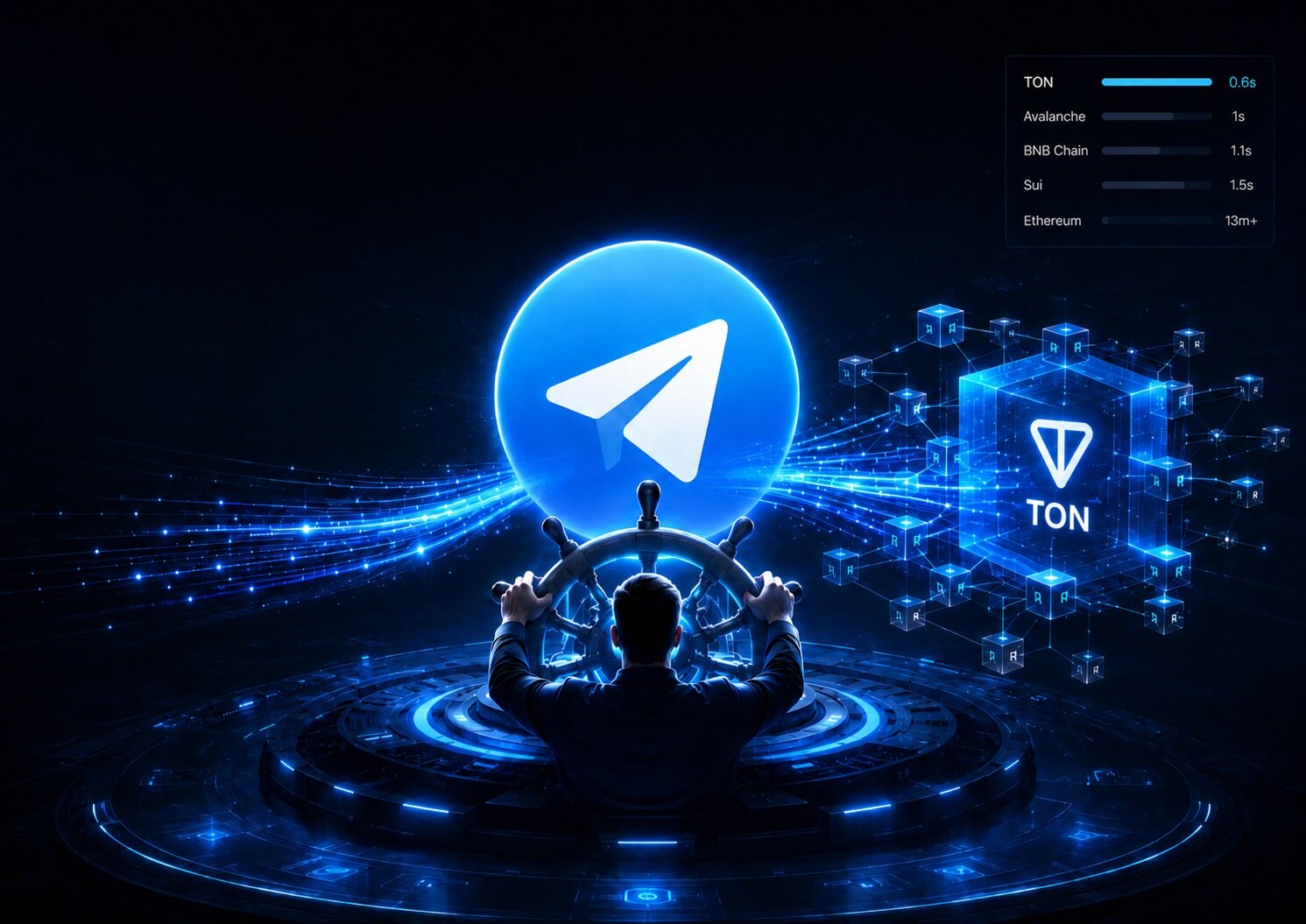
On May 4th, Pavel Durov, the founder of Telegram, stated on platform X that TON network fees have been reduced sixfold, now nearly zero. More crucially, he announced that Telegram will replace the TON Foundation to become the new core driver of the TON network and its largest validator. TON's upcoming focus will shift to technical advantages, including a new ton.org, new developer tools, and performance upgrades, all within the next 2 to 3 weeks.
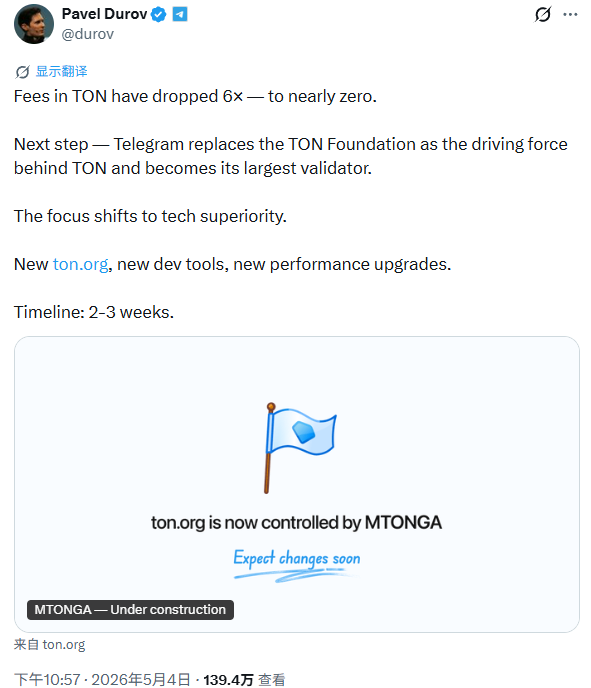
Telegram Founder: TON Fees Reduced 6x, Telegram to Become Largest Validator

Previously, the relationship between TON and Telegram was more like a strong binding with weak leadership. Telegram provided the entry point, while the Foundation and community were responsible for driving progress, maintaining a certain distance. But this time, Telegram is not just continuing to bring users to TON; it's starting to enter more fundamental positions like validator, technical roadmap, and development tools. TON is no longer just a chain adjacent to the Telegram ecosystem; it's being reintegrated into Telegram's product system.

TON Never Lacked an Entry Point; It Lacked Turning That Entry into Usage Scenarios

Past market discussions about TON often revolved around Telegram's user scale. But for a public chain, having an entry point does not equal having an ecosystem, and having user reach does not equal having long-term usage. The unique aspect of TON is its inherent connection to a high-frequency social platform, where Mini Apps, wallets, channels, bots, games, and payments already exist within Telegram. This means TON doesn't have to start from scratch to find users like most Layer1s. However, if these scenarios cannot translate into sustained on-chain interactions, Telegram's traffic can only bring waves of short-term hype.

Projects like Notcoin and Dogs have already proven that Telegram can quickly generate viral spread. Simple gameplay combined with social connections can indeed attract a massive number of users into crypto applications in a short time. But such explosions come and go quickly. TG mini-games and airdrops can bring attention but can hardly sustain a long-term ecosystem alone.

Therefore, the fee reduction, speed improvements, developer tools, and validator role emphasized by Pavel Durov this time point not to a single technical upgrade, but to TON addressing its most crucial missing piece — turning Telegram's entry point into sustainable usage scenarios. When fees are low enough, confirmation speeds are fast enough, and developer integration is simple enough, actions like channel tipping, Mini App tasks, game rewards, creator revenue, ad revenue sharing, bot calls, and small group payments have the potential to evolve from product features into on-chain activities.

TON doesn't need to repeat the story of "backed by Telegram." What it truly needs to prove is whether the high-frequency behaviors within Telegram can be supported by TON.

Fee Reduction and Speed Boost Are for Smaller, Higher-Frequency Transactions

The fee reduction by TON this time cannot be understood merely as a regular public chain cost optimization. Viewed within the context of Telegram, it genuinely addresses whether small, high-frequency interactions can be viable.

Potential on-chain behaviors within Telegram are mostly not large transfers but more fragmented daily operations. The amount per transaction is small, but the frequency is high. If users have to perceive fees, wait for confirmations, and repeatedly handle wallet interactions with every button click, such scenarios would struggle to truly take off.

Therefore, fee reduction and speed improvement must be considered together. Near-zero fees lower the barrier to entry; reducing final confirmation time to 0.6 seconds lowers the perception of waiting. For Telegram, the chain shouldn't be an extra layer perceived by users; it should be hidden behind product actions like sending messages, clicking buttons, and balance changes as much as possible.
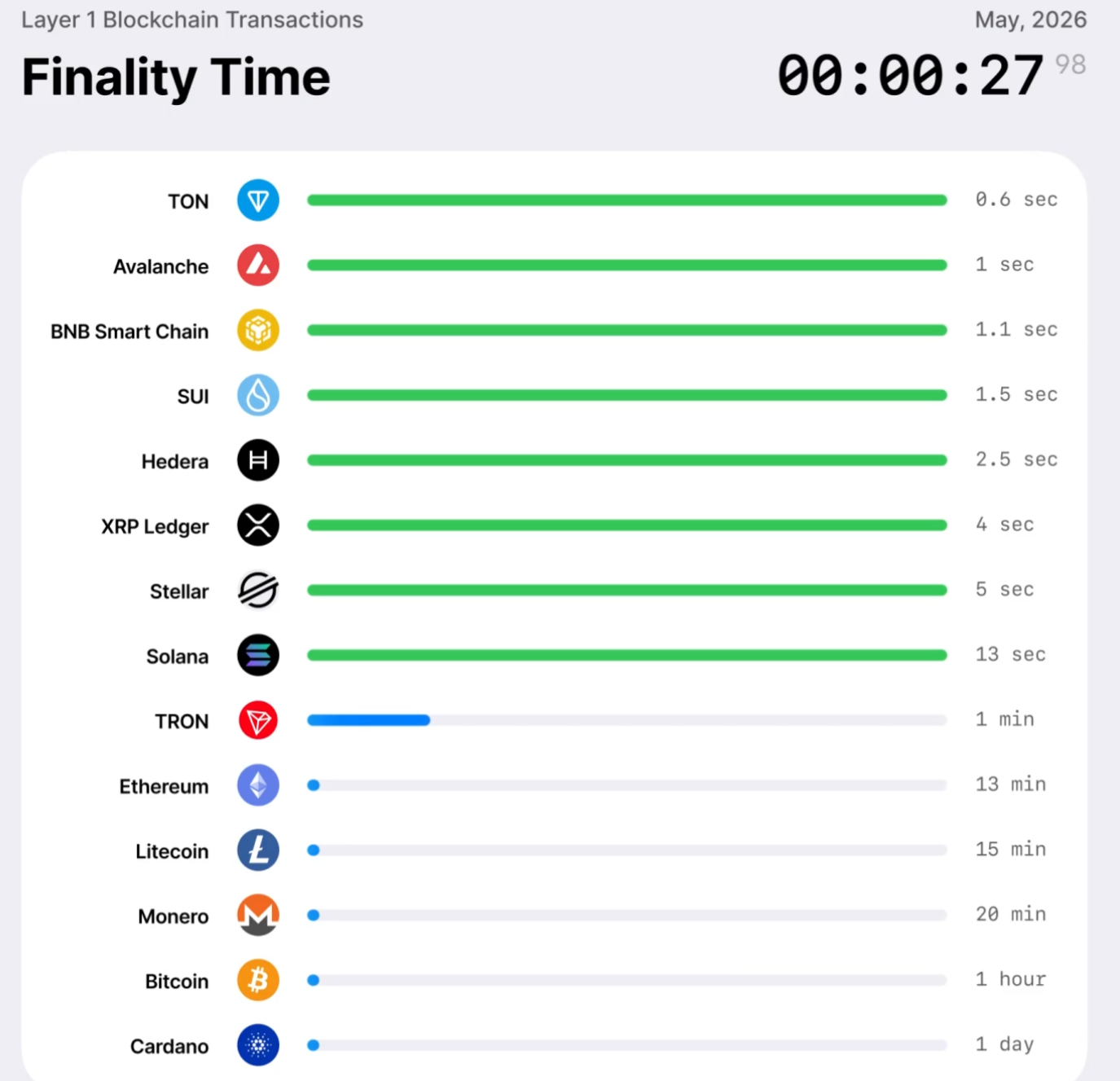
Comparison of "Finality Time" Among Mainstream Public Chains

This is also where TON differs from many Layer1s. It's not solely about making DeFi transactions faster or transfers cheaper; it's about embedding the chain into Telegram's daily usage. Only when costs, wait times, and wallet operations are sufficiently minimized can TON potentially evolve from a Telegram-related public chain into an underlying network directly accessible by the Telegram application layer.

From Entry Point to Validator, Telegram Begins Delving into TON's Core

Telegram becoming TON's largest validator is the most significant step in this change. It signifies that Telegram is no longer just providing TON with an entry point and brand endorsement; it's entering the network's security and operational mechanisms. Previously, TON was driven by the Foundation and community, which offered greater openness but a more dispersed pace. Now, with Telegram directly involved, products, wallets, Mini Apps, payments, and developer tools have the opportunity to be realigned under a single vision.

Efficiency will increase, but so will controversy. Telegram replacing the TON Foundation as the primary driving force and becoming the largest validator will inevitably lead to renewed discussions about TON's centralization risks. In response, Pavel Durov stated that Telegram's participation would attract more large-scale participants into the validator pool, thereby enhancing decentralization. This logic isn't unfounded, but the outcome matters more than the statement.

The truly important aspects going forward are whether the validator structure can become more diverse, whether governance information is sufficiently transparent, whether the Foundation and community still have independent space, and whether ecosystem projects can continue to develop without depending on Telegram's will.

Therefore, Telegram's return isn't purely positive news; it's a trade-off. For TON to enter the mainstream application layer, it needs Telegram's strong execution capability. But the more prominent Telegram becomes, the more TON needs to prove it's not merely an internal settlement chain serving Telegram.

High Staking Rewards Retain More Value for TON

Pavel Durov subsequently emphasized that TON ranks first in annual staking rewards among the top 50 cryptocurrencies by market cap, with a high rate of 18.8%. Compared to fee reductions and speed improvements, high staking rewards are more likely to stir capital sentiment, giving TON an additional reason for holding in the eyes of the market.
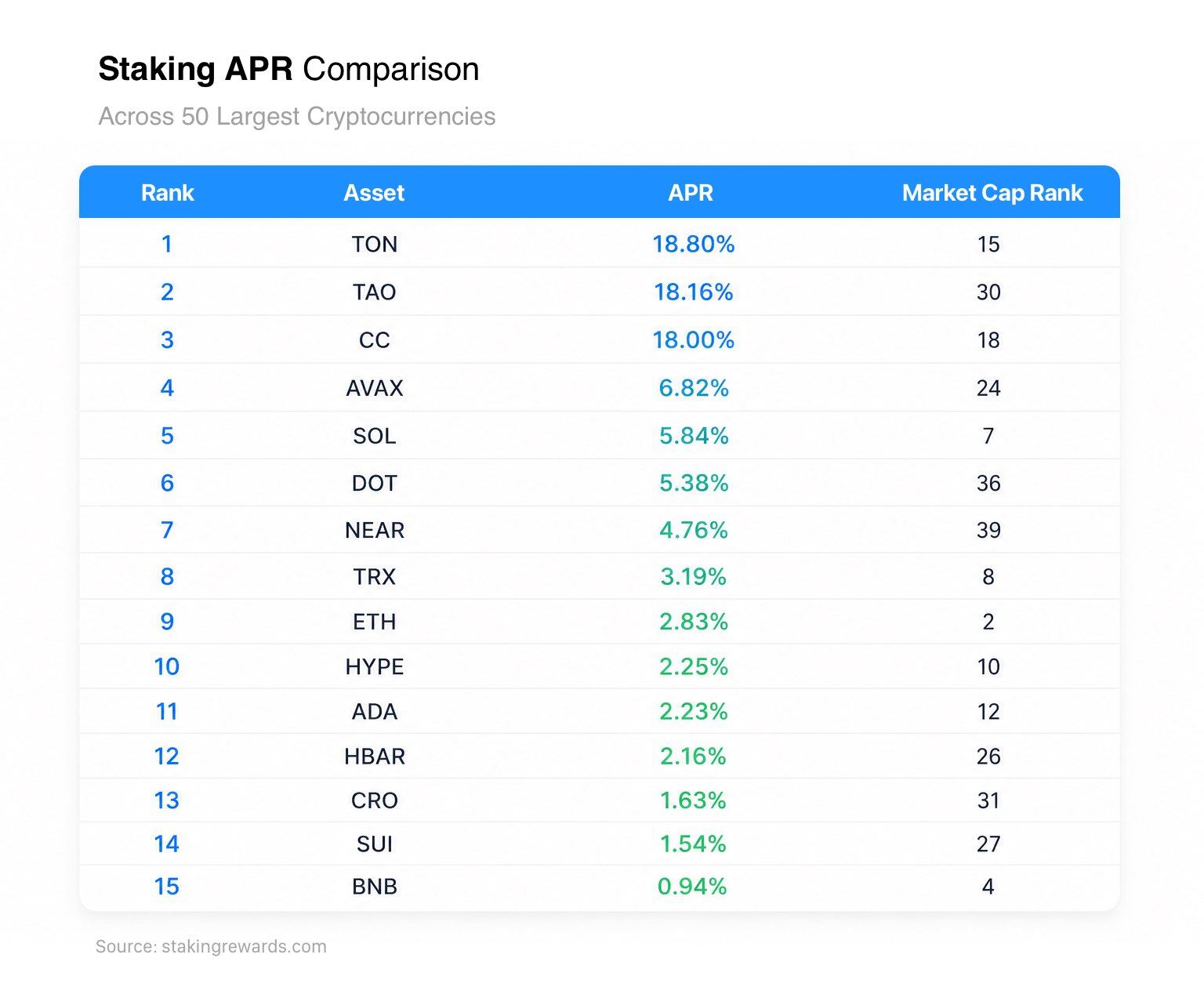
TON Annual Staking Reward Ranks First Among Top 50 Cryptocurrencies

This also makes TON's story somewhat more complete. It doesn't just rely on Telegram's user entry to attract attention or improve experience through technical upgrades; it's also using staking rewards to keep capital within the ecosystem. The simultaneous emergence of entry point, performance, validator role, and yield gives this change more weight than a single positive factor.

Of course, high yield itself is not the end goal; it's more like buying TON a longer observation period. If subsequent developer tools and performance upgrades are delivered, and more capital is locked into the network, it could form a positive feedback loop with real usage. For TON, the value of staking rewards isn't just about increasing holding returns; it's about making the market willing to continue waiting for it to truly convert Telegram's entry advantage.

TON Returning to Telegram Is Not the Finish Line, But a More Difficult Hurdle

The key for TON going forward is not to continue leveraging Telegram for traffic, but to truly become part of Telegram's application ecosystem. If Telegram's chatting, payments, applications, creator economy, and automated interactions are gradually handled by TON, then TON's competitors would not just be other Layer1s, but all networks attempting to become the next-generation application infrastructure.

TON isn't just retelling the social traffic story; it's beginning to attempt to turn social traffic into on-chain order. The entry point is just the beginning; usage is the answer. Telegram can bring TON to the forefront, but whether it stays depends ultimately on TON's ability to become that layer of infrastructure operating behind user perception, within application mechanics.

If past TON was proving how close it was to Telegram, now it must prove how deeply it can integrate into Telegram's daily usage. True mainstream adoption isn't making users aware they're using a chain; it's making the chain an integral part of the application experience.

TON's opportunity lies here, and so does its pressure.

Domande pertinenti

QWhat are the key changes announced by Telegram regarding the TON network according to the article?

AThe article states that Telegram founder Pavel Durov announced that TON network fees have been reduced sixfold, to near-zero levels. Crucially, Telegram will replace the TON Foundation as the network's core driver and become its largest validator. The focus will shift to technical advantages like a new ton.org, new developer tools, and performance upgrades over the next 2-3 weeks.

QHow does the article explain the previous relationship between TON and Telegram, and what is the significance of the new change?

APreviously, the relationship was described as 'strongly bound but weakly led.' Telegram provided the entry point, while the Foundation and community drove development, with a layer of separation. The new change signifies that Telegram is moving beyond just providing users and is now entering more foundational layers like validation, technical direction, and development tools. TON is being reintegrated into Telegram's product system.

QAccording to the article, why are the fee reduction and speed increase on TON particularly important in the context of Telegram?

AThe fee reduction and speed increase are crucial for enabling small-scale, high-frequency transactions within Telegram's ecosystem. Potential on-chain activities in Telegram, such as tipping, mini-app rewards, and group payments, involve small, frequent amounts. Near-zero fees lower the usage barrier, and a faster finality time (0.6 seconds) reduces the perception of waiting, allowing the blockchain to operate seamlessly behind user actions.

QWhat potential concern does the article raise about Telegram becoming the largest validator for TON?

AThe article raises concerns about increased centralization risk. Telegram replacing the TON Foundation as the main driving force and becoming the largest validator could lead to debates about TON's decentralization. While Pavel Durov argued this would attract more large participants to the validator pool, the article emphasizes the need to judge by results—such as validator diversity, transparent governance, and the independent space for the community—rather than just statements.

QWhat is the 'harder challenge' TON faces now, as described in the article's conclusion?

AThe article concludes that the harder challenge is for TON to move beyond leveraging Telegram for traffic and truly become an integral part of Telegram's application ecosystem. It must prove it can integrate deeply into daily Telegram use—like chat, payments, apps, and automated interactions—becoming the underlying infrastructure for application experience. True mainstream adoption means users don't perceive they are using a blockchain; the chain is just part of the app.

Letture associate

The Billionaires Behind the Most Expensive Midterm Election in History

"The Most Expensive Midterm Elections and Their Billionaire Backers" This analysis details the unprecedented scale of spending in the 2026 midterm elections, highlighting the key billionaire donors shaping the political landscape. Jeff Yass, founder of Susquehanna International Group, has contributed over $81 million, ranking third among individual donors behind George Soros ($102.6M) and Elon Musk ($84.8M). Yass is a major donor to Trump's MAGA Inc. and supports school choice and various candidates. Overall, federal committees have raised over $4.7 billion this cycle, with political ad spending projected to reach $10.8 billion. Republican-aligned groups are significantly out-raising their Democratic counterparts. "Dark money" from undisclosed sources continues to grow. The core stakes involve control of Congress and policy direction for Trump's final term. Donors are also motivated by specific issues: Sergey Brin and Chris Larsen are funding opposition to a proposed California wealth tax and supporting crypto-friendly policies. Other top donors include OpenAI's Greg Brockman and his wife Anna ($50M total to MAGA Inc. and an AI-focused PAC), Richard Uihlein ($45.3M to conservative causes), venture capitalists Marc Andreessen and Ben Horowitz (each over $44M to crypto/AI PACs and MAGA Inc.), Miriam Adelson ($42.6M to GOP leadership PACs), Paul Singer ($33.9M), and Diane Hendricks ($25.8M to MAGA Inc.). The article notes that the peak fundraising period is still ahead, with major primaries approaching.

marsbit2 min fa

The Billionaires Behind the Most Expensive Midterm Election in History

marsbit2 min fa

The Largest IPO in History Is Approaching, Surpassing SpaceX, 28 Years of AI Self-Iteration, Countdown to Intelligence Explosion

"Anthropic Nears Trillion-Dollar IPO, Fueled by Explosive Growth and 2028 'Intelligence Explosion' Warning Anthropic is considering a deal valuing the AI company near $1 trillion, potentially leading to one of the largest IPOs ever and surpassing SpaceX. Its revenue has skyrocketed, with Annual Recurring Revenue (ARR) reaching $45 billion in May 2026—a 500% increase in just five months. This vertical growth curve is attributed to its key products, Claude Code and Cowork, dominating AI coding and enterprise collaboration. Beyond commercial success, co-founder Jack Clark issued a pivotal warning in an interview: there is a greater than 50% chance that by the end of 2028, AI systems will achieve recursive self-improvement—the ability to autonomously build a 'better version' of themselves, initiating an 'intelligence explosion.' This prophecy underpins the company's astronomical valuation, as the market prices in the potential for transformative and disruptive AI. Further signaling its ambition, Anthropic formed a $1.5 billion joint venture with Goldman Sachs and Blackstone, aiming to disrupt traditional consulting firms like McKinsey by deploying Claude AI for complex strategic work. This move tests AI's capacity to replace high-level cognitive labor, a precursor to its predicted autonomous evolution. The narrative presents a dual future: unprecedented economic opportunity alongside significant risks like economic restructuring and security threats. Anthropic's meteoric rise and Clark's 2028 prediction frame the coming years as a countdown to a potential technological singularity."

marsbit13 min fa

The Largest IPO in History Is Approaching, Surpassing SpaceX, 28 Years of AI Self-Iteration, Countdown to Intelligence Explosion

marsbit13 min fa

Has Hook Summer Really Arrived? sato, Lo0p, FLOOD Ignite the New Narrative of Uniswap v4

"Hook Summer" Arrives? Sato, Lo0p, FLOOD Ignite Uniswap v4 Narrative Amidst a slight market recovery, attention within the Ethereum ecosystem has shifted to Meme coins built on Uniswap v4's Hook protocol. Following ASTEROID, tokens like sato, sat1, Lo0p, and FLOOD have become market focal points, with market caps ranging from millions to tens of millions, bringing concentrated liquidity to a narrative-dry market. Uniswap v4 Hooks are "plugin smart contracts" that allow developers to inject custom logic at key points in a liquidity pool's lifecycle (initialization, adding/removing liquidity, swaps, etc.), making the AMM programmable. Recent representative projects include: * **sato**: Market cap peaked over $38M; uses a v4 curve mechanism for minting/burning, locking ETH as reserve. * **sat1**: Market cap briefly exceeded $10M, positioning as an "optimized sato," but later declined significantly. * **Lo0p**: Market cap neared $6.6M; a "lending AMM protocol" allowing users to borrow ETH against deposited LO0P tokens without immediate selling pressure. * **FLOOD**: Market cap approached $6M; channels trading reserves into Aave v3 to generate yield, which is retained in the pool. The emergence of these Hook-based tokens could drive long-term growth for the Uniswap ecosystem by attracting users and liquidity to v4 pools. Combined with Uniswap's activated fee switch (partially used to burn UNI), the long-term outlook for UNI appears positive. However, short-term UNI price appreciation is not directly guaranteed. Factors include the sustainability and lifecycle of these new tokens, their price volatility, overall market conditions, and regulatory pressures. Currently, Uniswap v4's TVL ($595M) lags behind v3 and v2, indicating Hook adoption still requires time to mature. In summary, the Hook ecosystem serves as "long-term nourishment" for UNI, but acts more as a "catalyst" than a direct "booster" in the short term. Note: These are early-stage experimental tokens and may carry unknown risks.

marsbit39 min fa

Has Hook Summer Really Arrived? sato, Lo0p, FLOOD Ignite the New Narrative of Uniswap v4

marsbit39 min fa

Trading

Spot
Futures

Articoli Popolari

Come comprare TON

Benvenuto in HTX.com! Abbiamo reso l'acquisto di The Open Network (TON) semplice e conveniente. Segui la nostra guida passo passo per intraprendere il tuo viaggio nel mondo delle criptovalute.Step 1: Crea il tuo Account HTXUsa la tua email o numero di telefono per registrarti il tuo account gratuito su HTX. Vivi un'esperienza facile e sblocca tutte le funzionalità,Crea il mio accountStep 2: Vai in Acquista crypto e seleziona il tuo metodo di pagamentoCarta di credito/debito: utilizza la tua Visa o Mastercard per acquistare immediatamente The Open NetworkTON.Bilancio: Usa i fondi dal bilancio del tuo account HTX per fare trading senza problemi.Terze parti: abbiamo aggiunto metodi di pagamento molto utilizzati come Google Pay e Apple Pay per maggiore comodità.P2P: Fai trading direttamente con altri utenti HTX.Over-the-Counter (OTC): Offriamo servizi su misura e tassi di cambio competitivi per i trader.Step 3: Conserva The Open Network (TON)Dopo aver acquistato The Open Network (TON), conserva nel tuo account HTX. In alternativa, puoi inviare tramite trasferimento blockchain o scambiare per altre criptovalute.Step 4: Scambia The Open Network (TON)Scambia facilmente The Open Network (TON) nel mercato spot di HTX. Accedi al tuo account, seleziona la tua coppia di trading, esegui le tue operazioni e monitora in tempo reale. Offriamo un'esperienza user-friendly sia per chi ha appena iniziato che per i trader più esperti.

1.7k Totale visualizzazioniPubblicato il 2024.12.10Aggiornato il 2025.03.21

Come comprare TON

Discussioni

Benvenuto nella Community HTX. Qui puoi rimanere informato sugli ultimi sviluppi della piattaforma e accedere ad approfondimenti esperti sul mercato. Le opinioni degli utenti sul prezzo di TON TON sono presentate come di seguito.

活动图片