Raising Interest Rates Is Not a Tech Killer, EPS Is: A Strategy for Discarding the Weak and Retaining the Strong After the AI Theme's Sharp Decline

marsbitPubblicato 2026-06-11Pubblicato ultima volta 2026-06-11

Introduzione

**Summary: Rising Interest Rates Are Not the Killer of Tech; EPS Is: The "Keep the Strong, Ditch the Weak" Strategy After the AI Theme Plunge** The author argues that the sharp sell-off in tech and AI-related stocks, triggered by a strong US jobs report that heightened Fed rate hike fears, represents a "pullback to pick up passengers" rather than a "car crash." The true end of a tech bull market is not determined by an extra 25 basis point hike, but by industry overcapacity and the disproval of earnings per share (EPS) expectations. Historical analysis shows that during past rate hike cycles, the Nasdaq-100 often outperformed, provided EPS growth remained strong. The current phase is seen as a shift from a "broad narrative-driven rally" to a "focused verification stage" for AI. The investment strategy should be to "keep the strong, ditch the weak." * **Retain exposure** to high-conviction AI infrastructure leaders with clear order visibility, stable margins, strong cash flow, and upward EPS revisions (e.g., AI servers, advanced packaging, optical modules, key cloud suppliers). * **Reduce exposure** to high-beta, narrative-driven stocks with unclear profit paths (e.g., some quantum computing, space, or speculative chip stocks), especially on rebounds. Valuation concerns should focus on whether earnings can catch up to high multiples, not on high P/E alone. Crowded positioning signals a concentration into quality assets, not necessarily a market top. The upcoming Q2 ear...

Author: BIT

Investment Summary

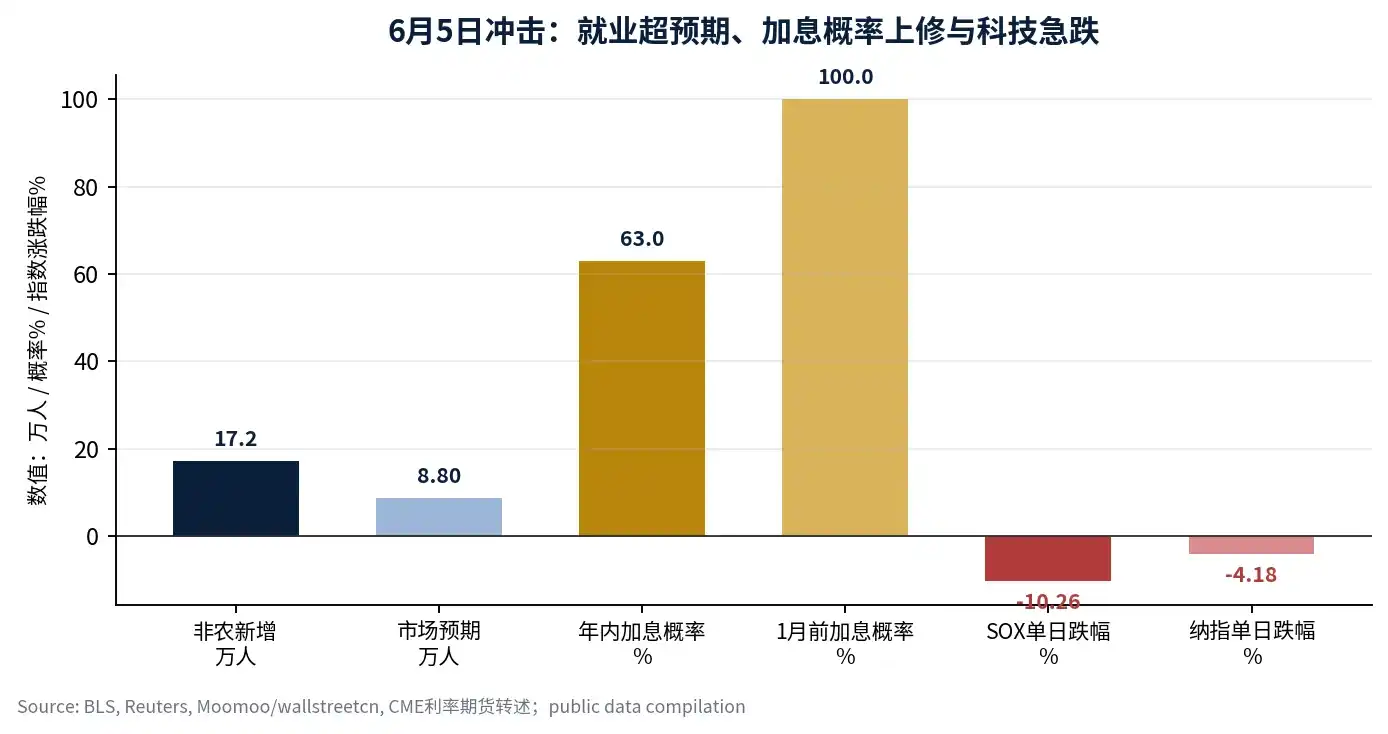
My conclusion is simple: the true killers of a tech rally are not the Fed hiking rates by another 25 basis points, but industry overcapacity and EPS being invalidated. Before these two signals appear, the sharp decline like the one on June 5th is more akin to "pulling back to pick up passengers," not a "crash and total loss." This statement is the main thesis of this report and my principle for managing positions amid this round of interest rate hike panic. The US non-farm payrolls added 172k jobs in May, significantly higher than the market expectation of 88k, pushing market expectations for a rate hike this year to 63% and close to 100% before January next year. The Philadelphia Semiconductor Index fell over 10% that day, and the Nasdaq fell 4.18%. However, I will not abandon the tech theme because of a single macro data day, because historically, what truly determines whether tech stocks can weather interest rate fluctuations is not the rates themselves, but whether EPS is still being revised upwards. [1] [2]

My judgment is that the current AI trade has shifted from a "broad-brush narrative" phase to a "tightening circle verification" phase. This is not a stage where one can continue buying all high-beta tech stocks indiscriminately, nor is it a stage where the AI theme has ended. Core positions should be allocated to leading assets with high order visibility, stable gross margins, strong cash flow quality, and EPS that can still be revised upwards by analysts; for stocks in quantum computing, aerospace, some small-cap chip story stocks lacking a profit loop, one should reduce positions or hedge portfolio volatility using options structures during rebounds.
I. Fact Check: Rate Hike Panic Is a Trigger, Not the Root Cause

The market reaction on June 5th was very sharp, but the trigger chain was not complex. Official BLS data shows US non-farm payrolls increased by 172k in May, with the unemployment rate holding at 4.3%, and March and April payrolls revised up by a total of 93k; strong employment data intensified market concerns about sticky inflation and further rate hikes. [3] Reuters and market reports show the Nasdaq fell 4.18% that day, the Philadelphia Semiconductor Index (SOX) fell over 10% in a single day, and investors quickly repriced risk assets for a "higher for longer" interest rate scenario. [1] [2]

Variable

Change Around June 5

My Interpretation

US May Non-Farm Payrolls

172k, significantly higher than 88k expectation

Short-term repricing on the interest rate front, but employment structure still needs to look at wages and inflation transmission

Unemployment Rate

4.3%, flat vs. prior

Labor market shows no recessionary deterioration, suppressing rate cut expectations instead

Rate Hike Probability This Year

Market transmission rises to 63%

Valuation pressure on long-duration assets, first hitting high-valuation tech

SOX Index

Single-day drop over 10%

Semiconductors are the core crowded trade, first hit by liquidity shock

Nasdaq Index

Single-day drop 4.18%

Clear panic at the index level, but does not equate to AI EPS being invalidated

I define this decline as a concentrated release of interest rate shock combined with a crowded trade. It will wipe out the part of valuation that expanded too quickly and force capital to withdraw from weak-thesis, high-volatility, low-profit-certainty stocks; but if there is no substantial downgrade in AI infrastructure orders, cloud provider capex, GPU/optical module/PCB demand, the tech theme has not ended because of this day's decline.

II. Historical Review: The Lesson from 1999 Is Not "Chase Bubbles," but "Look at EPS"

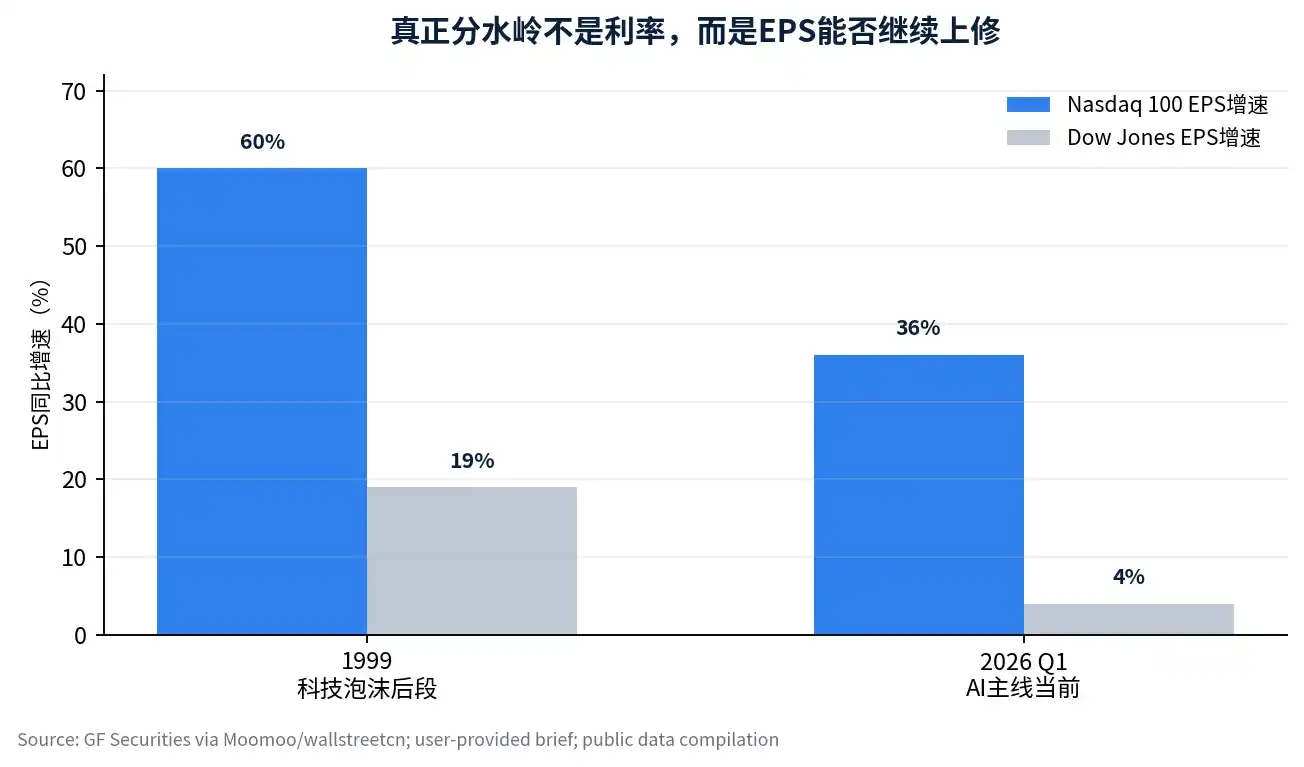
The 1999 dot-com bubble period is often cited as a warning for today's tech stocks, but I believe this analogy cannot focus solely on valuation; it must also look at earnings. At that time, the Fed entered a continuous rate hike cycle, the Dow traded sideways overall, while the Nasdaq continued to rise sharply until peaking in March 2000. Moomoo's reposted institutional research mentions that in 1999, Nasdaq 100 EPS grew about 60%, while Dow EPS growth lagged significantly; by Q1 2026, Nasdaq 100 EPS grew about 36%, the Dow about 4%, revealing a renewed profit divergence structure. [2]
Nasdaq Investment Intelligence's research on past rate-hike phases over the past 30+ years also supports the same conclusion. Among the 13 rate-hike phases lasting at least 6 months between 1985 and 2021, the Nasdaq-100 had an average cumulative return of 22.6%, higher than the S&P 500's 11.3% and the Dow's 12.7%; in the phase from October 1998 to January 2000 when the 10-year Treasury yield rose about 220 basis points, the Nasdaq-100 rose 165.3%, significantly exceeding the S&P 500 and Dow. [4]
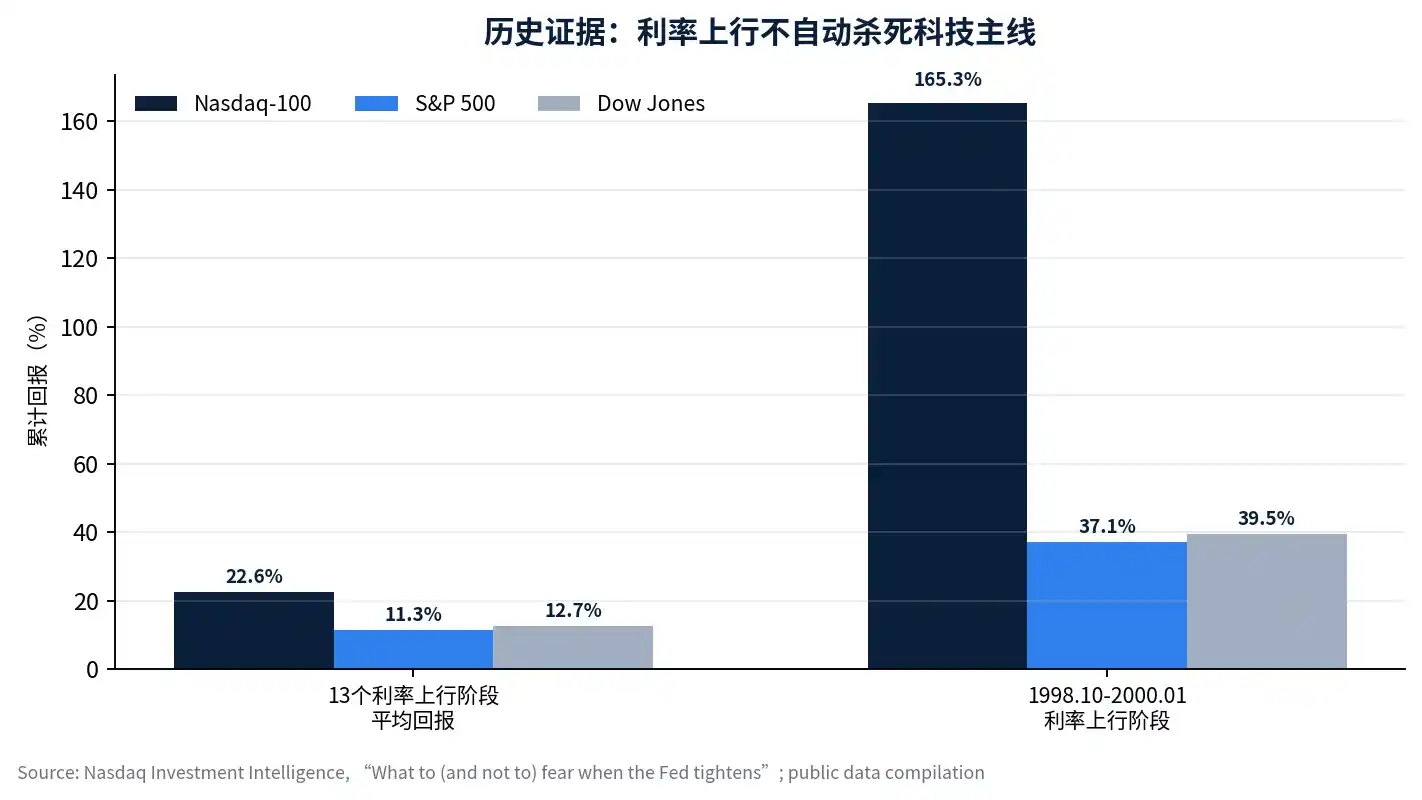
The inspiration this history gives me is not "high valuations can rise forever," but that interest rates are not a sufficient condition for selling tech stocks. The real dangers are two things: first, stock prices are driven only by PE expansion, with EPS not keeping up; second, industry competition begins to deteriorate, with leading players' gross margins and cash flows turning down first. If these two things haven't happened, interest rate hikes are more about adjusting the pace, not directly sentencing the main theme to death.

III. Valuation Framework: Focus on Business Cycle Short-Term, Safety Margin Long-Term

I do not agree with mechanically judging whether AI leaders are in a bubble using a single PE or PB percentile. In the short term (one-year horizon), stock prices are primarily determined by revenue growth rate, change in ROE, and EPS revision direction; in a three-to-five-year horizon, PB, free cash flow yield, and capital return cycle will truly determine long-term returns. Pacer ETFs' Nasdaq-100 research shows that at the end of 1999, the Nasdaq-100 was about 73x earnings with a free cash flow yield of only 0.76%; at the end of 2023, it was about 31x earnings with a free cash flow yield of 2.68%, and the current leaders' sales, profit, and free cash flow scale are also incomparable to internet bubble companies in 1999. [5]

Valuation Question

Wrong View

My Judgment Method

Does High PB Mean Bubble?

High PB equals bubble

Look at ROE, technological moat, capex return rate, and EPS revision direction

Must High PE Be Sold?

Reduce position if PE percentile is high

If EPS keeps being revised up, high PE may be digested by earnings; high PE is dangerous only if EPS stagnates

Are AI Leaders Too Crowded?

Crowded equals topping

Crowding is more like a signal for tightening the circle, with capital flowing from weak assets back to strong ones

How to Handle Rate Hikes?

Sell tech entirely

Reduce leverage, discard the weak and retain the strong, keep core positions with strongest EPS evidence

Therefore, I categorize AI core assets into two types. The first type are "toll booth assets" with real orders, real gross margins, and real cash flows, including the AI server chain, advanced packaging, optical modules, PCBs, core suppliers for cloud capex, etc. The second type are high-beta assets with only long-term narratives and vague profit realization paths, such as some quantum computing, aerospace, concept chip, and small software stocks lacking order validation. The former should be considered for buying windows during sharp declines, while the latter should reduce risk exposure during rebounds.

IV. Crowding: This Is Tightening the Circle, Not the First Top

The current capital concentration on AI core assets, creating a siphon effect away from dividends, small/micro caps, and non-theme assets, must be acknowledged. But crowding itself does not equal a top. A real top often requires three conditions simultaneously: first, industry capital expenditure shows marginal slowdown; second, leading players' competitive landscape deteriorates, with price wars or gross margin declines emerging; third, the EPS upward revision trend stops, even reverses to downgrades. So far, this round of adjustment aligns more with the characteristics of a "left-stage rotation from high to low" and "tightening the circle of the main theme," rather than confirming the first medium-term top for AI. [2]
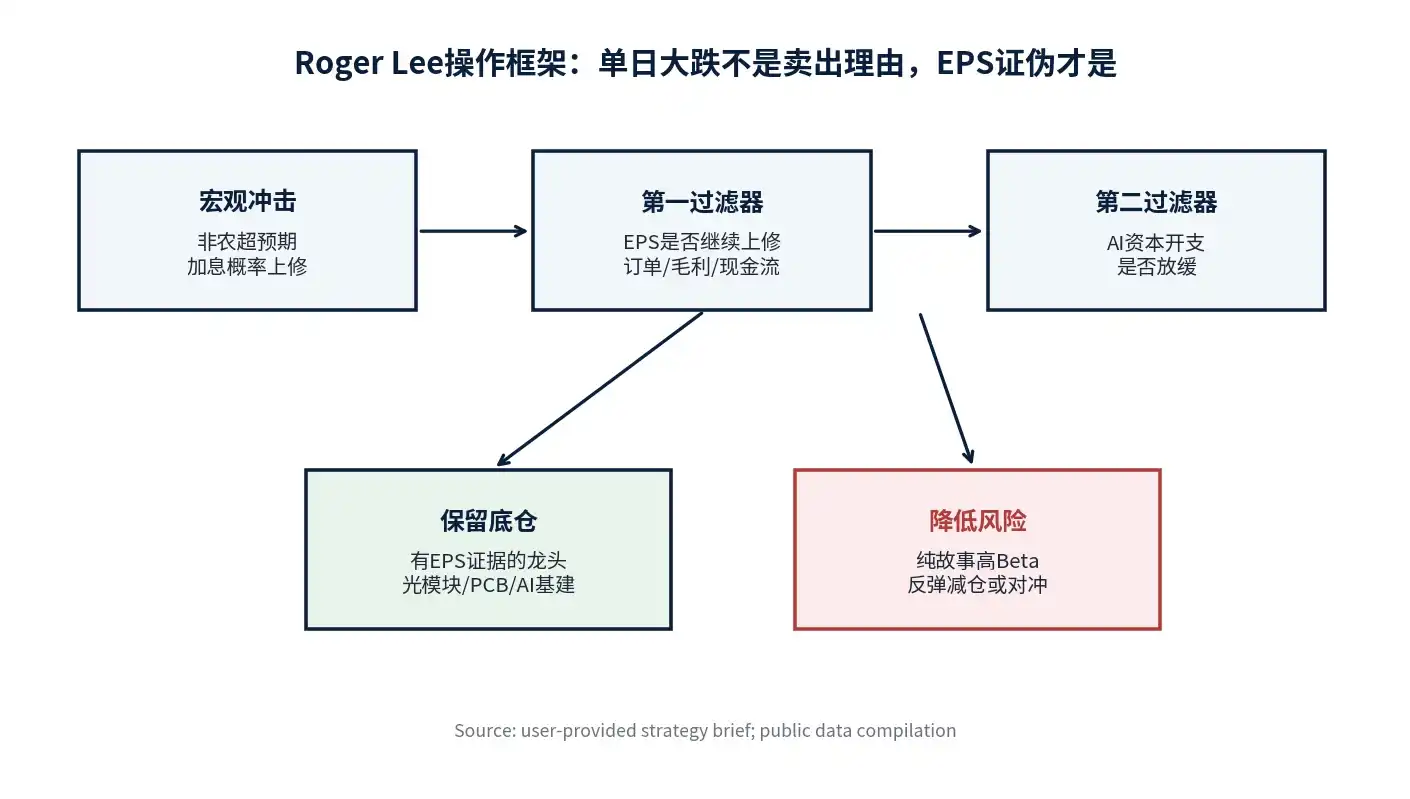
I will regard the period from late June to the Q2 earnings season in July as the real verification window. Interim report previews for A-shares, Q2 guidance for US tech stocks, cloud providers' capex language, and semiconductor supply chain order visibility will collectively determine whether this adjustment is a healthy turnover or the beginning of earnings invalidation for the main theme.

V. My Investment Interpretation: Don't Abandon the Tech Theme, But Must Discard the Weak and Retain the Strong

My operational principle is: allocate core positions to leaders with EPS evidence, and no longer waste risk budget on high-beta varieties with pure narratives. Within the AI infrastructure chain, I prefer holding companies with high order visibility, stable gross margins, good cash flows, and those in rigid segments of customer capital expenditure. Optical modules, PCBs, AI servers, advanced packaging, cloud infrastructure, and software platforms with pricing power are areas where I am willing to tolerate volatility.

Asset Category

Current Action

Core Rationale

Risk Control

AI Infrastructure Leaders

Keep core positions, observe on batches during sharp drops

EPS and order evidence still exists, short-term rate shock doesn't change industry trend

Don't chase highs, wait for key nodes to pass

Optical Modules/PCB/Advanced Packaging

Maintain core focus

Most direct transmission of AI server capex to hardware chain

Reduce weight immediately if gross margin or orders downgraded

Cloud & Platform Software

Select those with strong ecosystem moats

AI application entry points and enterprise refresh cycles still have long-term value

Guard against excessive valuation front-running

Quantum/Aerospace/Some Concept Chips

Reduce positions on rebounds

Strong narrative, weak EPS, most vulnerable to valuation compression during rate hikes

Can use options to hedge high-beta exposure

Dividend & Cash-like Assets

As portfolio stabilizer

Hedge macro node uncertainty

Don't treat defensive positions as long-term main theme

This is not blind optimism. On the contrary, I believe the coming month requires stricter monitoring of four nodes: CPI on June 10th – if core inflation exceeds expectations due to oil price transmission, reduce leverage; Oil prices and US-Iran tensions – if oil prices remain high long-term, will increase inflation stickiness; Mid-June ECB and BOJ meetings – will impact global liquidity; Waller's speech on June 18th – if extremely hawkish, will reshape rate path pricing. Macro nodes determine the rhythm, EPS determines the direction.

VI. Conclusion: Pulling Back to Pick Up Passengers, But Only Those With Earnings

I will not abandon the tech theme because of the single-day sharp decline on June 5th, but I will upgrade my portfolio from "buying the AI story" to "buying the AI income statement." If a company can prove sustained fulfillment of orders, gross margins, cash flow, and EPS, its decline amid interest rate shock is more like an opportunity; if a company only has a concept without a profit path, it should be reduced during rebounds.

The final conclusion remains the opening sentence: the killers of a tech rally are industry overcapacity and EPS being invalidated, not the Fed hiking by another 25bp. The current adjustment is "pulling back to pick up passengers," not a "crash and total loss"; hold positions with earnings, wait for the four major nodes to pass.

This report is prepared by a guest analyst. The views expressed herein represent the author's personal stance and do not represent the views of the BIT platform. This material is for reference only and does not constitute investment advice.


Domande pertinenti

QAccording to the article, what is the real threat to the technology stock rally, and what event is the recent sharp decline on June 5th compared to?

AAccording to the article, the real threats to the technology stock rally are industry-wide competition and EPS (Earnings Per Share) being disproven, not the Federal Reserve's interest rate hikes. The recent sharp decline on June 5th is compared to a car 'reversing to pick up passengers' ('倒车接人'), implying it's a buying opportunity, rather than a catastrophic event ('车毁人亡').

QWhat historical period does the article reference to argue that interest rate hikes alone are not a sufficient reason to sell tech stocks? What was the key supporting metric during that period?

AThe article references the 1999-2000 Dot-com bubble period to argue that interest rate hikes alone are not a sufficient reason to sell tech stocks. The key supporting metric was that during that time, despite rising rates, the Nasdaq-100's EPS growth was significantly higher than that of the Dow Jones Industrial Average, showing that strong earnings can offset valuation pressures from rates.

QWhat are the three conditions the article states are needed for a true market top to be confirmed in the AI sector?

AThe three conditions needed for a true market top in the AI sector are: 1) A marginal slowdown in industry capital expenditure. 2) Deterioration in the competitive landscape for leading companies, such as the start of price wars or declining gross margins. 3) A halt or reversal in the upward revision trend of EPS.

QHow does the author categorize AI-related assets for investment strategy? Provide examples for the main category.

AThe author categorizes AI-related assets into two main types. The first category, which should form the core holdings, consists of assets with real orders, stable gross margins, strong cash flow, and clear EPS evidence. Examples include AI server supply chains, advanced packaging, optical modules, PCBs, and core suppliers to cloud capital expenditure.

QWhat is the author's core investment principle and action plan regarding the technology/AI investment theme after the market decline?

AThe author's core investment principle is '去弱留强' (discard the weak, keep the strong). The action plan is to maintain core holdings in leading companies with solid EPS evidence and order visibility, using sharp declines as potential buying opportunities. Conversely, high-beta assets with strong narratives but weak profit paths (e.g., quantum computing, space stocks, some conceptual chips) should be reduced during rebounds.

Letture associate

The Largest IPO in History Ignites Heated Debate: Is SpaceX Worth $1.77 Trillion?

SpaceX's potential IPO is priced at $135 per share, aiming to raise $75 billion and valuing the company at approximately $1.77 trillion, which would make it the largest IPO in history. This valuation has sparked intense debate among investors. Bullish analysts, including major underwriters Goldman Sachs and Morgan Stanley, argue the valuation is justified by SpaceX's long-term potential. They see it not just as a rocket company but as a future leader in space infrastructure, with key growth drivers being Starlink satellite internet, low-cost rocket launches, and future AI-related ventures. They project revenues reaching hundreds of billions to trillions of dollars by 2030-2040. ARK Invest's model suggests a 2030 enterprise value could reach $2.5 trillion. Bearish analysts from independent research firms like Morningstar, PitchBook, and New Constructs contend the IPO price is excessively high, already pricing in unrealistic future growth. Using DCF and sum-of-the-parts models, they estimate fair value between $780 billion and $1.7 trillion, significantly below the IPO target. They highlight risks such as the speculative nature of AI projections, over-dependence on Elon Musk, high growth expectations, and corporate governance concerns. Trefis set a target price of just $79 per share. While both sides acknowledge SpaceX's unique position in commercial space, the core disagreement centers on whether the $135 share price offers a reasonable margin of safety or is overly optimistic. Despite the valuation controversy, reported strong demand for the IPO indicates significant market interest.

marsbit2 h fa

The Largest IPO in History Ignites Heated Debate: Is SpaceX Worth $1.77 Trillion?

marsbit2 h fa

Trading

Spot
Futures

Articoli Popolari

Cosa è $S$

Comprendere SPERO: Una Panoramica Completa Introduzione a SPERO Mentre il panorama dell'innovazione continua a evolversi, l'emergere delle tecnologie web3 e dei progetti di criptovaluta gioca un ruolo fondamentale nel plasmare il futuro digitale. Un progetto che ha attirato l'attenzione in questo campo dinamico è SPERO, denotato come SPERO,$$s$. Questo articolo mira a raccogliere e presentare informazioni dettagliate su SPERO, per aiutare gli appassionati e gli investitori a comprendere le sue basi, obiettivi e innovazioni nei domini web3 e crypto. Che cos'è SPERO,$$s$? SPERO,$$s$ è un progetto unico all'interno dello spazio crypto che cerca di sfruttare i principi della decentralizzazione e della tecnologia blockchain per creare un ecosistema che promuove l'impegno, l'utilità e l'inclusione finanziaria. Il progetto è progettato per facilitare interazioni peer-to-peer in modi nuovi, fornendo agli utenti soluzioni e servizi finanziari innovativi. Al suo interno, SPERO,$$s$ mira a responsabilizzare gli individui fornendo strumenti e piattaforme che migliorano l'esperienza dell'utente nello spazio delle criptovalute. Questo include la possibilità di metodi di transazione più flessibili, la promozione di iniziative guidate dalla comunità e la creazione di percorsi per opportunità finanziarie attraverso applicazioni decentralizzate (dApps). La visione sottostante di SPERO,$$s$ ruota attorno all'inclusività, cercando di colmare le lacune all'interno della finanza tradizionale mentre sfrutta i vantaggi della tecnologia blockchain. Chi è il Creatore di SPERO,$$s$? L'identità del creatore di SPERO,$$s$ rimane piuttosto oscura, poiché ci sono risorse pubblicamente disponibili limitate che forniscono informazioni dettagliate sul suo fondatore o fondatori. Questa mancanza di trasparenza può derivare dall'impegno del progetto per la decentralizzazione—un ethos che molti progetti web3 condividono, dando priorità ai contributi collettivi rispetto al riconoscimento individuale. Centrando le discussioni attorno alla comunità e ai suoi obiettivi collettivi, SPERO,$$s$ incarna l'essenza dell'empowerment senza mettere in evidenza individui specifici. Pertanto, comprendere l'etica e la missione di SPERO rimane più importante che identificare un creatore singolo. Chi sono gli Investitori di SPERO,$$s$? SPERO,$$s$ è supportato da una varietà di investitori che vanno dai capitalisti di rischio agli investitori angelici dedicati a promuovere l'innovazione nel settore crypto. Il focus di questi investitori generalmente si allinea con la missione di SPERO—dando priorità a progetti che promettono avanzamenti tecnologici sociali, inclusività finanziaria e governance decentralizzata. Queste fondazioni di investitori sono tipicamente interessate a progetti che non solo offrono prodotti innovativi, ma contribuiscono anche positivamente alla comunità blockchain e ai suoi ecosistemi. Il supporto di questi investitori rafforza SPERO,$$s$ come un concorrente degno di nota nel dominio in rapida evoluzione dei progetti crypto. Come Funziona SPERO,$$s$? SPERO,$$s$ impiega un framework multifunzionale che lo distingue dai progetti di criptovaluta convenzionali. Ecco alcune delle caratteristiche chiave che sottolineano la sua unicità e innovazione: Governance Decentralizzata: SPERO,$$s$ integra modelli di governance decentralizzati, responsabilizzando gli utenti a partecipare attivamente ai processi decisionali riguardanti il futuro del progetto. Questo approccio favorisce un senso di proprietà e responsabilità tra i membri della comunità. Utilità del Token: SPERO,$$s$ utilizza il proprio token di criptovaluta, progettato per servire varie funzioni all'interno dell'ecosistema. Questi token abilitano transazioni, premi e la facilitazione dei servizi offerti sulla piattaforma, migliorando l'impegno e l'utilità complessivi. Architettura Stratificata: L'architettura tecnica di SPERO,$$s$ supporta la modularità e la scalabilità, consentendo un'integrazione fluida di funzionalità e applicazioni aggiuntive man mano che il progetto evolve. Questa adattabilità è fondamentale per mantenere la rilevanza nel panorama crypto in continua evoluzione. Coinvolgimento della Comunità: Il progetto enfatizza iniziative guidate dalla comunità, impiegando meccanismi che incentivano la collaborazione e il feedback. Nutrendo una comunità forte, SPERO,$$s$ può affrontare meglio le esigenze degli utenti e adattarsi alle tendenze di mercato. Focus sull'Inclusione: Offrendo basse commissioni di transazione e interfacce user-friendly, SPERO,$$s$ mira ad attrarre una base utenti diversificata, inclusi individui che potrebbero non aver precedentemente interagito nello spazio crypto. Questo impegno per l'inclusione si allinea con la sua missione generale di empowerment attraverso l'accessibilità. Cronologia di SPERO,$$s$ Comprendere la storia di un progetto fornisce preziose intuizioni sulla sua traiettoria di sviluppo e sui traguardi. Di seguito è riportata una cronologia suggerita che mappa eventi significativi nell'evoluzione di SPERO,$$s$: Fase di Concettualizzazione e Ideazione: Le idee iniziali che formano la base di SPERO,$$s$ sono state concepite, allineandosi strettamente con i principi di decentralizzazione e focus sulla comunità all'interno dell'industria blockchain. Lancio del Whitepaper del Progetto: Dopo la fase concettuale, è stato rilasciato un whitepaper completo che dettaglia la visione, gli obiettivi e l'infrastruttura tecnologica di SPERO,$$s$ per suscitare interesse e feedback dalla comunità. Costruzione della Comunità e Prime Interazioni: Sono stati effettuati sforzi attivi di outreach per costruire una comunità di early adopters e potenziali investitori, facilitando discussioni attorno agli obiettivi del progetto e ottenendo supporto. Evento di Generazione del Token: SPERO,$$s$ ha condotto un evento di generazione del token (TGE) per distribuire i propri token nativi ai primi sostenitori e stabilire una liquidità iniziale all'interno dell'ecosistema. Lancio della Prima dApp: La prima applicazione decentralizzata (dApp) associata a SPERO,$$s$ è stata attivata, consentendo agli utenti di interagire con le funzionalità principali della piattaforma. Sviluppo Continuo e Partnership: Aggiornamenti e miglioramenti continui alle offerte del progetto, inclusi partnership strategiche con altri attori nello spazio blockchain, hanno plasmato SPERO,$$s$ in un concorrente competitivo e in evoluzione nel mercato crypto. Conclusione SPERO,$$s$ rappresenta una testimonianza del potenziale del web3 e delle criptovalute di rivoluzionare i sistemi finanziari e responsabilizzare gli individui. Con un impegno per la governance decentralizzata, il coinvolgimento della comunità e funzionalità progettate in modo innovativo, apre la strada verso un panorama finanziario più inclusivo. Come per qualsiasi investimento nello spazio crypto in rapida evoluzione, si incoraggiano potenziali investitori e utenti a ricercare approfonditamente e a impegnarsi in modo riflessivo con gli sviluppi in corso all'interno di SPERO,$$s$. Il progetto mostra lo spirito innovativo dell'industria crypto, invitando a ulteriori esplorazioni delle sue innumerevoli possibilità. Mentre il percorso di SPERO,$$s$ è ancora in fase di sviluppo, i suoi principi fondamentali potrebbero effettivamente influenzare il futuro di come interagiamo con la tecnologia, la finanza e tra di noi in ecosistemi digitali interconnessi.

75 Totale visualizzazioniPubblicato il 2024.12.17Aggiornato il 2024.12.17

Cosa è $S$

Cosa è AGENT S

Agent S: Il Futuro dell'Interazione Autonoma in Web3 Introduzione Nel panorama in continua evoluzione di Web3 e criptovalute, le innovazioni stanno costantemente ridefinendo il modo in cui gli individui interagiscono con le piattaforme digitali. Uno di questi progetti pionieristici, Agent S, promette di rivoluzionare l'interazione uomo-computer attraverso il suo framework agentico aperto. Aprendo la strada a interazioni autonome, Agent S mira a semplificare compiti complessi, offrendo applicazioni trasformative nell'intelligenza artificiale (AI). Questa esplorazione dettagliata approfondirà le complessità del progetto, le sue caratteristiche uniche e le implicazioni per il dominio delle criptovalute. Cos'è Agent S? Agent S si presenta come un innovativo framework agentico aperto, progettato specificamente per affrontare tre sfide fondamentali nell'automazione dei compiti informatici: Acquisizione di Conoscenze Specifiche del Dominio: Il framework apprende in modo intelligente da varie fonti di conoscenza esterne ed esperienze interne. Questo approccio duale gli consente di costruire un ricco repository di conoscenze specifiche del dominio, migliorando le sue prestazioni nell'esecuzione dei compiti. Pianificazione su Lungo Orizzonte di Compiti: Agent S impiega una pianificazione gerarchica potenziata dall'esperienza, un approccio strategico che facilita la suddivisione e l'esecuzione efficiente di compiti complessi. Questa caratteristica migliora significativamente la sua capacità di gestire più sottocompiti in modo efficiente ed efficace. Gestione di Interfacce Dinamiche e Non Uniformi: Il progetto introduce l'Interfaccia Agente-Computer (ACI), una soluzione innovativa che migliora l'interazione tra agenti e utenti. Utilizzando Modelli Linguistici Multimodali di Grandi Dimensioni (MLLM), Agent S può navigare e manipolare senza sforzo diverse interfacce grafiche utente. Attraverso queste caratteristiche pionieristiche, Agent S fornisce un framework robusto che affronta le complessità coinvolte nell'automazione dell'interazione umana con le macchine, preparando il terreno per innumerevoli applicazioni nell'AI e oltre. Chi è il Creatore di Agent S? Sebbene il concetto di Agent S sia fondamentalmente innovativo, informazioni specifiche sul suo creatore rimangono elusive. Il creatore è attualmente sconosciuto, il che evidenzia sia la fase embrionale del progetto sia la scelta strategica di mantenere i membri fondatori sotto anonimato. Indipendentemente dall'anonimato, l'attenzione rimane sulle capacità e sul potenziale del framework. Chi sono gli Investitori di Agent S? Poiché Agent S è relativamente nuovo nell'ecosistema crittografico, informazioni dettagliate riguardanti i suoi investitori e sostenitori finanziari non sono documentate esplicitamente. La mancanza di approfondimenti pubblicamente disponibili sulle fondazioni di investimento o sulle organizzazioni che supportano il progetto solleva interrogativi sulla sua struttura di finanziamento e sulla roadmap di sviluppo. Comprendere il supporto è cruciale per valutare la sostenibilità del progetto e il suo potenziale impatto sul mercato. Come Funziona Agent S? Al centro di Agent S si trova una tecnologia all'avanguardia che gli consente di funzionare efficacemente in contesti diversi. Il suo modello operativo è costruito attorno a diverse caratteristiche chiave: Interazione Uomo-Computer Simile a Quella Umana: Il framework offre una pianificazione AI avanzata, cercando di rendere le interazioni con i computer più intuitive. Mimando il comportamento umano nell'esecuzione dei compiti, promette di elevare le esperienze degli utenti. Memoria Narrativa: Utilizzata per sfruttare esperienze di alto livello, Agent S utilizza la memoria narrativa per tenere traccia delle storie dei compiti, migliorando così i suoi processi decisionali. Memoria Episodica: Questa caratteristica fornisce agli utenti una guida passo-passo, consentendo al framework di offrire supporto contestuale mentre i compiti si sviluppano. Supporto per OpenACI: Con la capacità di funzionare localmente, Agent S consente agli utenti di mantenere il controllo sulle proprie interazioni e flussi di lavoro, allineandosi con l'etica decentralizzata di Web3. Facile Integrazione con API Esterne: La sua versatilità e compatibilità con varie piattaforme AI garantiscono che Agent S possa adattarsi senza problemi agli ecosistemi tecnologici esistenti, rendendolo una scelta attraente per sviluppatori e organizzazioni. Queste funzionalità contribuiscono collettivamente alla posizione unica di Agent S all'interno dello spazio crittografico, poiché automatizza compiti complessi e multi-fase con un intervento umano minimo. Man mano che il progetto evolve, le sue potenziali applicazioni in Web3 potrebbero ridefinire il modo in cui si svolgono le interazioni digitali. Cronologia di Agent S Lo sviluppo e le tappe di Agent S possono essere riassunti in una cronologia che evidenzia i suoi eventi significativi: 27 Settembre 2024: Il concetto di Agent S è stato lanciato in un documento di ricerca completo intitolato “Un Framework Agentico Aperto che Usa i Computer Come un Umano”, mostrando le basi per il progetto. 10 Ottobre 2024: Il documento di ricerca è stato reso pubblicamente disponibile su arXiv, offrendo un'esplorazione approfondita del framework e della sua valutazione delle prestazioni basata sul benchmark OSWorld. 12 Ottobre 2024: È stata rilasciata una presentazione video, fornendo un'idea visiva delle capacità e delle caratteristiche di Agent S, coinvolgendo ulteriormente potenziali utenti e investitori. Questi indicatori nella cronologia non solo illustrano i progressi di Agent S, ma indicano anche il suo impegno per la trasparenza e il coinvolgimento della comunità. Punti Chiave su Agent S Man mano che il framework Agent S continua a evolversi, diversi attributi chiave si distinguono, sottolineando la sua natura innovativa e il potenziale: Framework Innovativo: Progettato per fornire un uso intuitivo dei computer simile all'interazione umana, Agent S porta un approccio nuovo all'automazione dei compiti. Interazione Autonoma: La capacità di interagire autonomamente con i computer attraverso GUI segna un passo avanti verso soluzioni informatiche più intelligenti ed efficienti. Automazione di Compiti Complessi: Con la sua metodologia robusta, può automatizzare compiti complessi e multi-fase, rendendo i processi più veloci e meno soggetti a errori. Miglioramento Continuo: I meccanismi di apprendimento consentono ad Agent S di migliorare dalle esperienze passate, migliorando continuamente le sue prestazioni e la sua efficacia. Versatilità: La sua adattabilità attraverso diversi ambienti operativi come OSWorld e WindowsAgentArena garantisce che possa servire un'ampia gamma di applicazioni. Man mano che Agent S si posiziona nel panorama di Web3 e delle criptovalute, il suo potenziale per migliorare le capacità di interazione e automatizzare i processi segna un significativo avanzamento nelle tecnologie AI. Attraverso il suo framework innovativo, Agent S esemplifica il futuro delle interazioni digitali, promettendo un'esperienza più fluida ed efficiente per gli utenti in vari settori. Conclusione Agent S rappresenta un audace passo avanti nell'unione tra AI e Web3, con la capacità di ridefinire il modo in cui interagiamo con la tecnologia. Sebbene sia ancora nelle sue fasi iniziali, le possibilità per la sua applicazione sono vaste e coinvolgenti. Attraverso il suo framework completo che affronta sfide critiche, Agent S mira a portare le interazioni autonome al centro dell'esperienza digitale. Man mano che ci addentriamo nei regni delle criptovalute e della decentralizzazione, progetti come Agent S giocheranno senza dubbio un ruolo cruciale nel plasmare il futuro della tecnologia e della collaborazione uomo-computer.

538 Totale visualizzazioniPubblicato il 2025.01.14Aggiornato il 2025.01.14

Cosa è AGENT S

Come comprare S

Benvenuto in HTX.com! Abbiamo reso l'acquisto di Sonic (S) semplice e conveniente. Segui la nostra guida passo passo per intraprendere il tuo viaggio nel mondo delle criptovalute.Step 1: Crea il tuo Account HTXUsa la tua email o numero di telefono per registrarti il tuo account gratuito su HTX. Vivi un'esperienza facile e sblocca tutte le funzionalità,Crea il mio accountStep 2: Vai in Acquista crypto e seleziona il tuo metodo di pagamentoCarta di credito/debito: utilizza la tua Visa o Mastercard per acquistare immediatamente SonicS.Bilancio: Usa i fondi dal bilancio del tuo account HTX per fare trading senza problemi.Terze parti: abbiamo aggiunto metodi di pagamento molto utilizzati come Google Pay e Apple Pay per maggiore comodità.P2P: Fai trading direttamente con altri utenti HTX.Over-the-Counter (OTC): Offriamo servizi su misura e tassi di cambio competitivi per i trader.Step 3: Conserva Sonic (S)Dopo aver acquistato Sonic (S), conserva nel tuo account HTX. In alternativa, puoi inviare tramite trasferimento blockchain o scambiare per altre criptovalute.Step 4: Scambia Sonic (S)Scambia facilmente Sonic (S) nel mercato spot di HTX. Accedi al tuo account, seleziona la tua coppia di trading, esegui le tue operazioni e monitora in tempo reale. Offriamo un'esperienza user-friendly sia per chi ha appena iniziato che per i trader più esperti.

1.1k Totale visualizzazioniPubblicato il 2025.01.15Aggiornato il 2026.06.02

Come comprare S

Discussioni

Benvenuto nella Community HTX. Qui puoi rimanere informato sugli ultimi sviluppi della piattaforma e accedere ad approfondimenti esperti sul mercato. Le opinioni degli utenti sul prezzo di S S sono presentate come di seguito.

活动图片