Raising $400 Million in Funding, Shenzhen's Embodied AI Unicorn is Heading for an IPO

marsbitPubblicato 2026-07-14Pubblicato ultima volta 2026-07-14

Introduzione

LimX Dynamics, a leading Chinese humanoid robotics company based in Shenzhen, has raised nearly $4 billion in total funding following a $2 billion Pre-IPO round. This latest round, backed by prominent global investors including IDG Capital, Lens Technology, GGG Group, and Redstone VC, values the company at approximately 150 billion yuan. Founded in 2022 by Southern University of Science and Technology professor Zhang Wei, the company has developed a full-stack, self-developed "brain system" for humanoid robots. Its three-layer technical architecture (System 0 for locomotion, System 1 for specific skills, and System 2 for cognitive reasoning) powers a diverse product matrix, including the LimX Luna for commercial service and the LimX Oli R&D platform. Often compared to its American counterpart Figure, LimX Dynamics differentiates itself by focusing on "serving people, not processes" and prioritizing commercial service scenarios over factory applications first. The company has secured thousands of pre-orders, with over half coming from overseas markets, and has begun initial deliveries. With a distinctly global investor base and strategy, LimX Dynamics aims to leverage China's manufacturing advantages for worldwide competition. Having completed its shareholding reform in March 2026, the company is now steadily advancing its IPO plans, positioning itself as a key contender in the intensifying race to go public within the humanoid robotics sector.

The largest embodied intelligence funding round of the second half of the year has emerged.

On July 14, the general-purpose humanoid robotics company LimX Dynamics announced the completion of its nearly $200 million Pre-IPO funding round. The investor lineup includes—IDG Capital, global AI hardware manufacturing leader Lens Technology, the pan-European diversified industrial and investment group GGG Group and Redstone VC, Walden International, Hefei Binhu Industrial Development Group, and other strategic investors.

Additionally, the UAE's Stone Venture continued its heavy investment across multiple rounds, while Oasis Capital, Cornerstone Capital, Nanshan Strategic Emerging Industry Investment, Shangqi Capital, Nio Capital, and several other existing shareholders made significant additional investments.

Thus, LimX Dynamics, one of Shenzhen's "Eight Great Vajras," has raised nearly $400 million in just half a year, reaching a post-money valuation of RMB 15 billion.

"In fundraising, we place more emphasis on a measured pace and long-term alignment of our shareholder structure rather than just stacking up numbers in the short term," investment community met Zhang Wei, founder of LimX Dynamics, in Shenzhen in early July. A professor at Southern University of Science and Technology, Zhang has researched humanoid robots for over a decade and founded LimX Dynamics in Nanshan, Shenzhen in 2022. Four years on, LimX Dynamics has built a fully self-developed brain system for humanoid robots and its skeleton—a three-layer technical architecture that integrates the cognitive, skill, and motion control layers. It has also created a diverse product matrix spanning from R&D to commercial interaction, making it a formidable Chinese competitor to Figure.

Holding thousands of overseas bulk orders, LimX Dynamics leaves a strong impression of its global nature. In March this year, the company already completed its shareholding reform ahead of schedule. According to informed sources, LimX Dynamics is steadily advancing its IPO progress.

Securing $400 Million, Valuation at RMB 15 Billion, with Renowned Global Capital Gathering

To some extent, LimX Dynamics' global DNA started with its founder, Zhang Wei.

This professor at Southern University of Science and Technology previously served as a tenured professor in the Department of Electrical and Computer Engineering at The Ohio State University. Having studied humanoid robots for over ten years, he led his team to achieve reinforcement learning-based walking for bipedal humanoid robots in indoor and outdoor environments as early as 2021—earlier than Musk's entry into humanoid robotics.

Over the past few years, the embodied intelligence arena has been bustling with noise, yet LimX Dynamics' fundraising pace hasn't been particularly fast. Each step, however, has been remarkable—In October 2023, it completed Angel and Pre-A rounds with entry from FreeS Fund, Future Capital, Oasis Capital, Legend Capital, and Kinzon Capital. In July 2024, Series A funding brought in strategic industrial investors like China Merchants Capital and SAIC Motor. In early 2025, Alibaba and Nio Capital joined—Alibaba's first investment in a humanoid robotics company. Nanshan Strategic Emerging Industry Investment also joined at this time. In July 2025, JD.com led a strategic investment round.

The real shift came in 2026. In the Series B funding round in February, the UAE's Stone Venture appeared for the first time, joined by Oriental Fortune Capital, Cornerstone Capital, Tianchuang Capital, GF Xinde, Hefei Innovation Investment, Guotai Junan Innovation Investment, China Securities, as well as industrial partners like Zhongding Sealing Parts, Guangyang Group, and Kyland Technology.

The latest chapter is the Pre-IPO round, equally star-studded.

The investment community noted that nearly 70% of this round's funding came from overseas institutions in Europe, the Middle East, North America, and other regions, including Middle East's Stone Venture, Silicon Valley's Walden International, and Europe's GGG Group and Redstone VC.

Such a globalized capital structure is relatively rare among domestic embodied intelligence companies. This implies that barriers for LimX Dynamics' products to penetrate overseas markets will be significantly lowered, accelerating its entry into global markets focused on Europe, the Middle East, and Asia.

The entry of Lens Technology holds even greater strategic significance. A humanoid robot comprises roughly a thousand components. While the manufacturing threshold is lower than that of an entire vehicle, scaling up production, achieving aesthetic structural design, and ensuring precise assembly require support from a mature consumer electronics manufacturing system.

As a leader in the consumer electronics supply chain, Lens Technology is hailed as the "Crown Jewel of Chinese Manufacturing." Its backing enables LimX Dynamics to leverage the efficiency of the domestic supply chain while gaining high-end manufacturing quality control capabilities to support the delivery of an increasingly large volume of overseas bulk orders.

For a general-purpose humanoid robotics company aiming for stable mass production and global expansion, this is more important than merely securing funds.

Looking back over four years, LimX Dynamics' shareholder lineup has gradually taken shape, evolving from early-stage market-oriented funds to comprehensive industrial capital across the chain, and then to global investment institutions. Following the Pre-IPO round, the company's post-money valuation has climbed to RMB 15 billion, becoming yet another super unicorn exceeding RMB 10 billion among Shenzhen's "Eight Great Vajras."

Figure's Strongest Chinese Competitor

"The embodied intelligence company with the strongest AI product DNA." remarked an investor who has participated in multiple funding rounds when discussing impressions of LimX Dynamics.

This evaluation points to LimX Dynamics' self-developed, full-stack three-layer technical architecture and its rich product matrix applicable to diverse scenarios. Zhang Wei likens the three-layer architecture to a complete brain system.
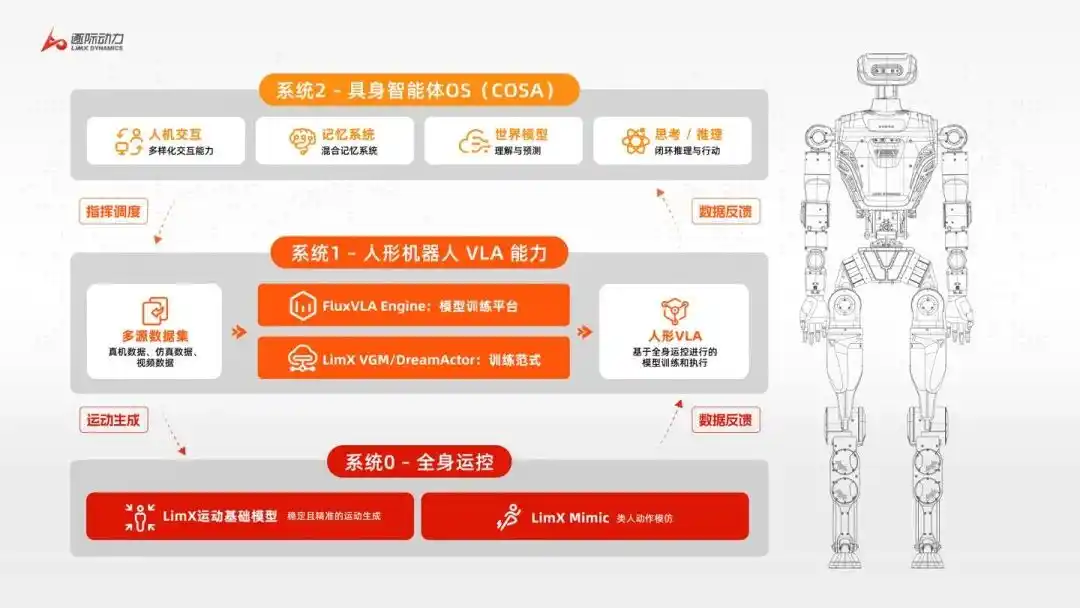
The bottom layer, System 0, is the cerebellum, responsible for whole-body motion control. This is the area where LimX Dynamics established its earliest advantage. When most robots in the industry could only "walk blind" on flat ground, unable to adjust their gait based on real-time environmental feedback, LimX Dynamics' full-size humanoid robot could already navigate stairs based on real-time perception.

The middle layer, System 1, handles VLA/WAM skills for specific tasks like opening doors, reception, and delivery. In January this year, LimX Dynamics open-sourced the FluxVLA Engine, providing global developers with a standardized infrastructure for model training, iteration, and deployment. Based on this, developers' efforts can be redirected to model innovation itself, rather than repeatedly building underlying engineering, pushing the industry from "training one good model" towards "enabling everyone to train models."

The top layer, System 2, is the brain. In January 2026, LimX Dynamics released the embodied agent system COSA, enabling full-size humanoid robots to achieve a brain system that "can think, can act, and works while thinking."

This is not unfamiliar to the industry. The Silicon Valley humanoid robotics company Figure, valued at over $39 billion, also adopted a "System 0—System 1—System 2" hierarchical architecture in its Helix 02 system released in January 2026.

The two architectures appear similar but are fundamentally different. Figure's System 1 and System 2 remain end-to-end systems at the model level; LimX Dynamics believes that models are merely skills, while the system is the true brain—an agent operating system integrating cognition, memory, scheduling, skills, and whole-body motion control, rather than a single model.

In a sense, LimX Dynamics is becoming Figure's most formidable Chinese competitor.

In fact, on the timeline, LimX Dynamics is even ahead. As early as 2023, LimX Dynamics had integrated the brain and cerebellum, with practical validations like its full-size humanoid robot Oli autonomously picking up tennis balls and the Guangzhou Tower stair climbing challenge. Figure truly achieved whole-body control only in early 2026.

Their commercialization paths also started differently. Figure focuses on factories and warehouses, while LimX Dynamics chose to enter through commercial service scenarios.

Zhang Wei's logic for not initially targeting factories is that humanoid robots are ultimately meant for homes, and entering factories isn't the most efficient path. "This doesn't mean entering factories is wrong. It's a choice. Our robots will still be sold to factories, and we will provide technical support. We just won't choose factories for our own initial deployments."

Therefore, LimX Dynamics almost obsessively pursues "Serve People, Not Process."

This system is being validated through productization.

In May this year, LimX Dynamics launched the full-size interactive humanoid robot LimX Luna, standing 160cm tall with 27 degrees of freedom, targeting commercial service and interaction scenarios. Deliveries to domestic and overseas clients began in less than a month. LimX Oli, released in 2025, is positioned as a full-size general-purpose humanoid robot platform for scientific research and industry development.

The TRON series consists of multi-form embodied robots. TRON 2 features one main body capable of switching between three configurations: dual-arm, bipedal, and dual-wheeled-legged, and supports reconfiguration into humanoid and quadrupedal forms.

Overall, LimX Dynamics' entire product line has accumulated thousands of orders, more than half from overseas, with the first batch of several hundred units already shipped. The company is collaborating with global developers and ecosystem partners to promote commercial deployment in more scenarios, including scientific research and education, commercial services, all-terrain inspection, industrial applications, and construction.

A Chinese Embodied Intelligence Globalization Case, Initiating the IPO Race

"You cannot use linear thinking to project exponential changes," Zhang Wei repeatedly emphasized during this exchange.

Having experienced the rise and fall of multiple technology cycles, he believes the public habitually uses linear thinking to predict exponential developments, often overestimating the short term and underestimating the long term. In his judgment, the current stage of the humanoid robotics industry is comparable to GPT-3, standing on the eve of a full-scale industrial explosion.

As an inflection point approaches, the core competitive logic is also being rewritten. Technology may no longer be the sole barrier; mass production delivery and global channels are becoming new watersheds.

The gap is already beginning to show. Leading Western manufacturers are constrained by shortcomings in their local supply chains, leading to long delivery cycles and persistently high unit costs. Conversely, most domestic peers' prototypes can only perform standardized demos like walking or performances, with clear gaps in product maturity. Very few models can operate stably in complex, unstructured environments without remote control, and companies capable of achieving scaled batch deliveries overseas are exceedingly rare.

Having worked in the global robotics field for many years, Zhang Wei has firsthand perception of the competitive landscape. He believes the starting lines for the Chinese and American humanoid robotics tracks are roughly equal. However, China possesses the world's most complete hardware supply chain and advantages in rapid engineering iteration. In the long run, China will move further ahead.

"This must be won in China." Zhang Wei stated directly, but this does not mean development is confined to the domestic market. The competition in humanoid robots is a global game. To maintain long-term industry initiative, overseas expansion is essential. This is also the underlying logic behind LimX Dynamics' firm commitment to a globalization strategy.

LimX Dynamics has already validated the feasibility of this globalization path with product deployment and overseas orders. The company has built a complete robotics product matrix covering scientific research and commercial services.

At this moment, the heat in the humanoid robotics track is still rising, and the queue of companies sprinting towards IPOs is growing longer. The matter of going public has quietly become a race tied to survival—whoever can list on the capital market first will have a greater probability of staying at the table.

The bubble will eventually recede, and the point of market consolidation is approaching. By then, the divide between two types of companies will become increasingly clear: one type has only prototype demos, lacks stable orders, and relies on continuous fundraising for survival; the other possesses a complete technological loop, a user-centric product matrix, batch orders, and a healthy capital structure, capable of self-sustaining.

For LimX Dynamics, its differentiated humanoid robot brain, precise commercial product positioning, thousands of overseas bulk orders, coupled with a capital structure dominated by foreign investors, sets it apart distinctly from most players in the field.

Business registration information shows that LimX Dynamics quietly completed its shareholding reform in March 2026. It is reported that the company is steadily advancing its IPO process.

Certainly, the ultimate outcome for humanoid robots remains distant. But looking back years from now, perhaps this very moment is the watershed.

This article is from the WeChat public account "PEdaily" (ID: pedaily2012), author: Zhou Jiali

Crypto di tendenza

Domande pertinenti

QWhat significant fundraising milestone did LimX Dynamics achieve recently?

ALimX Dynamics announced the completion of a nearly $200 million Pre-IPO funding round in July 2026. This brings its total funding raised in a short six months to nearly $400 million, resulting in a post-money valuation of 15 billion yuan.

QWhat is the core technical architecture developed by LimX Dynamics for its humanoid robots?

ALimX Dynamics has built a full-stack, self-developed three-layer technical architecture for the humanoid robot's 'brain' system. System 0 (the cerebellum) handles full-body motion control. System 1 manages VLA/WAM skills for specific tasks like opening doors. System 2 (the brain) is the embodied agent system named COSA, enabling the robot to think, act, and work while thinking.

QHow does LimX Dynamics's commercialization strategy differ from its US counterpart, Figure?

AWhile Figure primarily targets factory and warehouse applications, LimX Dynamics chose to enter the commercial service and interactive scenarios first. Its philosophy is to 'Serve People, Not Process,' aiming for robots that eventually enter homes. LimX Dynamics will still sell robots to factories but focuses its own deployment on commercial services.

QWhat advantage does LimX Dynamics gain from the strategic investment by Lens Technology?

AAs a leading consumer electronics supply chain manufacturer, Lens Technology's investment provides LimX Dynamics with crucial support in high-end manufacturing quality control, precision assembly, and scalable mass production capabilities. This is essential for reliably delivering its increasingly large volume of overseas bulk orders.

QWhat is the current status of LimX Dynamics regarding its IPO plans?

AAccording to the article, LimX Dynamics completed its shareholding reform (股改) in March 2026 and is steadily advancing its IPO process. The recent Pre-IPO round is a key step in this preparation.

Letture associate

Interest Rate Hike Option Back on the Table, CPI Release Imminent: What Variables Are Markets Focusing On?

The possibility of interest rate hikes is back on the table ahead of the June CPI release. Fed Governor Christopher Waller stated that if upcoming core inflation data remains hot, the FOMC should consider tightening monetary policy soon. His comments, directly linking potential action to the CPI report, caused market expectations for a July rate hike to rise from around 35% to over 40%. This CPI report is critical not for dictating a single meeting's outcome, but for testing the credibility of disinflation. A higher-than-expected core CPI reading would challenge the Fed's ability to remain patient, potentially shifting internal discussions toward more tightening. Conversely, cooler data would allow markets to view Waller's remarks as a warning rather than a policy shift signal. The repricing of rate expectations pressures risk assets like tech stocks and cryptocurrencies (BTC, ETH) by pushing up the discount rate for future cash flows and strengthening the US dollar. The key variable to watch post-CPI is whether the implied probability of a July hike stabilizes above 50%, which would signify a shift from pricing a tail risk to a baseline scenario. The most significant market stress would come from a combination of hot CPI data, a sustained rise in hike probabilities above 50%, and similar hawkish signals from other Fed officials, forcing a broad repricing of the "hiking cycle is over" trade.

marsbit43 min fa

Interest Rate Hike Option Back on the Table, CPI Release Imminent: What Variables Are Markets Focusing On?

marsbit43 min fa

Trading

Spot

Articoli Popolari

Cosa è $S$

Comprendere SPERO: Una Panoramica Completa Introduzione a SPERO Mentre il panorama dell'innovazione continua a evolversi, l'emergere delle tecnologie web3 e dei progetti di criptovaluta gioca un ruolo fondamentale nel plasmare il futuro digitale. Un progetto che ha attirato l'attenzione in questo campo dinamico è SPERO, denotato come SPERO,$$s$. Questo articolo mira a raccogliere e presentare informazioni dettagliate su SPERO, per aiutare gli appassionati e gli investitori a comprendere le sue basi, obiettivi e innovazioni nei domini web3 e crypto. Che cos'è SPERO,$$s$? SPERO,$$s$ è un progetto unico all'interno dello spazio crypto che cerca di sfruttare i principi della decentralizzazione e della tecnologia blockchain per creare un ecosistema che promuove l'impegno, l'utilità e l'inclusione finanziaria. Il progetto è progettato per facilitare interazioni peer-to-peer in modi nuovi, fornendo agli utenti soluzioni e servizi finanziari innovativi. Al suo interno, SPERO,$$s$ mira a responsabilizzare gli individui fornendo strumenti e piattaforme che migliorano l'esperienza dell'utente nello spazio delle criptovalute. Questo include la possibilità di metodi di transazione più flessibili, la promozione di iniziative guidate dalla comunità e la creazione di percorsi per opportunità finanziarie attraverso applicazioni decentralizzate (dApps). La visione sottostante di SPERO,$$s$ ruota attorno all'inclusività, cercando di colmare le lacune all'interno della finanza tradizionale mentre sfrutta i vantaggi della tecnologia blockchain. Chi è il Creatore di SPERO,$$s$? L'identità del creatore di SPERO,$$s$ rimane piuttosto oscura, poiché ci sono risorse pubblicamente disponibili limitate che forniscono informazioni dettagliate sul suo fondatore o fondatori. Questa mancanza di trasparenza può derivare dall'impegno del progetto per la decentralizzazione—un ethos che molti progetti web3 condividono, dando priorità ai contributi collettivi rispetto al riconoscimento individuale. Centrando le discussioni attorno alla comunità e ai suoi obiettivi collettivi, SPERO,$$s$ incarna l'essenza dell'empowerment senza mettere in evidenza individui specifici. Pertanto, comprendere l'etica e la missione di SPERO rimane più importante che identificare un creatore singolo. Chi sono gli Investitori di SPERO,$$s$? SPERO,$$s$ è supportato da una varietà di investitori che vanno dai capitalisti di rischio agli investitori angelici dedicati a promuovere l'innovazione nel settore crypto. Il focus di questi investitori generalmente si allinea con la missione di SPERO—dando priorità a progetti che promettono avanzamenti tecnologici sociali, inclusività finanziaria e governance decentralizzata. Queste fondazioni di investitori sono tipicamente interessate a progetti che non solo offrono prodotti innovativi, ma contribuiscono anche positivamente alla comunità blockchain e ai suoi ecosistemi. Il supporto di questi investitori rafforza SPERO,$$s$ come un concorrente degno di nota nel dominio in rapida evoluzione dei progetti crypto. Come Funziona SPERO,$$s$? SPERO,$$s$ impiega un framework multifunzionale che lo distingue dai progetti di criptovaluta convenzionali. Ecco alcune delle caratteristiche chiave che sottolineano la sua unicità e innovazione: Governance Decentralizzata: SPERO,$$s$ integra modelli di governance decentralizzati, responsabilizzando gli utenti a partecipare attivamente ai processi decisionali riguardanti il futuro del progetto. Questo approccio favorisce un senso di proprietà e responsabilità tra i membri della comunità. Utilità del Token: SPERO,$$s$ utilizza il proprio token di criptovaluta, progettato per servire varie funzioni all'interno dell'ecosistema. Questi token abilitano transazioni, premi e la facilitazione dei servizi offerti sulla piattaforma, migliorando l'impegno e l'utilità complessivi. Architettura Stratificata: L'architettura tecnica di SPERO,$$s$ supporta la modularità e la scalabilità, consentendo un'integrazione fluida di funzionalità e applicazioni aggiuntive man mano che il progetto evolve. Questa adattabilità è fondamentale per mantenere la rilevanza nel panorama crypto in continua evoluzione. Coinvolgimento della Comunità: Il progetto enfatizza iniziative guidate dalla comunità, impiegando meccanismi che incentivano la collaborazione e il feedback. Nutrendo una comunità forte, SPERO,$$s$ può affrontare meglio le esigenze degli utenti e adattarsi alle tendenze di mercato. Focus sull'Inclusione: Offrendo basse commissioni di transazione e interfacce user-friendly, SPERO,$$s$ mira ad attrarre una base utenti diversificata, inclusi individui che potrebbero non aver precedentemente interagito nello spazio crypto. Questo impegno per l'inclusione si allinea con la sua missione generale di empowerment attraverso l'accessibilità. Cronologia di SPERO,$$s$ Comprendere la storia di un progetto fornisce preziose intuizioni sulla sua traiettoria di sviluppo e sui traguardi. Di seguito è riportata una cronologia suggerita che mappa eventi significativi nell'evoluzione di SPERO,$$s$: Fase di Concettualizzazione e Ideazione: Le idee iniziali che formano la base di SPERO,$$s$ sono state concepite, allineandosi strettamente con i principi di decentralizzazione e focus sulla comunità all'interno dell'industria blockchain. Lancio del Whitepaper del Progetto: Dopo la fase concettuale, è stato rilasciato un whitepaper completo che dettaglia la visione, gli obiettivi e l'infrastruttura tecnologica di SPERO,$$s$ per suscitare interesse e feedback dalla comunità. Costruzione della Comunità e Prime Interazioni: Sono stati effettuati sforzi attivi di outreach per costruire una comunità di early adopters e potenziali investitori, facilitando discussioni attorno agli obiettivi del progetto e ottenendo supporto. Evento di Generazione del Token: SPERO,$$s$ ha condotto un evento di generazione del token (TGE) per distribuire i propri token nativi ai primi sostenitori e stabilire una liquidità iniziale all'interno dell'ecosistema. Lancio della Prima dApp: La prima applicazione decentralizzata (dApp) associata a SPERO,$$s$ è stata attivata, consentendo agli utenti di interagire con le funzionalità principali della piattaforma. Sviluppo Continuo e Partnership: Aggiornamenti e miglioramenti continui alle offerte del progetto, inclusi partnership strategiche con altri attori nello spazio blockchain, hanno plasmato SPERO,$$s$ in un concorrente competitivo e in evoluzione nel mercato crypto. Conclusione SPERO,$$s$ rappresenta una testimonianza del potenziale del web3 e delle criptovalute di rivoluzionare i sistemi finanziari e responsabilizzare gli individui. Con un impegno per la governance decentralizzata, il coinvolgimento della comunità e funzionalità progettate in modo innovativo, apre la strada verso un panorama finanziario più inclusivo. Come per qualsiasi investimento nello spazio crypto in rapida evoluzione, si incoraggiano potenziali investitori e utenti a ricercare approfonditamente e a impegnarsi in modo riflessivo con gli sviluppi in corso all'interno di SPERO,$$s$. Il progetto mostra lo spirito innovativo dell'industria crypto, invitando a ulteriori esplorazioni delle sue innumerevoli possibilità. Mentre il percorso di SPERO,$$s$ è ancora in fase di sviluppo, i suoi principi fondamentali potrebbero effettivamente influenzare il futuro di come interagiamo con la tecnologia, la finanza e tra di noi in ecosistemi digitali interconnessi.

118 Totale visualizzazioniPubblicato il 2024.12.17Aggiornato il 2024.12.17

Cosa è $S$

Cosa è AGENT S

Agent S: Il Futuro dell'Interazione Autonoma in Web3 Introduzione Nel panorama in continua evoluzione di Web3 e criptovalute, le innovazioni stanno costantemente ridefinendo il modo in cui gli individui interagiscono con le piattaforme digitali. Uno di questi progetti pionieristici, Agent S, promette di rivoluzionare l'interazione uomo-computer attraverso il suo framework agentico aperto. Aprendo la strada a interazioni autonome, Agent S mira a semplificare compiti complessi, offrendo applicazioni trasformative nell'intelligenza artificiale (AI). Questa esplorazione dettagliata approfondirà le complessità del progetto, le sue caratteristiche uniche e le implicazioni per il dominio delle criptovalute. Cos'è Agent S? Agent S si presenta come un innovativo framework agentico aperto, progettato specificamente per affrontare tre sfide fondamentali nell'automazione dei compiti informatici: Acquisizione di Conoscenze Specifiche del Dominio: Il framework apprende in modo intelligente da varie fonti di conoscenza esterne ed esperienze interne. Questo approccio duale gli consente di costruire un ricco repository di conoscenze specifiche del dominio, migliorando le sue prestazioni nell'esecuzione dei compiti. Pianificazione su Lungo Orizzonte di Compiti: Agent S impiega una pianificazione gerarchica potenziata dall'esperienza, un approccio strategico che facilita la suddivisione e l'esecuzione efficiente di compiti complessi. Questa caratteristica migliora significativamente la sua capacità di gestire più sottocompiti in modo efficiente ed efficace. Gestione di Interfacce Dinamiche e Non Uniformi: Il progetto introduce l'Interfaccia Agente-Computer (ACI), una soluzione innovativa che migliora l'interazione tra agenti e utenti. Utilizzando Modelli Linguistici Multimodali di Grandi Dimensioni (MLLM), Agent S può navigare e manipolare senza sforzo diverse interfacce grafiche utente. Attraverso queste caratteristiche pionieristiche, Agent S fornisce un framework robusto che affronta le complessità coinvolte nell'automazione dell'interazione umana con le macchine, preparando il terreno per innumerevoli applicazioni nell'AI e oltre. Chi è il Creatore di Agent S? Sebbene il concetto di Agent S sia fondamentalmente innovativo, informazioni specifiche sul suo creatore rimangono elusive. Il creatore è attualmente sconosciuto, il che evidenzia sia la fase embrionale del progetto sia la scelta strategica di mantenere i membri fondatori sotto anonimato. Indipendentemente dall'anonimato, l'attenzione rimane sulle capacità e sul potenziale del framework. Chi sono gli Investitori di Agent S? Poiché Agent S è relativamente nuovo nell'ecosistema crittografico, informazioni dettagliate riguardanti i suoi investitori e sostenitori finanziari non sono documentate esplicitamente. La mancanza di approfondimenti pubblicamente disponibili sulle fondazioni di investimento o sulle organizzazioni che supportano il progetto solleva interrogativi sulla sua struttura di finanziamento e sulla roadmap di sviluppo. Comprendere il supporto è cruciale per valutare la sostenibilità del progetto e il suo potenziale impatto sul mercato. Come Funziona Agent S? Al centro di Agent S si trova una tecnologia all'avanguardia che gli consente di funzionare efficacemente in contesti diversi. Il suo modello operativo è costruito attorno a diverse caratteristiche chiave: Interazione Uomo-Computer Simile a Quella Umana: Il framework offre una pianificazione AI avanzata, cercando di rendere le interazioni con i computer più intuitive. Mimando il comportamento umano nell'esecuzione dei compiti, promette di elevare le esperienze degli utenti. Memoria Narrativa: Utilizzata per sfruttare esperienze di alto livello, Agent S utilizza la memoria narrativa per tenere traccia delle storie dei compiti, migliorando così i suoi processi decisionali. Memoria Episodica: Questa caratteristica fornisce agli utenti una guida passo-passo, consentendo al framework di offrire supporto contestuale mentre i compiti si sviluppano. Supporto per OpenACI: Con la capacità di funzionare localmente, Agent S consente agli utenti di mantenere il controllo sulle proprie interazioni e flussi di lavoro, allineandosi con l'etica decentralizzata di Web3. Facile Integrazione con API Esterne: La sua versatilità e compatibilità con varie piattaforme AI garantiscono che Agent S possa adattarsi senza problemi agli ecosistemi tecnologici esistenti, rendendolo una scelta attraente per sviluppatori e organizzazioni. Queste funzionalità contribuiscono collettivamente alla posizione unica di Agent S all'interno dello spazio crittografico, poiché automatizza compiti complessi e multi-fase con un intervento umano minimo. Man mano che il progetto evolve, le sue potenziali applicazioni in Web3 potrebbero ridefinire il modo in cui si svolgono le interazioni digitali. Cronologia di Agent S Lo sviluppo e le tappe di Agent S possono essere riassunti in una cronologia che evidenzia i suoi eventi significativi: 27 Settembre 2024: Il concetto di Agent S è stato lanciato in un documento di ricerca completo intitolato “Un Framework Agentico Aperto che Usa i Computer Come un Umano”, mostrando le basi per il progetto. 10 Ottobre 2024: Il documento di ricerca è stato reso pubblicamente disponibile su arXiv, offrendo un'esplorazione approfondita del framework e della sua valutazione delle prestazioni basata sul benchmark OSWorld. 12 Ottobre 2024: È stata rilasciata una presentazione video, fornendo un'idea visiva delle capacità e delle caratteristiche di Agent S, coinvolgendo ulteriormente potenziali utenti e investitori. Questi indicatori nella cronologia non solo illustrano i progressi di Agent S, ma indicano anche il suo impegno per la trasparenza e il coinvolgimento della comunità. Punti Chiave su Agent S Man mano che il framework Agent S continua a evolversi, diversi attributi chiave si distinguono, sottolineando la sua natura innovativa e il potenziale: Framework Innovativo: Progettato per fornire un uso intuitivo dei computer simile all'interazione umana, Agent S porta un approccio nuovo all'automazione dei compiti. Interazione Autonoma: La capacità di interagire autonomamente con i computer attraverso GUI segna un passo avanti verso soluzioni informatiche più intelligenti ed efficienti. Automazione di Compiti Complessi: Con la sua metodologia robusta, può automatizzare compiti complessi e multi-fase, rendendo i processi più veloci e meno soggetti a errori. Miglioramento Continuo: I meccanismi di apprendimento consentono ad Agent S di migliorare dalle esperienze passate, migliorando continuamente le sue prestazioni e la sua efficacia. Versatilità: La sua adattabilità attraverso diversi ambienti operativi come OSWorld e WindowsAgentArena garantisce che possa servire un'ampia gamma di applicazioni. Man mano che Agent S si posiziona nel panorama di Web3 e delle criptovalute, il suo potenziale per migliorare le capacità di interazione e automatizzare i processi segna un significativo avanzamento nelle tecnologie AI. Attraverso il suo framework innovativo, Agent S esemplifica il futuro delle interazioni digitali, promettendo un'esperienza più fluida ed efficiente per gli utenti in vari settori. Conclusione Agent S rappresenta un audace passo avanti nell'unione tra AI e Web3, con la capacità di ridefinire il modo in cui interagiamo con la tecnologia. Sebbene sia ancora nelle sue fasi iniziali, le possibilità per la sua applicazione sono vaste e coinvolgenti. Attraverso il suo framework completo che affronta sfide critiche, Agent S mira a portare le interazioni autonome al centro dell'esperienza digitale. Man mano che ci addentriamo nei regni delle criptovalute e della decentralizzazione, progetti come Agent S giocheranno senza dubbio un ruolo cruciale nel plasmare il futuro della tecnologia e della collaborazione uomo-computer.

573 Totale visualizzazioniPubblicato il 2025.01.14Aggiornato il 2025.01.14

Cosa è AGENT S

Come comprare S

Benvenuto in HTX.com! Abbiamo reso l'acquisto di Sonic (S) semplice e conveniente. Segui la nostra guida passo passo per intraprendere il tuo viaggio nel mondo delle criptovalute.Step 1: Crea il tuo Account HTXUsa la tua email o numero di telefono per registrarti il tuo account gratuito su HTX. Vivi un'esperienza facile e sblocca tutte le funzionalità,Crea il mio accountStep 2: Vai in Acquista crypto e seleziona il tuo metodo di pagamentoCarta di credito/debito: utilizza la tua Visa o Mastercard per acquistare immediatamente SonicS.Bilancio: Usa i fondi dal bilancio del tuo account HTX per fare trading senza problemi.Terze parti: abbiamo aggiunto metodi di pagamento molto utilizzati come Google Pay e Apple Pay per maggiore comodità.P2P: Fai trading direttamente con altri utenti HTX.Over-the-Counter (OTC): Offriamo servizi su misura e tassi di cambio competitivi per i trader.Step 3: Conserva Sonic (S)Dopo aver acquistato Sonic (S), conserva nel tuo account HTX. In alternativa, puoi inviare tramite trasferimento blockchain o scambiare per altre criptovalute.Step 4: Scambia Sonic (S)Scambia facilmente Sonic (S) nel mercato spot di HTX. Accedi al tuo account, seleziona la tua coppia di trading, esegui le tue operazioni e monitora in tempo reale. Offriamo un'esperienza user-friendly sia per chi ha appena iniziato che per i trader più esperti.

1.1k Totale visualizzazioniPubblicato il 2025.01.15Aggiornato il 2026.06.02

Come comprare S

Discussioni

Benvenuto nella Community HTX. Qui puoi rimanere informato sugli ultimi sviluppi della piattaforma e accedere ad approfondimenti esperti sul mercato. Le opinioni degli utenti sul prezzo di S S sono presentate come di seguito.

活动图片