‘Quietly rebuilding momentum’ – Scaramucci backs Polkadot despite low network activity

ambcryptoPubblicato 2026-03-22Pubblicato ultima volta 2026-03-22

Introduzione

Anthony Scaramucci, founder of SkyBridge, has turned bullish on Polkadot, citing key catalysts that are "quietly rebuilding momentum" for the blockchain. These include recent regulatory clarity from the SEC, which classified DOT as a digital commodity, and a major tokenomics update that hard-capped the supply at 2.1 billion tokens and cut annual emissions by 53%. The launch of the 21Shares Spot DOT ETF was also noted, though it has seen minimal inflows since debuting. Despite these developments, Polkadot's network activity has declined significantly over the past two years, with weekly active addresses dropping from 16,000 to 5,000. The tokenomics changes briefly boosted trader sentiment, leading to an 18% price rally, but positive momentum faded at the $1.65 resistance level. If macroeconomic uncertainty continues, DOT could retreat to $1.23. While Scaramucci highlights bullish factors, Polkadot's adoption remains weak, and it is unclear how quickly recent upgrades will reignite growth and lift the token's value.

Anthony Scaramucci, founder of venture capital firm SkiBridge, has flipped bullish on Polkadot.

According to the crypto investor, the latest regulatory update and major tokenomics were some of the bullish catalysts that are ‘quietly rebuilding momentum’ for the chain.


Source: X

In the latest SEC guidance, DOT was categorized as a digital commodity like Bitcoin and Ethereum.

Beyond regulatory clarity, the recent tokenomics overhaul has hard-capped DOT supply at 2.1 billion. Additionally, the annual emissions were cut from 120 million DOT to 55 million DOT, marking a 53% cut.

The 21Shares Spot DOT ETF was another key catalyst, according to Scaramucci.

However, since the product debuted, it has only seen one day of inflow of $544.5K. For the rest of March, the Spot DOT ETF has seen zero flows, suggesting that the demand is not as strong as the analyst projected.

But the ETF demand isn’t the only thing lagging for DOT.

Polkadot network activity declining

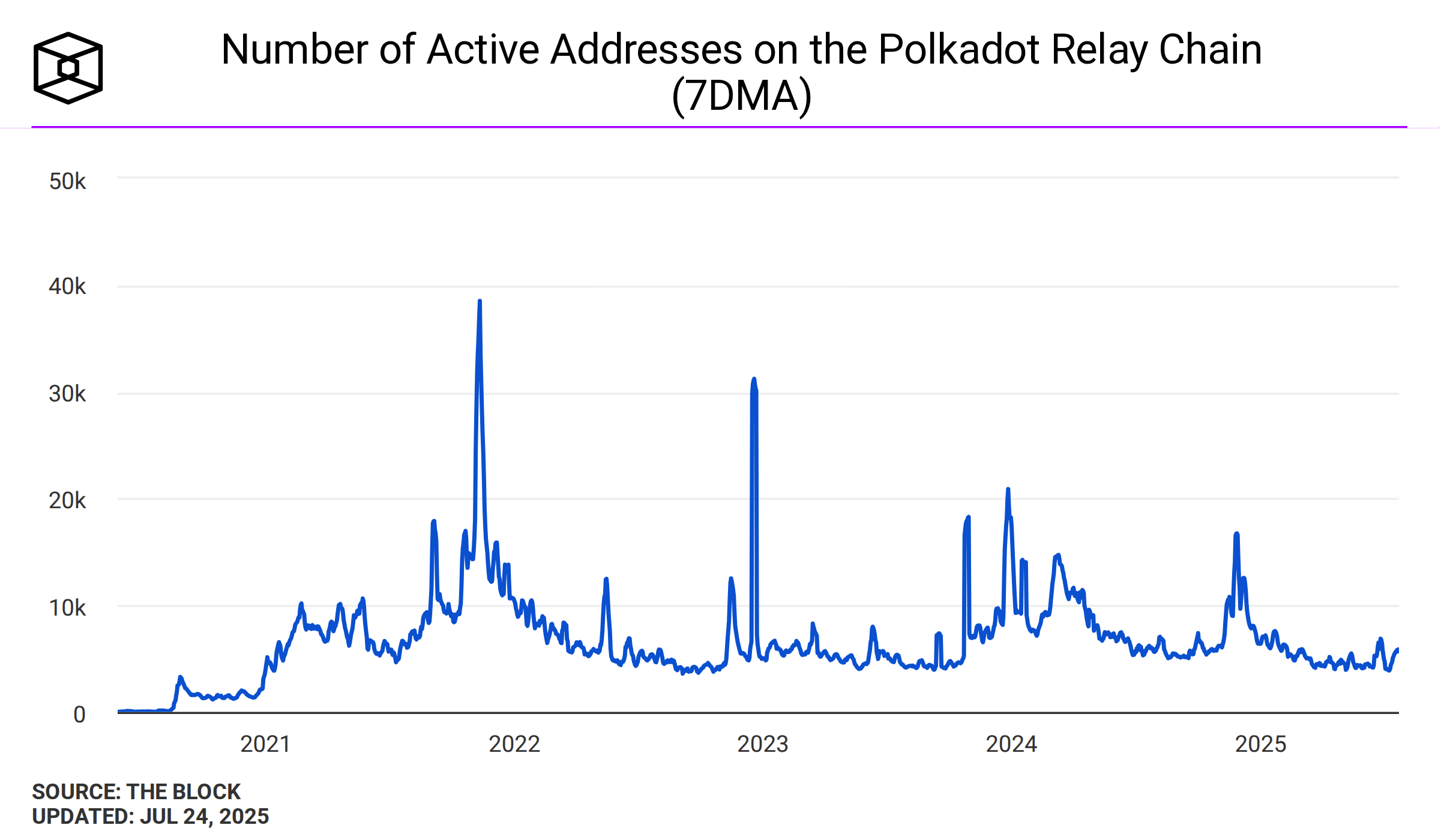
On the network activity and adoption, Polkadot has seen a significant loss in traction. Apart from the initial broader market hype and rally in late 2024, the chain’s adoption has been in a free fall.

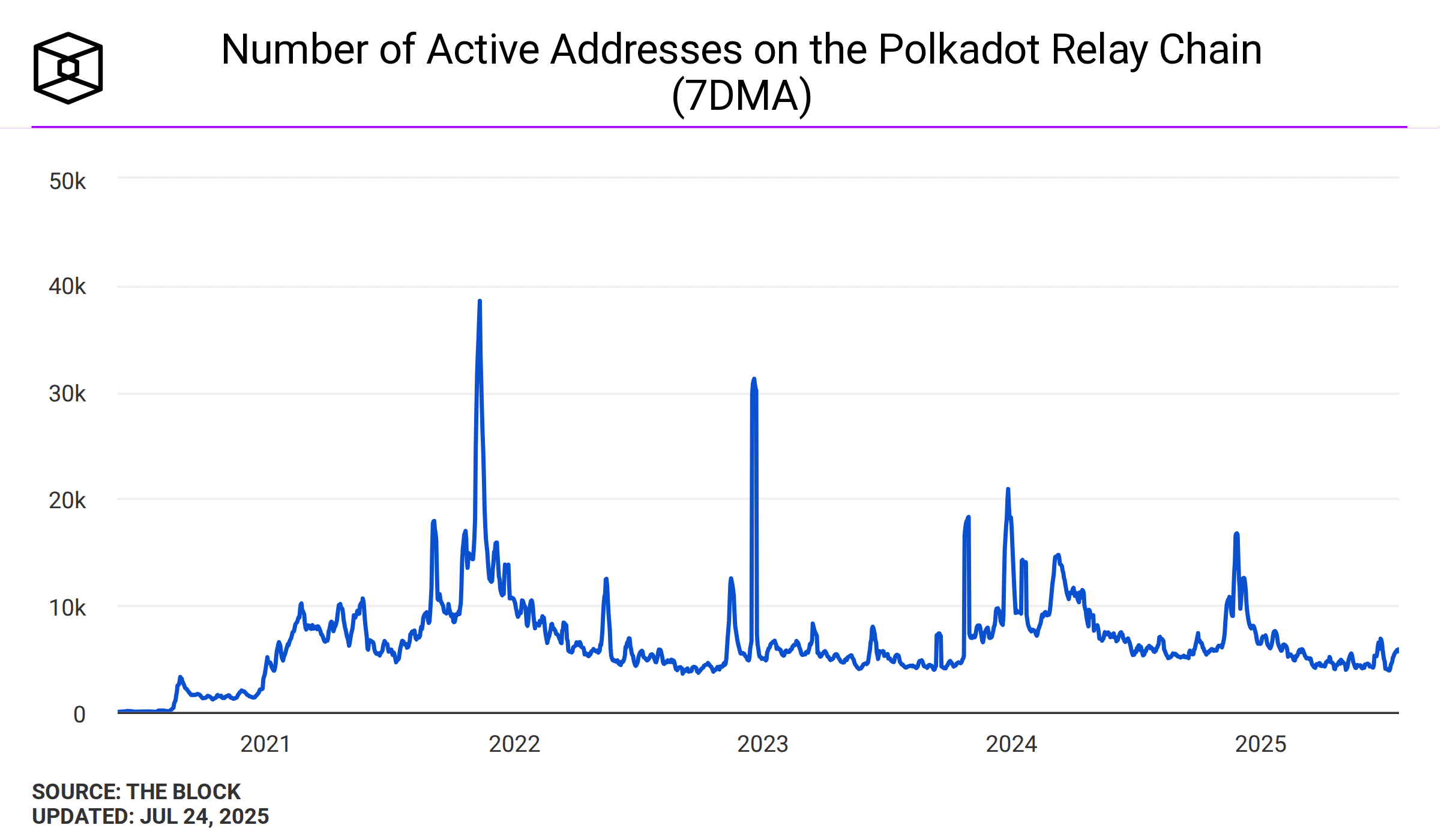
This was illustrated by the drop in weekly average active addresses, slipping from 16K to 5K in the past two years.
Source: The Block

It remains to be seen whether the recent tokenomics overhaul will attract users again.

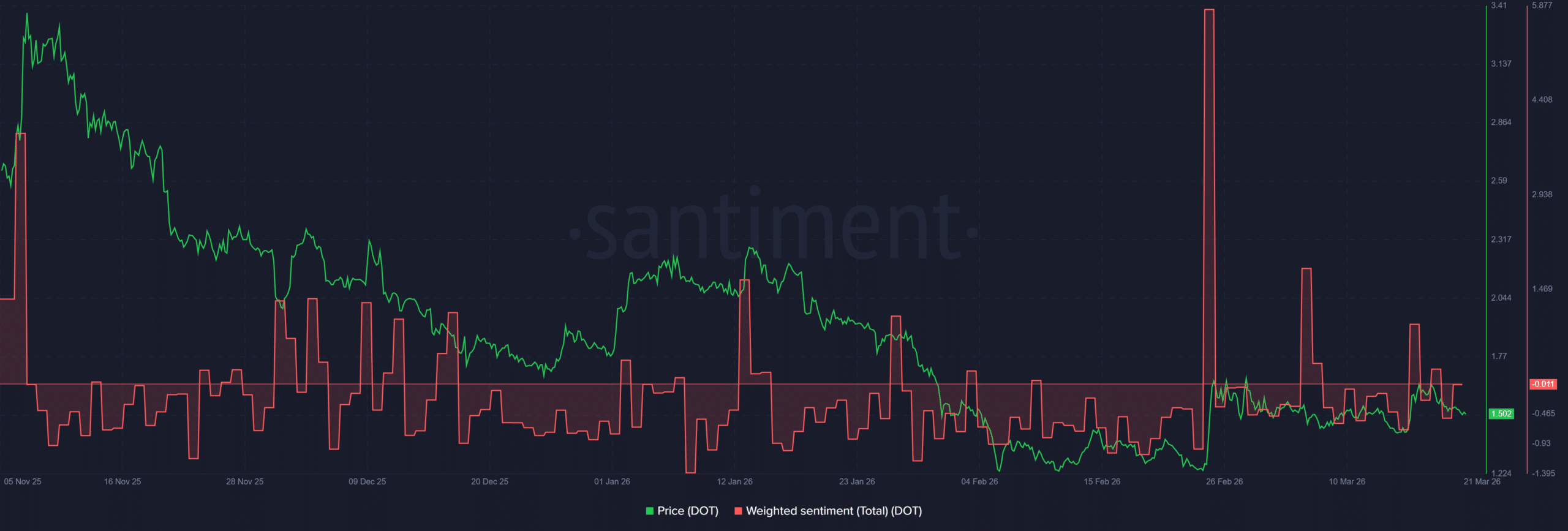
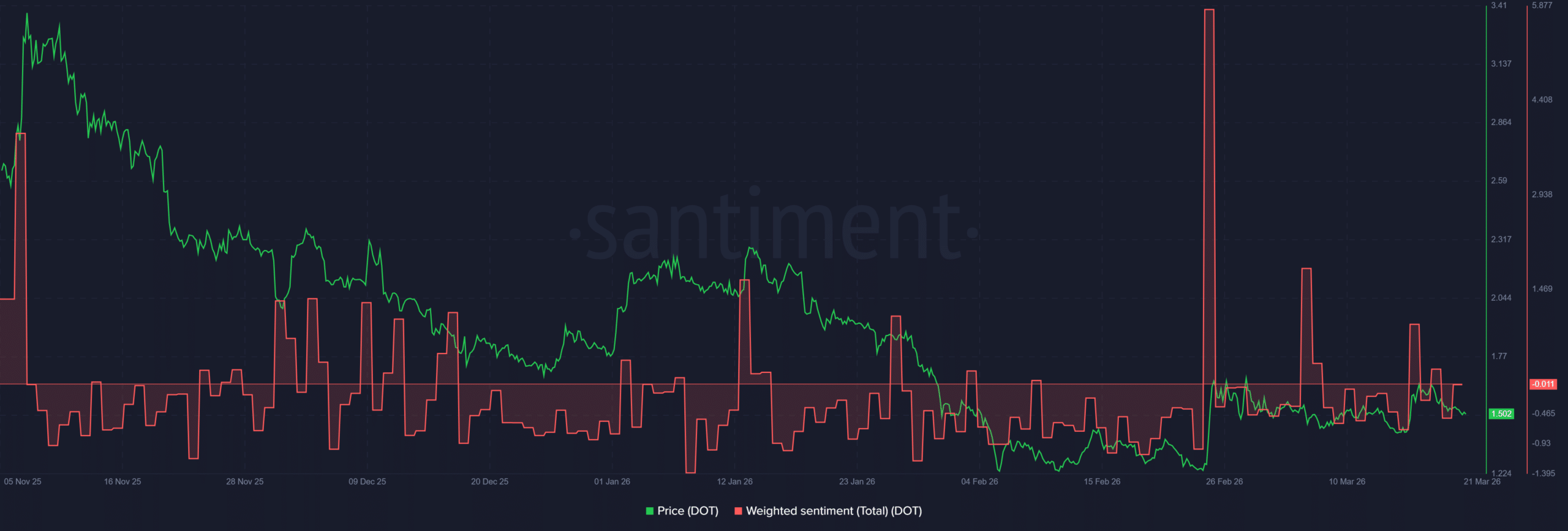
On market dynamics, DOT’s tokenomics and deflation push saw sentiment briefly flip positive before reverting to negative.
Source: Santiment

In other words, the changes temporarily tipped traders to go bullish on the altcoin. In fact, during the spike in positive sentiment, the altcoin rallied 18%. Put differently, the market welcomed the recent upgrades.

Meanwhile, the DOT rally faded at $1.65, a key roadblock in Q1 2026. If the ongoing macro uncertainty persists, DOT may extend the pullback to $1.23.
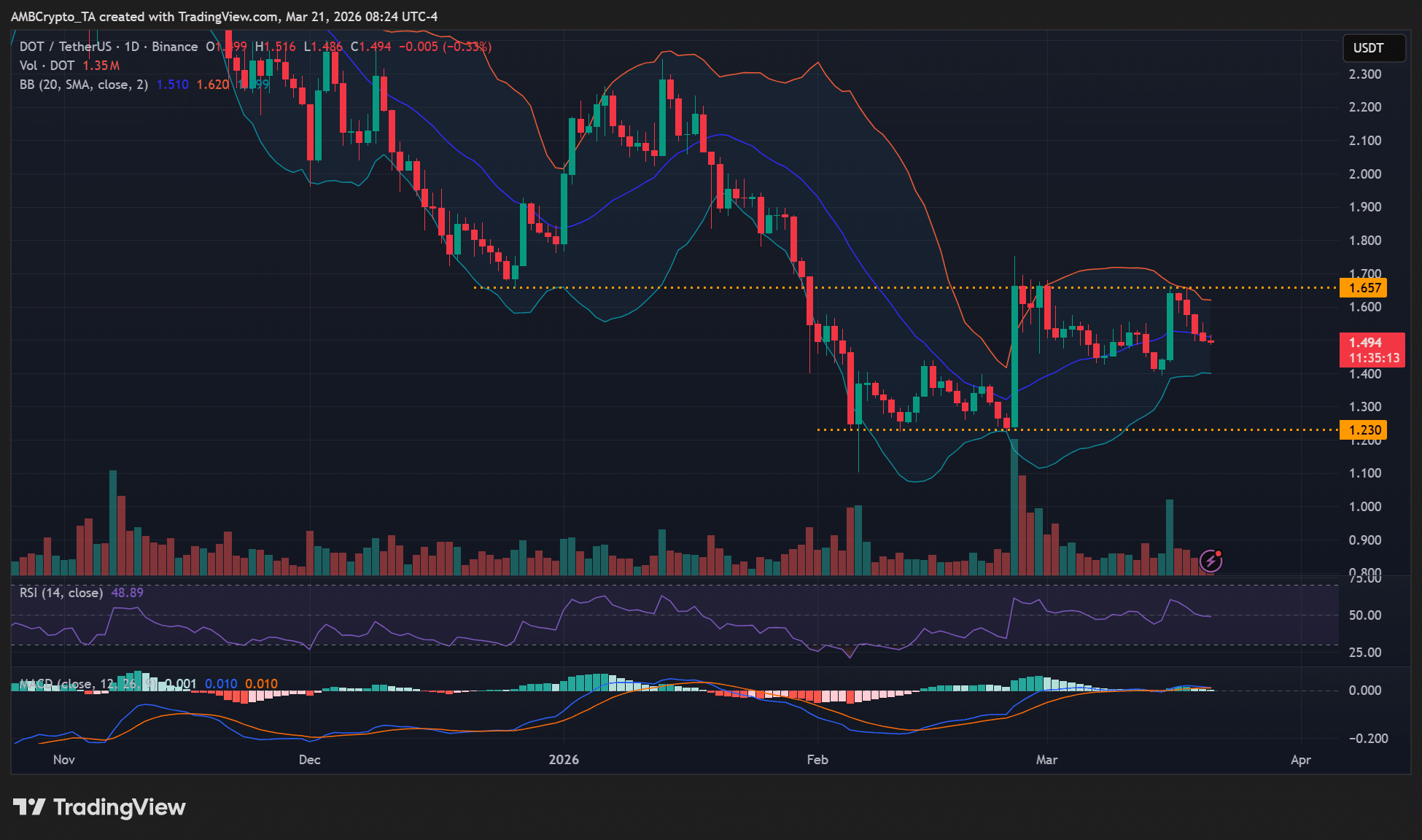
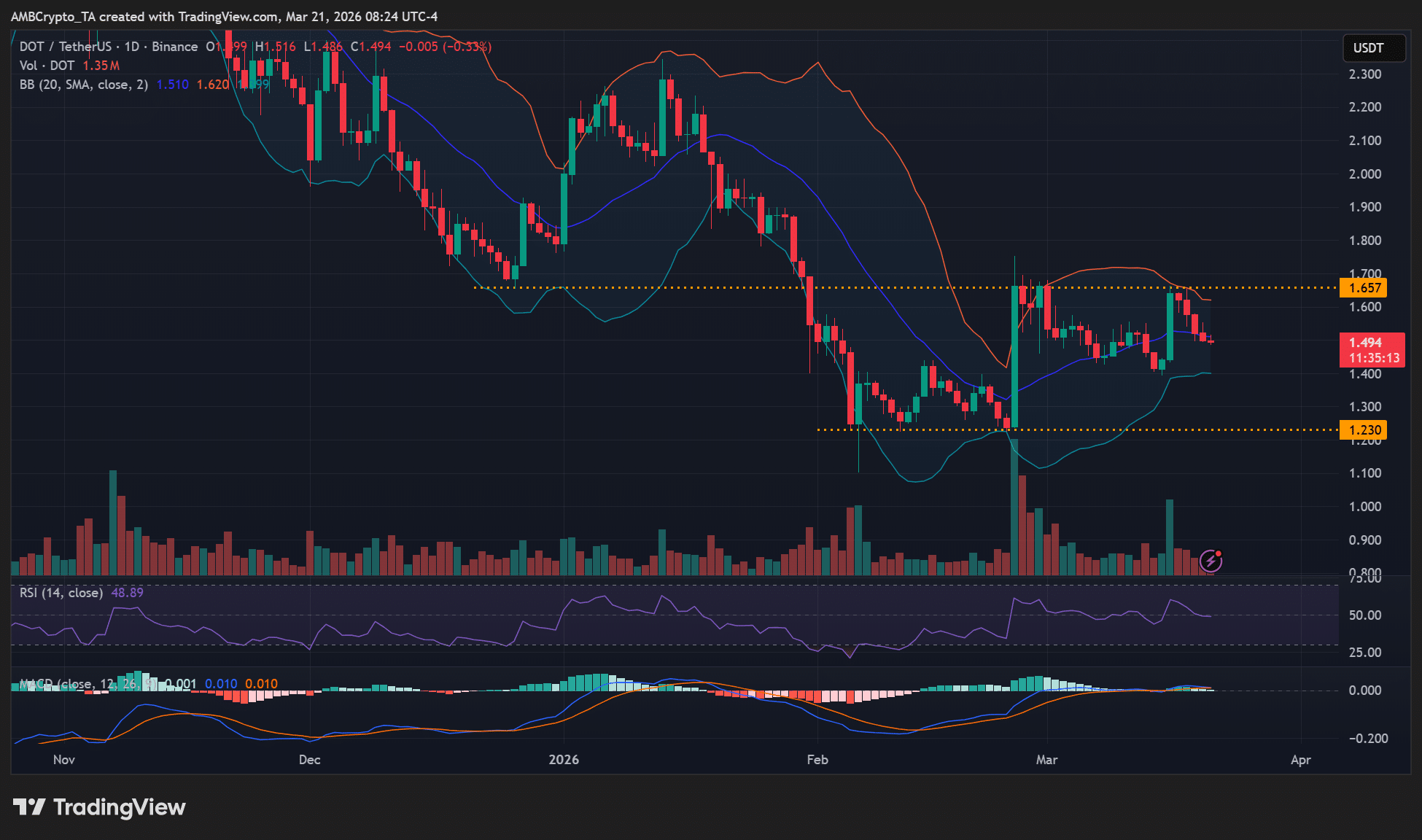
Source: DOT/USDT, TradingView

Overall, Scaramucci highlighted key bullish catalysts for the Polkadot chain and its native token. Even so, the chain’s traction has worsened in the past two years. It was unclear how fast the recent changes would reignite momentum and eventually lift DOT.


Final Summary

  • For SkiBridge’s Scaramucci, Polkadot’s bullish case was ‘quietly rebuilding momentum’ after recent upgrades.
  • The chain’s traction has declined in the past two years, but whether recent updates will help revive it remains to be seen.


Domande pertinenti

QWhat are the key bullish catalysts for Polkadot mentioned by Anthony Scaramucci?

AThe key bullish catalysts mentioned are the latest SEC guidance categorizing DOT as a digital commodity, the tokenomics overhaul that hard-capped DOT supply at 2.1 billion and cut annual emissions by 53%, and the launch of the 21Shares Spot DOT ETF.

QHow has Polkadot's network activity changed in the past two years according to the article?

APolkadot's network activity has significantly declined, with weekly average active addresses dropping from 16K to 5K over the past two years.

QWhat was the market reaction to Polkadot's recent tokenomics changes?

AThe tokenomics changes temporarily flipped market sentiment positive, resulting in an 18% price rally for DOT, though the positive sentiment eventually reverted to negative.

QWhat does the article say about the performance of the 21Shares Spot DOT ETF?

AThe ETF saw only one day of inflows totaling $544.5K since its debut and recorded zero flows for the rest of March, indicating weaker demand than projected.

QWhat are the key resistance and support levels mentioned for DOT's price?

AThe rally faded at the key resistance level of $1.65, and if macro uncertainty persists, DOT could extend its pullback to the support level of $1.23.

Letture associate

US and Japan's Unprecedented Joint Action in 30 Years Marks End of Yen Carry Trade Era

Japan and the U.S. conducted a rare coordinated intervention in the foreign exchange market around August 3rd to stem the yen's sharp depreciation. U.S. Treasury Secretary Scott Bessette's notepad, photographed by Reuters, revealed plans for a $5-10 billion yen-buying operation. Following official confirmation, the USD/JPY pair plunged from near 164 to around 155-156. The intervention marks a significant shift as the U.S. moved from verbal support to practical coordination. While the core carry trade logic—exploiting the higher U.S. interest rates—remains intact, the risk structure has changed. Traders must now account for potential repeated bilateral actions, altering the risk-reward calculation for yen shorts. The intervention's immediate effect is forcing leveraged positions to unwind, amplifying the yen's rebound. However, analysts note this does not signal the end of the yen carry trade. The fundamental driver—the wide interest rate differential between the U.S. (3.50%-3.75%) and Japan (1%)—persists. The action is seen more as buying time for the Bank of Japan's gradual policy normalization while mitigating imported inflation pressures. To avoid destabilizing the U.S. Treasury market during intervention, authorities utilized the Fed's FIMA repo facility, allowing Japan to obtain dollar liquidity using its Treasury holdings as collateral instead of selling them. The move aims to contain spillover risks. While creating short-term volatility and compressing leverage for yen bears, the long-term trend for the yen will ultimately depend on the convergence of U.S. and Japanese monetary policies, not unilateral market operations. The current action is narrower in scope than historical agreements like the Plaza Accord, focused on curbing excessive yen weakness rather than engineering a broad-based dollar decline.

marsbit20 min fa

US and Japan's Unprecedented Joint Action in 30 Years Marks End of Yen Carry Trade Era

marsbit20 min fa

Why Hasn't Bitcoin Made the Expected Surge? There Are Both Positive and Negative Data

Analytical firm Glassnode reports Bitcoin retreated to around $62,600 after failing to sustain above $66,000. Weak spot market demand and defensive positions in derivatives are applying downward pressure. However, structural support remains from resilient long-term holders, surging on-chain activity, and renewed inflows into Bitcoin ETFs. The price action reflects weakened spot momentum, with low trading volume and persistent seller pressure keeping Bitcoin in a consolidation phase with limited breakout potential. While open interest in derivatives has fallen, funding rates have risen again, and options investors maintain a cautious stance. Demand for downside protection has increased. Positively, Bitcoin ETFs have seen renewed net inflows and trading volume, indicating institutional repositioning. On-chain metrics show a significant spike in active addresses and adjusted transaction volume, pointing to increased network usage. The historically low ratio of short-term to long-term holders suggests long-term conviction remains firm. However, overall market profitability continues to decline as the proportion of Bitcoin in profit nears cycle lows, indicating a trend of loss realization and de-risking by investors. Glassnode concludes the Bitcoin market is in a transitional phase. Structural support is present, but valuation pressure, insufficient spot demand, and defensive derivatives positioning continue to limit overall risk appetite.

cryptonews.ru51 min fa

Why Hasn't Bitcoin Made the Expected Surge? There Are Both Positive and Negative Data

cryptonews.ru51 min fa

Trading

Spot
活动图片