US and Japan's Unprecedented Joint Action in 30 Years Marks End of Yen Carry Trade Era

marsbitPubblicato 2026-08-03Pubblicato ultima volta 2026-08-03

Introduzione

Japan and the U.S. conducted a rare coordinated intervention in the foreign exchange market around August 3rd to stem the yen's sharp depreciation. U.S. Treasury Secretary Scott Bessette's notepad, photographed by Reuters, revealed plans for a $5-10 billion yen-buying operation. Following official confirmation, the USD/JPY pair plunged from near 164 to around 155-156. The intervention marks a significant shift as the U.S. moved from verbal support to practical coordination. While the core carry trade logic—exploiting the higher U.S. interest rates—remains intact, the risk structure has changed. Traders must now account for potential repeated bilateral actions, altering the risk-reward calculation for yen shorts. The intervention's immediate effect is forcing leveraged positions to unwind, amplifying the yen's rebound. However, analysts note this does not signal the end of the yen carry trade. The fundamental driver—the wide interest rate differential between the U.S. (3.50%-3.75%) and Japan (1%)—persists. The action is seen more as buying time for the Bank of Japan's gradual policy normalization while mitigating imported inflation pressures. To avoid destabilizing the U.S. Treasury market during intervention, authorities utilized the Fed's FIMA repo facility, allowing Japan to obtain dollar liquidity using its Treasury holdings as collateral instead of selling them. The move aims to contain spillover risks. While creating short-term volatility and compressing leverage for...

The signal of joint US-Japan intervention on the yen quickly intensified around August 3.

Japanese Finance Minister Sakaki Katayama confirmed that the Japanese Ministry of Finance has coordinated with the US Treasury to buy yen. US President Trump and Treasury Secretary Scott Bessent also subsequently confirmed US involvement, stating that further joint actions are not ruled out. Following the official announcements, USD/JPY retreated sharply from near a 40-year high of 164 last week, falling to around 155.20 at one point; AP recorded an early August 3 rate of approximately 156.34.

US and Japanese Finance Ministers Meet

The most significant change in this round is not just Japan's renewed selling of dollars and buying of yen, but that the US has moved from verbal support to actual coordination.

For traders who have long bet on yen depreciation, the original logic has not completely failed: US interest rates remain significantly higher than Japan's, and holding dollar assets can still earn interest differentials. However, the risk structure of this trade has changed. In the past, the market mainly judged the scale and duration of Japan's unilateral intervention; now, it must also consider US participation, potential repeated operations by both sides, and the possibility of officials establishing a policy defense line at specific levels.

US-Japan Joint Intervention Materializes, Yen Rebounds Sharply

USD/JPY Retreats Rapidly from 164

The speed of the yen's rebound is itself the most direct evidence of how coordinated intervention affects market expectations.

In late July, USD/JPY approached 164, with the yen hitting its lowest level in about 40 years. A weak yen can boost overseas profits for Japanese exporters when converted to yen, but it also raises the cost of imported energy, food, and raw materials, further increasing living costs for households and operational pressures for companies. As the exchange rate broke through the previously sensitive levels of 150 and 160, the Japanese government's political tolerance for depreciation decreased significantly.

Japan had previously intervened unilaterally to buy yen, but the exchange rate typically rebounded only briefly. The market's familiar script was: the Ministry of Finance steps in, shorts temporarily cover, and then the US-Japan interest rate differential attracts capital back to dollar assets.

This time, the market is facing a different script.

The Japanese Ministry of Finance explicitly used the term 'coordinated intervention,' and Bessent stated that the US Treasury will continue to communicate with Japan and 'will not hesitate' to participate in joint action again. Officials may not need to continuously inject huge sums; as long as traders believe bilateral intervention is possible when USD/JPY nears 164, the tail risk of continuing to short the yen increases significantly.

Signal of $5-10 Billion Exposure, US Moves from Verbal Support to Actual Participation

A Reuters photo taken on July 31 showed Bessent's notepad at a Camp David cabinet meeting stating: 'To Do: Buy Japanese Yen (JPY) $5-10 bil.'
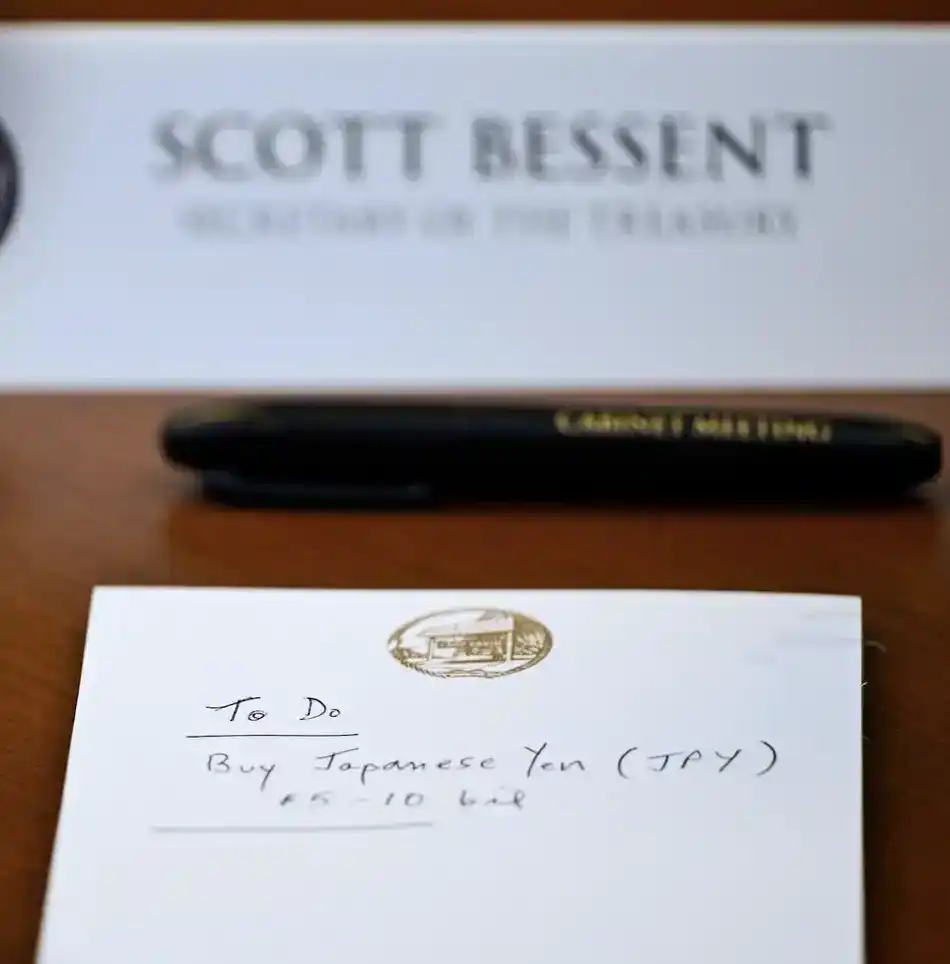
Reuters published a photo of a notepad in front of Bessent at Friday's cabinet meeting. Under the 'To Do' heading, Bessent wrote 'Buy $5-10 bil Japanese Yen (JPY)'.

This notepad does not prove how much yen the US ultimately bought. When the photo surfaced, the US Treasury had not yet confirmed the specific amount. Its key information is that the US Treasury at least seriously considered a yen-buying operation of an actual scale, beyond merely expressing diplomatic support for Japan.

Subsequently, the formal confirmation of joint intervention by the US and Japan further amplified the market significance of this photo. Bessent also publicly stated the US willingness to repeat the action if needed. $5-10 billion might not be enough to change the supply-demand dynamics of the global forex market long-term, but it is sufficient to force highly leveraged yen shorts to recalculate their stop-loss points and position sizes.

The way intervention truly works is not just through official funds directly moving the exchange rate.

When USD/JPY falls rapidly, investors who borrowed yen to buy dollar assets incur exchange rate losses. Some highly leveraged accounts need to post additional margin, and some trend trades and option positions trigger stop-losses. The covering process requires selling dollars and buying back yen, amplifying the yen's short-term gains.

Thus, the rapid retreat from near 164 to the 155-156 range likely includes both official trades and concentrated deleveraging of carry and trend positions.
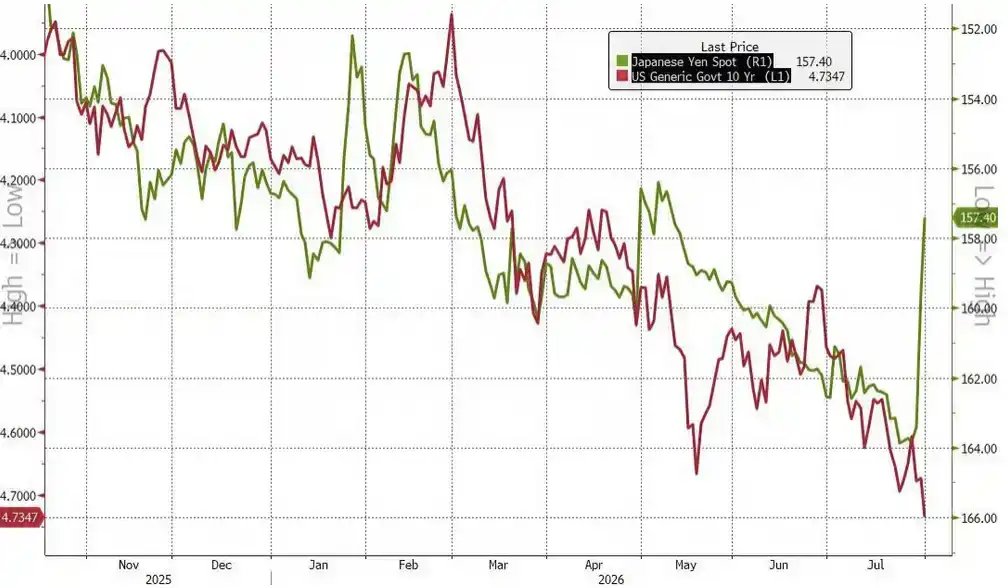
Yen Shorts Begin Retreat, Risk Spills Over to Global Assets

Yen Carry Trade Not Over, But Trade Odds Have Changed

Talk of the 'yen carry trade ending' has emerged in the market, but this judgment is premature.

The Fed kept its federal funds target range at 3.50% to 3.75% on July 29, while the Bank of Japan maintained its short-term policy rate at 1% on July 31. Even without considering hedging costs, US short-term rates remain significantly higher than Japan's, so the fundamental yield from borrowing yen and allocating to dollar assets has not disappeared.

Coordinated intervention changed the risk-reward ratio of this trade.

Previously, investors might have viewed Japan's unilateral intervention as only causing brief volatility, thus willing to re-establish shorts after yen rebounds. Now, they must also price in a higher risk premium for the possibility of US re-entering the market, officials increasing intervention frequency, and the Bank of Japan raising rates earlier.

Yen shorts may therefore reduce leverage, shrink positions, or buy more option protection, but this does not mean capital has entirely abandoned the carry trade. As long as the US-Japan rate differential remains high, the yen may still face new selling pressure on each rebound.

A more accurate assessment is: coordinated intervention has compressed the leverage space for yen shorts but has not yet eliminated the macro fundamentals for shorting the yen.

US Treasuries Face Spillover Risk, But Transmission Mechanism Has Changed

The global impact of yen intervention lies not only in the forex market but also in how Japan funds the dollars needed to buy yen.

US Treasury TIC data shows that as of the end of May 2026, Japan holds approximately $1.143 trillion in US Treasuries, the largest foreign holder. TIC data, affected by factors like custodial account attribution, does not precisely reflect ultimate ownership, but Japan's massive US Treasury holdings remain an important indicator for observing intervention spillover risk.

The traditional operational chain is that the Japanese Ministry of Finance uses foreign exchange reserves to sell dollars and buy yen in the market. If existing dollar cash is insufficient, it could theoretically sell dollar assets, including US Treasuries. Large-scale, sustained selling of US Treasuries could increase market supply, putting upward pressure on US long-term yields.

But this transmission chain is not inevitable.

Bessent revealed that the Fed's FIMA repo facility for foreign central banks and international monetary authorities played a role in this action. This tool allows foreign official institutions to temporarily pledge US Treasuries held at the New York Fed as collateral for dollar loans, thereby obtaining the dollar liquidity needed for intervention without directly selling Treasuries. Bessent also suggested expanding the scale of this facility in the future.

This implies that one aim of US-Japan coordination may be to allow Japan to support the yen while trying to avoid concentrated selling of US Treasuries that could push up US financing costs.

The US Treasury risk therefore needs to be understood on two levels: short-term, the FIMA tool can buffer forced selling pressure; if intervention scales persist and durations lengthen, Japan may still adjust its dollar asset allocation, and only then would the US Treasury market face more noticeable supply impacts.

Intervention Alters Short-Term Odds, Interest Differentials Determine Long-Term Trend

Ministry of Finance Can Buy Time, Central Bank Determines Trend

Coordinated intervention can change short-term positioning but can hardly alone determine the yen's medium-to-long term direction.

The Bank of Japan has gradually exited ultra-easy policy, raising the policy rate to 1%, but the pace of its tightening remains constrained by the domestic economy, government financing costs, and the stability of the Japanese government bond (JGB) market. On July 31, the BOJ maintained rates unchanged with an 8-1 vote, with only one board member advocating an immediate hike to 1.25%.

This creates clear tension for Japanese policy.

The Ministry of Finance wants to prevent excessive yen depreciation to reduce imported inflation and political pressure; the Bank of Japan cannot raise rates rapidly just for the exchange rate, as that could push up JGB yields and increase financing burdens for the government, companies, and households.

Intervention in this process is more like buying time: by creating two-way volatility and forcing shorts to reduce leverage, it creates a window for the BOJ to gradually normalize policy.

But the exchange rate trend ultimately depends on fundamentals. If the BOJ continues to hike and US yields fall, narrowing the US-Japan interest differential, a sustained yen rebound becomes easier; if the differential remains wide long-term, gains post-intervention could still gradually be given back.

Still Far from a 'New Plaza Accord'

Grand narratives like 'New Plaza Accord' and 'end of yen carry trade era' have already appeared in the market, but current facts are insufficient to support these judgments.

The 1985 Plaza Accord involved multiple major economies jointly pushing for an orderly dollar depreciation, encompassing broader policy coordination and global currency realignment. The current action's scope is narrower, directly aiming to curb the yen's excessive, disorderly depreciation and prevent forex and bond market volatility from spilling over into the global financial system.

What can be confirmed at this stage is that the US and Japan have jointly bought yen, Bessent's notepad shows the US considered an operation of $5-10 billion, and both sides explicitly reserve the possibility of intervening again. USD/JPY subsequently retreated rapidly from near 164 to the 155-156 range.

This is enough to change short-term trading but not enough to prove the yen has entered a long-term appreciation cycle.

Three things truly need watching next: whether the US participates in actual trades again, whether the BOJ accelerates its rate hike pace, and whether the FIMA tool allows Japan to continuously obtain dollar liquidity without significantly impacting the US Treasury market.

Until answers to these questions emerge, yen shorts will not disappear completely. But they can no longer easily bet, as in the past, that Japan's intervention is just a brief gust of wind.


Crypto di tendenza

Domande pertinenti

QWhat was the most significant change in the recent US-Japan coordinated currency intervention, beyond Japan acting alone?

AThe most significant change was the shift from Japan conducting unilateral interventions to the United States moving from verbal support to actual, coordinated participation in buying Yen.

QHow did the exposure of a note from US Treasury Secretary Scott Bessent influence market perception and the Yen's movement?

AA Reuters photo showing a note on Bessent's notepad with 'To Do: Buy Japanese Yen (JPY) $5-10 bil.' signaled serious US consideration of a sizable Yen-buying operation. This heightened market expectations of joint action, contributing to the Yen's rapid rebound from near 164 to the 155-156 range against the Dollar as it forced leveraged Yen shorts to reassess risks.

QHas the fundamental driver for the Yen carry trade been eliminated by the coordinated intervention?

ANo, the fundamental driver has not been eliminated. The interest rate differential remains, with US rates still significantly higher than Japan's. The intervention changed the risk-reward structure by introducing the credible threat of repeated, bilateral action, which compresses leverage and increases risk premiums for Yen shorts, but does not remove the underlying incentive for the carry trade.

QWhat mechanism did the US Treasury highlight to help Japan fund its Yen-buying intervention without necessarily selling US Treasuries?

AUS Treasury Secretary Bessent highlighted the Federal Reserve's FIMA (Foreign and International Monetary Authorities) repo facility. This tool allows foreign central banks to temporarily pledge their US Treasury holdings at the New York Fed as collateral to obtain dollar loans, providing the liquidity needed for intervention without immediately selling the bonds.

QWhat are the three key factors the article suggests need to be observed to determine if the Yen's recent strength can be sustained?

AThe three key factors are: 1) Whether the US participates in actual market interventions again. 2) Whether the Bank of Japan accelerates the pace of its interest rate hikes. 3) Whether the FIMA repo tool can allow Japan to persistently access dollar liquidity without significantly disrupting the US Treasury market.

Letture associate

Trump's Mining Company Reports $57 Million Loss

American Bitcoin, a cryptocurrency mining company co-founded by Eric Trump, son of Donald Trump, reported a net loss of $57.2 million for the second quarter of 2026. This loss was primarily driven by a decline in the value of Bitcoin held on its balance sheet. The company mined 932 BTC in the quarter, increasing its total reserves to 8,002 BTC, making it the 16th largest corporate Bitcoin holder. While mining revenue rose 8% to $67 million, the company's cost to mine one Bitcoin was approximately $36,500 against a market price around $63,000 in early August. Approximately 3,090 of its Bitcoins are pledged as collateral to equipment maker Bitmain. The company operates using the data centers and hardware of Hut 8, which received an 80% stake in American Bitcoin at its launch. American Bitcoin went public in September 2025, but its stock (ABTC) has since fallen over 90%. The company has faced controversy, with a Forbes investigation alleging it uses the Trump name to attract investors while primarily buying Bitcoin with raised funds rather than mining efficiently—a claim Eric Trump vehemently denied. For comparison, Michael Saylor's MicroStrategy, the world's largest corporate Bitcoin holder, reported a Q2 2026 net loss of $8.2 billion, also due to Bitcoin depreciation. Eric Trump has positioned the company as a way to give investors stock-market exposure to Bitcoin, similar to MicroStrategy, and has called himself a "Bitcoin maximalist."

cryptonews.ru8 min fa

Trump's Mining Company Reports $57 Million Loss

cryptonews.ru8 min fa

Forecast for August 2026 for the Crypto Market: Macroeconomics Will Determine Everything

Happy Coin News, with AI assistance from Gemini, presents a cryptocurrency market forecast for August 2026. The month is expected to solidify the market's structural transformation, where speculative narratives give way to pragmatic institutional integration. The key determinant of market dynamics will be the macroeconomic environment, with high U.S. interest rates and persistent inflation likely limiting retail capital inflow into high-risk digital assets. In this climate of limited liquidity, institutional players are predicted to gain near-total market control. Regulatory shifts will also be impactful. The EU's MiCA framework transition period officially ended on July 1, 2026, requiring full authorization for service providers. Meanwhile, the U.S. FIT21 bill will gain momentum, clarifying SEC and CFTC roles. These macro and regulatory pressures are reflected in the market structure: total capitalization is around $2.221 trillion, with Bitcoin's dominance high at 56.35%. A broad "altcoin season" is not imminent, as the Altcoin Season Index remains low. Growth in altcoins will be selective, with smart capital concentrating on AI infrastructure, next-gen DeFi, and tokenization projects. The main trend dominating August will be the tokenization of real-world assets (RWA), accelerated by the new regulatory clarity. This institutional integration will further tighten security and custodial requirements, moving the market definitively away from unregulated platforms toward hybrid models combining traditional finance tools with transparent blockchain infrastructure.

cryptonews.ru11 min fa

Forecast for August 2026 for the Crypto Market: Macroeconomics Will Determine Everything

cryptonews.ru11 min fa

Trading

Spot

Articoli Popolari

Cosa è $S$

Comprendere SPERO: Una Panoramica Completa Introduzione a SPERO Mentre il panorama dell'innovazione continua a evolversi, l'emergere delle tecnologie web3 e dei progetti di criptovaluta gioca un ruolo fondamentale nel plasmare il futuro digitale. Un progetto che ha attirato l'attenzione in questo campo dinamico è SPERO, denotato come SPERO,$$s$. Questo articolo mira a raccogliere e presentare informazioni dettagliate su SPERO, per aiutare gli appassionati e gli investitori a comprendere le sue basi, obiettivi e innovazioni nei domini web3 e crypto. Che cos'è SPERO,$$s$? SPERO,$$s$ è un progetto unico all'interno dello spazio crypto che cerca di sfruttare i principi della decentralizzazione e della tecnologia blockchain per creare un ecosistema che promuove l'impegno, l'utilità e l'inclusione finanziaria. Il progetto è progettato per facilitare interazioni peer-to-peer in modi nuovi, fornendo agli utenti soluzioni e servizi finanziari innovativi. Al suo interno, SPERO,$$s$ mira a responsabilizzare gli individui fornendo strumenti e piattaforme che migliorano l'esperienza dell'utente nello spazio delle criptovalute. Questo include la possibilità di metodi di transazione più flessibili, la promozione di iniziative guidate dalla comunità e la creazione di percorsi per opportunità finanziarie attraverso applicazioni decentralizzate (dApps). La visione sottostante di SPERO,$$s$ ruota attorno all'inclusività, cercando di colmare le lacune all'interno della finanza tradizionale mentre sfrutta i vantaggi della tecnologia blockchain. Chi è il Creatore di SPERO,$$s$? L'identità del creatore di SPERO,$$s$ rimane piuttosto oscura, poiché ci sono risorse pubblicamente disponibili limitate che forniscono informazioni dettagliate sul suo fondatore o fondatori. Questa mancanza di trasparenza può derivare dall'impegno del progetto per la decentralizzazione—un ethos che molti progetti web3 condividono, dando priorità ai contributi collettivi rispetto al riconoscimento individuale. Centrando le discussioni attorno alla comunità e ai suoi obiettivi collettivi, SPERO,$$s$ incarna l'essenza dell'empowerment senza mettere in evidenza individui specifici. Pertanto, comprendere l'etica e la missione di SPERO rimane più importante che identificare un creatore singolo. Chi sono gli Investitori di SPERO,$$s$? SPERO,$$s$ è supportato da una varietà di investitori che vanno dai capitalisti di rischio agli investitori angelici dedicati a promuovere l'innovazione nel settore crypto. Il focus di questi investitori generalmente si allinea con la missione di SPERO—dando priorità a progetti che promettono avanzamenti tecnologici sociali, inclusività finanziaria e governance decentralizzata. Queste fondazioni di investitori sono tipicamente interessate a progetti che non solo offrono prodotti innovativi, ma contribuiscono anche positivamente alla comunità blockchain e ai suoi ecosistemi. Il supporto di questi investitori rafforza SPERO,$$s$ come un concorrente degno di nota nel dominio in rapida evoluzione dei progetti crypto. Come Funziona SPERO,$$s$? SPERO,$$s$ impiega un framework multifunzionale che lo distingue dai progetti di criptovaluta convenzionali. Ecco alcune delle caratteristiche chiave che sottolineano la sua unicità e innovazione: Governance Decentralizzata: SPERO,$$s$ integra modelli di governance decentralizzati, responsabilizzando gli utenti a partecipare attivamente ai processi decisionali riguardanti il futuro del progetto. Questo approccio favorisce un senso di proprietà e responsabilità tra i membri della comunità. Utilità del Token: SPERO,$$s$ utilizza il proprio token di criptovaluta, progettato per servire varie funzioni all'interno dell'ecosistema. Questi token abilitano transazioni, premi e la facilitazione dei servizi offerti sulla piattaforma, migliorando l'impegno e l'utilità complessivi. Architettura Stratificata: L'architettura tecnica di SPERO,$$s$ supporta la modularità e la scalabilità, consentendo un'integrazione fluida di funzionalità e applicazioni aggiuntive man mano che il progetto evolve. Questa adattabilità è fondamentale per mantenere la rilevanza nel panorama crypto in continua evoluzione. Coinvolgimento della Comunità: Il progetto enfatizza iniziative guidate dalla comunità, impiegando meccanismi che incentivano la collaborazione e il feedback. Nutrendo una comunità forte, SPERO,$$s$ può affrontare meglio le esigenze degli utenti e adattarsi alle tendenze di mercato. Focus sull'Inclusione: Offrendo basse commissioni di transazione e interfacce user-friendly, SPERO,$$s$ mira ad attrarre una base utenti diversificata, inclusi individui che potrebbero non aver precedentemente interagito nello spazio crypto. Questo impegno per l'inclusione si allinea con la sua missione generale di empowerment attraverso l'accessibilità. Cronologia di SPERO,$$s$ Comprendere la storia di un progetto fornisce preziose intuizioni sulla sua traiettoria di sviluppo e sui traguardi. Di seguito è riportata una cronologia suggerita che mappa eventi significativi nell'evoluzione di SPERO,$$s$: Fase di Concettualizzazione e Ideazione: Le idee iniziali che formano la base di SPERO,$$s$ sono state concepite, allineandosi strettamente con i principi di decentralizzazione e focus sulla comunità all'interno dell'industria blockchain. Lancio del Whitepaper del Progetto: Dopo la fase concettuale, è stato rilasciato un whitepaper completo che dettaglia la visione, gli obiettivi e l'infrastruttura tecnologica di SPERO,$$s$ per suscitare interesse e feedback dalla comunità. Costruzione della Comunità e Prime Interazioni: Sono stati effettuati sforzi attivi di outreach per costruire una comunità di early adopters e potenziali investitori, facilitando discussioni attorno agli obiettivi del progetto e ottenendo supporto. Evento di Generazione del Token: SPERO,$$s$ ha condotto un evento di generazione del token (TGE) per distribuire i propri token nativi ai primi sostenitori e stabilire una liquidità iniziale all'interno dell'ecosistema. Lancio della Prima dApp: La prima applicazione decentralizzata (dApp) associata a SPERO,$$s$ è stata attivata, consentendo agli utenti di interagire con le funzionalità principali della piattaforma. Sviluppo Continuo e Partnership: Aggiornamenti e miglioramenti continui alle offerte del progetto, inclusi partnership strategiche con altri attori nello spazio blockchain, hanno plasmato SPERO,$$s$ in un concorrente competitivo e in evoluzione nel mercato crypto. Conclusione SPERO,$$s$ rappresenta una testimonianza del potenziale del web3 e delle criptovalute di rivoluzionare i sistemi finanziari e responsabilizzare gli individui. Con un impegno per la governance decentralizzata, il coinvolgimento della comunità e funzionalità progettate in modo innovativo, apre la strada verso un panorama finanziario più inclusivo. Come per qualsiasi investimento nello spazio crypto in rapida evoluzione, si incoraggiano potenziali investitori e utenti a ricercare approfonditamente e a impegnarsi in modo riflessivo con gli sviluppi in corso all'interno di SPERO,$$s$. Il progetto mostra lo spirito innovativo dell'industria crypto, invitando a ulteriori esplorazioni delle sue innumerevoli possibilità. Mentre il percorso di SPERO,$$s$ è ancora in fase di sviluppo, i suoi principi fondamentali potrebbero effettivamente influenzare il futuro di come interagiamo con la tecnologia, la finanza e tra di noi in ecosistemi digitali interconnessi.

220 Totale visualizzazioniPubblicato il 2024.12.17Aggiornato il 2024.12.17

Cosa è $S$

Cosa è AGENT S

Agent S: Il Futuro dell'Interazione Autonoma in Web3 Introduzione Nel panorama in continua evoluzione di Web3 e criptovalute, le innovazioni stanno costantemente ridefinendo il modo in cui gli individui interagiscono con le piattaforme digitali. Uno di questi progetti pionieristici, Agent S, promette di rivoluzionare l'interazione uomo-computer attraverso il suo framework agentico aperto. Aprendo la strada a interazioni autonome, Agent S mira a semplificare compiti complessi, offrendo applicazioni trasformative nell'intelligenza artificiale (AI). Questa esplorazione dettagliata approfondirà le complessità del progetto, le sue caratteristiche uniche e le implicazioni per il dominio delle criptovalute. Cos'è Agent S? Agent S si presenta come un innovativo framework agentico aperto, progettato specificamente per affrontare tre sfide fondamentali nell'automazione dei compiti informatici: Acquisizione di Conoscenze Specifiche del Dominio: Il framework apprende in modo intelligente da varie fonti di conoscenza esterne ed esperienze interne. Questo approccio duale gli consente di costruire un ricco repository di conoscenze specifiche del dominio, migliorando le sue prestazioni nell'esecuzione dei compiti. Pianificazione su Lungo Orizzonte di Compiti: Agent S impiega una pianificazione gerarchica potenziata dall'esperienza, un approccio strategico che facilita la suddivisione e l'esecuzione efficiente di compiti complessi. Questa caratteristica migliora significativamente la sua capacità di gestire più sottocompiti in modo efficiente ed efficace. Gestione di Interfacce Dinamiche e Non Uniformi: Il progetto introduce l'Interfaccia Agente-Computer (ACI), una soluzione innovativa che migliora l'interazione tra agenti e utenti. Utilizzando Modelli Linguistici Multimodali di Grandi Dimensioni (MLLM), Agent S può navigare e manipolare senza sforzo diverse interfacce grafiche utente. Attraverso queste caratteristiche pionieristiche, Agent S fornisce un framework robusto che affronta le complessità coinvolte nell'automazione dell'interazione umana con le macchine, preparando il terreno per innumerevoli applicazioni nell'AI e oltre. Chi è il Creatore di Agent S? Sebbene il concetto di Agent S sia fondamentalmente innovativo, informazioni specifiche sul suo creatore rimangono elusive. Il creatore è attualmente sconosciuto, il che evidenzia sia la fase embrionale del progetto sia la scelta strategica di mantenere i membri fondatori sotto anonimato. Indipendentemente dall'anonimato, l'attenzione rimane sulle capacità e sul potenziale del framework. Chi sono gli Investitori di Agent S? Poiché Agent S è relativamente nuovo nell'ecosistema crittografico, informazioni dettagliate riguardanti i suoi investitori e sostenitori finanziari non sono documentate esplicitamente. La mancanza di approfondimenti pubblicamente disponibili sulle fondazioni di investimento o sulle organizzazioni che supportano il progetto solleva interrogativi sulla sua struttura di finanziamento e sulla roadmap di sviluppo. Comprendere il supporto è cruciale per valutare la sostenibilità del progetto e il suo potenziale impatto sul mercato. Come Funziona Agent S? Al centro di Agent S si trova una tecnologia all'avanguardia che gli consente di funzionare efficacemente in contesti diversi. Il suo modello operativo è costruito attorno a diverse caratteristiche chiave: Interazione Uomo-Computer Simile a Quella Umana: Il framework offre una pianificazione AI avanzata, cercando di rendere le interazioni con i computer più intuitive. Mimando il comportamento umano nell'esecuzione dei compiti, promette di elevare le esperienze degli utenti. Memoria Narrativa: Utilizzata per sfruttare esperienze di alto livello, Agent S utilizza la memoria narrativa per tenere traccia delle storie dei compiti, migliorando così i suoi processi decisionali. Memoria Episodica: Questa caratteristica fornisce agli utenti una guida passo-passo, consentendo al framework di offrire supporto contestuale mentre i compiti si sviluppano. Supporto per OpenACI: Con la capacità di funzionare localmente, Agent S consente agli utenti di mantenere il controllo sulle proprie interazioni e flussi di lavoro, allineandosi con l'etica decentralizzata di Web3. Facile Integrazione con API Esterne: La sua versatilità e compatibilità con varie piattaforme AI garantiscono che Agent S possa adattarsi senza problemi agli ecosistemi tecnologici esistenti, rendendolo una scelta attraente per sviluppatori e organizzazioni. Queste funzionalità contribuiscono collettivamente alla posizione unica di Agent S all'interno dello spazio crittografico, poiché automatizza compiti complessi e multi-fase con un intervento umano minimo. Man mano che il progetto evolve, le sue potenziali applicazioni in Web3 potrebbero ridefinire il modo in cui si svolgono le interazioni digitali. Cronologia di Agent S Lo sviluppo e le tappe di Agent S possono essere riassunti in una cronologia che evidenzia i suoi eventi significativi: 27 Settembre 2024: Il concetto di Agent S è stato lanciato in un documento di ricerca completo intitolato “Un Framework Agentico Aperto che Usa i Computer Come un Umano”, mostrando le basi per il progetto. 10 Ottobre 2024: Il documento di ricerca è stato reso pubblicamente disponibile su arXiv, offrendo un'esplorazione approfondita del framework e della sua valutazione delle prestazioni basata sul benchmark OSWorld. 12 Ottobre 2024: È stata rilasciata una presentazione video, fornendo un'idea visiva delle capacità e delle caratteristiche di Agent S, coinvolgendo ulteriormente potenziali utenti e investitori. Questi indicatori nella cronologia non solo illustrano i progressi di Agent S, ma indicano anche il suo impegno per la trasparenza e il coinvolgimento della comunità. Punti Chiave su Agent S Man mano che il framework Agent S continua a evolversi, diversi attributi chiave si distinguono, sottolineando la sua natura innovativa e il potenziale: Framework Innovativo: Progettato per fornire un uso intuitivo dei computer simile all'interazione umana, Agent S porta un approccio nuovo all'automazione dei compiti. Interazione Autonoma: La capacità di interagire autonomamente con i computer attraverso GUI segna un passo avanti verso soluzioni informatiche più intelligenti ed efficienti. Automazione di Compiti Complessi: Con la sua metodologia robusta, può automatizzare compiti complessi e multi-fase, rendendo i processi più veloci e meno soggetti a errori. Miglioramento Continuo: I meccanismi di apprendimento consentono ad Agent S di migliorare dalle esperienze passate, migliorando continuamente le sue prestazioni e la sua efficacia. Versatilità: La sua adattabilità attraverso diversi ambienti operativi come OSWorld e WindowsAgentArena garantisce che possa servire un'ampia gamma di applicazioni. Man mano che Agent S si posiziona nel panorama di Web3 e delle criptovalute, il suo potenziale per migliorare le capacità di interazione e automatizzare i processi segna un significativo avanzamento nelle tecnologie AI. Attraverso il suo framework innovativo, Agent S esemplifica il futuro delle interazioni digitali, promettendo un'esperienza più fluida ed efficiente per gli utenti in vari settori. Conclusione Agent S rappresenta un audace passo avanti nell'unione tra AI e Web3, con la capacità di ridefinire il modo in cui interagiamo con la tecnologia. Sebbene sia ancora nelle sue fasi iniziali, le possibilità per la sua applicazione sono vaste e coinvolgenti. Attraverso il suo framework completo che affronta sfide critiche, Agent S mira a portare le interazioni autonome al centro dell'esperienza digitale. Man mano che ci addentriamo nei regni delle criptovalute e della decentralizzazione, progetti come Agent S giocheranno senza dubbio un ruolo cruciale nel plasmare il futuro della tecnologia e della collaborazione uomo-computer.

675 Totale visualizzazioniPubblicato il 2025.01.14Aggiornato il 2025.01.14

Cosa è AGENT S

Come comprare S

Benvenuto in HTX.com! Abbiamo reso l'acquisto di Sonic (S) semplice e conveniente. Segui la nostra guida passo passo per intraprendere il tuo viaggio nel mondo delle criptovalute.Step 1: Crea il tuo Account HTXUsa la tua email o numero di telefono per registrarti il tuo account gratuito su HTX. Vivi un'esperienza facile e sblocca tutte le funzionalità,Crea il mio accountStep 2: Vai in Acquista crypto e seleziona il tuo metodo di pagamentoCarta di credito/debito: utilizza la tua Visa o Mastercard per acquistare immediatamente SonicS.Bilancio: Usa i fondi dal bilancio del tuo account HTX per fare trading senza problemi.Terze parti: abbiamo aggiunto metodi di pagamento molto utilizzati come Google Pay e Apple Pay per maggiore comodità.P2P: Fai trading direttamente con altri utenti HTX.Over-the-Counter (OTC): Offriamo servizi su misura e tassi di cambio competitivi per i trader.Step 3: Conserva Sonic (S)Dopo aver acquistato Sonic (S), conserva nel tuo account HTX. In alternativa, puoi inviare tramite trasferimento blockchain o scambiare per altre criptovalute.Step 4: Scambia Sonic (S)Scambia facilmente Sonic (S) nel mercato spot di HTX. Accedi al tuo account, seleziona la tua coppia di trading, esegui le tue operazioni e monitora in tempo reale. Offriamo un'esperienza user-friendly sia per chi ha appena iniziato che per i trader più esperti.

1.3k Totale visualizzazioniPubblicato il 2025.01.15Aggiornato il 2026.06.02

Come comprare S

Discussioni

Benvenuto nella Community HTX. Qui puoi rimanere informato sugli ultimi sviluppi della piattaforma e accedere ad approfondimenti esperti sul mercato. Le opinioni degli utenti sul prezzo di S S sono presentate come di seguito.

活动图片