Pyth to launch reserve using buybacks from DAO treasury funds

cointelegraphPubblicato 2025-12-12Pubblicato ultima volta 2025-12-12

Introduzione

The Pyth Network, a blockchain oracle provider, announced it will use one-third of its protocol revenue to buy back PYTH tokens on the open market through its DAO treasury. This strategy aims to establish a network reserve and boost both revenue and token value. The PYTH token has declined over 80% in the past year, despite a brief surge after Pyth partnered with the U.S. government to publish economic data onchain. At the time of writing, PYTH was trading around $0.063, down 1.3% in 24 hours. The move follows a similar proposal from Aave’s DAO in October, though community reactions remain uncertain, citing past criticisms of token buyback schemes in other projects like Mango Markets.

The Pyth Network, a blockchain oracle provider, said it will convert a portion of its revenue into PYTH token purchases as part of a reserve strategy.

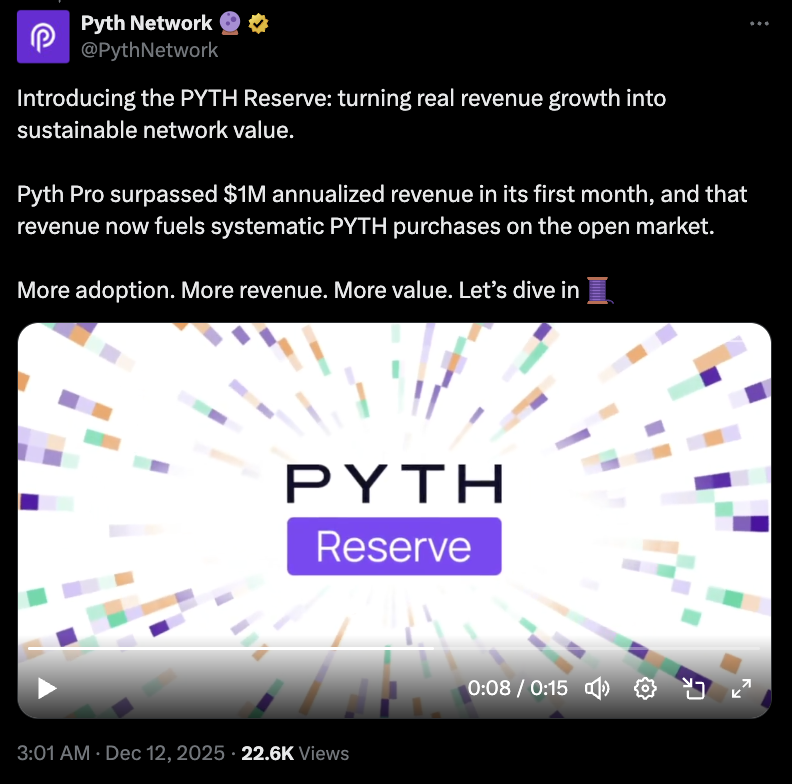
In a Friday blog post, Pyth said the tokens it buys on the open market with one-third of the protocol’s revenue through its decentralized autonomous organization (DAO) would constitute the network’s reserve. The network said the strategy was designed to increase revenue and token purchases.

“[I]t’s time to rewrite the market data economy on a global level,” said Pyth.
Source: Pyth

The price of the Pyth Network token (PYTH) has dropped by more than 80% over the past year, despite a brief surge when the platform deepened ties to the US government. The Trump administration announced in August that the company and Chainlink would be responsible for publishing the country’s economic data onchain.

According to data from Nansen, the PYTH price decreased by about 1.3% over the previous 24 hours, reaching about $0.063 at the time of publication.

Related: Grayscale launches Pyth investment fund

Aave DAO proposed a similar buyback initiative in October

The DAO behind the Aave protocol introduced a proposal that would use $50 million of its annual revenue to repurchase its native token, Aave (AAVE). As of Friday, it did not appear that the proposal had been approved.

It’s unclear how Pyth users may respond to the plan. In 2024, when Mango Markets suggested a buyback program to purchase its MNGO tokens, co-founder Daffy Durairaj accused the creators of “untrustworthy behavior and self-dealing.”

Magazine: When privacy and AML laws conflict: Crypto projects’ impossible choice

Letture associate

You Bet on the News, the Pros Read the Rules: The True Cognitive Gap in Losing Money on Polymarket

The article explains that the key to profiting on Polymarket, a prediction market platform, lies not just predicting real-world events correctly, but in meticulously understanding the specific rules that govern how each market will be resolved. It illustrates this with examples, such as a market on Venezuela's 2026 leader, where the official rules defining "officially holds" the office overruled the intuitive answer of who was in practical control. Other examples include debates over the definition of a "token" or what constitutes an "agreement." The core argument is that a "reality vs. rules" gap creates pricing discrepancies that savvy traders ("车头" or "whales") exploit. The platform has a formal dispute resolution process managed by UMA token holders to settle ambiguous outcomes. This process involves proposal submission, a challenge window, a discussion period, and a final vote. However, the article highlights a critical flaw in this system compared to a traditional court: the lack of separation between the arbiters (UMA voters) and the interested parties (traders with financial stakes in the outcome). This conflict of interest undermines the discussion phase, leads to herd mentality, and results in opaque final decisions without explanatory rulings. Consequently, the system lacks a body of precedent, making it difficult for users to learn from past disputes. The ultimate takeaway is that success on Polymarket requires a lawyer-like scrutiny of the rules to identify and capitalize on the cognitive gap between how events appear and how they are contractually defined for settlement.

marsbit20 min fa

You Bet on the News, the Pros Read the Rules: The True Cognitive Gap in Losing Money on Polymarket

marsbit20 min fa

Will the Fed Still Cut Interest Rates? Tonight's Data Is Crucial

The core debate surrounding the Federal Reserve's potential interest rate cuts is intensifying amid geopolitical conflict and rebounding inflation. The key question is whether high energy prices will cause persistent inflation or weaken consumer demand enough to force the Fed to cut rates. Citigroup presents a bullish case for cuts, arguing that oil supply disruptions from the Strait of Hormuz are temporary and will not lead to lasting inflationary pressure. They point to receding bond yields and oil prices as evidence the market is pricing in a short-lived shock. Citi's data also shows tightening financial conditions, a stabilizing labor market, and healthy tax returns, supporting their view that the path to lower rates remains open. Conversely, Deutsche Bank offers a starkly contrasting, more hawkish outlook. They argue the Fed's current policy is already neutral and expect rates to remain unchanged indefinitely. Their view is based on stalled disinflation progress and a shift toward more hawkish rhetoric from key Fed officials like Waller, who cited risks from prolonged Middle East conflict and tariffs. Other officials, including Williams and Hammack, signaled rates would likely stay on hold for a "considerable time." The market pricing has shifted dramatically, now forecasting zero cuts in 2026. The imminent release of the March retail sales "control group" data is highlighted as a critical test. This metric, which excludes gas station sales, will reveal if high gasoline prices are eroding consumer spending in other areas. A weak reading could support the case for imminent rate cuts, while a strong one would bolster the argument for the Fed to hold steady. This data is pivotal for determining the near-term policy path.

marsbit40 min fa

Will the Fed Still Cut Interest Rates? Tonight's Data Is Crucial

marsbit40 min fa

Trading

Spot
Futures

Articoli Popolari

Come comprare DAO

Benvenuto in HTX.com! Abbiamo reso l'acquisto di DAO Maker (DAO) semplice e conveniente. Segui la nostra guida passo passo per intraprendere il tuo viaggio nel mondo delle criptovalute.Step 1: Crea il tuo Account HTXUsa la tua email o numero di telefono per registrarti il tuo account gratuito su HTX. Vivi un'esperienza facile e sblocca tutte le funzionalità,Crea il mio accountStep 2: Vai in Acquista crypto e seleziona il tuo metodo di pagamentoCarta di credito/debito: utilizza la tua Visa o Mastercard per acquistare immediatamente DAO MakerDAO.Bilancio: Usa i fondi dal bilancio del tuo account HTX per fare trading senza problemi.Terze parti: abbiamo aggiunto metodi di pagamento molto utilizzati come Google Pay e Apple Pay per maggiore comodità.P2P: Fai trading direttamente con altri utenti HTX.Over-the-Counter (OTC): Offriamo servizi su misura e tassi di cambio competitivi per i trader.Step 3: Conserva DAO Maker (DAO)Dopo aver acquistato DAO Maker (DAO), conserva nel tuo account HTX. In alternativa, puoi inviare tramite trasferimento blockchain o scambiare per altre criptovalute.Step 4: Scambia DAO Maker (DAO)Scambia facilmente DAO Maker (DAO) nel mercato spot di HTX. Accedi al tuo account, seleziona la tua coppia di trading, esegui le tue operazioni e monitora in tempo reale. Offriamo un'esperienza user-friendly sia per chi ha appena iniziato che per i trader più esperti.

139 Totale visualizzazioniPubblicato il 2024.12.11Aggiornato il 2025.03.21

Come comprare DAO

Discussioni

Benvenuto nella Community HTX. Qui puoi rimanere informato sugli ultimi sviluppi della piattaforma e accedere ad approfondimenti esperti sul mercato. Le opinioni degli utenti sul prezzo di DAO DAO sono presentate come di seguito.

活动图片