Pyth to launch reserve using buybacks from DAO treasury funds

cointelegraphPubblicato 2025-12-12Pubblicato ultima volta 2025-12-12

Introduzione

The Pyth Network, a blockchain oracle provider, announced it will use one-third of its protocol revenue to buy back PYTH tokens on the open market through its DAO treasury. This strategy aims to establish a network reserve and boost both revenue and token value. The PYTH token has declined over 80% in the past year, despite a brief surge after Pyth partnered with the U.S. government to publish economic data onchain. At the time of writing, PYTH was trading around $0.063, down 1.3% in 24 hours. The move follows a similar proposal from Aave’s DAO in October, though community reactions remain uncertain, citing past criticisms of token buyback schemes in other projects like Mango Markets.

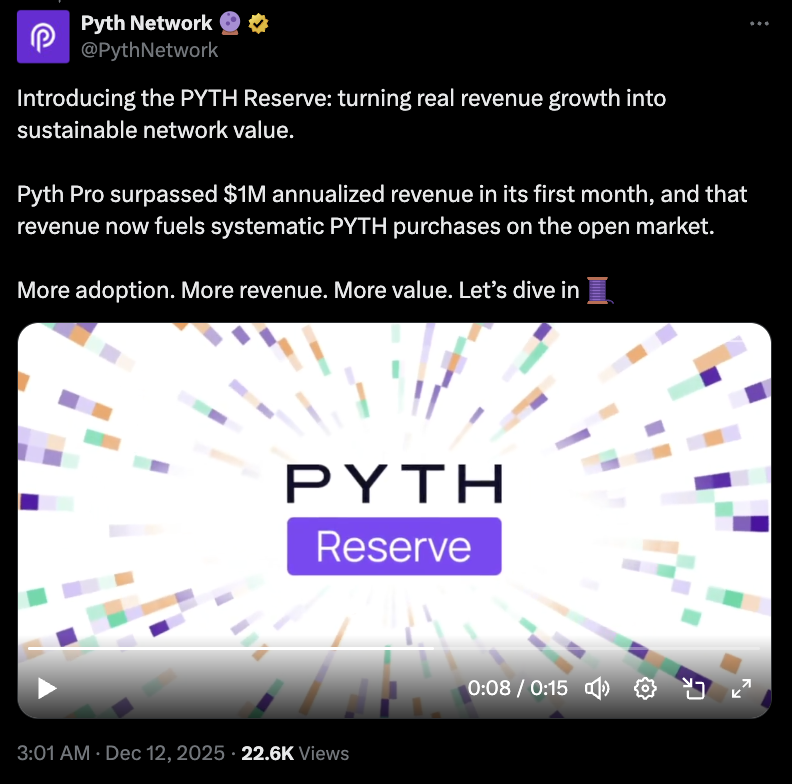
The Pyth Network, a blockchain oracle provider, said it will convert a portion of its revenue into PYTH token purchases as part of a reserve strategy.

In a Friday blog post, Pyth said the tokens it buys on the open market with one-third of the protocol’s revenue through its decentralized autonomous organization (DAO) would constitute the network’s reserve. The network said the strategy was designed to increase revenue and token purchases.

“[I]t’s time to rewrite the market data economy on a global level,” said Pyth.
Source: Pyth

The price of the Pyth Network token (PYTH) has dropped by more than 80% over the past year, despite a brief surge when the platform deepened ties to the US government. The Trump administration announced in August that the company and Chainlink would be responsible for publishing the country’s economic data onchain.

According to data from Nansen, the PYTH price decreased by about 1.3% over the previous 24 hours, reaching about $0.063 at the time of publication.

Related: Grayscale launches Pyth investment fund

Aave DAO proposed a similar buyback initiative in October

The DAO behind the Aave protocol introduced a proposal that would use $50 million of its annual revenue to repurchase its native token, Aave (AAVE). As of Friday, it did not appear that the proposal had been approved.

It’s unclear how Pyth users may respond to the plan. In 2024, when Mango Markets suggested a buyback program to purchase its MNGO tokens, co-founder Daffy Durairaj accused the creators of “untrustworthy behavior and self-dealing.”

Magazine: When privacy and AML laws conflict: Crypto projects’ impossible choice
Letture associate

Imbalance in Returns Amid High Correlation: Why is Capital Being 'Squeezed Out' of Altcoins?

Over the past year, a stark divergence has emerged between cryptocurrency and U.S. equity markets. While the S&P 500 and Nasdaq 100 have posted significant gains, altcoins have experienced a severe downturn, indicating a structural shift of capital toward higher-quality assets. Major indices like the S&P 500 and Nasdaq 100 rose substantially in 2024 and 2025 with relatively low drawdowns. In contrast, the CoinDesk 80 Index, tracking altcoins outside the top 20 cryptocurrencies, plummeted over 46% in Q1 2025 and was down 38% year-to-date by mid-July. A key driver is the "return imbalance under high correlation." Despite a correlation of 0.9 between major cryptocurrencies (CoinDesk 5 Index) and altcoins (CoinDesk 80), their returns diverged drastically. The former gained 12-13%, while the latter fell nearly 40%. The risk-adjusted return gap is even wider. Altcoin indices showed volatility similar to or higher than equities but delivered deeply negative returns and negative Sharpe ratios. Over five years, a small-cap crypto index returned -8%, while a large-cap index surged 380%. Trading data shows capital is not exiting crypto but flowing up the quality curve. Volume is concentrating in the top 10 altcoins and "institutional-grade" assets like Solana and XRP with regulatory clarity. Bitcoin and Ethereum ETFs are attracting sustained institutional inflows. Consequently, diversification into altcoins has lost its appeal. Their high correlation with major cryptos negates diversification benefits while adding risk. The market's logic has shifted: capital is now focused on regulated, liquid assets, squeezing out lower-quality altcoins.

marsbit11 min fa

Imbalance in Returns Amid High Correlation: Why is Capital Being 'Squeezed Out' of Altcoins?

marsbit11 min fa

Vision Announces Bitget Listing of VSN Token, Continuing International Expansion

Vision, a Bitpanda-backed protocol focused on bringing Europe into blockchain, has announced that its token VSN will be listed on Bitget. This marks another step in Vision’s international expansion, following its earlier listing on Binance Alpha. The Bitget listing is expected to enhance VSN’s liquidity and visibility in the global spot market, offering users another entry point to participate in the Vision ecosystem and its growing Web3 infrastructure. Florian Klein, Head of Business at Vision, stated that the move reflects the project’s rapid scaling momentum. VSN powers both the Vision and Bitpanda ecosystems, supporting staking, offering fee benefits, and enabling future governance. A portion of ecosystem revenue will be used for buybacks, burns, and staking rewards, allowing token holders to benefit from ecosystem growth. Vision is building a suite of Web3 products tailored to European regulations while remaining globally relevant. Its core offerings include the Bitpanda DeFi Wallet, Vision Protocol, Launchpad, and the upcoming Vision Chain for tokenization and institutional-grade on-chain infrastructure. Looking ahead, Vision plans to introduce governance, expand token utility, launch its chain, and form partnerships in tokenization and regulated digital assets. The Vision Web3 Foundation, based in Zug, Switzerland, oversees the development and governance of the VSN token.

深潮21 min fa

Vision Announces Bitget Listing of VSN Token, Continuing International Expansion

深潮21 min fa

Trading

Spot
Futures
活动图片