Prediction Market Leaders Are Frantically Competing for Top-Tier Sports IPs

Odaily星球日报Pubblicato 2026-01-28Pubblicato ultima volta 2026-01-28

Introduzione

Prediction market platforms are aggressively securing exclusive partnerships with major sports leagues, as seen in Polymarket's recent multi-year deal with Major League Soccer (MLS). This follows similar agreements with the NHL and UFC. While these "official exclusive prediction market" designations don’t legally prevent other platforms from offering markets on these leagues (due to the current ambiguous regulatory landscape for prediction markets compared to sports betting), they provide significant advantages. The core benefits include access to official, high-quality data for more accurate odds and faster settlements, brand authorization for marketing, and collaborative integrity monitoring to prevent market manipulation. With sports-related markets dominating trading volume on leading platforms like Kalshi (over 90%) and Polymarket (43%), competition for these lucrative partnerships is intensifying. This trend mirrors the established sports betting industry, where data and brand deals are crucial for service quality. While the top players battle for mainstream sports, data suggests emerging platforms may find opportunity in niche markets, such as crypto-native events, to differentiate themselves.

Original | Odaily Planet Daily (@OdailyChina)

Author | Azuma (@azuma_eth)

On January 27 local time in the United States, the commercial department of Major League Soccer (MLS), Soccer United Marketing (SUM), announced a multi-year cooperation agreement with the prediction market platform Polymarket. According to the agreement, Polymarket will become the official exclusive prediction market partner for the MLS league, MLS All-Star Game, MLS Cup Final, and the Leagues Cup. Meanwhile, MLS will require Polymarket to use the league's official data and third-party integrity monitoring systems, and it is not allowed to set up betting items that the league deems easily manipulated or potentially involving insider information.

This is not the first time a sports league has partnered with a prediction market. As early as last October, the National Hockey League (NHL) reached multi-year licensing agreements with both Kalshi and Polymarket; later, in November last year, Polymarket also reached an agreement with the Ultimate Fighting Championship (UFC), becoming UFC's official exclusive prediction market partner.

What does "official exclusive prediction market" mean? Does this mean that other unauthorized platforms will no longer be able to offer related markets in the future? What impact will this have on future competition? Although there are currently limited mature cases of prediction markets cooperating with sports events, and the observable samples are few, we can find similar answers to the above questions from the sports betting market, which has extremely similar service effects.

  • Odaily Note: For the similarities in services and differences in regulation between prediction markets and sports betting, as well as the regulatory博弈 surrounding prediction markets, please refer to our article from two weeks ago: "Prediction Markets Are Being Chased by the Old Order for Moving a Trillion-Dollar Cake of the Betting Industry."

Exclusive Authorization Market Licensing

First, let's answer the most critical question — Does the existence of exclusive authorization mean that other unauthorized platforms will no longer be able to offer related markets in the future?

The current situation in sports betting is that since the U.S. Supreme Court overturned the federal law "Professional and Amateur Sports Protection Act" (PASPA), which had prohibited commercial sports betting, on May 14, 2018, U.S. states have gained the autonomy to decide whether to legalize sports betting within their jurisdictions. In other words, the legality of betting services depends on state-level licensing, not commercial authorization from the leagues — in reality, when betting companies set up markets or provide betting services for various legal sports events, they do not need to obtain commercial authorization from the league operators.

However, in a few states like Tennessee, state-level sports betting regulatory agencies require betting companies to use the league's official data when providing in-play betting services, unless it can be proven that the data is not applicable or unavailable. This makes official authorization affect the scope of services of betting companies at a factual level — only by obtaining data authorization can they provide the most complete betting services.

But this logic does not directly apply to prediction markets at present. Due to the unclear (and objectively more lenient) regulatory system for prediction markets, before the final results of the appellate court or even the Supreme Court are determined, Polymarket and Kalshi are not obliged to follow similar requirements in betting regulations.

Therefore, although Polymarket has now obtained exclusive authorization from MLS, at least at this stage, it does not mean that other platforms like Kalshi are no longer allowed to set up MLS-related markets.

If Not Necessary, What Is the Significance of Authorization?

Although it is not "necessary to have authorization to open markets," in actual commercial operations, there are indeed a large number of commercial cooperation and authorization agreements between major sports leagues and betting companies. For example, the NFL has signed a long-term cooperation agreement with Genius Sports, authorizing real-time event data to betting companies through Genius as the sole official data provider, including rosters, match reports, technical statistics, etc.

For betting companies, the main significance of authorization is that they can directly obtain official data and brand authorization from the operators of sports events through commercial agreements to improve their service quality and user experience. If it is an exclusive authorization, an additional layer of exclusivity can be added on this basis.

The most core significance naturally lies in the quality and completeness of the data. Compared with data scraping through third-party channels, the official data obtained based on authorization agreements will definitely be more accurate, timely, and complete, which has a direct impact on improving the accuracy of betting odds, accelerating settlement efficiency, and expanding betting categories. As for brand and trademark authorization, it can allow betting companies to be more flexible in promoting related markets — they can use the logos of leagues, teams, and players while avoiding infringement risks.

Conversely, for sports events, reaching authorization agreements directly with betting companies also helps reduce the possibility of market manipulation (which may sound a bit abstract...). Both parties can standardize the betting range and share abnormal betting data to promptly detect potential manipulation possibilities. For example, in the cooperation between Polymarket and MLS, it has been clearly stated that markets that are easily manipulated by individuals, such as red and yellow card decisions, or those that may involve insider information, such as coach dismissals and player transfers, are not allowed.

Given the high overlap in service effects between prediction markets and sports betting, the significance of authorization agreements for the sports betting market will also take effect in prediction markets.

Head-on Clash of the Leaders, the Unconventional Second Tier

Sports betting has long been verified as a business with a huge scale and certain growth, and in prediction markets, sports events have gradually become the category with the highest transaction volume proportion.

Dovey Wan (@DoveyWan), founder of Primitive Ventures, yesterday posted the proportion of turnover of various types of events on several major prediction markets. Among them, the betting scale proportion of sports events on Kalshi has exceeded 90%, and the proportion of sports events on Polymarket has also reached 43% — obviously, sports events have become the core traffic source for these two leading prediction markets.
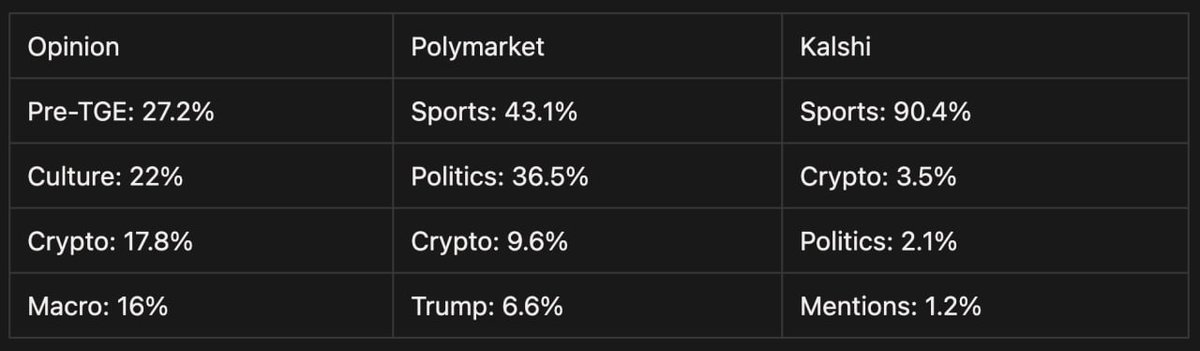
In the face of the huge存量规模 and visible增量空间, market competition is inevitable. Currently, among the four major U.S. sports leagues, only the NHL has stepped in and signed authorization agreements with Kalshi and Polymarket respectively, while the NFL, NBA, and MLB are still in a wait-and-see stage. It is expected that after Polymarket has successively seized the exclusive authorization of UFC and MLS, Kalshi and Polymarket, the two leaders with compliance and capital advantages, are likely to engage in more intense competition for the authorization of various top-tier sports events in the future, and there will inevitably be more exclusive agreements.

But the data also reveals another interesting phenomenon — perhaps due to cultural differences and user habits, emerging prediction markets on the other side of the world are moving towards截然不同的差异化道路. As shown in the previous figure, the proportion of event turnover围绕ing原生加密市场 events on Opinion is much higher than that on Kalshi and Polymarket. While the leaders are clashing head-on over the huge cake of sports events, choosing to take an unconventional path may be an opportunity for second-tier projects to catch up on a curve.


Domande pertinenti

QWhat is the significance of the partnership between MLS's Soccer United Marketing (SUM) and Polymarket?

AThe partnership makes Polymarket the official exclusive prediction market partner for MLS, MLS All-Star Game, MLS Cup, and Leagues Cup, allowing it to use official league data and integrity monitoring systems while restricting markets prone to manipulation or insider information.

QDoes an exclusive prediction market partnership like Polymarket's with MLS prevent other platforms from offering related markets?

ANo, it does not necessarily prevent other platforms from offering markets, as prediction markets currently operate under a less clear regulatory framework compared to sports betting, and authorization isn't legally required to open markets in most cases.

QWhat are the key benefits for a prediction market platform in securing an official data授权 from a sports league?

AOfficial data授权 provides more accurate, timely, and complete data, improving odds accuracy, settlement efficiency, and market variety. It also includes brand授权 for marketing and helps mitigate manipulation through regulated markets and shared monitoring.

QAccording to the data shared by Dovey Wan, what is the proportion of sports-related event volume on Kalshi and Polymarket?

ASports-related event volume accounts for over 90% on Kalshi and 43% on Polymarket, making it a core traffic source for these leading prediction markets.

QHow might the competition for top sports IP affect the prediction market landscape, particularly for second-tier projects?

AThe intense competition for exclusive sports授权 between giants like Kalshi and Polymarket may push second-tier projects to pursue差异化 strategies, such as focusing on crypto-native markets, as seen with Opinion's higher volume in that area.

Letture associate

This Week's Key Events Preview | U.S. to Release April CPI Data; U.S. Senate Banking Committee to Review "Digital Asset Market Structure Act of 2025"

Weekly News Preview: Key events for May 12-16 include major economic and crypto industry developments. On Tuesday, May 12, the U.S. will release its April CPI data. Additionally, the gaming blockchain Ronin will begin a 10-hour migration to an Ethereum Layer 2, built on OP Stack with EigenDA for data availability. This aims to leverage Ethereum's security and settle RON's annual inflation below 1%. Base's first independent network upgrade, "Base Azul," is scheduled for mainnet activation on Wednesday, May 13, focusing on security, performance, and developer experience enhancements. Thursday, May 14, sees the U.S. Senate Banking Committee voting on the "Digital Asset Market Structure Act of 2025." In other news, Solana DeFi protocol Carrot will shut down, setting a final withdrawal deadline due to impacts from the Drift exploit. The Moscow Exchange will launch futures trading for Solana, Ripple, and Tron indices (RUB-settled) for qualified investors. Multiple service closures are scheduled for Friday, May 15. Dmail Network will begin winding down due to unsustainable infrastructure costs and failed commercialization. Users must export data before this date. Separately, the Cosmos-based lending blockchain UX Chain will fully shut down. Finally, on Saturday, May 16, gaming infrastructure provider Lattice will wind down operations, with its Redstone Layer 2 network ceasing. Users are urged to withdraw assets, especially from contracts like Uniswap pools, before the shutdown.

链捕手48 min fa

This Week's Key Events Preview | U.S. to Release April CPI Data; U.S. Senate Banking Committee to Review "Digital Asset Market Structure Act of 2025"

链捕手48 min fa

Morning Post | Trump Media Group Releases Q1 Financial Report; Top Three DeFi Applications Return Nearly $100 Million in Revenue to Token Holders in 30 Days; Michael Saylor Shares Bitcoin Tracker Info Again

**Title: Daily Briefing | Trump Media Group Releases Q1 Report; Top 3 DeFi Apps Return Nearly $100M to Token Holders; Michael Saylor Signals Potential Bitcoin Buy** **Summary:** Key developments in the past 24 hours include: * **Economic Outlook:** Goldman Sachs has pushed back its forecast for the next two Federal Reserve interest rate cuts to December 2026 and March 2027, citing persistent inflationary pressures from energy costs. This delayed timeline is expected to tighten liquidity flow into risk assets, including cryptocurrencies. * **DeFi & Revenue:** Data from DefiLlama shows that three leading DeFi applications—Hyperliquid, Pump.fun, and EdgeX—collectively distributed $96.3 million in revenue to their token holders over the last 30 days. This trend highlights a shift in the crypto community's focus towards real protocol earnings and sustainable economic models. * **Corporate Bitcoin Moves:** Michael Saylor, founder of MicroStrategy (note: referred to as 'Strategy' in the text, likely a typographical error), has signaled potential upcoming Bitcoin purchases by posting a "Bitcoin Tracker" update, following a pattern that typically precedes the company's official disclosure of new acquisitions. * **Market Integrity:** Prediction market platform Polymarket announced updates to address platform issues, including identifying and banning clusters of accounts involved in "ghost-fill" activities and implementing measures to prevent bulk account creation. * **Regulation:** The Bank of England Governor warned that stablecoin regulation could lead to tensions between US and international regulators. In South Korea, the National Tax Service has launched a pilot program to entrust seized virtual assets to private custody firms for management. * **Meme Token Trends:** GMGN data lists the top trending meme tokens on Ethereum (e.g., HEX, SHIB), Solana (e.g., FWOG, TROLL), and Base (e.g., SKITTEN, PEPE) over the past day. **Financial Note:** Trump Media & Technology Group reported a Q1 loss of approximately $4 billion, primarily attributed to unrealized losses on its Bitcoin and other digital asset holdings.

链捕手1 h fa

Morning Post | Trump Media Group Releases Q1 Financial Report; Top Three DeFi Applications Return Nearly $100 Million in Revenue to Token Holders in 30 Days; Michael Saylor Shares Bitcoin Tracker Info Again

链捕手1 h fa

Telegram Takes Direct Control of TON, Social Traffic Rewrites the Public Chain Narrative

Telegram founder Pavel Durov announced that Telegram will replace the TON Foundation as the core driver and largest validator of The Open Network (TON). Key initiatives include a sixfold reduction in transaction fees, performance upgrades, and improved developer tools within the next few weeks. This marks a strategic shift from Telegram merely providing user access to deeply integrating TON into its platform's core infrastructure. The goal is to transform Telegram's massive social traffic into sustainable on-chain activity. While viral mini-apps like Notcoin have demonstrated Telegram's ability to drive user adoption, TON aims to support frequent, low-value transactions inherent to social platforms—such as tipping, in-app payments, and game rewards. Ultra-low fees and sub-second finality (0.6 seconds) are crucial to making blockchain interactions seamless and nearly invisible within the Telegram user experience. However, Telegram's increased central role raises questions about network decentralization. Durov argues that Telegram's participation will attract more large validators, thereby enhancing decentralization. TON also offers high annual staking rewards (18.8%), aiming to retain capital within its ecosystem. The fundamental challenge for TON is no longer leveraging Telegram's user base, but becoming an indispensable, seamless infrastructure layer for Telegram's everyday applications—moving from an adjacent chain to an embedded utility.

marsbit1 h fa

Telegram Takes Direct Control of TON, Social Traffic Rewrites the Public Chain Narrative

marsbit1 h fa

Trading

Spot
Futures
活动图片




