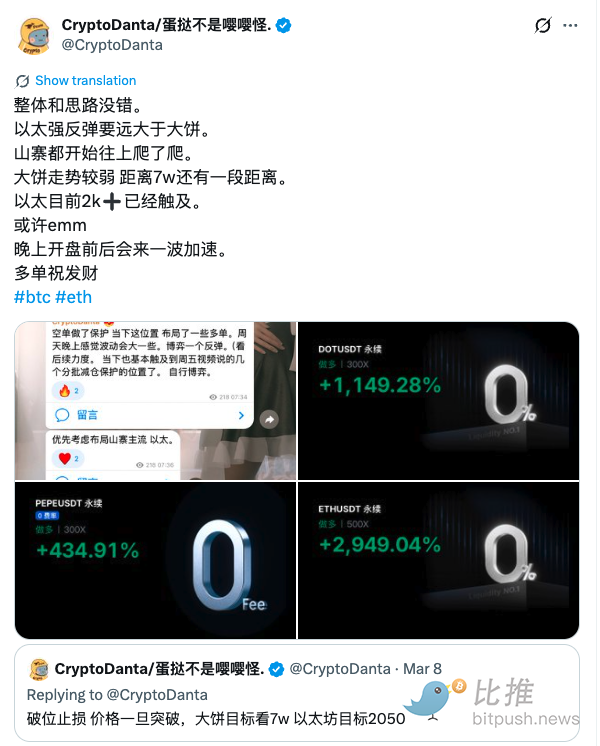
Post-00s Developer Raises 30 Million in 10 Days with Vibe Coding; Cryptocurrency Tycoon Suspected to Be Arrested by Authorities

比推Pubblicato 2026-03-09Pubblicato ultima volta 2026-03-09

Introduzione

A 00s-born founder reportedly secured 30 million yuan in funding for "Vibe Coding," a project developed in just 10 days. The GitHub repository and demo links were shared, though some critics dismissed it as a toy project or a resume-building effort. Meanwhile, a major figure in the Chinese crypto circle is rumored to have been arrested, sparking discussions and speculation across social platforms. Additionally, there are talks about Lobster (possibly a crypto or NFT project) opening offline stores in China, surprising even its founders. The article also touches on market sentiment around Bitcoin, with questions about whether it has bottomed out. Replies show mixed opinions—some see patterns while others remain skeptical and cautious about entering the market. The content is compiled from X (Twitter) and presented as personal viewpoints, not investment advice.

Hello dear readers~

What have the KOLs in the crypto circle been talking about in the past 24 hours?

Note: The following content is compiled from the X platform and represents personal opinions. It does not represent the stance of this platform and should not be considered investment advice.

Post-00s, 10 Days of Vibe Coding, 30 Million Funding

Additional details:

Github address: https://github.com/666ghj/MiroFish

Project journey and specific details (written by the founder): https://mp.weixin.qq.com/s/UyYVjlBCvQRJI6B_MmZbsA (Must-read article for super individuals in the AI era)

Product experience:

Official website experience: Wuhan University public opinion prediction: https://666ghj.github.io/mirofish-demo/console

Bilibili watch Dream of the Red Chamber demo (predicting subsequent plot based on the original 80 chapters): https://666ghj.github.io/mirofish-demo/console

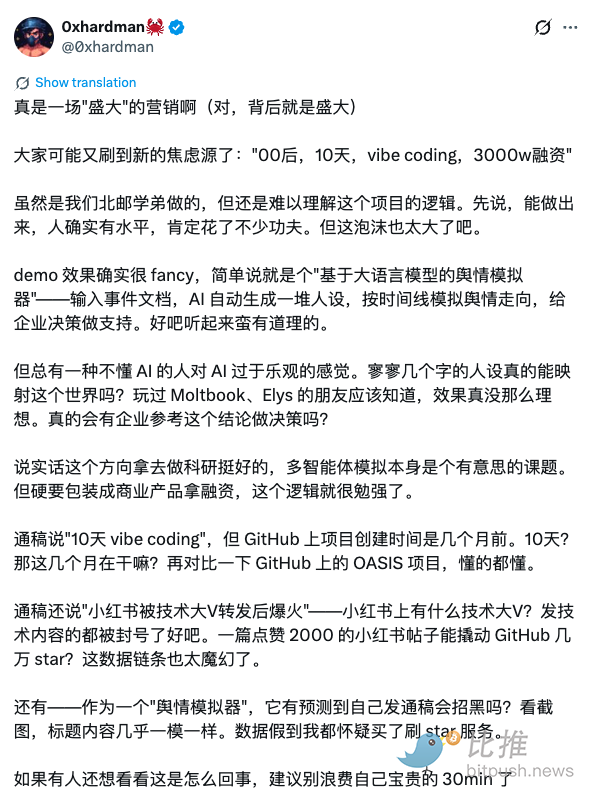
极简

Popular replies:

Maybe trying to replicate openclaw and manus from another 'angle'... Recently, I'm sensitive to many big Vs praising some new thing, so I坚决不用... Several have already gone silent... Just like the new movies in the hot comments are unwatchable;

What a thrilling internet legend;

Tried it; currently, it seems like a project with toy attributes. Probably a project for a sophomore to方便 find internships or jobs after graduation;

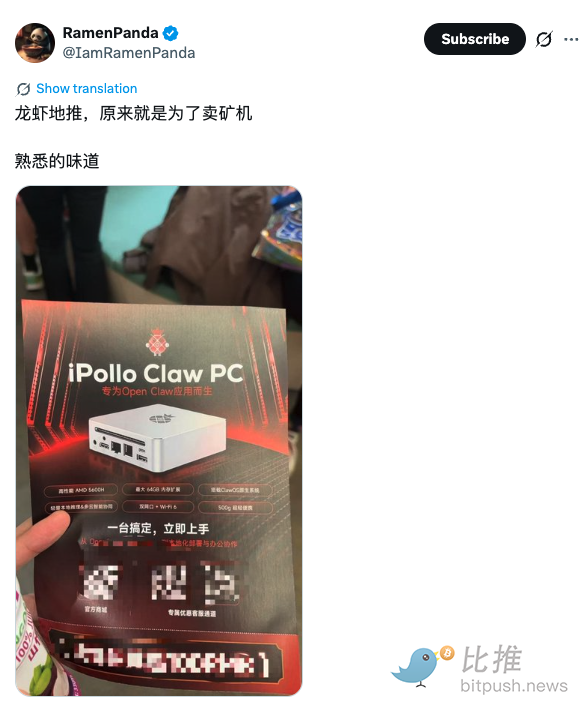
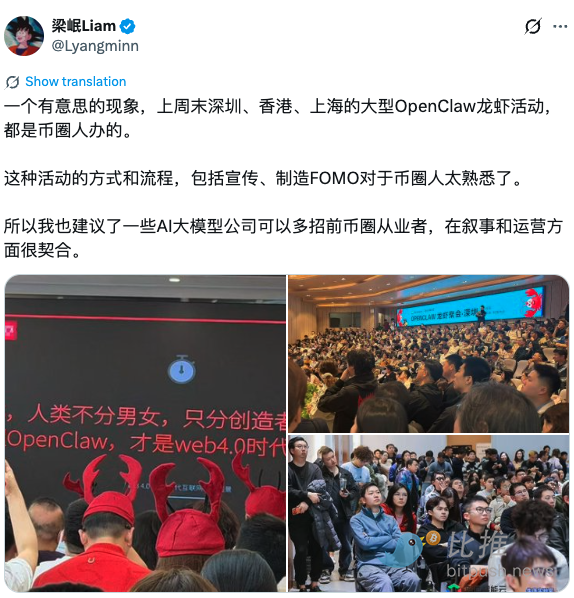
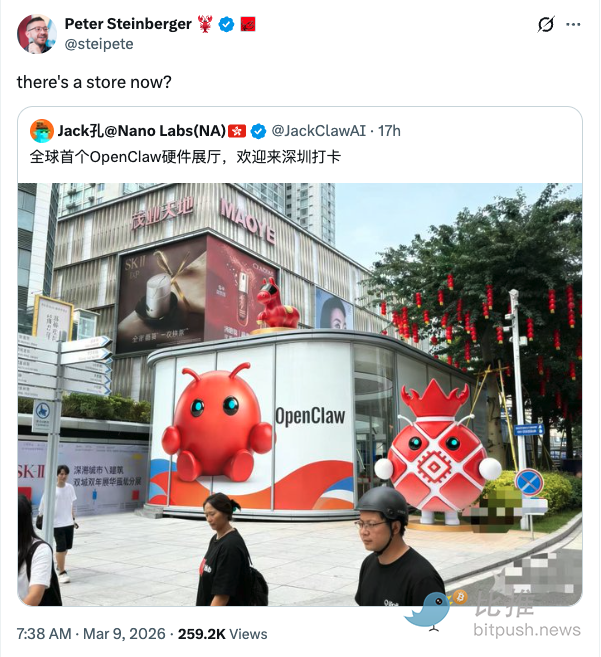
China is Getting a Lobster Offline Store, Even the Founder is Shocked

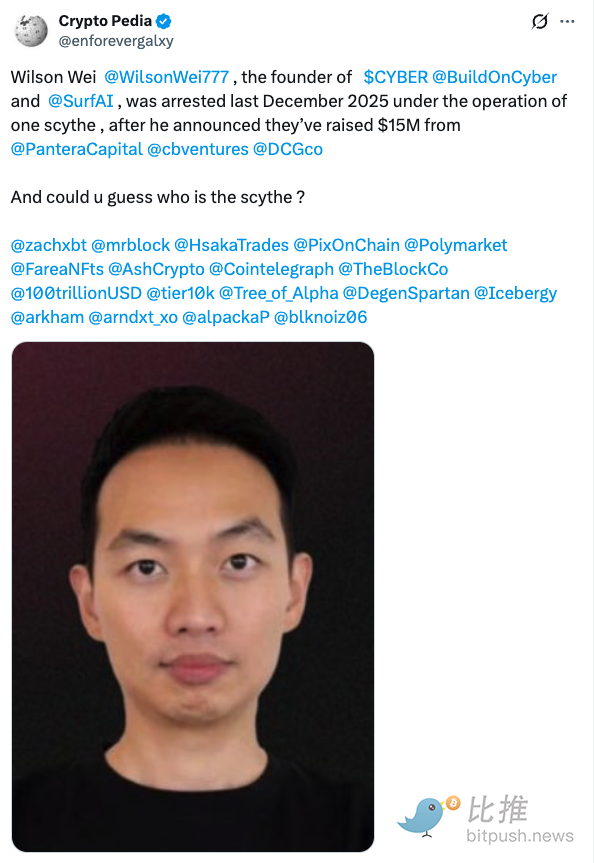
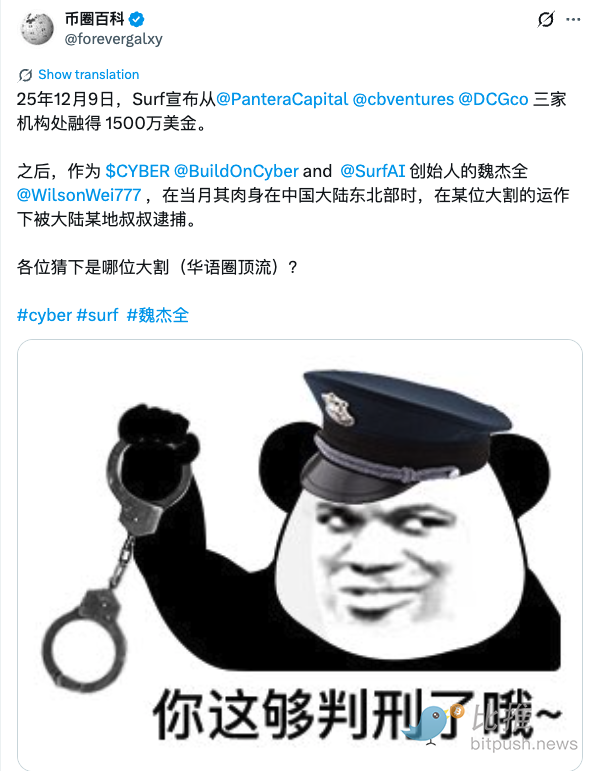
Crypto Gossip: Has a Certain Tycoon 'Flipped' and Been Arrested?!
Has Bitcoin Bottomed Out?
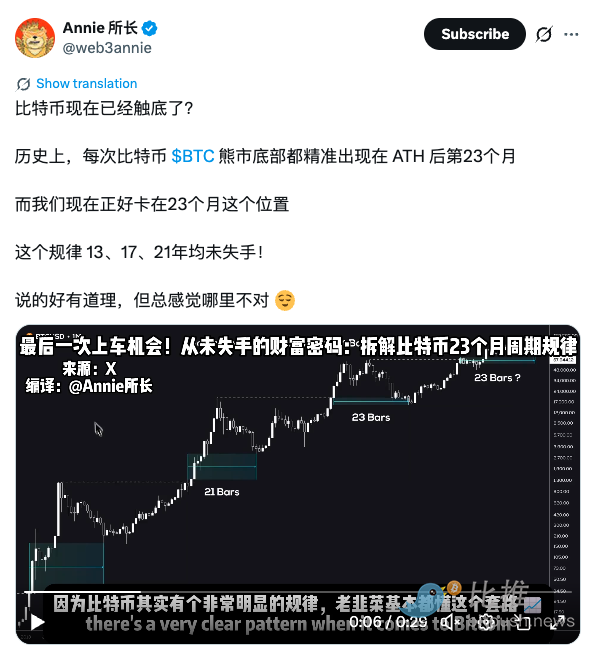
Popular replies:

Patterns are referential, but the market is unpredictable. Don't believe it completely; need to look comprehensively.

Don't忽悠 me to enter the market. Without a 90% drop, whoever goes in will die.


Twitter: https://twitter.com/BitpushNewsCN

Bitpush TG Discussion Group: https://t.me/BitPushCommunity

Bitpush TG Subscription: https://t.me/bitpush

Original link: https://www.bitpush.news/articles/7618195

Domande pertinenti

QWhat is the main achievement of the 00s generation project mentioned in the article?

AThe 00s generation project, Vibe Coding, secured 30 million yuan in funding within 10 days.

QWhat is the nature of the cryptocurrency-related incident involving a prominent figure?

AA cryptocurrency influencer is suspected to have been arrested by authorities, as hinted by the article's discussion of 'flipping' or legal trouble.

QWhat product or service is being introduced in China according to the article?

ALobster offline physical stores are being launched in China, which even surprised the founders.

QWhat is the general sentiment about Bitcoin's market condition based on the article?

AThere is speculation on whether Bitcoin has bottomed out, with mixed opinions; some warn against entering the market without a significant drop, while others analyze historical patterns.

QWhat disclaimer does the article provide regarding the opinions shared?

AThe article states that the content is compiled from personal viewpoints on platform X, does not represent the platform's stance, and is not intended as investment advice.

Letture associate

From South Korea to the United States: Blue-Collar Jobs Are Becoming Increasingly Popular, Thanks to AI

AI is reshaping the labor market's value proposition. The traditional four-year college degree is losing its appeal as a guaranteed career path, while skilled blue-collar trades like electricians, welders, and plumbers are experiencing historic demand and wage premiums. This shift is driven by dual pressures: AI's displacement of certain white-collar roles and a booming need for physical infrastructure and data center construction. Data confirms the trend. In the U.S., vocational school revenue surged, and a significant portion of recent layoffs are AI-related. Surveys show a majority of Gen Z adults plan to pursue blue-collar work, citing better job security against AI automation. Vocational education interest has exploded recently. Experts cite a psychological shift as younger generations seek tangible, AI-resistant careers and avoid high student debt. In many cases, salaries for skilled trades now match or exceed those requiring a bachelor's degree. In South Korea, semiconductor vocational high schools boast near-total employment, with graduates securing high-paying roles at companies like Samsung. The shortage is structural, exacerbated by a retiring baby boomer workforce and massive infrastructure projects. Companies like JPMorgan Chase, Meta, and Lowe's are investing heavily in training programs. However, overcoming historical stigma and a "perception gap" around trade careers remains a key challenge to closing the talent gap.

marsbit1 h fa

From South Korea to the United States: Blue-Collar Jobs Are Becoming Increasingly Popular, Thanks to AI

marsbit1 h fa

Qualcomm: AI Hype Subsides, When Will Smartphones Emerge from the Gloom?

Qualcomm reported its Q3 FY2026 results (ending June 2026), with revenue of $9.95B, down 4% YoY but above expectations. Gross margin declined to 53.1%, pressured by rising costs across manufacturing and memory. Key business segments showed mixed performance: Handset revenue fell 19.6% YoY to $5.09B, dragged by an 11% decline in non-Apple Android shipments and weaker high-end mix. Conversely, Automotive revenue surged 61% to $1.59B, and IoT grew 9% to $1.83B. Core operating profit dropped 41% YoY due to margin compression and higher expenses. Management's Q4 FY2026 guidance projects revenue of $9.7B-$10.5B, in line with consensus, but Non-GAAP EPS guidance of $2.05-$2.25 fell short of expectations. Amidst persistent weakness in its core handset market, Qualcomm is pursuing growth in AI, focusing on Edge AI (smartphones, PCs, automotive) and Data Center AI. Its data center strategy includes four pillars: AI accelerators (e.g., AI200), commercial CPUs (Dragonfly C1000), custom silicon, and connectivity solutions. While these initiatives initially boosted its stock, concerns over AI capital expenditure sustainability have since erased those gains. The company targets $5B in data center revenue for FY2027 and $15B for FY2029. The report concludes that with the traditional handset business still under pressure, the data center opportunity is currently viewed as a longer-term option, and a more conservative valuation based on core operations may be warranted until AI contributions materialize.

marsbit1 h fa

Qualcomm: AI Hype Subsides, When Will Smartphones Emerge from the Gloom?

marsbit1 h fa

From TPU to Self-Evolving Agents: How Jeff Dean Predicts the Next Step in AI

At the 2026 YC Startup School, Jeff Dean outlined his vision for AI's next phase, shifting focus from simply scaling models to building intelligent, autonomous systems. He believes AI's progress is no longer just about creating smarter models, but about integrating them into systems capable of long-term, iterative work, automated experimentation, and continuous learning. This evolution moves the competition from "who has the bigger model" to "who can best organize intelligence." Dean suggests AI capabilities are now comparable to a junior engineer, enabling the automation of complex workflows. However, the true challenge and opportunity lie in managing these AI "workers" at scale. He emphasizes the importance of **context engineering**—structuring tools, memory, and feedback loops—over raw model power. For startups, this means building deep expertise in niche domains where general models currently fail (near 0-1% success rates), leveraging proprietary data, specialized tools, and domain-specific evaluators. A recurring theme is re-examining fundamental constraints. Dean's past work, like moving Google's search index to memory or creating the TPU, stemmed from questioning outdated assumptions about hardware and cost. He sees similar inflection points today, particularly in **specialized inference hardware** to drastically reduce latency and energy consumption for real-time Agent operation. Notably, he points out that in modern AI systems, the dominant cost is often not computation but **data movement**. Reliable, long-running Agents require robust system design, borrowing concepts from distributed computing like checkpointing, state management, and parallel exploration to handle failures and maintain progress over days or weeks. As AI automates execution, the scarcest human skills will shift to **defining clear specifications**, **judging what problems are worth solving** (taste), and designing effective feedback loops. Ultimately, Dean's framework prioritizes understanding the problem deeply, identifying the true bottlenecks, and systematically building closed-loop systems where AI can not only perform tasks but also improve AI itself.

marsbit1 h fa

From TPU to Self-Evolving Agents: How Jeff Dean Predicts the Next Step in AI

marsbit1 h fa

Trading

Spot
活动图片