Popular Analyst Says If Bitcoin Doesn’t Hold This Level, This Is Where To Start Buying

bitcoinistPubblicato 2026-06-03Pubblicato ultima volta 2026-06-03

Introduzione

Popular crypto analyst CryptoMichNL highlights two key scenarios for Bitcoin. The current focus is on the critical support zone of $71,000-$73,000. Holding this level is essential to maintain the bullish structure and could pave the way for a push toward resistance at $76,600 and beyond. If this support fails, the analyst identifies a major buying opportunity in a lower accumulation range of $61,000-$65,000, aligning with historical support and the 200-day moving average. The market's next major move hinges on its reaction to these two thresholds.

Bitcoin is sitting at a make-or-break zone, according to market analyst CryptoMichNL, who recently outlined two key price areas that could determine the asset’s next major move. While he believes the broader bullish structure remains intact, he also identified a lower range where investors may find what he considers one of the most attractive buying opportunities of the current cycle if support fails.

Bitcoin’s Most Important Support Zone

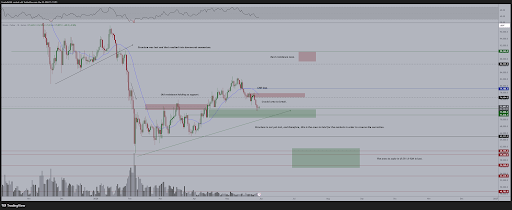
The analyst’s outlook centers on the region around $71,000 to $73,000, which he described as the level that must remain intact to prevent a deeper pullback. His accompanying chart highlights this area as a critical support block, positioned above a broader uptrend line that has guided Bitcoin’s recovery following the sharp correction seen earlier in the year.

According to the chart, the current market structure differs significantly from the breakdown that occurred in February. At that time, a previously established resistance level failed to transition into support, resulting in a rapid loss of momentum and a steep decline. This time, however, the analyst argues that the market is attempting to defend a former resistance zone as support, a development that could preserve the larger bullish framework.
Source: X

The chart also marks a “crucial area to break” near $76,600. Bitcoin recently retreated from that region after encountering resistance, leaving it as the next major hurdle for bulls. Just above it sits a Chicago Mercantile Exchange (CME) gap around $79,000, followed by another resistance cluster near the upper-$80,000 range.

According to the analyst, holding support is only the first step. A successful defense of the $71,000 area would keep the broader structure intact and increase the probability of another advance toward those overhead targets. In that scenario, Bitcoin could regain momentum and position itself for a push toward fresh cycle highs.

Where To Buy If Bitcoin Breaks Down

While the analyst remains constructive on the market, he also mapped out a contingency plan in case support gives way. If Bitcoin loses the $71,000-$73,000 region, his chart points to a significantly lower accumulation zone between roughly $61,000 and $65,000.

That area is notable for several reasons. It aligns with historical support levels established during previous consolidation phases and sits close to the 200-day moving average, a long-term trend indicator closely watched by institutional and retail participants alike. The analyst suggested that a decline into that region would represent an exceptional opportunity to buy in.

For now, the market’s attention remains fixed on two levels. The first is the defense of support near $71,000. The second is a decisive breakout above $76,600. How Bitcoin reacts around those thresholds could determine whether the next chapter brings a renewed surge toward record highs or a final opportunity for buyers to accumulate at significantly lower prices between the $61,000-$65,000 region.

BTC bears crash price | Source: BTCUSD on TradingView.com

Domande pertinenti

QAccording to analyst CryptoMichNL, what are the two key Bitcoin price zones that could determine its next major move?

AThe first is the critical support zone between $71,000 and $73,000 that must hold. The second is the resistance area near $76,600 that Bitcoin needs to break above for another advance.

QWhat is the significance of the support zone around $71,000 to $73,000 for Bitcoin's market structure?

AThis zone is described as the most important support level. Holding this area is crucial to prevent a deeper pullback and to keep the broader bullish structure intact. It represents a former resistance zone now being defended as support.

QIf Bitcoin fails to hold the $71,000-$73,000 support, where does the analyst suggest is an attractive buying opportunity?

AIf Bitcoin breaks down, the analyst points to a significantly lower accumulation zone between roughly $61,000 and $65,000. This area aligns with historical support levels and the 200-day moving average, representing what he considers an exceptional opportunity.

QWhat are the next major resistance levels for Bitcoin mentioned in the article after the $76,600 area?

AJust above the $76,600 level sits a Chicago Mercantile Exchange (CME) gap around $79,000, followed by another resistance cluster near the upper-$80,000 range.

QWhat is the key difference the analyst notes between the current market setup and the breakdown that occurred in February?

AIn February, a previously established resistance level failed to transition into support, leading to a rapid decline. Currently, the market is attempting to defend a former resistance zone ($71,000-$73,000) as support, which is a positive development that could preserve the larger bullish framework.

Letture associate

A Nation Blocks Chips, a Giant Buys a Nuclear Power Plant: Why It's Time to Seriously Consider DeAI

**Title: Great Powers Blockade Chips, Giants Buy Nuclear Plants: Why It's Time to Seriously Consider DeAI** In May 2026, the US closed loopholes for Chinese firms to acquire advanced NVIDIA chips via overseas subsidiaries. That same month, Kenya halted a $1B geothermal data center project involving Microsoft, fearing its immense energy consumption. Meanwhile, Huawei announced mass production of its Ascend AI chip. These disparate events underscore a new reality: the competition for computing power ("compute") has escalated beyond the tech industry, becoming a geopolitical and infrastructural battleground. A new era of oligopoly is forming, with control over the AI stack—from GPU chips (NVIDIA) and cloud platforms (AWS, Azure, Google Cloud) to foundational models (OpenAI, Anthropic)—concentrating in a few Western "AI Octopus" corporations. This centralization creates systemic risks: pricing power and platform lock-in for users, infrastructure fragility, and a widening "compute divide" that threatens to marginalize nations without independent AI capacity. An "AI Iron Curtain" is deepening through export controls. In response, some nations like Saudi Arabia and the UAE are investing heavily to buy compute power, aiming to transition from oil to AI economies. The EU seeks to triple its compute capacity by 2030 to reduce dependency. However, the spending gap is vast, with four US tech giants alone planning ~$750B in AI capex for 2026. The race is increasingly constrained by energy, with AI tasks consuming up to 1000x more power than web searches, pushing firms to even acquire nuclear plants. This landscape is fueling interest in Decentralized AI (DeAI). It proposes a third way: using open protocols to coordinate a global network of idle GPUs, independent developers, and data centers, creating an AI infrastructure without a single controlling entity. Leveraging blockchain and cryptographic verification, DeAI aims to break market concentration, disperse energy demands, reduce geopolitical dependencies, and enhance transparency. While still nascent in performance and stability, DeAI's core promise is not immediate superiority but providing a crucial alternative architecture to resist monopoly, censorship, and centralized power. As specialized AI hardware costs fall and open-source models flourish, the window to build this foundation is open. The very existence of such competition serves as a vital check against the inevitable abuse of concentrated power.

marsbit45 min fa

A Nation Blocks Chips, a Giant Buys a Nuclear Power Plant: Why It's Time to Seriously Consider DeAI

marsbit45 min fa

Outpoll Review: A Prediction Market Platform Built for Active Traders

Outpoll Review: A Prediction Market Platform Built for Active Traders In recent years, prediction markets have grown from a niche sector to a mainstream arena, attracting billions in trading volume and institutional capital. However, the user experience and tools for traders have not kept pace. Outpoll, a new global prediction market platform, aims to fill this gap by providing enhanced trading infrastructure for active and professional traders. Built on standard prediction market principles, Outpoll allows users to trade on the outcome of specific events. It uses fully collateralized contracts with USDC settlement, charges a competitive 0.1% fee per trade, and provides clear settlement rules upfront to minimize disputes. A key focus for Outpoll is its professional-grade trading tools. The platform supports limit and market orders, as well as take-profit and stop-loss orders for open positions—features uncommon in prediction markets. For automated trading, Outpoll offers comprehensive REST and WebSocket APIs, enabling portfolio management, price arbitrage, and integration with existing tools. The platform also features a creator-led market model, where approved experts and community leaders can create and manage markets for niche topics under platform supervision. Its integrated interface combines news feeds directly with trading functions, allowing users to monitor events and manage positions seamlessly. Outpoll launched with a native Android app (available on Google Play) and plans an iOS version later this year. In summary, Outpoll distinguishes itself with trader-focused tools, practical APIs, transparent and collateralized markets, integrated news, and an expanding creator program. For active traders, its advanced order types and API access alone make it a platform worth watching. Outpoll is now globally accessible via outpoll.com and Google Play.

marsbit53 min fa

Outpoll Review: A Prediction Market Platform Built for Active Traders

marsbit53 min fa

Bitwise: Crypto Becomes a Contrarian Investment, Three Logics to Understand the Current Market

**Summary** Matt Hougan, Bitwise's CIO, analyzes the current crypto market through three key lenses, arguing it has shifted from a momentum-driven to a contrarian investment. **1) Crypto Becomes a Contrarian Play:** The market is weak, with major assets like Bitcoin and Ethereum down significantly. Capital has moved to hot sectors like AI, leaving crypto as an "unloved" asset class. This transforms crypto investing from trend-following to a test of patience and fundamental analysis. Investors now favor projects with solid fundamentals (e.g., Hyperliquid) over speculative ones. **2) Regulatory Overhang:** The uncertain fate of the U.S. CLARITY Act, a major crypto regulatory framework, is a key headwind. With its passage in 2024 seen as far from guaranteed (estimates range from 30-55%), institutional capital remains on the sidelines, choosing less risky alternatives like AI stocks. The market needs clarity—whether the bill passes or fails—more than any specific outcome to move decisively. **3) Capital Rotates to New Fundamentals:** This cycle differs from past bear markets where money fled to Bitcoin. Now, capital seeks smaller assets with strong use cases. While major cryptos fell in May 2024, tokens like Hyperliquid (+72%), Zcash (+50%), and XLM (+44%) rallied on their specific fundamentals. This rotation confirms the new contrarian, fundamentals-driven logic and signals the bear market may be in its later stages. **Conclusion:** Short-term pressure persists due to regulatory uncertainty and competition from AI narratives. Investing in crypto now requires a contrarian mindset—acting against the crowd and focusing on fundamental value. Patience and targeting high-quality projects based on their merits are essential for capturing long-term gains.

marsbit1 h fa

Bitwise: Crypto Becomes a Contrarian Investment, Three Logics to Understand the Current Market

marsbit1 h fa

Trading

Spot
Futures

Articoli Popolari

Come comprare T

Benvenuto in HTX.com! Abbiamo reso l'acquisto di Threshold Network Token (T) semplice e conveniente. Segui la nostra guida passo passo per intraprendere il tuo viaggio nel mondo delle criptovalute.Step 1: Crea il tuo Account HTXUsa la tua email o numero di telefono per registrarti il tuo account gratuito su HTX. Vivi un'esperienza facile e sblocca tutte le funzionalità,Crea il mio accountStep 2: Vai in Acquista crypto e seleziona il tuo metodo di pagamentoCarta di credito/debito: utilizza la tua Visa o Mastercard per acquistare immediatamente Threshold Network TokenT.Bilancio: Usa i fondi dal bilancio del tuo account HTX per fare trading senza problemi.Terze parti: abbiamo aggiunto metodi di pagamento molto utilizzati come Google Pay e Apple Pay per maggiore comodità.P2P: Fai trading direttamente con altri utenti HTX.Over-the-Counter (OTC): Offriamo servizi su misura e tassi di cambio competitivi per i trader.Step 3: Conserva Threshold Network Token (T)Dopo aver acquistato Threshold Network Token (T), conserva nel tuo account HTX. In alternativa, puoi inviare tramite trasferimento blockchain o scambiare per altre criptovalute.Step 4: Scambia Threshold Network Token (T)Scambia facilmente Threshold Network Token (T) nel mercato spot di HTX. Accedi al tuo account, seleziona la tua coppia di trading, esegui le tue operazioni e monitora in tempo reale. Offriamo un'esperienza user-friendly sia per chi ha appena iniziato che per i trader più esperti.

386 Totale visualizzazioniPubblicato il 2024.12.10Aggiornato il 2026.06.02

Come comprare T

Discussioni

Benvenuto nella Community HTX. Qui puoi rimanere informato sugli ultimi sviluppi della piattaforma e accedere ad approfondimenti esperti sul mercato. Le opinioni degli utenti sul prezzo di T T sono presentate come di seguito.

活动图片













