PI Price Forecast Remains Stable at $0.086 as Pi Network Reforms App Economy

cryptonews.ruPubblicato 2026-08-18Pubblicato ultima volta 2026-08-18

Introduzione

PI price forecast remains stable around $0.086 as it continues to trade below a key descending trendline from April. The token has been consolidating in a narrow range between $0.078 and $0.086 throughout August, with major EMAs positioned above the price indicating bearish pressure. Key resistance levels are identified at the 20-day EMA ($0.08772) and the SuperTrend indicators around $0.09-$0.10. Support sits at the current price and the August range low of $0.070. Fundamentally, Pi Network announced a major change to its App Studio pricing model, set for August 24, 2026. The fixed, subsidized rate of 0.25 Pi for app creation/editing will shift to a usage-based model reflecting actual AI service costs. Subsidized rates will remain for apps demonstrating genuine user adoption. Separately, the mandatory node protocol upgrade has reached version 26.1, with only version 27.1 remaining to complete the sequence. On-chain activity shows increased transaction volume, including patterns of repeated 0.03 Pi transfers, potentially related to testing following the protocol upgrade. The bullish scenario targets a break above the $0.08772-$0.09000 resistance cluster, opening a path toward the 50-day EMA at $0.09560. The bearish risk is a breakdown below the consolidation range, potentially testing the $0.070 support level. The conclusion notes that while fundamental developments are progressing, the price chart remains technically constrained until it can decisively break above the per...

The PI price forecast remains defensive as the price holds a narrow range around $0.086, still below the same descending trendline that triggered the April sell signal. The system is being tested due to structural changes in the Pi Network app ecosystem economy, with the fixed price for App Studio creation ending on August 24th.

PI Price Analysis: Trendline Resistance Continues to Cap Every Rally
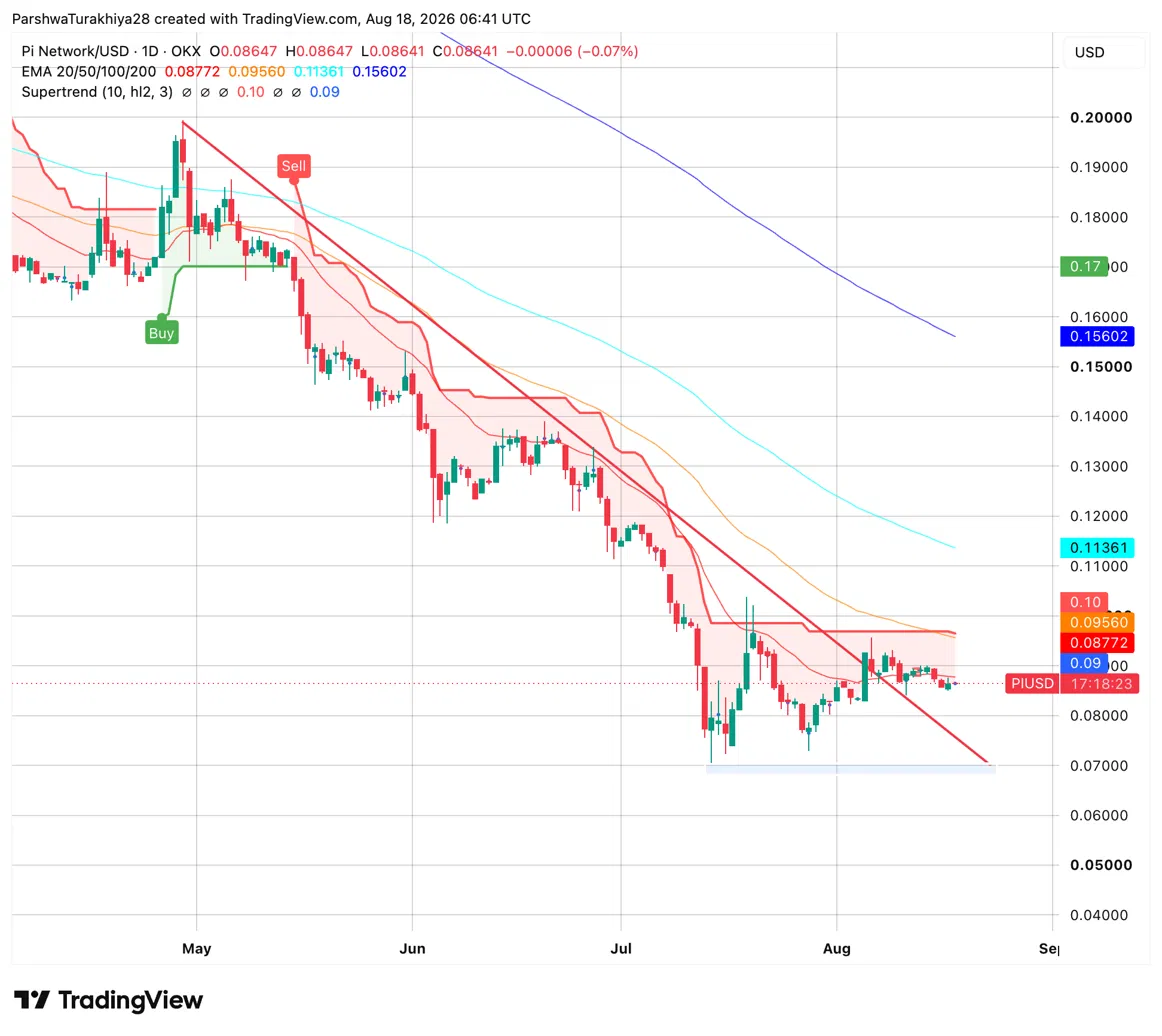
Pi Network Price Analysis (Source: TradingView)

PI consolidated for most of August between $0.078 and $0.086 – a narrow range that lies well below the broader downtrend defining the chart since April. All four EMAs remain stacked above the price in a bearish order: the nearest ceiling is the 20-day at $0.08772, followed by the 50-day at $0.09560, the 100-day at $0.11361, and the 200-day distant overhead at $0.15602.

The descending trendline drawn from the April high remains the dominant technical feature of the chart. Since May, it has rejected all recovery attempts and currently tracks just above the 20-day EMA, meaning PI must clear both levels together for the first real signs of relief. SuperTrend values at $0.09 and $0.10 confirm the same resistance zone, both are above price and confirm that sellers still control the higher timeframes.

Below the current price, the low end of the August range around $0.070 is a level that has held after repeated tests this month. As long as this floor remains intact, the consolidation is perceived as basing, not a new breakdown.

PI Support and Resistance Levels, August 18, 2026

Type Price Level
Resistance $0.08772 20-day EMA, nearest ceiling
Resistance $0.09000 SuperTrend, longer setting
Resistance $0.09560 50-day EMA
Resistance $0.10000 SuperTrend, shorter setting
Support $0.08641 Current price, session level
Support $0.07000 August range floor

Pi Network News: App Studio Ends Fixed Subsidy, Moves to Usage-Based Pricing

Update to Pi App Studio creation pricing on August 24, 2026! Read to learn more. https://t.co/NoBTHOXiMJ

— Pi Network (@PiCoreTeam) August 17, 2026

Pi Network announced on August 18th that App Studio, its AI-powered app creation tool, will change pricing effective August 24th. Currently, each creator pays a fixed 0.25 Pi to create an app and 0.25 Pi to edit, a rate that has remained subsidized since launch despite high AI costs.

This changes on August 24th. Pricing will shift to reflect the real cost of AI services, so the amount depends on how much compute power is actually required for the creation or edit. Pi Network states it is adding no markup beyond these costs, simply passing through the cost of the AI work.

Creators with genuine success retain the old subsidized rate. If an app attracts real users beyond the one testing it, it remains eligible for the lower price, and this eligibility is checked continuously, not locked at launch. Thus, a creator who doesn't qualify initially can still earn the subsidy later if their app attracts users. Pi Network states the goal is to stop funding spam and low-effort app creation, while continuing to support developers who are genuinely building things people use.

Details Value
Old Price 0.25 Pi for creation, 0.25 Pi for editing, flat for all creators
New Price Usage-based, tied to the real cost of AI services
Effective Date August 24, 2026
Who Keeps Subsidy Apps with genuine usage from distinct users
Recurring Cycle Eligibility can change over time

Pi Network News: Node Update 26.1 Complete, One More Step Remains

🟣⚫ PI NODE PROTOCOL UPGRADE — 26.1 COMPLETE ✅

🚀 Pi Network’s mandatory protocol upgrade path is moving forward step-by-step:

19.1 → 19.6 → 19.9 → 20.2 → 21.2 → 22.1 → 23.0 → 24.1 → 25.2 → 26.1 → 27.1

🖤 26.1 is now completed.
🔥 27.1 is the final upcoming upgrade... pic.twitter.com/AmLnwrg03g

— Dr. Chengdiao Fan (@DrChengdiaoFan) August 16, 2026

Developer Dr. Chengdiao Fan confirmed on August 16th that the mandatory Pi Network node upgrade path has reached stage 26.1, with only 27.1 remaining to complete the sequence.

The latest release updates the base Stellar Core software to version 26.1.0 and Horizon to 26.0.0, and Pi Network stated that no data migration is required for node operators upgrading to this version.

Pi Network News: On-Chain Activity Draws Attention Ahead of Ecosystem Expansion

The Pi Network blockchain explorer shows a rise in token movements and trading activity, according to a Pi News Media post from August 16th, pointing to early signs of activity related to potential VPN services, AI training on Pi nodes, and social apps being built on the network.

💬 PIONEERS — Have you noticed the chain of repeated 0.03 Pi transactions flooding the explorer? What's happening behind the scenes? 🔍

The blockchain is buzzing with activity. 🔥

The Pi Network blockchain explorer is showing waves of identical 0.03 Pi transactions, sent... pic.twitter.com/mcplMsBvhr

— amrOnChain (@amr_nannaware) August 16, 2026

Separately, on-chain researcher Amr Nannaware noted a wave of repeated 0.03 Pi transactions moving from multiple accounts to the same address, appearing every few seconds. Nannaware suggested this pattern likely reflects testing related to the recently completed Protocol v26, the newly released Node 0.6.2, or payments linked to Pi's distributed compute trials, rather than organic trading.

PI Price Forecast: Upside Targets and Downside Risks

Bull Case, Target: $0.09560 (50-day EMA)

PI breaks through the resistance cluster from $0.08772 to $0.09000, displacing both the 20-day EMA and the descending trendline on a daily close. Renewed focus on building App Studio usage and the nearly complete node upgrade path reinforce sentiment, and buyers hold the $0.070 floor line throughout the play. A confirmed breakout opens a path to the 50-day EMA at $0.09560, with the 100-day EMA at $0.11361 becoming the next major hurdle thereafter.

Bear Risk, Risk Level: $0.07000 (August Range Low)

The descending trendline and cluster of SuperTrends in the $0.09 to $0.10 area continue to repel every rally, keeping PI locked below its EMA stack. A decline in app creation activity following the App Studio price change adds short-term uncertainty, and price loses the $0.078 to $0.086 consolidation range on a daily close. A breakdown below the range directs PI towards the supporting low of $0.070, with no obvious chart support below that level.

Conclusion

Right now, the PI narrative is clearly split across two different timelines. Fundamentals are moving forward on schedule: the node upgrade path is one step from completion, and the App Studio pricing shift is a deliberate move toward a sustainable app economy, not a sign of trouble.

The chart hasn't caught up to either one yet. The descending trendline from April has rejected every rally since May, and until PI can overcome both that trendline and the 20-day EMA together, the default Pi Network price forecast remains defensive. The August range low at $0.070 defines whether this consolidation is building a base or another breakdown in progress.


Frequently Asked Questions

end-content

Domande pertinenti

QWhat is the current price forecast and trading range for PI, according to the technical analysis?

AThe price forecast for PI remains defensive as it holds a narrow range around $0.086, consolidating between $0.078 and $0.086 for most of August. A key downward trend line from April continues to act as resistance, limiting every price bounce.

QWhat major change is Pi Network implementing for the App Studio on August 24, 2026?

AOn August 24, 2026, Pi Network will end the fixed, subsidized pricing for App Studio creation (0.25 Pi for creation and 0.25 Pi for editing). It will shift to a usage-based pricing model that reflects the actual AI service costs. Apps with real, ongoing usage from multiple users will retain access to the subsidized rate.

QWhat is the status of the Pi Node protocol upgrade path mentioned in the article?

AThe mandatory Pi Node protocol upgrade has reached version 26.1. According to Dr. Chengdiao Fan, only one step remains, with version 27.1 being the final upcoming upgrade in the sequence. The upgrade to 26.1 updates the underlying Stellar Core and Horizon software.

QWhat are the identified key resistance and support levels for PI price as of August 18, 2026?

AKey resistance levels are: the 20-day EMA at $0.08772, SuperTrend at $0.09000, the 50-day EMA at $0.09560, and another SuperTrend level at $0.10000. Key support levels are: the current session price at $0.08641 and the August range low at $0.07000.

QWhat are the bullish and bearish price targets outlined in the PI price forecast?

AThe bullish case target is a break above the $0.08772-$0.09000 resistance cluster, aiming for the 50-day EMA at $0.09560. The bearish risk level is a break below the consolidation range, which would target the August range low of $0.07000, with no clear support below that level.

Letture associate

Bessent's True Agenda

U.S. Treasury Secretary Besant's recent interventions in the bond market are seen by some as an attempt to artificially trigger a massive short squeeze before the midterm elections. The alleged goal is to push the 10-year yield toward 5% initially, then use covering by short sellers to drive it down to around 4.3%, providing political breathing room for the Trump administration. Analysts point to near-record short positions held by CTA trend-following funds. According to Goldman Sachs data, a price rally of two standard deviations could trigger historically large short-covering. Besant's tactics reportedly include bond buybacks, shifting issuance toward shorter-term debt, and potentially canceling ultra-long bond auctions to pressure these market positions. So far, interventions like modest buybacks have had limited effect on yields, with the Treasury later hinting at using its General Account (TGA) cash for support. Critics argue these measures cannot address structural pressures like large deficits and high inflation. Instead, the strategy appears tactical—aimed at buying time and exploiting technical market vulnerabilities rather than reversing the underlying yield trend. The political timeline is clear: achieve lower yields ahead of the midterms to help lower mortgage rates and craft a favorable narrative. However, analysts warn that once the election passes, structural upward pressure on yields and equity valuations could reassert themselves more forcefully. Market signals suggest this potential short-squeeze dynamic could intensify in the coming days.

marsbit34 min fa

Bessent's True Agenda

marsbit34 min fa

Jackson Hole Speech Preview: Is the Fed Seeking Justification for a Rate Hike?

"Jackson Hole Speech Preview: Is the Fed Looking for Reasons to Raise Rates?" Ahead of the key Jackson Hole symposium, Federal Reserve officials and the IMF are signaling heightened concern over persistent inflation, with some advocating for tighter policy. Boston Fed President Susan Collins, in a recent article, supported holding rates steady only if evidence of falling inflation continues. Otherwise, she argues for prompt tightening, noting inflation has been above target for over five years and warning that prolonged deviation could entrench consumer expectations. Although not a voting member this year, her stance aligns with several officials; three FOMC voters dissented in July, favoring a rate hike. Richmond Fed's Tom Barkin warned of a future "reckoning" regarding the $40 trillion public debt, while IMF Managing Director Kristalina Georgieva urged central banks to maintain a laser focus on price stability. The core dilemma lies in the sources of inflation: Trump-era tariffs, Middle East conflict-driven oil prices, and surging AI investment. Collins believes the first two factors are fading, but identifies AI infrastructure spending as exerting "upward pressure" on core goods inflation. The problem is that interest rate hikes primarily curb demand, not these supply-side shocks. Georgieva framed it as a "tug of war" between negative supply shocks from the Middle East and positive demand shocks from AI. Meanwhile, economic data shows strain. The August Consumer Confidence Index fell to a seven-month low of 89.4. While the present situation index improved, future expectations plummeted. Consumers expect higher inflation (5.8% vs. 5.6% last month), likely influenced by high gas prices. Other data points are weak: July retail sales saw the largest drop in over a year, and job growth stalled. Key upcoming events include the July PCE inflation data (expected to remain well above the 2% target) and new Fed Chair Kevin Warsh's first major speech at Jackson Hole. Market pricing remains conflicted, showing a high probability of a December hike but expecting no move in September. Gold prices, however, have surged over 7% to near three-month highs, signaling market anxiety.

marsbit49 min fa

Jackson Hole Speech Preview: Is the Fed Seeking Justification for a Rate Hike?

marsbit49 min fa

Today, HYPE Activates Its Second Buyback Engine

"Hyperliquid Activates Second Buyback Engine with AQAv2 Launch" On August 26th, Hyperliquid officially activated its Aligned Quote Assets v2 (AQAv2) mechanism, introducing a major new source of revenue and buyback power for its native token, HYPE. Unlike the existing revenue stream from trading fees, AQAv2 generates income by sharing approximately 90% of the adjusted reserve earnings from stablecoins (primarily USDC) circulating on the Hyperliquid chain. This income is settled every 30 days and automatically funneled into the Assistance Fund for HYPE buybacks, with the first expected distribution on October 3rd. Through a partnership with Circle (issuer of USDC) and Coinbase (treasury manager), Hyperliquid leverages its user base and financial infrastructure to share in the yield generated by stablecoin reserves. This transforms its liquidity and distribution capabilities into a scalable business model. Initial estimates project AQAv2 could generate $150-200 million in annual buyback funds, based on the current ~$6.43 billion USDC supply on Hyperliquid and an assumed reserve yield. Crucially, this revenue is weakly correlated with trading activity and grows directly with the platform's stablecoin adoption. With HYPE recently reaching an all-time high, AQAv2 provides a new fundamental support layer. It shifts Hyperliquid's value capture beyond just transaction fees, anchoring HYPE's long-term buyback potential to the expanding scale of its stablecoin ecosystem.

marsbit53 min fa

Today, HYPE Activates Its Second Buyback Engine

marsbit53 min fa

NVIDIA Earnings Preview: The Market No Longer Expects a Positive Surprise

NVIDIA's upcoming earnings report has seen market expectations shift from anticipating big positive surprises to seeking clarity on capital allocation and future growth sustainability. While analysts forecast Q2 revenue near doubling year-over-year to $92.18 billion, option markets are pricing in a relatively muted post-earnings stock move of around 5.4%—the lowest implied volatility in two years. This reflects a growing sense that the phase of massive AI-driven earnings beats and stock surges may be ending. This year, NVIDIA's stock has slightly underperformed the S&P 500 and significantly lagged the semiconductor index. Analysts now emphasize the need for more than just beating estimates. Key investor focuses include details on how NVIDIA will deploy its capital, maintain its exceptional gross margins amid rising costs, and use its substantial free cash flow for investments and share buybacks. The forward P/E ratio of about 21x suggests the market is already pricing in a growth deceleration. NVIDIA's recent strategic moves—like facilitating massive AI financing, guaranteeing loans for data center projects (including a major one for OpenAI), and investing in power infrastructure—have positioned it beyond a mere chipmaker. However, this raises questions about potential "circular financing," where revenue might be artificially supported by lending to customers. The health of its AI clients, like OpenAI which reported slowing revenue growth, is now crucial. The report arrives amid a challenging backdrop: political pushback against AI data centers, rising borrowing costs, and massive debt-funded spending by cloud giants. Investors are keenly watching for signals on the transition to the new Blackwell and upcoming Vera Rubin architectures and, ultimately, whether the explosive demand for AI is losing momentum.

marsbit1 h fa

NVIDIA Earnings Preview: The Market No Longer Expects a Positive Surprise

marsbit1 h fa

Trading

Spot
活动图片