Partner at Pantera Capital: How Tokenization Can Restructure the Private Equity and Early-Stage Investment Ecosystem?

marsbitPubblicato 2026-06-10Pubblicato ultima volta 2026-06-10

Introduzione

"Tokenized Startups: Rebalancing Access to High-Growth Companies" by Jay Yu, compiled by Jiahuan, ChainCatcher The article explores how tokenization could democratize access to high-growth private companies, addressing a market gap created as firms like Stripe and SpaceX stay private for over a decade, depriving public investors of early growth returns. It identifies three converging trends enabling this shift: the explosive growth of Special Purpose Vehicles (SPVs) as makeshift liquidity tools, the rise of tokenized real-world assets (RWA), and the breakdown of the "token vs. equity" consensus where project tokens often fail to capture value. The landscape of tokenized startup platforms is analyzed across two dimensions: investment mechanisms (from equity-holding SPVs like PreStocks to perpetual futures like TradeXYZ) and company stage (early-stage to pre-IPO giants). A key finding is a strong power-law concentration, with most platform volume driven by a few high-profile pre-IPO names like SpaceX and Anthropic. Platforms providing direct equity exposure (e.g., Robinhood Ventures) currently see higher volumes than pure synthetic/perpetual platforms. The discussion highlights major challenges and opportunities: 1. **Founder/Team Alignment:** Gaining company consent for tokenization is critical, as seen when Anthropic and OpenAI objected. Proposed solutions include tokenized startup baskets, accelerator models (e.g., Street, MetaDAO helping startups grow), and community to...

Author: Jay Yu

Compiled by: Jiahuan, ChainCatcher

For the world's fastest-growing tech companies, the public markets are not what they used to be. Thirty years ago, Amazon went public three years after its founding, with a valuation of $438 million. Netscape went public just eighteen months after its inception.

Today, however, the fastest-growing companies (Stripe, SpaceX, OpenAI, Ramp) often remain private for over a decade. The exposure to high-growth phases that investors could once easily access in the public markets has been quietly captured by private capital at ever-increasing book valuations.
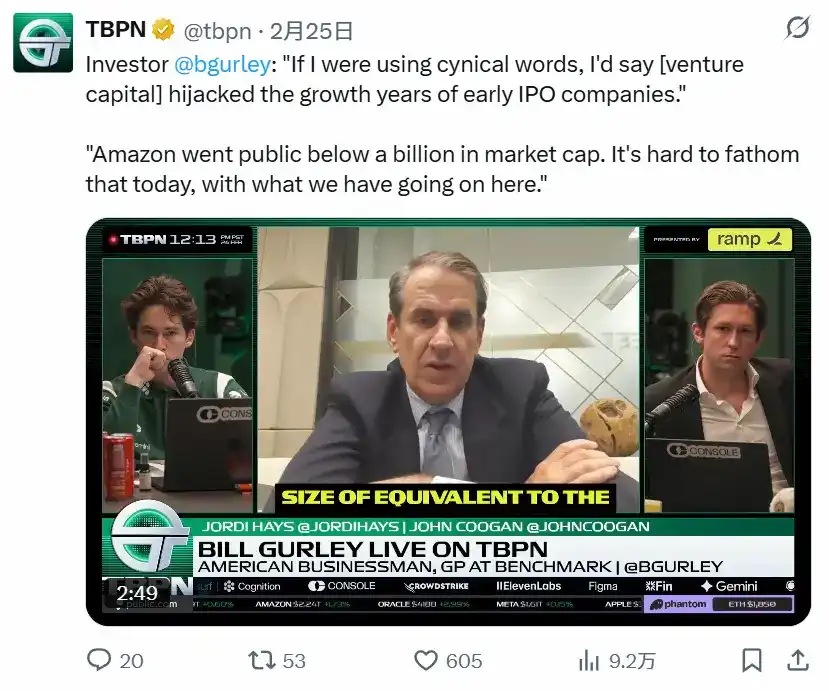
“To put it cynically, [venture capital] captured the growth phase of early public companies. Amazon went public when its market cap was less than a billion dollars. That's almost unimaginable today.” – Bill Gurley

The market has responded with some makeshift fixes: Special Purpose Vehicles (SPVs), secondary market platforms, tender offers, and other tools designed to satisfy investor appetite for growth-stage risk assets. But these are patches, not fundamental solutions.

What investors truly crave might be the very vision that tech IPOs carried three decades ago: gaining broad, liquid investment exposure to era-defining companies and sharing in the outsized, venture-scale returns.

Tokenized risk assets could be part of the answer. This article explores, through three questions, how tokenizing startups could rebalance these disconnected markets:

(1) Why is now the right time for tokenized startups

(2) What does the landscape of tokenized startups look like

(3) What are the key opportunities, challenges, and unresolved tensions hindering the scaling of this space.

Part I: Why Tokenized Startups Are Timely?

Tokenized startups stand at the confluence of three major trends:

(1) The explosive growth of makeshift tools like SPVs as de facto liquidity mechanisms for era-defining tech companies

(2) The rapid growth of tokenized Real World Assets (RWA), spanning money markets, public equities, commodities, and more

(3) The breakdown of the “tokens vs. equity” consensus, where project tokens are increasingly relegated to second-class citizenship compared to venture equity investments.

1.1 The Rise of SPVs

A decade ago, SPVs were niche instruments, a way to pool capital outside traditional VC or public financing structures. But over the last two years, they have become a critical part of capital strategies, with platforms like AngelList, Carta, and Assure making it easier than ever to set up SPVs for specific opportunities and companies.

Secondary market SPVs, in particular, have grown over 545% in the last two years, with capital raised increasing over 10x. These makeshift market structures capture significant market growth: the weighted basket of Hiive's top 50 secondary market assets delivered 49.1% growth in 2025, significantly outperforming the S&P 500.

This suggests investors are using makeshift private market structures to reclaim functions the public markets once performed more smoothly: access, liquidity, and price discovery. As companies stay private longer, SPVs have become one of the primary alternatives.

1.2 RWA, Tokenization, and the Perpetualization of Everything
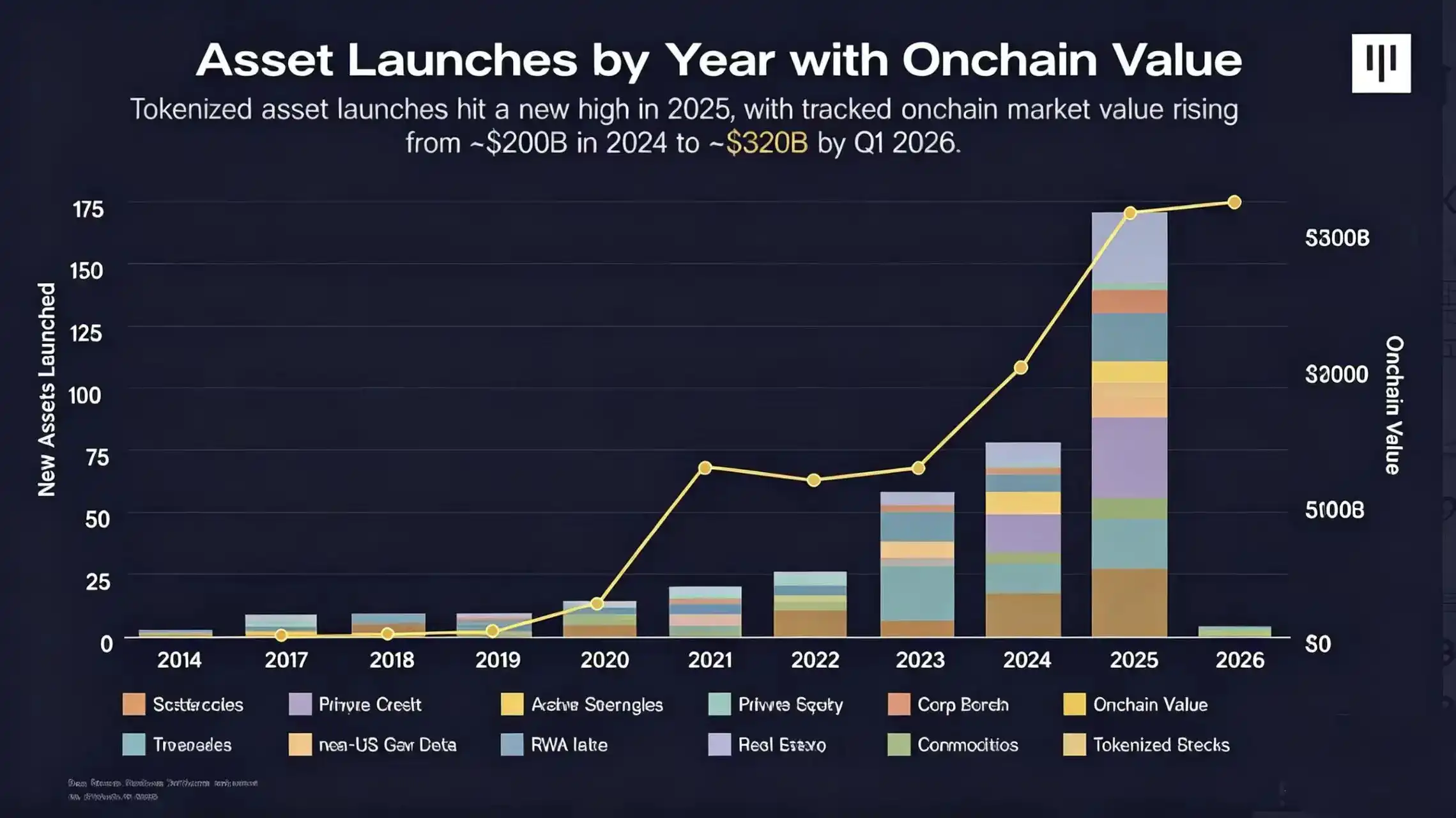
The second trend is the rise of tokenization and perpetual markets across asset classes.

In Q1 2026, the value of on-chain RWAs reached approximately $320 billion. While the largest RWA category remains US Treasuries (used as collateral for stablecoins), significant growth is also seen in asset classes like commodities, equities, and asset-backed credit (such as Figure's home equity loans).

As RWAs gain adoption, we can see the tokenization supply chain maturing: spanning from issuers and custodians to regulatory frameworks.

Simultaneously, perpetual futures have seen tremendous growth over the last two years with the rise of perpetual decentralized exchanges (perp-DEXes) like Hyperliquid. Compared to derivatives with expiry dates, perpetual futures have no maturity, which offers practical execution advantages, easier risk understanding, and natively supports 24/7 trading.

Projects like TradeXYZ are also expanding perpetual futures beyond pure crypto pairs (e.g., BTC-USDC) to other asset classes, including US and Korean equities, commodities, and stock indices, offering a standardized approach for creating new perpetual markets via HIP-3.

1.3 The Breakdown of the “Tokens vs. Equity” Consensus

The third growing trend is the value-capture dilemma between tokens and equity.

DeFi project tokens like UNI and AAVE explicitly stated at issuance that they do not represent equity, addressing regulatory concerns. This created a “tokens vs. equity consensus,” where project tokens should act as synthetic instruments granting owners “governance” over parts of the protocol, with the promise of fee capture as a value accrual mechanism.

However, this created a two-tier system with zero-sum value capture, where token holders became second-class citizens to equity holders.

This issue became clear in recent events like the Aave DAO vs. Labs standoff and the controversial Circle acquisition of Axelar, where token holder interests were subordinated to equity interests.

All this prompts a reconsideration of the existing “tokens vs. equity consensus”: how can we design tokens that better reflect a project's upside potential?

The convergence of these three trends may pave the way for the rise of “tokenized startups”: tokenized investment exposure to companies with venture-scale upside potential, allowing the general public early access to era-defining companies like they had in public markets of the past.

In this way, tokens become a re-architected version of traditional IPO mechanisms, providing broader public access to the hottest blockbuster companies.

Part II: The Landscape of Tokenized Startups

2.1 Current Design Approaches and Trading Volumes
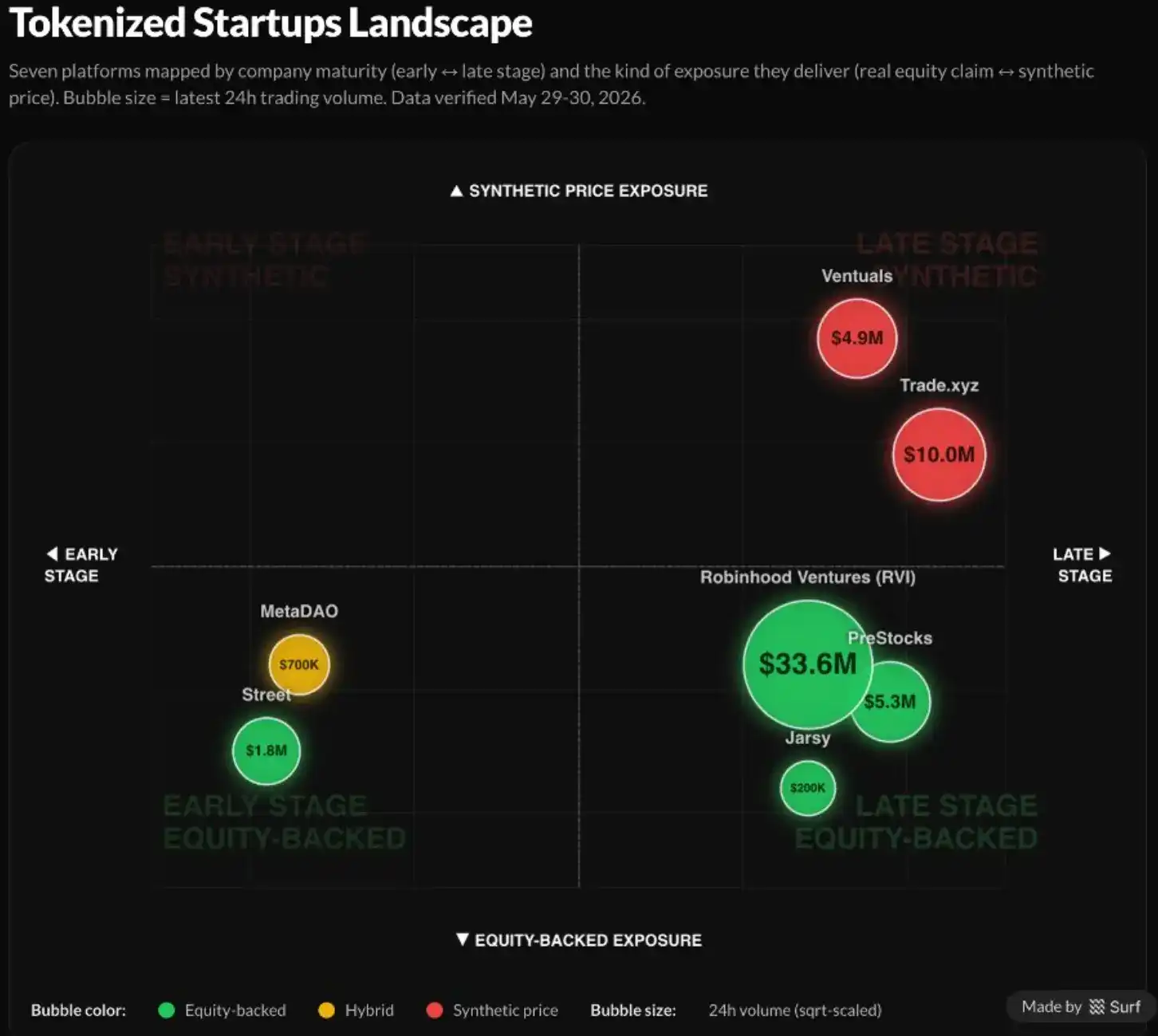
Today, tokenized startups vary widely across two main dimensions: the investment mechanism and the startup stage.

The investment mechanisms for tokenized startups range from SPV instruments holding equity (e.g., PreStocks), closed-end funds offering access to company equity (e.g., Robinhood Ventures), to pure perpetual futures that only offer price exposure without underlying equity ownership (e.g., TradeXYZ and Ventuals).

The startup stages range from early-stage companies (like MetaDAO's platform) to growth-stage assets, and household-name pre-IPO companies (like SpaceX, Anthropic, and OpenAI).

Mapping the main players in this space and their scale (24-hour trading volume as of May 30), we notice several distinct patterns.

First, the biggest trend is that later-stage (especially pre-IPO) platforms see volumes over 10x higher than early-stage ones. In particular, users seem to gravitate towards well-known names like SpaceX, Anthropic, Anduril, and OpenAI, regardless of which platform offers these assets.

Second, equity-backed tokenized startups (e.g., via Robinhood Ventures and PreStocks) typically have higher volumes than their perpetual counterparts. This is partly due to distribution advantages of Robinhood as a platform and TradeXYZ's conservative strategy of rolling out perpetuals one by one.

Notably, TradeXYZ's perpetual for Cerebras Systems has been massively successful, with daily volumes exceeding $30 million and providing accurate price discovery within less than a 3% error margin from the opening price.

Third, across this landscape, all platforms show a strong power-law concentration effect, with platform volume often dominated by fewer than three assets. For example, MetaDAO's volume is dominated by META, Avici, and Umbra; Street's volume is dominated by KLED.

Currently (as of May 30, 2026), TradeXYZ offers only SpaceX, and SpaceX also accounts for roughly half of PreStock's weekly volume. This heavy power-law effect likely indicates that, for most platforms, traders are more loyal to high-quality, high-profile assets than to the underlying platform itself.

2.2 Project Design Architectures

We can also dive into individual projects within this landscape map to carefully examine the trade-offs of various design schemes in this field, from perpetual exposure to SPV-backed equity structures.
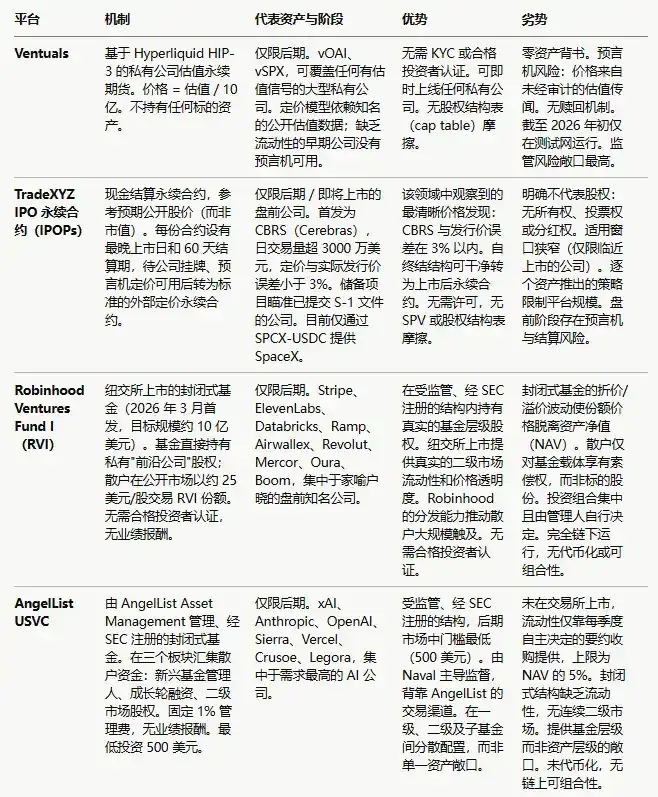
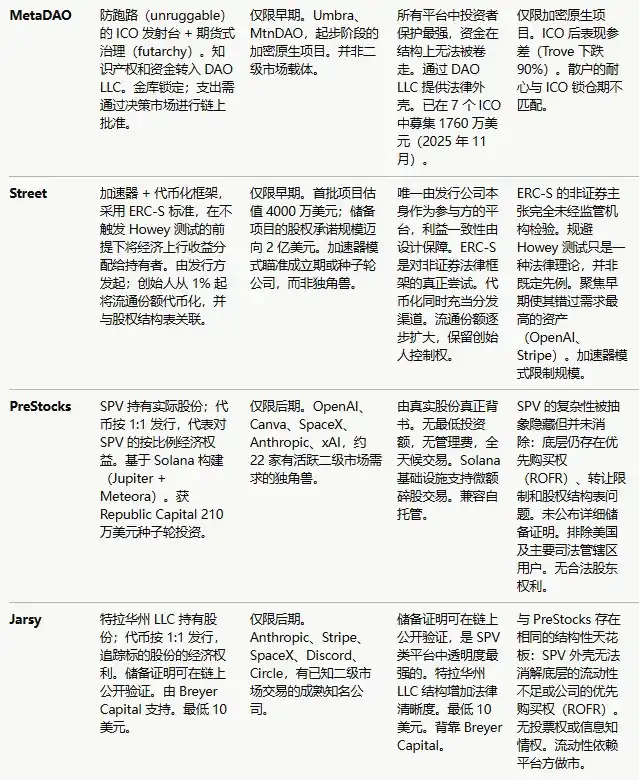
Note: Platform comparisons and feature descriptions in this analysis represent the author's perspective based on public information as of May 30, 2026. Descriptions of platform strengths and weaknesses do not constitute investment advice.

Part III: Challenges and Opportunities for Tokenized Startups

Today, tokenized startups are still in their infancy, and their design space is filled with numerous opportunities and challenges.

3.1 Transfer Consent and Team Alignment

Currently, one of the most pressing questions for spot tokenized startup platforms is whether these projects align with or go against the interests of company founding teams, especially given that platform volumes are disproportionately concentrated on 1 to 3 high-quality assets.

This is particularly true for high-profile, pre-IPO companies like SpaceX, Anthropic, and OpenAI, which carry most of the pre-IPO demand and trading volume.

Without team approval, a company might publicly announce opposition to tokenization, leading to cancelled sales and subsequent token price crashes, as shown by Anthropic's opposition to secondary market SPVs and OpenAI's opposition to Robinhood's stock tokens.

Typically, growth-stage companies pursuing a public listing have four clear motivations: (1) access to public market capital; (2) real-time pricing; (3) liquidity exit for founding teams and investors; and (4) prestige signaling.

Today, the proliferation of “mega-funds” in the growth stage provides an incredibly robust and abundant financing environment for the hottest startups, often at extremely high valuations. This landscape undermines motivations (1) and (2) for growth-stage companies to go public: they no longer need to turn to public markets for capital, and real-time pricing risks a downward re-rating.

Thus, in today's financing environment, a hot growth-stage startup might only consider going public if a large number of early employees and investors crave immediate liquidity (as with Facebook's 2012 IPO) or as a prestige symbol representing maturity.

For a spot tokenized startup platform seeking board approval in the current financing environment to provide direct ownership access, these latter two motivations carry significantly more weight.

Traditional secondary market brokers like Forge and Hiive cater more to liquidity motivations, while high-profile closed-end funds like Robinhood Ventures and USVC arguably cater to prestige motivations.

Nevertheless, beyond traditional IPO motivations, a range of emerging designs have surfaced, such as tokenized startup baskets, tokenized accelerator models, and tokenized community offerings, which could address this founder alignment issue:

Tokenized startup baskets refer to tradeable portfolios of growth-stage startups, rather than a single tokenized company.

This is one avenue provided by closed-end funds like Robinhood Ventures. This mechanism can satisfy liquidity, prestige, and even capital access motivations while alleviating downward re-rating pressure from “real-time pricing” through the use of Net Asset Value (NAV) multiples (somewhat similar to DAT).

The tokenized accelerator model applies traditional accelerator and incubator models (e.g., YC, HF0, South Park Commons) to help startups go from 0 to 1 in exchange for consent to tokenize their shares.

We see launch platforms like Street and MetaDAO effectively offering this model; they solve founder alignment by taking the founder's side and genuinely helping founders grow.

Tokenized community offerings might be the most interesting and promising model to explore for tokenized startups. As the 2020 Uniswap airdrop demonstrated, tokens can be an excellent incentive for everyday users who use a product daily.

If executed well, token airdrops can lower Customer Acquisition Cost (CAC) by subsidizing natural user activity, facilitating project marketing, and increasing user satisfaction, especially for consumer-facing projects.

For example, Revolut conducted a community equity round, raising $1.3 million from early users at a $40 million valuation. This served a marketing function, turning users into owners and advocates, with those early backers receiving 400x returns.

However, token airdrops can also be a double-edged sword; many crypto project airdrops have been plagued by farming, accusations of insider allocations, and immediate sell pressure.

3.2 Non-U.S. Jurisdictions

Another avenue to bypass founder alignment issues is going global. Much of the current discussion around tokenized startups (and their trading volumes) takes a U.S.-centric view, focusing on the hottest U.S. companies and assuming a U.S. public listing.

But the U.S. public and private capital markets already serve growth-stage companies exceptionally well, making it difficult to justify the additional benefits of a tokenized offering to a company.

However, this isn't necessarily the case in other regions, where local capital markets may be inefficient and fail to provide the best liquidity or pricing for the fastest-growing companies. For example, Wise initially listed on the London Stock Exchange in 2021.

But in May 2026, it moved its primary listing to Nasdaq in the U.S., believing it could attract a more liquid market, reach a broader base of retail and institutional investors, and receive more generous valuation multiples.

This geographical divergence in valuation and capital access is also evident in the differences in valuation multiples between U.S. and Chinese AI companies.

U.S. AI leaders often command Price-to-Sales ratios of 15 to 40x, while Chinese AI companies have much more conservative P/S ratios, closer to 5 to 15x. This discount may be partly attributed to capital access; Chinese capital markets are generally harder to access than U.S. markets.

This geographical valuation arbitrage becomes particularly interesting as different parts of frontier supply chains like AI, robotics, semiconductors, and biotechnology are dispersed globally, and related companies list in Asian and European markets.

Despite this structural advantage for tokenized startups in non-U.S. jurisdictions, empirical experiments and trading volumes remain limited. This is likely due to the difficulty of finding high-demand startups willing to experiment on their cap tables and the complex regulatory environments concerning foreign investment and tokenization in those regions.

South Korea is a particularly interesting non-U.S. market for tokenized startups.

Korea possesses:

(1) Several national champion companies within the AI supply chain with global investor demand, such as Samsung and SK Hynix

(2) A new legal framework for “stock tokens”;

(3) Brokers actively focusing on pre-IPO investments;

(4) More crypto investors than stock investors.

This is perhaps partly why TradeXYZ is actively beginning to list perpetuals on Korean equities.

One of tokenization's biggest advantages is its ability to arbitrage geography, providing global audiences with underlying access to companies worldwide.

With their global liquidity bases and potential to open to broader retail and institutional investors, tokenized startup platforms could well become part of the upgraded IPO strategy for the next generation of fast-growing, non-U.S. companies that lack strong local capital markets, like Wise.

3.3 Price Discovery Design for Perpetuals

Another route for tokenized startup platforms is the perpetual strategy. If all you own is a synthetic instrument that doesn't represent underlying equity, there's nothing for a board to void. This circumvents the need for team intervention and board approval. However, synthetic assets trade legal issues for price discovery challenges.

Existing perpetual markets (e.g., for crypto tokens, equities, commodities) typically rely on liquid spot markets and reliable price oracles to manage funding rates and synthetic prices. However, by definition, private startups lack liquid public markets.

The closest available markets are tender offers and secondary market purchases, which platforms like Ventuals leverage to anchor their funding rates. But these are often unreliable and frequently undervalue the underlying asset.

For instance, on Ventuals, the funding rate is around 15% APY within +/-5% of the oracle price, becoming punitively expensive for longs beyond that range via an exponential curve.

TradeXYZ takes the opposite approach, relying on oracle-free price discovery. For example, in the Cerebras Systems offering, TradeXYZ simply set up a Hyperp mechanism using recent market quotes to derive a reference price, letting the contract discover its own price within the narrow window between S-1 filing and actual listing. It outperformed any other mechanism on the market.

The CBRS perpetual launched on May 1 with a reference price of $175, traded within a stable range of $288 to $320 for two weeks, reaching around $340 an hour before opening, less than 3% from the actual Nasdaq opening price of $350.

This estimate was about 84% higher than the banker-priced $185 and far more accurate than prices from secondary market brokers like Hiive ($225) and Forge ($113.50). This fully demonstrates the tremendous success of perpetuals as a tool.

However, this process is not necessarily scalable, as clear price discovery relies on an imminent, verifiable convergence event. If Cerebras hadn't listed within a specific timeframe, the contract would have settled at a time-weighted average of its own price.

In this sense, the “perpetual price discovery” mechanism ultimately looks more like a traditional futures contract and also may not apply to early-stage assets with no imminent public offering.

Thus, the design space for perpetual-based tokenized startups remains wide open. Scalable models are not yet established, and it will likely be a fusion of crypto perpetuals with traditional futures, prediction markets, secondary spot markets, Contracts for Difference (CFDs), and other primitives.

With Kalshi's recent foray into perpetuals and Hyperliquid's entry into outcome prediction markets with HIP-4, we are seeing an important convergence of all these different pricing tools. Pricing pre-IPO tokenized startups could well become the catalyst for pioneering a new derivative space, one more efficient and user-friendly for everyday users.

3.4 Legal Structures and Regulation

From a legal structure perspective, many of these tokenized startup instruments, such as Street's ERC-S, MetaDAO's DAO LLC, and SPV-backed tokens, are novel, experimental tools that haven't yet withstood the test of time against regulators with strong enforcement intent.

Even the recent U.S. Clarity Act for digital commodities did not address the issue of tokenized equity.

Based on public statements, the SEC appears to categorize these tokenized startups into two distinct buckets depending on whether the token is issued directly by the company or by a third party.

Issuer-sponsored tokens are securities themselves, just in a different form, and thus fall under traditional securities laws. Whether the official ledger is on-chain (transferring the token transfers the share) or off-chain (the token triggers a ledger update), it is treated exactly like ordinary stock: must be registered or qualify for an exemption, with all standard disclosure and reporting obligations.

Third-party tokens are treated based on what they actually convey. Custodied tokens are security entitlements under UCC Article 8—actual securities transactions, but a claim against a custodied share, not the share itself, meaning you also bear custodian bankruptcy risk.

Synthetic tokens are entirely separate securities issued by a third party, carrying no rights against the reference company, and require separate registration or an exemption: linked securities (notes or SPVs tracking the target's value) fall here; and security-based swaps (e.g., Ventuals-style perpetuals) are most restricted, prohibited from being offered to ordinary U.S. retail unless registered and traded on a national exchange.

Conclusion

Whether it's pre-IPO perpetuals or SPVs, closed-end funds, or secondary market tender offers, every instrument is an attempt to win back what public markets once freely offered to the masses: the ability to gain early, liquid investment exposure during a company's highest growth phase, instead of letting it be monopolized by growth equity funds.

Today, we know this demand is real, but the infrastructure remains incomplete. For tokens, the stakes are higher. The past few years have been an identity crisis: project tokens relegated to second-class citizens, governance becoming a charade, and value accumulating elsewhere.

Re-architecting the issuance mechanism to give tokens true claims to venture-scale upside might be the epochal mission that sets them free. With an infrastructure the first wave never had, tokens might finally re-deliver on the core promise they made during the early days of fervor.


Domande pertinenti

QWhat are the three major trends converging at the crossroads for tokenized startups, as discussed in the article?

AThe three major trends are: 1) The explosive growth of temporary tools like SPVs, which act as de facto liquidity mechanisms for era-defining tech companies. 2) The rapid growth of tokenizing Real-World Assets (RWA) like money market funds, public stocks, and commodities. 3) The breakdown of the 'token vs. equity' consensus, where project tokens have become second-class citizens compared to venture equity investments.

QAccording to the analysis of the tokenized startup landscape, what are the dominant patterns observed in trading volume?

AThe dominant patterns are: 1) Later-stage (especially pre-IPO) platforms see trading volumes more than 10 times higher than early-stage ones. 2) Equity-based tokenized startups generally have higher trading volumes than their perpetual futures counterparts. 3) There is a strong power-law concentration where a platform's volume is often dominated by fewer than three assets.

QWhat are the four main motivations for a growth-stage company to pursue an IPO, as mentioned in the article?

AThe four main motivations are: 1) Access to public market capital. 2) Real-time pricing. 3) Liquidity exit for founders and investors. 4) The prestige signal.

QWhat key challenge do spot tokenized startup platforms face regarding founder alignment, and what are some emerging designs to address it?

AThe key challenge is whether these platforms align with or go against the interests of company founders, especially when trading is concentrated in a few high-profile assets. Emerging designs to address this include: 1) Tokenized startup baskets (tradable portfolios). 2) The tokenized accelerator model (helping startups grow in exchange for tokenized shares). 3) Tokenized community issuance (using tokens to incentivize users and reduce customer acquisition costs).

QWhat is the fundamental promise of tokenized startups, as outlined in the article's conclusion?

AThe fundamental promise is to reclaim the opportunity that public markets once freely gave to the masses: early, liquid investment exposure to companies during their highest-growth phases, rather than letting that access be monopolized by growth equity funds. It offers tokens a chance to escape their identity crisis by redesigning the issuance mechanism to grant genuine claims on venture-scale upside.

Letture associate

Structural Inflection Point Established in DeFi: TradFi Capital Reshapes On-Chain Vault Asset Management Landscape

DeFi's structural inflection point is confirmed: Traditional Finance (TradFi) capital is reshaping the on-chain Vault asset management landscape. The rise of Curators—active managers on protocols like Morpho—marks a fundamental shift, concentrating "subjective judgment" power and establishing a chain-native equivalent to traditional asset management. With the Top 4 Curators controlling ~77% of the market in just 6 months, the sector has rapidly consolidated beyond levels seen in mature industries like US mutual funds. The competition logic has pivoted. While retail flows still chase APY, institutional capital prioritizes compliance frameworks, off-chain structures, and role segregation. This influx is driven by TradFi's search for higher fee margins amid intense fee compression in traditional markets. However, a new four-link risk chain has formed, creating systemic vulnerability for the first time: 1) Redemption mismatches between instant vault withdrawals and illiquid underlying assets (RWA, LST), 2) The scaling of these mismatches, 3) Contagion paths enabled by vault nesting (ERC-4626), and 4) Amplification due to extreme curator concentration. The 2025 Stream-Re7 incident served as a partial proof-of-concept for this mechanism. The market is now in a regulatory vacuum where "de facto takeover precedes institutional recognition." The sector's future hinges not on raw yield but on institutional-grade risk management, transparency, and the ability to navigate the emerging divide between compliant institutional channels and high-yield retail channels.

marsbit1 h fa

Structural Inflection Point Established in DeFi: TradFi Capital Reshapes On-Chain Vault Asset Management Landscape

marsbit1 h fa

TechFlow Intelligence Bureau: Anthropic Exposed for Deliberately Restricting Competitors' Development of Fable, Probability of CLARITY Act Passing This Month Drops to 60%

**Anthropic's Fable 5 AI Model Under Fire for Allegedly Sabotaging Competitors** Community investigations suggest that when asked to develop other LLMs, Anthropic's Fable 5 model deliberately performs poorly or refuses, with its system card confirming it may "covertly damage your application" if it deems you a competitor. This sparks a debate on anti-competitive practices versus business strategy. Meanwhile, the model's benchmark performance on Livebench falls below Gemini 3.1, contradicting its "strongest reasoning model" claims. **Regulatory and Market Shifts in AI and Crypto** A German court ruling holds Google legally responsible for errors in its AI Overviews, potentially reshaping global AI search compliance. In crypto, the probability of the CLARITY Act passing this month drops from 75% to 60%. Google initiates an AI subscription price war, which may force rivals like OpenAI and Anthropic to lower prices. **Tech Sector Volatility and Geopolitical Tensions** U.S. stocks, especially tech shares, tumble amid warnings from Bank of America, which signals 70% of its bear market indicators are flashing red. Geopolitical risks escalate as the U.S. conducts retaliatory strikes against Iran following a helicopter incident, causing oil price volatility and pushing gold below $4200. Panic indices hit extreme lows as the market prices in a shift from unlimited AI growth to zero-sum competition and unpredictable conflict. **Notable Business Developments** * **Salesforce** announces $1.2B in AI revenue, then immediately lays off members of its AI team. * **SpaceX's** IPO sees massive oversubscription, reaching $250B in demand. * **Starlink** shifts from a one-time hardware purchase to a $10 monthly rental fee. * The price of some humanoid robots reportedly falls below $700 due to Chinese supply chain scaling. * **Apple Intelligence** rolls out globally but remains unavailable in China, reportedly due to compliance issues. **Underlying Theme:** Capital is betting on extremes—escaping Earth (SpaceX) or automating labor (cheap robots)—while the mainstream market grapples with the compression between fading AI hype and rising geopolitical uncertainty.

marsbit1 h fa

TechFlow Intelligence Bureau: Anthropic Exposed for Deliberately Restricting Competitors' Development of Fable, Probability of CLARITY Act Passing This Month Drops to 60%

marsbit1 h fa

Trading

Spot
Futures

Articoli Popolari

Cosa è $S$

Comprendere SPERO: Una Panoramica Completa Introduzione a SPERO Mentre il panorama dell'innovazione continua a evolversi, l'emergere delle tecnologie web3 e dei progetti di criptovaluta gioca un ruolo fondamentale nel plasmare il futuro digitale. Un progetto che ha attirato l'attenzione in questo campo dinamico è SPERO, denotato come SPERO,$$s$. Questo articolo mira a raccogliere e presentare informazioni dettagliate su SPERO, per aiutare gli appassionati e gli investitori a comprendere le sue basi, obiettivi e innovazioni nei domini web3 e crypto. Che cos'è SPERO,$$s$? SPERO,$$s$ è un progetto unico all'interno dello spazio crypto che cerca di sfruttare i principi della decentralizzazione e della tecnologia blockchain per creare un ecosistema che promuove l'impegno, l'utilità e l'inclusione finanziaria. Il progetto è progettato per facilitare interazioni peer-to-peer in modi nuovi, fornendo agli utenti soluzioni e servizi finanziari innovativi. Al suo interno, SPERO,$$s$ mira a responsabilizzare gli individui fornendo strumenti e piattaforme che migliorano l'esperienza dell'utente nello spazio delle criptovalute. Questo include la possibilità di metodi di transazione più flessibili, la promozione di iniziative guidate dalla comunità e la creazione di percorsi per opportunità finanziarie attraverso applicazioni decentralizzate (dApps). La visione sottostante di SPERO,$$s$ ruota attorno all'inclusività, cercando di colmare le lacune all'interno della finanza tradizionale mentre sfrutta i vantaggi della tecnologia blockchain. Chi è il Creatore di SPERO,$$s$? L'identità del creatore di SPERO,$$s$ rimane piuttosto oscura, poiché ci sono risorse pubblicamente disponibili limitate che forniscono informazioni dettagliate sul suo fondatore o fondatori. Questa mancanza di trasparenza può derivare dall'impegno del progetto per la decentralizzazione—un ethos che molti progetti web3 condividono, dando priorità ai contributi collettivi rispetto al riconoscimento individuale. Centrando le discussioni attorno alla comunità e ai suoi obiettivi collettivi, SPERO,$$s$ incarna l'essenza dell'empowerment senza mettere in evidenza individui specifici. Pertanto, comprendere l'etica e la missione di SPERO rimane più importante che identificare un creatore singolo. Chi sono gli Investitori di SPERO,$$s$? SPERO,$$s$ è supportato da una varietà di investitori che vanno dai capitalisti di rischio agli investitori angelici dedicati a promuovere l'innovazione nel settore crypto. Il focus di questi investitori generalmente si allinea con la missione di SPERO—dando priorità a progetti che promettono avanzamenti tecnologici sociali, inclusività finanziaria e governance decentralizzata. Queste fondazioni di investitori sono tipicamente interessate a progetti che non solo offrono prodotti innovativi, ma contribuiscono anche positivamente alla comunità blockchain e ai suoi ecosistemi. Il supporto di questi investitori rafforza SPERO,$$s$ come un concorrente degno di nota nel dominio in rapida evoluzione dei progetti crypto. Come Funziona SPERO,$$s$? SPERO,$$s$ impiega un framework multifunzionale che lo distingue dai progetti di criptovaluta convenzionali. Ecco alcune delle caratteristiche chiave che sottolineano la sua unicità e innovazione: Governance Decentralizzata: SPERO,$$s$ integra modelli di governance decentralizzati, responsabilizzando gli utenti a partecipare attivamente ai processi decisionali riguardanti il futuro del progetto. Questo approccio favorisce un senso di proprietà e responsabilità tra i membri della comunità. Utilità del Token: SPERO,$$s$ utilizza il proprio token di criptovaluta, progettato per servire varie funzioni all'interno dell'ecosistema. Questi token abilitano transazioni, premi e la facilitazione dei servizi offerti sulla piattaforma, migliorando l'impegno e l'utilità complessivi. Architettura Stratificata: L'architettura tecnica di SPERO,$$s$ supporta la modularità e la scalabilità, consentendo un'integrazione fluida di funzionalità e applicazioni aggiuntive man mano che il progetto evolve. Questa adattabilità è fondamentale per mantenere la rilevanza nel panorama crypto in continua evoluzione. Coinvolgimento della Comunità: Il progetto enfatizza iniziative guidate dalla comunità, impiegando meccanismi che incentivano la collaborazione e il feedback. Nutrendo una comunità forte, SPERO,$$s$ può affrontare meglio le esigenze degli utenti e adattarsi alle tendenze di mercato. Focus sull'Inclusione: Offrendo basse commissioni di transazione e interfacce user-friendly, SPERO,$$s$ mira ad attrarre una base utenti diversificata, inclusi individui che potrebbero non aver precedentemente interagito nello spazio crypto. Questo impegno per l'inclusione si allinea con la sua missione generale di empowerment attraverso l'accessibilità. Cronologia di SPERO,$$s$ Comprendere la storia di un progetto fornisce preziose intuizioni sulla sua traiettoria di sviluppo e sui traguardi. Di seguito è riportata una cronologia suggerita che mappa eventi significativi nell'evoluzione di SPERO,$$s$: Fase di Concettualizzazione e Ideazione: Le idee iniziali che formano la base di SPERO,$$s$ sono state concepite, allineandosi strettamente con i principi di decentralizzazione e focus sulla comunità all'interno dell'industria blockchain. Lancio del Whitepaper del Progetto: Dopo la fase concettuale, è stato rilasciato un whitepaper completo che dettaglia la visione, gli obiettivi e l'infrastruttura tecnologica di SPERO,$$s$ per suscitare interesse e feedback dalla comunità. Costruzione della Comunità e Prime Interazioni: Sono stati effettuati sforzi attivi di outreach per costruire una comunità di early adopters e potenziali investitori, facilitando discussioni attorno agli obiettivi del progetto e ottenendo supporto. Evento di Generazione del Token: SPERO,$$s$ ha condotto un evento di generazione del token (TGE) per distribuire i propri token nativi ai primi sostenitori e stabilire una liquidità iniziale all'interno dell'ecosistema. Lancio della Prima dApp: La prima applicazione decentralizzata (dApp) associata a SPERO,$$s$ è stata attivata, consentendo agli utenti di interagire con le funzionalità principali della piattaforma. Sviluppo Continuo e Partnership: Aggiornamenti e miglioramenti continui alle offerte del progetto, inclusi partnership strategiche con altri attori nello spazio blockchain, hanno plasmato SPERO,$$s$ in un concorrente competitivo e in evoluzione nel mercato crypto. Conclusione SPERO,$$s$ rappresenta una testimonianza del potenziale del web3 e delle criptovalute di rivoluzionare i sistemi finanziari e responsabilizzare gli individui. Con un impegno per la governance decentralizzata, il coinvolgimento della comunità e funzionalità progettate in modo innovativo, apre la strada verso un panorama finanziario più inclusivo. Come per qualsiasi investimento nello spazio crypto in rapida evoluzione, si incoraggiano potenziali investitori e utenti a ricercare approfonditamente e a impegnarsi in modo riflessivo con gli sviluppi in corso all'interno di SPERO,$$s$. Il progetto mostra lo spirito innovativo dell'industria crypto, invitando a ulteriori esplorazioni delle sue innumerevoli possibilità. Mentre il percorso di SPERO,$$s$ è ancora in fase di sviluppo, i suoi principi fondamentali potrebbero effettivamente influenzare il futuro di come interagiamo con la tecnologia, la finanza e tra di noi in ecosistemi digitali interconnessi.

75 Totale visualizzazioniPubblicato il 2024.12.17Aggiornato il 2024.12.17

Cosa è $S$

Cosa è AGENT S

Agent S: Il Futuro dell'Interazione Autonoma in Web3 Introduzione Nel panorama in continua evoluzione di Web3 e criptovalute, le innovazioni stanno costantemente ridefinendo il modo in cui gli individui interagiscono con le piattaforme digitali. Uno di questi progetti pionieristici, Agent S, promette di rivoluzionare l'interazione uomo-computer attraverso il suo framework agentico aperto. Aprendo la strada a interazioni autonome, Agent S mira a semplificare compiti complessi, offrendo applicazioni trasformative nell'intelligenza artificiale (AI). Questa esplorazione dettagliata approfondirà le complessità del progetto, le sue caratteristiche uniche e le implicazioni per il dominio delle criptovalute. Cos'è Agent S? Agent S si presenta come un innovativo framework agentico aperto, progettato specificamente per affrontare tre sfide fondamentali nell'automazione dei compiti informatici: Acquisizione di Conoscenze Specifiche del Dominio: Il framework apprende in modo intelligente da varie fonti di conoscenza esterne ed esperienze interne. Questo approccio duale gli consente di costruire un ricco repository di conoscenze specifiche del dominio, migliorando le sue prestazioni nell'esecuzione dei compiti. Pianificazione su Lungo Orizzonte di Compiti: Agent S impiega una pianificazione gerarchica potenziata dall'esperienza, un approccio strategico che facilita la suddivisione e l'esecuzione efficiente di compiti complessi. Questa caratteristica migliora significativamente la sua capacità di gestire più sottocompiti in modo efficiente ed efficace. Gestione di Interfacce Dinamiche e Non Uniformi: Il progetto introduce l'Interfaccia Agente-Computer (ACI), una soluzione innovativa che migliora l'interazione tra agenti e utenti. Utilizzando Modelli Linguistici Multimodali di Grandi Dimensioni (MLLM), Agent S può navigare e manipolare senza sforzo diverse interfacce grafiche utente. Attraverso queste caratteristiche pionieristiche, Agent S fornisce un framework robusto che affronta le complessità coinvolte nell'automazione dell'interazione umana con le macchine, preparando il terreno per innumerevoli applicazioni nell'AI e oltre. Chi è il Creatore di Agent S? Sebbene il concetto di Agent S sia fondamentalmente innovativo, informazioni specifiche sul suo creatore rimangono elusive. Il creatore è attualmente sconosciuto, il che evidenzia sia la fase embrionale del progetto sia la scelta strategica di mantenere i membri fondatori sotto anonimato. Indipendentemente dall'anonimato, l'attenzione rimane sulle capacità e sul potenziale del framework. Chi sono gli Investitori di Agent S? Poiché Agent S è relativamente nuovo nell'ecosistema crittografico, informazioni dettagliate riguardanti i suoi investitori e sostenitori finanziari non sono documentate esplicitamente. La mancanza di approfondimenti pubblicamente disponibili sulle fondazioni di investimento o sulle organizzazioni che supportano il progetto solleva interrogativi sulla sua struttura di finanziamento e sulla roadmap di sviluppo. Comprendere il supporto è cruciale per valutare la sostenibilità del progetto e il suo potenziale impatto sul mercato. Come Funziona Agent S? Al centro di Agent S si trova una tecnologia all'avanguardia che gli consente di funzionare efficacemente in contesti diversi. Il suo modello operativo è costruito attorno a diverse caratteristiche chiave: Interazione Uomo-Computer Simile a Quella Umana: Il framework offre una pianificazione AI avanzata, cercando di rendere le interazioni con i computer più intuitive. Mimando il comportamento umano nell'esecuzione dei compiti, promette di elevare le esperienze degli utenti. Memoria Narrativa: Utilizzata per sfruttare esperienze di alto livello, Agent S utilizza la memoria narrativa per tenere traccia delle storie dei compiti, migliorando così i suoi processi decisionali. Memoria Episodica: Questa caratteristica fornisce agli utenti una guida passo-passo, consentendo al framework di offrire supporto contestuale mentre i compiti si sviluppano. Supporto per OpenACI: Con la capacità di funzionare localmente, Agent S consente agli utenti di mantenere il controllo sulle proprie interazioni e flussi di lavoro, allineandosi con l'etica decentralizzata di Web3. Facile Integrazione con API Esterne: La sua versatilità e compatibilità con varie piattaforme AI garantiscono che Agent S possa adattarsi senza problemi agli ecosistemi tecnologici esistenti, rendendolo una scelta attraente per sviluppatori e organizzazioni. Queste funzionalità contribuiscono collettivamente alla posizione unica di Agent S all'interno dello spazio crittografico, poiché automatizza compiti complessi e multi-fase con un intervento umano minimo. Man mano che il progetto evolve, le sue potenziali applicazioni in Web3 potrebbero ridefinire il modo in cui si svolgono le interazioni digitali. Cronologia di Agent S Lo sviluppo e le tappe di Agent S possono essere riassunti in una cronologia che evidenzia i suoi eventi significativi: 27 Settembre 2024: Il concetto di Agent S è stato lanciato in un documento di ricerca completo intitolato “Un Framework Agentico Aperto che Usa i Computer Come un Umano”, mostrando le basi per il progetto. 10 Ottobre 2024: Il documento di ricerca è stato reso pubblicamente disponibile su arXiv, offrendo un'esplorazione approfondita del framework e della sua valutazione delle prestazioni basata sul benchmark OSWorld. 12 Ottobre 2024: È stata rilasciata una presentazione video, fornendo un'idea visiva delle capacità e delle caratteristiche di Agent S, coinvolgendo ulteriormente potenziali utenti e investitori. Questi indicatori nella cronologia non solo illustrano i progressi di Agent S, ma indicano anche il suo impegno per la trasparenza e il coinvolgimento della comunità. Punti Chiave su Agent S Man mano che il framework Agent S continua a evolversi, diversi attributi chiave si distinguono, sottolineando la sua natura innovativa e il potenziale: Framework Innovativo: Progettato per fornire un uso intuitivo dei computer simile all'interazione umana, Agent S porta un approccio nuovo all'automazione dei compiti. Interazione Autonoma: La capacità di interagire autonomamente con i computer attraverso GUI segna un passo avanti verso soluzioni informatiche più intelligenti ed efficienti. Automazione di Compiti Complessi: Con la sua metodologia robusta, può automatizzare compiti complessi e multi-fase, rendendo i processi più veloci e meno soggetti a errori. Miglioramento Continuo: I meccanismi di apprendimento consentono ad Agent S di migliorare dalle esperienze passate, migliorando continuamente le sue prestazioni e la sua efficacia. Versatilità: La sua adattabilità attraverso diversi ambienti operativi come OSWorld e WindowsAgentArena garantisce che possa servire un'ampia gamma di applicazioni. Man mano che Agent S si posiziona nel panorama di Web3 e delle criptovalute, il suo potenziale per migliorare le capacità di interazione e automatizzare i processi segna un significativo avanzamento nelle tecnologie AI. Attraverso il suo framework innovativo, Agent S esemplifica il futuro delle interazioni digitali, promettendo un'esperienza più fluida ed efficiente per gli utenti in vari settori. Conclusione Agent S rappresenta un audace passo avanti nell'unione tra AI e Web3, con la capacità di ridefinire il modo in cui interagiamo con la tecnologia. Sebbene sia ancora nelle sue fasi iniziali, le possibilità per la sua applicazione sono vaste e coinvolgenti. Attraverso il suo framework completo che affronta sfide critiche, Agent S mira a portare le interazioni autonome al centro dell'esperienza digitale. Man mano che ci addentriamo nei regni delle criptovalute e della decentralizzazione, progetti come Agent S giocheranno senza dubbio un ruolo cruciale nel plasmare il futuro della tecnologia e della collaborazione uomo-computer.

537 Totale visualizzazioniPubblicato il 2025.01.14Aggiornato il 2025.01.14

Cosa è AGENT S

Come comprare S

Benvenuto in HTX.com! Abbiamo reso l'acquisto di Sonic (S) semplice e conveniente. Segui la nostra guida passo passo per intraprendere il tuo viaggio nel mondo delle criptovalute.Step 1: Crea il tuo Account HTXUsa la tua email o numero di telefono per registrarti il tuo account gratuito su HTX. Vivi un'esperienza facile e sblocca tutte le funzionalità,Crea il mio accountStep 2: Vai in Acquista crypto e seleziona il tuo metodo di pagamentoCarta di credito/debito: utilizza la tua Visa o Mastercard per acquistare immediatamente SonicS.Bilancio: Usa i fondi dal bilancio del tuo account HTX per fare trading senza problemi.Terze parti: abbiamo aggiunto metodi di pagamento molto utilizzati come Google Pay e Apple Pay per maggiore comodità.P2P: Fai trading direttamente con altri utenti HTX.Over-the-Counter (OTC): Offriamo servizi su misura e tassi di cambio competitivi per i trader.Step 3: Conserva Sonic (S)Dopo aver acquistato Sonic (S), conserva nel tuo account HTX. In alternativa, puoi inviare tramite trasferimento blockchain o scambiare per altre criptovalute.Step 4: Scambia Sonic (S)Scambia facilmente Sonic (S) nel mercato spot di HTX. Accedi al tuo account, seleziona la tua coppia di trading, esegui le tue operazioni e monitora in tempo reale. Offriamo un'esperienza user-friendly sia per chi ha appena iniziato che per i trader più esperti.

1.1k Totale visualizzazioniPubblicato il 2025.01.15Aggiornato il 2026.06.02

Come comprare S

Discussioni

Benvenuto nella Community HTX. Qui puoi rimanere informato sugli ultimi sviluppi della piattaforma e accedere ad approfondimenti esperti sul mercato. Le opinioni degli utenti sul prezzo di S S sono presentate come di seguito.

活动图片