Pantera: The Year of Ups and Downs in 2025, The Projects We Invested In

marsbitPubblicato 2026-01-19Pubblicato ultima volta 2026-01-19

Introduzione

Pantera Capital's 2025 Investment Report highlights a record year with 31 investments, 85% of which were led by the firm. Four portfolio companies went public, reaching a combined market cap of ~$33 billion. Key investment areas included Infrastructure (38.71%), Internet Capital Markets (16.3%), Stablecoins (12.9%), Consumer (12.9%), AI & Robotics (12.9%), and Enterprise Solutions (6.45%). Geographically, 64.52% of investments were in North America. The year saw significant developments like $46T in stablecoin volume, BlackRock’s IBIT surpassing $100B AUM, and increased regulatory clarity. Pantera emphasizes that 2025’s volatility helped distinguish real value from hype, setting the stage for a stronger 2026.

Author: Paul Veradittakit

Compiled by: Deep Tide TechFlow

Deep Tide Guide:Pantera Capital released its 2025 annual investment report, completing 31 investments throughout the year, with a lead investment ratio of 85%, setting a record high for deployed capital. Four portfolio companies went public, with a combined market capitalization of approximately $33 billion.

The report details the geographical distribution of investments, sector preferences, and stage allocation, with infrastructure and stablecoins being the heavily weighted directions. As one of the oldest venture capital firms in the crypto industry, Pantera's annual data is an important window to observe the flow of industry capital.
I have been investing in the blockchain space for over a decade, and the best years are often not the smoothest ones.

2025 was a year of diverse elements: regulatory clarity, market volatility, and public market access for investors through exchange-traded funds (ETFs), digital asset trusts (DATs), and initial public offerings (IPOs). At Pantera, we had four portfolio companies successfully go public, with a total market capitalization of approximately $33 billion as of January 2026. Additionally, we completed a strategic exit (Robinhood acquired Bitstamp), and 2025 became the year with the highest capital deployment in Pantera's history—we led 85% of new investments. This year was a rollercoaster of ups and downs, but also full of vitality, exactly what the industry needed to distinguish real value from short-term hype.

The companies that performed well were not chasing hot narratives—they were solving real problems. Stablecoin trading volume reached $46 trillion; infrastructure teams delivered production-grade layered sequencing and parallel execution frameworks; prediction markets entered the mainstream; IBIT (Blackrock's Bitcoin ETF) assets under management (AUM) surpassed $100 billion; and Coinbase even made it into the Fortune 500.

As we move full speed ahead into 2026, let's take a moment to look back at 2025. Through this review, you will understand why we believe 2026 will be an even better year.

Thanks to the Pantera team for their help in preparing this report, including Ping Chen, Jonathan Gieg, Enzo Bachaumard, and Raymond Yu.

Here are some key highlights from 2025:
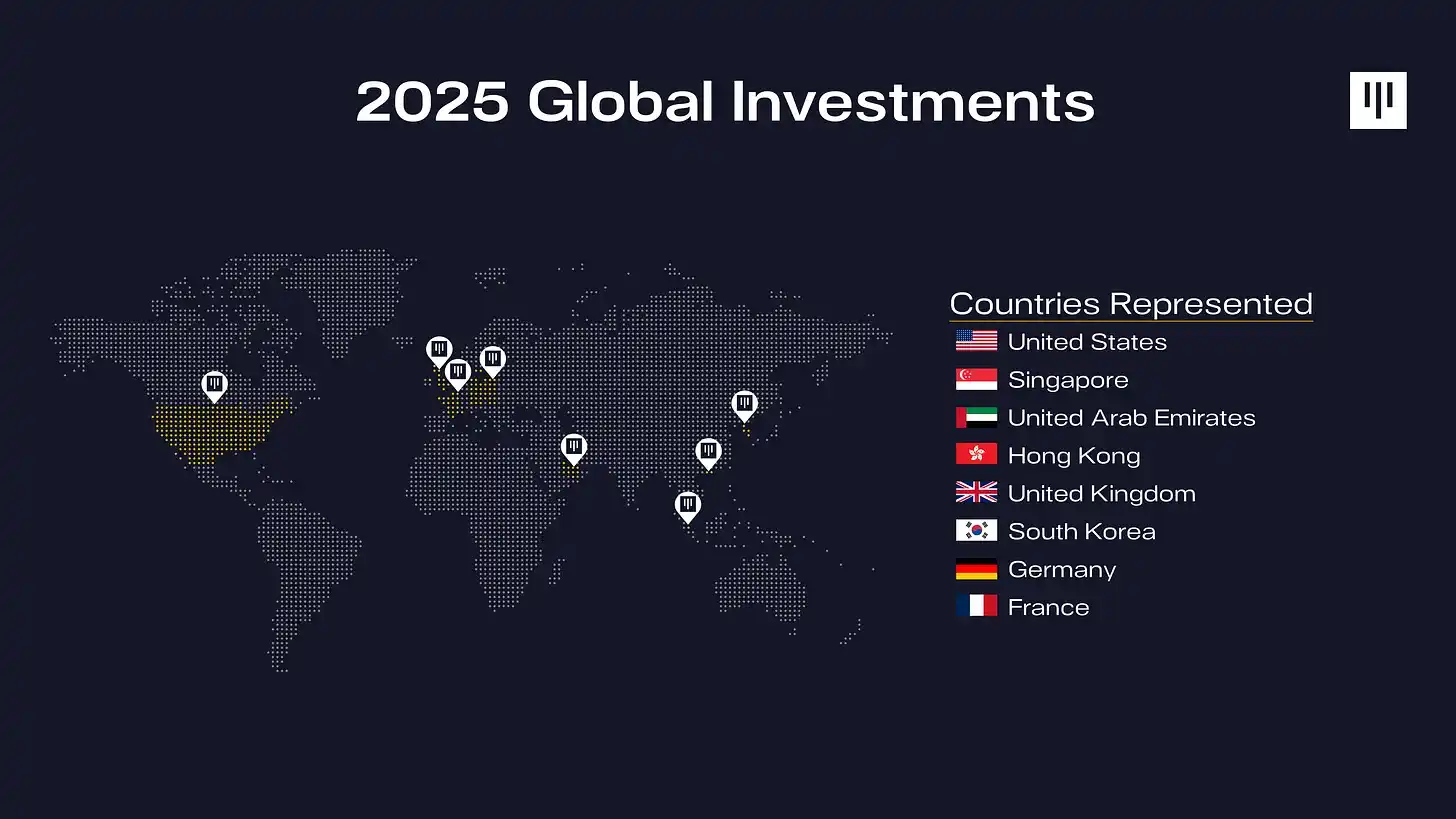
Our investments last year covered eight countries across four regions:

North America (64.52%)

Asia (16.13%)

Europe (9.68%)

Middle East (9.68%)
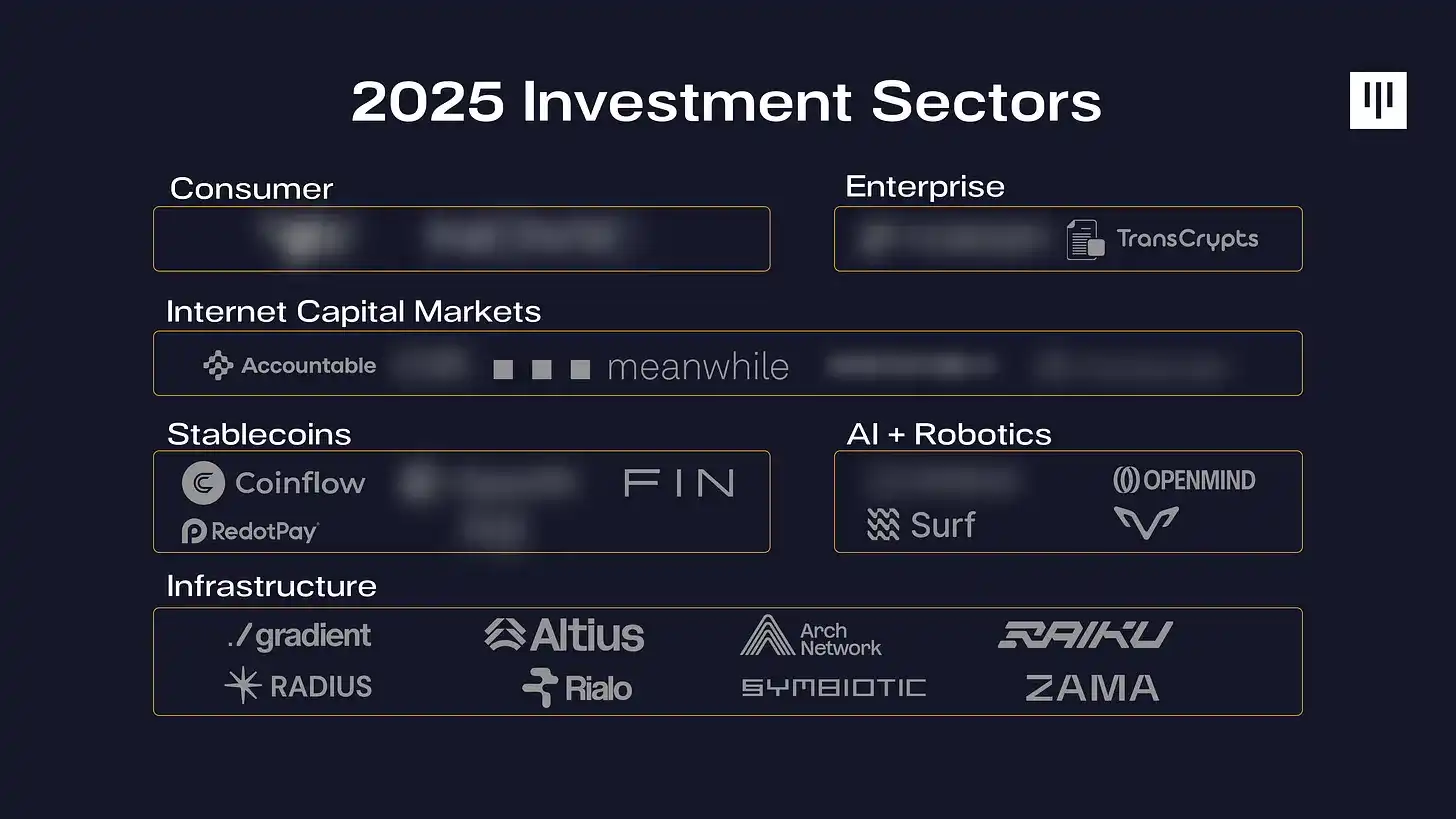
Overview of Investment Sectors Last Year: Distribution of 31 Investments Across Key Industries

Infrastructure (38.71%)

  • Altius: A VM-agnostic parallel execution framework for Layer 1 blockchains (L1s), Rollups, and Appchains, designed for high-performance execution and multi-chain atomic composability.
  • Arch Network: Bitcoin-native smart contract and settlement infrastructure, enabling developers to build applications directly on Bitcoin without bridging.
  • Radius: A decentralized sequencing and block space network adopted by Rollups and L2 teams to monetize block space, improve user experience, and enable shared sequencing infrastructure.
  • Raiku: A Solana-native block space market and network scaling framework, providing guarantees and MEV capture for Solana appchains and high-throughput applications.
  • Rialo: A modular omnichain programmable network, enabling developers to achieve low-latency cross-chain execution, intelligent workflows, and autonomous interactions.
  • Symbiotic: A general-purpose shared security layer providing sovereign security bootstrapping for emerging and existing decentralized networks, while retaining flexibility in governance and token design.
  • Zama: Open-source cryptographic infrastructure enabling enterprises, developers, and governments to run private computations, confidential smart contracts, and privacy-preserving AI using fully homomorphic encryption (FHE).

Internet Capital Markets (16.3%)

  • Accountable: Privacy-preserving financial data and reporting infrastructure, helping institutional investors, issuers, and exchanges verify the returns, risks, and disclosures of crypto-native financial products.
  • [Stealth]: An institutionally-backed crypto exchange serving brokers, market makers, and large asset managers, adapting to the shift in market structure towards multi-venue best execution.
  • Meanwhile: A crypto-native life insurance and annuity platform for Bitcoin holders, focusing on regulated downside protection and long-term Bitcoin-denominated financial products.
  • [Stealth]: A decentralized exchange and liquidity protocol providing permissionless token trading and on-chain price discovery for traders, developers, and liquidity providers.
  • [Stealth]: Token liquidity launch and capital formation infrastructure, helping token issuers and on-chain projects launch assets, build deep liquidity, and capture long-term trading fees through native Uniswap v4 mechanisms.

Stablecoins (12.9%)

  • Coinflow: A unified fiat and crypto payment platform offering compliant checkout services, embedded fraud protection, and chargeback insurance for high-risk and high-volume merchants.
  • Fin: A payment platform helping individuals, creators, and businesses send and receive stablecoins, NFTs, and cryptocurrencies instantly with minimal friction, designed for payments, peer-to-peer transfers, and embedded payment flows.
  • [Stealth]: Decentralized monetary middleware connecting off-chain liquidity from institutions, protocols, and asset issuers to on-chain markets.
  • [Stealth]: Real-time cross-border foreign exchange settlement infrastructure, providing instant, transparent high-value payment services for fintech companies, payment firms, and global enterprises.
  • RedotPay: A consumer-centric stablecoin payment and card platform serving the underbanked and crypto holders who wish to use stablecoins globally via the Visa network, with strong performance in African and Asian markets.

Consumer Sector (12.9%)

  • [Stealth]: A crypto-native casino and sports betting platform offering a compliance-first, brand-driven, and VIP-centric gaming experience for players.
  • [Stealth]: A two-way sports prediction exchange providing trading for retail bettors, professional traders, and liquidity providers on money lines, spreads, parlays, and prop bets, offering tighter pricing and a superior mobile-first experience through a CLOB-style market.

AI + Robotics (12.9%)

  • OpenMind: An open-source AI and robotics infrastructure platform building software and physical reasoning layers for general-purpose robots, enabling scalable intelligent real-world interactions through a global network of machines.
  • Surf AI: A crypto-native AI research and execution platform helping traders, analysts, exchanges, and KOLs generate on-chain-backed intelligence in real-time, faster than general AI tools.
  • Vigil: An AI-driven trading and research platform building an autonomous hedge fund enhanced by proprietary inference systems, designed for active traders, hedge funds, and other market participants.
  • [Stealth]: Formal reasoning and verification infrastructure for blockchain foundations, enterprises, and government-related organizations to mathematically verify code correctness and eliminate erroneous inferences in critical systems.

Enterprise Solutions (6.45%)

  • [Stealth]: An institutional-grade custody and transaction management platform for funds, DAOs, and enterprises to securely manage assets, tokenization, and DeFi workflows.
  • TransCrypts: A self-sovereign identity and data verification protocol enabling enterprises to verify revenue, employment, and financial data via zkTLS while protecting user ownership and privacy.

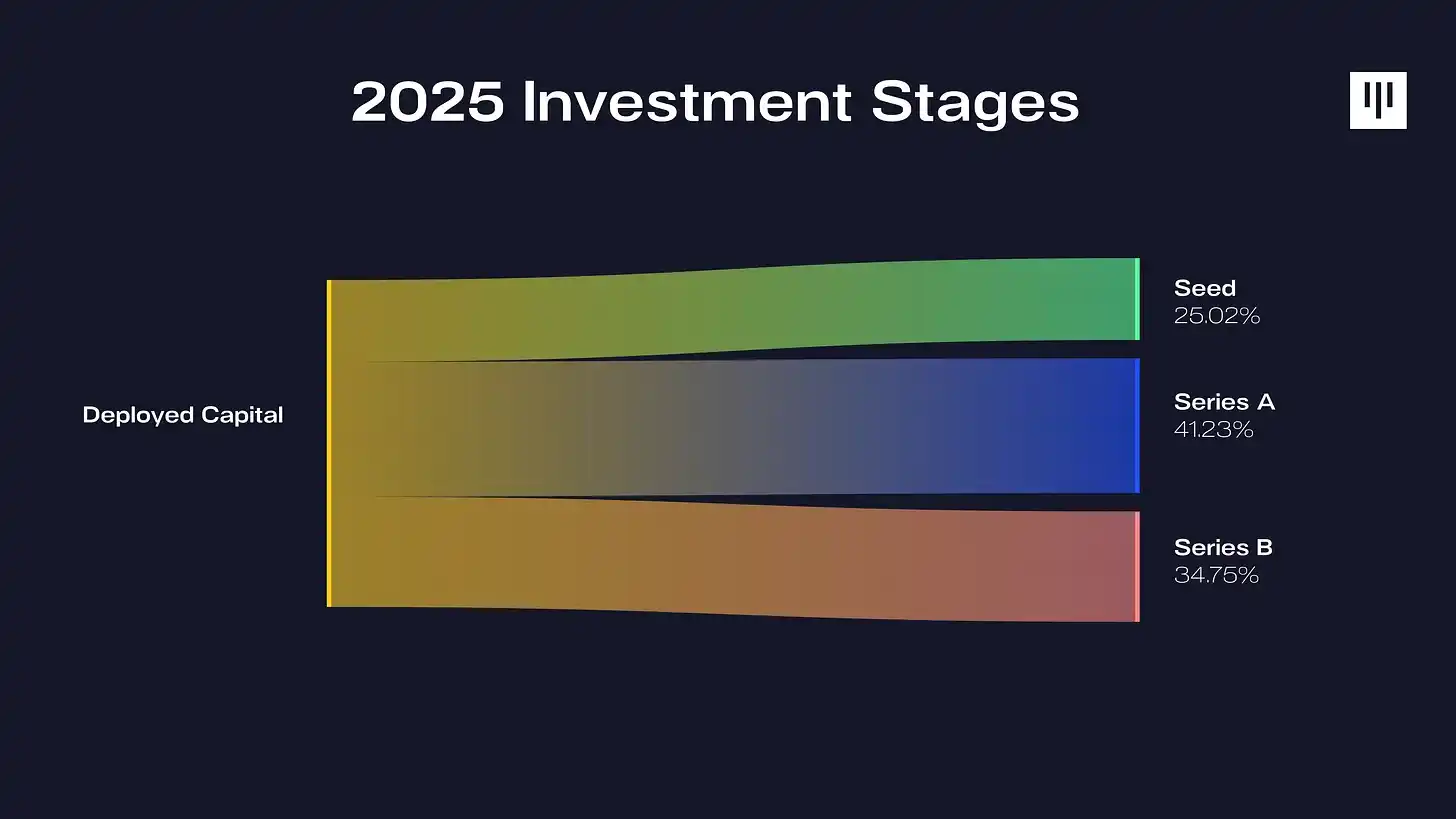
Capital Deployment by Round (31 Investments):

  • Series A: 48.4%
  • Seed Round: 25.8%
  • Series B: 25.8%

Business

  • Iran's $780 Million Crypto Ecosystem Growth

Chainalysis reported that Iran's crypto ecosystem grew rapidly, with on-chain activity in Q4 2025 accounting for about half of its crypto ecosystem, indicating its increasingly important role in Iran's economy.

  • Avalanche Powers Galaxy Digital's $75 Million Tokenized CLO Debut

Galaxy Digital (Nasdaq: GLXY) completed its first tokenized collateralized loan obligation (CLO), aiming to bring private credit onto the blockchain. The tokens are expected to be listed on INX's ATS platform.

  • CoinGecko CEO Responds to $500 Million Sale Rumors

CoinGecko is evaluating "strategic opportunities" and has hired U.S. investment bank Moelis as a sale advisor. Moelis has been involved in transactions totaling over $5 trillion across various industries.

  • Miami Crypto-Settled Real Estate Transaction Sets Record with $14 Million USDT Deal

Driven by Propy, Ciprés, and Rilea Group, crypto-backed real estate purchases are becoming a trend as an alternative to wire transfers.

  • Algorand Foundation Returns to U.S. Due to Crypto-Friendly Policy Shift

After years of operating in Singapore, the foundation announced its return to the U.S. and appointed new board members. Jito Foundation also moved back to the U.S. from the Cayman Islands, similarly citing its crypto-friendly environment.

Regulation

  • U.S. Senate Banking Committee Delays Crypto Vote

The vote originally scheduled for January 15 was postponed. Coinbase expressed concerns about potential impacts that could stifle innovation, subordinate the CFTC to the SEC, and possibly eliminate stablecoin rewards. A new vote date has not been set.

  • New Dubai International Financial Centre (DIFC) Crypto Token Regulations to Take Effect

The DIFC updated its rules following a public consultation last year. Financial services companies engaged in crypto businesses will now be directly responsible for judging whether tokens meet national standards.

  • Tennessee Bans Kalshi, Polymarket, and Crypto.com from Offering Sports Betting Services

The state sent letters to these companies, accusing them of offering services without a license from the Sports Wagering Committee.

  • Russia Pushes for Cryptocurrency to Become "Everyday Finance"

If legislation passes, digital assets will no longer fall under a special regulatory category, allowing ordinary investors to participate in a broader retail market within a limit of approximately $3,800.

New Products & Deals

  • CME Group Launches ADA, LINK, and XLM Futures, Expanding Crypto Derivatives

After receiving regulatory approval, CME Group is preparing to launch futures contracts, further driving the institutionalization of altcoin investment in the U.S.

  • BitMine Backs MrBeast with $200 Million Investment

BitMine Immersive Technology Company announced an equity investment, continuing to deploy capital beyond traditional blockchain projects.

  • London Stock Exchange Launches Digital Settlement Platform, Promoting Blockchain Adoption

The London Stock Exchange launched a digital settlement hub to facilitate fund exchanges between independent payment systems, using underlying technology that supports crypto capabilities, applicable to both blockchain and traditional finance.

  • State Street Joins Crypto Craze, Launches Digital Asset Products

The custodian bank will develop products like stablecoins and tokenized deposits, collaborating with asset managers and clients.

Pantera This Week

  • New Stateful Episode Discusses Bitcoin vs. Gold: Why 2025 Was Different

Discussion highlights include why Bitcoin's $2 trillion market cap isn't yet ready for national-level capital flows; how gold's $20 trillion market cap absorbs central bank diversification; and why nations are the last, not the first, to adopt Bitcoin.

  • Pantera Prepares for 2026 Ondo Summit in New York City

Pantera CEO and founder Dan Morehead will speak at the Ondo Summit on February 3, 2026. The summit brings together the most influential executives, founders, and leaders shaping the intersection of blockchain and finance.

  • Join Nexus Chat to Discuss 2026 Crypto Predictions

On the January 15 episode, Pantera's research and investment expert Jay Lu shared his insights with Nexus CEO and co-founder Daniel Martin.

Offline Meetup Schedule

  • New York City: January 28 - 30
  • Hong Kong: February 10 - 11
  • Singapore: February 12
  • New York City: February 26

Domande pertinenti

QAccording to Pantera Capital's 2025 investment report, what was the total number of investments made and what percentage of these were led by Pantera?

APantera Capital completed 31 investments in 2025, and they led 85% of these new investments.

QWhich two investment sectors did Pantera allocate the highest percentage of its capital to in 2025?

AInfrastructure (38.71%) and Stablecoins (12.9%) were the two sectors that received the highest percentage of Pantera's capital allocation in 2025.

QWhat significant milestone did four of Pantera's portfolio companies achieve in 2025, and what was their combined market capitalization as of January 2026?

AFour of Pantera's portfolio companies had an Initial Public Offering (IPO) in 2025, and their combined market capitalization was approximately $33 billion as of January 2026.

QName one infrastructure company in Pantera's portfolio that focuses on providing parallel execution frameworks for blockchains.

AAltius is an infrastructure company in Pantera's portfolio that builds a virtual machine-agnostic parallel execution framework for L1s, Rollups, and Appchains.

QWhich region received the majority of Pantera's investments in 2025, and what was the percentage?

ANorth America received the majority of Pantera's investments in 2025, accounting for 64.52% of their total investments.

Letture associate

The First Case on AI Agents: What Was Adjudicated?

"The First 'Agent' Ruling: What Was Decided?" On April 30, the Guangzhou Internet Court issued a ruling—China's first behavior preservation order in the intelligent agent (AI agent) field. The defendant, an open-source AI agent software, was ordered to stop downloads, cease actions that bypassed a platform's technical protection measures, and delete related tutorials and data. The core issue: the software used the operating system's "accessibility service" permissions to automate user interactions within other apps without those platforms' authorization. This mirrors a recent US case where Amazon sued Perplexity for similar reasons—bypassing Amazon's API to directly scrape and interact with its pages—and won a preliminary injunction. Both rulings establish a crucial legal boundary for the AI agent era: agents cannot operate unchecked. The article argues the fundamental legal principle emerging is one of **dual authorization**. An AI agent requires both **user consent** AND **platform consent** to operate legitimately within that platform's ecosystem. Bypassing platform rules through system-level permissions, even with user permission, undermines platform responsibilities for content moderation, data security, and user privacy, creating liability issues. The piece uses the evolution of "Doubao Phone" (an AI-integrated smartphone) as a case study. Its initial, aggressive version that bypassed platform controls faced roadblocks. Its upcoming 2.0 version is reportedly pivoting to negotiate API access and authorization deals with major platforms (like Alibaba's ecosystem), seen as a strategic adaptation to the new regulatory reality. A global trend is identified: the era of unregulated, "wild west" growth for AI agents is ending, replaced by a **compliance race**. This raises barriers to entry, as securing platform authorizations becomes a new cost. Open-source status is also not a legal shield if the code facilitates bypassing technical protections. In conclusion, these first rulings target not the largest, but the most **aggressive and representative** cases. By setting precedent with them, regulators are efficiently steering the entire industry towards a new, more regulated operating paradigm defined by dual authorization and platform cooperation.

marsbit4 min fa

The First Case on AI Agents: What Was Adjudicated?

marsbit4 min fa

Fired by Google Over a 14-Page Paper, Over 4,000 Rallied for Her. 6 Years Later: She Almost Predicted the Entire AI Era Back Then.

In late 2020, Google AI researcher Timnit Gebru was effectively dismissed following a conflict over a 14-page, unpublished research paper she co-authored titled "On the Dangers of Stochastic Parrots." The paper, which has since been cited over 14,000 times, raised critical early warnings about the risks of large language models (LLMs). It argued that these models, trained on vast, biased internet data, are essentially "stochastic parrots" that mimic language without true understanding, potentially amplifying societal biases, generating plausible but false information (later termed "AI hallucination"), consuming massive energy, and obscuring their training data contents. Gebru's stance led to a clash with Google management, who requested the paper's withdrawal. Her subsequent internal criticism of the company's diversity efforts and handling of the matter culminated in her termination, which sparked protests from over 4,000 Google employees and researchers. Six years later, the paper's predictions have proven remarkably prescient. Issues like AI hallucination, embedded bias (evident in resume screening and healthcare algorithms), soaring energy consumption from AI data centers, unvetted training data containing harmful content, and the risk of "model collapse" from AI-generated internet content have become central industry challenges. The incident also highlighted concerns about AI development being driven primarily by commercial competition within a handful of powerful tech companies, often at the expense of ethical considerations. After leaving Google, Gebru founded the Distributed AI Research Institute (DAIR) to explore these issues independently. The controversy underscores how her early, critical insights into the fundamental limitations and societal impacts of LLMs anticipated many of the most pressing dilemmas in today's AI era.

marsbit5 min fa

Fired by Google Over a 14-Page Paper, Over 4,000 Rallied for Her. 6 Years Later: She Almost Predicted the Entire AI Era Back Then.

marsbit5 min fa

Elderly Borrow Money to Trade Stocks, Entire Nation Adds Leverage: 'Ant Army' Panics as South Korean Stock Market Plunges

Titled "Panic Among 'Ant Army' as South Korean Stocks Plunge After Elders Borrow to Invest, Everyone Leverages Up," this article details a dramatic reversal in South Korea's red-hot stock market. After a sustained rally toward 9,000 points driven by AI semiconductor hype, the KOSPI index recently crashed, triggering circuit breakers. The sell-off was led by major chipmakers Samsung Electronics and SK Hynix, whose combined weight in the index is over 50%. The plunge exposed the extreme leverage and speculative behavior that fueled the boom. Individual investors, dubbed the "ant army," had borrowed heavily or used leverage ETFs to chase gains, with trading accounts outnumbering the population. A significant portion of this leveraged money came from older citizens, some of whom reportedly cashed out insurance policies to invest. ETF trading became dominated (over 90%) by high-risk leveraged and inverse products. The correction was triggered by a pullback in U.S. tech stocks, leading to a foreign capital exodus and a weakening Korean won, creating a vicious cycle. While President Lee Jae-myung attempted to reassure markets and NVIDIA's CEO signaled support during a visit, officials like Finance Minister Ju Yeong-geun expressed concern over the dangerous "herd mentality." The article highlights a pervasive, high-risk investment culture where everyone from office workers to retirees and even parents opening accounts for newborns sought quick profits, largely concentrated in a few tech stocks, setting the stage for a sharp and painful correction.

marsbit11 min fa

Elderly Borrow Money to Trade Stocks, Entire Nation Adds Leverage: 'Ant Army' Panics as South Korean Stock Market Plunges

marsbit11 min fa

From Hunyuan to WeChat AI: Tencent's Slow Paced Journey Reaches the Delivery Juncture

On June 8, 2026, WeChat's developer platform announced the internal testing of "WeChat AI," an AI assistant integrated into the WeChat ecosystem. It allows users to invoke, access, and operate Mini Programs through natural language conversation. The platform offers two access modes: an "Automatic Mode" where developers authorize platform access to their source code for zero-configuration AI operation, and a "Developer Mode" for building custom skills. While the name "WeChat AI" is provisional, this marks WeChat's first step in opening its vast Mini Program ecosystem—comprising over 400,000 developers and hundreds of millions of daily active users—to AI-driven conversational interaction. This move represents the latest step in Tencent's deliberate AI strategy, moving from technical R&D and standalone product validation to integration within its super-app. The underlying foundation is Tencent's self-developed Hunyuan large language model. Ranked first domestically in application-oriented capabilities like Agent task execution in 2025, Hunyuan's focus on stability and precision over raw parameter count aligns with WeChat AI's need for reliable, low-latency operations involving sensitive tasks like payments and bookings. Prior C-side validation came from "Yuanbao," a standalone AI app whose Monthly Active Users (MAU) surpassed 114 million during the 2026 Chinese New Year红包 campaign, though daily activity later subsided. This "pulse growth" highlighted the challenge of user retention for standalone apps, informing the decision to integrate AI natively into WeChat's high-frequency scenarios. However, WeChat AI's "Automatic Mode," which requires source code access, raises developer concerns about code security, data visibility, and liability for AI errors. A deeper, ecosystem-level tension exists between the efficiency of centralized AI task调度 and the potential "short-circuiting" of merchant pages, which could erode their branding, advertising revenue, and user engagement. As Tencent Chairman Pony Ma noted, balancing centralized AI调度 with the protection of decentralized merchant traffic is a core challenge. In summary, Tencent's AI path—comprising the stable Hunyuan base model, the user-validated Yuanbao app, and the newly testing WeChat AI integration—is logically coherent. The success of WeChat AI now hinges on resolving developer trust, establishing fair ecosystem rules for merchants, and ensuring operational reliability to gain user confidence for deep, transactional use.

marsbit11 min fa

From Hunyuan to WeChat AI: Tencent's Slow Paced Journey Reaches the Delivery Juncture

marsbit11 min fa

STRC Briefly Fell Below $91: Will Strategy Be Hunted by 'Market Fear'?

The article draws a parallel between FTX's 2022 collapse and the current situation facing MicroStrategy (Strategy), a major corporate holder of Bitcoin. The author argues that MicroStrategy's financial model, heavily reliant on issuing equity and convertible debt at a premium to its Bitcoin holdings, is under stress. The core issue is the compression of MSTR's stock premium over its Bitcoin holdings (NAV). This erodes the viability of its "flywheel" – using equity sales to buy more Bitcoin. The company has shifted towards preferred shares (like STRC) and debt to raise capital, incurring significant dividend and interest obligations (approximately $1.7 billion annually). With cash reserves dwindling and debt maturities looming, MicroStrategy faces mounting pressure to generate cash. The article outlines three problematic options: 1) cutting preferred dividends, damaging investor confidence; 2) issuing more MSTR stock at low premiums, diluting existing shareholders; or 3) selling Bitcoin, which founder Michael Saylor had vowed against but recently did in a small symbolic transaction. The author suggests that, like FTX, a crisis of confidence could trigger a rapid downward spiral as investors flee. While noting Saylor's actions are legal—unlike SBF's fraud at FTX—the article warns the structural risk born from financial engineering and over-leverage is significant. The preferred path out is a sharp rise in Bitcoin's price to restart the premium flywheel, but this would only create a larger, more complex system vulnerable to future failure. The author concludes by advocating for direct Bitcoin ownership over exposure through MicroStrategy's increasingly risky financial structure.

Foresight News26 min fa

STRC Briefly Fell Below $91: Will Strategy Be Hunted by 'Market Fear'?

Foresight News26 min fa

Trading

Spot
Futures
活动图片