P2P team admits to betting on its own raise days after Polymarket tightened insider trading rules

ambcryptoPubblicato 2026-03-27Pubblicato ultima volta 2026-03-27

Introduzione

P2P, a crypto project, has admitted that its team placed bets on Polymarket regarding the outcome of its own $6 million fundraising campaign. The bets were made approximately 10 days before the raise concluded, using funds from the project's treasury. This activity, which generated around $23,000 in profit and loss, occurred just days after Polymarket updated its rules to explicitly prohibit insider trading, including by individuals who can influence an event's outcome. While P2P stated the bets were not based on guaranteed information and plans to return all proceeds, the case highlights the enforcement challenges decentralized prediction markets face in preventing manipulation and maintaining trust, especially from involved actors. The incident is a real-world test of how newly tightened market integrity rules are applied in practice.

A crypto project has disclosed that it placed bets on its own fundraising outcome on Polymarket, drawing attention to how newly tightened market integrity rules may apply in practice.

In a public statement, P2P.me confirmed that an account labeled “P2P Team” on-chain was controlled by its team. The account was used to bet on whether the project would reach a $6 million fundraising target.

The bets were placed roughly 10 days before the raise concluded, when the outcome had not yet been finalized.

The project stated that the capital used came from its foundation’s treasury and that all proceeds would be returned. It added that it plans to liquidate the positions and introduce internal policies governing prediction market activity.

Case emerges days after Polymarket tightened insider trading rules

The disclosure comes just days after Polymarket updated its rules on 23 March, introducing stricter definitions around insider trading and manipulation.

Among the changes, the platform explicitly prohibited trading by individuals who hold positions of influence over an outcome. That category includes participants directly involved in events tied to prediction markets.

While P2P said the bets were placed before the raise was completed and not based on guaranteed allocations, the timing of the disclosure places the case within a broader shift toward tighter oversight on prediction platforms.

On-chain activity shows active trading and profits

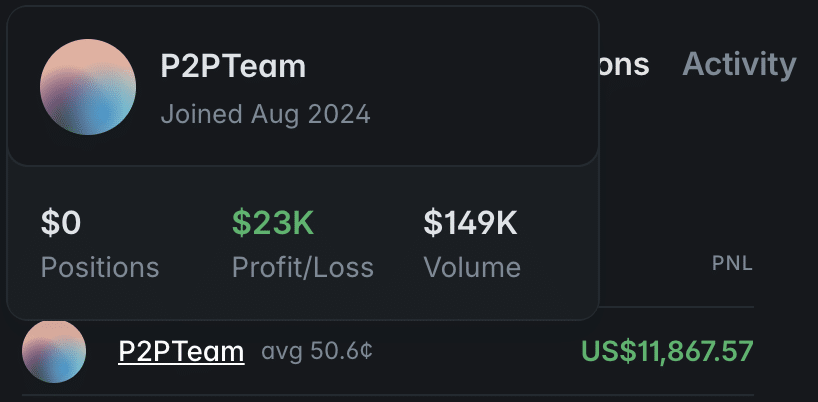
Data from the “P2P Team” account indicates the activity was not purely symbolic.

The account recorded roughly $149,000 in trading volume and around $23,000 in profit and loss. Individual positions generated gains of over $11,000. The figures suggest the trades were executed as active positions rather than passive signaling.
Source: Polymarket

P2P acknowledged that failing to disclose the activity at the time was a mistake. The team notes that trading on outcomes that a team can influence may erode trust, even if the result is not predetermined.

Incident highlights challenges in prediction market enforcement

The case underscores a broader challenge facing decentralized prediction markets: how to manage participation by individuals who may influence event outcomes.

Polymarket’s model relies on open participation and transparent on-chain activity. However, the presence of informed or involved actors can complicate enforcement, particularly when trades occur before outcomes are finalized.

As platforms move to formalize rules around insider activity, real-world cases like this may shape how those standards are interpreted and applied.


Final Summary

  • P2P disclosed betting on its own fundraise outcome, raising questions about insider participation in prediction markets.
  • The incident comes as platforms like Polymarket tighten rules, highlighting ongoing challenges in enforcing market integrity.


Domande pertinenti

QWhat did the P2P team admit to doing on Polymarket?

AThe P2P team admitted to placing bets on their own fundraising outcome, specifically on whether the project would reach its $6 million target.

QWhen did Polymarket update its rules regarding insider trading and manipulation?

APolymarket updated its rules, introducing stricter definitions around insider trading and manipulation, on March 23.

QWhat was the financial result of the 'P2P Team' account's trading activity?

AThe 'P2P Team' account recorded approximately $149,000 in trading volume and around $23,000 in profit and loss, with individual positions generating gains of over $11,000.

QAccording to the article, what is a key challenge for decentralized prediction markets highlighted by this incident?

AA key challenge is managing participation by individuals who may influence event outcomes, as the presence of informed or involved actors complicates enforcement, especially when trades occur before outcomes are finalized.

QWhat action did P2P say it would take following this disclosure?

AP2P stated it would liquidate the positions, return all proceeds to its foundation's treasury, and introduce internal policies governing prediction market activity.

Letture associate

Bitwise: Bullish on Bitcoin's Performance in the Second Half of the Year, AI and Regulation Will Spark a New Altcoin Season

Bitwise CIO Matt Hougan and Research Lead Ryan Rasmussen express strong bullish sentiment on Bitcoin's long-term prospects, suggesting that its $1 million price target may be too conservative. They argue Bitcoin serves a dual role: as digital gold and a potential global settlement asset, especially amid declining trust in traditional monetary systems. Despite a weak Q1 2026 where nearly all crypto assets and prices saw double-digit declines, the analysts remain optimistic due to strong forward-looking catalysts, including institutional adoption via Bitcoin ETFs from major firms like Morgan Stanley and Goldman Sachs. Geopolitical instability, such as Iran’s mention of using Bitcoin for international payments, increases the value of Bitcoin’s “out-of-the-money call option” as a non-political, global settlement currency. This enhances its appeal beyond a mere store of value. . Additionally, Hougan highlights that a clearer regulatory token framework under current SEC leadership, combined with AI efficiency gains and high-performance blockchains, could fuel a new “altseason” by late 2026. This may lead to a wave of legitimate, value-capturing token projects, unlike the earlier ICO boom. . Bitwise also announced an Avalanche ETF, citing its unique architecture and rapid growth in real-world asset (RWA) tokenization, which has surged 10x to nearly $30 billion in two years. The firm believes Layer 1 blockchains are still early in their growth cycle, with significant potential ahead.

marsbit27 min fa

Bitwise: Bullish on Bitcoin's Performance in the Second Half of the Year, AI and Regulation Will Spark a New Altcoin Season

marsbit27 min fa

Trading

Spot
Futures
活动图片




