OpenAI Is Turning AI into a Nuclear Arms Race That Ordinary People Can't Afford

marsbitPubblicato 2026-02-28Pubblicato ultima volta 2026-02-28

Introduzione

In a record-breaking funding round, OpenAI has secured $110 billion, raising its post-money valuation to $840 billion. This investment, led by Amazon, NVIDIA, and SoftBank, marks the largest-ever private tech funding and signals a new phase in the global AI race—one defined by extreme capital concentration and geopolitical significance. The scale of funding dwarfs the GDP of many mid-sized nations and equals nearly half of NVIDIA’s annual revenue. It also accounts for more than half of all AI startup funding in 2025, accelerating an industry-wide arms race in compute, talent, and model development. This capital influx, however, risks widening the gap between giants and smaller players, potentially stifling innovation and increasing market consolidation. Strategic investors are not merely providing capital: Amazon’s $50 billion commitment includes an eight-year, $100 billion cloud expansion deal. SoftBank’s $30 billion staged investment serves as both a hedge and a bridge for future sovereign wealth entrants. NVIDIA’s $30 billion replaces an earlier partnership promise and effectively locks up its advanced GPU supply, creating a closed loop that sidelines competitors. Despite ChatGPT reaching 900 million weekly active users and 50 million paid subscribers, OpenAI’s burn rate remains high. It spent $0.62 for every dollar earned in 2025, with cumulative cash burn projected to hit $1150 billion by 2029. At the same time, its market share is eroding amid rising competition from...

Author: Nancy, PANews

Last night, the air in Silicon Valley was thick with the smell of burning money.

$110 billion in funding, an $840 billion post-money valuation—the depth charge thrown by OpenAI not only shattered the ceiling for private tech companies but also plunged the global AI competition into an extremely brutal "folded space."

This is no longer a romantic tale of tech entrepreneurship but a high-stakes game concerning national destiny, computing supremacy, and the direction of civilization.

A Hundred Billion Dollars Poured into AI, OpenAI Becomes the Most Expensive Experiment

In tech history, OpenAI has set a staggering funding record.

On February 27, OpenAI announced a new massive funding round of $110 billion at a $730 billion valuation, directly pushing its post-money valuation to $840 billion. Compared to the $40 billion funding round a year earlier, this round has multiplied in size, setting a new record for private tech company funding. The capital bet on it has shifted from "betting on the future" to "locking in the future in advance."
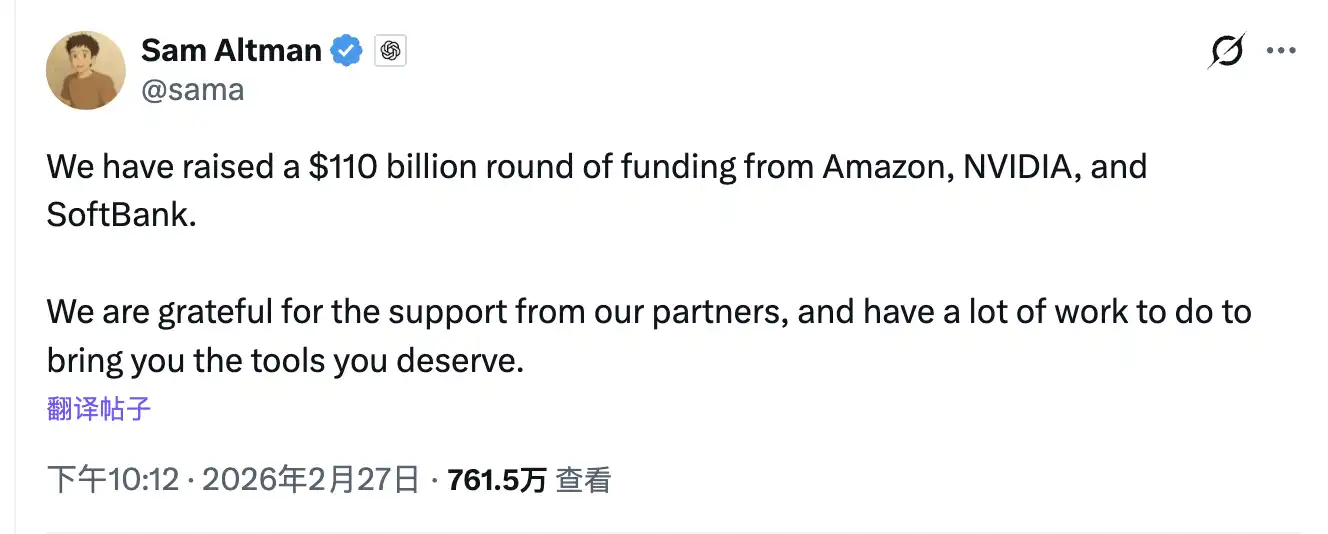
What does $110 billion mean?

This figure exceeds the annual GDP of medium-sized countries like Kenya, Venezuela, Luxembourg, and Panama. Even the global oil powerhouse Saudi Arabia has an annual GDP of about $1 trillion. OpenAI's single funding round is equivalent to roughly one-tenth of Saudi Arabia's annual output.

This amount is roughly equivalent to NVIDIA's annual revenue, close to half of SpaceX's current valuation, and the sum of the funding amounts of internet golden age giants like Uber, Didi, Alibaba, ByteDance, Tencent, and Meituan.

In the AI landscape, a single funding round of $110 billion is undoubtedly a watershed moment, overnight changing the entire industry's funding rules. In 2025, the total funding for AI startups broke through $200 billion, hitting a historical high, and OpenAI alone took over half of that in one night.

Such funding scale intensifies the arms race in the AI field. Top competitors must follow up with larger funding rounds; otherwise, they will gradually fall behind in the competition for computing power, models, and talent. However, the expansion of funding scale also brings higher valuation pressures and return requirements. When massive capital is concentrated and siphoned away, the funding window will inevitably narrow sharply. The valuation negotiation space for small and medium-sized AI enterprises shrinks, their survival cycles lengthen, and the risk of industry consolidation further increases, potentially leading to valuation bubbles, resource monopolies, and a decline in innovative vitality.

From this perspective, when capital bets with such enormous volume, AI is no longer just the protagonist of a tech narrative but truly transforms into the mainline asset of the capital era, becoming a battleground for giant capital gambles.

A Capital Gambit Around AGI, Three Giants Take the Field

The backers writing this $110 billion check are Amazon, NVIDIA, and SoftBank, assembling computing power, channels, and capital.

But this is not a simple funding round. Rather than mere financial transfusion, it is a strategic high-stakes bet centered on the prospects of AGI, deeply intertwined with technology, computing power, and commercial interests.

The most generous contributor this round is Amazon, which is both a key investor in OpenAI and its long-term strategic partner.

Out of a total commitment of $50 billion, an initial $15 billion has been confirmed, with the remaining $35 billion to be delivered in the coming months based on specific conditions. Trigger conditions include achieving AGI milestones or advancing an IPO by year-end. Additionally, the two parties signed an 8-year, $100 billion expansion agreement.

This model of exchanging capital investment for future computing power needs and technological priority is similar to OpenAI's previous cooperation logic with Microsoft. It is worth mentioning that OpenAI and Microsoft have a special clause: once AGI is achieved, Microsoft will lose access to the related technology (Note: In the new agreement signed in 2025, Microsoft's IP rights to models and products were extended to 2032).

SoftBank Group contributed $30 billion, with funds to be delivered in three installments in April, July, and October 2026. This staged arrangement is also interpreted as a risk hedge. SoftBank's role in this funding round is not just about providing money. Market消息称, OpenAI is expected to raise about another $10 billion from investors before March, including sovereign wealth funds and investment institutions, potentially pushing the overall valuation to $850 billion, and these potential investors are likely to enter through SoftBank's bridge.

SoftBank founder Masayoshi Son has frequently bet on AI in recent years, publicly stating that "the AI revolution is the most exciting and dynamic front-end trend of the future." Son visited Trump's Mar-a-Lago at the end of 2024, promising $100 billion in U.S. investments, and last year officially announced participation in "Stargate," a $500 billion AI infrastructure investment project in the U.S., serving as its chairman. SoftBank is responsible for financial obligations, while OpenAI handles operational responsibilities. To support OpenAI, Son even reluctantly sold off NVIDIA shares last year "with tears," using the proceeds for additional investment in OpenAI, becoming one of OpenAI's largest external investors.

NVIDIA, which had long预告 its investment,掏出了 $30 billion this time, replacing the $100 billion long-term cooperation commitment agreed upon last year. This also allows OpenAI to monopolize NVIDIA's production capacity in advance, creating an exclusive "internal循环 system." Any competitor outside this circle would have to queue until 2030 just to buy graphics cards.

This循环 model is seen as a typical supplier financing, essentially tech giants using capital binding to lock in long-term商业合作. It can be said that in this AI race, capital is no longer just a financial tool but a chip to lock in computing resources and seize discourse power.

The Race Between Technology and Capital, Considering an IPO at the Right Time

Behind the massive capital injection is not only a collective bet on the AGI track but also recognition of OpenAI's business growth.

According to official disclosures, OpenAI's flagship product ChatGPT now has over 900 million weekly active users, a number that stood at around 200 million 18 months ago; individual subscription users have surpassed the 50 million mark, hitting a historical high with a paid penetration rate of over 5%; paid商业 users exceed 9 million, including numerous enterprises and government agencies using ChatGPT or building products based on the OpenAI API.

However, behind the rapid growth is an expanding cash burn. OpenAI's revenue in 2025 was approximately $13 billion, with cash expenditures of $80 billion, meaning that for every dollar earned, about $0.62 of rigid cash outflow is burned. According to The Information, internal projections disclosed by OpenAI to investors show that cumulative cash burn by the end of 2029 will reach $115 billion, with profitability expected only by 2030. Meanwhile, OpenAI recently disclosed plans to invest a total of about $600 billion in computing power construction by 2030.

This means that if substantial profitability cannot be achieved in the short term, this astonishing "burn rate" forces OpenAI to continuously rely on transfusions to stay alive.

But more critically, OpenAI's once impregnable moat is loosening.

According to data from mobile analytics firm Apptopia, ChatGPT's app market share has declined from 69.1% in January 2025 to 45.3% in 2026. During the same period, Google's Gemini chatbot app's market share rose from 14.7% to 25.2%; Musk's Grok climbed to 15.2%, up from just 1.6% a year earlier.

With profitability challenges and strong competitors closing in, an IPO might become OpenAI's "lifesaving ammunition."

Currently, OpenAI's IPO timetable may be approaching. According to a recent Wall Street Journal report citing informed sources, OpenAI is paving the way for a Q4 2026 listing, has contacted Wall Street investment banks, and recruited a chief accounting officer and head of investor relations. Its founder Sam Altman最新 disclosed that he will consider going public at the appropriate time. If realized, this would be one of the most important IPO events in the tech industry in 2026.

This means Sam Altman is running blindfolded on the tightrope of an IPO. This is not just a race of technology but a life-and-death sprint against capital's patience.

And this target IPO at year-end might be the peak of this AI bubble, or perhaps the true beginning of the AGI era. But until then, everyone is holding their breath at the most expensive gambling table, waiting for the cards to be revealed.


Crypto di tendenza

Domande pertinenti

QWhat is the total amount of funding OpenAI's latest round and what is the post-investment valuation?

AOpenAI raised $110 billion in its latest funding round, with a post-investment valuation of $840 billion.

QWhich three major companies are the primary investors in OpenAI's $110 billion funding round?

AThe primary investors are Amazon, NVIDIA, and SoftBank.

QWhat is the current weekly active user count for ChatGPT and how much has it grown in the last 18 months?

AChatGPT currently has over 900 million weekly active users, up from 200 million 18 months ago.

QWhat significant financial challenge does OpenAI face despite its revenue growth, according to the article?

AOpenAI faces a significant cash burn, spending approximately $0.62 for every $1 it earns in revenue, and is projected to have a cumulative cash consumption of $1.15 trillion by the end of 2029.

QWhat is OpenAI's reported plan regarding an Initial Public Offering (IPO)?

AOpenAI is reportedly preparing for an IPO in Q4 of 2026 and has begun engaging with Wall Street banks and hiring key financial executives.

Letture associate

Only 153 Venture Capital Firms Invested in July: Is the Crypto VC Industry Experiencing a 'Mass Extinction'?

In July 2026, only 153 unique venture capital firms participated in disclosed crypto funding rounds, marking the lowest monthly count since November 2020. This figure represents an 87% decline from the peak of 1,177 firms in 2022. Overall, the first seven months of 2026 saw crypto projects raise approximately $11.78 billion across 481 rounds. This crypto VC contraction contrasts sharply with the broader venture capital landscape, where global VC investment reached a record $560.4 billion in H1 2026, heavily fueled by major AI company financings. This shift in capital allocation has drawn funds away from the crypto sector. Within crypto, funding is highly concentrated. Trading platforms, prediction markets, and payment sectors absorbed 53% of the total capital. While early-stage deals remain frequent, the largest sums flow to a few late-stage rounds and mergers & acquisitions, which surged to $7.23 billion in Q2 2026. The market is consolidating around top funds like a16z crypto and Dragonfly, which successfully raised new multi-billion dollar funds, while many smaller firms have retreated. Analysts describe this as a "great extinction" for crypto VCs, where capital is becoming more selective, favoring proven business models and assets over early-stage speculation. This raises the bar for project quality, funding efficiency, and viable exit paths.

marsbit3 min fa

Only 153 Venture Capital Firms Invested in July: Is the Crypto VC Industry Experiencing a 'Mass Extinction'?

marsbit3 min fa

Strategy's Loss in the Second Quarter Reaches $8.22 Billion Amid Bitcoin Decline

Strategy, the largest corporate holder of Bitcoin, reported a net loss of $8.22 billion for the second quarter. This loss was primarily driven by an $8.32 billion unrealized loss on its Bitcoin holdings due to a decline in the asset's price during the period. Despite these paper losses, the company increased its Bitcoin holdings to 843,775 BTC, a 25% growth since the start of the year. As part of a new monetization strategy, Strategy sold approximately $218.4 million worth of Bitcoin, mainly to fund dividends for preferred shareholders, with $216 million of that sold after Q2 ended. The company also built a $3.75 billion cash reserve, which it claims is sufficient to cover over two years of dividend and interest payments, aiming to insulate itself from Bitcoin's volatility while meeting obligations. Following the earnings release, Strategy's stock (MSTR) rose 4.7% in regular trading but corrected slightly after-hours. This pattern reflects how the company's accounting results are heavily tied to Bitcoin's price swings, even as its long-term strategy remains unchanged. The report indicates that Strategy is maintaining its core strategy of accumulating Bitcoin while building a financial buffer. This quarterly loss follows a recognizable pattern, with the company posting significant unrealized losses in previous quarters (e.g., $12.4 billion in Q4 2025 and ~$12.5 billion in Q1 2026) due to fair-value accounting. A key technical shift is its new monetization program, which introduces periodic selling pressure on the market, transitioning Strategy from a pure accumulator to a participant that occasionally adds supply. A critical question remains: how long can the cash reserve cover dividend obligations if a Bitcoin price downturn persists beyond two years?

cryptonews.ru23 min fa

Strategy's Loss in the Second Quarter Reaches $8.22 Billion Amid Bitcoin Decline

cryptonews.ru23 min fa

Will Terrorist Durov Ban Russian Officials?

Telegram founder Pavel Durov publicly reacted to being labeled a "terrorist" by Russian authorities, stating the designation came after he refused demands for mass surveillance and censorship on the platform. In a Telegram post, he highlighted that this status formally bans him from "publishing information online." Durov concluded with a statement widely circulated: Russian officials "clearly don't understand who can ban whom on the internet." This remark suggests Durov could potentially restrict official Russian government and officials' channels on Telegram, which continue to operate on the platform despite its formal blocking in Russia. The situation parallels previous, slow-moving state directives, like switching officials to domestic cars, contrasted with the current push to migrate all government communication to the Russian-made messenger MAX by 2030. However, reports indicate many officials still use Telegram via workarounds, fearing surveillance on MAX, while alternatives like BiP and KakaoTalk recently became inaccessible in Russia without a VPN. Durov has not specified any immediate actions against state channels. His statement is an initial response, with further developments depending on the authorities' reaction. The dynamic differs from 2020 when Russian regulators lifted a block on Telegram; now, Durov implies control from within the platform itself over the official accounts that persisted through that earlier blockade.

cryptonews.ru23 min fa

Will Terrorist Durov Ban Russian Officials?

cryptonews.ru23 min fa

DeepSeek V4 Official Version Arrives, New Capabilities Emerge, Value-for-Money King Enters the Fray

On July 31st, DeepSeek officially launched the public API beta for its DeepSeek-V4-Flash model. A key highlight is its performance on multiple Agent benchmark tests, reportedly nearing or even surpassing the level of the V4-Pro preview version from three months ago. Notably, the Flash model achieves this with significantly smaller scale (130B active parameters vs. Pro's 490B), suggesting that post-training optimization and data quality may be as crucial as raw model size. DeepSeek emphasized that the V4-Flash-0731 uses the same model architecture and size as its preview version, with improvements attributed solely to "re-trained post-training." The update also marks the official debut of DeepSeek's self-developed Agent framework, "Harness." The move signals DeepSeek's strategic push to position its cost-effective Flash model as a competitive base for Agent applications—scenarios requiring autonomous planning, tool usage, and complex task execution—where inference speed and cost are critical. By natively supporting OpenAI's Responses API format and adapting for code-generation scenarios, DeepSeek aims not just to be a cheaper alternative but to establish its own ecosystem in the Agent era. This release follows DeepSeek's record-breaking ~$50 billion fundraising round roughly two months prior, underscoring market confidence in its technology and commercialization prospects. The company is reportedly preparing for another funding round at a valuation of approximately $71 billion. The Flash model's advancement represents a step in fulfilling the high expectations that come with this valuation, setting the stage for the impending release of the V4-Pro official version and intensifying competition in the global Agent landscape.

marsbit28 min fa

DeepSeek V4 Official Version Arrives, New Capabilities Emerge, Value-for-Money King Enters the Fray

marsbit28 min fa

Trading

Spot

Articoli Popolari

Come comprare PEOPLE

Benvenuto in HTX.com! Abbiamo reso l'acquisto di ConstitutionDAO (PEOPLE) semplice e conveniente. Segui la nostra guida passo passo per intraprendere il tuo viaggio nel mondo delle criptovalute.Step 1: Crea il tuo Account HTXUsa la tua email o numero di telefono per registrarti il tuo account gratuito su HTX. Vivi un'esperienza facile e sblocca tutte le funzionalità,Crea il mio accountStep 2: Vai in Acquista crypto e seleziona il tuo metodo di pagamentoCarta di credito/debito: utilizza la tua Visa o Mastercard per acquistare immediatamente ConstitutionDAOPEOPLE.Bilancio: Usa i fondi dal bilancio del tuo account HTX per fare trading senza problemi.Terze parti: abbiamo aggiunto metodi di pagamento molto utilizzati come Google Pay e Apple Pay per maggiore comodità.P2P: Fai trading direttamente con altri utenti HTX.Over-the-Counter (OTC): Offriamo servizi su misura e tassi di cambio competitivi per i trader.Step 3: Conserva ConstitutionDAO (PEOPLE)Dopo aver acquistato ConstitutionDAO (PEOPLE), conserva nel tuo account HTX. In alternativa, puoi inviare tramite trasferimento blockchain o scambiare per altre criptovalute.Step 4: Scambia ConstitutionDAO (PEOPLE)Scambia facilmente ConstitutionDAO (PEOPLE) nel mercato spot di HTX. Accedi al tuo account, seleziona la tua coppia di trading, esegui le tue operazioni e monitora in tempo reale. Offriamo un'esperienza user-friendly sia per chi ha appena iniziato che per i trader più esperti.

513 Totale visualizzazioniPubblicato il 2024.12.12Aggiornato il 2026.06.02

Come comprare PEOPLE

Discussioni

Benvenuto nella Community HTX. Qui puoi rimanere informato sugli ultimi sviluppi della piattaforma e accedere ad approfondimenti esperti sul mercato. Le opinioni degli utenti sul prezzo di PEOPLE PEOPLE sono presentate come di seguito.

活动图片