OpenAI IPO Market Sounding Meets Cold Reception, How to Convince Investors with an $850 Billion Valuation?

比推Pubblicato 2026-03-10Pubblicato ultima volta 2026-03-10

Introduzione

Wall Street investment banks are conducting market soundings for a potential OpenAI IPO, but are encountering a cooler-than-expected reception from public market investors. OpenAI is currently raising funds at an $850 billion valuation, which represents a price-to-sales multiple of 28 times its projected 2026 revenue—far exceeding Nvidia's multiple of about 12. Key investor concerns include OpenAI's own projection that it will not be profitable until at least 2030, requiring continuous capital investment. Prominent investors, including Jim Chanos, question the high valuation, especially compared to profitable and dominant players like Nvidia. Additionally, the rise of well-funded competitor Anthropic, which has a lower projected cost structure and strong enterprise sales, is diverting investor attention and capital. Some investors have indicated they may short OpenAI stock upon its debut, betting that public markets will have limited patience for its long path to profitability.

Author: Dong Jing

Source: Wall Street News

Original Title: Wall Street Conducts "Market Sounding" for OpenAI IPO, Investment Institutions Unimpressed?


OpenAI may still be at least half a year away from going public, but Wall Street's预热work has quietly begun. Several investment banks are actively approaching public market investors to gauge their views on the上市prospects of the parent company of ChatGPT—and the responses received are far colder than expected.

On March 9, according to a report by tech media The Information, sources revealed that multiple investment banks competing for OpenAI's上市underwriting business have started conducting "market soundings" with public market investors. The Information interviewed 11 public market investors for this purpose, most of whom do not yet hold OpenAI equity.

The respondents generally adopted a cautious stance towards this IPO, with core concerns集中在two points:一是unclear profit prospects—OpenAI itself predicts that it will continue to burn cash until at least 2030;二是excessive valuation—the company is currently completing a new round of financing at an $850 billion valuation, equivalent to 28 times the expected revenue for 2026, far exceeding Nvidia's price-to-sales ratio of approximately 12 times.

The report stated that the "cold" market sentiment reflects the deep-seated矛盾faced by this potential largest IPO in history: investors generally recognize OpenAI's leading position in the AI competitive landscape but remain reserved about whether it can achieve reasonable pricing in the public market. At the same time, the strong rise of competitor Anthropic is further分散investors' attention and enthusiasm.

Valuation Controversy: 28x Price-to-Sales Ratio, Where's the Premium?

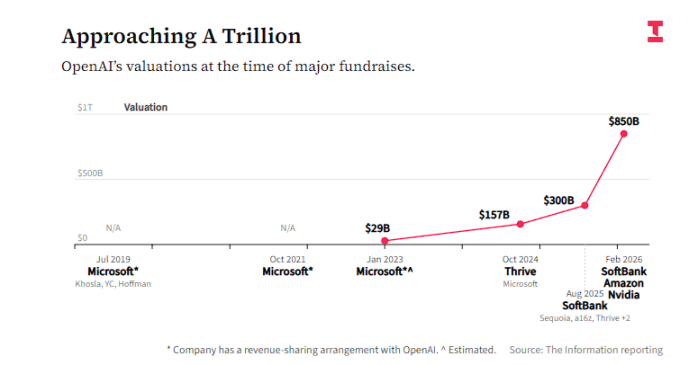
OpenAI is currently completing a new round of financing at an $850 billion valuation, with participants including Nvidia, Amazon, and SoftBank. This figure has already made many public market investors hesitant, and its IPO pricing may be even higher届时.

Based on the expected revenue for 2026, $850 billion corresponds to a price-to-sales ratio of approximately 28 times. In comparison, Nvidia, regarded as a benchmark for AI investment, currently has a price-to-sales ratio of about 12 times.
The report stated that Bob Lang, founder of trading firm Explosive Options,直言:

"I do think OpenAI is an excellent company with a strong moat, but I don't think any valuation on the first day of trading is a good deal for investors."

He said he would likely not participate in public market investment in OpenAI, especially given its higher valuation multiple than Nvidia.

Lang also pointed out that the real beneficiaries of this IPO will be those early investors and hyperscale cloud computing companies that already hold shares—they will use this as an opportunity to cash out.

Well-known short-seller Jim Chanos used Nvidia as a reference point to question OpenAI's valuation logic:

"Nvidia basically has a monopoly on the market, with rapid growth, extremely high profit margins, and ample cash flow. So why would you give OpenAI a higher valuation?"

Path to Profitability: Burning Cash Until 2030, Will the Public Market Accept It?

According to the report, OpenAI itself predicts that the company will continue to incur losses until at least 2030. This timeline makes public market investors, accustomed to scrutinizing profitability, quite uneasy.

Some investors worry whether the funds raised from the IPO can support OpenAI until it reaches profitability, or whether it will still need to raise funds again届时, thereby diluting existing shareholder equity.

Mark Malek, Chief Investment Officer of Siebert Financial, stated that even if OpenAI finds it difficult to achieve significant profitability in the short term, he would still consider building a position after the IPO, but would strictly control the position size—this is the same strategy he used when investing in Palantir.

Palantir currently has a high price-to-sales ratio of 49 times, with growth far exceeding peers, but Malek believes Palantir's risk is still lower than OpenAI's because its cost structure is more flexible.

"If Palantir loses a government contract, that's bad, but they can lay people off. If you spend five years building a data center, you can't say 'forget it, don't want it anymore.' Palantir is driving a Formula One car, while OpenAI is driving a fully loaded freighter."

Analysts at J.P. Morgan noted in a report this January that OpenAI's move to introduce ads in ChatGPT helps retain users, but also observed that客户sentiment towards OpenAI was "mixed" after the company announced large-scale chip and data center spending plans.

Not everyone is观望—some investors have explicitly stated that once OpenAI goes public, they will consider shorting its stock, betting that the public market's tolerance for its long path to profitability is limited.

Chanos holds a similar position. The core logic he conveys to clients is: "You should be long the output of chips, short the places where chips are stored." The implication is that operating data centers itself is not a high-return business, and OpenAI's business model is highly dependent on large-scale computing infrastructure investment.

Chanos also pointed out that there is a severe lack of financial information about OpenAI on the market currently, making in-depth analysis difficult. But he expects that once OpenAI formally submits its IPO application, the public market will engage in fierce debate over its competitive landscape:

"Is this a winner-take-all, or is the market fragmented like cloud computing? Or like search engines, where one company becomes the standard and maintains it for a long time? For now, the various models are still constantly surpassing each other."

Anthropic's Disruption: Competitor Diverts Funds and Attention

OpenAI's path to an IPO also faces potential pressure from competitor Anthropic.

At this week's Morgan Stanley Annual Technology Conference, Anthropic CEO Dario Amodei disclosed that the company's annualized revenue run rate has doubled to $20 billion. Anthropic recently completed a new round of financing with a valuation of $380 billion, and its enterprise products like the AI programming tool Claude Code are seeing strong sales momentum.

The Information previously reported that Anthropic expects its cost expenditures on AI model training and operations in the coming years to be significantly lower than OpenAI's. Some investors are beginning to believe that,凭借success in the enterprise customer market—customers who are willing to pay a premium for AI services—Anthropic's long-term profitability may be better than OpenAI's.

As Anthropic also prepares for an上市, the IPOs of the two companies could form a competition, further分散investors' funds and enthusiasm. Investors like Chanos have explicitly stated a preference for Anthropic's relatively restrained computing power investment strategy, viewing it as a more prudent and sustainable business path.


Twitter:https://twitter.com/BitpushNewsCN

Bitpush TG Discussion Group:https://t.me/BitPushCommunity

Bitpush TG Subscription: https://t.me/bitpush

Original link:https://www.bitpush.news/articles/7618438

Domande pertinenti

QWhat are the main concerns of public market investors regarding OpenAI's potential IPO?

AInvestors are primarily concerned about two issues: OpenAI's unclear profit prospects, as the company predicts it will continue to burn cash until at least 2030, and its high valuation of $850 billion, which represents a price-to-sales ratio of 28 times its projected 2026 revenue, far exceeding Nvidia's ratio of about 12 times.

QHow does OpenAI's valuation multiple compare to Nvidia's, and why is this a point of criticism?

AOpenAI's $850 billion valuation implies a price-to-sales multiple of about 28 times its projected 2026 revenue. This is significantly higher than Nvidia's multiple of approximately 12 times. Critics, like short-seller Jim Chanos, question this valuation by pointing out that Nvidia has a near-monopoly, rapid growth, extremely high profit margins, and strong cash flow, making OpenAI's higher multiple difficult to justify.

QWhat is OpenAI's own projection for its path to profitability, and how do investors react to this timeline?

AOpenAI itself predicts that it will continue to burn cash and operate at a loss until at least 2030. This extended timeline to profitability makes public market investors, who are accustomed to scrutinizing profitability, quite uneasy. Some worry that funds raised from an IPO may not be sufficient to reach profitability, potentially requiring further financing that would dilute existing shareholders.

QWho does the article suggest would be the real beneficiaries of an OpenAI IPO?

AThe article suggests that the real beneficiaries of an OpenAI IPO would be its early investors and the large cloud computing companies that are already shareholders. These parties would use the IPO as an opportunity to cash out and realize gains on their investments.

QHow is the competitor Anthropic potentially impacting investor sentiment towards OpenAI's IPO?

AAnthropic is seen as a strong competitor that is diverting investor attention and capital. Its annualized revenue run rate has doubled to $20 billion, it has a lower projected cost structure for model training and operations, and some investors believe its long-term profitability could be superior to OpenAI's due to its success with enterprise clients. This competition could split investor interest and enthusiasm between the two companies as they both prepare for potential IPOs.

Letture associate

A 'Overlooked' Market Event: Joint US-Japan-South Korea Intervention, Rare US Treasury Involvement, and Bessent's Quiet 'Market Rescue'?

Summary: The United States, Japan, and South Korea executed their largest coordinated foreign exchange intervention in nearly 30 years. The action targeted depreciation pressure on the Japanese yen and South Korean won. This move is seen as a significant effort by the US to stabilize the financial markets of its key allies and prevent the spillover of risks. Key details: * Japan reportedly intervened on July 30 using approximately 8.45 trillion yen (about $52.8 billion). South Korean authorities also intervened that day, selling dollars to support the won. * Notably, the US Treasury Department intervened directly in yen markets for the first time in roughly 30 years. The New York Fed, reportedly acting on behalf of the Treasury, sold euros to buy yen via Goldman Sachs and Morgan Stanley on July 31. Analysts view the use of the euro-yen pair as a way to alleviate yen pressure without adding selling pressure to the US dollar. * Prior to the action, the New York Fed conducted "rate checks" on both USD/JPY and EUR/JPY, a newer signaling tool that falls between verbal and physical intervention. The intervention is interpreted as going beyond traditional currency stabilization. Analysts, such as Michael Hartnett of Bank of America, suggest it resembles a "Price Keeping Operation" for the AI era. The core US objectives are perceived to be: 1. Preventing rapid yen depreciation from triggering a sharp rise in Japanese government bond yields. 2. Containing financial stress from spreading across Asian markets like South Korea and Japan. 3. Reducing the risk of disorderly capital flows impacting the US bond market. This coordinated action underscores the importance of Japan and South Korea as critical partners in the US semiconductor and AI supply chain. Stabilizing their financial markets is seen as vital to mitigating risks to the broader tech industry and the US market itself. The intervention coincides with market pressures, including the KOSDAQ index hitting a low since October 2022. While seen as a move to control volatility, some analysts caution it may not fundamentally reverse existing market trends.

marsbit1 min fa

A 'Overlooked' Market Event: Joint US-Japan-South Korea Intervention, Rare US Treasury Involvement, and Bessent's Quiet 'Market Rescue'?

marsbit1 min fa

Will the Federal Reserve Definitely Raise Interest Rates in September? How Will Cryptocurrencies and US Stocks Bear the Pressure?

In early August 2024, market expectations for a September Federal Reserve rate hike surged dramatically, from below 50% to over 80%, driven by renewed inflation concerns. This shift followed a contentious July FOMC meeting where a 9-3 vote to hold rates revealed a growing hawkish faction advocating for an immediate hike, citing prolonged above-target inflation. The key catalyst is escalating conflict near the Strait of Hormuz, which has pushed oil prices up approximately 20% in July, threatening to reignite inflation. The next critical data point is the July CPI report on August 12th; a hot reading could solidify hike expectations. For crypto assets, particularly Bitcoin, this represents near-term pressure. Bitcoin continues to exhibit high-beta, risk-on characteristics, making it sensitive to tightening liquidity and higher opportunity costs. However, historical precedent suggests that if a hike is perceived as the cycle's end rather than its start, the negative impact may be brief, with markets quickly pivoting to anticipate future rate cuts. U.S. stocks, especially crypto-linked equities like Coinbase and high-valuation tech stocks, face amplified volatility. Higher rates increase discount rates in valuation models, pressuring growth stocks. This coincides with a pivotal tech earnings season where investor focus has shifted from massive AI capital expenditures to demonstrable revenue and cash flow generation. Companies with negative cash flows and weak growth narratives could see severe pressure if a September hike materializes, as financing costs would rise. Key indicators to watch include oil prices, upcoming inflation data, and Fed commentary at events like the Jackson Hole symposium.

Odaily星球日报1 min fa

Will the Federal Reserve Definitely Raise Interest Rates in September? How Will Cryptocurrencies and US Stocks Bear the Pressure?

Odaily星球日报1 min fa

From South Korea to the United States: Blue-Collar Jobs Are Becoming Increasingly Popular, Thanks to AI

AI is reshaping the labor market's value proposition. The traditional four-year college degree is losing its appeal as a guaranteed career path, while skilled blue-collar trades like electricians, welders, and plumbers are experiencing historic demand and wage premiums. This shift is driven by dual pressures: AI's displacement of certain white-collar roles and a booming need for physical infrastructure and data center construction. Data confirms the trend. In the U.S., vocational school revenue surged, and a significant portion of recent layoffs are AI-related. Surveys show a majority of Gen Z adults plan to pursue blue-collar work, citing better job security against AI automation. Vocational education interest has exploded recently. Experts cite a psychological shift as younger generations seek tangible, AI-resistant careers and avoid high student debt. In many cases, salaries for skilled trades now match or exceed those requiring a bachelor's degree. In South Korea, semiconductor vocational high schools boast near-total employment, with graduates securing high-paying roles at companies like Samsung. The shortage is structural, exacerbated by a retiring baby boomer workforce and massive infrastructure projects. Companies like JPMorgan Chase, Meta, and Lowe's are investing heavily in training programs. However, overcoming historical stigma and a "perception gap" around trade careers remains a key challenge to closing the talent gap.

marsbit1 h fa

From South Korea to the United States: Blue-Collar Jobs Are Becoming Increasingly Popular, Thanks to AI

marsbit1 h fa

Trading

Spot
活动图片