OpenAI IPO Market Sounding Meets Cold Reception, How to Convince Investors with an $850 Billion Valuation?

比推Pubblicato 2026-03-10Pubblicato ultima volta 2026-03-10

Introduzione

Wall Street investment banks are conducting market soundings for a potential OpenAI IPO, but are encountering a cooler-than-expected reception from public market investors. OpenAI is currently raising funds at an $850 billion valuation, which represents a price-to-sales multiple of 28 times its projected 2026 revenue—far exceeding Nvidia's multiple of about 12. Key investor concerns include OpenAI's own projection that it will not be profitable until at least 2030, requiring continuous capital investment. Prominent investors, including Jim Chanos, question the high valuation, especially compared to profitable and dominant players like Nvidia. Additionally, the rise of well-funded competitor Anthropic, which has a lower projected cost structure and strong enterprise sales, is diverting investor attention and capital. Some investors have indicated they may short OpenAI stock upon its debut, betting that public markets will have limited patience for its long path to profitability.

Author: Dong Jing

Source: Wall Street News

Original Title: Wall Street Conducts "Market Sounding" for OpenAI IPO, Investment Institutions Unimpressed?


OpenAI may still be at least half a year away from going public, but Wall Street's预热work has quietly begun. Several investment banks are actively approaching public market investors to gauge their views on the上市prospects of the parent company of ChatGPT—and the responses received are far colder than expected.

On March 9, according to a report by tech media The Information, sources revealed that multiple investment banks competing for OpenAI's上市underwriting business have started conducting "market soundings" with public market investors. The Information interviewed 11 public market investors for this purpose, most of whom do not yet hold OpenAI equity.

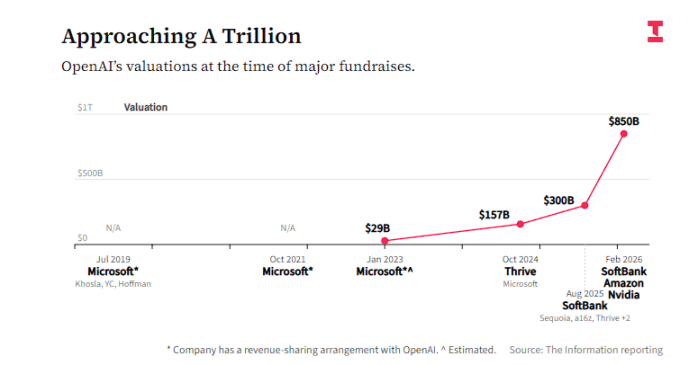
The respondents generally adopted a cautious stance towards this IPO, with core concerns集中在two points:一是unclear profit prospects—OpenAI itself predicts that it will continue to burn cash until at least 2030;二是excessive valuation—the company is currently completing a new round of financing at an $850 billion valuation, equivalent to 28 times the expected revenue for 2026, far exceeding Nvidia's price-to-sales ratio of approximately 12 times.

The report stated that the "cold" market sentiment reflects the deep-seated矛盾faced by this potential largest IPO in history: investors generally recognize OpenAI's leading position in the AI competitive landscape but remain reserved about whether it can achieve reasonable pricing in the public market. At the same time, the strong rise of competitor Anthropic is further分散investors' attention and enthusiasm.

Valuation Controversy: 28x Price-to-Sales Ratio, Where's the Premium?

OpenAI is currently completing a new round of financing at an $850 billion valuation, with participants including Nvidia, Amazon, and SoftBank. This figure has already made many public market investors hesitant, and its IPO pricing may be even higher届时.

Based on the expected revenue for 2026, $850 billion corresponds to a price-to-sales ratio of approximately 28 times. In comparison, Nvidia, regarded as a benchmark for AI investment, currently has a price-to-sales ratio of about 12 times.
The report stated that Bob Lang, founder of trading firm Explosive Options,直言:

"I do think OpenAI is an excellent company with a strong moat, but I don't think any valuation on the first day of trading is a good deal for investors."

He said he would likely not participate in public market investment in OpenAI, especially given its higher valuation multiple than Nvidia.

Lang also pointed out that the real beneficiaries of this IPO will be those early investors and hyperscale cloud computing companies that already hold shares—they will use this as an opportunity to cash out.

Well-known short-seller Jim Chanos used Nvidia as a reference point to question OpenAI's valuation logic:

"Nvidia basically has a monopoly on the market, with rapid growth, extremely high profit margins, and ample cash flow. So why would you give OpenAI a higher valuation?"

Path to Profitability: Burning Cash Until 2030, Will the Public Market Accept It?

According to the report, OpenAI itself predicts that the company will continue to incur losses until at least 2030. This timeline makes public market investors, accustomed to scrutinizing profitability, quite uneasy.

Some investors worry whether the funds raised from the IPO can support OpenAI until it reaches profitability, or whether it will still need to raise funds again届时, thereby diluting existing shareholder equity.

Mark Malek, Chief Investment Officer of Siebert Financial, stated that even if OpenAI finds it difficult to achieve significant profitability in the short term, he would still consider building a position after the IPO, but would strictly control the position size—this is the same strategy he used when investing in Palantir.

Palantir currently has a high price-to-sales ratio of 49 times, with growth far exceeding peers, but Malek believes Palantir's risk is still lower than OpenAI's because its cost structure is more flexible.

"If Palantir loses a government contract, that's bad, but they can lay people off. If you spend five years building a data center, you can't say 'forget it, don't want it anymore.' Palantir is driving a Formula One car, while OpenAI is driving a fully loaded freighter."

Analysts at J.P. Morgan noted in a report this January that OpenAI's move to introduce ads in ChatGPT helps retain users, but also observed that客户sentiment towards OpenAI was "mixed" after the company announced large-scale chip and data center spending plans.

Not everyone is观望—some investors have explicitly stated that once OpenAI goes public, they will consider shorting its stock, betting that the public market's tolerance for its long path to profitability is limited.

Chanos holds a similar position. The core logic he conveys to clients is: "You should be long the output of chips, short the places where chips are stored." The implication is that operating data centers itself is not a high-return business, and OpenAI's business model is highly dependent on large-scale computing infrastructure investment.

Chanos also pointed out that there is a severe lack of financial information about OpenAI on the market currently, making in-depth analysis difficult. But he expects that once OpenAI formally submits its IPO application, the public market will engage in fierce debate over its competitive landscape:

"Is this a winner-take-all, or is the market fragmented like cloud computing? Or like search engines, where one company becomes the standard and maintains it for a long time? For now, the various models are still constantly surpassing each other."

Anthropic's Disruption: Competitor Diverts Funds and Attention

OpenAI's path to an IPO also faces potential pressure from competitor Anthropic.

At this week's Morgan Stanley Annual Technology Conference, Anthropic CEO Dario Amodei disclosed that the company's annualized revenue run rate has doubled to $20 billion. Anthropic recently completed a new round of financing with a valuation of $380 billion, and its enterprise products like the AI programming tool Claude Code are seeing strong sales momentum.

The Information previously reported that Anthropic expects its cost expenditures on AI model training and operations in the coming years to be significantly lower than OpenAI's. Some investors are beginning to believe that,凭借success in the enterprise customer market—customers who are willing to pay a premium for AI services—Anthropic's long-term profitability may be better than OpenAI's.

As Anthropic also prepares for an上市, the IPOs of the two companies could form a competition, further分散investors' funds and enthusiasm. Investors like Chanos have explicitly stated a preference for Anthropic's relatively restrained computing power investment strategy, viewing it as a more prudent and sustainable business path.


Twitter:https://twitter.com/BitpushNewsCN

Bitpush TG Discussion Group:https://t.me/BitPushCommunity

Bitpush TG Subscription: https://t.me/bitpush

Original link:https://www.bitpush.news/articles/7618438

Domande pertinenti

QWhat are the main concerns of public market investors regarding OpenAI's potential IPO?

AInvestors are primarily concerned about two issues: OpenAI's unclear profit prospects, as the company predicts it will continue to burn cash until at least 2030, and its high valuation of $850 billion, which represents a price-to-sales ratio of 28 times its projected 2026 revenue, far exceeding Nvidia's ratio of about 12 times.

QHow does OpenAI's valuation multiple compare to Nvidia's, and why is this a point of criticism?

AOpenAI's $850 billion valuation implies a price-to-sales multiple of about 28 times its projected 2026 revenue. This is significantly higher than Nvidia's multiple of approximately 12 times. Critics, like short-seller Jim Chanos, question this valuation by pointing out that Nvidia has a near-monopoly, rapid growth, extremely high profit margins, and strong cash flow, making OpenAI's higher multiple difficult to justify.

QWhat is OpenAI's own projection for its path to profitability, and how do investors react to this timeline?

AOpenAI itself predicts that it will continue to burn cash and operate at a loss until at least 2030. This extended timeline to profitability makes public market investors, who are accustomed to scrutinizing profitability, quite uneasy. Some worry that funds raised from an IPO may not be sufficient to reach profitability, potentially requiring further financing that would dilute existing shareholders.

QWho does the article suggest would be the real beneficiaries of an OpenAI IPO?

AThe article suggests that the real beneficiaries of an OpenAI IPO would be its early investors and the large cloud computing companies that are already shareholders. These parties would use the IPO as an opportunity to cash out and realize gains on their investments.

QHow is the competitor Anthropic potentially impacting investor sentiment towards OpenAI's IPO?

AAnthropic is seen as a strong competitor that is diverting investor attention and capital. Its annualized revenue run rate has doubled to $20 billion, it has a lower projected cost structure for model training and operations, and some investors believe its long-term profitability could be superior to OpenAI's due to its success with enterprise clients. This competition could split investor interest and enthusiasm between the two companies as they both prepare for potential IPOs.

Letture associate

Has Hook Summer Really Arrived? sato, Lo0p, FLOOD Ignite the New Narrative of Uniswap v4

"Hook Summer" Arrives? Sato, Lo0p, FLOOD Ignite Uniswap v4 Narrative Amidst a slight market recovery, attention within the Ethereum ecosystem has shifted to Meme coins built on Uniswap v4's Hook protocol. Following ASTEROID, tokens like sato, sat1, Lo0p, and FLOOD have become market focal points, with market caps ranging from millions to tens of millions, bringing concentrated liquidity to a narrative-dry market. Uniswap v4 Hooks are "plugin smart contracts" that allow developers to inject custom logic at key points in a liquidity pool's lifecycle (initialization, adding/removing liquidity, swaps, etc.), making the AMM programmable. Recent representative projects include: * **sato**: Market cap peaked over $38M; uses a v4 curve mechanism for minting/burning, locking ETH as reserve. * **sat1**: Market cap briefly exceeded $10M, positioning as an "optimized sato," but later declined significantly. * **Lo0p**: Market cap neared $6.6M; a "lending AMM protocol" allowing users to borrow ETH against deposited LO0P tokens without immediate selling pressure. * **FLOOD**: Market cap approached $6M; channels trading reserves into Aave v3 to generate yield, which is retained in the pool. The emergence of these Hook-based tokens could drive long-term growth for the Uniswap ecosystem by attracting users and liquidity to v4 pools. Combined with Uniswap's activated fee switch (partially used to burn UNI), the long-term outlook for UNI appears positive. However, short-term UNI price appreciation is not directly guaranteed. Factors include the sustainability and lifecycle of these new tokens, their price volatility, overall market conditions, and regulatory pressures. Currently, Uniswap v4's TVL ($595M) lags behind v3 and v2, indicating Hook adoption still requires time to mature. In summary, the Hook ecosystem serves as "long-term nourishment" for UNI, but acts more as a "catalyst" than a direct "booster" in the short term. Note: These are early-stage experimental tokens and may carry unknown risks.

marsbit23 min fa

Has Hook Summer Really Arrived? sato, Lo0p, FLOOD Ignite the New Narrative of Uniswap v4

marsbit23 min fa

Has Hook Summer Truly Arrived? sato, Lo0p, FLOOD Ignite the New Uniswap v4 Narrative

With the broader market showing signs of recovery, a new wave of interest has emerged around Ethereum-based meme coins. Following ASTEROID, tokens like sato, sat1, Lo0p, and FLOOD, built upon the Uniswap v4 Hook protocol, are capturing market attention. Their market capitalizations range from millions to tens of millions of dollars, injecting much-needed focused liquidity into a market lacking narratives. This article explores whether this trend signifies an incoming "Hook Summer" and its potential impact on UNI's price. Hooks are essentially plug-in smart contracts for Uniswap v4 liquidity pools, allowing developers to inject custom logic at key points in a pool's lifecycle (like initialization, adding/removing liquidity, swaps). This transforms the AMM into programmable building blocks. Key highlighted projects include: * **sato**: Peaked over $38M market cap. It utilizes a v4 curve for minting/burning; buying locks ETH as reserve to mint new tokens, while selling redeems ETH from the reserve and burns tokens. * **sat1**: Market cap briefly exceeded $10M, promoted as an "optimized sato," but later declined significantly. * **Lo0p**: Reached nearly $6.6M. It's a lending AMM protocol where buying LO0P tokens locks them as collateral, allowing users to borrow ETH from the pool reserve at 40% LTV, aiming to improve capital efficiency for idle ETH in LPs. * **FLOOD**: Peaked near $6M. Its mechanism directs asset reserves from buys into Aave v3 to generate yield, with fees and interest retained in the pool to potentially influence the token's price long-term. In the long term, the development of the Hook ecosystem can attract users and liquidity to Uniswap v4, benefiting UNI's fundamentals—especially combined with the recent activation of the protocol fee switch, where a portion of fees is used to burn UNI. However, in the short term, these Hook-based tokens are unlikely to directly drive significant UNI price appreciation. Their impact is moderated by factors like token sustainability, price volatility, and broader market and regulatory conditions. Currently, Uniswap v4's TVL ($595M) still trails behind v2 and v3, indicating adoption and growth will take time. The article concludes that while the Hook ecosystem provides long-term "nourishment" for UNI, its short-term role is more of a "catalyst" than a "booster." Readers are cautioned that these are early-stage experimental tokens and may carry unknown risks.

Odaily星球日报35 min fa

Has Hook Summer Truly Arrived? sato, Lo0p, FLOOD Ignite the New Uniswap v4 Narrative

Odaily星球日报35 min fa

Interview with Michael Saylor: I Did Say I Would Sell Bitcoin, But Never a Net Sale

Interview with Michael Saylor: I Said We'd Sell Bitcoin, But Never Be a Net Seller In a recent podcast, MicroStrategy Executive Chairman Michael Saylor clarified the company's stance on potentially selling Bitcoin. Following MicroStrategy's earnings call statement about being prepared to sell BTC to fund dividends for its STRC (Strategic) credit product, Saylor emphasized the distinction between selling and being a "net seller." Saylor explained the core business model: MicroStrategy sells credit instruments like STRC and uses the proceeds to buy Bitcoin, which is viewed as "digital capital" expected to appreciate around 30-40% annually. A portion of these capital gains can then be used to pay the dividends on the credit products. He stressed that even if the company sells some Bitcoin for dividends, it simultaneously buys much more with new credit issuance. For example, after raising $3.2 billion from STRC sales in April, the dividend obligation was only $80-90 million, making the company a net buyer. The clarification aims to counter market narratives questioning the value of Bitcoin on MicroStrategy's balance sheet if it were never sold, and to dismiss claims of a "Ponzi scheme." Saylor reiterated his personal philosophy for investors: "Don't be a net seller of bitcoin" and ensure your Bitcoin holdings increase each year. Saylor also discussed Bitcoin's role as the foundation for "digital credit," noting that STRC has become the largest and most liquid preferred stock issue in the U.S., offering high risk-adjusted returns (Sharpe ratio). He highlighted Bitcoin's deep liquidity, stating that even large purchases by MicroStrategy do not move the market significantly, which is driven by macro factors, geopolitical tensions, and capital flows from ETFs and credit products. Finally, Saylor reflected on his early inspiration from sci-fi books, which motivated his path to MIT, and maintained his fundamental thesis on Bitcoin remains unchanged: it is superior digital capital enabling superior digital credit.

链捕手39 min fa

Interview with Michael Saylor: I Did Say I Would Sell Bitcoin, But Never a Net Sale

链捕手39 min fa

Trading

Spot
Futures
活动图片





