On the Eve of the Explosion of On-Chain Options

marsbitPubblicato 2026-03-12Pubblicato ultima volta 2026-03-12

Introduzione

On-Chain Options on the Brink of Breakout The cryptocurrency options market is larger than most realize, with CME's crypto derivatives volume up 46% year-over-year. Institutional investors require defined-risk tools like options for hedging large positions. A pivotal shift occurred in mid-2025 when Bitcoin options open interest reached $65 billion, surpassing futures for the first time, indicating a move from pure leverage to risk-defined instruments. Growth is concentrated on Deribit (now backed by Coinbase after its acquisition) and traditional finance capital via IBIT options. While decentralized derivatives have grown from 2% to over 10% market share in two years, on-chain options remain nascent. @DeriveXYZ leads with over $700 million in notional options volume over 30 days. It has evolved from an AMM to a gas-free central limit order book on its own L2, featuring portfolio margin and cross-margin. @KyanExchange is approaching similarly with on-chain portfolio margining and partial liquidation mechanics. Structured products and asset managers urgently need options for their defined risk/return profiles. Institutional demand is clear, with IBIT options OI surpassing the gold ETF GLD and CME handling $3 trillion in crypto derivatives notional volume in 2025. Regulatory clarity is improving. A joint statement from the SEC and CFTC in 2025 allows regulated exchanges to trade spot crypto assets, and the CLARITY Act has passed the House. This improved environment, alongsid...

Author: Delphi Digital

Compiled by: AididiaoJP, Foresight News

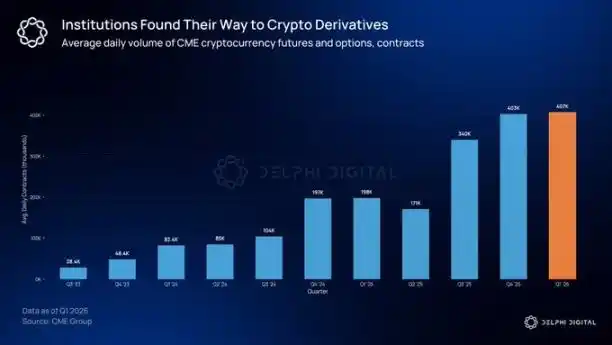
The size of the cryptocurrency options market far exceeds most people's perceptions. Trading volume for cryptocurrency derivatives on the Chicago Mercantile Exchange (CME) is 46% higher than the record high set last year. Institutional investors need clear risk management tools to hedge large positions, and options are the only cryptocurrency instrument that provides this functionality.
Reshaping the Landscape

By mid-2025, the total open interest in Bitcoin options reached $65 billion, surpassing futures open interest for the first time. Futures are leverage tools, while options allow funds to set a cap on losses for their $500 million Bitcoin holdings by paying a premium. This turning point indicates that tools with defined risk functions are gradually replacing pure leverage tools.

This growth has been concentrated on two platforms. Deribit has been the mainstream platform for cryptocurrency options trading for years. After being acquired by Coinbase for $2.9 billion in 2025, it gained institutional-grade endorsement. Meanwhile, IBIT options, launched in late 2024, brought traditional financial capital into this field. The options market is expanding rapidly, but the vast majority of trading still requires intermediaries.

On-Chain Options Are Still in Their Infancy

The market share of decentralized derivatives has climbed from 2% to over 10% in two years. Hyperliquid has proven that decentralized exchanges (DEXs) can rival centralized exchanges in speed and transparency. However, no similar representative project has emerged for on-chain options yet.

@DeriveXYZ remains the leading on-chain options protocol, with a nominal options trading volume exceeding $700 million in the past 30 days. The protocol was launched in August 2021 under the name Lyra as an options automated market maker (AMM). After weathering the bear market, it was completely rebuilt in 2023 and is now built on its own OP Stack Layer 2 with a gas-free central limit order book.
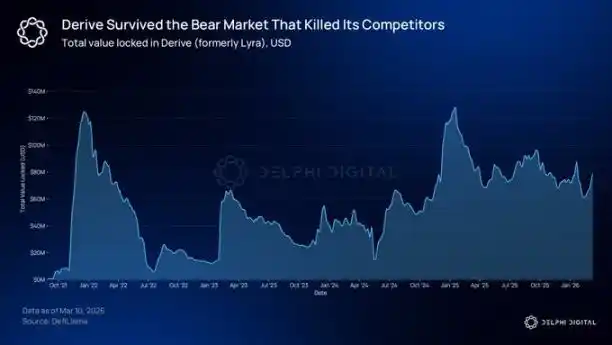
This rebuild fundamentally changed the pricing mechanism. Market makers quote prices directly on the order book, leading to narrower spreads, more precise pricing, and support for larger trades. Traders enjoy zero gas fees and sub-second execution speeds.

Its portfolio margin system has also attracted institutional attention. The system assesses overall position risk through scenario analysis. For example, if a trader holds both a long call option and a short put option on the same underlying asset, the system does not charge margin for each leg separately.

The collateral required for a hedged position is lower than the simple sum of the individual parts, which is the common logic in traditional financial derivatives trading desks. Derive also offers perpetual contracts and lending services on the same Layer 2, supporting cross-product cross-margining.

@KyanExchange is moving in the same direction but in a different way. This platform combines an order book matching engine with on-chain portfolio margining, supporting multi-leg operations in a single atomic transaction. Traders can deploy an iron condor strategy with just a few clicks.

Kyan's liquidation mechanism also differs from most DeFi protocols. When a margin threshold is breached, the platform does not liquidate the entire account but executes a partial close-out, only closing the minimum number of positions necessary to bring the account back to the margin requirement. Kyan is currently in the Arbitrum test phase, with a mainnet launch imminent.

Who Needs Options?

Asset management companies building structured products urgently need the clearly defined risk-return profiles provided by options. Take J.P. Morgan's Equity Premium Income ETF as an example. This fund is built on a covered call strategy and is one of the largest actively managed funds globally. The total assets under management for yield products based on derivatives exceed one hundred billion dollars. As more institutional capital moves on-chain, the corresponding hedging needs will migrate as well.

Currently, more and more institutional investors already hold or plan to allocate to digital assets in the short term. The open interest for IBIT options has surpassed that of the gold ETF GLD. In 2025, the CME processed a nominal trading volume of $3 trillion in cryptocurrency derivatives.

The Timing is Ripening

Most early on-chain options protocols failed to survive, primarily due to regulatory uncertainty. For instance, Opyn was fined by the CFTC for operating an unlicensed derivatives exchange. At that time, teams developing products could not predict whether their product would be deemed illegal the next quarter.

This situation is now improving. In September 2025, the U.S. Securities and Exchange Commission (SEC) and the Commodity Futures Trading Commission (CFTC) jointly issued a statement allowing regulated exchanges to conduct spot crypto asset trading. The CLARITY Act has passed the House of Representatives, proposing to place spot markets for digital commodities under CFTC oversight. The Senate version is still under negotiation and is currently stalled. CME Group will launch 24/7 cryptocurrency options trading on May 29th. While this does not guarantee that on-chain protocols will necessarily succeed, the overall environment has undergone a fundamental shift.


Domande pertinenti

QWhat major shift occurred in the Bitcoin derivatives market in mid-2025, and what does it signify?

AIn mid-2025, the total open interest for Bitcoin options reached $65 billion, surpassing that of futures for the first time. This signifies a shift is underway from purely leveraged tools (futures) to instruments with defined risk (options), as institutions seek better risk management tools for their large holdings.

QWhich two platforms are highlighted as the main drivers of growth in the cryptocurrency options market?

AThe growth is concentrated on two platforms: Deribit, which gained institutional credibility after its acquisition by Coinbase, and IBIT options, which introduced TradFi capital into the space starting in late 2024.

QWhat is the current state of on-chain options, and which protocol is mentioned as the current leader?

AOn-chain options are described as being in their infancy. The leading on-chain options protocol mentioned is @DeriveXYZ, which has processed over $700 million in notional options volume in the past 30 days.

QHow did the protocol @DeriveXYZ (formerly Lyra) improve its system after a 2023 overhaul?

AThe 2023 overhaul replaced its AMM model with a gas-free central limit order book (CLOB) built on its own OP Stack Layer 2. This allowed market makers to quote prices directly, leading to tighter spreads, more precise pricing, support for larger trades, and sub-second execution speeds for traders.

QWhat are two key reasons mentioned for why the environment for on-chain options is now more favorable than before?

ATwo key reasons are: 1) Improved regulatory clarity, exemplified by a joint SEC-CFTC statement allowing regulated exchanges to trade spot crypto assets and the progress of the CLARITY Act. 2) The growing institutional demand for defined-risk tools, as seen with the massive success of CME's crypto derivatives and IBIT options.

Letture associate

380,000 Apps Exposed, 2,000+ Apps Leaked Secrets: AI Programming Turns 'Intranet' into Public Internet

Israeli cybersecurity firm RedAccess uncovered a severe data exposure trend linked to "vibe coding" or AI-powered software development tools. Their research found approximately 38,000 publicly accessible web applications built with platforms like Lovable, Base44, Netlify, and Replit. Of these, an estimated 2,000 apps exposed sensitive corporate and personal data, including medical records, financial information, internal strategic documents, and customer chat logs. In some cases, access even granted administrative privileges. The core issue stems from default privacy settings that make applications public by default, combined with a lack of built-in security controls (like authentication) in the AI-generated code. This allows employees without security expertise—"citizen developers"—to easily create and deploy applications that bypass standard corporate security reviews. The exposed apps, often indexed by search engines, are trivially discoverable. While some platform providers (Replit, Lovable, Wix/Base44) argue that security configuration is the user's responsibility and question the validity of some findings, security researchers confirm the widespread reality of such exposures. This pattern, also noted in prior studies, highlights a critical security gap as AI democratizes app creation, potentially leading to massive, unintentional data leaks.

marsbit11 min fa

380,000 Apps Exposed, 2,000+ Apps Leaked Secrets: AI Programming Turns 'Intranet' into Public Internet

marsbit11 min fa

Attracting Global Capital, Asia's New 'Super Cycle' Is Unfolding

Investors are turning to Asia as the next frontier for global equity growth, with a new "super cycle" unfolding across the region. Driven by the AI revolution, Asian markets, particularly South Korea, have seen significant rallies. According to Morgan Stanley analysis, the underlying drivers of Asia's industrial cycle are shifting from traditional sectors like real estate and manufacturing to massive investments in AI infrastructure, energy security and transition, and supply chain resilience. Fixed asset investment in Asia is projected to grow from around $11 trillion in 2025 to $16 trillion by 2030, with a 7% annual growth rate from 2026-2030. The AI wave is a primary catalyst, driving immense capital expenditure for chips, servers, data centers, and power systems. Asia is central to this hardware supply chain. In China, AI investment is focused on building a full-system domestic capability, with the local AI chip market potentially reaching $86 billion by 2030. Beyond AI, China's export story is expanding from EVs and batteries to robotics. The country already captures about half of new global industrial robot demand and over 90% of humanoid robot shipments. This growth phase mirrors the early stages of China's EV export boom. Simultaneously, energy security investments, spurred by AI's massive power needs, are rising, with China benefiting from its leadership in solar, batteries, and EVs. Regional defense spending is also increasing structurally, supporting demand for advanced manufacturing. The main beneficiaries are China, South Korea, and Japan, positioned in core supply chain areas. However, risks remain, including potential overcapacity, profit margin pressures from competition, persistent technological restrictions, geopolitical friction, and workforce displacement due to AI-driven automation. Market volatility is also expected to increase as investor expectations diverge on the realization of these capital investment and export themes.

marsbit12 min fa

Attracting Global Capital, Asia's New 'Super Cycle' Is Unfolding

marsbit12 min fa

Funding Weekly Report | 14 Public Funding Events, Kalshi Completes $10B New Funding Round at $220B Valuation Led by Coatue Management

Weekly Funding Roundup: 14 Deals and $10.49B+ in Total Funding, Led by Kalshi's $1B Round Last week (5.4-5.10) saw 14 notable funding events in the global blockchain ecosystem, raising over $10.49 billion in total. Key highlights include Kalshi, a prediction market platform, securing a $1 billion round led by Coatue Management, reaching a $22 billion valuation. The platform now boasts ~2 million MAUs and $178B in annualized trading volume. In DeFi, regulated on-chain reinsurer OnRe raised $5 million in Series A funding, and Bitcoin-backed credit protocol Saturn Credit completed a $2 million seed round. For Infrastructure & Tools, OpenTrade raised $17 million to expand its stablecoin yield infrastructure, and RWA platform Balcony secured $12.7 million to deploy its property settlement service in the US. Centralized Finance saw one deal: AI-driven trading platform Stockcoin.ai completed a seed round led by Amber Group. In the prediction market sector alongside Kalshi, AI-powered platform Elastics raised $2 million. Other notable deals include SC Ventures' strategic investment in crypto market maker GSR and Centrifuge securing a "seven-figure" investment from Coinbase to become a core RWA partner for Base. On the investor side, Haun Ventures raised a new $1 billion fund targeting crypto and AI, and Multi Investment raised ~$616 million to focus on blockchain and Web3 investments.

marsbit1 h fa

Funding Weekly Report | 14 Public Funding Events, Kalshi Completes $10B New Funding Round at $220B Valuation Led by Coatue Management

marsbit1 h fa

Trading

Spot
Futures
活动图片




