On the Eve of Fed Policy: The Dual Test of "Trillion-Dollar Tariff Ruling" and "Non-Farm Payroll Report"

marsbitPubblicato 2026-01-09Pubblicato ultima volta 2026-01-09

Introduzione

Key events this week are set to reshape U.S. markets, with major implications for stocks, bonds, and metals. The Supreme Court may rule on the legality of Trump-era tariffs, potentially requiring refunds of up to $133 billion. A ruling against tariffs could boost S&P 500 profits but worsen the deficit, complicating Fed policy. Separately, the U.S. may decide on metals tariffs under Section 232 by January 10, affecting silver, platinum, and palladium. Meanwhile, the Bloomberg Commodity Index rebalancing is forcing significant sell-offs in gold and silver, adding volatility. Finally, the December nonfarm payrolls report on January 9 will be a critical data point for the Fed’s upcoming policy decision. Investors should brace for heightened market swings.

Written by: Wall Street Insights

This weekend is bound to be eventful.

The market is holding its breath for a true "major test." From the Supreme Court's "trillion-dollar tariff ruling" to the "tariff stick" targeting metals, and the "forced selling" by passive funds, the market is in the midst of multiple storm eyes this week.

The outcomes of these three key events, erupting in quick succession, will profoundly reshape market trends and directly impact the pricing logic of U.S. stocks, U.S. bonds, and precious metals markets.

Additionally, at 21:30 Beijing time on January 9 (Friday), the U.S. Bureau of Labor Statistics (BLS) will release the December non-farm payroll report.

After weeks of data vacuum caused by the government shutdown, this report will serve as a "reliable reading" for the economy's health and the most decisive reference before the Fed's January policy meeting, directly influencing its choice between "standing pat" or "continuing rate cuts."

At this "major test" juncture, fastening your seatbelt and guarding against volatility risks might be the best strategy.

Below, we break down these heavyweight changes one by one.

01 1,000 Companies "Besiege" the White House: Will the Trillion-Dollar Tariffs Be Refunded?

An unprecedented legal "siege" is underway in Washington.

According to the latest statistics, over 1,000 companies have officially filed lawsuits attempting to overturn the current tariff policies and demanding refunds totaling up to a hundred billion dollars in tariffs.

This includes listed giants like Costco and Goodyear Tire & Rubber Co. Dozens of entities joined the fray just in the first few days of 2026.

The focus of this lawsuit is the final ruling by the U.S. Supreme Court on the legality of the comprehensive tariff plan introduced by Trump.

According to CCTV News, the Supreme Court has set this Friday (U.S. Eastern Time) as the opinion release day. Although it is not yet confirmed whether it includes the tariff case, the market widely expects the ruling to be announced as early as this week.

What happens if the court rules the tariffs illegal?

  • Bullish for U.S. Stocks: Wells Fargo chief equity strategist Ohsung Kwon estimates that if tariffs are overturned, the EBIT of S&P 500 component companies in 2026 could increase by about 2.4% compared to last year. Canceling tariffs would directly improve corporate profits, benefiting the stock market.
  • Bearish for U.S. Bonds: The flip side of the coin is that canceling tariffs would削弱 an important source of government revenue, exacerbating federal deficit concerns and potentially triggering a sell-off in U.S. bonds.
  • Policy Complication: If refunds form additional economic stimulus, the Fed's rate-cutting path will become more complex.

Even if the Supreme Court rules it illegal, the specific refund process (involving approximately $133 billion) may still need to be handled by lower courts, and the White House might invoke other laws to re-impose restrictions, meaning policy uncertainty will persist long-term.

02 Critical Minerals Tariff Countdown: Silver, Platinum Face "Nerve-Wracking Moment"

Besides the comprehensive tariff case, the results of the U.S. "Section 232" investigation on critical minerals are expected to be announced this Saturday (January 10). This decision directly affects the fate of Comex silver and platinum group metals.

The Citi research team provided a detailed scenario analysis:

If tariffs are imposed: The market will have an implementation window of about 15 days, triggering a short-term "rush to ship to the U.S." behavior. This will push up domestic U.S. benchmark pricing and the Exchange for Physical (EFP) premium.

As of January 7, EFP pricing indicates the market expects a platinum tariff of about 12.5%, palladium about 7%, and silver about 5.5%. These implied tariff rates reflect market uncertainty amidst high volatility.
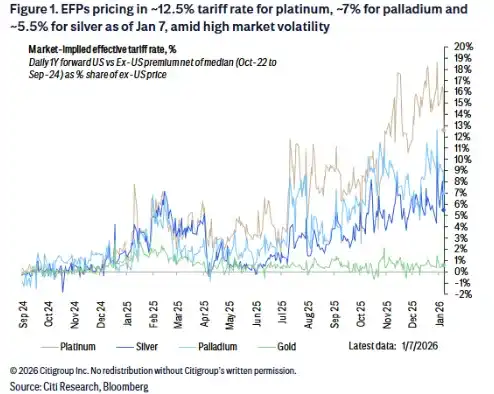
(Expected Tariff Rates from EFP Pricing)

If no tariffs are imposed: Metals will flow out of the U.S. to other global regions, easing pressure on London spot prices and potentially causing a price pullback.

What's the view on specific varieties?

  • Silver (Likely Safe): Due to heavy U.S. reliance on silver imports, Citi believes no tariff is the base case, and even if imposed, Canada and Mexico might be exempt. However, in a "no tariff" scenario, silver prices could face temporary downward pressure.
  • Palladium (High Risk): Most likely to face tariffs (e.g., 50%). If imposed, U.S. domestic import costs would rise sharply, pushing up futures prices.
  • Platinum (A Coin Toss): Whether tariffs will be imposed is currently extremely uncertain.

The investigation results were originally due on October 12, 2025, and President Trump has 90 days to take action, meaning the deadline is around January 10 (this Saturday). However, Citi believes that given the large number of commodities involved, President Trump's action might be indefinitely delayed, in which case silver and PGM prices are likely to continue rising during this period.

03 Technical Sell-off Approaches: The "Bloody Week" of Commodity Index Rebalancing

Beyond fundamental news, a "passive storm" on the funding side has already begun.

The highly anticipated annual weight rebalancing of the Bloomberg Commodity Index (BCOM) started after the close on January 8 and will continue until January 14. To maintain the diversification rule that no single commodity weight exceeds 15%, this adjustment poses significant selling pressure on the precious metals sector.

Gold: Weight reduced from 20.4% to 14.9%, facing selling pressure equivalent to 3% of total holdings.

Silver: Faces particularly huge pressure! Weight will be drastically cut from 9.6% to 3.94%, with expected selling volume reaching up to 9% of total holdings.

This "non-fundamental" selling triggered by index rules forces speculative funds to stay on the sidelines, exacerbating short-term volatility.
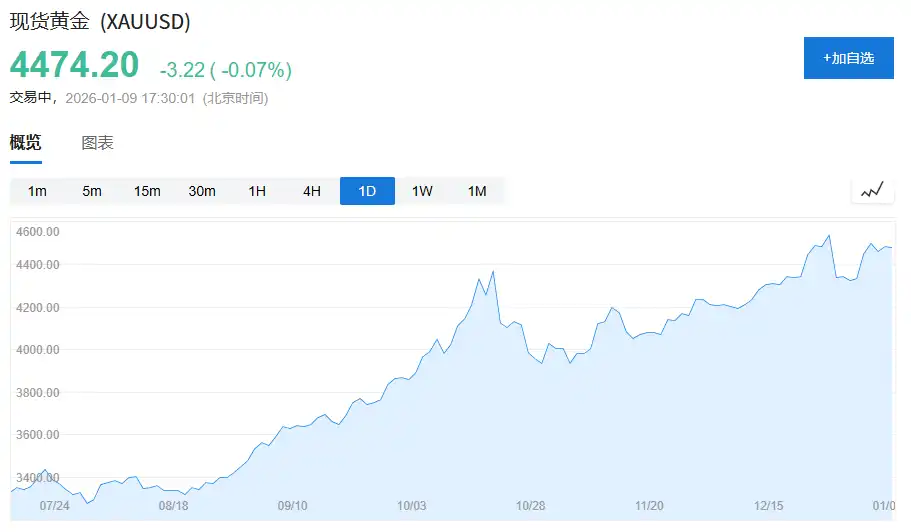
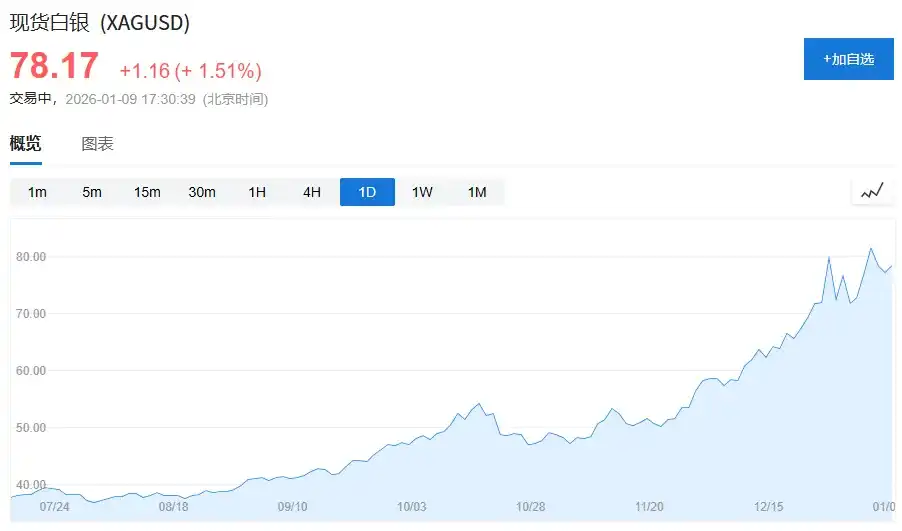
It's worth noting that the decline in gold, silver, and other precious metals comes after a rare epic rally. Spot gold surged over 70% throughout 2025, and silver gains once reached about 150%, entering a frenzy mode from December 23 last year and continuously hitting record highs. Such massive short-term profit accumulation makes the market extremely fragile when facing liquidity events.

Although Goldman Sachs analysts believe that as long as the tight London inventory situation persists, liquidity is the key determinant of prices, in the short term, investors' nerves must be strained in the face of such large-scale passive fund "repositioning."


Domande pertinenti

QWhat are the three major events that are creating a 'storm' for the markets this week, according to the article?

AThe three major events are: 1) The U.S. Supreme Court's ruling on the legality of the 'trillion-dollar tariff' policy. 2) The expected announcement of the 'Section 232' investigation results on critical minerals, which could impose new tariffs. 3) The technical selling pressure from the Bloomberg Commodity Index (BCOM) annual rebalancing.

QWhy is the upcoming U.S. non-farm payrolls report on January 9th considered so crucial for the Federal Reserve?

AThe non-farm payrolls report is considered a 'reliable reading' of the economy's health after a data vacuum caused by the government shutdown. It is the most decisive reference point for the Fed's January policy meeting, directly influencing its choice to either 'stand pat' or 'continue with interest rate cuts'.

QWhat are the potential market impacts if the Supreme Court rules the broad tariff policy is illegal?

AA ruling that the tariffs are illegal could: 1) Boost U.S. stocks (e.g., lift S&P 500 companies' EBIT by ~2.4% by improving corporate profits). 2) Be negative for U.S. Treasuries by reducing a key government revenue source and worsening deficit concerns. 3) Complicate the Fed's rate-cutting path if refunds act as an additional economic stimulus.

QAccording to Citigroup's analysis, which metal is at the highest risk of having new tariffs imposed, and which is least likely?

AAccording to Citigroup: Palladium is at the highest risk, with a high probability of a significant tariff (e.g., 50%) being imposed. Silver is the least likely ('low probability') to see tariffs, as the U.S. heavily relies on imports and any potential tariffs would likely exempt Canada and Mexico.

QWhat is causing the significant technical selling pressure on gold and silver this week?

AThe selling pressure is caused by the annual rebalancing of the Bloomberg Commodity Index (BCOM). To maintain its diversification rule that no single commodity can exceed a 15% weight, the index is forced to sell significant amounts of gold (reducing its weight from 20.4% to 14.9%) and silver (reducing its weight drastically from 9.6% to 3.94%), creating non-fundamental, passive fund-driven selling.

Letture associate

The AI Agent Era Accelerates Its Arrival: Questflow Defines a New Paradigm of Financial Intelligence with On-Chain AI Brokerage

The AI Agent era is accelerating, with the CB Insights AI 100 list highlighting global investment confidence. The focus has shifted from whether AI works to its speed of deployment and ability to manage complex workflows, with autonomous AI Agents driving this transformation. At the forefront is Questflow, a Singapore-based startup redefining financial intelligence through its on-chain AI brokerage. Unlike tools that merely provide data dashboards, Questflow deploys AI Agents that proactively scan markets, form judgments, and execute trades via a conversational interface—operating 24/7 without requiring manual confirmation for each decision. This embodies the new AI paradigm of agents capable of executing multi-step workflows autonomously. Questflow's mission is to democratize institutional-grade trading intelligence. Historically reserved for the ultra-wealthy, this capability is now accessible starting from just $1 through Questflow's "AI Clone + Copy Trade" model. The platform charges only a 1% execution fee, aligning its incentives directly with users and eliminating traditional management or performance fees. The timing is opportune, aligning with key trends identified by CB Insights: the scalable deployment of AI Agents, accelerated AI adoption in financial services, and the maturation of on-chain infrastructure. With robust liquidity on platforms like Hyperliquid and Polymarket, alongside advancements in AI reasoning and non-custodial wallet security, Questflow is positioned to merge the roles of broker, fund, and exchange into a single, accessible platform for millions.

链捕手7 min fa

The AI Agent Era Accelerates Its Arrival: Questflow Defines a New Paradigm of Financial Intelligence with On-Chain AI Brokerage

链捕手7 min fa

Why Pricing Social Interactions is Doomed to Fail?

Titled "Why Putting a Price on Social Interaction Is Doomed to Fail," this article critiques attempts to monetize social networks directly through SocialFi models, arguing their inevitable failure stems from a fundamental misunderstanding of media dynamics. Using Marshall McLuhan's theory of "hot" and "cold" media, the author posits that social networks are inherently "cold" media. Their value isn't contained in individual posts but is co-created through user participation, interpretation, and fragmented, ongoing interaction (e.g., replies, shares). This ambiguity and need for user involvement are core to their function. The article asserts that SocialFi projects like Friend.tech failed because introducing real-time, tradable financial pricing (a definitive "hot" signal) into this "cold" environment doesn't add a layer—it replaces the medium's essence. The unambiguous price signal overshadows and nullifies the nuanced, participatory social signal. Users become traders, not participants, and when speculative profits vanish, the underlying social ecosystem—never genuinely cultivated—collapses entirely. This principle extends beyond crypto. The author argues platforms like Twitter have gradually "heated up" through metrics (likes, retweets counts, algorithmically defined value), shifting users from participants to performers and eroding organic engagement. The solution isn't to abandon capital but to manage its entry point. Successful models like Substack, Patreon, or Bandcamp allow capital to "condense" at specific, isolated nodes (e.g., subscriptions, one-time payments) without permeating and "heating" every social interaction. They preserve the core "cold," participatory medium while enabling monetization at designated boundaries. The NFT boom and bust serves as a stark parallel: the ancient "cold" medium of collecting (valued for story, community, gradual accumulation) was rapidly destroyed by platforms that introduced real-time floor prices, rarity scores, and trading dashboards, transforming collectors into speculators and vaporizing cultural value when prices fell. The core lesson: "Liquidity equals heat." Injecting high liquidity and definitive pricing into a "cold" participatory medium doesn't optimize it; it fundamentally alters and destroys its value-creating mechanism. The future lies not in pricing every social gesture but in finding precise, non-invasive points for capital to condense without overheating the entire ecosystem.

marsbit15 min fa

Why Pricing Social Interactions is Doomed to Fail?

marsbit15 min fa

Jensen Huang's CMU Speech: In the AI Era, Don't Just Watch, Build

Jensen Huang, CEO of NVIDIA and a first-generation immigrant, delivered the commencement address to Carnegie Mellon University's class of 2026. He shared his personal journey from a humble background to founding NVIDIA, emphasizing resilience, learning from failure, and the responsibility that comes with leadership. Huang framed the present moment as the dawn of the AI revolution, a shift he believes is more profound than previous computing waves. He described AI as fundamentally resetting computing—moving from human-written software to machines that understand, reason, and use tools. This will create a new industry for generating intelligence and transform every sector. While acknowledging AI's potential to automate tasks and displace some jobs, Huang distinguished between the *tasks* of a job and its core *purpose*. He argued AI will augment human capability, not replace humans. The real risk, he stated, is not AI itself, but people being left behind by those who effectively use AI. He presented AI as a generational opportunity for massive infrastructure investment—in chip factories, data centers, energy grids, and advanced manufacturing—that could re-industrialize nations like the U.S. and bridge the digital divide by making computing and intelligent tools accessible to all. Huang called for a balanced approach: advancing AI safely and responsibly, establishing prudent policies, ensuring broad access, and encouraging universal participation. He urged the graduates not to fear the future but to engage with optimism and ambition, reminding them of CMU's motto, "My heart is in the work." His core message was clear: this is their moment to actively build and shape the AI-powered future, not merely observe it.

marsbit1 h fa

Jensen Huang's CMU Speech: In the AI Era, Don't Just Watch, Build

marsbit1 h fa

Trading

Spot
Futures
活动图片




