Oil Price Forecast: Risks in the Strait of Hormuz Push WTI and Brent Prices Towards Key Breakout Levels

Pubblicato 2026-08-20Pubblicato ultima volta 2026-08-20

Introduzione

The outlook for oil prices remains optimistic, but the next move will depend on supply risks and technical breakouts. Tensions in the Middle East and slow shipping in the Strait of Hormuz have pushed oil prices higher. However, unless the conflict causes a significant supply disruption, increasing US inventories may limit the upside for prices.

Key Points:

Tensions in the Strait of Hormuz continue to support oil prices.

Rising US inventories may limit further gains.

WTI and Brent prices are approaching significant breakout zones.

Oil prices stabilized near recent highs as traders assessed the risks of further turmoil in the Middle East. Shipping in the Strait of Hormuz remains slow, with many shipowners choosing to avoid the route. Conflicting signals from the US and Iran have also added to market confusion. Persistent tensions due to sporadic attacks involving Iran, the UAE, and Oman have kept a risk premium in oil prices. However, the absence of any major escalation has limited fresh buying interest.

Rising US inventories could also cap further oil price gains. As shown in the chart below, crude inventories increased by 4.4 million barrels. Gasoline stocks also rose. These figures suggest US supply remains relatively ample, and demand may not be strong enough to drive prices significantly higher. Oil prices may grind higher as long as war and shipping risks persist. But a major market move likely requires a significant disruption to supplies via the Strait of Hormuz.

WTI Oil Price Forecast: Break above $87-$89 Targets $105

The 4-hour chart below shows WTI oil prices forming a constructive structure above $70. A rounded bottom pattern has formed above $70. A break above $87 would target a further move towards the $93.80 and $97 zones.
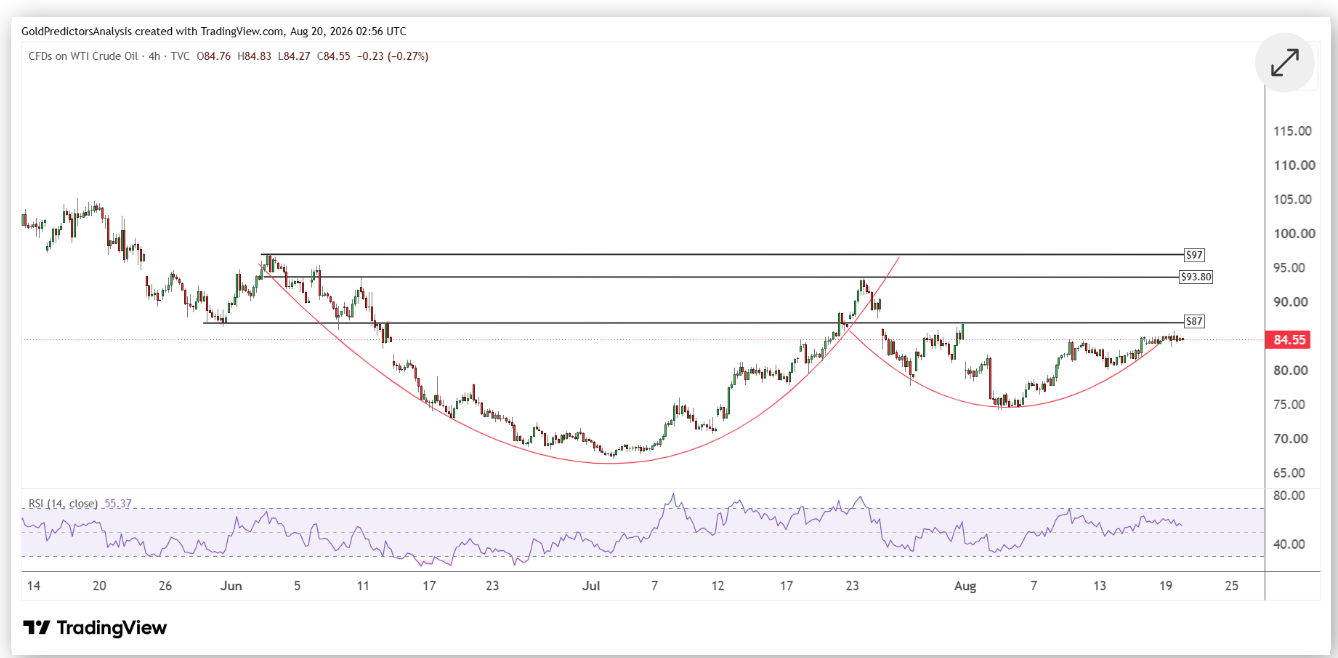
Notably, the price action from May appears more bullish. A rounded bottom has formed just below a descending trendline. This trendline will be broken around $89.

A break above this descending trendline would likely confirm a bottom and target a move towards the $105 zone. The Relative Strength Index (RSI) is also consolidating above the midline, indicating potential for further upside in the WTI market. However, a break below $66 would invalidate the bullish structure and could lead to further declines.
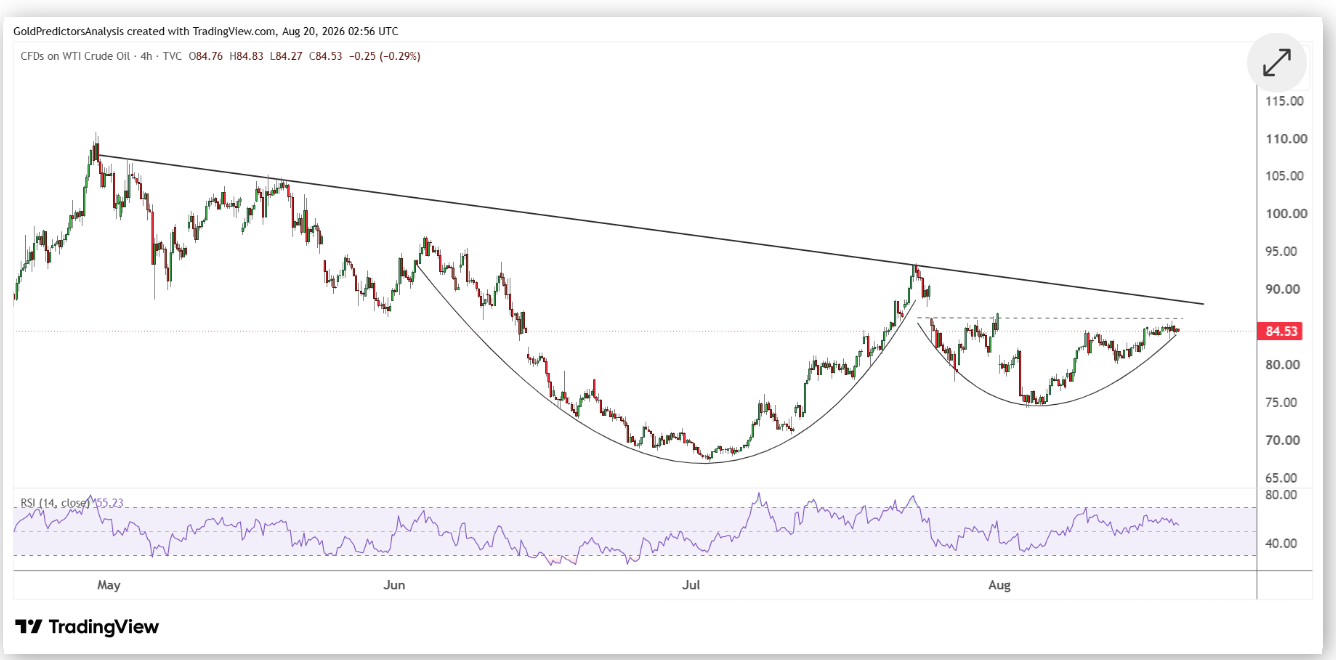
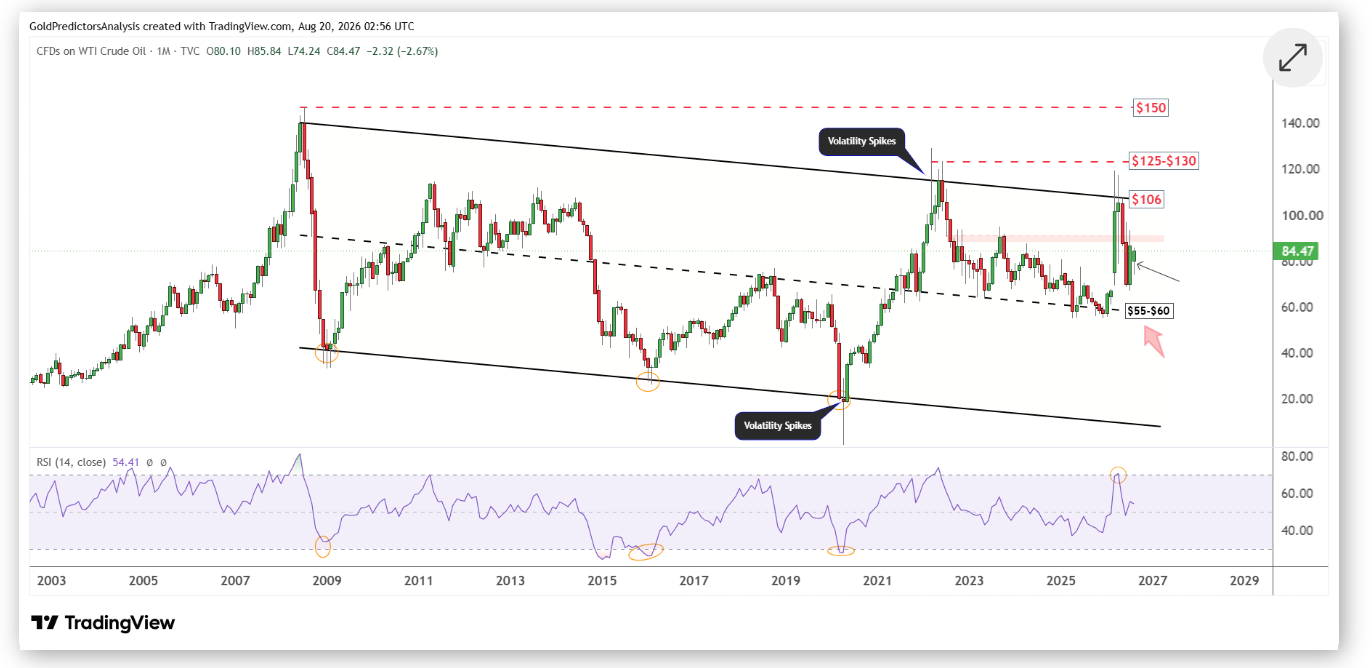
The long-term outlook for WTI remains optimistic. After the US-Iran war, prices surged from around $66 to near $120 but failed to break the channel's descending trendline. A sharp sell-off from $120 to around $67 followed, driven by this strong resistance.

But WTI prices found a bottom after July's decline. Prices are now retracing back towards the $100 zone. This suggests a potential move to the $125-$130 zone if the price breaks out of this descending channel. On the other hand, a break above $130 could target the $150 zone. The Relative Strength Index (RSI) is also rebounding from the midline, indicating positive momentum for WTI prices.
Brent Oil Price Forecast: Break above $100 Opens Path to $120-$127

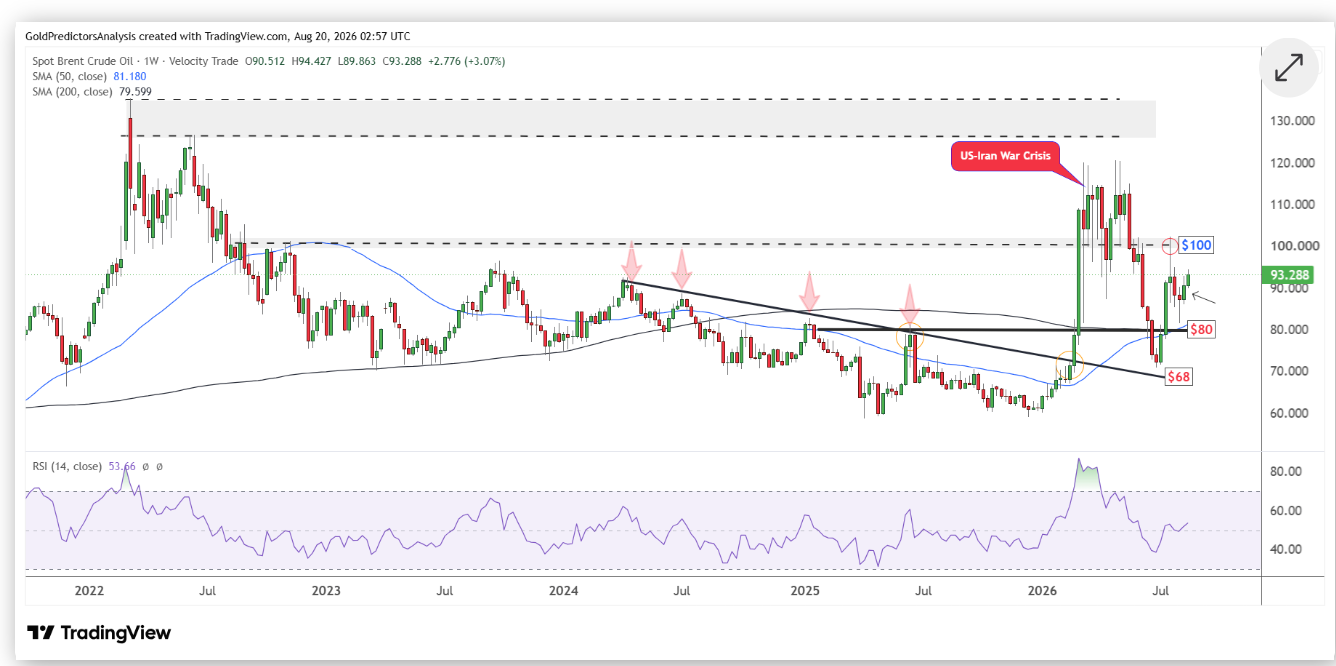
Compared to the WTI market, Brent oil price action is stronger. The price held above $80 after declines. A strong rebound in the first week of August 2026 triggered a solid weekly bullish candle, signaling a potential move towards the $100 zone.

On the weekly chart, the 50-day Simple Moving Average has crossed above the 200-day SMA. The RSI is also holding above the midline, indicating strong bullish momentum in the Brent market. A break above the $100 zone could target the $120 area for Brent. Conversely, a break above $120 could aim for further gains towards $135.
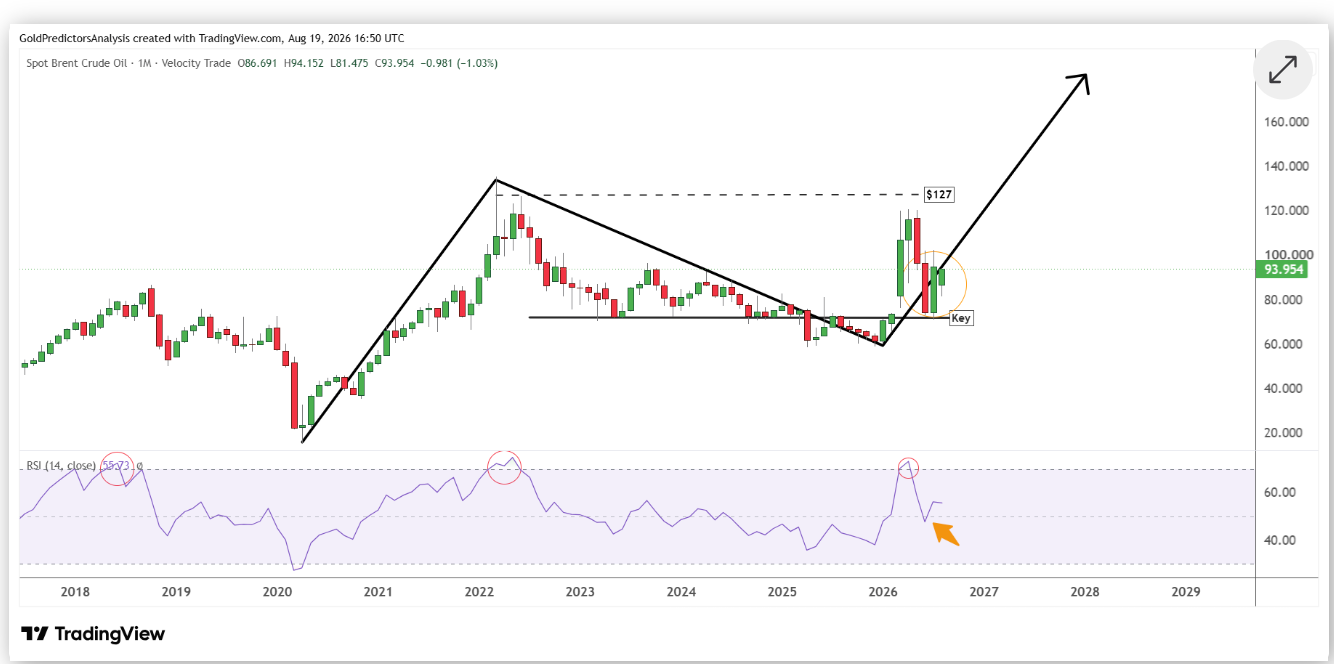
The monthly chart for Brent also shows positive price action. A strong rally is evident from the April 2020 lows to the March 2022 highs, followed by a correction from the March 2022 highs to the December 2025 lows, forming a robust, positive bullish structure.

Recent declines in Brent in June 2026 failed to break the key $70 level, followed by a strong rebound. The July monthly candle suggests Brent could target the $127 mark. A break above $127 could pave the way for a strong rally towards the $160-$180 zone.

The RSI is also rebounding from the midline as Brent bounced from the key $70 level. This indicates potential for continued gains in the near term.
Conclusion

The oil price outlook remains optimistic, but the next move hinges on supply risks and technical breakouts. Middle East tensions and slow shipping in the Strait of Hormuz have pushed prices higher. However, rising US inventories may limit gains unless conflict causes a severe supply disruption.

WTI must break above the $87-$89 resistance to target $100-$105. But a break below $66 would weaken the bullish view. Brent shows stronger upside momentum and could target $120-$127 if it breaks above $100. Brent must hold the key $70 level to maintain its upward momentum. Therefore, oil prices may continue to rise gradually, but a stronger rally would require a clear technical breakout or a significant regional supply disruption.


Letture associate

Why Are Long-Term U.S. Bonds Becoming Harder to Sell? The Real Issue May Not Be Inflation

This article analyzes recent trends in US long-term bond markets. The 30-year Treasury yield recently surged to levels not seen since 2007. While inflation is often cited as a primary driver, the author argues the problem is more complex. Key factors include persistently high US fiscal deficits, which increase the supply of long-dated bonds, and a shift in demand from traditional major buyers like Japan. Simultaneously, the rise of AI-related corporate bond issuance is creating new long-duration assets for investors like pension funds and insurers. In response to the yield spike, the Treasury Department announced an expansion of its regular buyback program for long-dated bonds. While officially a liquidity management tool, the timing suggests the government is becoming more sensitive to rising long-term rates and their tightening effect on financial conditions. The author draws a parallel to the Federal Reserve’s "Operation Twist" of the past, which aimed to lower long-term yields by adjusting the maturity profile of bonds held by the central bank. The current Treasury actions, though different in mechanism, similarly aim to reduce the net duration supply the private market must absorb. However, this strategy has limits. If inflation expectations were to re-anchor higher, any policy perceived as artificially suppressing yields could backfire. Moving forward, the key signal will be whether the Treasury consistently uses its debt management tools to respond to rapid increases in long-term yields, marking a shift in its "policy reaction function" alongside the Federal Reserve's. This would add a new layer of complexity for markets assessing the outlook for the dollar, stocks, and other assets.

marsbit10 min fa

Why Are Long-Term U.S. Bonds Becoming Harder to Sell? The Real Issue May Not Be Inflation

marsbit10 min fa

This Year's Graduates, Trapped in Countless 'Online Assessments'

This Year's Graduates, Trapped in Endless "Online Assessments" After years of standardized exams, new graduates face a new hurdle: a seemingly endless series of online evaluations to enter the job market. Over 60% of large and mid-sized companies now incorporate online tests into their campus recruitment, increasingly using AI for screening and even initial interviews. For graduates like Yang Liu, daily life revolves around practicing for these assessments—covering professional skills, aptitude tests (similar to civil service exams), and personality quizzes. The pressure is immense, with a record 12.22 million graduates in 2025 and fierce competition for limited positions. Even securing an internship often requires passing multiple rounds of tests, some involving complex tasks like producing full industry reports using specific AI tools. From an HR perspective, these rigorous screenings are a necessary tool to manage overwhelming application volumes and identify candidates with the right learning ability, logic, and resilience. Some insiders acknowledge the process also acts as a "compliance test" to filter for stable, adaptable candidates. However, many graduates feel the tests are often irrelevant to the actual job and serve merely as a bulk-filtering mechanism. This has spawned a grey market catering to graduate anxiety. Services range from selling leaked question banks and AI-powered cheating tools to high-priced "full-process tutoring" packages promising to secure offers, sometimes costing tens of thousands of yuan. While some risk disqualification by cheating, the desperation to "get ashore" with a job offer drives the demand. The grueling process is altering life paths. Some postpone academic dreams, others change study abroad plans to align with recruitment cycles, and many compromise on their ideal careers, accepting any offer to end the uncertainty. As one graduate summarized cynically, a strange cycle has emerged: students use AI to write theses, companies use AI to assess them, candidates use AI to search for answers, and eventually, they'll use AI at work—a relentless, technology-driven standoff.

marsbit12 min fa

This Year's Graduates, Trapped in Countless 'Online Assessments'

marsbit12 min fa

Circle Q2 Investor AMA: 11 Q&A Transcript on USDC, Arc, and the Future of Finance

**Circle Q2 2026 Investor AMA: Summary** On August 19, 2026, Circle CEO Jeremy Allaire hosted an AMA, addressing key topics on USDC, Arc, and the future of finance. **Team & Execution:** Allaire expressed confidence in Circle's execution, citing strong cross-functional collaboration, controlled growth, institutional depth, and the integration of AI as a "capability amplifier." Key areas for enhancement are cybersecurity and global/local operational capabilities. **Stablecoin Use Cases & Opportunities:** Allaire identified several areas with strong product-market fit: 1) **Digital asset markets** (operational capital, collateral), 2) **Digital dollar storage** in emerging markets, and 3) **Cross-border settlement**. Significant future opportunities lie in **AI agentic payments** and **retail merchant payments** (via stablecoin cards and QR codes), driven by instant settlement and low fees. **Circle's Economic Model:** While **reserve income** from a multi-trillion dollar future stablecoin market remains a core engine, Circle is diversifying. New revenue streams include **transaction fees** from the growing Circle Payment Network (CPN) and **platform fees** from **Arc**, envisioned as an "Economic Operating System" or "Economic Cloud" with AWS-scale potential. **Arc's Vision:** Arc, launching its mainnet on September 16, is designed as a **stablecoin-native chain** (using USDC for fees) to make blockchain invisible to end-users. It aims to host the future "onchain world," where companies and economic activities become increasingly software-coordinated and agentic. Its developer-friendly model allows builders to absorb minimal transaction costs, similar to cloud services. **AI & Trust:** For an AI agent economy, foundational "trust primitives" are essential: **Know Your Agent (KYA)** verification, robust **reputation systems**, and **programmable spending policies** for wallets. **EURC Growth & Regulatory Outlook:** EURC's rapid growth to over €400 million is attributed to early preparation for EU regulation (MiCA) and leveraging Circle's existing distribution. Allaire is bullish on **global stablecoin adoption**, noting that USDC growth is independent of the U.S. CLARITY Act's passage, supported by frameworks like the GENIUS Act and worldwide regulatory advancements. **Personal Philosophy:** Allaire shared that maintaining discipline in **diet, sleep, mindfulness, and exercise** is crucial for sustaining the energy and clarity needed for Circle's long-term mission.

marsbit26 min fa

Circle Q2 Investor AMA: 11 Q&A Transcript on USDC, Arc, and the Future of Finance

marsbit26 min fa

Trading

Spot
活动图片