Editor's Note: This week, the yield on the 30-year U.S. Treasury note briefly rose to around 5.34%, reaching its highest level since 2007. Subsequently, U.S. Treasury Secretary Bethcent announced an expansion of long-term Treasury buybacks, increasing the maximum single buyback size for some 10–30 year bonds from $2 billion to at least $4 billion. The arrangement will be implemented from September 9th to November 4th. Following the announcement, long-end yields fell, the dollar weakened, and risk assets found some support.
On the surface, this is a relatively small-scale liquidity operation for the bond market. More worthy of discussion are the questions: Why has the long-end U.S. interest rate risen to a point where the Treasury Department needs to take a more proactive stance? And is the market starting to reinterpret the Treasury's "policy reaction function" regarding long-end yields?
In "Beware the Bond," Trader Joe explains that the recent sell-off in long-term bonds cannot be simply attributed to inflation. Persistent fiscal deficits are creating Treasury supply, demand from traditional long-term bond buyers like Japan is shifting, and AI capital expenditures are generating substantial long-term bond supply in the credit market. These forces collectively increase the volume of long-duration assets that the market must absorb.
The author further likens Bethcent's expansion of long-term bond buybacks to a Treasury version of "Operation Twist." This analogy captures the direction of "reducing long-duration supply in the market," but the two are not equivalent: the 2011 Operation Twist involved the Fed selling short-term bonds and buying long-term ones, with the explicit goal of lowering long-term rates and easing financial conditions; the Treasury's current buyback program is officially positioned as improving secondary market liquidity and cash management. What is truly worth watching, therefore, is not the $4 billion itself, but whether this tool will increasingly take on the role of managing long-end financial conditions in the future.
The following is a translation of the original article:
Earlier this week, the yield on the 30-year U.S. Treasury note briefly reached its highest level since 2007, U.S. stocks gave back some gains, and the dollar also began to weaken.
Then, Bethcent stepped in.
The U.S. Treasury Department announced it would increase the maximum single buyback size for some 10–30 year long-term Treasury bonds from $2 billion to at least $4 billion, to be executed from September 9th to November 4th. Following the announcement, the 30-year Treasury yield retreated from its previous high of around 5.34% to approximately 5.2%, the dollar weakened further, and the stock market stabilized somewhat.
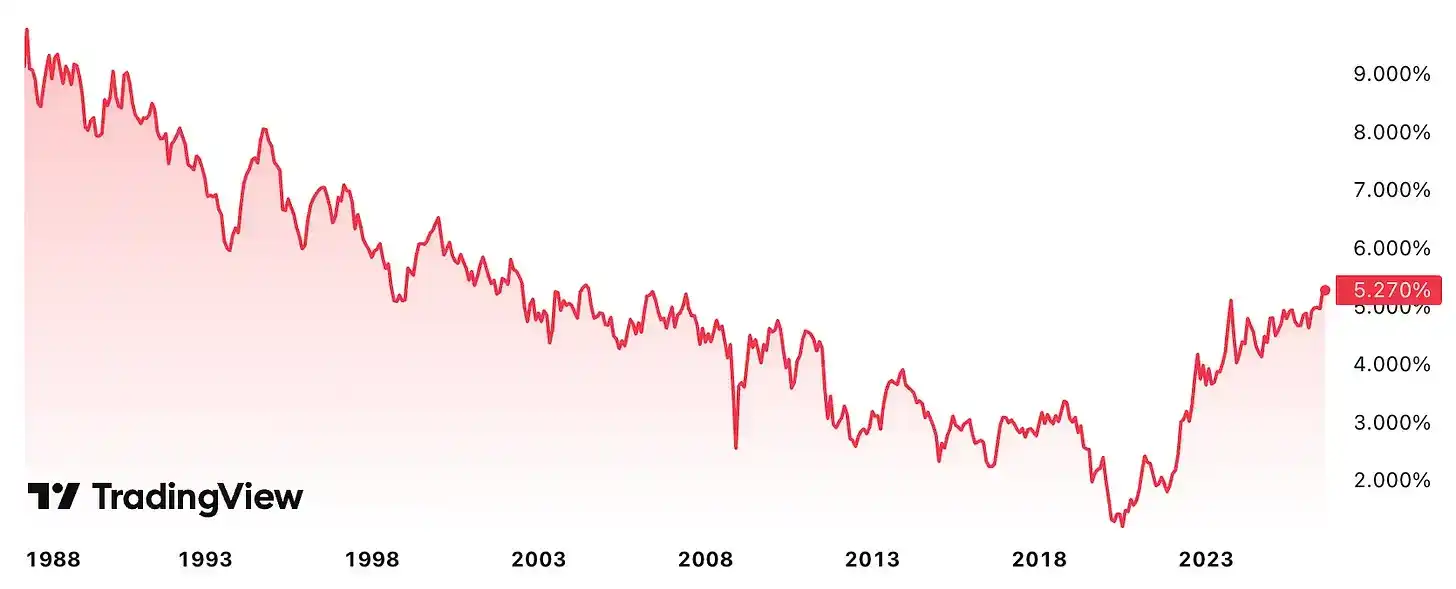
U.S. 30-Year Treasury Yield
The question is: Is this merely a temporary fix for bond market liquidity, or does it signal a shift in U.S. policymakers' attitude toward long-end interest rates?
To understand this, we must first answer another question: Why have long-end yields risen to this point?
Why Have Long-End Yields Risen to This Point? The Problem Is Not Just Inflation
The most intuitive explanation is inflation.
If investors fear that inflation will remain elevated long-term, they naturally demand higher yields on long-term Treasury bonds as compensation. However, the author argues this alone does not fully explain the recent moves.
At least from consumer surveys, long-term inflation expectations have not shown signs of significant de-anchoring yet. The University of Michigan's preliminary August survey showed the one-year inflation expectation edged up from 4.2% to 4.3%, but the five-year inflation expectation remained at 3.3%. In other words, short-term inflation concerns persist, but "long-term inflation expectations de-anchoring" is not the sole, or even necessarily the most important, explanation currently.
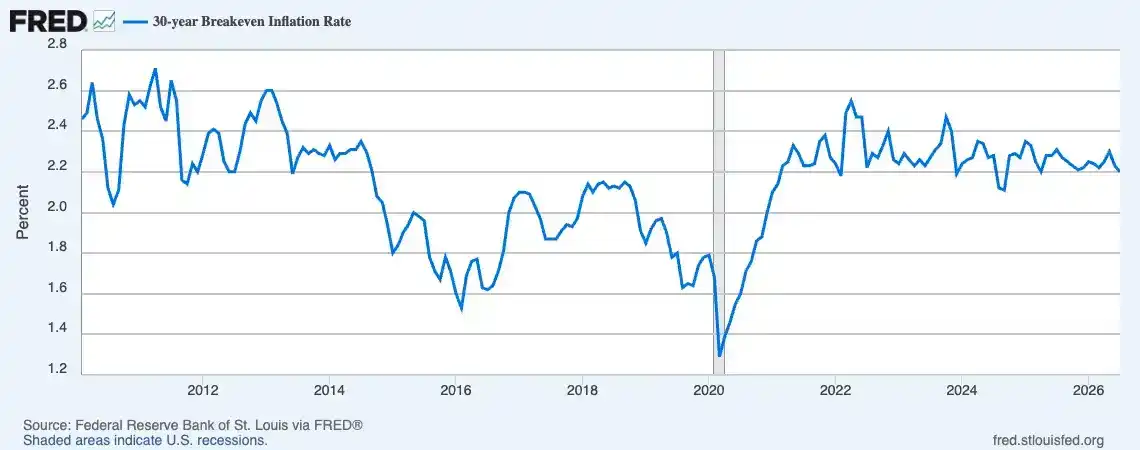
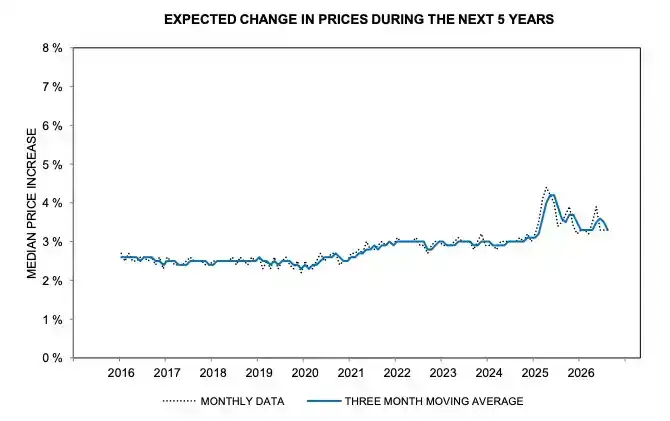
Source: University of Michigan Consumer Survey
Long-term Treasury yields have never reflected only future short-term policy rates and inflation. Economic growth, term premium, regulatory environment, how much debt the Treasury needs to issue, and how much long-term U.S. debt insurers, pension funds, and foreign investors are willing to allocate all influence long-end pricing.
And the author believes what is most notable now is that long-term bond supply is increasing persistently, while traditional demand is not expanding in sync.
The U.S. fiscal deficit means the Treasury still needs to continuously finance itself. How this financing is done—through short-term Treasury bills (T-bills), medium-term notes, or 30-year long bonds—directly affects how much duration risk the market needs to absorb.
If the Treasury relies more on short-term T-bill financing, it effectively reduces the supply of long-term bonds the market must digest, putting relatively less pressure on long-end yields. Conversely, if more financing shifts to long-term securities like 10-year, 20-year, and 30-year bonds, the market must absorb more duration, potentially creating greater upward pressure on long-end yields.
This is also why the structure of debt issuance itself is increasingly becoming a macroeconomic variable.
Why Is the Treasury Acting Now? 5.3% at the Long End Begins to Affect Financial Conditions
Short-Term Bonds Can Alleviate Long-End Pressure, But the Liquidity Buffer Is Thinning
The problem is, short-term bonds cannot be issued indefinitely either.
In recent years, as the U.S. Treasury issued large amounts of T-bills, a key source of funding was money from money market funds previously parked in the Fed's overnight reverse repurchase facility (ON RRP). When short-term bond yields became more attractive, this money could flow from RRP to T-bills, absorbing new short-term issuance without significantly draining bank reserves.
But now, this buffer is nearly depleted. Fed data shows ON RRP usage is now close to zero on most trading days. Meanwhile, U.S. banking system reserves stood at approximately $3.1 trillion as of mid-year.
In the second half of 2025, the large-scale rebuilding of the U.S. Treasury General Account (TGA) further drained liquidity from the banking system. Fed data shows that after the debt ceiling issue was resolved, the TGA balance increased by about $442 billion at one point, while reserves saw a noticeable decline.
This was also part of the backdrop for the Fed ending quantitative tightening (QT) by the end of 2025.
In October 2025, the Fed announced it would stop balance sheet reduction starting December 1st; in December, it began Reserve Management Purchases (RMP), buying short-term U.S. Treasuries to ensure bank reserves remained at an "ample" level.
Such operations can easily visually resemble QE, but their policy purpose is different.
QE typically involves buying long-term Treasuries or MBS to actively lower long-term yields and ease overall financial conditions; RMP mainly purchases short-term securities like T-bills, with the official goal of maintaining sufficient bank reserves and control over short-end rates, not providing macroeconomic stimulus. The Fed has also explicitly emphasized that RMP does not represent a change in monetary policy stance.
The author's concern is that if the Treasury continues to increase the proportion of short-term financing to reduce long-term bond supply, then after liquidity buffers like RRP are nearly exhausted, new short-term issuance may increasingly compete with bank reserves.
At that point, the Fed may be forced to conduct more reserve management operations to maintain system liquidity. This creates a delicate policy mix: the Treasury tries to minimize duration released to the market, while the Fed ensures ample reserves at the short end.
Japan and AI Are Changing the Supply-Demand Structure for Long Bonds
There's another side to the long-end issue: Who will buy?
Japan has long been one of the most important foreign investors in U.S. Treasuries. The latest U.S. Treasury TIC data shows that as of June 2026, Japan held approximately $1.116 trillion in U.S. Treasuries, still the largest foreign holder, but down about 2.3% from May.
Meanwhile, Japan's own long-term government bond yields are rising.
For domestic Japanese institutions like insurers, banks, and pension funds, if Japanese government bonds themselves offer increasingly attractive yields, the marginal appeal of allocating to U.S. long-term Treasuries naturally may decline, especially after accounting for dollar hedging costs.
This does not mean Japan will necessarily continue large-scale sales of U.S. bonds, but it suggests a structural long-term bond buyer that has been a stable absorber of U.S. duration in the past may not be as reliable in the future.
Another competitor comes from AI.
AI infrastructure buildout is shifting from a stock market story to a credit market story. Goldman Sachs Research estimates that from the start of 2026 to date, the entire AI-related industrial chain has issued close to $500 billion in debt; hyperscale cloud providers alone have issued about $194 billion. More importantly is the maturity structure. In the U.S. investment-grade credit market this year, about 40% of new issuance with maturities of 15 years or more has come from AI companies or AI-related financing.
This means the choices facing traditional long-duration funds like pension funds and insurers are multiplying. They are no longer just comparing 30-year U.S. Treasuries with other sovereign bonds; they can also buy long-term investment-grade debt from major tech companies like Amazon and Google, as well as AI-related credit assets like data centers and infrastructure.
From the author's framework, this clarifies the core problem facing U.S. long bonds: The Treasury needs to sell increasing amounts of debt, while other long-term assets requiring investor absorption are also proliferating rapidly in the global market.
The Treasury Version of Operation Twist: The $4 Billion Isn't Large, the Real Change Is the Policy Response
It is against this backdrop that Bethcent expanded long-term Treasury buybacks.
The U.S. Treasury's regular buyback program began in 2024, officially established with two purposes: improving secondary market liquidity and conducting cash management.
Among these, liquidity support buybacks mainly purchase less liquid off-the-run Treasuries. By regularly serving as a potential buyer for these bonds, the Treasury hopes to help dealers free up inventory and improve the tradability of off-the-run securities. (U.S. Department of the Treasury)
Therefore, by design, this is not a QE tool created to suppress 30-year yields.
Moreover, a single buyback of at least $4 billion is still small within the over $30 trillion U.S. Treasury market. Reuters also noted that the market generally believes this scale is insufficient to address structural issues like fiscal deficits and increasing long-term supply.
But what the author is truly focused on is not the scale, but the policy intent.
In the past, the Treasury could emphasize that buybacks were merely a market liquidity tool; now, as the 30-year yield rapidly approaches its highest level in nearly two decades, the Treasury immediately expanded long-term bond buybacks. The market naturally begins to ask: If the long-end continues to run out of control in the future, will the Treasury further adjust buybacks and issuance structures?
This is precisely why the author terms the current policy a Treasury version of "Operation Twist."
Note: Operation Twist, often called "Twist Operation" or "Maturity Extension Operation" in Chinese. Its core is not "printing more money," but adjusting the maturity structure of bonds held by the central bank: selling short-term bonds and buying long-term ones, thereby lowering long-term interest rates.
The classic 2011 Operation Twist was executed by the Fed: the Fed sold or allowed short-term Treasuries to mature while purchasing an equivalent amount of 6–30 year Treasuries, extending the duration of its asset portfolio without expanding its balance sheet size, thereby reducing long-term Treasuries held by the private sector and lowering long-term rates.
What's happening today is not the same operation. The Treasury is not engaging in a strict "sell short, buy long" as the Fed did back then, and expanding buybacks is still officially defined as a debt management and liquidity tool. But from the perspective of market duration supply, they share a similar direction: If the Treasury buys back more long-term off-the-run bonds while leaving more of the net financing pressure at the short end, the net duration the private market needs to absorb may be relatively reduced.
This is what the author calls the "Treasury version of Operation Twist." More accurately, it is currently a market interpretation, not an established new policy framework.
Can This Approach Suppress the Long End? Risk May Shift to the Dollar and Inflation
So, under what circumstances might this set of policies continue to escalate? The author believes that rather than looking for an absolute "red line" for the 30-year yield, it's better to observe the speed of the yield increase. Whether the 30-year yield is at 5.2% or 5.3% may not itself be enough to trigger policy changes; but if the market starts experiencing consecutive rapid jumps of around 10 basis points, signaling significantly deteriorating trading order and demand, the probability of further intervention by the Treasury or the Fed would increase.
Meanwhile, long bond yields are increasingly competing directly with stocks for capital. According to the data at the time of the article's publication, the 30-year U.S. Treasury nominal yield was around 5.2%, with the real yield implied by long-term TIPS close to 3%; in contrast, the S&P 500 earnings yield was about 3.8%.
These are not directly comparable one-to-one—earnings yield is not a risk-free rate, and corporate earnings will also grow or decline in the future—but when the risk-free long-term real yield rises to such a high level, the opportunity cost borne by stock valuations is clearly increasing.
Therefore, what is truly important about Bethcent's move may not be temporarily pulling the 30-year yield back from above 5.3% to around 5.2%.
Rather, it's that the market has obtained its first new observation sample: When U.S. long-end yields rise rapidly, will the Treasury become increasingly proactive in responding through buyback size and debt maturity structure?
If the answer gradually becomes "yes," then what influences the dollar, U.S. stocks, gold, and long-term Treasuries in the future will not just be the Fed's policy reaction function, but also this additional layer from the Treasury.
But this logic also has its limits. If the rise in the long end stems mainly from bond supply-demand imbalances, reducing the duration the market needs to absorb might ease the pressure; if inflation expectations significantly reaccelerate, then continuing to expand buybacks and increase short-term financing might instead make markets worry that policy is artificially suppressing financial conditions.
Therefore, what truly needs to be observed next is not just whether the Treasury will increase buybacks further, but whether inflation expectations, long-term Treasury issuance structure, foreign demand, and the volatility speed of long-end yields are all shifting simultaneously.
Only if these variables continue pointing in the same direction will the author's judgment that "the Treasury is taking over part of the management of long-end financial conditions" receive further confirmation.