Author: Nancy, PANews
Recently, NVIDIA faced a collective lawsuit from investors, accused of concealing over $1 billion in cryptocurrency mining revenue, drawing market attention.
This long-standing lawsuit has once again brought market focus back to that frenzied era of全民淘金潮 (nationwide gold rush). The now AI empire NVIDIA was a direct beneficiary of that craze at the time.
Accused of Hiding Over $1 Billion in Mining Revenue, Years-Long Collective Lawsuit Officially Advances
A U.S. federal judge has approved a collective lawsuit against NVIDIA and its CEO Jensen Huang.
According to the plaintiffs, between 2017 and 2018, NVIDIA concealed the extent to which its gaming graphics card revenue relied on demand from cryptocurrency mining.
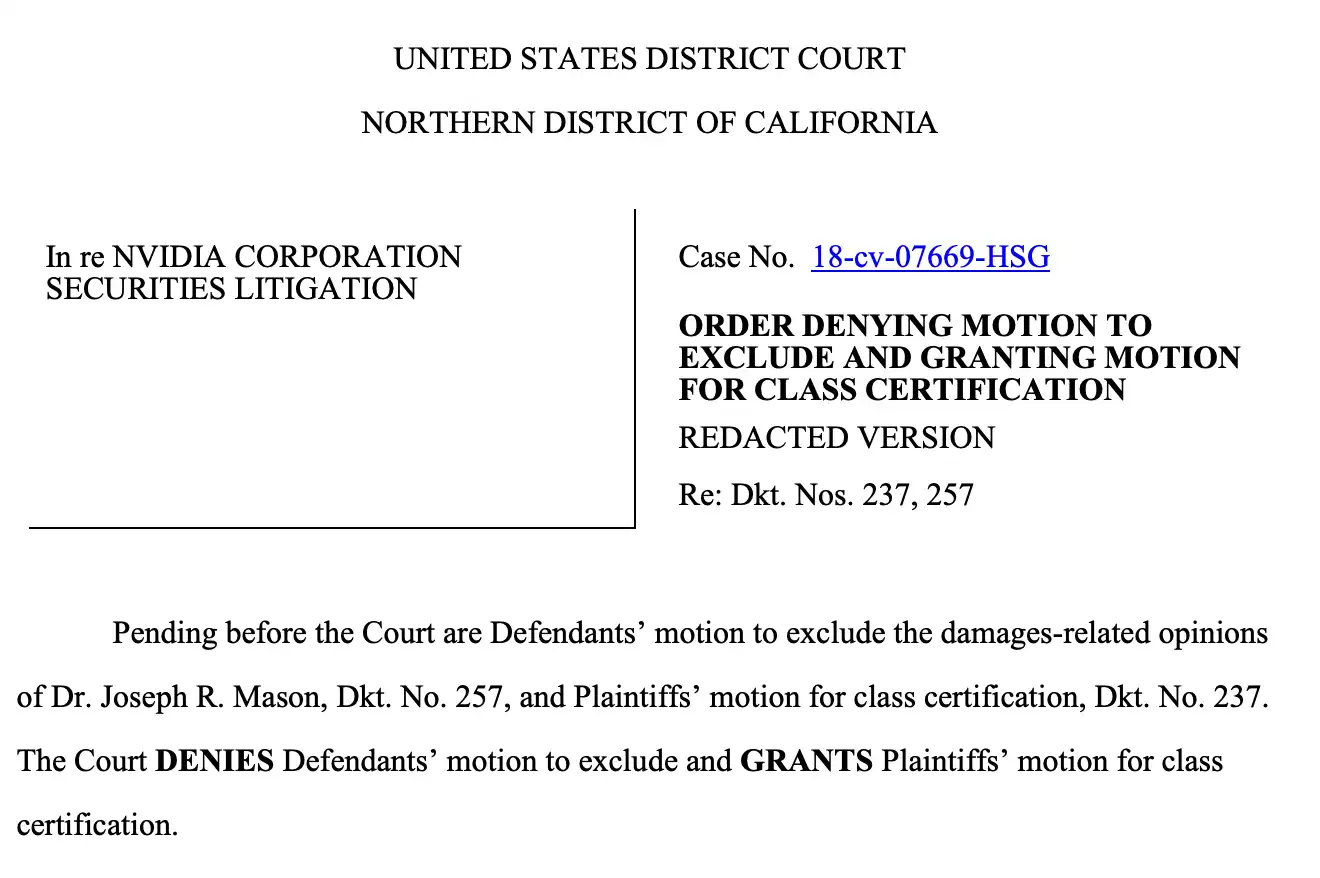
The lawsuit was initially filed by investors in 2018 and was dismissed in 2021. It was subsequently appealed and retried. NVIDIA's appeal to the U.S. Supreme Court was not accepted, and the case has now officially received approval for collective action status.
The plaintiffs argue that NVIDIA generated over $1 billion in cryptocurrency-related revenue through its GeForce gaming graphics cards but recorded most of it under the "Gaming" segment, thereby downplaying the risk disclosure to investors. Investors allege that CEO Jensen Huang downplayed the true scale of cryptocurrency demand at the time. NVIDIA had consistently claimed that cryptocurrency mining constituted only a small part of its business, with Gaming revenue primarily coming from gamers.
The plaintiffs point out that this practice directly exposed the company to the risks associated with the volatility of the cryptocurrency market cycle. Particularly after the company made a corrective disclosure in November 2018, its stock price fell approximately 28.5% over two days.
More crucially, the court's ruling cited an internal email from an NVIDIA vice president, considering it particularly compelling evidence. The judge noted that an internal executive had stated that "the company's stock price remained high precisely because of previous related statements," indicating that these remarks had impacted the stock price.
In fact, as early as 2022, the U.S. SEC had accused NVIDIA of failing to adequately disclose the impact of cryptocurrency mining on its gaming business, believing that its financial reports for two quarters may have misled investors. NVIDIA neither admitted nor denied the SEC's allegations but agreed to pay a $5.5 million fine and reach a resolution.
This approved collective lawsuit covers investors who purchased NVIDIA stock between August 10, 2017, and November 15, 2018. The court plans to hold a case management conference on April 21, where the judge will clarify the subsequent trial process.
NVIDIA's Mining History: Once in the Crypto Gold Rush
Rewind to the 2017 bull market. Mining rigs were snapped up, chips were in short supply, and countless prospectors rushed into Bitcoin mining.
At that time, NVIDIA was best known for its gaming graphics card business. But as the prices of cryptocurrencies, led by Bitcoin and Ethereum, soared, the graphics card market faced a supply shortage, remaining in a state of severe scarcity for a long time. NVIDIA's GPU products were naturally in extremely high demand, even leading to a situation where ordinary gamers found it hard to get a card.
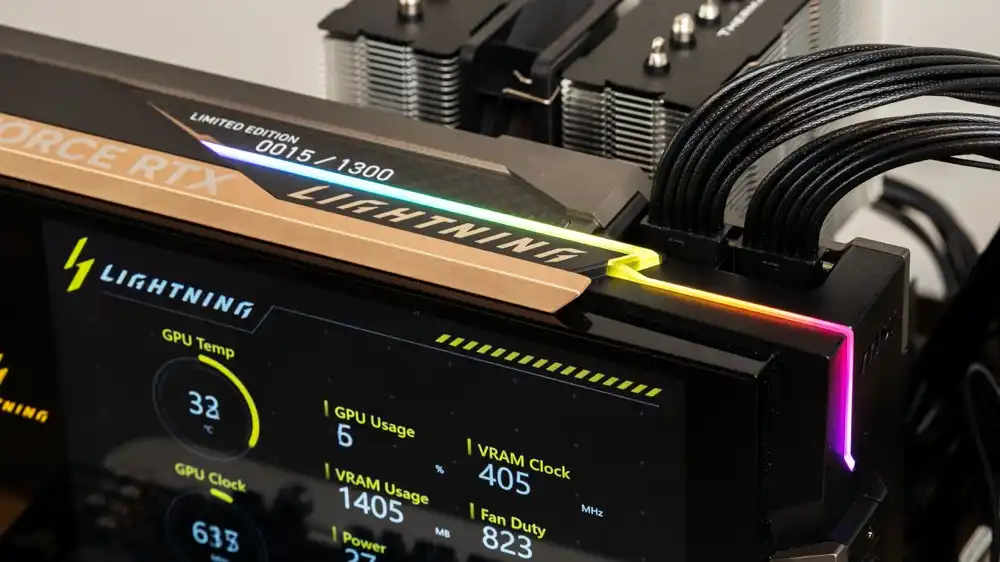
By 2020, a new bull market once again ignited mining enthusiasm. This time, NVIDIA took the initiative, launching CMP (Cryptocurrency Mining Processor) cards specifically designed for mining to meet the special demands of Ethereum mining, and imposed mining performance limits on the RTX 3080 aimed at gamers. Even so, it was difficult to curb the狂热需求 (fanatical demand) of miners. According to NVIDIA's disclosure, sales of CMP mining-specific chips alone reached $155 million in Q1 2021, while the global market size for discrete graphics cards flowing into crypto mining was about $500 million in the same period.
Clearly, this mining boom allowed NVIDIA to reap substantial profits. But how much of this revenue actually came from miners has always been a mystery. In NVIDIA's financial reports, mining earnings were categorized under the gaming segment, making it difficult for outsiders to accurately discern its true composition.
But looking at revenue, mining确实“带飞”了 (indeed "carried") NVIDIA at the time. In 2018 alone, NVIDIA's operating revenue reached $9.714 billion, a year-on-year increase of 41%, with the gaming business contributing more than half (about $5.5 billion). Interestingly, Bitmain, a mining company founded just a few years prior, was expanding rapidly during the same period, with profits once approaching NVIDIA's, and NVIDIA was one of its suppliers.
However, this portion of earnings was greatly affected by crypto cycle fluctuations. After the mining demand plummeted in 2022, it also led to a decline in NVIDIA's sales and inventory surplus, with the gaming business becoming the main segment dragging down its overall performance, and the decline in GPU sales was a key reason. Interestingly, NVIDIA CTO Michael Kagan直言 (stated bluntly) in 2023 that cryptocurrency "doesn't bring anything useful for society," suggesting that the emergence of ChatGPT was the "iPhone moment" for AI.
Since then, NVIDIA's AI success story has become widely known, making it the strongest卖铲人 (shovel seller) in the AI era, selling new Tokens (metaphor for AI chips/tools). Meanwhile, the mining companies that once profited effortlessly are也开始将目光转向 (also beginning to turn their attention to) the AI business.