Number of Bitcoin Wallets Reaches Highest Since 2026 Amid Growing Fallout from Coldcard Hack

cryptonews.ruPubblicato 2026-08-08Pubblicato ultima volta 2026-08-08

Introduzione

The number of Bitcoin wallets has reached its highest level since 2026, driven by growing concerns over the Coldcard hardware wallet exploit. Data from Santiment shows a surge in network activity, with 751,000 active wallets and 2.27 million new wallets created recently. Daily active addresses peaked at approximately 978,000 on July 31st. Notably, this increase was not accompanied by a corresponding rise in exchange inflows, which remained slightly below July's average. This divergence suggests a defensive market posture, likely due to users migrating funds from potentially compromised wallets. The vulnerability stemmed from a firmware flaw in certain Coldcard models (Mk3, Mk4, Mk5, and Q), where seed phrase generation relied on a software-based random number generator instead of the dedicated hardware entropy chip. This drastically reduced cryptographic security, leaving some devices with as little as 40 bits of real randomness. Reported losses have exceeded $116 million, with thefts continuing in waves. The data indicates that security-conscious owners of affected devices are likely creating new wallets on secure hardware and transferring their coins, explaining the spike in new and active addresses without increased trading activity. Coinkite has since released a firmware patch and a report detailing the issue. Experts emphasize this is not a Bitcoin protocol flaw but a supply-chain issue specific to one manufacturer's implementation. The incident highlights how a narro...

This week, Santiment published network data, noting that 751,000 active wallets and 2.27 million newly created wallets indicate the highest Bitcoin network activity in recent months. The number of active addresses peaked at around 978,000 on July 31st, approximately 1.6 times the July daily average, before stabilizing during the first week of August at a still-high level of around 751,000 per day—compared to the July average of close to 610,000.
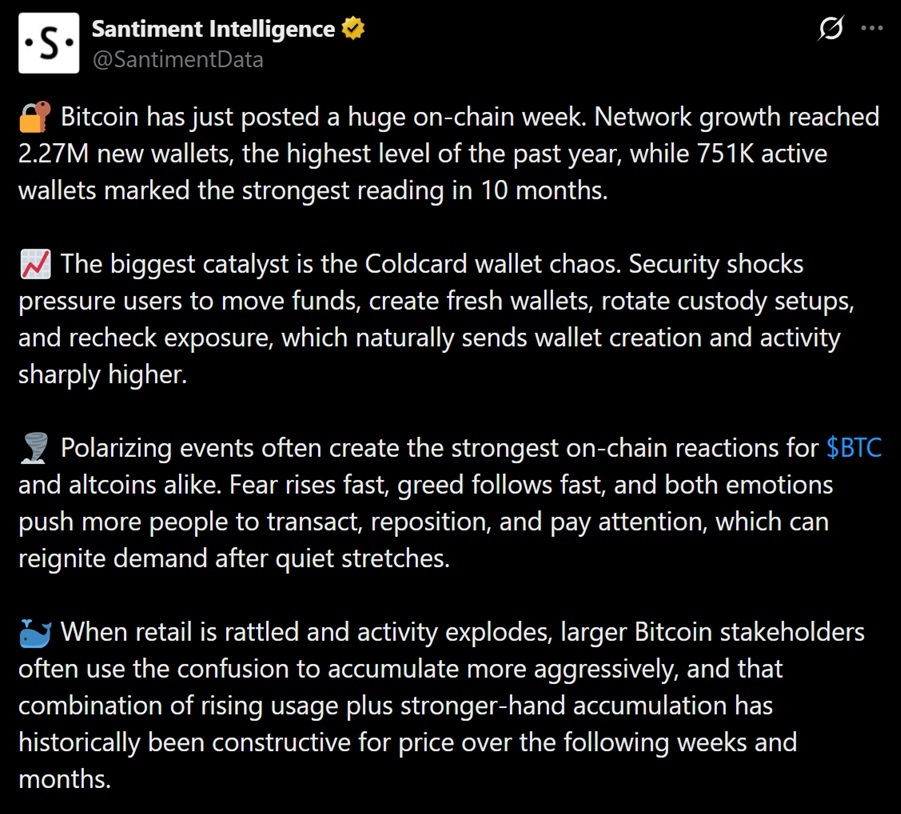
Image source: Santiment

The distinction of this surge from a typical bull-market address boom lies in what's missing: purchases. Exchange inflows during the same period averaged about $1.55 billion per day, essentially slightly below July's average of $1.67 billion. The number of wallets is growing, coins are moving within them, but money is not flowing onto exchanges for trading. This divergence points to a defensive stance among market participants.

Inside the Coldcard Vulnerability

The root cause lies in the Coldcard hardware wallets by Coinkite, where a firmware bug (first appearing in the March 2021 build for versions 4.0.1 through 4.1.9) led to seed phrase generation on affected Mk3 devices being handled by a software random number generator instead of the device's dedicated hardware entropy chip.

What was supposed to be a 128-bit cryptographic key turned out, on the most affected devices, to have about 40 bits of real randomness, and on some later models around 72 bits. Bitcoin.com News is tracking the scale of the damage: losses have exceeded $116 million, and a fourth wave of thefts continues to drain wallets even days after the initial disclosure.

What the Data Really Shows

When news spread that seeds for certain Coldcard Mk3, Mk4, Mk5, and Q devices running vulnerable firmware could be brute-forced, security-conscious owners had every reason to create new wallets on unaffected hardware, move their coins to new addresses, and abandon any configurations that might harbor the same weak-entropy vulnerability.

This behavior alone could explain the spike in new and active wallets combined with the lack of expected exchange inflows.

Since then, Coinkite has released a firmware patch and published a post-mortem on fixing the entropy issue, detailing how much random data the vulnerable devices were actually generating. Independent security researchers have also joined the effort: one emergency audit found nearly 5,000 separate vulnerabilities across hundreds of Bitcoin-related projects in just over a day of testing.

This Is Not a Protocol-Level Issue

Experts are keen to draw a clear distinction between this incident and a vulnerability in Bitcoin itself. The vulnerability was solely in how one manufacturer's firmware generated random data for seed phrases—a self-custody supply chain failure, not a blockchain problem.

Geographic data added another layer of complexity: researchers tracking victim wallets found that Canadian users account for roughly a quarter of the losses linked to this vulnerability, likely reflecting Coinkite's Canadian base and the concentration of early customers in that country.

Coupled with reports that this vulnerability briefly amplified market anxiety over unrelated Bitcoin fork proposals circulating at the same time, this episode serves as a vivid example of how a narrow, fixable firmware bug can still ripple through key blockchain metrics, extending its impact beyond the number of affected devices.

end-content

Crypto di tendenza

Domande pertinenti

QWhat recent data from Santiment indicates heightened Bitcoin network activity?

ASantiment data shows 751,000 active wallets and 2.27 million newly created wallets, representing the highest Bitcoin network activity in recent months. The number of active addresses peaked at about 978,000 on July 31, which is roughly 1.6 times the daily average for July.

QWhat is the key difference between this recent spike in wallet activity and typical bull market activity, according to the article?

AThe key difference is the absence of significant buying pressure. While the number of wallets is growing and coins are moving, the average daily exchange inflows during this period were about $1.55 billion, slightly below July's average of $1.67 billion. This suggests market participants are taking a defensive position rather than trading.

QWhat was the core technical flaw in the affected Coldcard hardware wallets?

AThe flaw was in the firmware (versions 4.0.1 to 4.1.9 for Mk3 and other models). It caused seed phrase generation to use a software-based random number generator instead of the device's dedicated hardware entropy chip. This reduced the real randomness of the cryptographic key from 128 bits to approximately 40 bits on the worst-affected devices and about 72 bits on some later models.

QHow does the article explain the connection between the Coldcard vulnerability and the surge in new Bitcoin wallets?

AThe article suggests that security-conscious owners of potentially affected Coldcard devices likely created new wallets on uncompromised hardware and moved their coins to new addresses. This mass migration to secure new wallets directly explains the surge in new and active wallet counts without a corresponding increase in exchange deposits for trading.

QAccording to experts cited in the article, what is the important distinction between the Coldcard incident and a Bitcoin protocol flaw?

AExperts clarify that this was a supply chain failure in a specific manufacturer's self-custody product (a flaw in how Coldcard's firmware generated random data for seed phrases) and not a vulnerability in the Bitcoin blockchain or protocol itself.

Letture associate

Vote on CLARITY Act in US Senate Scheduled for September 15

The U.S. Senate is scheduled to hold a key procedural cloture vote on the Digital Asset Market Clarity Act (CLARITY Act) on September 15. The motion was filed by Senate Majority Leader John Thune, aiming to advance the bill for floor consideration after lawmakers failed to reach an agreement before the August recess. The vote requires 60 votes to proceed, meaning Republican support from Democrats is necessary. The landmark crypto regulatory bill aims to establish a federal market structure for digital assets, clarify whether crypto assets qualify as securities or commodities, and delineate regulatory authority between the SEC and CFTC. However, negotiations have been stalled by disagreements over proposed ethics provisions, which would restrict government officials and their families from profiting from digital assets while in office, and rules governing stablecoin yields. To break the impasse, lawmakers are reportedly working on a bipartisan ethics amendment, partly addressing Democratic concerns about former President Trump's crypto-related financial interests. The outcome of the September 15 vote and the ability to resolve disputes over ethics and stablecoin rules before then will determine the bill's future. Passage would significantly shape U.S. digital asset regulation for years to come, though aligning SEC and CFTC operational standards post-enactment is expected to be a lengthy process.

cryptonews.ru21 min fa

Vote on CLARITY Act in US Senate Scheduled for September 15

cryptonews.ru21 min fa

Trading

Spot

Articoli Popolari

Come comprare DATA

Benvenuto in HTX.com! Abbiamo reso l'acquisto di DATA Network (DATA) semplice e conveniente. Segui la nostra guida passo passo per intraprendere il tuo viaggio nel mondo delle criptovalute.Step 1: Crea il tuo Account HTXUsa la tua email o numero di telefono per registrarti il tuo account gratuito su HTX. Vivi un'esperienza facile e sblocca tutte le funzionalità,Crea il mio accountStep 2: Vai in Acquista crypto e seleziona il tuo metodo di pagamentoCarta di credito/debito: utilizza la tua Visa o Mastercard per acquistare immediatamente DATA NetworkDATA.Bilancio: Usa i fondi dal bilancio del tuo account HTX per fare trading senza problemi.Terze parti: abbiamo aggiunto metodi di pagamento molto utilizzati come Google Pay e Apple Pay per maggiore comodità.P2P: Fai trading direttamente con altri utenti HTX.Over-the-Counter (OTC): Offriamo servizi su misura e tassi di cambio competitivi per i trader.Step 3: Conserva DATA Network (DATA)Dopo aver acquistato DATA Network (DATA), conserva nel tuo account HTX. In alternativa, puoi inviare tramite trasferimento blockchain o scambiare per altre criptovalute.Step 4: Scambia DATA Network (DATA)Scambia facilmente DATA Network (DATA) nel mercato spot di HTX. Accedi al tuo account, seleziona la tua coppia di trading, esegui le tue operazioni e monitora in tempo reale. Offriamo un'esperienza user-friendly sia per chi ha appena iniziato che per i trader più esperti.

531 Totale visualizzazioniPubblicato il 2026.07.01Aggiornato il 2026.07.01

Come comprare DATA

Discussioni

Benvenuto nella Community HTX. Qui puoi rimanere informato sugli ultimi sviluppi della piattaforma e accedere ad approfondimenti esperti sul mercato. Le opinioni degli utenti sul prezzo di DATA DATA sono presentate come di seguito.

活动图片