No Holiday Break|What Have Crypto KOLs Been Talking About in the Last 24 Hours?

比推Pubblicato 2026-02-18Pubblicato ultima volta 2026-02-18

Introduzione

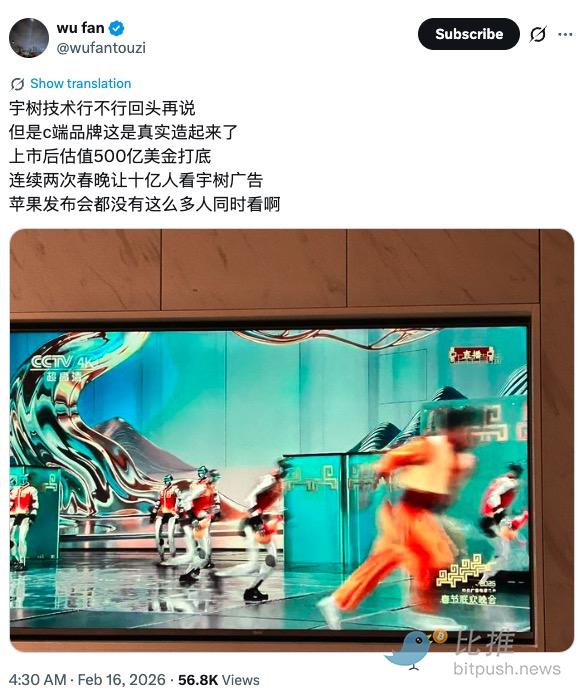
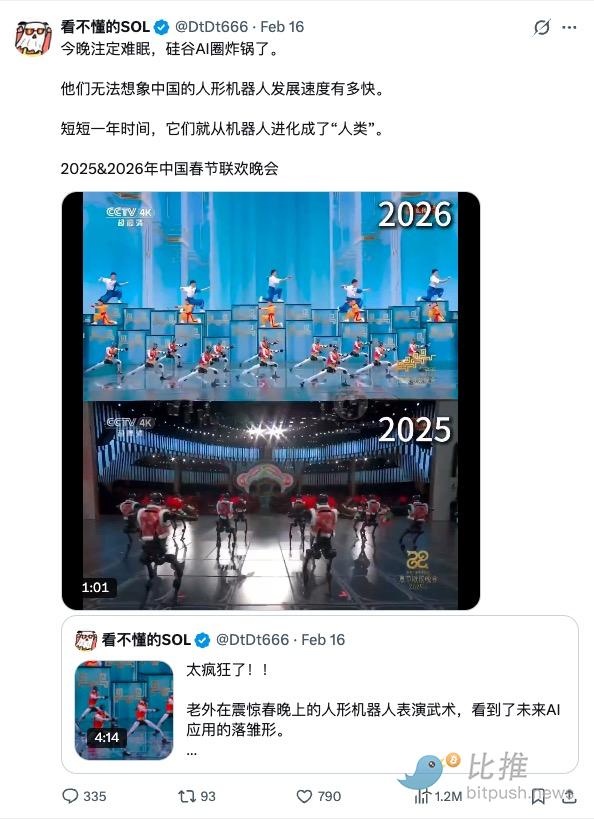
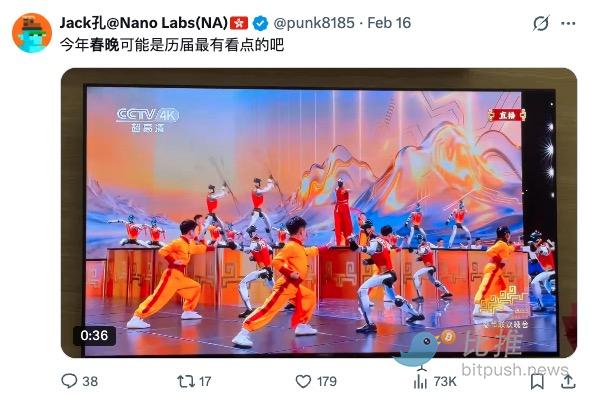
This article summarizes discussions from crypto KOLs on X (formerly Twitter) over the past 24 hours during the Chinese New Year period. Key topics include: - Reflections on the Spring Festival and the growing role of AI, especially its prominence in the Spring Festival Gala. - Kraken Exchange launching an official Chinese account, with executives greeting the community in Chinese. - An analysis of the evolution of crypto listing cycles, arguing that "narratives are dead, utility prevails." The piece discusses different eras—from early chaos, to IEOs, the rise of Airdrops, and the current balance between VCs, projects, and retail. He Yi from Binance commented on the industry’s maturation and shifting dynamics. - Market sentiment discussions, noting that in a bull market, even unrelated news is seen as positive, while in bear markets, all news is perceived negatively. Some expect Bitcoin to consolidate around $60k–$70k for a while. - Humorous community comments about Justin Sun (often referred to as "Sun Ge" or "Sun Cut"), poking fun at his reputation and anecdotal stories. The article includes multiple screenshots of tweets and disclaims that the opinions expressed are personal and not investment advice.

Dear readers, may the Year of the Horse bring you great fortune!

This Bingwu Spring Festival, we wish you: ever-rising portfolios, a mindset as steady as a galloping horse, and profits racing like a track sprint!

Let’s take a look at what KOLs in the crypto space have been hotly discussing over the past 24 hours—

Note: The following content is compiled from the X platform, representing personal opinions only. It does not represent the stance of this platform and should not be considered investment advice.

New Year Reflections, and When AI Takes Center Stage at the Spring Festival Gala

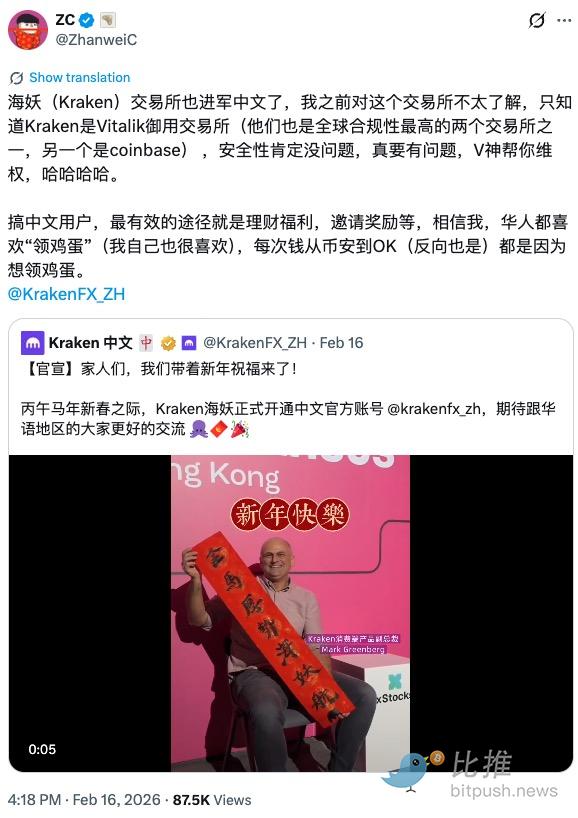
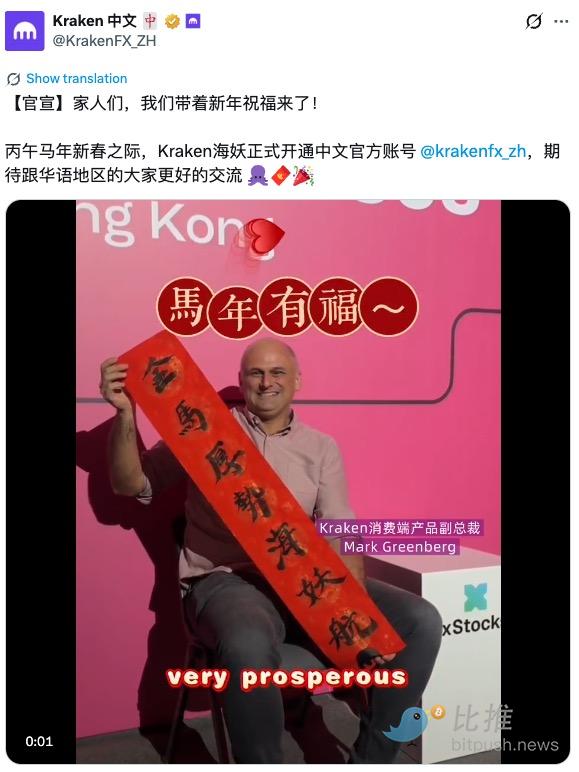
Kraken Exchange Launches Chinese Account, Executives Extend New Year Greetings in Chinese
The Evolution of Listing Cycles: “Narratives Are Dead, Utility Reigns”

Article link: https://www.bitpush.news/articles/7612622

Author’s note: “As an old-timer in crypto who’s anti-VC, this sentiment really resonates with us—do you know how long it took for the crypto community to reclaim pricing power? So today, from the perspective of a seasoned veteran, I’ve strung together these phases to help newcomers understand the journey. This is a hearty dish for you to savor during boring family visits or while traveling. It’s worth reading again and again.”

He Yi’s repost comment:

“From an exchange’s perspective, the first phase was the wild west era where many projects cashed out and left. Binance began restricting investors & project teams from unlocking tokens based on milestones or timelines.

The second IEO era emerged because liquidity was concentrated, giving Binance more leverage to advise projects on low-price TGEs to benefit retail investors, without charging listing fees—a win-win logic. Coupled with the bear market introducing longs, shorts, and leverage, this became the ‘golden age’ everyone reminisces about.

The third era saw AMMs revolutionize DEXs, the rise of VCs, and the professionalization of industry KOLs and institutions. This diluted CEXs’ pricing power and introduced compliance standards, leading to airdrops.

The fourth era is marked by further institutional professionalization among players. Exchanges evolved from early curation to CEXs integrating wallets and enabling trading of any on-chain token, giving rise to ‘the eggs every generation must claim’—Alpha, intended to balance VC & institutional, project, and retail interests.

For any emerging industry, it’s a process of feeling our way forward. Most people lack faith in the industry’s long-term prospects, hence ‘not looking long-term.’ It’s like many don’t believe we can cross this river, but only those who believe can make it to the other shore.”

Market Discussions
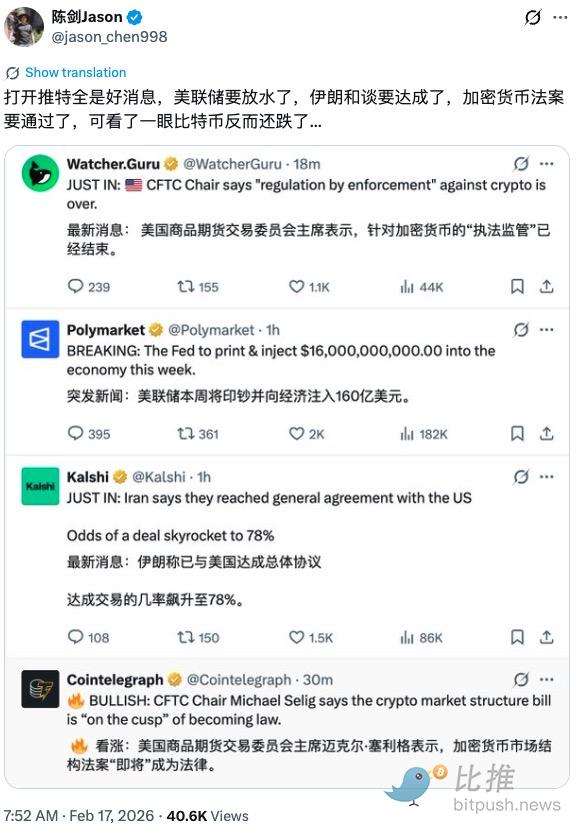
Popular replies:

In a bear market, any news is bearish; in a bull market, even unrelated news is bullish;

When Bitcoin ETFs were approved, the price didn’t rise—it actually dropped from 44k to 38k, but later hit 120k. Probably now it’ll hover around 60k-70k for a long time;

It’s these positive factors that pushed it past 70k; otherwise, it would’ve dropped to 60k already.

The Charm of “Sun Studies”

Popular replies:

A joke: you think he’s just borrowing a pen, but when you look back, your wallet’s gone too. Then Brother Sun invites you to dinner under the pretext of returning it, and you end up losing the meal on top of it;

His never-miss-a-trick nature is etched in his genes;

I heard that last time Sun Cut was interviewed in Hong Kong, he pocketed two glass cups on his way out;

Original article link: https://www.bitpush.news/articles/7612688

Domande pertinenti

QWhat is the main topic discussed by crypto KOLs in the past 24 hours according to the article?

AThe main topics include Chinese New Year reflections, AI's role in the Spring Festival Gala, Kraken Exchange opening a Chinese account and executives greeting in Chinese, the evolution of token listing cycles, market discussions, and the 'charm of Sun Studies' (referring to Sun Yuchen's influence).

QWhich exchange opened a Chinese account and had executives send New Year greetings in Chinese?

AKraken Exchange opened a Chinese account and had its executives send New Year greetings in Chinese.

QWhat is the core argument in the 'Token Listing Cycle Evolution Theory' mentioned in the article?

AThe core argument is 'Narrative is dead, utility stands,' highlighting a shift from speculative narratives to practical utility in token listings, with insights into the industry's phases from wild growth to institutional professionalism.

QHow did the community react to market discussions, as per the popular replies in the article?

AThe community noted that in a bear market, any news is seen as negative, while in a bull market, even unrelated news is perceived as positive. They also discussed Bitcoin's price consolidation around $60,000-$70,000 after ETF approval.

QWhat is the community's humorous take on 'Sun Studies' (孙学) in the article?

AThe community humorously commented on Sun Yuchen's reputation, joking that he might take advantage of situations, such as 'taking wallets' or even pocketing glass cups after an interview, reflecting his opportunistic character.

Letture associate

How Does Codex Use a Computer? Three Entry Points and Permission Boundaries

This article explains the three primary methods for Codex to interact with a computer, each with distinct use cases, permission boundaries, and trust levels. **1. Computer Use:** This offers the broadest access, allowing Codex to visually control and interact with the graphical user interface of authorized macOS/Windows apps, system settings, and even iOS simulators. It's ideal for tasks lacking APIs or structured tools, such as operating legacy software or multi-app workflows. However, it's the slowest method and has the widest permission scope, requiring careful supervision for sensitive actions. **2. Chrome Extension:** This grants Codex access to the user's logged-in Chrome browser state, including cookies, profiles, and open tabs. It's best for tasks requiring user identity across websites like Gmail, LinkedIn, Salesforce, or internal dashboards. Its key advantage is multi-tab control for complex workflows. While more powerful for browser-based tasks than Computer Use, it carries higher sensitivity as actions are performed under the user's identity. **3. In-App Browser:** This is a browser isolated within the Codex thread, separate from the user's personal browsing data. It excels in web development and debugging scenarios—previewing local servers, testing responsive layouts, or annotating designs directly on the page. Its isolation is a strength for development but a limitation for tasks requiring login sessions. The core principle is to choose the narrowest, safest, and most structured interface for the task. Use plugins or MCPs first, resort to visual control (Computer Use) only for GUI-dependent tasks, employ the Chrome extension for identity-reliant browser work, and prefer the In-App Browser for isolated development. **Appshots** are clarified as a fourth, complementary tool for *inputting* context—capturing a screenshot of a window to point Codex to something—rather than a method for Codex to *act*. Together, this layered approach highlights a key to AI agent productization: not granting unlimited permissions, but constraining them within clear boundaries for specific tasks while preserving user oversight.

marsbit11 min fa

How Does Codex Use a Computer? Three Entry Points and Permission Boundaries

marsbit11 min fa

The "Iron Rule" of Chip Equipment Is Being Broken

For years, the semiconductor equipment industry followed an unwritten "iron rule": suppliers offered steep discounts for new tool introductions (Design-in) and faced consistent price pressure during repeat orders, especially during market downturns. This long-standing buyer's market dynamic is now being upended. Recently, SK Hynix's primary equipment suppliers have reportedly requested a 3-4% price *increase*, a nearly unprecedented move. This shift is driven by a severe supply-demand imbalance fueled by the AI compute boom. Securing equipment has become an urgent arms race as chipmakers' expansion speed dictates their ability to fulfill massive AI chip orders. Key areas feeling the strain include: **TCB (Thermal Compression Bonding) Equipment:** Demand is exploding, driven by the simultaneous needs of HBM4 memory stacking, AI chip Chip-on-Substrate (C2S), and logic Chiplet Chip-on-Wafer (C2W) packaging. Players like Hanmi Semiconductor, Hanwha Semitech, and ASMPT are receiving major orders. While hybrid bonding is seen as the future, TCB remains the pragmatic choice for HBM4 mass production, with its lifecycle extended by relaxed specifications and ongoing technological upgrades. **Test Equipment Bottlenecks:** Ironically, AI-driven shortages are now crippling test equipment manufacturing. Critical components like FPGAs, Driver ICs, and CPUs face severe shortages and extended lead times (up to 52 weeks for FPGAs), as AI data center and server vendors prioritize supply. This creates a paradoxical cycle: AI chip shortages drive fab expansion, which requires more test equipment, whose production is delayed because its key parts are diverted to make AI chips. The industry is entering a broad, AI-powered upcycle. SEMI forecasts global semiconductor equipment sales to hit a record $156 billion by 2027, fueled by investment in advanced logic/foundry, HBM-driven DRAM, and advanced packaging (like CoWoS). Major players like TSMC, SK Hynix, and Micron are aggressively ramping capital expenditure. In conclusion, leading equipment vendors are no longer just selling tools; they are selling the critical capability to deliver AI-era capacity. Pricing power is shifting decisively to those with indispensable technology in key process nodes like advanced logic, HBM, and advanced packaging, rewriting the industry's traditional power structure.

marsbit24 min fa

The "Iron Rule" of Chip Equipment Is Being Broken

marsbit24 min fa

Trading

Spot
Futures
活动图片