New Crypto Buyer Enters the Market: Kazakhstan Plans to Invest Up to $350 Million

marsbitPubblicato 2026-03-09Pubblicato ultima volta 2026-03-09

Introduzione

Kazakhstan's central bank, under Governor Timur Suleimanov, plans to invest up to $350 million from its gold and foreign exchange reserves into the crypto asset sector, with investments set to begin between April and May. The move, which represents a cautious 0.5% of the country's total reserves, will include not only cryptocurrencies but also stocks of high-tech companies, index funds, and other crypto-related financial instruments. The National Investment Corporation (NIC) will also incorporate confiscated crypto assets from law enforcement operations into the national crypto fund. This decision follows eased regulations in January, which recognized digital financial assets as a new asset class and allowed licensed crypto exchanges. Kazakhstan currently holds 3,544 bitcoins, ranking eighth globally in government crypto holdings.

By: Felix, PANews

On March 6, Timur Suleimanov, the Governor of the National Bank of Kazakhstan, stated that the central bank plans to use part of its gold and foreign exchange reserves to invest in the crypto asset sector, with an amount of up to $350 million.

Although the specific asset categories and timeline for the investment have not yet been disclosed, according to Aliya Moldabekova, Deputy Governor of the National Bank of Kazakhstan, the investment will begin between April and May.

Pilot Phase Allocation Accounts for 0.5% of Reserves

Despite the high-profile announcement of the purchase, Kazakhstan has demonstrated a cautious approach in every aspect of its national reserve plan for crypto assets.

The consideration phase alone took six months. As early as last July, Governor Timur Suleimenov indicated that the central bank was considering investing part of its foreign exchange reserves and national fund assets into crypto assets, emphasizing that this is a complex issue requiring careful handling due to the high volatility of such assets, despite their potential for high returns.

It was not until January of this year that Timur Suleimenov announced that an initial fund of $350 million had been allocated for this special purpose. This fund will be deployed using part of the foreign exchange and gold reserves.

Additionally, the investment approach is relatively diversified. Suleimanov stated during an interest rate briefing: "We are currently compiling a list of investments, which includes not only cryptocurrencies themselves but also high-tech company stocks related to cryptocurrencies and digital financial assets, index funds, and other instruments with dynamics similar to crypto assets."

Deputy Governor Aliya Moldabekova emphasized, "We are not making large-scale investments in cryptocurrencies. We are currently screening companies engaged in the digital asset business, such as those involved in building cryptocurrency infrastructure. We are in the process of selecting such companies."

Furthermore, the scale of the investment reflects a "cautious" approach, with the $350 million allocation accounting for only 0.5% of the country's total reserves. As of February 1, the National Bank of Kazakhstan's gold and foreign exchange reserves stood at $69.4 billion, while the assets of the national fund totaled $65.23 billion.

Easing Crypto Regulations and Incorporating Seized Assets into Crypto Fund

It is worth noting that not all of the reserved crypto assets will come from purchases; proceeds from law enforcement actions will also be a source.

In January of this year, the National Investment Corporation (NIC), the investment arm of the National Bank of Kazakhstan, announced plans to use cryptocurrencies seized by law enforcement agencies, along with foreign exchange and gold reserves, to enhance the national crypto reserve.

Kassym-Jomart Tokayev, President of Kazakhstan, revealed that during operations to "crack down on illegal mining farms," law enforcement agencies have shut down 130 illegal exchanges and seized assets worth over $5 million. These seized crypto assets, such as Bitcoin, will no longer serve merely as evidence but will be fully incorporated into the national crypto fund.

According to data from Bitcoin Treasuries, Kazakhstan currently ranks eighth in the global ranking of national crypto reserves (including law enforcement seizures), holding 3,544 BTC.
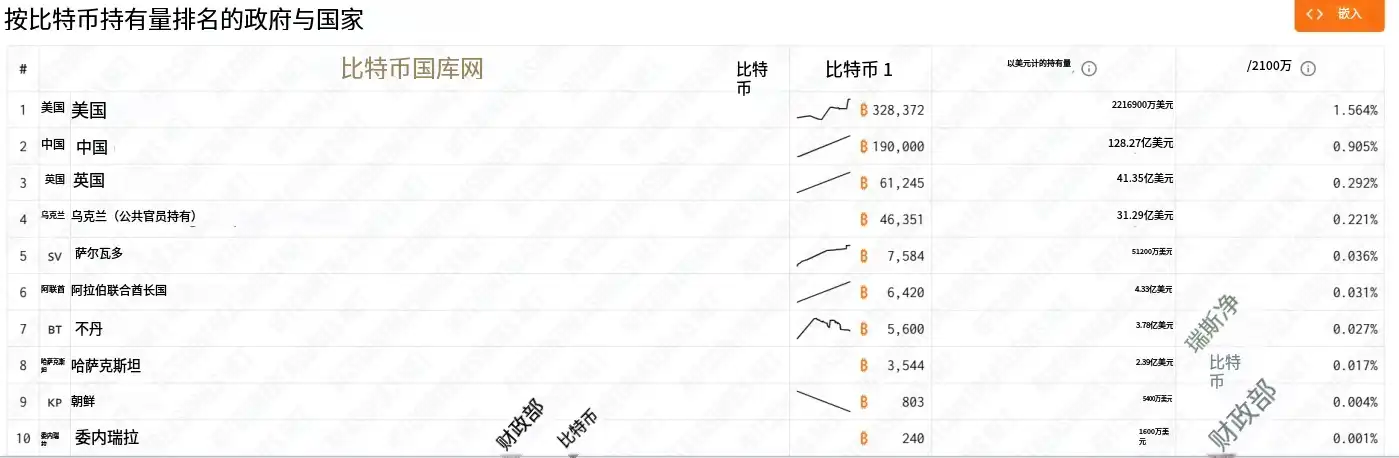
Governments and Countries Ranked by Bitcoin Holdings

Kazakhstan eased cryptocurrency regulations in January of this year, explicitly classifying digital financial assets (DFA) as a new asset category under regulation and allowing their circulation within the country. It also permitted the establishment of crypto exchanges licensed by the central bank. Additionally, the central bank will formulate a list of approved cryptocurrencies for circulation and impose certain restrictions on cryptocurrency trading activities.

Against the current macroeconomic backdrop of a crypto bear market, Kazakhstan's use of up to $350 million in reserve funds to invest in crypto assets not only reflects further recognition of cryptocurrencies by sovereign states but also provides a certain boost to the market. PANews will continue to monitor the specific allocation of subsequent funds.

Related reading: Is Venezuela's $60 Billion Bitcoin Shadow Reserve Real or Fake?

Crypto di tendenza

Domande pertinenti

QWhat is the maximum amount Kazakhstan's central bank plans to invest in crypto assets from its reserves?

AKazakhstan's central bank plans to invest up to $350 million from its gold and foreign exchange reserves into the crypto asset sector.

QWhen is the investment in crypto assets scheduled to begin, according to the Deputy Governor of the National Bank of Kazakhstan?

AAccording to Deputy Governor Aliya Moldabekova, the investment is scheduled to begin between April and May.

QWhat percentage of Kazakhstan's total reserves does the initial $350 million crypto investment represent?

AThe initial $350 million allocation represents 0.5% of Kazakhstan's total reserves.

QBesides purchasing crypto directly, what is another source of crypto assets for Kazakhstan's national fund?

AAnother source of crypto assets for the national fund is from assets seized by law enforcement agencies during operations against illegal mining and exchanges.

QWhat regulatory change did Kazakhstan implement regarding digital financial assets in January?

AIn January, Kazakhstan relaxed its cryptocurrency regulations by officially recognizing digital financial assets (DFA) as a new asset class, allowing their circulation within the country, and permitting the establishment of licensed crypto exchanges.

Letture associate

Nvidia Faces Collective Selling by Funds: What Are Private Equity Firms Sniffing Out?

Several prominent Chinese private equity funds, including Gaoyi Asset and Dantoo's Orient Harbor, made significant portfolio adjustments in Q2 2024, as revealed in their latest SEC 13F filings. The most notable move was a collective retreat from AI chip leader NVIDIA, with Gaoyi reducing its stake by over 70%, Jilin Asset selling out completely, and Orient Harbor trimming its holdings. This shift does not signal a loss of faith in the AI trend, but rather a change in investment focus from "expectation-driven" to "realization-driven" valuation. Capital is flowing from crowded, high-valuation names towards segments with clearer profitability visibility and better risk-reward profiles. The funds' new major conviction is Taiwan Semiconductor Manufacturing Company (TSMC), which Gaoyi built into its top holding. The thesis centers on TSMC's role as a critical bottleneck in the AI supply chain due to its dominance in advanced semiconductor manufacturing and, crucially, advanced CoWoS packaging capacity. As demand for AI chips explodes, TSMC's "must-pass" foundry services grant it significant pricing power, suggesting a potential migration of profits from chip designers to manufacturers. Simultaneously, both Gaoyi and Orient Harbor substantially increased positions in memory chip companies like Micron and SanDisk. The investment logic here is twofold: a cyclical recovery in the memory market combined with a new, structural growth driver from AI. High Bandwidth Memory (HBM), essential for AI processor performance, is supply-constrained and its production diverts capacity from standard DRAM and NAND, creating a broad-based pricing tailwind for the memory sector. The collective reduction in NVIDIA reflects a view that its massive prior gains have compressed its future upside potential ("lowered赔率"). The market now demands flawless execution and faces new risks like rising costs from TSMC and HBM suppliers, as well as competition from cloud companies' custom chips. The funds' reallocation highlights a broader thematic: as the AI boom matures, investment opportunities and excess profits are shifting along the supply chain—from design to the physical constraints of manufacturing and memory. The next phase of AI investing may be defined by pricing power derived from tangible bottlenecks like advanced packaging and HBM capacity.

marsbit12 min fa

Nvidia Faces Collective Selling by Funds: What Are Private Equity Firms Sniffing Out?

marsbit12 min fa

Reverse Turing Test: This 'Pure Handcrafted Large Model' Is Driving Netizens Crazy

An art project called ChatTJB, humorously billed as a "next-generation, single-operator Large Language Experience" (LLE), gained viral attention in San Francisco. Promoted via a billboard, its website mimicked a genuine AI service with a chat interface, documentation, and even a "Pro" subscription. The twist? It was entirely manual. A single person, named Tucker, personally read, thought about, and typed replies to thousands of user queries using his thumbs, even hand-drawing images. He coined terms like "human-powered reasoning layer" to describe this process, highlighting its inherent human limitations: speed depended on his alertness, capacity was strictly one conversation at a time, and errors were traceable to a specific individual. The project's popularity overwhelmed Tucker, forcing a pause on new users and leading to plans for a community version with volunteer "AIs" (Average Individuals). While initially a source of amusement, Tucker noted that some users began sharing genuine personal concerns, valuing the knowledge that a real person was attentively listening and responding. The project satirizes AI hype while underscoring the irreplaceable value of human connection and attention in an age of automated, scalable interactions. A similar platform, "Your AI Slop Bores Me," was mentioned, where users either submit requests or role-play as the "AI" to fulfill others' text or drawing prompts, further emphasizing the human element behind the interface. The core message: sometimes, knowing there's a real person on the other end is what truly matters.

marsbit16 min fa

Reverse Turing Test: This 'Pure Handcrafted Large Model' Is Driving Netizens Crazy

marsbit16 min fa

Overnight, GPT-5.6 Sol Was Accelerated 14x by OpenAI

OpenAI, in collaboration with chipmaker Cerebras, has unveiled a limited preview of an "Ultrafast Mode" for its flagship GPT-5.6 Sol model. This new service tier reportedly achieves output speeds of up to 750 tokens per second—a 14x increase over the standard mode's baseline of ~53 tokens/s—without any loss in quality. Key to this acceleration is Cerebras's wafer-scale architecture (WSE-3), which houses model parameters entirely in on-chip SRAM to eliminate the memory bandwidth bottlenecks typical of traditional GPU clusters. In benchmark testing on the challenging "Humanity's Last Exam" (HLE), GPT-5.6 Sol in Ultrafast Mode answered all 2500 questions in 11 hours and 11 minutes, compared to over 78 hours for a competitor model, while maintaining similar accuracy. The speed boost also translated to a 5.6x faster end-to-end performance on the GDP-Val benchmark for economically valuable knowledge work. OpenAI highlights several potential applications for such rapid inference, including real-time event response and reliability analysis, dynamic financial research and security, complex customer support, interactive shopping assistance, and accelerated research and experimentation workflows that enable multiple iterative cycles within a single workday. This advancement may allow users to deploy the highest-tier models for tasks previously requiring slower secondary models, significantly compressing multi-step agent workflows from hours to minutes.

marsbit19 min fa

Overnight, GPT-5.6 Sol Was Accelerated 14x by OpenAI

marsbit19 min fa

Black Whale Emerges, DeepSeek's Second Half Begins

DeepSeek has unveiled its V4 Pro model and officially launched DeepSeek Harness, a developer-preview agent framework released as open-source under the MIT license. The article highlights that while model capabilities set the upper limit, the execution system (or "Harness") significantly determines real-world task success rates and cost efficiency, as demonstrated by tests where the same DeepSeek V4-Flash model performed differently across various harnesses. DeepSeek Harness is built on a "Everything is a plugin" philosophy using the Cordis system, allowing developers to modularly replace or extend core components like the model, tools, and UI without modifying the core code. It emphasizes full traceability with an append-only session log and is designed for stable, long-running tasks. Notably, it supports integration with nearly 40 external LLMs, including Kimi, OpenAI, and Anthropic, positioning itself not as a fixed agent but as a customizable platform. The release signals a strategic shift for DeepSeek from merely selling computational tokens (inference) to delivering actionable results (task completion). However, the v0.1 Harness faces challenges, including competing with established players like Claude Code, building a robust plugin ecosystem, and adapting to a potential "pay-for-result" business model. The article concludes that while both V4 Pro and Harness are early-stage with gaps to top models, DeepSeek's consistent direction is to make advanced AI capabilities affordable and operable within practical systems, with its long-term success now tied to the open-source community.

marsbit25 min fa

Black Whale Emerges, DeepSeek's Second Half Begins

marsbit25 min fa

Trading

Spot

Articoli Popolari

Come comprare BAN

Benvenuto in HTX.com! Abbiamo reso l'acquisto di Comedian (BAN) semplice e conveniente. Segui la nostra guida passo passo per intraprendere il tuo viaggio nel mondo delle criptovalute.Step 1: Crea il tuo Account HTXUsa la tua email o numero di telefono per registrarti il tuo account gratuito su HTX. Vivi un'esperienza facile e sblocca tutte le funzionalità,Crea il mio accountStep 2: Vai in Acquista crypto e seleziona il tuo metodo di pagamentoCarta di credito/debito: utilizza la tua Visa o Mastercard per acquistare immediatamente ComedianBAN.Bilancio: Usa i fondi dal bilancio del tuo account HTX per fare trading senza problemi.Terze parti: abbiamo aggiunto metodi di pagamento molto utilizzati come Google Pay e Apple Pay per maggiore comodità.P2P: Fai trading direttamente con altri utenti HTX.Over-the-Counter (OTC): Offriamo servizi su misura e tassi di cambio competitivi per i trader.Step 3: Conserva Comedian (BAN)Dopo aver acquistato Comedian (BAN), conserva nel tuo account HTX. In alternativa, puoi inviare tramite trasferimento blockchain o scambiare per altre criptovalute.Step 4: Scambia Comedian (BAN)Scambia facilmente Comedian (BAN) nel mercato spot di HTX. Accedi al tuo account, seleziona la tua coppia di trading, esegui le tue operazioni e monitora in tempo reale. Offriamo un'esperienza user-friendly sia per chi ha appena iniziato che per i trader più esperti.

669 Totale visualizzazioniPubblicato il 2024.12.11Aggiornato il 2026.06.02

Come comprare BAN

Discussioni

Benvenuto nella Community HTX. Qui puoi rimanere informato sugli ultimi sviluppi della piattaforma e accedere ad approfondimenti esperti sul mercato. Le opinioni degli utenti sul prezzo di BAN BAN sono presentate come di seguito.

活动图片