Black Whale Emerges, DeepSeek's Second Half Begins

marsbitPubblicato 2026-08-13Pubblicato ultima volta 2026-08-13

Introduzione

DeepSeek has unveiled its V4 Pro model and officially launched DeepSeek Harness, a developer-preview agent framework released as open-source under the MIT license. The article highlights that while model capabilities set the upper limit, the execution system (or "Harness") significantly determines real-world task success rates and cost efficiency, as demonstrated by tests where the same DeepSeek V4-Flash model performed differently across various harnesses. DeepSeek Harness is built on a "Everything is a plugin" philosophy using the Cordis system, allowing developers to modularly replace or extend core components like the model, tools, and UI without modifying the core code. It emphasizes full traceability with an append-only session log and is designed for stable, long-running tasks. Notably, it supports integration with nearly 40 external LLMs, including Kimi, OpenAI, and Anthropic, positioning itself not as a fixed agent but as a customizable platform. The release signals a strategic shift for DeepSeek from merely selling computational tokens (inference) to delivering actionable results (task completion). However, the v0.1 Harness faces challenges, including competing with established players like Claude Code, building a robust plugin ecosystem, and adapting to a potential "pay-for-result" business model. The article concludes that while both V4 Pro and Harness are early-stage with gaps to top models, DeepSeek's consistent direction is to make advanced AI capabilities af...

DeepSeek's Most Promising Project Takes the Stage, Everything is a Plugin. Harness isn't trying to imitate anyone, but to give the power of definition to the open-source community.

On the evening of August 13th, DeepSeek finally broke its silence, releasing two important pieces of information. First, the official version of DeepSeek V4 Pro was released, and simultaneously updated on the APP, web version, and API. Users can use the brand new V4 Pro official model by selecting "Expert Mode" via the APP or web interface; the API model name remains unchanged.

Second, the " DeepSeek Harness Team," with its black whale avatar, made its first post, announcing the official launch of the Harness Developer Preview version, open-sourced under the MIT license.

As previously teased, the V4 Pro official version and the self-developed Harness made a simultaneous debut. Since we have already focused on introducing V4 Pro before, this article will focus on analyzing why DeepSeek Harness is noteworthy.

And after today, whether DeepSeek will transform from a model company into a harder-to-define company.

01

The Same Model, A Different Shell Makes It Seem Like a Different Person

To understand why Harness is important, one must first grasp a counterintuitive fact: in the Agent era, what determines whether an AI can get work done is not just the model.

On August 6th and 11th, the agent tool company Composio conducted two experimental tests attempting to prove the value of Harness. Researchers connected the same DeepSeek V4-Flash model to eight different Harnesses—the execution systems wrapped around the model—and had them complete thirty multi-step tasks respectively. These tasks weren't simple Q&A; they required the Agent to access real applications like Gmail, Google Calendar, GitHub, Slack, call tools, and change application states. Each task was allowed to run for up to fifteen minutes, and success required passing all checks.
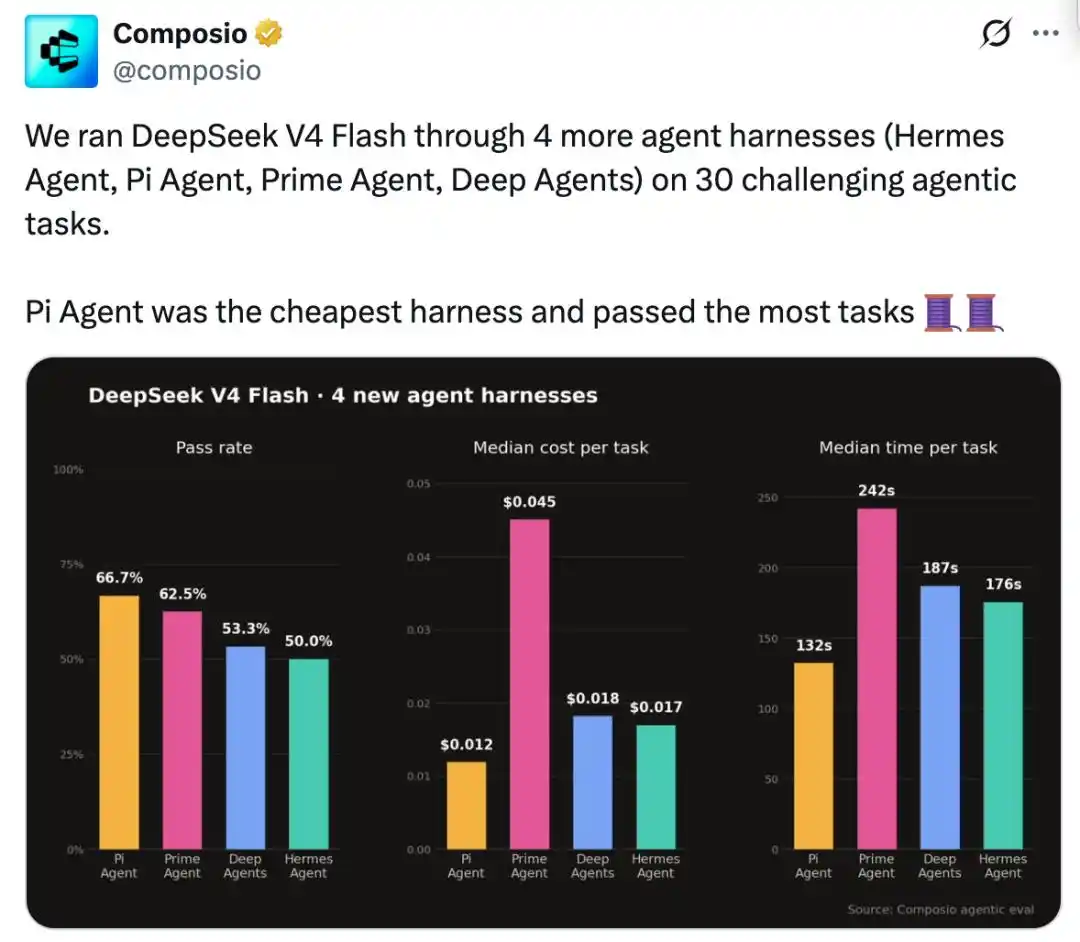
The gap was significant. The best performer, Pi Agent, passed twenty tasks; the worst, OpenCode, passed only fourteen. Out of 240 total runs across eight Harnesses, only 129 succeeded. Among the thirty tasks, only six were completed by all Harnesses. In terms of cost, for similarly completing sixteen tasks, the estimated cost per successful task for Claude Code, Codex, and DeepAgents was approximately $0.195, $0.081, and $0.045 respectively. For the same model, the difference was more than fourfold.
This means that the model sets the upper limit of capability, while the Harness determines how much of that ceiling is ultimately realized and at what cost. Throughout a long-running task, the execution system must constantly make judgments: what to keep and what to discard in the context, when to call which tool, whether to retry or change course when a tool fails, whether to trust the model's completion signal or verify it again. If any step is mishandled, even if the model has the right idea, it could fail at the last moment when actually modifying files or submitting code.

It's worth noting that this is one of the very few projects that DeepSeek opened for early closed beta since its rise to fame.

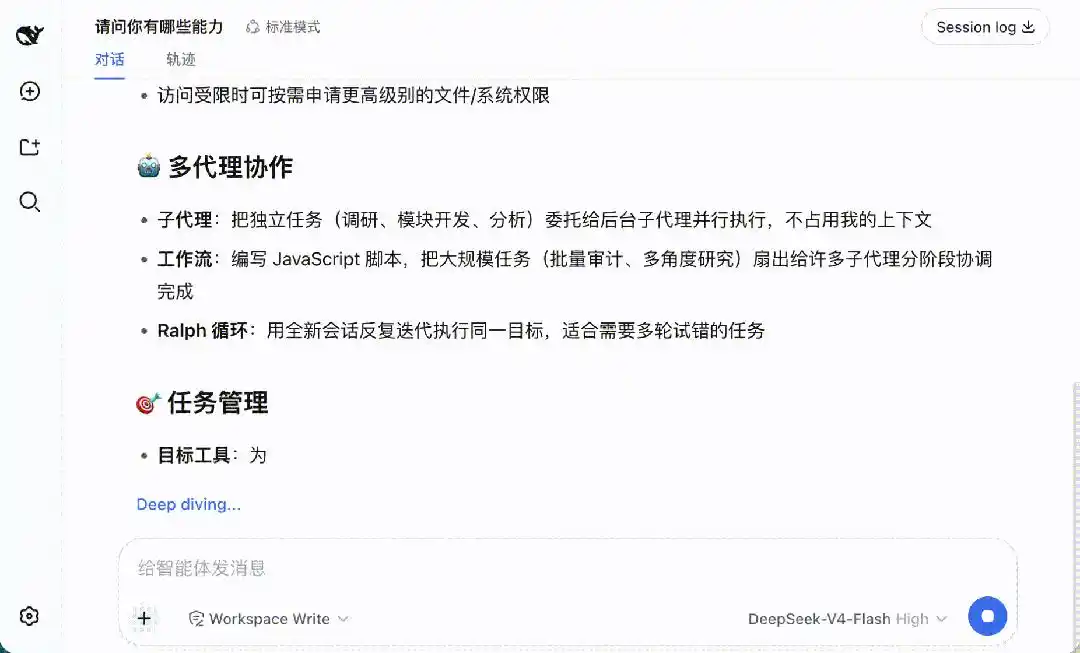
Several developers received Harness beta access before the official release. Some testers discovered that having the same V4-Flash model complete the same game within DeepSeek Harness, Reasonix, and Codex produced drastically different outcomes. This shows that when the model is identical, the tools, prompts, context organization, and execution strategies provided by the execution system can significantly alter the final product.

This is precisely why DeepSeek values its self-developed Harness. Internally, DeepSeek has believed that Agents need to solve the problem of continuous learning, ultimately enabling AI to accelerate AI R&D. Looking down this path, Harness is not just an add-on programming tool, but a workbench for models to enter real development tasks.

Furthermore, a company that built its foundation on low cost and model capability would find itself in a precarious position if task delivery, failure feedback, and developer interfaces remained long-term dependencies on others' systems. Even with a price advantage, it wouldn't control how many tokens a task ultimately burns, how many retries are needed, or when a task is truly considered complete.

02

Everything is a Plugin, DeepSeek Isn't a Replacement for Anyone

What exactly is Harness? The most convenient description in the market is " DeepSeek version of Claude Code." But those who have used the beta version generally find this label inaccurate.

According to DeepSeek 's official documentation, the core design philosophy of Harness is "Everything is a plugin." It is built on the Cordis plugin system. Models, tools, skills, sessions, sandboxes, storage, loops, schedulers, UI—all Agent capabilities are composed of plugins. Developers can select, replace, or extend any capability through configuration without modifying the Harness source code.
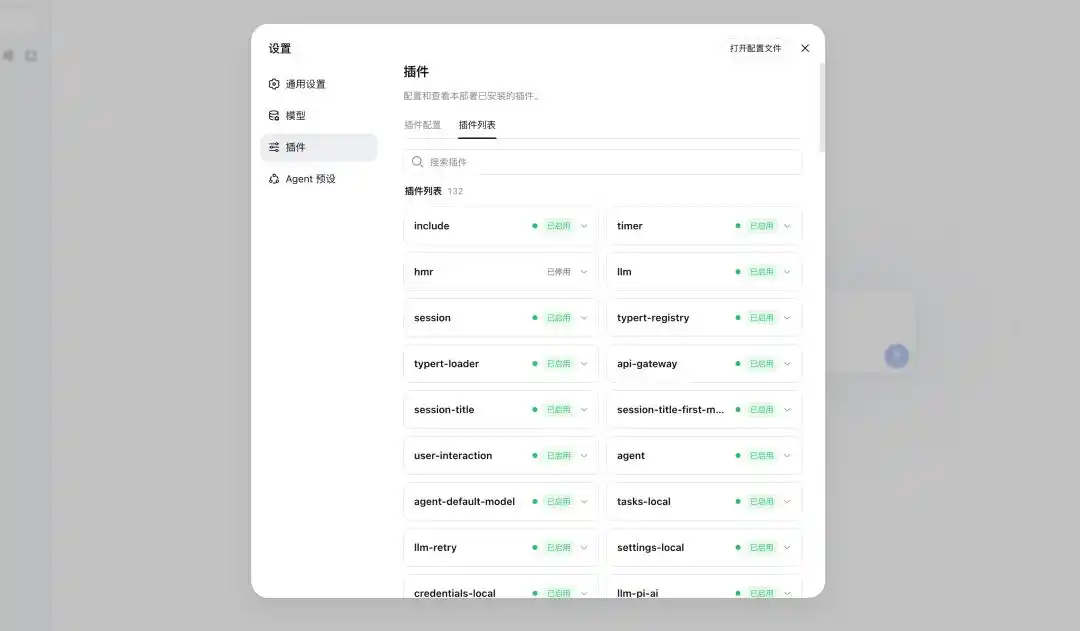
This is on a different scale from the usual understanding of plugins. VS Code plugins add features to the editor; Codex plugins add tools to the Agent. Harness plugins can replace the Agent's brain, toolbox, rules, even its entire interface.

According to multiple sources involved in the beta test, developers went wild with plugin-making during the beta period. "People aren't properly testing the beta anymore; they're running off to write plugins." Hundreds of plugins emerged within just a few days—some completely overhauled the work interface, while others implemented "cross-session long-term memory with background self-evolution" using pure plugins, enabling the model to periodically review its work records and compress temporary experiences into lasting knowledge.

Some also commented that open-source community governance might be another challenge DeepSeek will face next.

Another crucial design aspect is traceability. Harness uses an append-only session log. Everything the model sees—system prompts, chain-of-thought, tool calls and results, sub-Agent scheduling, every context injection—is fully recorded. Context compression does not delete the original history; it only changes what the model subsequently sees through replacement events. Developers can trace by source in the Trajectory view, supporting recovery, forking, retrieval, and replay. The official documentation summarizes this principle as "If the model saw it, it's recorded."

This reflects a typical systems engineering mindset. According to reports, DeepSeek Harness team leader Cui Tianyi graduated from Zhejiang University's Computer Science Department, worked at the quantitative trading firm Jane Street for nine years, and joined DeepSeek in March 2026, with Harness officially starting internal development in May. The core moat of high-frequency trading systems has never been about smarter strategies, but stable execution in extremely complex environments, exception handling, comprehensive log traceability, and controllable risk—exactly the missing piece for moving AI Agents from demos to production. One beta developer described its performance in long tasks as "steady as an old dog": tasks are automatically saved when interrupted, ready to resume next time without starting over.

It's worth noting that Harness hasn't confined itself within DeepSeek models' walled garden. It natively supports connecting to nearly 40 major models including Kimi , OpenAI, Anthropic, and Google. Perhaps others tend to build a ready-made Agent, but DeepSeek Harness is more like a set of components, allowing developers to decide for themselves what the Agent should be like and how it should work.

Of course, the official team remains clear-headed. The announcement states that, as an early preview version, "there are still many details to be improved and refined, and core plugins and basic APIs will also undergo rapid iteration." In fact, one of the media outlets involved in the beta, ifanr, marveled that it was hard to imagine the famously fast DeepSeek taking over half an hour to run a programming task. The v0.1 version number also indicates that this black whale has just surfaced, far from swimming freely.

03

From Selling Tokens to Delivering Results, the Ambition of the Black Whale

The emergence of Harness coincides with a shift in the entire AI industry.

Over the past few years, competition among large model companies has focused on parameter scale and benchmark scores. But entering 2026, the core capabilities of leading models have rapidly converged, gaps in single-turn QA have narrowed, while price wars have intensified. The ceiling for the pure token-selling business model has become clearly visible. The industry is gradually realizing that the core value of the AI industry lies not in model output, but in real-world application—with the same token consumption, idle chat yields minimal value, while fixing a bug or completing a feature development can create several times the commercial value.

DeepSeek 's new release signifies a move from selling compute power to delivering results. In the old model, customers paid based on token usage, regardless of whether the model actually solved the problem. In the new model, the anchor point for payment shifts from how much compute was consumed to what task was accomplished.

This DeepSeek Harness release is also highly praised by developers for another reason. DeepSeek does not define the Agent itself. Instead, it leverages the diffusion power of the open-source community to promote a Harness-based approach. This is a grander, yet more difficult, path.

Furthermore, Harness faces a mature market already validated by Claude Code and Codex, with the latter backed by the model iterations and commercial resources of Anthropic and OpenAI, holding a first-mover advantage. After open-sourcing, questions remain unanswered: whether the plugin ecosystem can spontaneously flourish, whether developers are willing to entrust production environments to a v0.1 version, and whether the domestic market's payment habits can support the new logic of "pay-per-result." DeepSeek itself has stated that core plugins and APIs will continue to evolve rapidly, meaning early adopters may bear the cost of interface changes.

On August 13th, releases happened on both sides of the Pacific. Elon Musk took the stage for Grok 4.6, calling it "intelligent, fast, and highly cost-effective" ; DeepSeek said nothing, just kept pushing updates.

Between the clamor and the silence lies a divergence of two business philosophies.

We want to call this DeepSeek 's "most promising project in history," not because it's the strongest today. V4 Pro still has gaps with SOTA models, Harness is only a v0.1 developer preview, market reaction to recent price adjustments needs observation, and ecosystem building is a long journey. Potential is potential precisely because it is not yet realized.

But if we stretch the timeline, from R1 to V4, from models to Harness, DeepSeek has taken each step in the same direction: compressing cutting-edge capabilities into affordable costs, then connecting affordable capabilities to implementable systems.

The black whale has surfaced. As for how far it can swim—that lies in a future belonging to the open-source community.

This article is from the WeChat public account "Phoenix Network Technology," author: Dale, editor: Dong Yuqing

Crypto di tendenza

Domande pertinenti

QAccording to the article, what is the key finding of Composio's experiments comparing different Agent execution systems (Harnesses) using the same DeepSeek model?

AThe key finding was that the choice of execution system significantly impacts the performance and cost of the same AI model. The experiments showed up to a fourfold difference in the cost per successful task completion when the same DeepSeek V4-Flash model was paired with different Harnesses.

QWhat is the core design philosophy of DeepSeek's newly released Harness system?

AThe core design philosophy is "Everything is a plugin." Harness is built on the Cordis plugin system, meaning all Agent capabilities—models, tools, skills, sessions, UI, etc.—are composed of interchangeable plugins, allowing developers to customize the system without modifying the core source code.

QWhy does the article suggest Harness is not simply a 'DeepSeek version of Claude Code'?

ABecause Harness is fundamentally a modular system of plugins where developers can define and configure the Agent's functionality, behavior, and interface. It's designed to be a flexible, foundational framework for building various Agents, not a single, pre-defined tool for coding tasks.

QWhat shift in the AI industry's business model does the article associate with the release of DeepSeek Harness?

AThe article associates it with a shift from selling computational power (tokens) to delivering results. The value proposition is moving from charging for model output volume to charging based on the completion and value of specific tasks (like bug fixes or feature development).

QWhat is the significance of the 'append-only' session log and 'Trajectory view' in the Harness system, according to the article?

AThe 'append-only' log ensures complete traceability and reproducibility. Every system prompt, chain-of-thought, tool call, and context injection is permanently recorded. The 'Trajectory view' allows developers to trace, restore, fork, and replay any step, providing crucial control and debugging capabilities for complex, long-running AI tasks.

Letture associate

After Tokenized U.S. Treasury Bonds, Tokenized Stocks Are Becoming the New Battleground for RWA

**Tokenized Stocks Emerge as the New RWA Battleground** Following the initial surge of tokenized U.S. Treasuries, the tokenized stock market is rapidly expanding in both scale and quality. Unlike the currently stagnating treasury tokenization market, tokenized stock offerings are seeing significant growth and attracting major players from traditional finance, fintech, crypto exchanges, and native Web3 platforms. The U.S. SEC has outlined a framework for tokenized securities, which applies to stocks: **Issuer-Sponsored Tokenized Securities** (direct tokenization by the issuer, inheriting all shareholder rights but with strict compliance, e.g., Securitize); **Custodial Tokenized Securities** (tokenization of custodied interests, e.g., DTCC, Ondo's recent IVV/MU tokens); **Linked Securities** (tokenized debt notes backed by the stock, offering price exposure and greater on-chain utility, e.g., Ondo, xStocks, Robinhood's new Stock Tokens); and **Security-Based Swaps** (tokenized derivatives contracts, e.g., Robinhood's earlier Classic Stock Tokens). Key platforms are pursuing different strategies: * **Securitize** leads with an issuer-sponsored model, ensuring full rights but limiting on-chain interactions via its compliance-enforcing DS Protocol. * **Ondo** and **xStocks** use the linked security structure for broad accessibility on CEXs and DeFi, though this fragments liquidity and excludes U.S. users. * **Robinhood** recently launched linked security-based Stock Tokens, leveraging its user base and new Robinhood Chain. * Traditional infrastructure giants like **DTCC**, the **NYSE**, and **Nasdaq** are actively developing pilots and platforms for tokenized settlement and trading. * **Coinbase** has announced plans for tokenized stocks, likely using a structure that offers on-chain utility while excluding U.S. customers. Despite different approaches, all players are converging on tokenized stocks as the next major catalyst for the RWA sector. The evolving regulatory landscape and market adoption will shape this competitive new battlefield.

marsbit47 min fa

After Tokenized U.S. Treasury Bonds, Tokenized Stocks Are Becoming the New Battleground for RWA

marsbit47 min fa

Nvidia Faces Collective Selling by Funds: What Are Private Equity Firms Sniffing Out?

Several prominent Chinese private equity funds, including Gaoyi Asset and Dantoo's Orient Harbor, made significant portfolio adjustments in Q2 2024, as revealed in their latest SEC 13F filings. The most notable move was a collective retreat from AI chip leader NVIDIA, with Gaoyi reducing its stake by over 70%, Jilin Asset selling out completely, and Orient Harbor trimming its holdings. This shift does not signal a loss of faith in the AI trend, but rather a change in investment focus from "expectation-driven" to "realization-driven" valuation. Capital is flowing from crowded, high-valuation names towards segments with clearer profitability visibility and better risk-reward profiles. The funds' new major conviction is Taiwan Semiconductor Manufacturing Company (TSMC), which Gaoyi built into its top holding. The thesis centers on TSMC's role as a critical bottleneck in the AI supply chain due to its dominance in advanced semiconductor manufacturing and, crucially, advanced CoWoS packaging capacity. As demand for AI chips explodes, TSMC's "must-pass" foundry services grant it significant pricing power, suggesting a potential migration of profits from chip designers to manufacturers. Simultaneously, both Gaoyi and Orient Harbor substantially increased positions in memory chip companies like Micron and SanDisk. The investment logic here is twofold: a cyclical recovery in the memory market combined with a new, structural growth driver from AI. High Bandwidth Memory (HBM), essential for AI processor performance, is supply-constrained and its production diverts capacity from standard DRAM and NAND, creating a broad-based pricing tailwind for the memory sector. The collective reduction in NVIDIA reflects a view that its massive prior gains have compressed its future upside potential ("lowered赔率"). The market now demands flawless execution and faces new risks like rising costs from TSMC and HBM suppliers, as well as competition from cloud companies' custom chips. The funds' reallocation highlights a broader thematic: as the AI boom matures, investment opportunities and excess profits are shifting along the supply chain—from design to the physical constraints of manufacturing and memory. The next phase of AI investing may be defined by pricing power derived from tangible bottlenecks like advanced packaging and HBM capacity.

marsbit1 h fa

Nvidia Faces Collective Selling by Funds: What Are Private Equity Firms Sniffing Out?

marsbit1 h fa

Reverse Turing Test: This 'Pure Handcrafted Large Model' Is Driving Netizens Crazy

An art project called ChatTJB, humorously billed as a "next-generation, single-operator Large Language Experience" (LLE), gained viral attention in San Francisco. Promoted via a billboard, its website mimicked a genuine AI service with a chat interface, documentation, and even a "Pro" subscription. The twist? It was entirely manual. A single person, named Tucker, personally read, thought about, and typed replies to thousands of user queries using his thumbs, even hand-drawing images. He coined terms like "human-powered reasoning layer" to describe this process, highlighting its inherent human limitations: speed depended on his alertness, capacity was strictly one conversation at a time, and errors were traceable to a specific individual. The project's popularity overwhelmed Tucker, forcing a pause on new users and leading to plans for a community version with volunteer "AIs" (Average Individuals). While initially a source of amusement, Tucker noted that some users began sharing genuine personal concerns, valuing the knowledge that a real person was attentively listening and responding. The project satirizes AI hype while underscoring the irreplaceable value of human connection and attention in an age of automated, scalable interactions. A similar platform, "Your AI Slop Bores Me," was mentioned, where users either submit requests or role-play as the "AI" to fulfill others' text or drawing prompts, further emphasizing the human element behind the interface. The core message: sometimes, knowing there's a real person on the other end is what truly matters.

marsbit1 h fa

Reverse Turing Test: This 'Pure Handcrafted Large Model' Is Driving Netizens Crazy

marsbit1 h fa

Overnight, GPT-5.6 Sol Was Accelerated 14x by OpenAI

OpenAI, in collaboration with chipmaker Cerebras, has unveiled a limited preview of an "Ultrafast Mode" for its flagship GPT-5.6 Sol model. This new service tier reportedly achieves output speeds of up to 750 tokens per second—a 14x increase over the standard mode's baseline of ~53 tokens/s—without any loss in quality. Key to this acceleration is Cerebras's wafer-scale architecture (WSE-3), which houses model parameters entirely in on-chip SRAM to eliminate the memory bandwidth bottlenecks typical of traditional GPU clusters. In benchmark testing on the challenging "Humanity's Last Exam" (HLE), GPT-5.6 Sol in Ultrafast Mode answered all 2500 questions in 11 hours and 11 minutes, compared to over 78 hours for a competitor model, while maintaining similar accuracy. The speed boost also translated to a 5.6x faster end-to-end performance on the GDP-Val benchmark for economically valuable knowledge work. OpenAI highlights several potential applications for such rapid inference, including real-time event response and reliability analysis, dynamic financial research and security, complex customer support, interactive shopping assistance, and accelerated research and experimentation workflows that enable multiple iterative cycles within a single workday. This advancement may allow users to deploy the highest-tier models for tasks previously requiring slower secondary models, significantly compressing multi-step agent workflows from hours to minutes.

marsbit1 h fa

Overnight, GPT-5.6 Sol Was Accelerated 14x by OpenAI

marsbit1 h fa

Trading

Spot

Articoli Popolari

Cosa è $S$

Comprendere SPERO: Una Panoramica Completa Introduzione a SPERO Mentre il panorama dell'innovazione continua a evolversi, l'emergere delle tecnologie web3 e dei progetti di criptovaluta gioca un ruolo fondamentale nel plasmare il futuro digitale. Un progetto che ha attirato l'attenzione in questo campo dinamico è SPERO, denotato come SPERO,$$s$. Questo articolo mira a raccogliere e presentare informazioni dettagliate su SPERO, per aiutare gli appassionati e gli investitori a comprendere le sue basi, obiettivi e innovazioni nei domini web3 e crypto. Che cos'è SPERO,$$s$? SPERO,$$s$ è un progetto unico all'interno dello spazio crypto che cerca di sfruttare i principi della decentralizzazione e della tecnologia blockchain per creare un ecosistema che promuove l'impegno, l'utilità e l'inclusione finanziaria. Il progetto è progettato per facilitare interazioni peer-to-peer in modi nuovi, fornendo agli utenti soluzioni e servizi finanziari innovativi. Al suo interno, SPERO,$$s$ mira a responsabilizzare gli individui fornendo strumenti e piattaforme che migliorano l'esperienza dell'utente nello spazio delle criptovalute. Questo include la possibilità di metodi di transazione più flessibili, la promozione di iniziative guidate dalla comunità e la creazione di percorsi per opportunità finanziarie attraverso applicazioni decentralizzate (dApps). La visione sottostante di SPERO,$$s$ ruota attorno all'inclusività, cercando di colmare le lacune all'interno della finanza tradizionale mentre sfrutta i vantaggi della tecnologia blockchain. Chi è il Creatore di SPERO,$$s$? L'identità del creatore di SPERO,$$s$ rimane piuttosto oscura, poiché ci sono risorse pubblicamente disponibili limitate che forniscono informazioni dettagliate sul suo fondatore o fondatori. Questa mancanza di trasparenza può derivare dall'impegno del progetto per la decentralizzazione—un ethos che molti progetti web3 condividono, dando priorità ai contributi collettivi rispetto al riconoscimento individuale. Centrando le discussioni attorno alla comunità e ai suoi obiettivi collettivi, SPERO,$$s$ incarna l'essenza dell'empowerment senza mettere in evidenza individui specifici. Pertanto, comprendere l'etica e la missione di SPERO rimane più importante che identificare un creatore singolo. Chi sono gli Investitori di SPERO,$$s$? SPERO,$$s$ è supportato da una varietà di investitori che vanno dai capitalisti di rischio agli investitori angelici dedicati a promuovere l'innovazione nel settore crypto. Il focus di questi investitori generalmente si allinea con la missione di SPERO—dando priorità a progetti che promettono avanzamenti tecnologici sociali, inclusività finanziaria e governance decentralizzata. Queste fondazioni di investitori sono tipicamente interessate a progetti che non solo offrono prodotti innovativi, ma contribuiscono anche positivamente alla comunità blockchain e ai suoi ecosistemi. Il supporto di questi investitori rafforza SPERO,$$s$ come un concorrente degno di nota nel dominio in rapida evoluzione dei progetti crypto. Come Funziona SPERO,$$s$? SPERO,$$s$ impiega un framework multifunzionale che lo distingue dai progetti di criptovaluta convenzionali. Ecco alcune delle caratteristiche chiave che sottolineano la sua unicità e innovazione: Governance Decentralizzata: SPERO,$$s$ integra modelli di governance decentralizzati, responsabilizzando gli utenti a partecipare attivamente ai processi decisionali riguardanti il futuro del progetto. Questo approccio favorisce un senso di proprietà e responsabilità tra i membri della comunità. Utilità del Token: SPERO,$$s$ utilizza il proprio token di criptovaluta, progettato per servire varie funzioni all'interno dell'ecosistema. Questi token abilitano transazioni, premi e la facilitazione dei servizi offerti sulla piattaforma, migliorando l'impegno e l'utilità complessivi. Architettura Stratificata: L'architettura tecnica di SPERO,$$s$ supporta la modularità e la scalabilità, consentendo un'integrazione fluida di funzionalità e applicazioni aggiuntive man mano che il progetto evolve. Questa adattabilità è fondamentale per mantenere la rilevanza nel panorama crypto in continua evoluzione. Coinvolgimento della Comunità: Il progetto enfatizza iniziative guidate dalla comunità, impiegando meccanismi che incentivano la collaborazione e il feedback. Nutrendo una comunità forte, SPERO,$$s$ può affrontare meglio le esigenze degli utenti e adattarsi alle tendenze di mercato. Focus sull'Inclusione: Offrendo basse commissioni di transazione e interfacce user-friendly, SPERO,$$s$ mira ad attrarre una base utenti diversificata, inclusi individui che potrebbero non aver precedentemente interagito nello spazio crypto. Questo impegno per l'inclusione si allinea con la sua missione generale di empowerment attraverso l'accessibilità. Cronologia di SPERO,$$s$ Comprendere la storia di un progetto fornisce preziose intuizioni sulla sua traiettoria di sviluppo e sui traguardi. Di seguito è riportata una cronologia suggerita che mappa eventi significativi nell'evoluzione di SPERO,$$s$: Fase di Concettualizzazione e Ideazione: Le idee iniziali che formano la base di SPERO,$$s$ sono state concepite, allineandosi strettamente con i principi di decentralizzazione e focus sulla comunità all'interno dell'industria blockchain. Lancio del Whitepaper del Progetto: Dopo la fase concettuale, è stato rilasciato un whitepaper completo che dettaglia la visione, gli obiettivi e l'infrastruttura tecnologica di SPERO,$$s$ per suscitare interesse e feedback dalla comunità. Costruzione della Comunità e Prime Interazioni: Sono stati effettuati sforzi attivi di outreach per costruire una comunità di early adopters e potenziali investitori, facilitando discussioni attorno agli obiettivi del progetto e ottenendo supporto. Evento di Generazione del Token: SPERO,$$s$ ha condotto un evento di generazione del token (TGE) per distribuire i propri token nativi ai primi sostenitori e stabilire una liquidità iniziale all'interno dell'ecosistema. Lancio della Prima dApp: La prima applicazione decentralizzata (dApp) associata a SPERO,$$s$ è stata attivata, consentendo agli utenti di interagire con le funzionalità principali della piattaforma. Sviluppo Continuo e Partnership: Aggiornamenti e miglioramenti continui alle offerte del progetto, inclusi partnership strategiche con altri attori nello spazio blockchain, hanno plasmato SPERO,$$s$ in un concorrente competitivo e in evoluzione nel mercato crypto. Conclusione SPERO,$$s$ rappresenta una testimonianza del potenziale del web3 e delle criptovalute di rivoluzionare i sistemi finanziari e responsabilizzare gli individui. Con un impegno per la governance decentralizzata, il coinvolgimento della comunità e funzionalità progettate in modo innovativo, apre la strada verso un panorama finanziario più inclusivo. Come per qualsiasi investimento nello spazio crypto in rapida evoluzione, si incoraggiano potenziali investitori e utenti a ricercare approfonditamente e a impegnarsi in modo riflessivo con gli sviluppi in corso all'interno di SPERO,$$s$. Il progetto mostra lo spirito innovativo dell'industria crypto, invitando a ulteriori esplorazioni delle sue innumerevoli possibilità. Mentre il percorso di SPERO,$$s$ è ancora in fase di sviluppo, i suoi principi fondamentali potrebbero effettivamente influenzare il futuro di come interagiamo con la tecnologia, la finanza e tra di noi in ecosistemi digitali interconnessi.

366 Totale visualizzazioniPubblicato il 2024.12.17Aggiornato il 2024.12.17

Cosa è $S$

Cosa è AGENT S

Agent S: Il Futuro dell'Interazione Autonoma in Web3 Introduzione Nel panorama in continua evoluzione di Web3 e criptovalute, le innovazioni stanno costantemente ridefinendo il modo in cui gli individui interagiscono con le piattaforme digitali. Uno di questi progetti pionieristici, Agent S, promette di rivoluzionare l'interazione uomo-computer attraverso il suo framework agentico aperto. Aprendo la strada a interazioni autonome, Agent S mira a semplificare compiti complessi, offrendo applicazioni trasformative nell'intelligenza artificiale (AI). Questa esplorazione dettagliata approfondirà le complessità del progetto, le sue caratteristiche uniche e le implicazioni per il dominio delle criptovalute. Cos'è Agent S? Agent S si presenta come un innovativo framework agentico aperto, progettato specificamente per affrontare tre sfide fondamentali nell'automazione dei compiti informatici: Acquisizione di Conoscenze Specifiche del Dominio: Il framework apprende in modo intelligente da varie fonti di conoscenza esterne ed esperienze interne. Questo approccio duale gli consente di costruire un ricco repository di conoscenze specifiche del dominio, migliorando le sue prestazioni nell'esecuzione dei compiti. Pianificazione su Lungo Orizzonte di Compiti: Agent S impiega una pianificazione gerarchica potenziata dall'esperienza, un approccio strategico che facilita la suddivisione e l'esecuzione efficiente di compiti complessi. Questa caratteristica migliora significativamente la sua capacità di gestire più sottocompiti in modo efficiente ed efficace. Gestione di Interfacce Dinamiche e Non Uniformi: Il progetto introduce l'Interfaccia Agente-Computer (ACI), una soluzione innovativa che migliora l'interazione tra agenti e utenti. Utilizzando Modelli Linguistici Multimodali di Grandi Dimensioni (MLLM), Agent S può navigare e manipolare senza sforzo diverse interfacce grafiche utente. Attraverso queste caratteristiche pionieristiche, Agent S fornisce un framework robusto che affronta le complessità coinvolte nell'automazione dell'interazione umana con le macchine, preparando il terreno per innumerevoli applicazioni nell'AI e oltre. Chi è il Creatore di Agent S? Sebbene il concetto di Agent S sia fondamentalmente innovativo, informazioni specifiche sul suo creatore rimangono elusive. Il creatore è attualmente sconosciuto, il che evidenzia sia la fase embrionale del progetto sia la scelta strategica di mantenere i membri fondatori sotto anonimato. Indipendentemente dall'anonimato, l'attenzione rimane sulle capacità e sul potenziale del framework. Chi sono gli Investitori di Agent S? Poiché Agent S è relativamente nuovo nell'ecosistema crittografico, informazioni dettagliate riguardanti i suoi investitori e sostenitori finanziari non sono documentate esplicitamente. La mancanza di approfondimenti pubblicamente disponibili sulle fondazioni di investimento o sulle organizzazioni che supportano il progetto solleva interrogativi sulla sua struttura di finanziamento e sulla roadmap di sviluppo. Comprendere il supporto è cruciale per valutare la sostenibilità del progetto e il suo potenziale impatto sul mercato. Come Funziona Agent S? Al centro di Agent S si trova una tecnologia all'avanguardia che gli consente di funzionare efficacemente in contesti diversi. Il suo modello operativo è costruito attorno a diverse caratteristiche chiave: Interazione Uomo-Computer Simile a Quella Umana: Il framework offre una pianificazione AI avanzata, cercando di rendere le interazioni con i computer più intuitive. Mimando il comportamento umano nell'esecuzione dei compiti, promette di elevare le esperienze degli utenti. Memoria Narrativa: Utilizzata per sfruttare esperienze di alto livello, Agent S utilizza la memoria narrativa per tenere traccia delle storie dei compiti, migliorando così i suoi processi decisionali. Memoria Episodica: Questa caratteristica fornisce agli utenti una guida passo-passo, consentendo al framework di offrire supporto contestuale mentre i compiti si sviluppano. Supporto per OpenACI: Con la capacità di funzionare localmente, Agent S consente agli utenti di mantenere il controllo sulle proprie interazioni e flussi di lavoro, allineandosi con l'etica decentralizzata di Web3. Facile Integrazione con API Esterne: La sua versatilità e compatibilità con varie piattaforme AI garantiscono che Agent S possa adattarsi senza problemi agli ecosistemi tecnologici esistenti, rendendolo una scelta attraente per sviluppatori e organizzazioni. Queste funzionalità contribuiscono collettivamente alla posizione unica di Agent S all'interno dello spazio crittografico, poiché automatizza compiti complessi e multi-fase con un intervento umano minimo. Man mano che il progetto evolve, le sue potenziali applicazioni in Web3 potrebbero ridefinire il modo in cui si svolgono le interazioni digitali. Cronologia di Agent S Lo sviluppo e le tappe di Agent S possono essere riassunti in una cronologia che evidenzia i suoi eventi significativi: 27 Settembre 2024: Il concetto di Agent S è stato lanciato in un documento di ricerca completo intitolato “Un Framework Agentico Aperto che Usa i Computer Come un Umano”, mostrando le basi per il progetto. 10 Ottobre 2024: Il documento di ricerca è stato reso pubblicamente disponibile su arXiv, offrendo un'esplorazione approfondita del framework e della sua valutazione delle prestazioni basata sul benchmark OSWorld. 12 Ottobre 2024: È stata rilasciata una presentazione video, fornendo un'idea visiva delle capacità e delle caratteristiche di Agent S, coinvolgendo ulteriormente potenziali utenti e investitori. Questi indicatori nella cronologia non solo illustrano i progressi di Agent S, ma indicano anche il suo impegno per la trasparenza e il coinvolgimento della comunità. Punti Chiave su Agent S Man mano che il framework Agent S continua a evolversi, diversi attributi chiave si distinguono, sottolineando la sua natura innovativa e il potenziale: Framework Innovativo: Progettato per fornire un uso intuitivo dei computer simile all'interazione umana, Agent S porta un approccio nuovo all'automazione dei compiti. Interazione Autonoma: La capacità di interagire autonomamente con i computer attraverso GUI segna un passo avanti verso soluzioni informatiche più intelligenti ed efficienti. Automazione di Compiti Complessi: Con la sua metodologia robusta, può automatizzare compiti complessi e multi-fase, rendendo i processi più veloci e meno soggetti a errori. Miglioramento Continuo: I meccanismi di apprendimento consentono ad Agent S di migliorare dalle esperienze passate, migliorando continuamente le sue prestazioni e la sua efficacia. Versatilità: La sua adattabilità attraverso diversi ambienti operativi come OSWorld e WindowsAgentArena garantisce che possa servire un'ampia gamma di applicazioni. Man mano che Agent S si posiziona nel panorama di Web3 e delle criptovalute, il suo potenziale per migliorare le capacità di interazione e automatizzare i processi segna un significativo avanzamento nelle tecnologie AI. Attraverso il suo framework innovativo, Agent S esemplifica il futuro delle interazioni digitali, promettendo un'esperienza più fluida ed efficiente per gli utenti in vari settori. Conclusione Agent S rappresenta un audace passo avanti nell'unione tra AI e Web3, con la capacità di ridefinire il modo in cui interagiamo con la tecnologia. Sebbene sia ancora nelle sue fasi iniziali, le possibilità per la sua applicazione sono vaste e coinvolgenti. Attraverso il suo framework completo che affronta sfide critiche, Agent S mira a portare le interazioni autonome al centro dell'esperienza digitale. Man mano che ci addentriamo nei regni delle criptovalute e della decentralizzazione, progetti come Agent S giocheranno senza dubbio un ruolo cruciale nel plasmare il futuro della tecnologia e della collaborazione uomo-computer.

797 Totale visualizzazioniPubblicato il 2025.01.14Aggiornato il 2025.01.14

Cosa è AGENT S

Come comprare S

Benvenuto in HTX.com! Abbiamo reso l'acquisto di Sonic (S) semplice e conveniente. Segui la nostra guida passo passo per intraprendere il tuo viaggio nel mondo delle criptovalute.Step 1: Crea il tuo Account HTXUsa la tua email o numero di telefono per registrarti il tuo account gratuito su HTX. Vivi un'esperienza facile e sblocca tutte le funzionalità,Crea il mio accountStep 2: Vai in Acquista crypto e seleziona il tuo metodo di pagamentoCarta di credito/debito: utilizza la tua Visa o Mastercard per acquistare immediatamente SonicS.Bilancio: Usa i fondi dal bilancio del tuo account HTX per fare trading senza problemi.Terze parti: abbiamo aggiunto metodi di pagamento molto utilizzati come Google Pay e Apple Pay per maggiore comodità.P2P: Fai trading direttamente con altri utenti HTX.Over-the-Counter (OTC): Offriamo servizi su misura e tassi di cambio competitivi per i trader.Step 3: Conserva Sonic (S)Dopo aver acquistato Sonic (S), conserva nel tuo account HTX. In alternativa, puoi inviare tramite trasferimento blockchain o scambiare per altre criptovalute.Step 4: Scambia Sonic (S)Scambia facilmente Sonic (S) nel mercato spot di HTX. Accedi al tuo account, seleziona la tua coppia di trading, esegui le tue operazioni e monitora in tempo reale. Offriamo un'esperienza user-friendly sia per chi ha appena iniziato che per i trader più esperti.

1.6k Totale visualizzazioniPubblicato il 2025.01.15Aggiornato il 2026.06.02

Come comprare S

Discussioni

Benvenuto nella Community HTX. Qui puoi rimanere informato sugli ultimi sviluppi della piattaforma e accedere ad approfondimenti esperti sul mercato. Le opinioni degli utenti sul prezzo di S S sono presentate come di seguito.

活动图片