New AMD Paper Overturns Conventional Wisdom: FP4 Training Instability's Cause Is Not Insufficient Randomness

marsbitPubblicato 2026-05-27Pubblicato ultima volta 2026-05-27

Introduzione

AMD's new research challenges the conventional understanding of FP4 training instability. While reducing precision from FP8 to FP4 promises doubled computational throughput and is supported by new hardware like NVIDIA Blackwell and AMD MI350 series, training large language models natively with FP4 has been notoriously unstable, often attributed to insufficient stochasticity. The paper "Pretraining large language models with MXFP4 on Native FP4 Hardware" demonstrates successful end-to-end FP4 pre-training of Llama 3.1-8B on AMD MI355X GPUs using the MXFP4 format, achieving a 9-10% overall speedup over FP8. Crucially, it identifies the root cause of instability: not randomness, but the accumulation of *structural micro-scaling errors* along the sensitive weight gradient (Wgrad) path. Through controlled experiments, researchers found that quantizing the Wgrad operation to FP4 caused significant convergence degradation. Counterintuitively, common stochasticity-based mitigation techniques like stochastic rounding and randomized Hadamard transforms worsened performance. In contrast, applying a *deterministic* Hadamard transform successfully stabilized training by ensuring consistent error patterns, reducing the extra token cost from 26-27% to just 8-9%. This work has significant implications: 1) It provides a clear diagnostic for low-precision training instability, steering focus towards structural errors. 2) It pushes FP4 from a primarily inference-focused format into the realm...

As is well known, training large models is extremely costly.

However, it's also widely understood that reducing training precision can significantly lower training costs. DeepSeek-V3's use of FP8 training brought the cost down to $5.6 million, already capturing the attention of the entire industry.

Following the success of FP8, the industry continues to explore the boundaries of lower precision: from FP8 down to FP4, how much more can training costs be reduced?

Theoretically, FP4 computational throughput could be twice that of FP8. Both NVIDIA's Blackwell and AMD's MI350 series have already natively supported FP4 operations at the hardware level, with the former claiming FP4 performance up to 4500 TOPS (sparse) on the B200. The hardware is ready, but the software and algorithm side has been stuck on one problem:

Training large models from scratch with FP4 is highly unstable.

Over the past two years, works like LLM-FP4 and NVFP4 pre-training have attempted this path, but few solutions have cleanly and efficiently executed full pipeline pre-training at 4-bit precision while maintaining convergence quality close to FP8.

More troublesome is that the cause of the collapse has been unclear. Analysis suggested the instability in FP4 training was likely due to insufficient randomness.

But recently, AMD, in collaboration with Pennsylvania State University, published a paper that overturns this traditional understanding, offering a new and clear diagnosis for native FP4 training.
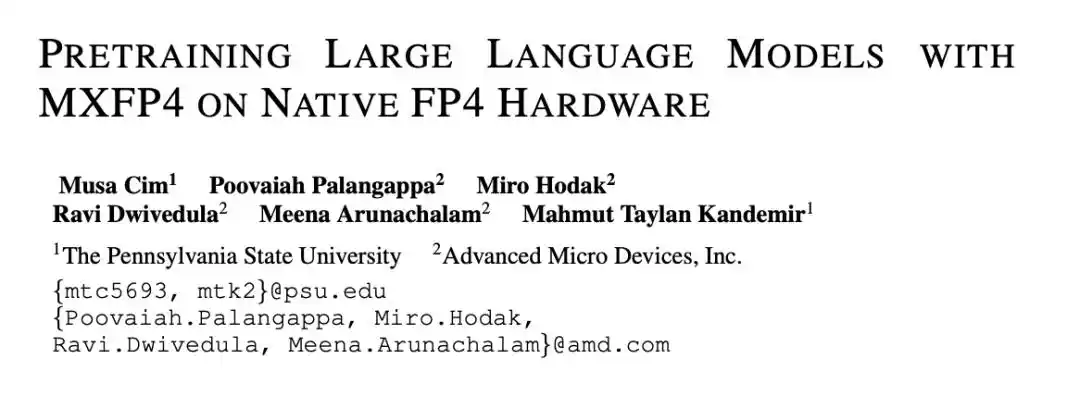
  • Paper Title: Pretraining large language models with MXFP4 on Native FP4 Hardware
  • Paper Link: https://arxiv.org/abs/2605.09825

This paper successfully completed the full-pipeline pre-training of Llama 3.1-8B using the MXFP4 format on AMD Instinct MI355X GPUs, achieving 9-10% faster end-to-end training speed compared to the FP8 baseline, with only an 8-9% additional token cost. This is the first complete experiment to finish large model pre-training on native FP4 hardware (not software simulation).

More importantly, the paper reveals the core issue: The source of FP4 training instability is not insufficient randomness, but the cumulative amplification of structural microscaling errors along sensitive gradient paths.

What is MXFP4

Before dissecting the paper, it's necessary to understand the MXFP4 data format.

Traditional integer quantization typically uses a single scaling factor for an entire tensor. The core design of MXFP4 is called "Micro-scaling": splitting a tensor into small blocks (e.g., groups of 32 elements), assigning a shared exponent (E8M0 format) to each block, where each element within the block is represented by a 4-bit floating-point number. The reconstruction formula can be written as:

Where E_shared is the maximum exponent within the block, and Q_FP4 is the value rounded to the nearest representable 4-bit floating-point value.

The benefit of micro-scaling is that each small block has its own dynamic range and won't be "held hostage" by global outliers. This significantly improves the representational quality of 4-bit floating-point numbers compared to naive global quantization.

However, even with micro-scaling, FP4 training remains unstable.

Troubleshooting Experiments: The Root of Instability

The research team first designed a step-by-step controlled troubleshooting experiment.

A complete Transformer linear layer computation involves three general matrix multiplication operations:

Fprop (Forward Propagation): Computes Y = XW^T, producing activation values.

Dgrad (Activation Gradient): Computes ∇X = ∇Y · W, propagating gradients back to the input.

Wgrad (Weight Gradient): Computes ∇W = (∇Y)^T · X, producing the gradient used to update the weights.

Keeping all other factors constant, the research team gradually replaced these three operations from FP8 to MXFP4, observing the impact of each step on convergence. All experiments were executed using native FP4 tensor cores on AMD Instinct MI355X, without relying on software simulation.

The training task followed the MLPerf standard setup, pre-training Llama 3.1-8B on the C4 dataset, with a convergence target of achieving a validation perplexity of 3.3.

The first two steps only incurred a modest additional token cost. However, once Wgrad was also switched to MXFP4, the cost directly jumped to 26-27%.

Wgrad is the bottleneck for FP4 training. Forward propagation and activation gradient have considerable tolerance for FP4 quantization, but once the weight gradient is quantized to 4 bits, convergence quality degrades significantly.

The industry's prevailing intuition was that FP4 quantization error is essentially a noise problem, which could be "smoothed" by injecting randomness. Two common strategies are:

Stochastic Rounding: Introduces randomness during quantization to make the expected value of rounding error zero.

Randomized Hadamard Rotation: Uses a Hadamard transform with random sign flips to scatter the data distribution before quantization.
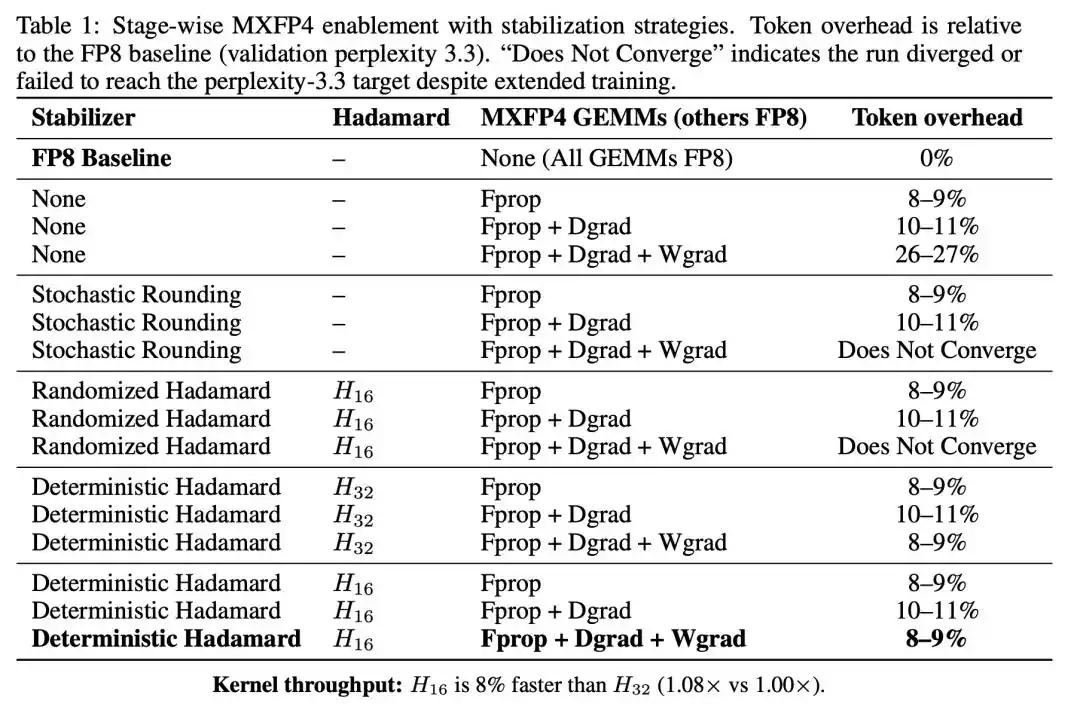
When Wgrad is quantized, both randomness strategies not only failed to stabilize training but directly caused non-convergence. Randomness didn't help; instead, it introduced more effective quantization error on the critical gradient path.

In contrast, deterministic Hadamard rotation dramatically reduced the full-pipeline token cost from 26-27% back to 8-9%, with the training trajectory closely tracking the FP8 baseline.

This is a highly diagnostic result. Both random and deterministic Hadamard rotations are orthogonal transformations that can scatter outlier energy distribution; theoretically, their effects on mitigating quantization error should be similar. Yet, their performance in the Wgrad scenario is completely opposite, revealing the nature of the problem:

FP4 training instability is driven by structural errors generated by MXFP4 micro-scaling on sensitive gradient paths. Randomness strategies failed because they introduced varying error patterns at each step, and these changing patterns accumulated along the gradient path, amplifying instability. Deterministic rotation was effective precisely because it applied the same transformation at every step, keeping the error pattern consistent and preventing error accumulation.

End-to-End Efficiency: Training Step Throughput +20%, Comprehensive Speedup 9-10%

After applying deterministic Hadamard rotation to the full-pipeline MXFP4, the efficiency data is as follows:
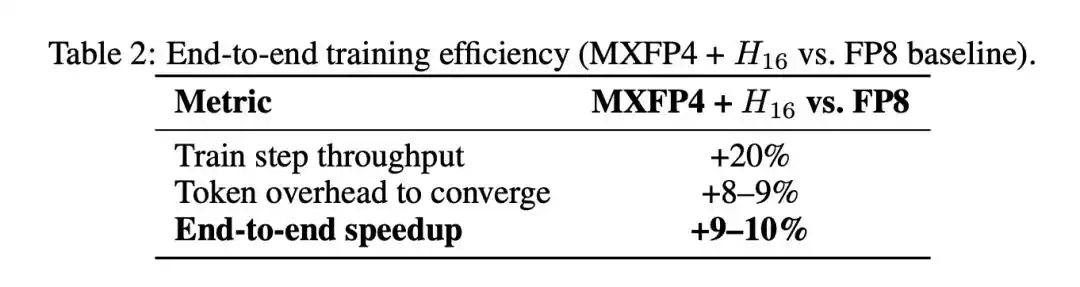
Training step throughput increased by 20%. After accounting for the additional 8-9% token cost, the end-to-end comprehensive speedup remains 9-10%.

Considering this directly halves precision from 8 bits to 4 bits, this convergence quality and speedup magnitude are quite significant.
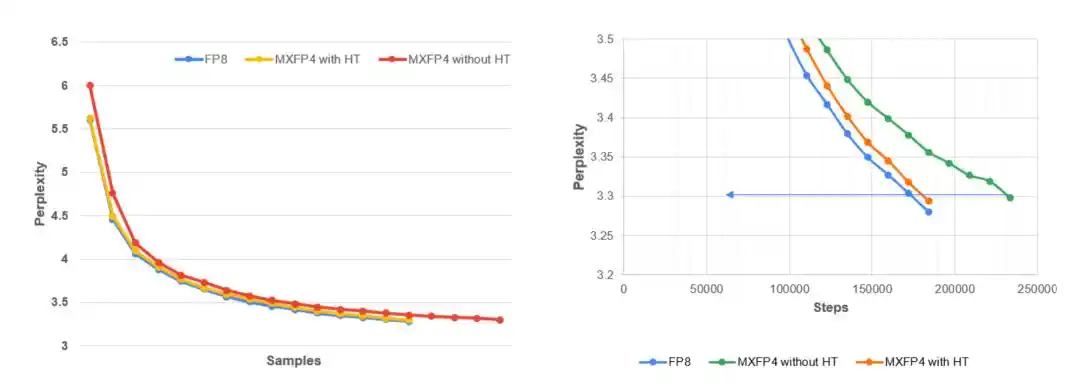
Left: Curve showing the validation perplexity of Llama 3.1–8B versus training token count during MLPerf pre-training on the C4 dataset. Results show MXFP4 + deterministic Hadamard performs very close to FP8, while unstabilized full-pipeline MXFP4 converges slower and is less stable. Right: Zoomed-in view of the later training stage. The MLPerf target perplexity is 3.3. Compared to the unstabilized MXFP4 run, deterministic Hadamard (H16) maintains much tighter alignment with the FP8 baseline.

Notably, the authors explicitly emphasize an important limitation in the paper: The effectiveness of this FP4 training scheme (MLPerf C4 dataset + Llama 3.1-8B) has been verified, but it cannot be assumed to seamlessly transfer to all models, all datasets, and all training methods. FP4 training behavior might be highly setting-dependent, and specific stabilization strategies need re-validation per scenario.

Conclusion

Placing this paper within the broader industry context reveals at least three layers of significance.

First layer: It answers a fundamental "why". Previous FP4 training work mostly focused on "how to make it not crash." This paper provides the first clear causal diagnosis: collapse stems from structural microscaling errors on the Wgrad path, not insufficient randomness. This diagnosis itself holds methodological value, telling subsequent researchers that when encountering instability in low-precision training, they should prioritize investigating structural error sources rather than blindly adding randomness.

Second layer: It pushes FP4 from "inference-only" towards "usable for training". Previously, the industry consensus was that FP4 was only suitable for inference quantization, with FP8 being the minimum for training. NVIDIA's emphasis on FP4 inference rather than training on Blackwell also reflects this judgment. This paper successfully ran full-pipeline pre-training on native FP4 hardware, meaning that the FP4 compute power prepared for inference on MI355X and Blackwell could theoretically also be used for training. If FP4 training proves viable on larger models and more scenarios, it effectively doubles the usable training compute of existing hardware.

Third layer: It utilizes the OCP open standard. MXFP4 is part of the OCP Microscaling format standard, jointly supported by seven companies: AMD, NVIDIA, Intel, Meta, Microsoft, Arm, and Qualcomm. Basing on an open standard means this method has portability across different vendors' hardware and won't be locked into a single ecosystem.

From FP16 to FP8, DeepSeek-V3 has already proven that halving precision can dramatically reduce training costs. From FP8 to FP4, this paper takes the critical first step. With each slash in precision, the entire economics of large model training are shifting.

This article is from the WeChat public account "Machine Heart" (ID: almosthuman2014), edited by Leng Mao.


Domande pertinenti

QAccording to AMD's new research, what is the root cause of training instability when using FP4 precision for large language models, and why do common randomization strategies fail to address it?

AAccording to the AMD and Penn State University paper, the root cause of instability in native FP4 training is not insufficient randomness, but rather the amplification of structural microscaling error accumulation along the sensitive gradient path, specifically the weight gradient (Wgrad) path. Common randomization strategies like stochastic rounding and randomized Hadamard transforms fail because they introduce varying error patterns at each step. When these inconsistent patterns accumulate along the gradient path, they amplify instability instead of mitigating it. In contrast, a deterministic Hadamard transform is effective because it applies the same consistent transformation at every step, preventing the accumulation of divergent error patterns.

QWhat is MXFP4, and how does its 'micro-scaling' design differ from traditional quantization methods?

AMXFP4 is a 4-bit floating-point data format part of the OCP Microscaling (MSFP) standard. Its core design feature is 'micro-scaling', which differs from traditional tensor-level quantization that uses a single scaling factor for an entire tensor. In MXFP4, a tensor is divided into small blocks (e.g., groups of 32 elements). Each block is assigned a shared exponent (E8M0 format), and each element within the block is represented by a 4-bit mantissa. This approach allows each block to have its own dynamic range, preventing the representation quality of the entire block from being 'held hostage' by a few global outliers, thereby improving representation quality compared to naive global quantization.

QIn the diagnostic experiment, which specific operation (Fprop, Dgrad, or Wgrad) was identified as the bottleneck when quantized to MXFP4, and what was the observed impact on training efficiency?

AIn the step-by-step diagnostic experiment, quantizing the Weight Gradient (Wgrad) operation to MXFP4 was identified as the bottleneck. While replacing the Forward Propagation (Fprop) and Activation Gradient (Dgrad) operations with MXFP4 incurred only a modest additional token overhead, replacing Wgrad with MXFP4 caused the token overhead to jump significantly to 26-27%, indicating a substantial degradation in convergence quality and training stability.

QWhat were the key performance results of the end-to-end MXFP4 training with the deterministic Hadamard stabilization on the Llama 3.1-8B model?

AThe end-to-end MXFP4 training with deterministic Hadamard stabilization on the Llama 3.1-8B model achieved a 20% improvement in training step throughput. After accounting for the additional 8-9% token overhead required for convergence compared to the FP8 baseline, the net end-to-end training speedup was 9-10%. The validation perplexity curve closely tracked that of the FP8 baseline, successfully meeting the MLPerf target perplexity of 3.3 on the C4 dataset.

QWhat are the broader implications of this research for the AI hardware and training ecosystem, according to the article's conclusion?

AThe research has three key broader implications for the ecosystem. First, it provides a fundamental diagnostic methodology, shifting the focus from adding randomness to identifying and addressing structural error sources in low-precision training. Second, it potentially moves FP4 from a 'inference-only' to a 'training-viable' precision, effectively doubling the usable training compute on native FP4 hardware like AMD MI355X and NVIDIA Blackwell if validated at scale. Third, by building on the OCP Microscaling (MXFP) open standard supported by multiple major companies, the approach promotes hardware portability and avoids vendor lock-in, benefiting the wider industry.

Letture associate

Trump, the "Stock Market Manipulator" in U.S. Stocks, Lifts Up the Entire Quantum Computing Sector

"Trump, the 'U.S. Stock Market Mastermind,' Boosts the Entire Quantum Computing Sector" This article details how former U.S. President Donald Trump's policies and public statements have significantly influenced the stock market, particularly in the quantum computing sector. A key example is the U.S. government's direct investment in Intel stock in August 2025, which yielded over $45 billion in gains within seven months. Trump publicly credited himself for this profit. Recently, the Trump administration announced a new $2 billion initiative. Through the Department of Commerce, funding from the CHIPS and Science Act will be provided to nine quantum computing companies in exchange for minority, non-controlling equity stakes. The recipients include IBM ($1B for its subsidiary Anderon), GlobalFoundries ($375M), and listed companies like D-Wave, Infleqtion, and Rigetti ($100M each). Private firms such as Atom Computing and PsiQuantum also received $100M. This "investment-for-equity" strategy marks a shift from pure subsidies to an "active investor" model under the CHIPS Act. The announcement immediately boosted quantum computing stocks. The article frames this as part of Trump's "America First" industrial policy, aimed at securing U.S. technological leadership, similar to past investments in semiconductors, rare earths, and lithium. The author suggests this pattern of government-backed market intervention, alongside Trump's personal stock endorsements, is a hallmark of his approach to driving market gains and may continue in sectors like defense and advanced energy.

marsbit16 min fa

Trump, the "Stock Market Manipulator" in U.S. Stocks, Lifts Up the Entire Quantum Computing Sector

marsbit16 min fa

2-Year Return of 225x? Uncovering Mysterious Researcher Serenity's AI 'Choke Point' Investment Strategy

"2 Years, 225x Returns? Decoding Serenity's AI 'Chokepoint' Investment Strategy" This article profiles Serenity (formerly AleaBito on Reddit's WallStreetBets), a pseudonymous researcher known for exceptional returns by applying a "Chokepoint Theory" to AI investments. His methodology involves a bottom-up, reverse-engineering approach of the AI hardware supply chain. He identifies critical, irreplaceable physical bottlenecks (chokepoints) that could cripple entire AI systems if disrupted, bypassing Wall Street's top-down focus on major tech firms. Key examples include pinpointing essential suppliers in the emerging Silicon Photonics and Co-Packaged Optics (CPO) sector—components vital for next-generation AI data center interconnects—such as niche companies providing external laser sources, molecular beam epitaxy equipment, or ultra-pure raw materials. Similarly, he highlights geopolitical "chokepoints" in the humanoid robotics supply chain, where key hardware components and rare earth elements are concentrated in Asia. Serenity validates his investment theses through rigorous adversarial AI debates before publication. He leverages institutional blind spots, directing a sophisticated network of retail followers toward undervalued, under-covered micro-cap stocks across global exchanges, driving significant price movements in names like Sivers ($SIVE), Soitec, and Raspberry Pi ($RPI). While presenting a powerful framework for finding critical system dependencies, the strategy carries inherent risks: extreme concentration on specific technological paths, liquidity issues in small-cap stocks, and accusations of market manipulation. Ultimately, the core takeaway is not to copy his trades, but to adopt his analytical lens: to ask which silent, physical switches hold irreplaceable power within a complex system and invest ahead of the market's recognition of their value.

链捕手18 min fa

2-Year Return of 225x? Uncovering Mysterious Researcher Serenity's AI 'Choke Point' Investment Strategy

链捕手18 min fa

Bitroot Public Chain Invited to Attend Tencent Cloud Singapore AI Conference, Discussing the Future Alongside Solana

On May 19, Bitroot, an emerging Layer 1 blockchain, participated in the Tencent Cloud AI Summit in Singapore alongside key industry players like Solana Foundation. The event explored the intersection of AI infrastructure, enterprise applications, AI Agents, and Web3. Bitroot's invitation, despite being pre-mainnet, highlights industry interest in its focus on high-performance, AI-native architecture tailored for future AI Agent execution and verifiable on-chain automation. Bitroot CEO Juan Jose emphasized that AI competition is shifting from model performance to data, real-world application scenarios, and trust infrastructure. He argued that for AI Agents to evolve from assistants to autonomous executors managing transactions and assets, they require low-latency, low-cost, and high-throughput blockchain environments. Bitroot aims to address this through its EVM-compatible design, optimistic parallel execution, and a consensus mechanism targeting high scalability. Currently in its Testnet 5.0 phase, Bitroot reports metrics like over 50,000 peak TPS and sub-0.3 second average block time. Its narrative positions it within a growing landscape where next-generation Layer 1s like Monad and Aptos also compete on performance, while Bitroot differentiates by integrating AI computational capabilities natively across its stack. The summit underscored that the fusion of AI and Web3 is moving from concept to infrastructure competition, where networks balancing performance, security, and verifiability will be crucial for enabling scalable AI-driven applications.

marsbit1 h fa

Bitroot Public Chain Invited to Attend Tencent Cloud Singapore AI Conference, Discussing the Future Alongside Solana

marsbit1 h fa

Hedge Fund Q1 Interpretation: Everyone Is Selling Software, Buying Chips

Hedge Funds and Mutual Funds Aligned in Q1: Dumping Software, Buying Chips A clear consensus emerged among major U.S. hedge funds and mutual funds in Q1: they were simultaneously selling software stocks and pouring capital into the semiconductor sector. This aggressive rotation pushed semiconductor exposure in hedge fund long portfolios to a record high. Hedge funds delivered a 7% return year-to-date, while only 30% of large-cap active mutual funds outperformed their benchmarks. The average short interest for S&P 500 constituents rose to 3% of market cap, the highest since 2011. Within technology, the structural shift was stark. Hedge funds' semiconductor weighting hit an all-time high, while software fell to its lowest since 2019. Excluding Microsoft, mutual funds' relative overexposure to semis vs. software was the largest since 2012. Microsoft was among the most net-sold stocks by both groups. Hedge funds net purchased semiconductor names like LRCX and AMAT. Strategies diverged on leverage and cash. Hedge funds increased their net exposure to near a one-year high after an initial cut. Mutual funds raised their cash allocation, though it remains historically low at 1.4%. Sector alignment was high in Industrials (both overweight) but divergent in Tech: hedge funds increased their Tech net tilt by a record 853 basis points, while mutual funds reduced theirs. Clear splits also appeared in Financials and Consumer Discretionary. Four stocks appeared on both Goldman's hedge fund VIP and mutual fund overweight lists: BA, MA, MRVL, and V. This "shared favorites" basket has returned 10% YTD, outperforming the equal-weight S&P 500. Notably, all "Magnificent Seven" stocks are on the hedge fund VIP list but are uniformly underweighted by mutual funds.

marsbit1 h fa

Hedge Fund Q1 Interpretation: Everyone Is Selling Software, Buying Chips

marsbit1 h fa

Trading

Spot
Futures

Articoli Popolari

Cosa è $S$

Comprendere SPERO: Una Panoramica Completa Introduzione a SPERO Mentre il panorama dell'innovazione continua a evolversi, l'emergere delle tecnologie web3 e dei progetti di criptovaluta gioca un ruolo fondamentale nel plasmare il futuro digitale. Un progetto che ha attirato l'attenzione in questo campo dinamico è SPERO, denotato come SPERO,$$s$. Questo articolo mira a raccogliere e presentare informazioni dettagliate su SPERO, per aiutare gli appassionati e gli investitori a comprendere le sue basi, obiettivi e innovazioni nei domini web3 e crypto. Che cos'è SPERO,$$s$? SPERO,$$s$ è un progetto unico all'interno dello spazio crypto che cerca di sfruttare i principi della decentralizzazione e della tecnologia blockchain per creare un ecosistema che promuove l'impegno, l'utilità e l'inclusione finanziaria. Il progetto è progettato per facilitare interazioni peer-to-peer in modi nuovi, fornendo agli utenti soluzioni e servizi finanziari innovativi. Al suo interno, SPERO,$$s$ mira a responsabilizzare gli individui fornendo strumenti e piattaforme che migliorano l'esperienza dell'utente nello spazio delle criptovalute. Questo include la possibilità di metodi di transazione più flessibili, la promozione di iniziative guidate dalla comunità e la creazione di percorsi per opportunità finanziarie attraverso applicazioni decentralizzate (dApps). La visione sottostante di SPERO,$$s$ ruota attorno all'inclusività, cercando di colmare le lacune all'interno della finanza tradizionale mentre sfrutta i vantaggi della tecnologia blockchain. Chi è il Creatore di SPERO,$$s$? L'identità del creatore di SPERO,$$s$ rimane piuttosto oscura, poiché ci sono risorse pubblicamente disponibili limitate che forniscono informazioni dettagliate sul suo fondatore o fondatori. Questa mancanza di trasparenza può derivare dall'impegno del progetto per la decentralizzazione—un ethos che molti progetti web3 condividono, dando priorità ai contributi collettivi rispetto al riconoscimento individuale. Centrando le discussioni attorno alla comunità e ai suoi obiettivi collettivi, SPERO,$$s$ incarna l'essenza dell'empowerment senza mettere in evidenza individui specifici. Pertanto, comprendere l'etica e la missione di SPERO rimane più importante che identificare un creatore singolo. Chi sono gli Investitori di SPERO,$$s$? SPERO,$$s$ è supportato da una varietà di investitori che vanno dai capitalisti di rischio agli investitori angelici dedicati a promuovere l'innovazione nel settore crypto. Il focus di questi investitori generalmente si allinea con la missione di SPERO—dando priorità a progetti che promettono avanzamenti tecnologici sociali, inclusività finanziaria e governance decentralizzata. Queste fondazioni di investitori sono tipicamente interessate a progetti che non solo offrono prodotti innovativi, ma contribuiscono anche positivamente alla comunità blockchain e ai suoi ecosistemi. Il supporto di questi investitori rafforza SPERO,$$s$ come un concorrente degno di nota nel dominio in rapida evoluzione dei progetti crypto. Come Funziona SPERO,$$s$? SPERO,$$s$ impiega un framework multifunzionale che lo distingue dai progetti di criptovaluta convenzionali. Ecco alcune delle caratteristiche chiave che sottolineano la sua unicità e innovazione: Governance Decentralizzata: SPERO,$$s$ integra modelli di governance decentralizzati, responsabilizzando gli utenti a partecipare attivamente ai processi decisionali riguardanti il futuro del progetto. Questo approccio favorisce un senso di proprietà e responsabilità tra i membri della comunità. Utilità del Token: SPERO,$$s$ utilizza il proprio token di criptovaluta, progettato per servire varie funzioni all'interno dell'ecosistema. Questi token abilitano transazioni, premi e la facilitazione dei servizi offerti sulla piattaforma, migliorando l'impegno e l'utilità complessivi. Architettura Stratificata: L'architettura tecnica di SPERO,$$s$ supporta la modularità e la scalabilità, consentendo un'integrazione fluida di funzionalità e applicazioni aggiuntive man mano che il progetto evolve. Questa adattabilità è fondamentale per mantenere la rilevanza nel panorama crypto in continua evoluzione. Coinvolgimento della Comunità: Il progetto enfatizza iniziative guidate dalla comunità, impiegando meccanismi che incentivano la collaborazione e il feedback. Nutrendo una comunità forte, SPERO,$$s$ può affrontare meglio le esigenze degli utenti e adattarsi alle tendenze di mercato. Focus sull'Inclusione: Offrendo basse commissioni di transazione e interfacce user-friendly, SPERO,$$s$ mira ad attrarre una base utenti diversificata, inclusi individui che potrebbero non aver precedentemente interagito nello spazio crypto. Questo impegno per l'inclusione si allinea con la sua missione generale di empowerment attraverso l'accessibilità. Cronologia di SPERO,$$s$ Comprendere la storia di un progetto fornisce preziose intuizioni sulla sua traiettoria di sviluppo e sui traguardi. Di seguito è riportata una cronologia suggerita che mappa eventi significativi nell'evoluzione di SPERO,$$s$: Fase di Concettualizzazione e Ideazione: Le idee iniziali che formano la base di SPERO,$$s$ sono state concepite, allineandosi strettamente con i principi di decentralizzazione e focus sulla comunità all'interno dell'industria blockchain. Lancio del Whitepaper del Progetto: Dopo la fase concettuale, è stato rilasciato un whitepaper completo che dettaglia la visione, gli obiettivi e l'infrastruttura tecnologica di SPERO,$$s$ per suscitare interesse e feedback dalla comunità. Costruzione della Comunità e Prime Interazioni: Sono stati effettuati sforzi attivi di outreach per costruire una comunità di early adopters e potenziali investitori, facilitando discussioni attorno agli obiettivi del progetto e ottenendo supporto. Evento di Generazione del Token: SPERO,$$s$ ha condotto un evento di generazione del token (TGE) per distribuire i propri token nativi ai primi sostenitori e stabilire una liquidità iniziale all'interno dell'ecosistema. Lancio della Prima dApp: La prima applicazione decentralizzata (dApp) associata a SPERO,$$s$ è stata attivata, consentendo agli utenti di interagire con le funzionalità principali della piattaforma. Sviluppo Continuo e Partnership: Aggiornamenti e miglioramenti continui alle offerte del progetto, inclusi partnership strategiche con altri attori nello spazio blockchain, hanno plasmato SPERO,$$s$ in un concorrente competitivo e in evoluzione nel mercato crypto. Conclusione SPERO,$$s$ rappresenta una testimonianza del potenziale del web3 e delle criptovalute di rivoluzionare i sistemi finanziari e responsabilizzare gli individui. Con un impegno per la governance decentralizzata, il coinvolgimento della comunità e funzionalità progettate in modo innovativo, apre la strada verso un panorama finanziario più inclusivo. Come per qualsiasi investimento nello spazio crypto in rapida evoluzione, si incoraggiano potenziali investitori e utenti a ricercare approfonditamente e a impegnarsi in modo riflessivo con gli sviluppi in corso all'interno di SPERO,$$s$. Il progetto mostra lo spirito innovativo dell'industria crypto, invitando a ulteriori esplorazioni delle sue innumerevoli possibilità. Mentre il percorso di SPERO,$$s$ è ancora in fase di sviluppo, i suoi principi fondamentali potrebbero effettivamente influenzare il futuro di come interagiamo con la tecnologia, la finanza e tra di noi in ecosistemi digitali interconnessi.

75 Totale visualizzazioniPubblicato il 2024.12.17Aggiornato il 2024.12.17

Cosa è $S$

Cosa è AGENT S

Agent S: Il Futuro dell'Interazione Autonoma in Web3 Introduzione Nel panorama in continua evoluzione di Web3 e criptovalute, le innovazioni stanno costantemente ridefinendo il modo in cui gli individui interagiscono con le piattaforme digitali. Uno di questi progetti pionieristici, Agent S, promette di rivoluzionare l'interazione uomo-computer attraverso il suo framework agentico aperto. Aprendo la strada a interazioni autonome, Agent S mira a semplificare compiti complessi, offrendo applicazioni trasformative nell'intelligenza artificiale (AI). Questa esplorazione dettagliata approfondirà le complessità del progetto, le sue caratteristiche uniche e le implicazioni per il dominio delle criptovalute. Cos'è Agent S? Agent S si presenta come un innovativo framework agentico aperto, progettato specificamente per affrontare tre sfide fondamentali nell'automazione dei compiti informatici: Acquisizione di Conoscenze Specifiche del Dominio: Il framework apprende in modo intelligente da varie fonti di conoscenza esterne ed esperienze interne. Questo approccio duale gli consente di costruire un ricco repository di conoscenze specifiche del dominio, migliorando le sue prestazioni nell'esecuzione dei compiti. Pianificazione su Lungo Orizzonte di Compiti: Agent S impiega una pianificazione gerarchica potenziata dall'esperienza, un approccio strategico che facilita la suddivisione e l'esecuzione efficiente di compiti complessi. Questa caratteristica migliora significativamente la sua capacità di gestire più sottocompiti in modo efficiente ed efficace. Gestione di Interfacce Dinamiche e Non Uniformi: Il progetto introduce l'Interfaccia Agente-Computer (ACI), una soluzione innovativa che migliora l'interazione tra agenti e utenti. Utilizzando Modelli Linguistici Multimodali di Grandi Dimensioni (MLLM), Agent S può navigare e manipolare senza sforzo diverse interfacce grafiche utente. Attraverso queste caratteristiche pionieristiche, Agent S fornisce un framework robusto che affronta le complessità coinvolte nell'automazione dell'interazione umana con le macchine, preparando il terreno per innumerevoli applicazioni nell'AI e oltre. Chi è il Creatore di Agent S? Sebbene il concetto di Agent S sia fondamentalmente innovativo, informazioni specifiche sul suo creatore rimangono elusive. Il creatore è attualmente sconosciuto, il che evidenzia sia la fase embrionale del progetto sia la scelta strategica di mantenere i membri fondatori sotto anonimato. Indipendentemente dall'anonimato, l'attenzione rimane sulle capacità e sul potenziale del framework. Chi sono gli Investitori di Agent S? Poiché Agent S è relativamente nuovo nell'ecosistema crittografico, informazioni dettagliate riguardanti i suoi investitori e sostenitori finanziari non sono documentate esplicitamente. La mancanza di approfondimenti pubblicamente disponibili sulle fondazioni di investimento o sulle organizzazioni che supportano il progetto solleva interrogativi sulla sua struttura di finanziamento e sulla roadmap di sviluppo. Comprendere il supporto è cruciale per valutare la sostenibilità del progetto e il suo potenziale impatto sul mercato. Come Funziona Agent S? Al centro di Agent S si trova una tecnologia all'avanguardia che gli consente di funzionare efficacemente in contesti diversi. Il suo modello operativo è costruito attorno a diverse caratteristiche chiave: Interazione Uomo-Computer Simile a Quella Umana: Il framework offre una pianificazione AI avanzata, cercando di rendere le interazioni con i computer più intuitive. Mimando il comportamento umano nell'esecuzione dei compiti, promette di elevare le esperienze degli utenti. Memoria Narrativa: Utilizzata per sfruttare esperienze di alto livello, Agent S utilizza la memoria narrativa per tenere traccia delle storie dei compiti, migliorando così i suoi processi decisionali. Memoria Episodica: Questa caratteristica fornisce agli utenti una guida passo-passo, consentendo al framework di offrire supporto contestuale mentre i compiti si sviluppano. Supporto per OpenACI: Con la capacità di funzionare localmente, Agent S consente agli utenti di mantenere il controllo sulle proprie interazioni e flussi di lavoro, allineandosi con l'etica decentralizzata di Web3. Facile Integrazione con API Esterne: La sua versatilità e compatibilità con varie piattaforme AI garantiscono che Agent S possa adattarsi senza problemi agli ecosistemi tecnologici esistenti, rendendolo una scelta attraente per sviluppatori e organizzazioni. Queste funzionalità contribuiscono collettivamente alla posizione unica di Agent S all'interno dello spazio crittografico, poiché automatizza compiti complessi e multi-fase con un intervento umano minimo. Man mano che il progetto evolve, le sue potenziali applicazioni in Web3 potrebbero ridefinire il modo in cui si svolgono le interazioni digitali. Cronologia di Agent S Lo sviluppo e le tappe di Agent S possono essere riassunti in una cronologia che evidenzia i suoi eventi significativi: 27 Settembre 2024: Il concetto di Agent S è stato lanciato in un documento di ricerca completo intitolato “Un Framework Agentico Aperto che Usa i Computer Come un Umano”, mostrando le basi per il progetto. 10 Ottobre 2024: Il documento di ricerca è stato reso pubblicamente disponibile su arXiv, offrendo un'esplorazione approfondita del framework e della sua valutazione delle prestazioni basata sul benchmark OSWorld. 12 Ottobre 2024: È stata rilasciata una presentazione video, fornendo un'idea visiva delle capacità e delle caratteristiche di Agent S, coinvolgendo ulteriormente potenziali utenti e investitori. Questi indicatori nella cronologia non solo illustrano i progressi di Agent S, ma indicano anche il suo impegno per la trasparenza e il coinvolgimento della comunità. Punti Chiave su Agent S Man mano che il framework Agent S continua a evolversi, diversi attributi chiave si distinguono, sottolineando la sua natura innovativa e il potenziale: Framework Innovativo: Progettato per fornire un uso intuitivo dei computer simile all'interazione umana, Agent S porta un approccio nuovo all'automazione dei compiti. Interazione Autonoma: La capacità di interagire autonomamente con i computer attraverso GUI segna un passo avanti verso soluzioni informatiche più intelligenti ed efficienti. Automazione di Compiti Complessi: Con la sua metodologia robusta, può automatizzare compiti complessi e multi-fase, rendendo i processi più veloci e meno soggetti a errori. Miglioramento Continuo: I meccanismi di apprendimento consentono ad Agent S di migliorare dalle esperienze passate, migliorando continuamente le sue prestazioni e la sua efficacia. Versatilità: La sua adattabilità attraverso diversi ambienti operativi come OSWorld e WindowsAgentArena garantisce che possa servire un'ampia gamma di applicazioni. Man mano che Agent S si posiziona nel panorama di Web3 e delle criptovalute, il suo potenziale per migliorare le capacità di interazione e automatizzare i processi segna un significativo avanzamento nelle tecnologie AI. Attraverso il suo framework innovativo, Agent S esemplifica il futuro delle interazioni digitali, promettendo un'esperienza più fluida ed efficiente per gli utenti in vari settori. Conclusione Agent S rappresenta un audace passo avanti nell'unione tra AI e Web3, con la capacità di ridefinire il modo in cui interagiamo con la tecnologia. Sebbene sia ancora nelle sue fasi iniziali, le possibilità per la sua applicazione sono vaste e coinvolgenti. Attraverso il suo framework completo che affronta sfide critiche, Agent S mira a portare le interazioni autonome al centro dell'esperienza digitale. Man mano che ci addentriamo nei regni delle criptovalute e della decentralizzazione, progetti come Agent S giocheranno senza dubbio un ruolo cruciale nel plasmare il futuro della tecnologia e della collaborazione uomo-computer.

526 Totale visualizzazioniPubblicato il 2025.01.14Aggiornato il 2025.01.14

Cosa è AGENT S

Come comprare S

Benvenuto in HTX.com! Abbiamo reso l'acquisto di Sonic (S) semplice e conveniente. Segui la nostra guida passo passo per intraprendere il tuo viaggio nel mondo delle criptovalute.Step 1: Crea il tuo Account HTXUsa la tua email o numero di telefono per registrarti il tuo account gratuito su HTX. Vivi un'esperienza facile e sblocca tutte le funzionalità,Crea il mio accountStep 2: Vai in Acquista crypto e seleziona il tuo metodo di pagamentoCarta di credito/debito: utilizza la tua Visa o Mastercard per acquistare immediatamente SonicS.Bilancio: Usa i fondi dal bilancio del tuo account HTX per fare trading senza problemi.Terze parti: abbiamo aggiunto metodi di pagamento molto utilizzati come Google Pay e Apple Pay per maggiore comodità.P2P: Fai trading direttamente con altri utenti HTX.Over-the-Counter (OTC): Offriamo servizi su misura e tassi di cambio competitivi per i trader.Step 3: Conserva Sonic (S)Dopo aver acquistato Sonic (S), conserva nel tuo account HTX. In alternativa, puoi inviare tramite trasferimento blockchain o scambiare per altre criptovalute.Step 4: Scambia Sonic (S)Scambia facilmente Sonic (S) nel mercato spot di HTX. Accedi al tuo account, seleziona la tua coppia di trading, esegui le tue operazioni e monitora in tempo reale. Offriamo un'esperienza user-friendly sia per chi ha appena iniziato che per i trader più esperti.

937 Totale visualizzazioniPubblicato il 2025.01.15Aggiornato il 2025.03.21

Come comprare S

Discussioni

Benvenuto nella Community HTX. Qui puoi rimanere informato sugli ultimi sviluppi della piattaforma e accedere ad approfondimenti esperti sul mercato. Le opinioni degli utenti sul prezzo di S S sono presentate come di seguito.

活动图片













