NEAR to Airdrop 330,000 Tokens, Betting on TVL Reaching $70 Million

Foresight NewsPubblicato 2026-06-12Pubblicato ultima volta 2026-06-12

Introduzione

On June 11th, NEAR Protocol launched the Near@3.33 Milestone Incentive Program, targeting users of its Confidential Intents privacy cross-chain execution feature. The program will distribute 333,333 milestone tokens when the Confidential Intents Total Value Locked (TVL) reaches $70 million. Users must have conducted Confidential transactions on near.com and maintain a Confidential balance above $100 in any asset to qualify, with a single wallet capped at 2% of the current airdrop pool. The milestone tokens will be locked upon receipt and cannot be sold or transferred. They can only be converted 1:1 to NEAR tokens once NEAR's Volume Weighted Average Price (VWAP) maintains $3.33 or higher for three consecutive trading days. As of the report, Confidential Intents TVL exceeds $20.69 million, needing roughly a 3x increase to trigger the airdrop. Confidential Intents, launched in February 2026, is NEAR's privacy execution layer designed to prevent MEV, front-running, and strategy leaks by building confidentiality directly into the execution environment. Its TVL has grown from zero to approximately $15 million in about three months. NEAR token price, which surged from around $1 in April to a peak of $3.08, currently trades near $2. The program aims to boost user activity for Confidential Intents, with future incentive rounds planned as community engagement increases.


By: Ma He, Foresight News


On June 11th, NEAR Protocol officially launched the Near@3.33 Milestone Incentive Program. This program is designed for users of the Confidential Intents private cross-chain execution function. When the total TVL of Confidential Intents reaches $70 million, a snapshot will be triggered, and the first round of 333,333 milestone tokens will be distributed to eligible accounts.


With airdrops generally being shelved by project teams and token prices remaining low in the bear market, is NEAR making another big move in the privacy space?


Airdrop Details


According to the official announcement, the first round will distribute 333,333 milestone tokens. When the aggregated TVL of Confidential Intents reaches $70 million, the system will automatically take a snapshot and allocate tokens to eligible accounts. Users' past activities will continue to be counted towards the allocation weight until the snapshot occurs; newly joined users can still gain a higher share by increasing their activity on the platform.


The specific eligibility threshold requires users to have conducted Confidential transactions on near.com. The Confidential balance must remain above $100 (in any asset), and holdings and transaction activities exceeding the threshold will affect the final allocation ratio. A single wallet can receive a maximum of 2% of the current airdrop pool.


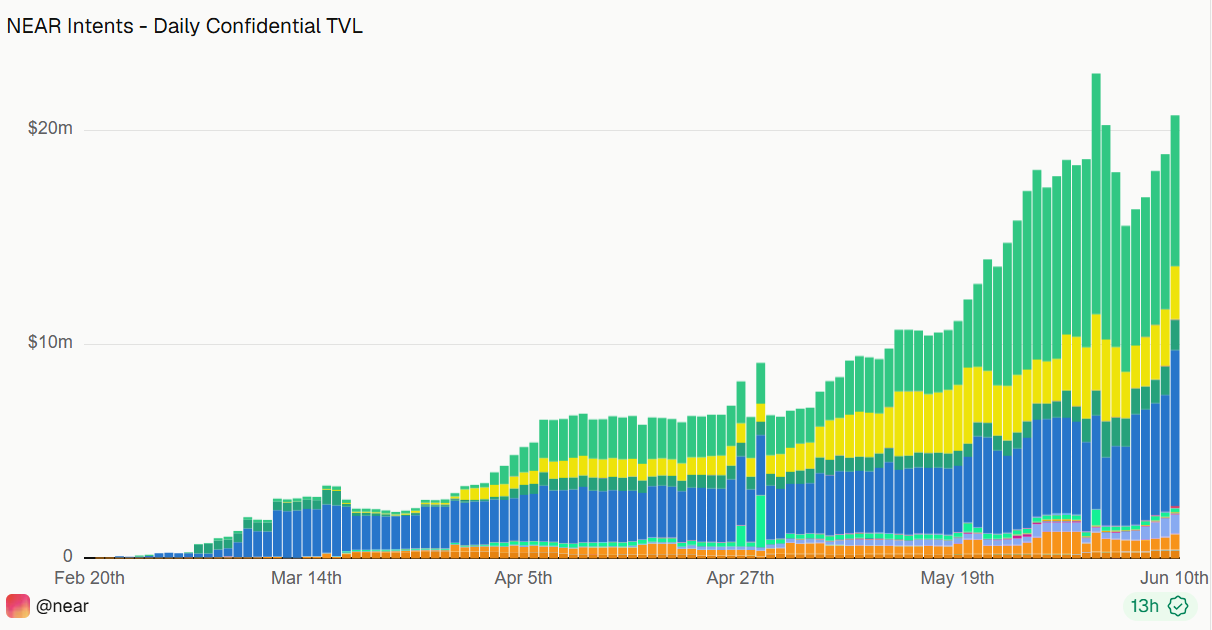
Currently, according to the latest data from Dune's dashboard, NEAR's Confidential Intents total TVL has exceeded $20.69 million, meaning it needs to grow another 3 times to reach the airdrop threshold.


The NEAR milestone tokens will be locked upon receipt and cannot be sold or transferred. They can only be converted into NEAR tokens at a 1:1 ratio when the volume-weighted average price (VWAP) of NEAR tokens remains at or above $3.33 for three consecutive trading days.


The official statement also indicates that subsequent rounds of incentive programs will be launched gradually. The trigger conditions for each round will increase correspondingly with the growth of community activity, continuously encouraging higher levels of participation.


Confidential Intents


Confidential Intents is the privacy execution layer of the NEAR Intents protocol, officially launched in late February 2026. It is not a simple coin mixer or post-hoc anonymization tool but builds confidentiality directly into the execution environment, allowing users to achieve limited visibility when conducting cross-chain transactions.


Confidential Intents is initially operated by decentralized permissioned validators and connects to the NEAR mainnet via a bridge based on Trusted Execution Environments (TEE).


Issues like MEV, front-running, strategy leaks, and forced liquidations have long plagued DeFi players on public chains. Confidential Intents avoids these risks from the source through sharded execution: retail users no longer lose value to sandwich attacks, large holders can execute substantial operations without exposing their intent, institutions can protect their positions and negotiation information while retaining selective disclosure capabilities to meet compliance and audit needs. Enterprise application scenarios include confidential handling of sensitive operations such as salary payments, treasury management, and supply chain payments.


Since its launch, according to official NEAR and community data, the TVL of Confidential Intents has grown from zero to approximately $15 million in about three months.


The product addresses real needs, and the incentives will also boost user participation and activity. For Confidential Intents to reach the $70 million target, perhaps under the ongoing wave of AI and privacy narratives, it might have a chance to achieve it in the second half of this year.
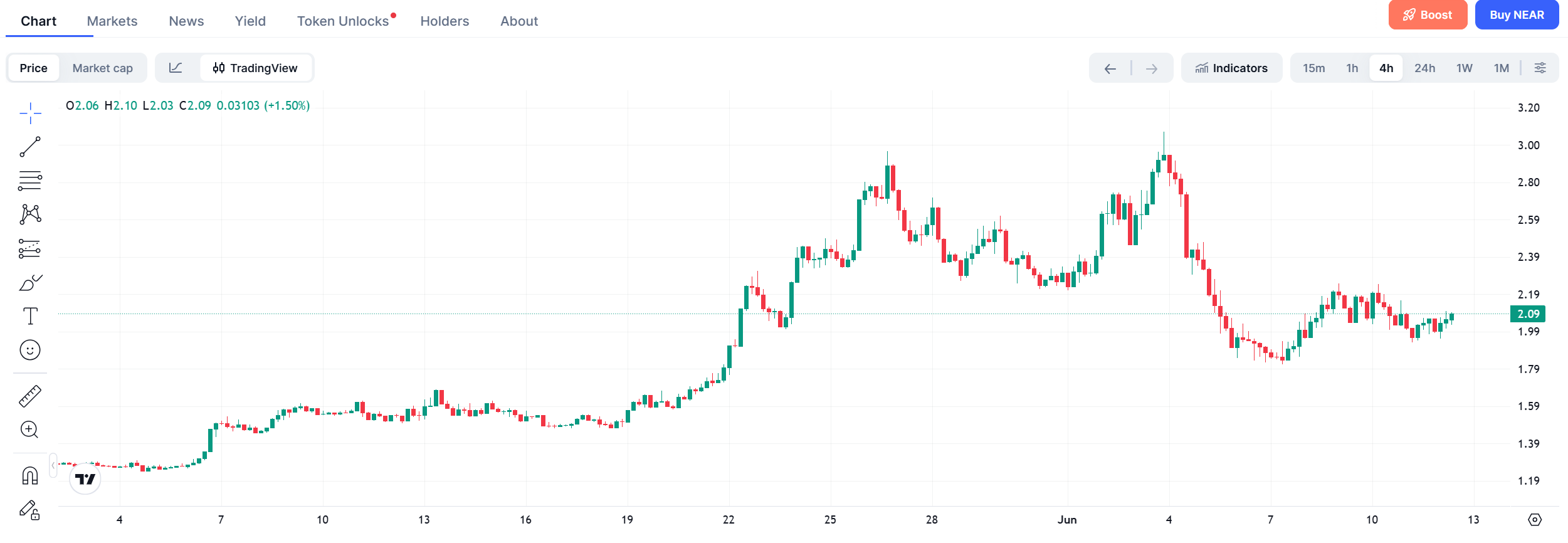


Previously, the NEAR token price surged under the AI narrative from around $1 in April this year to a high of $3.08, currently fluctuating around $2. When the crypto market conditions improve and liquidity becomes more abundant, the locked milestone tokens will convert into fully liquid NEAR tokens.


Domande pertinenti

QWhat is the trigger condition for NEAR Protocol's milestone token airdrop to begin distribution?

AThe first round of 333,333 milestone tokens will be distributed once the total TVL of Confidential Intents reaches $70 million.

QWhat are the eligibility criteria for users to participate in the NEAR@3.33 milestone incentive airdrop?

AUsers must have performed a Confidential transaction on near.com and maintain a Confidential balance above $100 (in any asset). Holdings and transaction activity beyond the threshold influence the final allocation share.

QWhat is Confidential Intents on the NEAR Protocol, and what problem does it aim to solve?

AConfidential Intents is the privacy execution layer for NEAR's Intents protocol. It builds confidentiality directly into the execution environment to provide users with limited visibility during cross-chain transactions, aiming to solve issues like MEV, front-running, strategy leakage, and forced liquidations.

QWhen do the milestone tokens received from the airdrop become convertible to NEAR tokens?

AThe milestone tokens are locked upon receipt and can only be converted to NEAR tokens at a 1:1 ratio when the volume-weighted average price (VWAP) of NEAR tokens remains at or above $3.33 for three consecutive trading days.

QAccording to the article, what is the current approximate TVL of NEAR's Confidential Intents and how close is it to the airdrop trigger target?

AAccording to the article, the current TVL of Confidential Intents is over $20.69 million. It needs to grow approximately 3.4 times from this level to reach the $70 million airdrop trigger target.

Letture associate

2026 Altcoin Season Guide: Current Values & Market Signals, Is It Time to Prepare for Altcoin Season?

Altcoin Season Guide 2026: Signals & Timing Analysis This guide explores the dynamics of an "altcoin season," defined as a 90-day period where at least 75% of the top 50 cryptocurrencies outperform Bitcoin (BTC). Historically signaling capital rotation from BTC to alternative assets ("alts"), these periods have evolved. Key differences for the 2026 market cycle include the "ETF Wall," where institutional capital via spot Bitcoin ETFs may remain concentrated in BTC, potentially slowing a broad altseason. A genuine, sustainable altseason now likely requires BTC profit-taking combined with new retail and on-chain liquidity entering the wider market. Analysts use tools like the Altseason Index (values >75 indicate an altseason) but also monitor key pairs like ETH/BTC and SOL/BTC for confirmation. Additional signals include a declining Bitcoin Dominance rate (ideally below 40-50%), accelerating altcoin total market cap growth, and surges in trading volume and social sentiment for alts. Modern altseasons are increasingly narrative-driven and selective, not uniform across all coins. Capital typically rotates in stages: from BTC to major altcoins (like ETH), then into leading narratives (e.g., AI, RWA, DePIN), and finally into mid/small-cap projects and meme coins. The peak phase is often marked by extreme greed, parabolic rises, and high leverage, serving as a cautionary signal. For preparation, investors are advised to build a quality watchlist based on fundamentals, product traction, and team strength. Strategies should include portfolio diversification, disciplined risk management (position sizing, stop-losses, stablecoin reserves), and capitalizing on sector rotations rather than chasing past winners. While precise timing is uncertain, historical patterns suggest strong altcoin rallies often follow Bitcoin halvings by 12-30 months. For the 2024 halving cycle, 2026-2027 could present favorable conditions if supported by macro liquidity, technological narratives, and a sustained drop in Bitcoin Dominance. A true, broad altseason is unlikely if Bitcoin experiences a sharp crash (>20%), as capital tends to flee the entire crypto market.

Foresight News52 min fa

2026 Altcoin Season Guide: Current Values & Market Signals, Is It Time to Prepare for Altcoin Season?

Foresight News52 min fa

This Might Be the Most Stunning Image at This Year's WAIC!

This article introduces Shangtang's newly released multimodal AI model, **SenseNova U1 Pro**, unveiled at WAIC 2026. The model is highlighted for its ability to generate **native 8K-resolution images** with exceptional detail and coherence, even in extremely wide-format compositions. It goes beyond simple image generation by employing a **"图文交错思维" (interleaved image-text reasoning)** workflow, where it can plan, sketch, refine, check, and correct its outputs to achieve a final, deliverable result. Key capabilities demonstrated include generating a long 8K scroll depicting the 9-year history of WAIC, a detailed 24 solar terms illustration, a complex academic poster, a琉璃 (colored glaze)-style landscape, and a ready-to-use movie poster. The model handles intricate prompts involving layout, text clarity, material textures, and stylistic consistency. The article draws a parallel between this evolution in image generation and the progression seen in AI coding—from simple code completion to autonomous project delivery. U1 Pro represents a shift from generating single images to providing **complete content delivery systems** for professional scenarios like infographics, urban planning, and commercial design. While challenges like generation time and professional workflow integration remain, the model signifies a move towards multimodal AI agents that are accountable for producing usable, high-quality outputs.

marsbit2 h fa

This Might Be the Most Stunning Image at This Year's WAIC!

marsbit2 h fa

How Did This Round of Deleveraging in the Korean Stock Market Occur?

This article details the timeline and mechanisms behind the deleveraging event in the South Korean stock market, focusing on the KOSPI index from late June to mid-July. The core trigger was the market's structure, heavily concentrated in Samsung Electronics and SK Hynix, which comprised over half of the KOSPI. The situation was amplified by the May 27th launch of single-stock double-leveraged ETFs on these two companies, which attracted massive retail investment and concentrated risk. The process unfolded in eight stages: 1. Initial price collapse on June 23rd after regulatory warnings, but without significant debt reduction. 2. A rebound from June 24-25 fueled by retail buying and ETF rebalancing, which actually increased leverage. 3. Foreign and institutional investors selling from June 26-30, with domestic retail investors becoming the marginal buyers, transferring risk to household balance sheets. 4. A shift in global semiconductor sentiment from July 1-3, causing leveraged ETFs to systematically sell during declines. 5. The market failing to rally on strong earnings (July 6-8), signaling a turn from technical correction to concerns over peak profitability. 6. A rise in forced liquidations and the cross-listing of SK Hynix ADRs, spreading leverage risks to US and Hong Kong markets (July 9-10). 7. A cascade of synchronized selling from various players on July 13th, followed by a mechanical, ETF-driven rebound. 8. Institutionalization of deleveraging on July 16th, marked by an interest rate hike and new regulatory restrictions on single-stock leveraged products. The author concludes this was not a simple semiconductor correction but a negative feedback loop involving foreign capital rebalancing, retail margin trading, daily ETF rebalancing, forced liquidations, shifting industry expectations, and tightening monetary and regulatory policy. Leveraged ETFs acted as a critical amplifier, not the initial spark. The price decline (-25%) far exceeded the reduction in margin debt (-11%), indicating the deleveraging was primarily expressed through asset prices rather than immediate balance sheet repair.

marsbit2 h fa

How Did This Round of Deleveraging in the Korean Stock Market Occur?

marsbit2 h fa

Trading

Spot
活动图片