Nasdaq Stalls, But Power Stocks Keep Hitting New Highs? AI's Second Half: A Deep Dive into the 2026 U.S. Grid Modernization Investment Map

marsbitPubblicato 2026-02-27Pubblicato ultima volta 2026-02-27

Introduzione

The U.S. stock market in 2026 shows a clear divergence: while the Nasdaq stagnates, industrial, energy, and utility stocks surge. This signals a shift in AI competition from algorithms to physical resources—specifically, power and grid infrastructure. The AI-driven explosion in data center energy consumption, alongside manufacturing reshoring and broader electrification (EVs, heat pumps), is straining an aging U.S. grid. Much of the infrastructure is decades old and ill-equipped for modern demands, leading to bottlenecks, extended delays for critical components like transformers, and rising costs. Grid modernization is not just about expansion but about creating a digital, bidirectional, and self-healing network. Key layers include: - Smart metering (AMI) for real-time data exchange, - Automation and self-healing systems (e.g., FLISR by GE Vernova), - Virtual power plants (VPPs) enabling decentralized energy distribution. Investment opportunities are stratified: - High-margin software/automation firms (e.g., GEV, Siemens, Itron), - Critical equipment manufacturers (e.g., Eaton, ABB, Schneider Electric), - Engineering and construction leaders (e.g., Quanta Services, MasTec) directly capturing infrastructure spending, - Regulated utilities (e.g., NextEra Energy, Duke Energy) managing upgraded networks. The value reassessment of power assets is underway, positioning the grid as a national strategic asset essential to AI and economic resilience.

Entering 2026, the U.S. stock market exhibits an extreme divergence: the Nasdaq has failed to hit a new high for four consecutive months, with the valuations of AI leaders suffering in the anxious stalemate awaiting a new round of rate cuts; yet, on the other end of the market, industrial, energy, and utility stocks are breaking through first amidst the roar of the "old world."

This divergence sends a clear signal: the competition in AI has decisively shifted from an algorithm race to a physical resource race. If 2024 was the "Year of the Chip," then 2026 is the "Year One of Grid Modernization."

Currently, the revaluation of power assets is unstoppable. The market was buying the "brain" (chips) in 2023-2024, while in 2025-2026, capital is flowing to the "heart and blood vessels" (power and grid).

This article will provide a complete recap for investors on the structural changes, competitive landscape, and the opportunities within the U.S. power and grid industry.

The RockFlow investment research team believes investors should focus on three tiers: the high-margin software and automation layer represented by GEV, the high-certainty equipment manufacturing layer centered on Eaton and Schneider, and the direct harvesters of the infrastructure boom led by PWR.

1. AI Demand Shock and the U.S. Grid's "Ailments of Age"
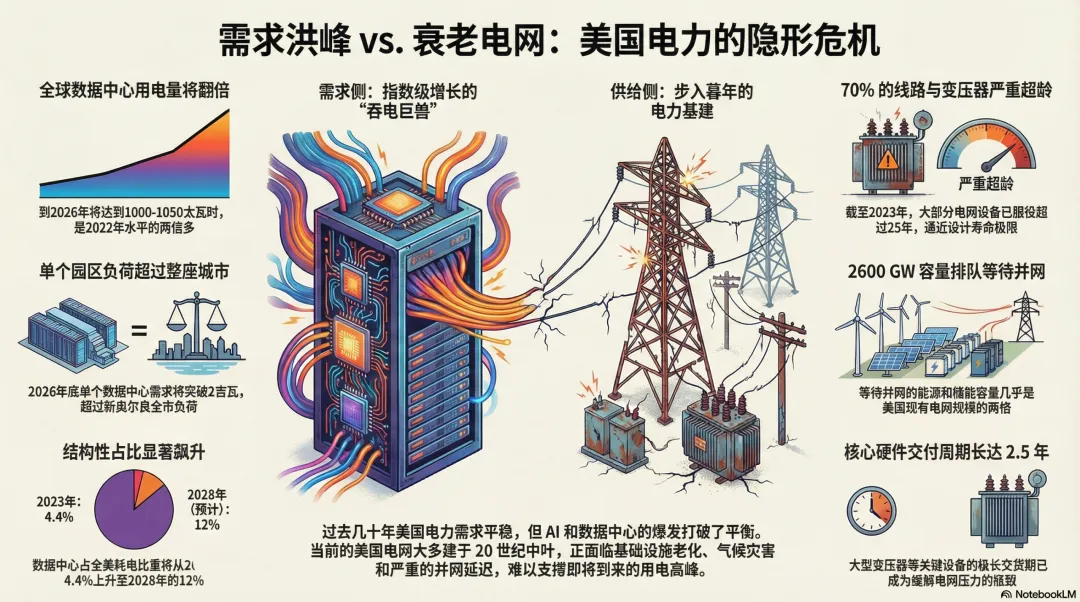
For the past few decades, Americans had almost forgotten what "power shortage" meant. In the early 2000s, thanks to the widespread adoption of LED lighting and the mandatory enforcement of the EPA's "Energy Star" certification, energy consumption in the U.S. miraculously plateaued despite population growth.

But this stagnation was completely shattered in 2025. With the exponential growth of large-scale data centers and AI applications, the energy demand curve experienced a near-vertical inflection point:

  • Doubled Consumption: Global data center consumption is expected to reach 1000-1050 Terawatt-hours (TWh) by 2026, more than double the 2022 level.
  • The Magnitude of a City: By the end of 2026, the power demand of a single, independent data center campus will exceed 2 Gigawatts (GW). This is equivalent to the power load of a medium-sized city.
  • Structural Share: In 2023, data centers accounted for only 4.4% of U.S. electricity consumption; by 2028, this figure is projected to soar to 12%.

Beyond AI, this "power-guzzling behemoth," the reshoring of manufacturing and overall societal electrification (EVs, heat pumps, etc.) are also simultaneously increasing the load. The power industry is transitioning from a "zero-growth" boring sector into a new period of rapid expansion.

In stark contrast to this are the "ailments of age" plaguing the U.S. grid.

The current U.S. grid was not designed to support the AI era. It more closely resembles a "Frankenstein's monster" patched together with mid-20th-century technology.

The grid consists mainly of three parts: generation, transmission, and distribution. The current problems lie in:

  • Aging Infrastructure: As of 2023, 70% of U.S. power lines and transformers are over 25 years old. Most of the grid was built in the 1960s and 70s, approaching the 50 to 80-year design life limit.
  • Climate Change's "Final Straw": The first half of 2025 alone saw dozens of weather disasters costing billions of dollars each. Grid failures caused by extreme heat (sagging lines) and hurricanes are becoming the norm for regional blackouts.

On the other hand, we see a desperate "queueing crisis." Nearly 2600 GW of energy and storage capacity (almost twice the size of the current U.S. grid) is currently queued up waiting for grid connection.

Reportedly, lead times for large transformers have stretched to 2.5 years. Just for the 2026/27 delivery year, customers of PJM Interconnection will pay an additional $3.5 billion in capacity costs due to interconnection bottlenecks.

2. Redefining the Smart Grid
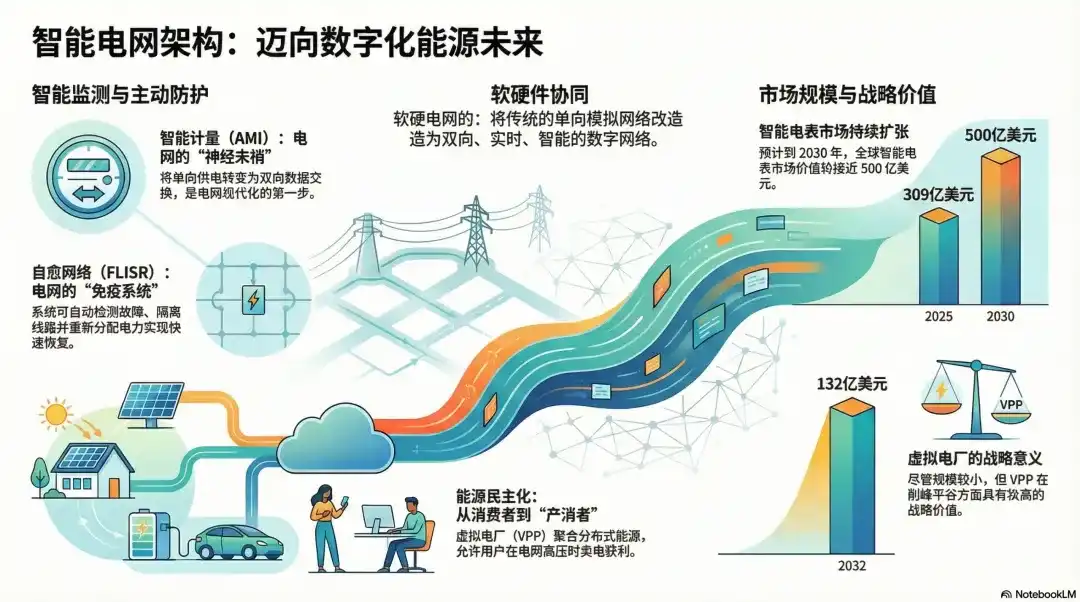
So-called grid modernization is not simply about stringing up more power lines; it's about transforming the traditional one-way analog network into a two-way, real-time, intelligent digital network.

Nerve Endings: Advanced Metering Infrastructure (AMI)

AMI is the first step in modernization. It turns one-way power supply into two-way data exchange. Its core lies in smart meters transmitting data back to the system via radio frequency or cellular networks.

Statistics show the global smart meter market was worth approximately $30.9 billion in 2025 and is expected to approach $50 billion by 2030.

Immune System: Automation and Self-Healing Networks (FLISR)

This is the infrastructure's shift from passive to active. Using software developed by companies like GE Vernova, upgraded power systems can:

1. Automatically Detect: Precisely locate the position of a fallen tree or exploding transformer.

2. Automatically Isolate: Instantly cut off the faulty line.

3. Automatically Restore: Redirect power from adjacent feeders to unaffected areas, achieving "self-healing."

Energy Democratization: Virtual Power Plants (VPP)

VPPs use cloud software to aggregate home solar systems and electric vehicle batteries. Consumers are no longer just buying electricity; they become "prosumers," selling power back to the grid for profit during times of high stress.

Although the niche market size is only in the hundreds of billions of dollars, its strategic importance for peak shaving and load balancing is immense.

3. Who is Sharing This Massive Pie?
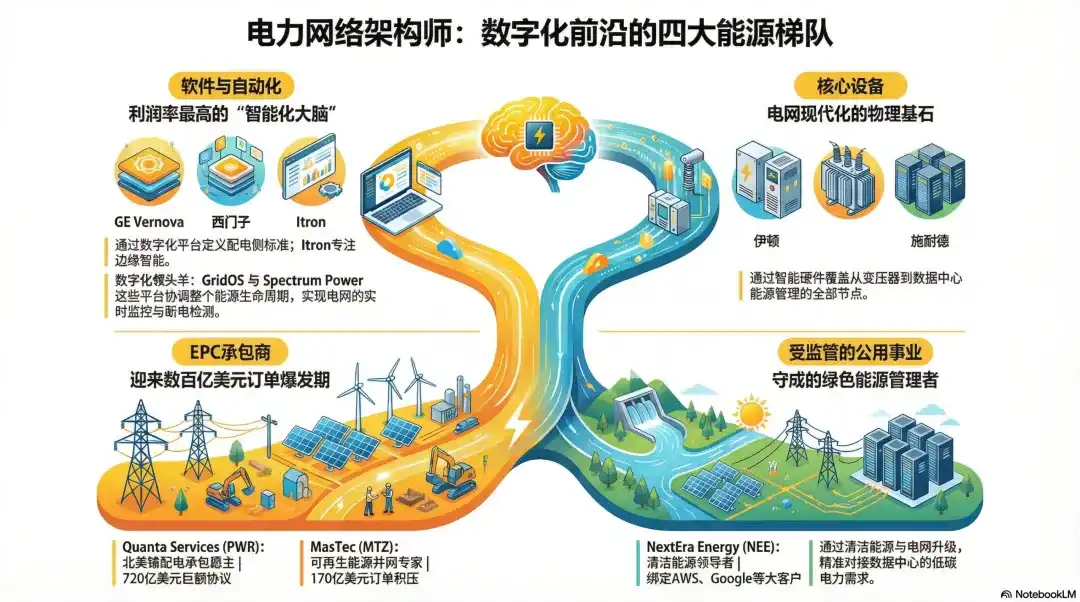
Based on the current industry attributes and profit structure of the U.S. power grid, the RockFlow investment research team categorizes the beneficiary companies into four tiers:

Software & Automation: The Intelligent "Brain"

This is the segment with the highest profit margins and the deepest moats.

  • GE Vernova (GEV): Coordinates the entire energy lifecycle through its GridOS platform. As a pure-play entity after the GE spin-off, it is the absolute leader in grid digitization.
  • Siemens (SIEGY): Possesses the leading Spectrum Power system. Its latest Gridscale X platform is defining the digital standards for the distribution side.
  • Itron (ITRI): The king of smart metering. Its "edge intelligence" products can detect outages in real-time without central processing, acting as the "guardian" at the distribution grid's endpoint.

Equipment Manufacturing & Power Electronics: The Critical Foundation

  • Eaton (ETN): A giant in electrical distribution equipment. From circuit breakers to transformers, Eaton's product portfolio covers almost every physical node of grid modernization.
  • ABB: A global expert in high-voltage products and automation. Its record order backlog is primarily driven by grid modernization projects.
  • Schneider Electric (SBGSY): Focuses on smart grid technology and microgrid solutions, providing end-to-end energy management solutions to help data centers maximize energy efficiency. It deeply integrates hardware with digital management through its EcoStruxure platform, holding a dominant position, especially in data centers and microgrids.

Engineering, Procurement & Construction (EPC): The Builders

  • Quanta Services (PWR): The dominant force in North American transmission and distribution contracting. Its recent massive $72 billion agreement with AEP is the best footnote to the grid upgrade trend. (Note: Corrected likely typo from 720 to 72 billion based on common scale)
  • MasTec (MTZ): Focuses on renewable energy interconnection. Its $17 billion order backlog foreshadows an earnings explosion over the next two years.

Regulated Utilities: The Established "Managers"

  • NextEra Energy (NEE): The largest clean energy company in the U.S., focused on wind and solar power generation. It owns extensive renewable energy assets and secures stable revenue through long-term Power Purchase Agreements (PPAs) with large customers.
  • Duke Energy (DUK): Owns extensive grid infrastructure covering multiple data center clusters. By modernizing its transmission and distribution networks, the company can provide efficient, low-loss power transmission services for data centers. Additionally, DUK is investing in clean energy generation to meet data center demand for green power.

Conclusion: The "Revaluation" of Power Assets Has Begun

In 2026, the power network is no longer that forgotten "utility" but a core asset concerning national security and the outcome of the AI race.

The RockFlow investment research team believes that for investors, software-driven automation companies (GEV, ITRI) possess the highest premium capability; equipment manufacturers (ETN, ABB) have the most certain order visibility; and EPC giants (PWR) are the direct harvesters of the infrastructure boom.

In the next five years, Alpha in U.S. stocks will no longer exist solely in code, but also in the hum of every smart transformer.


Domande pertinenti

QWhat is the main reason for the current revaluation of power assets in the US stock market according to the article?

AThe revaluation is driven by the shift in AI competition from algorithms to physical resources, with massive electricity demand from data centers and AI applications, coupled with an aging US grid infrastructure that is ill-equipped to handle this new load.

QWhich three investment gradients does the RockFlow research team recommend focusing on for the US power grid modernization trend?

AThe three gradients are: 1) High-margin software and automation layer (e.g., GEV), 2) High-certainty equipment manufacturing layer (e.g., Eaton, Schneider), and 3) Direct infrastructure红利 harvesters in the EPC sector (e.g., PWR).

QWhat are the two major challenges facing the existing US power grid as highlighted in the article?

AThe two major challenges are: 1) Aging infrastructure, with 70% of lines and transformers over 25 years old, and 2) The 'queueing crisis,' where nearly 2600 GW of energy and storage capacity is waiting to connect to the grid, exacerbated by long lead times for critical components like large transformers.

QName one company mentioned as a leader in the 'Software and Automation' layer and describe its role.

AGE Vernova (GEV) is highlighted as the absolute leader in grid digitization. It coordinates the entire energy lifecycle through its GridOS platform, acting as the intelligent 'brain' for the modern grid.

QWhat is a Virtual Power Plant (VPP) and what role does it play in grid modernization?

AA Virtual Power Plant (VPP) uses cloud software to aggregate distributed energy resources like home solar panels and EV batteries. It turns consumers into 'prosumers' who can sell power back to the grid during peak demand, playing a crucial strategic role in peak shaving and balancing the grid.

Letture associate

Has Hook Summer Really Arrived? sato, Lo0p, FLOOD Ignite the New Narrative of Uniswap v4

"Hook Summer" Arrives? Sato, Lo0p, FLOOD Ignite Uniswap v4 Narrative Amidst a slight market recovery, attention within the Ethereum ecosystem has shifted to Meme coins built on Uniswap v4's Hook protocol. Following ASTEROID, tokens like sato, sat1, Lo0p, and FLOOD have become market focal points, with market caps ranging from millions to tens of millions, bringing concentrated liquidity to a narrative-dry market. Uniswap v4 Hooks are "plugin smart contracts" that allow developers to inject custom logic at key points in a liquidity pool's lifecycle (initialization, adding/removing liquidity, swaps, etc.), making the AMM programmable. Recent representative projects include: * **sato**: Market cap peaked over $38M; uses a v4 curve mechanism for minting/burning, locking ETH as reserve. * **sat1**: Market cap briefly exceeded $10M, positioning as an "optimized sato," but later declined significantly. * **Lo0p**: Market cap neared $6.6M; a "lending AMM protocol" allowing users to borrow ETH against deposited LO0P tokens without immediate selling pressure. * **FLOOD**: Market cap approached $6M; channels trading reserves into Aave v3 to generate yield, which is retained in the pool. The emergence of these Hook-based tokens could drive long-term growth for the Uniswap ecosystem by attracting users and liquidity to v4 pools. Combined with Uniswap's activated fee switch (partially used to burn UNI), the long-term outlook for UNI appears positive. However, short-term UNI price appreciation is not directly guaranteed. Factors include the sustainability and lifecycle of these new tokens, their price volatility, overall market conditions, and regulatory pressures. Currently, Uniswap v4's TVL ($595M) lags behind v3 and v2, indicating Hook adoption still requires time to mature. In summary, the Hook ecosystem serves as "long-term nourishment" for UNI, but acts more as a "catalyst" than a direct "booster" in the short term. Note: These are early-stage experimental tokens and may carry unknown risks.

marsbit23 min fa

Has Hook Summer Really Arrived? sato, Lo0p, FLOOD Ignite the New Narrative of Uniswap v4

marsbit23 min fa

Has Hook Summer Truly Arrived? sato, Lo0p, FLOOD Ignite the New Uniswap v4 Narrative

With the broader market showing signs of recovery, a new wave of interest has emerged around Ethereum-based meme coins. Following ASTEROID, tokens like sato, sat1, Lo0p, and FLOOD, built upon the Uniswap v4 Hook protocol, are capturing market attention. Their market capitalizations range from millions to tens of millions of dollars, injecting much-needed focused liquidity into a market lacking narratives. This article explores whether this trend signifies an incoming "Hook Summer" and its potential impact on UNI's price. Hooks are essentially plug-in smart contracts for Uniswap v4 liquidity pools, allowing developers to inject custom logic at key points in a pool's lifecycle (like initialization, adding/removing liquidity, swaps). This transforms the AMM into programmable building blocks. Key highlighted projects include: * **sato**: Peaked over $38M market cap. It utilizes a v4 curve for minting/burning; buying locks ETH as reserve to mint new tokens, while selling redeems ETH from the reserve and burns tokens. * **sat1**: Market cap briefly exceeded $10M, promoted as an "optimized sato," but later declined significantly. * **Lo0p**: Reached nearly $6.6M. It's a lending AMM protocol where buying LO0P tokens locks them as collateral, allowing users to borrow ETH from the pool reserve at 40% LTV, aiming to improve capital efficiency for idle ETH in LPs. * **FLOOD**: Peaked near $6M. Its mechanism directs asset reserves from buys into Aave v3 to generate yield, with fees and interest retained in the pool to potentially influence the token's price long-term. In the long term, the development of the Hook ecosystem can attract users and liquidity to Uniswap v4, benefiting UNI's fundamentals—especially combined with the recent activation of the protocol fee switch, where a portion of fees is used to burn UNI. However, in the short term, these Hook-based tokens are unlikely to directly drive significant UNI price appreciation. Their impact is moderated by factors like token sustainability, price volatility, and broader market and regulatory conditions. Currently, Uniswap v4's TVL ($595M) still trails behind v2 and v3, indicating adoption and growth will take time. The article concludes that while the Hook ecosystem provides long-term "nourishment" for UNI, its short-term role is more of a "catalyst" than a "booster." Readers are cautioned that these are early-stage experimental tokens and may carry unknown risks.

Odaily星球日报36 min fa

Has Hook Summer Truly Arrived? sato, Lo0p, FLOOD Ignite the New Uniswap v4 Narrative

Odaily星球日报36 min fa

Interview with Michael Saylor: I Did Say I Would Sell Bitcoin, But Never a Net Sale

Interview with Michael Saylor: I Said We'd Sell Bitcoin, But Never Be a Net Seller In a recent podcast, MicroStrategy Executive Chairman Michael Saylor clarified the company's stance on potentially selling Bitcoin. Following MicroStrategy's earnings call statement about being prepared to sell BTC to fund dividends for its STRC (Strategic) credit product, Saylor emphasized the distinction between selling and being a "net seller." Saylor explained the core business model: MicroStrategy sells credit instruments like STRC and uses the proceeds to buy Bitcoin, which is viewed as "digital capital" expected to appreciate around 30-40% annually. A portion of these capital gains can then be used to pay the dividends on the credit products. He stressed that even if the company sells some Bitcoin for dividends, it simultaneously buys much more with new credit issuance. For example, after raising $3.2 billion from STRC sales in April, the dividend obligation was only $80-90 million, making the company a net buyer. The clarification aims to counter market narratives questioning the value of Bitcoin on MicroStrategy's balance sheet if it were never sold, and to dismiss claims of a "Ponzi scheme." Saylor reiterated his personal philosophy for investors: "Don't be a net seller of bitcoin" and ensure your Bitcoin holdings increase each year. Saylor also discussed Bitcoin's role as the foundation for "digital credit," noting that STRC has become the largest and most liquid preferred stock issue in the U.S., offering high risk-adjusted returns (Sharpe ratio). He highlighted Bitcoin's deep liquidity, stating that even large purchases by MicroStrategy do not move the market significantly, which is driven by macro factors, geopolitical tensions, and capital flows from ETFs and credit products. Finally, Saylor reflected on his early inspiration from sci-fi books, which motivated his path to MIT, and maintained his fundamental thesis on Bitcoin remains unchanged: it is superior digital capital enabling superior digital credit.

链捕手40 min fa

Interview with Michael Saylor: I Did Say I Would Sell Bitcoin, But Never a Net Sale

链捕手40 min fa

Trading

Spot
Futures
活动图片




