Mythos Report Released: Billions of Devices Worldwide Exposed, 10,000 Critical Vulnerabilities Uncovered in 30 Days

marsbitPubblicato 2026-05-25Pubblicato ultima volta 2026-05-25

Introduzione

The first report from Anthropic's "Project Glasswing" reveals staggering results from its secret initiative using the next-generation AI model, Claude Mythos Preview. In just 30 days, collaborating with roughly 50 global tech giants and critical infrastructure developers, Mythos identified over 10,000 high or critical-severity software vulnerabilities. It demonstrated an extremely low false-positive rate, even outperforming human experts, and successfully intercepted a $1.5 million bank fraud in progress. Key findings include uncovering 2,000 bugs in Cloudflare's core systems, fixing 271 critical vulnerabilities in Firefox 150 (ten times more than previous methods), and discovering a 27-year-old hidden bug in OpenBSD's codebase. The AI even autonomously constructed full attack chains for some exploits. Mythos also scanned over 1,000 essential open-source projects, identifying 23,019 total vulnerabilities, with 6,202 rated high/critical by the AI. Independent verification confirmed a 90.6% true-positive rate, validating 1,094 severe vulnerabilities. A critical case involved wolfSSL, a cryptography library used by billions of devices, where Mythos found a flaw allowing perfect digital certificate forgery. This unprecedented discovery speed has created a new crisis: human developers are overwhelmed and cannot patch vulnerabilities fast enough. In response, Anthropic is rolling out defensive tools like "Claude Security" to auto-generate patches and releasing frameworks to help ...

A's Project Glasswing Achieves Initial Success: Mythos Uncovers 10,000 Critical Vulnerabilities in 30 Days, Even Intercepts $1.5M in Wire Fraud! Facing a Blizzard of Reports, Human Programmers Plead for Mercy: "Stop Finding Them! We Can't Possibly Fix Them All!"

Just now, Anthropic released another piece of news that has shocked the global tech and security circles.

The first-month battle report for "Project Glasswing" has been officially announced!

In this secret operation, Anthropic deployed its next-generation top-tier large language model—Claude Mythos Preview—for the first time.

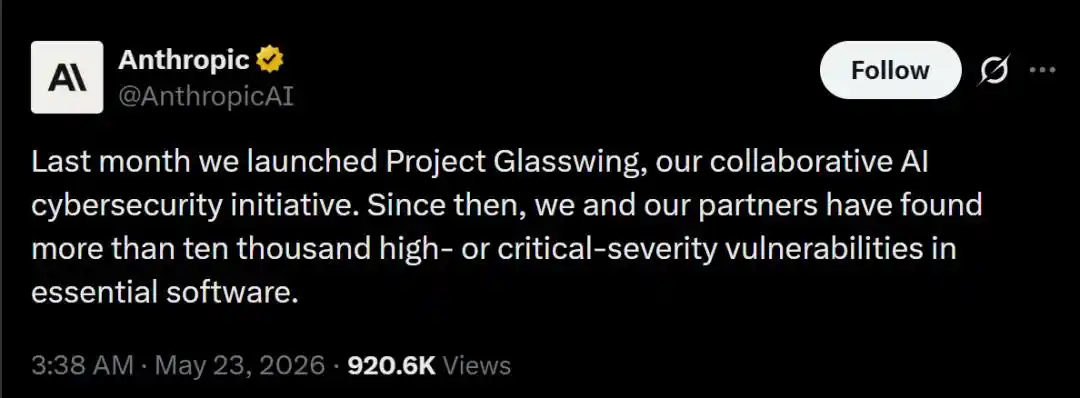
In just 30 days, partnering with about 50 global internet giants and critical infrastructure software developers, it unearthed over 10,000 high-risk or critical-level software vulnerabilities in one go!
Even more terrifying, it can not only find vulnerabilities but also automatically construct "end-to-end" attack chains.

In a real business scenario at a partner bank, it even successfully intercepted a $1.5 million wire fraud attempt!

Instantly, the entire security community was thoroughly shaken.

Some security experts even exclaimed in despair on X: "The foundation of the internet has been turned upside down by AI... We might really be done for!"
The Crazy 30 Days

Global Tech Giants Experience Firsthand: How Terrifying is Mythos?

In April 2026, Anthropic secretly launched Project Glasswing. The name symbolizes the hope of making the world's most important closed-source and open-source software transparent and secure.

The first batch to join the plan comprised about 50 critical infrastructure software developers.

After they gained testing access to Claude Mythos Preview, within just one month, the entire industry's worldview was shattered.
Let's look at this dazzling battle report—

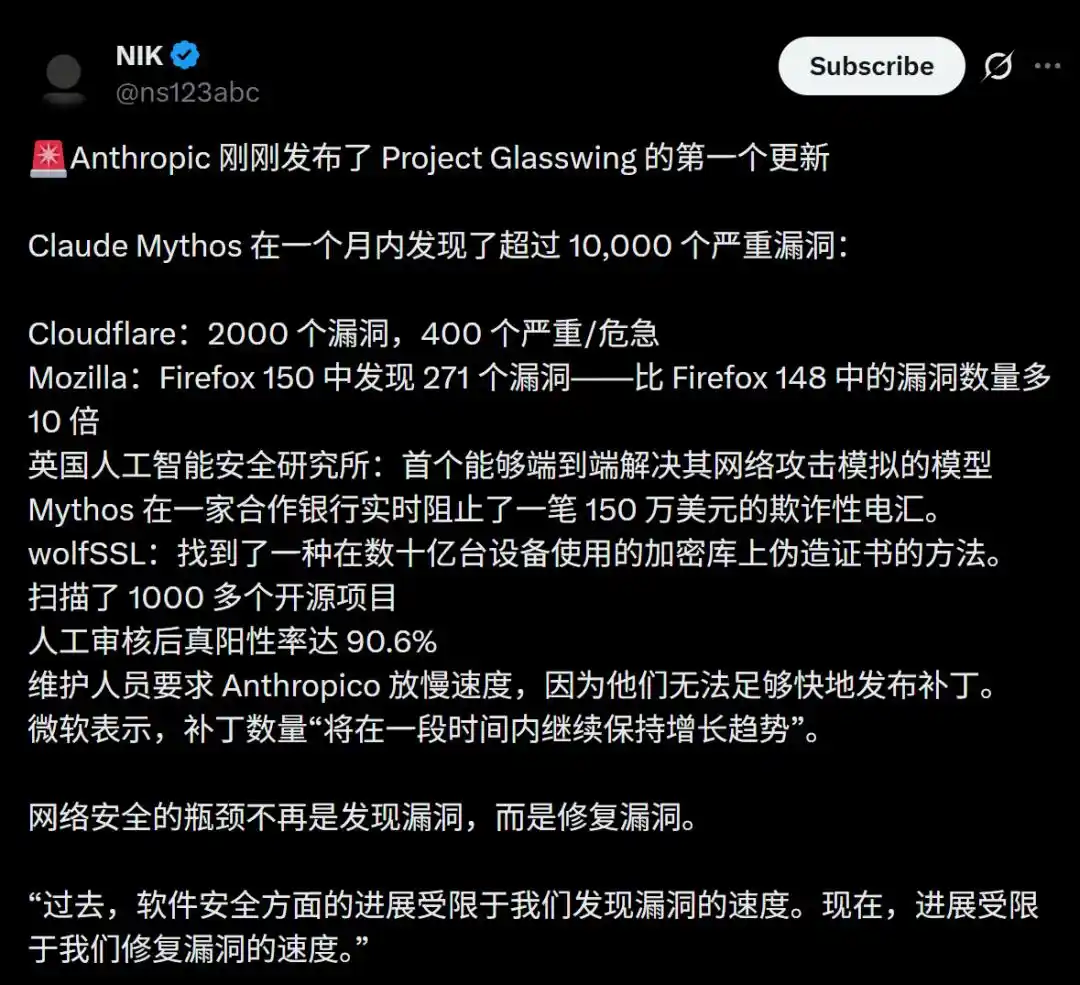
Cloudflare reported that in their extremely critical core-path systems, Mythos dug up 2000 vulnerabilities in one go! Among them, 400 were high-risk or critical-level.

Even more outrageous, Cloudflare's security team exclaimed: This AI's false-positive rate is even lower than that of top-tier human security testers.

In the testing of Mozilla's latest Firefox 150 browser, Mythos fixed 271 high-risk vulnerabilities in one go.

This number is over 10 times the vulnerabilities previously found using Opus 4.6 in Firefox version 148!

OpenBSD's reported results are downright spine-chilling: Mythos unearthed a bug hidden in the OpenBSD codebase for a full 27 years!

Moreover, the model didn't even need human intervention; it constructed a complete vulnerability exploitation chain itself.
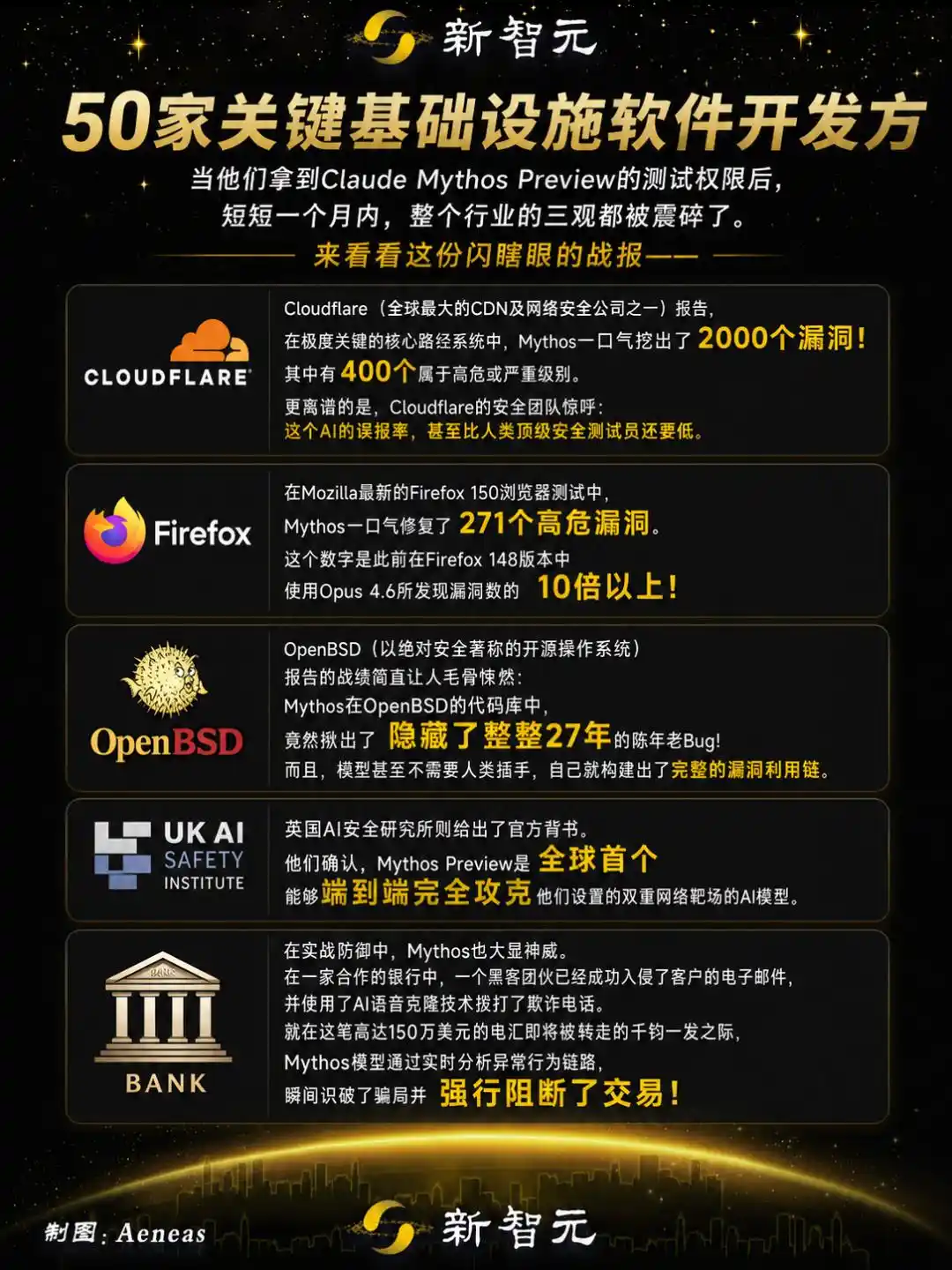
The UK AI Safety Institute offered official endorsement. They confirmed that Mythos Preview is the world's first AI model capable of end-to-end, fully compromising the double-network test environment they set up.

In practical defense, Mythos also demonstrated its prowess.

At a partner bank, a hacker group had successfully infiltrated a client's email and used AI voice-cloning technology to make a fraudulent call.

At the critical moment when the $1.5 million wire transfer was about to be sent, the Mythos model, through real-time analysis of the abnormal behavior chain, instantly saw through the scam and forcibly blocked the transaction!

"We human security experts look like primitives holding spears, watching an F-22 fighter jet fly overhead," a security researcher participating in the internal testing lamented on X.

Billions of Exposed Devices Worldwide Saved by Mythos!

However, Mythos also triggered a productivity crisis.

In the past, the core bottleneck in cybersecurity was discovering vulnerabilities. Finding a high-risk zero-day vulnerability could take top white-hat hackers weeks or even months.

Now, Claude Mythos has driven the cost and time of finding vulnerabilities to "infinitely close to zero."

Anthropic used it to scan over 1,000 core open-source projects underpinning the global internet. The results are hair-raising—

A total of 23,019 vulnerabilities were discovered, including 6,202 high-risk or critical vulnerabilities assessed by Mythos!

To ensure it wasn't the AI "rambling," Anthropic collaborated with six globally renowned independent security research firms for manual cross-verification.

The result proved: The AI's true positive rate (i.e., the vulnerability actually exists) was as high as 90.6%! Ultimately, 1,094 were confirmed as undeniable high-risk or critical vulnerabilities.
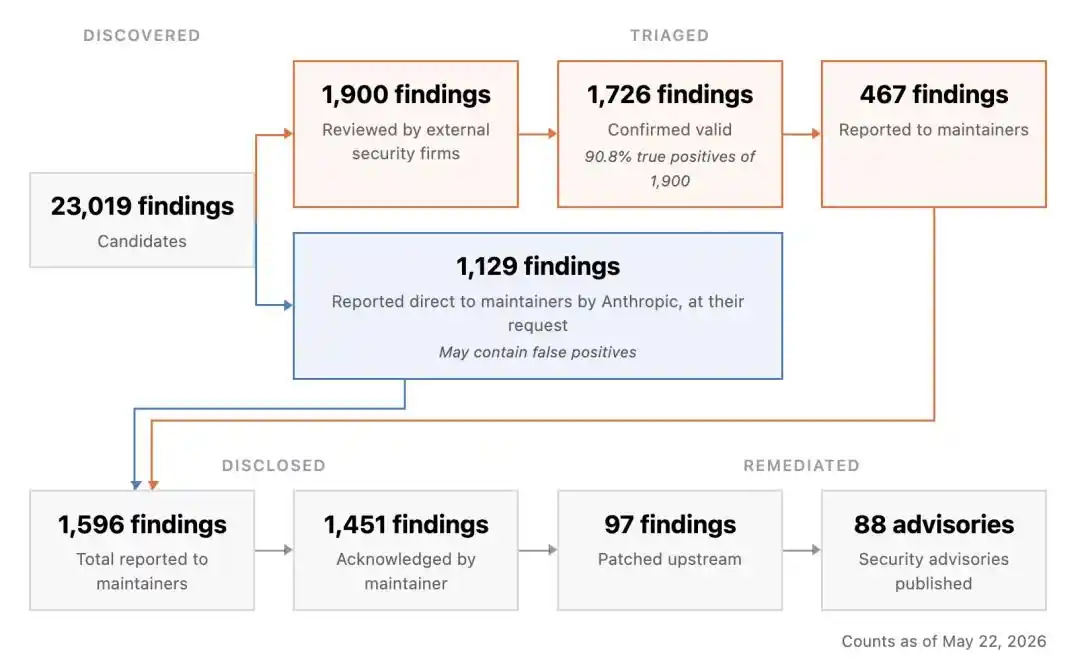
Open-source vulnerability dashboard, showing vulnerabilities of all severity levels

Here, an extremely typical case must be mentioned—wolfSSL.

wolfSSL is a famously prominent open-source cryptography library, used by billions of devices worldwide (including IoT devices, routers, smart cars, etc.).

However, before Mythos, wolfSSL's defenses were like paper. Mythos not only discovered an extremely hidden logic vulnerability but even wrote a set of attack code itself!

Using this code, hackers could arbitrarily forge digital certificates, creating incredibly realistic bank websites or email login pages with no flaws.
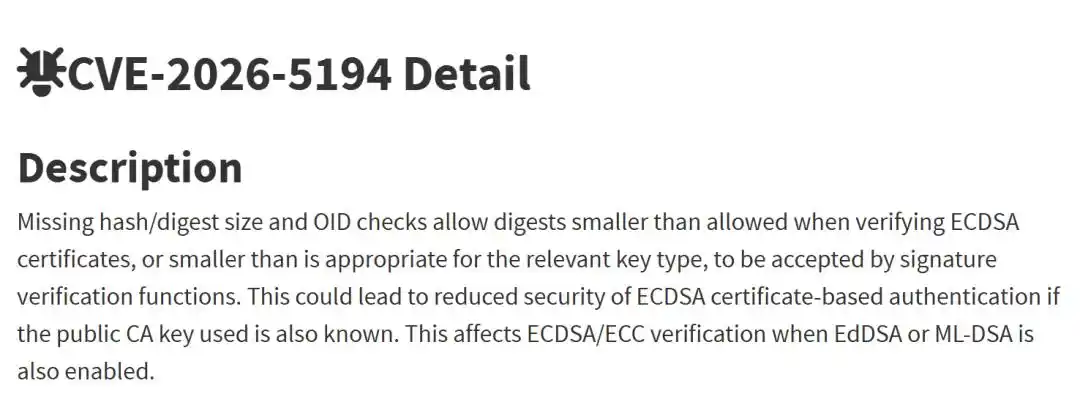
If this vulnerability hadn't been discovered and reported for repair by Mythos in advance, once exploited by the black market, the consequences would be unimaginable.

Billions of devices worldwide were actually running exposed on the edge of danger. This time, Mythos pulled them back.

Epic Reversal: Finding Bugs is No Longer the Bottleneck, Fixing Them Is!

As Project Glasswing progressed, a bizarre phenomenon never before seen in cybersecurity history was born.

"The bottleneck of cybersecurity is no longer finding vulnerabilities. The current bottleneck is: the speed at which humans can fix vulnerabilities is far outpaced by the speed at which AI discovers them."

For open-source community maintainers, this is simply a nightmare.
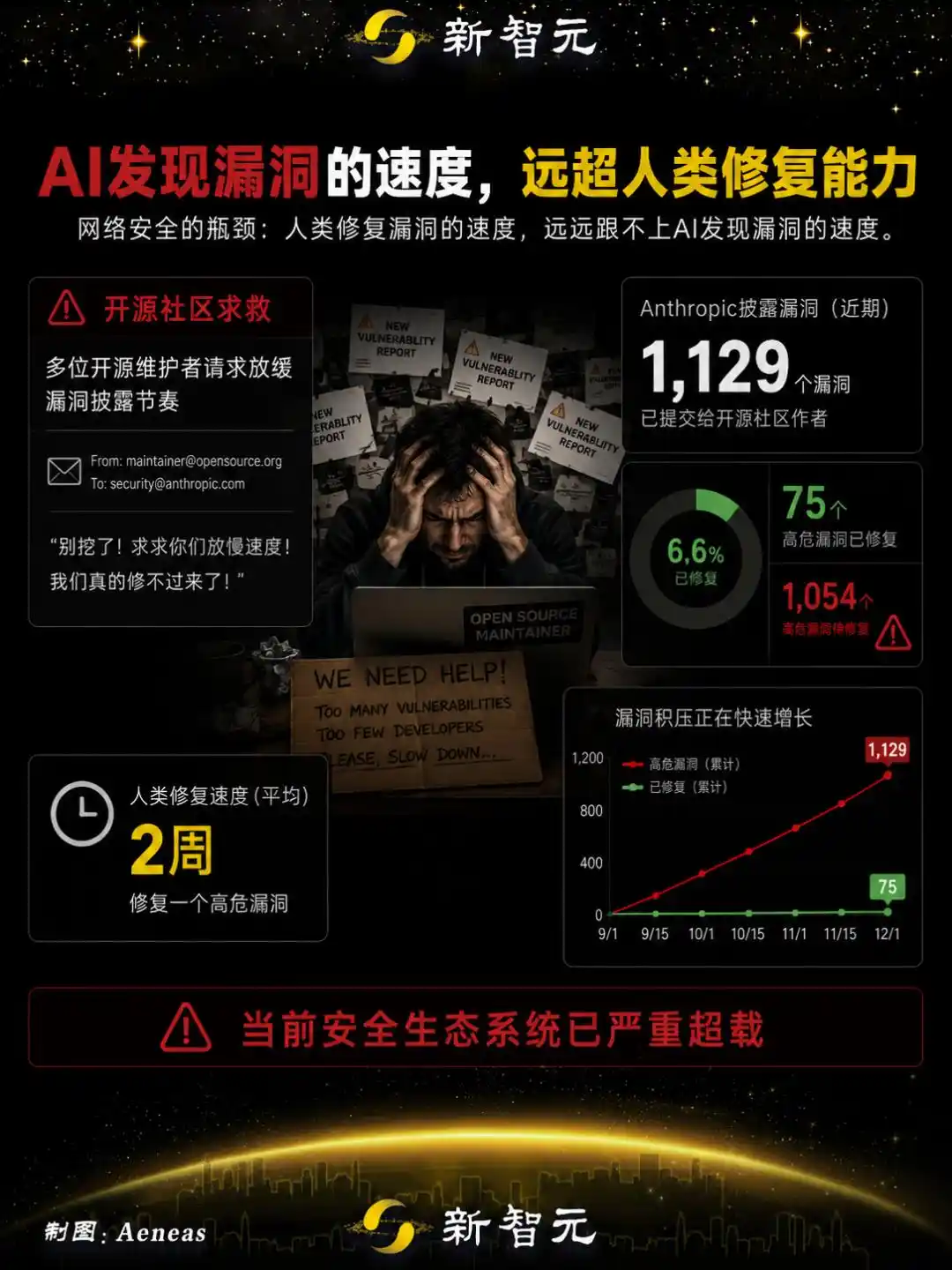
Anthropic's vulnerability reports flew like snowflakes to major open-source communities. The authors are already overwhelmed.

"Stop digging! Please, slow down! We really can't fix them fast enough!"

According to Anthropic, several open-source maintainers recently sent "pleading" emails asking them to slow down the pace of vulnerability disclosure due to severe manpower shortages.

Even with detailed reports, human programmers still need an average of two full weeks to fix a single high-risk vulnerability.

Currently, out of the 1,129 vulnerabilities Anthropic submitted to open-source authors, only 75 high-risk ones have been successfully patched. The current security ecosystem is severely overloaded!

Fight Fire with Fire: Anthropic's Defense

Since humans can't keep up with fixing them, fight fire with fire.

Anthropic decisively unveiled its "Defender Toolkit" plan.

First is the heavy-weight launch of Claude Security.

This is an automation marvel built specifically for Claude Enterprise customers. Its logic is: I not only help you find vulnerabilities in your codebase, but I also directly write the fix patches for you.

Within just three weeks of launch, enterprise customers have already used Opus 4.7 to fix over 2100 vulnerabilities at lightning speed!

Next is the "Network Verification Program."

Anthropic now allows professional white-hats, penetration testers, and red/blue teams to legally and compliantly lift certain "security restraints" on the Claude model for legitimate vulnerability research and test range activities.

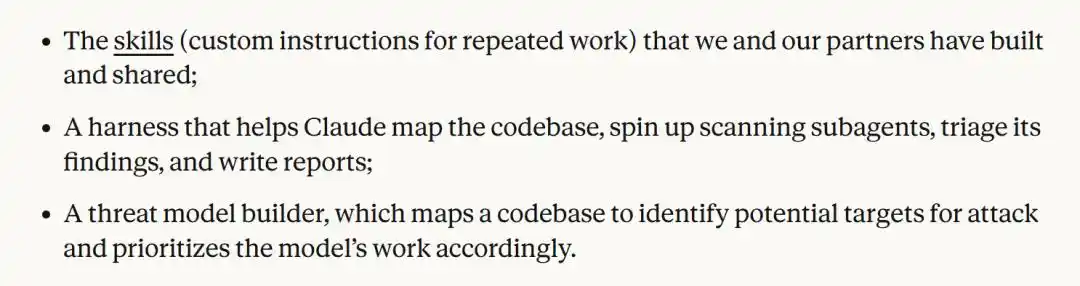
More interestingly, Anthropic directly open-sourced a "BUG-finding pipeline."

1 Customized Instructions (Skills): Teach you how to keep the AI focused for deep code review.

2 Automation Framework (Harness): A command system enabling Claude to automatically traverse massive codebases, clone sub-agents for parallel scanning, automatically triage vulnerabilities, and generate reports.

3 Threat Model Builder: Simply throw your code in, and the AI automatically identifies the system's most vulnerable "soft spots," prioritizing them for defense.
Internet giant Cisco also stepped forward, announcing the open-sourcing of the "Foundry Security Spec" system to build security assessment defenses similar to Mythos.

From now on, it will be: AI finds vulnerabilities, then AI generates patches, with humans only responsible for final review.

This is the ultimate future form of cybersecurity.

The Sword of Damocles: When Will Mythos Be Publicly Released?

So, when exactly will Claude Mythos be officially released to the public?

Anthropic's current stance remains very cautious.

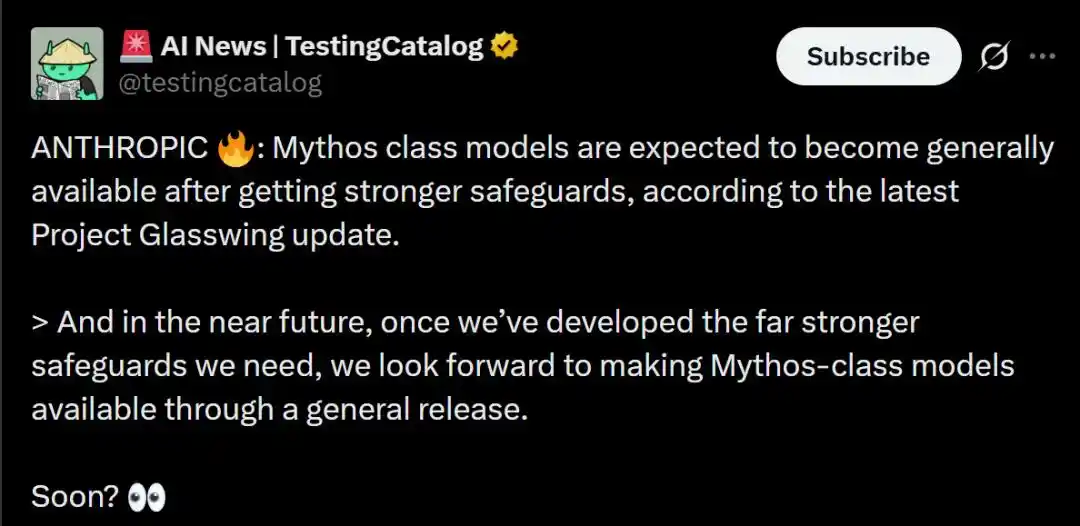
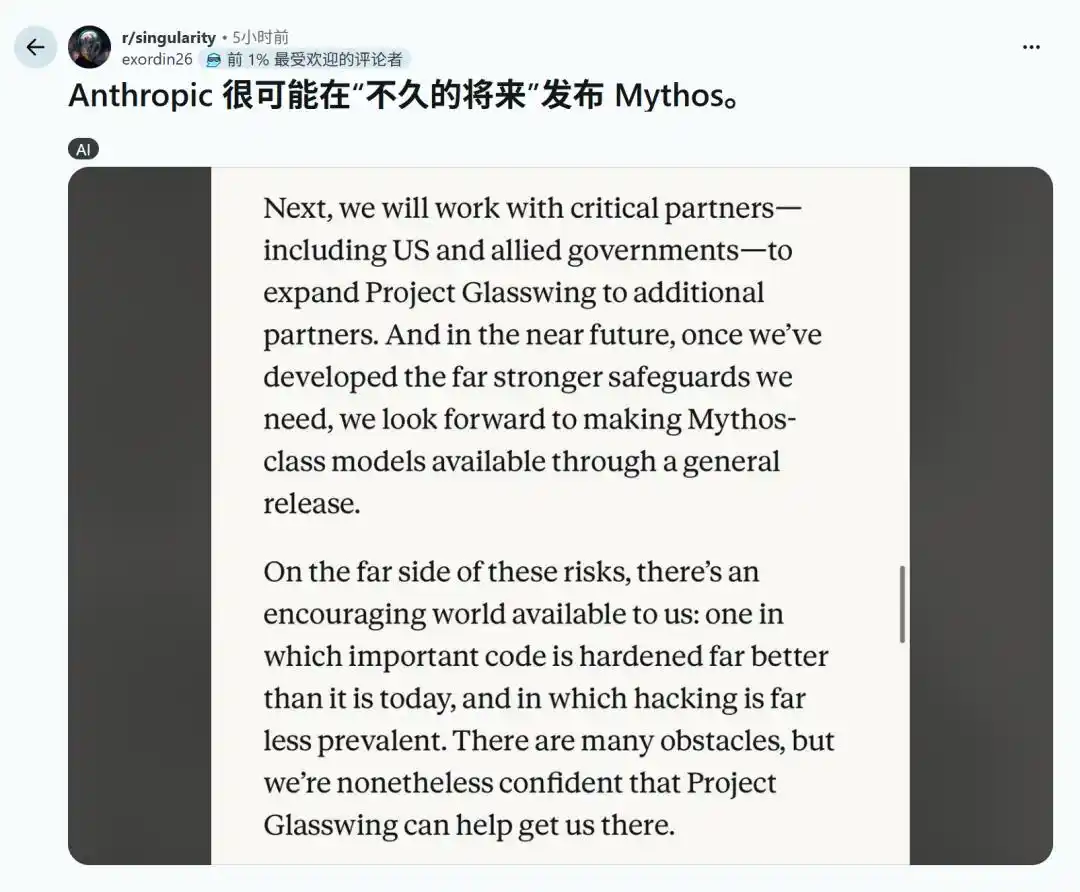
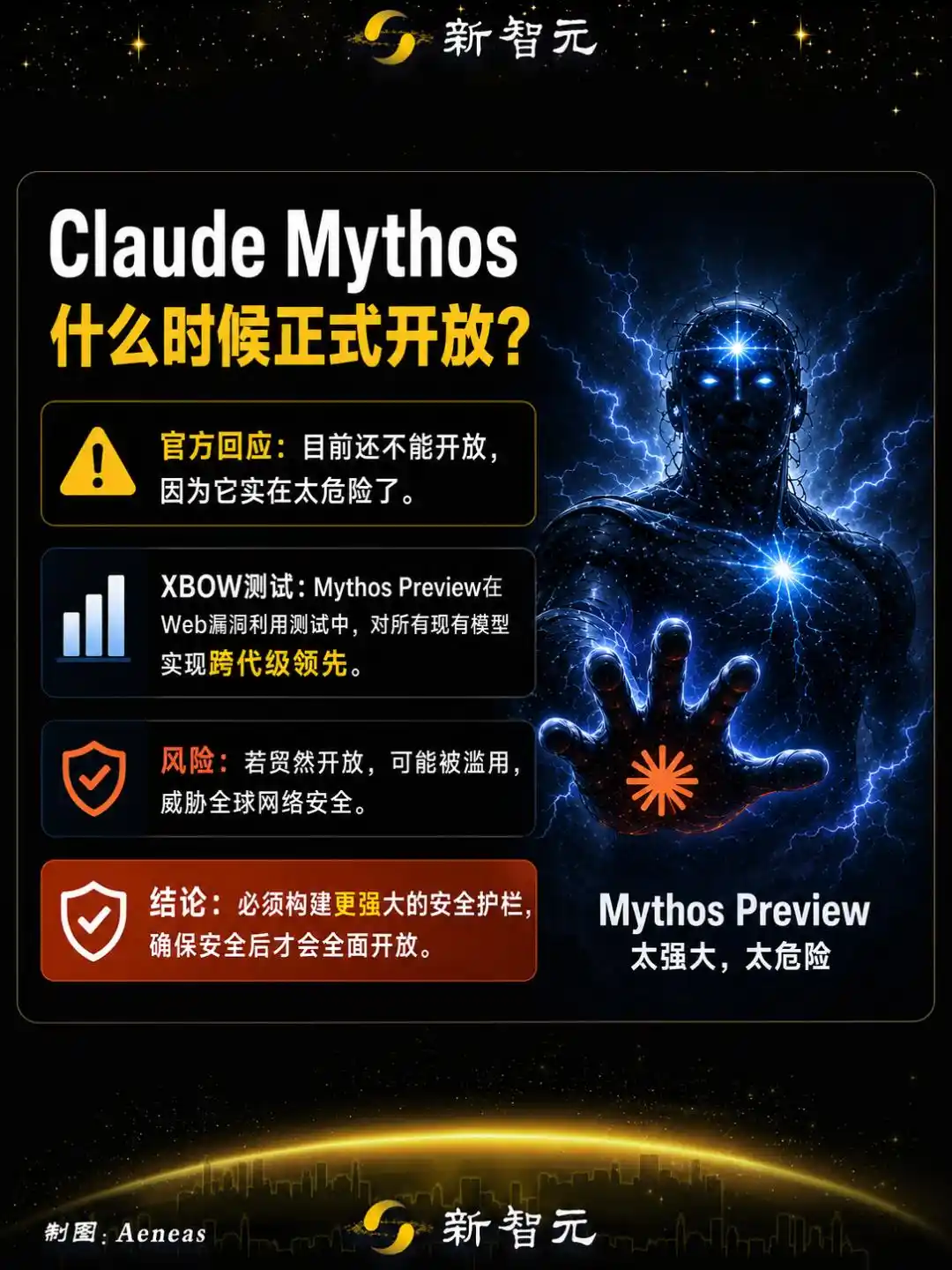
They state that once "more powerful, higher-level safety guardrails" are built, Mythos-level models will inevitably be pushed for full public release!

It cannot be released now because it is simply too dangerous.
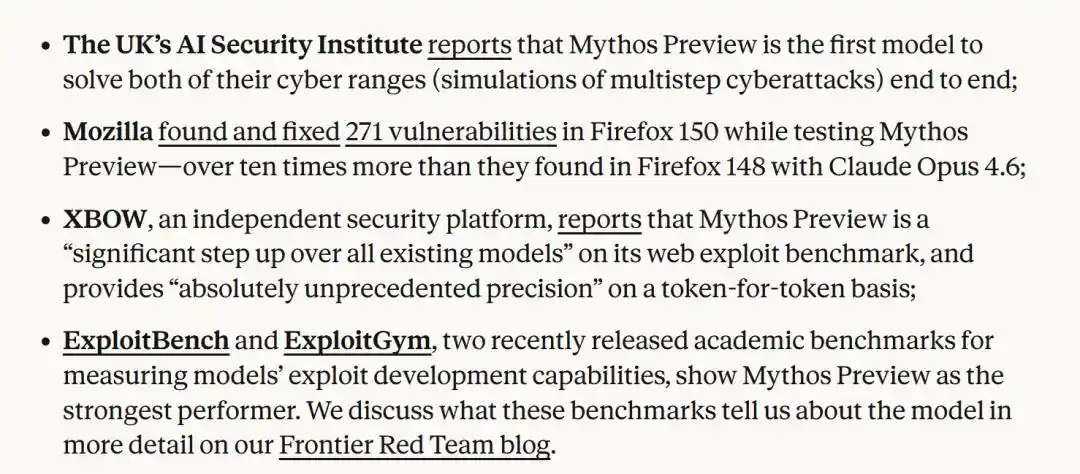
As the XBOW test report states: Mythos Preview achieves "generational leaps ahead of all existing models" in web vulnerability exploitation benchmarks, even demonstrating "absolutely unprecedented precision" in every single token generation.

Anthropic is very clear that currently, no company in the world possesses security mechanisms strong enough to 100% ensure this model won't be abused.

If Mythos's API were made public today, tomorrow global hacker groups, and even some extremist organizations, could mass-produce thousands of zero-day exploitation tools at extremely low cost.

Ordinary people's computers, hospital systems, power grid control centers would face a catastrophe!

Anthropic's recommendations are:

1 Shorten the patch cycle! Shorten the patch cycle! Shorten the patch cycle! Don't hoard updates for a month; use existing AI tools (like Opus 4.7) to push security fixes to users as soon as possible.

2 Enforce upgrade policies. Developers must make updates as effortless as possible for users to install; for those who stubbornly refuse to upgrade, enforce network disconnection. Return to security fundamentals.

3 Strengthen multi-factor authentication (MFA), harden default configurations, maintain detailed logs.

The Calm Before the Storm

One month, collaboration with over 50 giants, 10,000+ critical vulnerabilities, intercepting $1.5M in wire fraud... These are just the initial results of Claude Mythos Preview flexing its muscles.

Right now, human programmers are experiencing the birth pangs—being inundated by AI reports, patching bugs that have lurked for 20-30 years.

But as Anthropic envisions—

"After navigating these risks, an exhilarating world beckons: one where humanity's important code will be forged to be a hundred times more robust than today's, and hacker attacks will become an exceedingly rare historical footnote."

Let us silently thank those AIs tirelessly reviewing hundreds of millions of lines of code.

It's quite possible that it just blocked a potentially fatal nuclear blast for you.

References:

https://x.com/AnthropicAI/status/20579091025425495

This article is from the WeChat public account "AI New Wisdom," author: ASI Revelation, editor: Aeneas Moses


Domande pertinenti

QWhat was the outcome of Anthropic's 'Project Glasswing' in its first 30 days?

AIn its first 30 days, Anthropic's 'Project Glasswing,' which utilized the Claude Mythos Preview AI model, identified over 10,000 high or critical severity software vulnerabilities across approximately 50 major tech companies and critical infrastructure software providers.

QWhat significant achievement did the Claude Mythos model accomplish in a real-world banking scenario?

AIn a real-world banking scenario, the Claude Mythos model successfully intercepted a $1.5 million wire transfer fraud by analyzing the transaction's abnormal behavior chain in real-time and blocking it at the last moment.

QWhat major shift in cybersecurity bottlenecks does the report highlight due to AI like Claude Mythos?

AThe report highlights a major shift where the bottleneck in cybersecurity is no longer finding vulnerabilities, but rather the human inability to patch them fast enough. AI can discover vulnerabilities far quicker than developers can fix them.

QWhat was a particularly dangerous vulnerability discovered by Mythos in the wolfSSL library, and why was it significant?

AMythos discovered a hidden logic flaw in the wolfSSL cryptography library that could allow hackers to forge digital certificates and create perfect fake websites. This was significant because wolfSSL is used in billions of devices globally, meaning they were all at severe risk.

QWhy is Anthropic hesitant to publicly release the Claude Mythos model immediately, according to the article?

AAnthropic is hesitant to publicly release Claude Mythos immediately because it is considered too dangerous. They state that without 'more powerful, higher-level safety guardrails,' releasing it could enable malicious actors to cheaply mass-produce zero-day exploit tools, potentially devastating critical systems worldwide.

Letture associate

AI PCs Are Here, Going Toe-to-Toe with 120B Models Locally! NVIDIA Redefines the "Personal AI Computer" Foundation with RTX Spark

NVIDIA has redefined the "AI PC" standard with the launch of the RTX Spark super chip at GTC 2026. Boasting 1 petaflop (1000 TOPS) of AI performance, it dwarfs the 45-50 TOPS NPUs in current AI PCs. The SoC features a Blackwell GPU, a 20-core Arm CPU co-designed with MediaTek, and crucially, up to 128GB of unified memory shared between CPU and GPU. This architectural shift enables local execution of 120-billion-parameter large language models with million-token context windows, a massive leap from the 9B-40B models typical on current consumer hardware. Beyond AI, use cases include 12K video editing and high-fps ray-traced gaming. Key to enterprise adoption is a security collaboration with Microsoft. Windows security is upgraded, and NVIDIA's OpenShell sandbox runtime is integrated to safely contain AI agent actions. Major software support comes from Adobe, which announced a deep,底层-level rewrite of Photoshop and Premiere to leverage the unified memory for up to 2x performance gains. Six OEMs, including Dell, HP, Lenovo, and Microsoft Surface, will release RTX Spark-based轻薄本 and compact desktops this fall. However, questions remain about real-world performance,功耗, thermal management in laptops, pricing, and the actual impact of the OpenShell sandbox. The RTX Spark represents a fundamental power shift in the PC industry, moving from an x86 CPU-centric model to a GPU-centric SoC platform, but its ultimate success hinges on the upcoming product rollouts and ecosystem validation.

marsbit5 min fa

AI PCs Are Here, Going Toe-to-Toe with 120B Models Locally! NVIDIA Redefines the "Personal AI Computer" Foundation with RTX Spark

marsbit5 min fa

Jensen Huang: Vera Rubin Full Mass Production, AI Agent a Key Focus, Challenging Intel to Target the Next-Generation AI PC Gateway

NVIDIA CEO Jensen Huang delivered the keynote speech at GTC Taipei 2026, announcing several major product launches and strategic directions. The company's Vera Rubin architecture is now in full-scale production, with OpenAI, Anthropic, and SpaceX among the first customers. NVIDIA highlighted AI Agent as a key future focus, introducing the Vera CPU designed for AI agents and the Vera BlueField-4 STX for secure, chip-level AI storage processing. A significant move involves challenging Intel in the PC market. NVIDIA, in collaboration with MediaTek, is developing the RTX SPARK PC chip (manufactured by TSMC) for Windows systems, set to launch this fall for laptops and desktops. This signals NVIDIA's push into the next-generation AI PC arena, aiming to provide a vertically integrated core computing platform for the entire Windows ecosystem, similar to Apple's approach. Other announcements include the new Nemotron 3 Ultra AI model and the NVIDIA DSX platform, described as a complete "playbook" for building AI factories, allowing performance simulation and validation before physical deployment. In automotive, the DRIVE Hyperion platform was positioned as a global robotaxi platform, with major Chinese automakers like BYD, Geely, Zeekr, Xiaomi, and Pony.ai already adopting or developing autonomous driving solutions based on it. The Alpamayo 2 super open inference model for robotaxis was also introduced. For robotics, NVIDIA unveiled the Isaac GR00T humanoid robot reference platform for academic research and a large open-source agent tools and skills suite for Physical AI. The company plans to collaborate with global humanoid robot manufacturers, including China's Unitree, whose H2 Plus robot served as the reference hardware for the GR00T platform demonstration.

marsbit32 min fa

Jensen Huang: Vera Rubin Full Mass Production, AI Agent a Key Focus, Challenging Intel to Target the Next-Generation AI PC Gateway

marsbit32 min fa

Running MoE on Mobile Phones? Meta Proposes MobileMoE, Speeding Up iPhone 16 Pro by 3.8x

Meta's MobileMoE, a mobile-optimized Mixture-of-Experts (MoE) language model architecture, enables efficient on-device large language model (LLM) inference for the first time on commercial smartphones. Designed for decoder-only Transformers, it replaces dense feed-forward layers with MoE layers. Key design choices include 8 experts with granularity g=8, top-4 routing, and a shared expert. The model undergoes a four-stage training process: pre-training, intermediate training, supervised fine-tuning, and quantization-aware training. Results show MobileMoE models, with similar memory footprint, achieve equal or higher average accuracy across 14 foundational benchmarks while using only 1/2 to 1/4 of the FLOPs compared to dense baselines. After INT4 quantization, they remain competitive. Notably, on an iPhone 16 Pro, MobileMoE-S demonstrates significant speedups: up to 3.8x faster in the prompt phase and 2.2-3.4x faster in per-token generation compared to a dense counterpart, with lower peak memory usage. While MobileMoE establishes a new Pareto frontier for on-device LLMs in accuracy-compute trade-offs, particularly excelling in code and math tasks, it currently lags behind models like Qwen3.5 2B in advanced instruction following and knowledge reasoning. Future work includes improving post-training techniques, exploring NPU deployment, and managing the runtime memory sensitivity of MoE models to varying inputs.

marsbit37 min fa

Running MoE on Mobile Phones? Meta Proposes MobileMoE, Speeding Up iPhone 16 Pro by 3.8x

marsbit37 min fa

Trading

Spot
Futures

Articoli Popolari

Cosa è $S$

Comprendere SPERO: Una Panoramica Completa Introduzione a SPERO Mentre il panorama dell'innovazione continua a evolversi, l'emergere delle tecnologie web3 e dei progetti di criptovaluta gioca un ruolo fondamentale nel plasmare il futuro digitale. Un progetto che ha attirato l'attenzione in questo campo dinamico è SPERO, denotato come SPERO,$$s$. Questo articolo mira a raccogliere e presentare informazioni dettagliate su SPERO, per aiutare gli appassionati e gli investitori a comprendere le sue basi, obiettivi e innovazioni nei domini web3 e crypto. Che cos'è SPERO,$$s$? SPERO,$$s$ è un progetto unico all'interno dello spazio crypto che cerca di sfruttare i principi della decentralizzazione e della tecnologia blockchain per creare un ecosistema che promuove l'impegno, l'utilità e l'inclusione finanziaria. Il progetto è progettato per facilitare interazioni peer-to-peer in modi nuovi, fornendo agli utenti soluzioni e servizi finanziari innovativi. Al suo interno, SPERO,$$s$ mira a responsabilizzare gli individui fornendo strumenti e piattaforme che migliorano l'esperienza dell'utente nello spazio delle criptovalute. Questo include la possibilità di metodi di transazione più flessibili, la promozione di iniziative guidate dalla comunità e la creazione di percorsi per opportunità finanziarie attraverso applicazioni decentralizzate (dApps). La visione sottostante di SPERO,$$s$ ruota attorno all'inclusività, cercando di colmare le lacune all'interno della finanza tradizionale mentre sfrutta i vantaggi della tecnologia blockchain. Chi è il Creatore di SPERO,$$s$? L'identità del creatore di SPERO,$$s$ rimane piuttosto oscura, poiché ci sono risorse pubblicamente disponibili limitate che forniscono informazioni dettagliate sul suo fondatore o fondatori. Questa mancanza di trasparenza può derivare dall'impegno del progetto per la decentralizzazione—un ethos che molti progetti web3 condividono, dando priorità ai contributi collettivi rispetto al riconoscimento individuale. Centrando le discussioni attorno alla comunità e ai suoi obiettivi collettivi, SPERO,$$s$ incarna l'essenza dell'empowerment senza mettere in evidenza individui specifici. Pertanto, comprendere l'etica e la missione di SPERO rimane più importante che identificare un creatore singolo. Chi sono gli Investitori di SPERO,$$s$? SPERO,$$s$ è supportato da una varietà di investitori che vanno dai capitalisti di rischio agli investitori angelici dedicati a promuovere l'innovazione nel settore crypto. Il focus di questi investitori generalmente si allinea con la missione di SPERO—dando priorità a progetti che promettono avanzamenti tecnologici sociali, inclusività finanziaria e governance decentralizzata. Queste fondazioni di investitori sono tipicamente interessate a progetti che non solo offrono prodotti innovativi, ma contribuiscono anche positivamente alla comunità blockchain e ai suoi ecosistemi. Il supporto di questi investitori rafforza SPERO,$$s$ come un concorrente degno di nota nel dominio in rapida evoluzione dei progetti crypto. Come Funziona SPERO,$$s$? SPERO,$$s$ impiega un framework multifunzionale che lo distingue dai progetti di criptovaluta convenzionali. Ecco alcune delle caratteristiche chiave che sottolineano la sua unicità e innovazione: Governance Decentralizzata: SPERO,$$s$ integra modelli di governance decentralizzati, responsabilizzando gli utenti a partecipare attivamente ai processi decisionali riguardanti il futuro del progetto. Questo approccio favorisce un senso di proprietà e responsabilità tra i membri della comunità. Utilità del Token: SPERO,$$s$ utilizza il proprio token di criptovaluta, progettato per servire varie funzioni all'interno dell'ecosistema. Questi token abilitano transazioni, premi e la facilitazione dei servizi offerti sulla piattaforma, migliorando l'impegno e l'utilità complessivi. Architettura Stratificata: L'architettura tecnica di SPERO,$$s$ supporta la modularità e la scalabilità, consentendo un'integrazione fluida di funzionalità e applicazioni aggiuntive man mano che il progetto evolve. Questa adattabilità è fondamentale per mantenere la rilevanza nel panorama crypto in continua evoluzione. Coinvolgimento della Comunità: Il progetto enfatizza iniziative guidate dalla comunità, impiegando meccanismi che incentivano la collaborazione e il feedback. Nutrendo una comunità forte, SPERO,$$s$ può affrontare meglio le esigenze degli utenti e adattarsi alle tendenze di mercato. Focus sull'Inclusione: Offrendo basse commissioni di transazione e interfacce user-friendly, SPERO,$$s$ mira ad attrarre una base utenti diversificata, inclusi individui che potrebbero non aver precedentemente interagito nello spazio crypto. Questo impegno per l'inclusione si allinea con la sua missione generale di empowerment attraverso l'accessibilità. Cronologia di SPERO,$$s$ Comprendere la storia di un progetto fornisce preziose intuizioni sulla sua traiettoria di sviluppo e sui traguardi. Di seguito è riportata una cronologia suggerita che mappa eventi significativi nell'evoluzione di SPERO,$$s$: Fase di Concettualizzazione e Ideazione: Le idee iniziali che formano la base di SPERO,$$s$ sono state concepite, allineandosi strettamente con i principi di decentralizzazione e focus sulla comunità all'interno dell'industria blockchain. Lancio del Whitepaper del Progetto: Dopo la fase concettuale, è stato rilasciato un whitepaper completo che dettaglia la visione, gli obiettivi e l'infrastruttura tecnologica di SPERO,$$s$ per suscitare interesse e feedback dalla comunità. Costruzione della Comunità e Prime Interazioni: Sono stati effettuati sforzi attivi di outreach per costruire una comunità di early adopters e potenziali investitori, facilitando discussioni attorno agli obiettivi del progetto e ottenendo supporto. Evento di Generazione del Token: SPERO,$$s$ ha condotto un evento di generazione del token (TGE) per distribuire i propri token nativi ai primi sostenitori e stabilire una liquidità iniziale all'interno dell'ecosistema. Lancio della Prima dApp: La prima applicazione decentralizzata (dApp) associata a SPERO,$$s$ è stata attivata, consentendo agli utenti di interagire con le funzionalità principali della piattaforma. Sviluppo Continuo e Partnership: Aggiornamenti e miglioramenti continui alle offerte del progetto, inclusi partnership strategiche con altri attori nello spazio blockchain, hanno plasmato SPERO,$$s$ in un concorrente competitivo e in evoluzione nel mercato crypto. Conclusione SPERO,$$s$ rappresenta una testimonianza del potenziale del web3 e delle criptovalute di rivoluzionare i sistemi finanziari e responsabilizzare gli individui. Con un impegno per la governance decentralizzata, il coinvolgimento della comunità e funzionalità progettate in modo innovativo, apre la strada verso un panorama finanziario più inclusivo. Come per qualsiasi investimento nello spazio crypto in rapida evoluzione, si incoraggiano potenziali investitori e utenti a ricercare approfonditamente e a impegnarsi in modo riflessivo con gli sviluppi in corso all'interno di SPERO,$$s$. Il progetto mostra lo spirito innovativo dell'industria crypto, invitando a ulteriori esplorazioni delle sue innumerevoli possibilità. Mentre il percorso di SPERO,$$s$ è ancora in fase di sviluppo, i suoi principi fondamentali potrebbero effettivamente influenzare il futuro di come interagiamo con la tecnologia, la finanza e tra di noi in ecosistemi digitali interconnessi.

75 Totale visualizzazioniPubblicato il 2024.12.17Aggiornato il 2024.12.17

Cosa è $S$

Cosa è AGENT S

Agent S: Il Futuro dell'Interazione Autonoma in Web3 Introduzione Nel panorama in continua evoluzione di Web3 e criptovalute, le innovazioni stanno costantemente ridefinendo il modo in cui gli individui interagiscono con le piattaforme digitali. Uno di questi progetti pionieristici, Agent S, promette di rivoluzionare l'interazione uomo-computer attraverso il suo framework agentico aperto. Aprendo la strada a interazioni autonome, Agent S mira a semplificare compiti complessi, offrendo applicazioni trasformative nell'intelligenza artificiale (AI). Questa esplorazione dettagliata approfondirà le complessità del progetto, le sue caratteristiche uniche e le implicazioni per il dominio delle criptovalute. Cos'è Agent S? Agent S si presenta come un innovativo framework agentico aperto, progettato specificamente per affrontare tre sfide fondamentali nell'automazione dei compiti informatici: Acquisizione di Conoscenze Specifiche del Dominio: Il framework apprende in modo intelligente da varie fonti di conoscenza esterne ed esperienze interne. Questo approccio duale gli consente di costruire un ricco repository di conoscenze specifiche del dominio, migliorando le sue prestazioni nell'esecuzione dei compiti. Pianificazione su Lungo Orizzonte di Compiti: Agent S impiega una pianificazione gerarchica potenziata dall'esperienza, un approccio strategico che facilita la suddivisione e l'esecuzione efficiente di compiti complessi. Questa caratteristica migliora significativamente la sua capacità di gestire più sottocompiti in modo efficiente ed efficace. Gestione di Interfacce Dinamiche e Non Uniformi: Il progetto introduce l'Interfaccia Agente-Computer (ACI), una soluzione innovativa che migliora l'interazione tra agenti e utenti. Utilizzando Modelli Linguistici Multimodali di Grandi Dimensioni (MLLM), Agent S può navigare e manipolare senza sforzo diverse interfacce grafiche utente. Attraverso queste caratteristiche pionieristiche, Agent S fornisce un framework robusto che affronta le complessità coinvolte nell'automazione dell'interazione umana con le macchine, preparando il terreno per innumerevoli applicazioni nell'AI e oltre. Chi è il Creatore di Agent S? Sebbene il concetto di Agent S sia fondamentalmente innovativo, informazioni specifiche sul suo creatore rimangono elusive. Il creatore è attualmente sconosciuto, il che evidenzia sia la fase embrionale del progetto sia la scelta strategica di mantenere i membri fondatori sotto anonimato. Indipendentemente dall'anonimato, l'attenzione rimane sulle capacità e sul potenziale del framework. Chi sono gli Investitori di Agent S? Poiché Agent S è relativamente nuovo nell'ecosistema crittografico, informazioni dettagliate riguardanti i suoi investitori e sostenitori finanziari non sono documentate esplicitamente. La mancanza di approfondimenti pubblicamente disponibili sulle fondazioni di investimento o sulle organizzazioni che supportano il progetto solleva interrogativi sulla sua struttura di finanziamento e sulla roadmap di sviluppo. Comprendere il supporto è cruciale per valutare la sostenibilità del progetto e il suo potenziale impatto sul mercato. Come Funziona Agent S? Al centro di Agent S si trova una tecnologia all'avanguardia che gli consente di funzionare efficacemente in contesti diversi. Il suo modello operativo è costruito attorno a diverse caratteristiche chiave: Interazione Uomo-Computer Simile a Quella Umana: Il framework offre una pianificazione AI avanzata, cercando di rendere le interazioni con i computer più intuitive. Mimando il comportamento umano nell'esecuzione dei compiti, promette di elevare le esperienze degli utenti. Memoria Narrativa: Utilizzata per sfruttare esperienze di alto livello, Agent S utilizza la memoria narrativa per tenere traccia delle storie dei compiti, migliorando così i suoi processi decisionali. Memoria Episodica: Questa caratteristica fornisce agli utenti una guida passo-passo, consentendo al framework di offrire supporto contestuale mentre i compiti si sviluppano. Supporto per OpenACI: Con la capacità di funzionare localmente, Agent S consente agli utenti di mantenere il controllo sulle proprie interazioni e flussi di lavoro, allineandosi con l'etica decentralizzata di Web3. Facile Integrazione con API Esterne: La sua versatilità e compatibilità con varie piattaforme AI garantiscono che Agent S possa adattarsi senza problemi agli ecosistemi tecnologici esistenti, rendendolo una scelta attraente per sviluppatori e organizzazioni. Queste funzionalità contribuiscono collettivamente alla posizione unica di Agent S all'interno dello spazio crittografico, poiché automatizza compiti complessi e multi-fase con un intervento umano minimo. Man mano che il progetto evolve, le sue potenziali applicazioni in Web3 potrebbero ridefinire il modo in cui si svolgono le interazioni digitali. Cronologia di Agent S Lo sviluppo e le tappe di Agent S possono essere riassunti in una cronologia che evidenzia i suoi eventi significativi: 27 Settembre 2024: Il concetto di Agent S è stato lanciato in un documento di ricerca completo intitolato “Un Framework Agentico Aperto che Usa i Computer Come un Umano”, mostrando le basi per il progetto. 10 Ottobre 2024: Il documento di ricerca è stato reso pubblicamente disponibile su arXiv, offrendo un'esplorazione approfondita del framework e della sua valutazione delle prestazioni basata sul benchmark OSWorld. 12 Ottobre 2024: È stata rilasciata una presentazione video, fornendo un'idea visiva delle capacità e delle caratteristiche di Agent S, coinvolgendo ulteriormente potenziali utenti e investitori. Questi indicatori nella cronologia non solo illustrano i progressi di Agent S, ma indicano anche il suo impegno per la trasparenza e il coinvolgimento della comunità. Punti Chiave su Agent S Man mano che il framework Agent S continua a evolversi, diversi attributi chiave si distinguono, sottolineando la sua natura innovativa e il potenziale: Framework Innovativo: Progettato per fornire un uso intuitivo dei computer simile all'interazione umana, Agent S porta un approccio nuovo all'automazione dei compiti. Interazione Autonoma: La capacità di interagire autonomamente con i computer attraverso GUI segna un passo avanti verso soluzioni informatiche più intelligenti ed efficienti. Automazione di Compiti Complessi: Con la sua metodologia robusta, può automatizzare compiti complessi e multi-fase, rendendo i processi più veloci e meno soggetti a errori. Miglioramento Continuo: I meccanismi di apprendimento consentono ad Agent S di migliorare dalle esperienze passate, migliorando continuamente le sue prestazioni e la sua efficacia. Versatilità: La sua adattabilità attraverso diversi ambienti operativi come OSWorld e WindowsAgentArena garantisce che possa servire un'ampia gamma di applicazioni. Man mano che Agent S si posiziona nel panorama di Web3 e delle criptovalute, il suo potenziale per migliorare le capacità di interazione e automatizzare i processi segna un significativo avanzamento nelle tecnologie AI. Attraverso il suo framework innovativo, Agent S esemplifica il futuro delle interazioni digitali, promettendo un'esperienza più fluida ed efficiente per gli utenti in vari settori. Conclusione Agent S rappresenta un audace passo avanti nell'unione tra AI e Web3, con la capacità di ridefinire il modo in cui interagiamo con la tecnologia. Sebbene sia ancora nelle sue fasi iniziali, le possibilità per la sua applicazione sono vaste e coinvolgenti. Attraverso il suo framework completo che affronta sfide critiche, Agent S mira a portare le interazioni autonome al centro dell'esperienza digitale. Man mano che ci addentriamo nei regni delle criptovalute e della decentralizzazione, progetti come Agent S giocheranno senza dubbio un ruolo cruciale nel plasmare il futuro della tecnologia e della collaborazione uomo-computer.

528 Totale visualizzazioniPubblicato il 2025.01.14Aggiornato il 2025.01.14

Cosa è AGENT S

Come comprare S

Benvenuto in HTX.com! Abbiamo reso l'acquisto di Sonic (S) semplice e conveniente. Segui la nostra guida passo passo per intraprendere il tuo viaggio nel mondo delle criptovalute.Step 1: Crea il tuo Account HTXUsa la tua email o numero di telefono per registrarti il tuo account gratuito su HTX. Vivi un'esperienza facile e sblocca tutte le funzionalità,Crea il mio accountStep 2: Vai in Acquista crypto e seleziona il tuo metodo di pagamentoCarta di credito/debito: utilizza la tua Visa o Mastercard per acquistare immediatamente SonicS.Bilancio: Usa i fondi dal bilancio del tuo account HTX per fare trading senza problemi.Terze parti: abbiamo aggiunto metodi di pagamento molto utilizzati come Google Pay e Apple Pay per maggiore comodità.P2P: Fai trading direttamente con altri utenti HTX.Over-the-Counter (OTC): Offriamo servizi su misura e tassi di cambio competitivi per i trader.Step 3: Conserva Sonic (S)Dopo aver acquistato Sonic (S), conserva nel tuo account HTX. In alternativa, puoi inviare tramite trasferimento blockchain o scambiare per altre criptovalute.Step 4: Scambia Sonic (S)Scambia facilmente Sonic (S) nel mercato spot di HTX. Accedi al tuo account, seleziona la tua coppia di trading, esegui le tue operazioni e monitora in tempo reale. Offriamo un'esperienza user-friendly sia per chi ha appena iniziato che per i trader più esperti.

942 Totale visualizzazioniPubblicato il 2025.01.15Aggiornato il 2025.03.21

Come comprare S

Discussioni

Benvenuto nella Community HTX. Qui puoi rimanere informato sugli ultimi sviluppi della piattaforma e accedere ad approfondimenti esperti sul mercato. Le opinioni degli utenti sul prezzo di S S sono presentate come di seguito.

活动图片