Morgan Stanley Eyes Bitcoin ETF With Fee That Could Shake An $83 Billion Market

bitcoinistPubblicato 2026-03-29Pubblicato ultima volta 2026-03-29

Introduzione

Morgan Stanley has filed for a spot Bitcoin ETF with a record-low fee of 0.14%, undercutting major competitors like BlackRock (0.25%) and Grayscale (0.15%). The bank’s strategy targets its network of 16,000 financial advisors who manage $6.2 trillion in assets, making the product an easy recommendation without client fee concerns. If approved, it would be the first U.S. spot Bitcoin ETF issued by a major bank. The fund has appointed Coinbase and Bank of New York Mellon as custodians, signaling a long-term commitment. This move could pressure the $83 billion ETF market to lower fees. Morgan Stanley is also expanding into other crypto ETFs, including Solana and staked Ether.

Morgan Stanley’s 16,000 financial advisors manage $6.2 trillion in client assets. That number has been sitting in the background of a major filing — and it explains a lot about why the bank set its proposed Bitcoin ETF fee where it did.

A Fee Built For Advisors, Not Just Investors

The bank filed an updated S-1 registration statement with the SEC on Friday, setting the fee for its proposed Morgan Stanley Bitcoin Trust at 0.14%.

If approved, that would make it the lowest fee of any spot Bitcoin ETF currently trading in the US market. Bloomberg ETF analyst Eric Balchunas said the fee was set with advisors in mind — at that price point, no one on the firm’s sales floor would feel awkward recommending the product to clients.
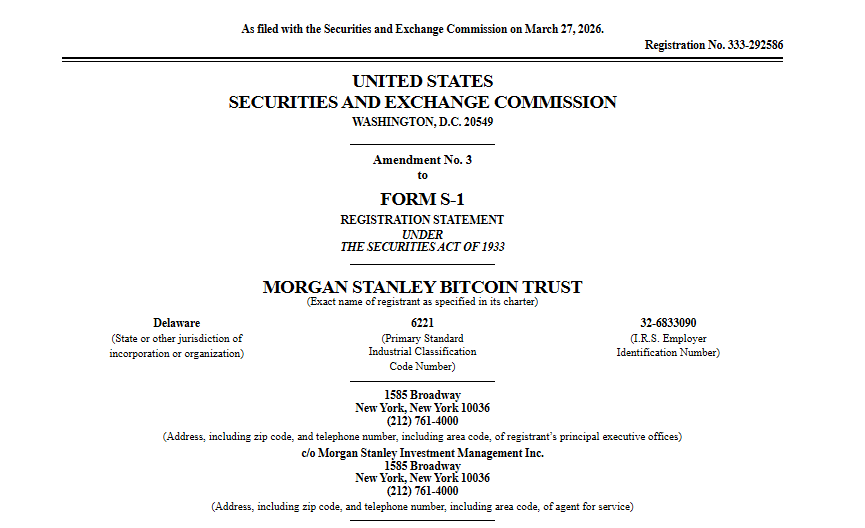
Morgan Stanley disclosed the 0.14% fee in its latest S-1 filing on Friday.

That is a practical calculation. Advisors who push high-fee products into client portfolios face questions. At 0.14%, those questions go away.

BlackRock’s iShares Bitcoin Trust charges 0.25%. The Grayscale Bitcoin Mini Trust sits at 0.15%. Morgan Stanley is going in one basis point below both of its nearest rivals.

Bloomberg ETF analyst James Seyffart called it a big move and said an early April launch is likely, pending regulatory approval.

Image: Kitco

First Bank To Issue A Spot Bitcoin ETF

Approval would put Morgan Stanley in a category of one. No major bank has yet issued a spot Bitcoin ETF in the US. That distinction, combined with a rock-bottom fee and a distribution network of thousands of advisors, gives the product a strong early position if it clears the SEC.

Bitcoin is now trading at $66,180. Chart: TradingView

The bank named Coinbase and Bank of New York Mellon as custodians for the fund. Those are two of the most established names in digital asset custody, and the pairing signals that Morgan Stanley is building this to last — not testing the waters.

Rivals will now face a decision. The $83 billion spot ETF market has operated with fees clustered around 0.20% to 0.25%. A new entrant coming in below all of them puts pressure on existing providers to respond or accept the risk of losing assets over time.

More Than Just Bitcoin

The Bitcoin ETF is one piece of a larger push. In January, Morgan Stanley also filed for a Solana ETF and a staked Ether ETF. Weeks later, it applied for a national trust banking charter that would allow it to custody digital assets, carry out trades, and offer staking services directly to clients.

Featured image from Unsplash, chart from TradingView

Domande pertinenti

QWhat is the proposed fee for Morgan Stanley's Bitcoin ETF and how does it compare to its competitors?

AMorgan Stanley's proposed Bitcoin ETF fee is 0.14%, which is lower than BlackRock's iShares Bitcoin Trust (0.25%) and the Grayscale Bitcoin Mini Trust (0.15%).

QWhy did Morgan Stanley set its Bitcoin ETF fee at 0.14%, according to Bloomberg analyst Eric Balchunas?

AEric Balchunas stated that the 0.14% fee was set with the firm's financial advisors in mind, making it a price point where no one would feel awkward recommending the product to clients.

QWhat significant distinction would Morgan Stanley achieve if its Bitcoin ETF is approved by the SEC?

AMorgan Stanley would become the first major bank to issue a spot Bitcoin ETF in the US.

QWhich two companies did Morgan Stanley name as custodians for its proposed Bitcoin fund?

AMorgan Stanley named Coinbase and Bank of New York Mellon as the custodians for the fund.

QBeyond a Bitcoin ETF, what other crypto-related products has Morgan Stanley recently filed for?

AIn addition to the Bitcoin ETF, Morgan Stanley has also filed for a Solana ETF, a staked Ether ETF, and applied for a national trust banking charter to custody digital assets and offer staking services.

Letture associate

Arbitrum Pretends to Be the Hacker, 'Steals' Back the Money Lost by KelpDAO

Title: Arbitrum Poses as Hacker to Recover Stolen Funds from KelpDAO Last week, KelpDAO suffered a hack resulting in nearly $300 million in losses, marking the largest DeFi security incident this year. Approximately 30,765 ETH (worth over $70 million) remained on an Arbitrum address controlled by the attacker. In an unprecedented move, Arbitrum’s Security Council utilized its emergency authority to upgrade the Inbox bridge contract, adding a function that allowed them to impersonate the hacker’s address and initiate a transfer without access to its private key. The council’s action, approved by 9 of its 12 members, moved the stolen ETH to a frozen address in a single transaction before reverting the contract to its original state. The operation was coordinated with law enforcement, which attributed the attack to North Korea’s Lazarus Group. Community reactions are divided: some praise the recovery of funds, while others question the centralization of power, as the council can upgrade core contracts without governance votes. However, such emergency mechanisms are common among major L2s. Despite the partial recovery, over $292 million was stolen in total, with more than $100 million in bad debt on Aave and remaining funds scattered across other chains. The incident highlights escalating security challenges in DeFi, with state-sponsored hackers employing advanced tactics and L2s responding with elevated countermeasures.

marsbit9 min fa

Arbitrum Pretends to Be the Hacker, 'Steals' Back the Money Lost by KelpDAO

marsbit9 min fa

iQiyi Is Too Impatient

The article "iQiyi Is Too Impatient" discusses the controversy surrounding the Chinese streaming platform IQiyi's recent announcement of an "AI Actor Library" during its 2026 World Conference. IQiyi claimed over 100 actors, including well-known names like Zhang Ruoyun and Yu Hewei, had joined the initiative. CEO Gong Yu suggested AI could enable actors to "star in 14 dramas a year instead of 4" and that "live-action filming might become a world cultural heritage." The announcement quickly sparked backlash. Multiple actors named in the list issued urgent statements denying they had signed any AI-related authorization agreements. This forced IQiyi to clarify that inclusion in the library only indicated a willingness to *consider* AI projects, with separate negotiations required for any specific role. The incident, which trended on social media with hashtags like "IQiyi is crazy," is presented as a sign of the company's growing desperation. Facing intense competition from short-video platforms like Douyin and Kuaishou, as well as Bilibili and Xiaohongshu, IQiyi's financial performance has weakened, with revenues declining for two consecutive years. The author argues that IQiyi is "too impatient" to tell a compelling AI story to reassure the market, especially as it pursues a listing on the Hong Kong stock exchange. The piece concludes by outlining three key "AI questions" IQiyi must answer: defining its role as a tool provider versus a content creator, balancing the "coldness" of AI with the human element audiences desire, and properly managing the interests of platforms, actors, and viewers. The core dilemma is that while AI can reduce costs and increase efficiency, it risks creating homogenized, formulaic content and devaluing human performers.

marsbit1 h fa

iQiyi Is Too Impatient

marsbit1 h fa

Trading

Spot
Futures
活动图片