MicroStrategy Will Not Die in This Downturn: Reflexivity, STRC Anchoring Back to Par, and the Self-Rescue Logic of "Sell Stock, Not Bitcoin"

marsbitPubblicato 2026-06-09Pubblicato ultima volta 2026-06-09

Introduzione

This article analyzes the recent sharp decline in Bitcoin and MicroStrategy (MSTR), framing it as a targeted "reflexivity" attack. The trigger was MSTR using its cash reserves to buy back convertible notes, raising market concerns about a liquidity crisis. The playbook follows George Soros's principle: market expectations can shape reality. Fears that MSTR might be forced to sell BTC caused panic selling, lowering BTC's price and worsening MSTR's financial ratios, thus reinforcing the negative narrative. The author argues that MSTR's Structured Convertible (STRC), while falling in price, is a floating-rate security that will eventually return to par value (100). The price drop reflects the market demanding a higher yield due to perceived risk, but as a floating-rate instrument, its coupon can adjust, naturally pulling the price back to par over time. This is crucial for MSTR's continued ability to raise funds. The core thesis is that MSTR's best move to counter the attack is to **issue new equity (sell shares)**, not sell its Bitcoin holdings. While selling BTC would solve the immediate cash crunch, it would destroy the company's core investment thesis and premium. It would dilute the BTC per share, likely erase the market premium over its net asset value (mNAV > 1), and worsen its debt-to-asset ratio. Issuing shares while mNAV is high (e.g., 1.25x) allows MSTR to raise cash for reserves without harming shareholder value or the "perpetual accumulation" narrative. It improve...

Author: @bonnazhu, Bonna | U酪乳

This round of rapid decline driven by STRC, in my opinion, might be the best financial teaching case.

Long post warning, again, with strong personal views.

TL;DR

  • If MSTR were to truly die, it would still be due to reflexivity, but not this time.
  • The return of STRC to its par value anchor is a matter of time; this is the nature of floating-rate bonds.
  • Selling Bitcoin to raise cash is merely drinking poison to quench thirst, solving short-term problems while sowing endless future troubles.

The detailed analysis is as follows:

First, How to Understand This BTC Decline?

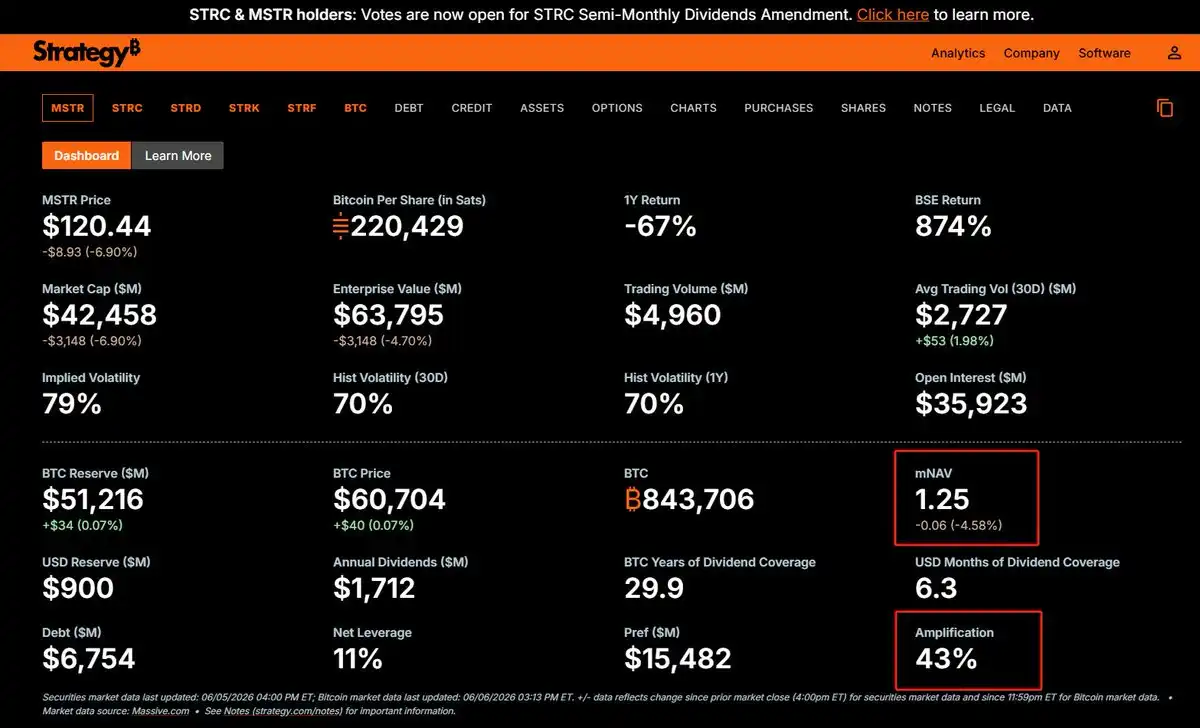
Personally, I tend to believe this rapid decline in BTC was a targeted attack by capital around MSTR. The trigger was MSTR using its already insufficient cash reserves (widely believed by the market to be a safety cushion set aside for preferred stock dividends) to repurchase part of its convertible bonds, causing the cash reserve coverage for preferred dividends to plummet from over two years to about six months, immediately followed by the sale of 32 BTC.

The market instantly picked up the scent of a "cash flow crisis" and launched a swift attack. Pre-existing sentiment worries, such as massive IPOs draining liquidity, the World Cup diverting attention, resurgent inflation and dampened rate cut expectations, further facilitated the attackers in solidifying this expectation in the market, allowing them to quickly force information-asymmetric funds to capitulate or hesitate to step in and buy the dip.

This is essentially a classic case of reflexivity in traditional financial markets:

Market prices do not passively reflect reality; they actively change it.

In other words:

Expectations are contagious, and this contagion can alter reality.

Soros' attack on the British Pound followed the same script. The Bank of England's forex reserves might have been sufficient initially, but market participants are information-asymmetric. Once everyone believes the reserves are insufficient and collectively shorts, the reserves can indeed become insufficient. Bank runs are the same: if everyone simultaneously believes the bank will fail and withdraws their money, the expectation of failure can become a reality!

Applying this to MSTR, the attackers' playbook is:

Cash reserves decline → Market expects a liquidity crisis, forcing BTC sales → Panic selling drives down BTC → BTC decline further compresses mNAV, worsens the balance sheet → The "can't hold on" expectation becomes increasingly validated by the price, options dwindle → More join the short side → Expectation moves closer to reality.

And the inherent soft spot that BTC itself cannot create sustainable cash flow for MSTR to cover dividend payments, requiring continuous reliance on financing to keep the flywheel spinning, is also why attackers find easier opportunities.

Second, The Logic Behind STRC's Decline and Return to Par Anchor

The relationship between STRC and MSTR common stock is essentially that of senior and junior tranches:

Common stock, as the junior tranche, absorbs most of the risk from BTC price volatility.

STRC, as the senior tranche, remains relatively stable under most circumstances.

Based on MSTR's target overall leverage ratio discipline of roughly 33-35% (currently increased to about 43% due to BTC's drop to $61k), theoretically, only if BTC price falls below $26k, wiping out the common stock, would the preferred stock be truly impacted.

So why did STRC decline too?

This involves some basics of bond pricing.

STRC is nominally preferred stock but is debt in substance, with floating interest and no maturity date.

The price of a bond is essentially the present value sum of all future cash flows (each period's interest, calculated from the coupon rate + principal at maturity, equal to par value of 100), discounted back at a discount rate. This discount rate is the required rate of return demanded by the market at that moment.

If the coupon rate exactly equals the required rate of return, the discounted price equals the par value of 100. This often happens at issuance, where underwriters typically set the coupon rate based on prevailing market conditions and investor return requirements.

However, a bond's life is long. Throughout its duration, external interest rate environments and issuer creditworthiness can change, affecting that discount rate (the denominator) corresponding to the required return. Once the market's required return rises while the coupon interest (the numerator) remains fixed, the discounted present value falls below par, and the bond trades at a discount. Conversely, if the required return falls, the bond trades at a premium.

Therefore, a bond's price is never a static number. Instead, it reflects the return the market currently demands to hold it.

A price falling below par implies: "The market demands a higher return than the coupon rate." If you buy at this discount and hold to maturity, your ultimate yield will indeed be higher than the coupon rate, as the portion of principal you didn't pay when buying the $100 face value bond compensates for the return the coupon didn't provide. That is, the market uses the discount to extract the compensation it deems necessary for the risk, which the coupon rate fails to provide.

STRC is similar. Market concerns about MSTR's cash flow translate into a repricing of STRC's repayment capacity. As the "cash flow crisis" narrative develops, the required return demanded by the market to hold STRC jumps; bearing this risk, the 11.5% coupon is no longer enough.

Of course, from the attackers' perspective, this is also part of putting on a full show: only by having STRC decline alongside can they, under information asymmetry, solidify the "cash flow crisis" narrative, making you wonder:

Is there really some information I don't know?

For fixed-rate bonds, the story essentially ends here. The increase in the market's required return can only be matched by a price drop, so the discount can persist long-term without returning to the par anchor. But STRC is not a fixed-rate bond; it's floating-rate, allowing adjustment of the numerator.

For example, if the market demands a 12% required return to hold STRC, and MSTR management consequently raises the coupon dividend from 11.5%, the price cannot stay below par value 100 for long. In such a case, buying STRC at a discount would yield an actual return above 12%, naturally attracting buy-side pressure that pushes the price to a level where the implied return equals 12%, i.e., par value.

This is why medium-to-long-term floating-rate bonds must anchor to par value 100; it's an inherent property of such instruments.

For MSTR, STRC's price returning to its par anchor of 100 is a prerequisite for its ability to continuously use it for financing. Because if issued at a discount, the company nominally issues $100 face value, but the buyer only pays $90. This means the company incurs dividend obligations based on a $100 face value for only $90 of actual funds received, artificially raising its real financing cost—losing money on every financing round. Is that fucking possible?

Third, When mNAV > 1, Sell Stock, Never Sell Bitcoin

So, what's the key to breaking the deadlock?

As discussed earlier, this entire decline is a reflexive script of a self-fulfilling prophecy, built on information asymmetry and expectations of a cash flow crisis. To break it, one only needs to prove this liquidity crisis doesn't exist, refilling the reserves, and the attack loses its footing, breaking the reflexive spiral.

How to replenish reserves?

As many on X have shouted, should Saylor just come out and say, "In this decline, we sold more BTC, and now we have ample funds for several years"? This move would certainly work, and the panic would end.

But its cost is another layer of implied uncertainty.

Because it tells the market: You need to reprice me.

The capital market premium flywheel narrative of "continuous accumulation, never selling Bitcoin, constantly increasing BTC per share for shareholders" would surely be gone. It would shift to, "May sell significant amounts of BTC to shrink the balance sheet if necessary, thereby diluting BTC per share," at least a discounted flywheel taking three steps forward, one step back.

The result is you don't know how common shareholders will react, and whether mNAV might completely disappear. Even if it doesn't disappear, narrowing is highly likely. After all, the premium for the part where mNAV > 1 corresponds to an implicit Call Option on "future increased BTC per share" for MSTR. If the acceleration of BTC per share growth slows, the Call naturally becomes less valuable.

The importance of mNAV premium to MSTR is self-evident. MSTR's expansion logic doesn't rely solely on common stock or leverage instruments like STRC (debt in substance), but on a cycle of adding water when there's more flour, and flour when there's more water, thereby keeping overall leverage from spiraling out of control, maintaining its ideal 33-35% range. A narrowing mNAV premium would directly impact the window for subsequent equity financing, constituting a poison-quenching-thirst action.

A better approach, in my view, would be to leverage the current situation where mNAV = 1.25x, and the premium remains significant, to raise cash reserves by issuing and selling stock. MSTR previously registered a Shelf Offering with the SEC with ample capacity. This is the only operation that clearly pleases both STRC holders (debt in substance) and common shareholders simultaneously, without the risk of repricing.

The specific mechanism is:

When mNAV is significantly greater than 1, choosing to issue and sell stock first means that for every $1 of stock you issue and use entirely to buy BTC, you create more than $1 of shareholder value in the capital market. This is precisely why shareholders are willing to give you money. And precisely because of this, in this state, you don't actually need to use all the raised funds to buy BTC: you can retain a portion as cash reserves for future debt servicing, without negatively impacting shareholder value. Meanwhile, increased cash reserves make STRC holders feel safer, the alarm dissipates, risk premiums decrease, and STRC gradually returns to its anchor, allowing subsequent STRC financing if desired. It doesn't hinder either.

Conversely, choosing to sell Bitcoin for cash is drinking poison to quench thirst. Once repricing causes mNAV to narrow or disappear, the path of issuing stock to buy BTC becomes impassable. At that point, your stock's fair value equals its underlying BTC—why wouldn't I just buy BTC directly? Moreover, if you then retain a portion of the financing for interest payments, that's outright negative shareholder value: taking my money, part to buy BTC (creating value just breaking even in the capital market), and another part directly used for interest payments, which is pure loss.

This is a net bleed structure.

By then, as equity issuance becomes unfeasible, STRC issuance would also gradually be affected. Not only would the overall expansion flywheel likely get stuck, but your financing window would also close, forcing reliance on cash reserves. Once those are exhausted, you're truly left with only selling Bitcoin, and that's the end.

Moreover, selling stock has the added benefit of directly improving the leverage ratio. Currently, with BTC at $61k, MSTR's overall leverage ratio has increased from the target 33-35% to about 43%. Issuing and selling stock brings in equity capital: cash (asset side) increases, equity increases. After deducting a small portion retained for interest payments, the overall leverage ratio would actually improve further.

And selling Bitcoin? Because the cash from selling BTC is immediately paid out as dividends, the asset side first sees BTC decrease, then cash outflow. The net effect is total assets shrink, liabilities remain unchanged, and the leverage ratio actually worsens slightly.

Sell stock: Improves leverage ratio ✓, Preserves BTC per share ✓, Doesn't harm premium ✓

Sell Bitcoin: Worsens leverage ratio, Reduces BTC per share, Severely harms premium

The superiority is clear.

Finally, if, I mean if,

MSTR truly sells large amounts of Bitcoin to replenish reserves?

Then, indeed, as many X influencers, including those from Delphi, have said, the short-term crisis would be resolved, BTC would rebound, and STRC would return to its anchor. This is precisely why I say, if MSTR were to truly die, it wouldn't be this time. Whether selling stock or Bitcoin can indeed solve the immediate crisis.

But personally speaking, for me, MSTR and Saylor would then be demystified.

And due to the repricing of common stock logic, that "BTC per share" Call Option would no longer be as valuable, causing the mNAV premium to gradually disappear. This could lead to a strange divergence: BTC rebounds, STRC returns to anchor, while MSTR common stock反而下跌.

And next time, when cash reserves dwindle again, and the market anticipates Bitcoin sales again, the reflexive script plays out once more. Then, who knows if it's the beginning of the end.

But honestly, I would accept such an outcome.

Perhaps "change" itself is part of this "game."
Domande pertinenti

QWhat is the main reason the author believes MicroStrategy (MSTR) is under attack in this BTC downturn?

AThe author believes the attack is a self-fulfilling prophecy based on market expectations of a 'cash flow crisis.' This was triggered by MSTR using its limited cash reserves (believed to be a safety cushion for preferred stock dividends) to repurchase some convertible notes, which drastically reduced its cash coverage for dividends. This led to market panic, selling pressure on BTC, and a worsening balance sheet, creating a vicious cycle.

QAccording to the article, why did the price of STRC (MicroStrategy's preferred stock) fall alongside MSTR's common stock?

ASTRC fell because the market's perceived risk of holding it increased. Fears about MSTR's cash flow led to a higher required rate of return from investors. Since STRC is a floating-rate security, a higher required return causes its market price to drop below its par value ($100) until its effective yield matches the new, higher market demand. However, its floating-rate nature means it will eventually re-anchor to par.

QWhy does the author argue that selling BTC to raise cash is a short-sighted solution for MicroStrategy?

ASelling BTC is seen as 'drinking poison to quench thirst.' While it solves the immediate cash shortage, it fundamentally damages the core investment narrative of 'continuous accumulation, never selling.' This would lead to a re-rating of the common stock, eroding the mNAV (market premium over net asset value) premium. A lower mNAV makes future equity financing difficult and harms long-term shareholder value by reducing per-share BTC holdings.

QWhat is the author's preferred method for MicroStrategy to replenish its cash reserves, and why?

AThe author prefers issuing new common stock (equity financing) while the mNAV is significantly above 1 (e.g., 1.25x). This method improves the debt-to-equity ratio, does not dilute per-share BTC holdings (as proceeds can be partly used to buy more BTC), preserves the mNAV premium critical for future financing, and reassures STRC holders by boosting cash reserves—all without triggering a damaging narrative shift.

QWhat is 'reflexivity' as described in the article, and how does it apply to the situation with MicroStrategy?

AReflexivity is the concept that market prices do not passively reflect reality but can actively change it. In MSTR's case, the market's expectation of a cash flow crisis (triggered by its actions) led to panic selling of BTC. This price drop worsened MSTR's balance sheet (lowering the value of its BTC holdings), which made the 'crisis' expectation seem more real, leading to more selling—a self-reinforcing downward spiral.

Letture associate

U.S. Tech Momentum Stocks Post Largest Single-Day Gain Ever, But Is the Plunge Over?

US tech momentum stocks staged a sharp rebound on Tuesday (July 21st). Morgan Stanley's TMT Momentum Factor surged over 12%, marking its largest single-day gain on record, exceeding even peaks from the 2000 dot-com bubble. Key momentum indices from Goldman Sachs also posted their strongest daily performances in years. The rally was led by semiconductors, with the Philadelphia Semiconductor Index jumping 4.6%. This rebound followed three consecutive down days and a cumulative 33% plunge in momentum stocks, one of the steepest drawdowns since the dot-com era. Analysts attribute the surge largely to a short squeeze. Heavy selling had pushed high-beta momentum stocks into deeply oversold territory, forcing many short sellers, particularly in Asia, to cover their positions, creating a self-reinforcing buying spiral. However, the rebound's internals appear weak. Trading volume was notably low, and advancing stocks still lagged decliners on the S&P 500, indicating a narrow, concentrated rally rather than broad market participation. Diverging views emerge on the outlook. BTIG warns the bounce has hit key resistance and recommends selling into strength, citing extreme volatility and historical parallels to past market tops. Conversely, Goldman Sachs and UBS believe the momentum unwind is nearing its end, suggesting it may be time to gradually add exposure, as positioning has been significantly reduced. They caution, however, that high volatility warrants a measured approach, potentially using defined-risk strategies. The upcoming earnings season, particularly reports from major tech firms like Alphabet, is seen as a critical test for the rally's sustainability. Simultaneously, bond markets flashed a warning, with yields rising partly due to spiking oil prices. Analysts note that if long-term Treasury yields break decisively higher, it could pose a significant headwind for equities, especially growth stocks.

marsbit5 min fa

U.S. Tech Momentum Stocks Post Largest Single-Day Gain Ever, But Is the Plunge Over?

marsbit5 min fa

U.S. Tech Momentum Stocks Record Largest Single-Day Gain Ever, but Has the Rout Ended?

U.S. tech momentum stocks staged a dramatic rebound on Tuesday, July 21st. Key momentum indices like the Morgan Stanley TMT Momentum Factor and Goldman Sachs' High Beta Momentum Long Index posted historic or near-historic single-day gains, fueled largely by semiconductor stocks. This sharp rally followed a severe three-day sell-off that saw momentum stocks plunge 33%, marking one of the steepest pullbacks since the dot-com bubble. Analysts attribute the bounce primarily to a short squeeze, as forced covering from over-leveraged traders, particularly in Asia, created a buying spiral. However, the rally's health is questioned due to weak market breadth—overall trading volume was low, and decliners outnumbered advancers in the S&P 500 despite the index's gain—suggesting a narrow, concentrated surge rather than broad recovery. Opinions on the sustainability diverge. BTIG strategists warn the rebound has hit key resistance levels, citing extreme volatility and historic stock dispersion as signs of an ongoing broader correction, and recommend selling into strength. Conversely, Goldman Sachs and UBS view the aggressive momentum unwinding as nearing its end, noting reduced positioning and a lack of new fundamental catalysts. They suggest the sell-off presents a selective opportunity to add exposure, albeit cautiously and gradually using defined-risk strategies. The immediate trajectory hinges on the ongoing earnings season, with market focus on Alphabet's capital expenditure guidance for AI investment clarity. Meanwhile, bond markets present a risk, with rising Treasury yields—potentially heading toward 5.5%—and widening credit spreads for mega-cap tech companies posing a threat to equity valuations. The combination of technical factors, earnings results, and macro conditions leaves the durability of the rebound in doubt.

链捕手8 min fa

U.S. Tech Momentum Stocks Record Largest Single-Day Gain Ever, but Has the Rout Ended?

链捕手8 min fa

Long-Divided Must Unite, Long-United Must Divide: When L1 Becomes Its Own Rollup, What Is Ethereum's Endgame?

"The Inevitable Cycle: When L1 Becomes Its Own Rollup – What is Ethereum's Endgame?" For years, the Ethereum community grappled with concerns that L2s were fragmenting the ecosystem and eroding L1's value. While L2s provided cheaper execution, they also splintered liquidity and the unified user experience of a single chain. This has prompted a fundamental reassessment of the relationship between L1 and L2. Ethereum's roadmap is evolving. The "Scale" initiative merges L1 and L2 expansion into a holistic framework. L1 itself is advancing with higher gas limits, statelessness, and zkEVM verification, no longer content to be just a low-throughput settlement layer. Consequently, the primary value proposition of L2s is shifting from merely providing cheap blockspace to offering L1 cannot easily provide: application-specific optimizations, privacy features, and flexible governance models. L2s are becoming a spectrum of execution environments with varying degrees of security inheritance from Ethereum. A critical challenge in this multi-chain future is interoperability. The vision is to make Ethereum "feel like one chain again." This relies on advancements in native account abstraction (like EIP-7702) and intent-based architectures (Open Intents Framework), where users declare desired outcomes, and solvers handle the complex cross-chain execution. Furthermore, shortening Ethereum's finality time from minutes to seconds is crucial, as it underpins trust between chains for bridges, stablecoins, and cross-chain applications. Perhaps the most provocative idea is that Ethereum L1 itself could become a form of "its own Rollup." As zkEVM and proof systems mature, high-performance nodes could execute transactions and generate validity proofs. Regular validators would then verify these proofs instead of re-executing all transactions. This blurs the traditional L1/L2 hierarchy, making "Rollup" more of a general execution-verification architecture. Native Rollup aims to integrate L2 validation more directly into the Ethereum protocol, allowing L2s to inherit L1's security more fully and move away from reliance on security councils. In the end, L2s are not destined to replace L1 or be made obsolete by it. The likely future is a unified system where diverse execution environments—each optimized for specific use cases like DeFi, gaming, or privacy—coexist. They will share a common foundation of security, liquidity, and verifiable state, seamlessly connected to restore a cohesive user experience. The next phase for Ethereum is not just about scaling through separation, but about intelligently reintegrating what was separated back into a coherent whole.

链捕手24 min fa

Long-Divided Must Unite, Long-United Must Divide: When L1 Becomes Its Own Rollup, What Is Ethereum's Endgame?

链捕手24 min fa

Agent Race Ends, Super Workbench Takes Over

The era of fragmented AI agents is ending. Over the past month, China's tech giants—Tencent, Alibaba, and ByteDance—have simultaneously shifted strategy: instead of launching new, standalone AI agents, they are consolidating their various agent projects into unified "super workbenches." Tencent integrated its QClaw teams into WorkBuddy, a strategic product hailed as a potential third flagship after QQ and WeChat. Alibaba is merging its QoderWork, Wukong, and MuleRun agents into a new "Qianwen Office" platform under DingTalk's leadership. ByteDance rebranded its TRAE SOLO coding agent to TRAE Work, signaling a broader focus on workflow collaboration. This convergence marks a pivotal industry consensus. The initial exploration phase, where companies rapidly built numerous overlapping agents for different scenarios, proved costly and inefficient. With open-source tools eroding technical barriers, competition has shifted from agent creation to resource consolidation and cost control. Historically, platform wars are won not by creating more products, but by simplifying them—as seen with browsers unifying web access and super-apps consolidating services. Now, the "super workbench" aims to become the unified AI entry point for work. This reflects a deeper market realization: the primary audience for AI is no longer just programmers (a market in the tens of millions) but all knowledge workers (a market of billions). The real opportunity lies in augmenting everyday tasks—managing emails, documents, data, and meetings—across the entire workday. The core battleground is becoming control over the primary AI entry point that employees use daily. Tencent's WorkBuddy leverages WeChat and Tencent Docs; Alibaba's Qianwen Office taps into DingTalk's organizational data; ByteDance's TRAE Work integrates with Feishu's workflows. Whoever owns this "super workbench" gains strategic control over orchestrating enterprise data and APIs. This shift is redefining enterprise software. Traditional SaaS applications, valued for their user interfaces, will recede into the background. Their core functionalities will be exposed as standardized "Skills" or APIs for the super workbench's agents to invoke. Software value will shift from selling user seats to charging based on API calls and outcomes delivered. The evolution of agents is moving through clear stages: first as novel standalone products, then as consolidated primary work entry points, and finally as pervasive, invisible capabilities embedded into the digital fabric. The recent moves by major tech firms signal the transition from the first stage into the second, accelerating toward the third. In the end, the most successful agent technology may become invisible—like electricity or the HTTP protocol—a fundamental, unnamed infrastructure powering work itself.

marsbit51 min fa

Agent Race Ends, Super Workbench Takes Over

marsbit51 min fa

Trading

Spot
活动图片