Meta's Big Bet on AI: Investing $135 Billion, Is Zuckerberg in 2026 Worth Believing?

比推Pubblicato 2026-01-30Pubblicato ultima volta 2026-01-30

Introduzione

Meta is making a massive $135 billion bet on AI by 2026, a near-doubling of its capital expenditures from the previous year. This aggressive investment comes after the company reported strong Q4 2025 and Q1 2026 results that exceeded market expectations, with revenue reaching $59.9 billion (up 24% YoY) and EPS at $8.88 (up 11% YoY). The market responded positively, with Meta's stock surging over 10%. Unlike its previous metaverse gamble, which resulted in nearly $80 billion in cumulative losses for its Reality Labs division, this AI investment is already showing tangible returns by directly improving Meta's core advertising business. AI-driven enhancements to recommendation and ad delivery systems have increased ad prices by 6% and impressions by 18% in Q4. Key growth drivers include the strong performance of Instagram Reels and the accelerated commercialization of WhatsApp, which is expected to become a major revenue stream. CEO Mark Zuckerberg emphasized that the company's goal is to develop "superintelligence," and this investment is part of a long-term strategy involving talent acquisition, computational infrastructure, and organizational restructuring. To fund this, Meta is reallocating resources, including cutting about 10% of Reality Labs staff. The company's approach differs from competitors like Google and Microsoft by focusing on internalizing AI to enhance its existing massive user traffic and monetization engines, rather than primarily selling external AI produ...

Strong cash flow foundation, billions poured into AI, the market seems to applaud the "splurge," but will this time be different from the metaverse?

Written by: Frank, M Tong MSX

$135 billion—this is the amount Meta (META.M) plans to spend in 2026.

The Q4 2025 earnings and Q1 2026 guidance, both exceeding expectations, let many who were anxious about "falling behind" breathe a sigh of relief. But at the same time, the full-year 2026 capital expenditure (CapEx) soaring to $135 billion, nearly double last year's, is hard not to worry about—could this be another aggressive gamble?

Surprisingly, the market seemed to choose to buy, with Meta's stock surging over 10% after hours and continuing to rise overnight.
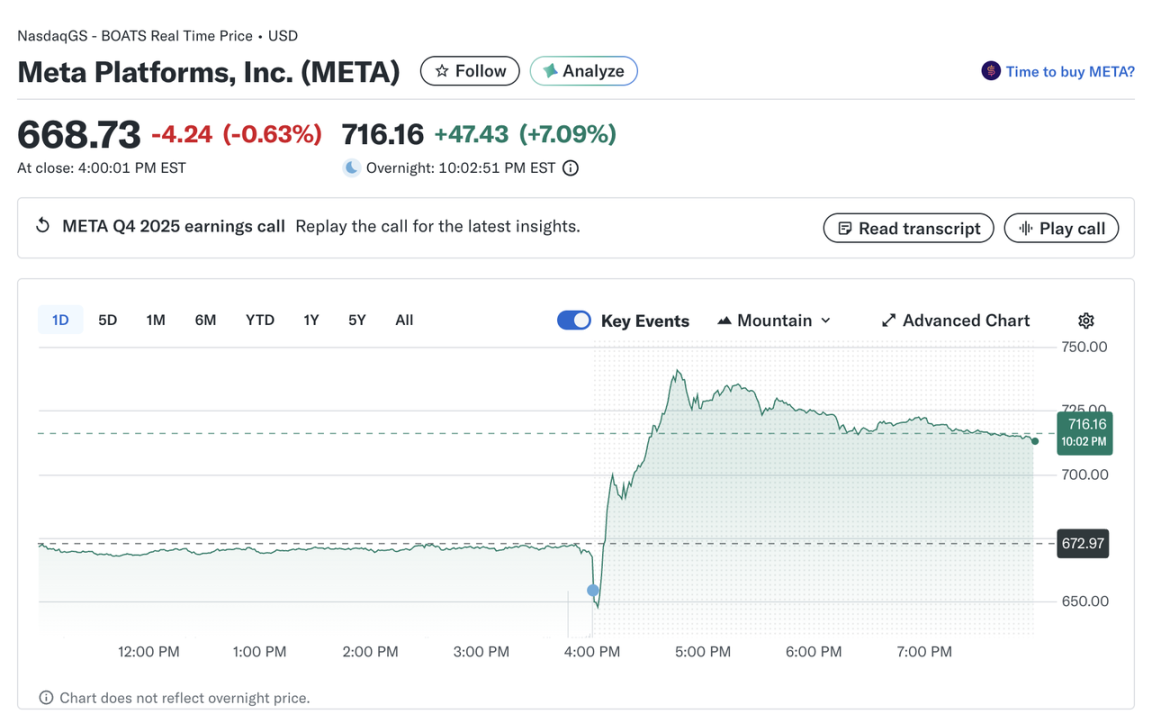
Meta Stock Price Data Source: Yahoo Finance

The answer lies hidden in this earnings report: at least at this stage, it shows the market that AI investment isn't just a future vision but is already tangibly improving the current core cash cow—advertising business. So Wall Street started betting on Meta's narrative reversal and is willing to buy into this super spending plan.

Ultimately, "daring to spend, daring to bet" has always been the底色 of Meta and Zuckerberg. This also means that winning could be a huge narrative reversal; losing, at least under the current financial structure, is unlikely to turn into an uncontrollable disaster.

I. Earnings Quick Read: Earnings & Guidance "Double Beat"

From the results, this is an earnings report足以改变市场情绪.

Among them, Q4 2025 core financial indicators almost all exceeded expectations across the board: revenue of $59.893 billion, up 24% YoY, above market expectations of $586 billion; net profit of $22.768 billion, up 9% YoY; diluted earnings per share (EPS) of $8.88, up 11% YoY, above market expectations of $8.23.

It can be said that whether in terms of growth resilience on the revenue side or profit release节奏 on the profit side, Meta delivered a solid, stable Q4 report card.

Extending the perspective to the full year, the growth logic同样成立: 2025 full-year revenue of $200.966 billion, up 22% YoY; operating profit of $83.276 billion, up 20% YoY, core indicators still maintaining double-digit expansion.

The only seemingly "against the trend" was the full-year net profit recording $60.458 billion, down 3% YoY, but this change wasn't due to恶化 of main business but mainly from a one-time tax factor—affected by the "Big and Beautiful Act," the company recognized about $16 billion in one-time non-cash income tax expense.

Excluding this factor, full-year net profit and EPS would still achieve可观增长, also explaining the surface contradiction between the full-year data and the quarter's strong performance.
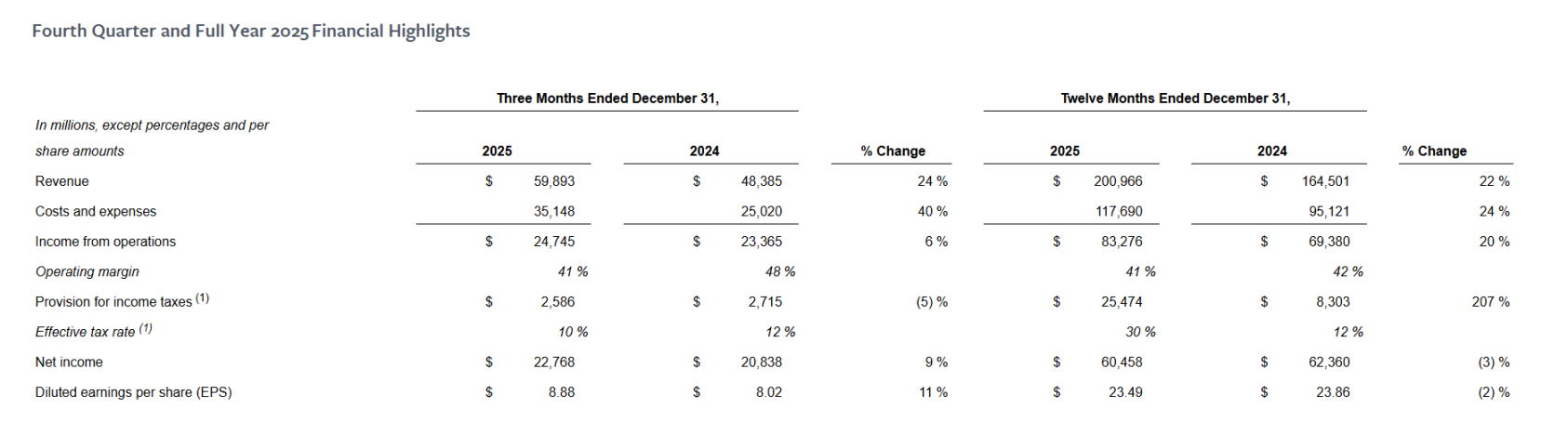
Source: Meta

At the same time, operational metrics also showed typical "volume and price rising together" characteristics:

  • Family app daily active users (DAP) reached 3.58 billion, up 7% YoY, meeting market expectations;

  • Ad impressions up 18% YoY; average price per ad up 6% YoY;

  • Average revenue per user (ARPU) was $16.73, up 16% YoY;

This set of data points to one conclusion: Meta's advertising moat not only hasn't slowed down but is continuously evolving in efficiency and monetization capability.

Furthermore, what further stimulated market sentiment turning wasn't just the realized超预期业绩, but also management's optimistic guidance for the future: Meta expects Q1 2026 revenue to reach $535-565 billion, corresponding to YoY growth of 26%-34%, significantly higher than the previous market expectation of about 21% growth. This pricing implies management's judgment that Reels' high growth momentum will continue, and Threads' commercialization progress is better than the market's previous cautious expectations.

With the advertising base盘稳固, this guidance directly strengthened market confidence in AI-driven advertising efficiency improvement having sustainability.
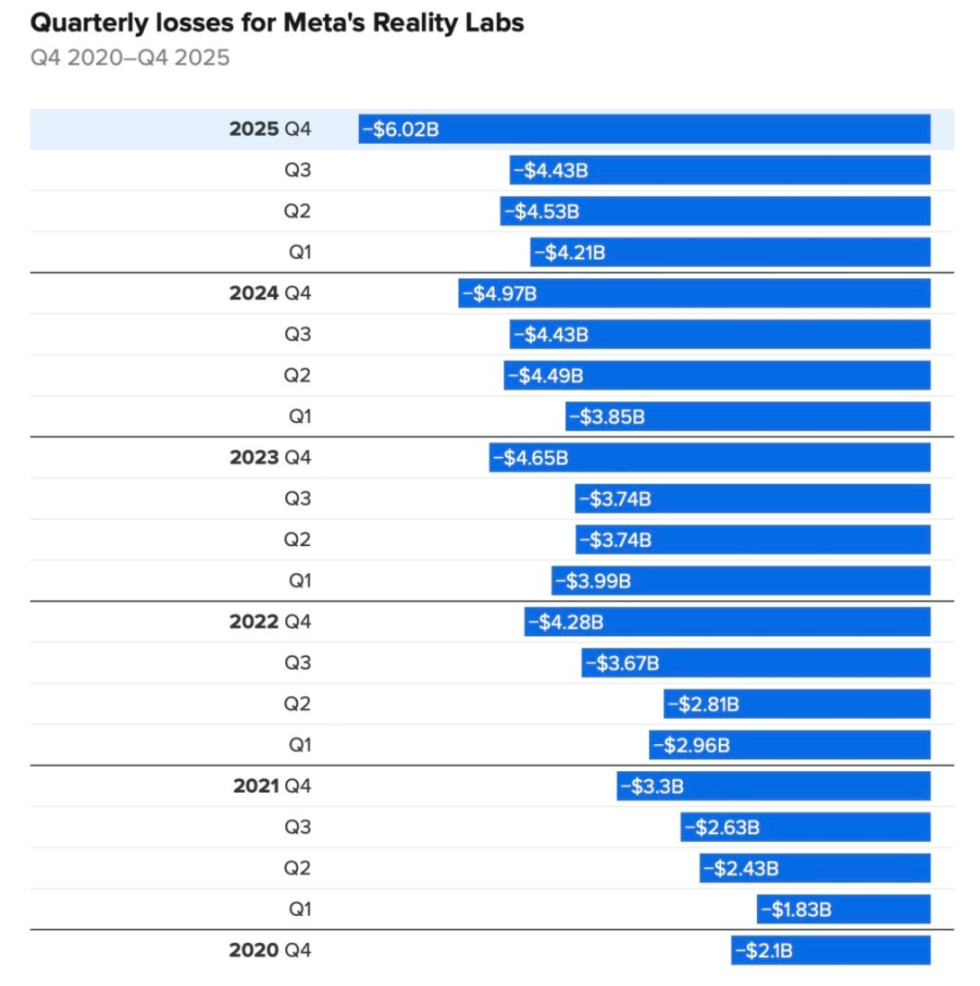
Reality Labs Five-Year Loss Details

Of course, it's worth mentioning that the "metaverse" is still Meta's bleeding edge, with its元宇宙部门 Reality Labs recording an operating loss of $6.02 billion in Q4, expanding 21% YoY. Revenue was $955 million, up 13% YoY. Since late 2020, this department's cumulative operating loss has approached $80 billion.

But different from the past, Reality Labs' role in the current earnings report is no longer the core variable左右公司整体叙事, but is gradually being marginalized.

II. Social Base盘稳固, AI Deepens the "Moat"

At least at the main business level, AI has indeed started creating value for Meta's (META.M)商业化真金白银.

It can be said that to some extent, unlike Google (GOOGL.M) or Microsoft (MSFT.M), Meta is currently the most direct and already earnings-reported player with "AI investment directly feeding back to main business cash flow".

First体现在广告效率的系统性提升上, this benefits from AI directly嵌入推荐系统与广告投放系统, making Meta's Q4 average ad price up 6% YoY, with impressions大增 18%. Management has also多次强调, AI recommendation algorithms and投放系统的升级, significantly improved ad conversion rates and投放效率.

Among them, Instagram Reels' watch time in the US market grew over 30% YoY, becoming the core engine driving ad inventory and monetization capability.

Second is the accelerated推进 of WhatsApp commercialization. Meta plans to fully introduce ads into WhatsApp Status this year, seen as the company's next potential billion-dollar revenue growth point, also a key step for AI recommendation and ad systems to expand to more traffic scenarios.

Overall, against the backdrop of ongoing external competition like TikTok, Meta's social base盘 hasn't loosened; instead, through deep AI embedding into recommendation and ad systems, it has further deepened its moat.

Source: Meta

Looking back over the past year, Meta's actions in the AI direction can be described as激进—from spending billions to acquire Scale AI equity, inviting Alexandr Wang to lead the "Meta Superintelligence Lab (MSL)", to continuously high-salary poaching, restructuring AI organizational structure, then investing tens of billions to acquire Manus, and launching Meta Compute, planning to build tens of GW-level computing and power infrastructure within this decade...

This series of actions reminds many of that familiar script: aggressive investment, grand narrative, long payback period. In other words, we seem to see the "Zuckerberg of the metaverse era" again.

But different from the metaverse period, management this time gave a clear bottom expectation, stating that even with大幅提升基础设施投入, 2026 operating profit will still be higher than 2025, and the cost growth path for the huge 2026 investment is highly transparent, mainly concentrated on computing power, depreciation, third-party cloud services, and high-end technical personnel.

In short, in Meta's strategic framework, AI isn't just a technological narrative押注未来, but a real tool持续改善主营现金流, its logic isn't complicated: when AI is deeply embedded into recommendation systems and ad systems, even marginal improvements, like making 3.6 billion users stay几十秒 longer daily, or improving ad conversion rate by 1%, on Meta's current traffic scale and ad base, will be rapidly放大为可观、可重复的现金流增量.

It is under this high-leverage structure that the efficiency improvement brought by AI is实实在在地对冲甚至覆盖高达 135 billion annual capital expenditure. In other words, Wall Street is no longer afraid of Meta burning money, to some extent because it has seen the real silver brought by AI.

Interestingly, from a more macro perspective, in Silicon Valley's AI arms race, besides the mainstream path of忙着向外输出算力、模型与工具, "selling shovels and tools" to the world, another is the Meta model—internalizing AI as the heart of its own commercial system, directly amplifying existing traffic and monetization engines.

It is this model of not relying on external sales of new products, but improving self-monetization efficiency to achieve回报, that makes Meta's AI investment path明显区别于其他大型科技公司以大模型或云服务为核心的变现逻辑, also because of this, the market began重新审视 Meta's pricing basis:

AI here isn't a long-term story waiting to be realized, but can already through the advertising system,持续、量化地反馈到主营现金流中的现实变量.

This或许也正是市场愿意重新给 Meta 定价的根本原因.

III. Violent Betting, an Unloseable War?

"Superintelligence" has become one of the highest frequency keywords in Zuckerberg and Meta management's mouths.

Zuckerberg on this earnings call also didn't hide his ambition: "I look forward to promoting superintelligence for global users", this也成为一场涵盖人才、算力与基础设施的 Meta 长期战略.

First from capital expenditure numbers, as mentioned above, Meta started an uncompromising violent betting, 2026 full-year operating expenses will reach $162-169 billion, up 37%-44% YoY,明显高于市场买方此前约 1500-1600 billion expectation range.

At the same time, Meta is also using actions to release "abandonment signals" to the market. This month, media revealed its plan to cut about 10% of Reality Labs employees again, involving about 1,500 people, meaning元宇宙相关业务正被进一步压缩,为 AI 与核心业务腾挪资源.

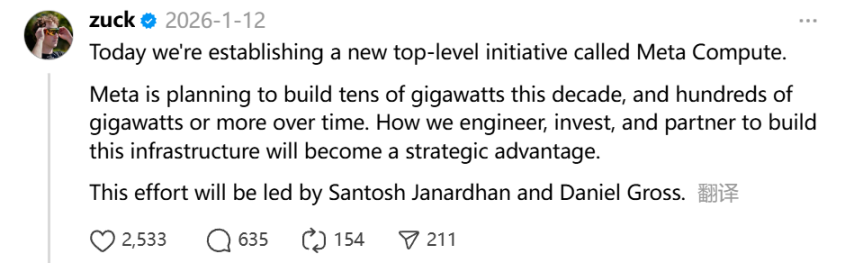
More strategically significant is Meta's redefinition of computing power and infrastructure. Zuckerberg personally posted on January 12,表示 "started a new top-level strategic project named Meta Compute". According to disclosed information, Meta plans to cumulatively invest at least $600 billion in US data centers and related infrastructure by 2028.

However, Meta CFO Susan Li later clarified this number, saying this investment isn't solely for AI server procurement but covers US本土数据中心建设、算力与电力设施, as well as supporting new employees and配套成本 needed for US business operations.
Objectively, whether from talent density, computing scale, or infrastructure intensity, Meta's investment in AI direction已经不逊于、甚至某些维度上超过了主要竞争对手.

Of course, this path is also naturally a double-edged sword. Once revenue growth, advertising efficiency, or new model progress cannot持续跑在成本扩张之前, the market's tolerance will rapidly decline, valuation and profit expectations都可能面临反噬.

In other words, this isn't an experiment that can be tried repeatedly, but a strategic war once the bow is drawn, it's hard to turn back.

Written at the End

As early as a blog program in September 2025, Zuckerberg直言, if ultimately几千亿美元浪费掉, that would be very unfortunate, but on the other hand,假设在 AI 浪潮中掉队, the risk for Meta might be higher.

"For Meta, the real risk isn't whether the investment is too aggressive, but whether it will hesitate at key moments", this remark, in today's context, can almost be seen as the footnote for all Meta's strategic actions over the past year.

Of course, history isn't easily forgotten. In the last metaverse narrative, Zuckerberg同样选择了提前下注、全力推进, but the final result didn't meet the market's initial expectations.

The difference is that this time Meta holds the world's densest, most commercializable user traffic entrance; and AI is正在以前所未有的方式, directly重塑人与内容、人与商业之间的连接效率.

As for 135 billion, whether it's a historic strategic sprint or another costly lesson, the answer still needs time to tell.


Original link:https://msx.com/news-details/246/?code=MPoint
Disclaimer: All Bitpush articles only represent author's views and do not constitute investment advice.
MetaRWA

Domande pertinenti

QWhat is the total amount Meta plans to invest in 2026, and how does it compare to the previous year?

AMeta plans to invest $135 billion in capital expenditures (CapEx) in 2026, which is nearly double the amount from the previous year.

QHow did Meta's Q4 2025 financial performance compare to market forecasts?

AMeta's Q4 2025 performance exceeded market expectations: revenue was $59.893 billion (up 24% YoY), net profit was $22.768 billion (up 9% YoY), and diluted EPS was $8.88 (up 11% YoY), all above market forecasts.

QIn what ways is AI already contributing to Meta's core advertising business?

AAI is improving Meta's advertising efficiency by being integrated into recommendation and ad delivery systems, leading to a 6% YoY increase in average ad price and an 18% rise in ad impressions in Q4 2025.

QWhat is Meta's strategic focus for AI, and how does it differ from other tech giants like Google or Microsoft?

AMeta's AI strategy focuses on internalizing AI to enhance its existing traffic and monetization engines, such as improving ad systems and user engagement, rather than primarily selling AI models or cloud services externally like Google or Microsoft.

QWhat is the long-term financial outlook for Meta despite its massive AI investments?

AMeta expects its operating profit in 2026 to be higher than in 2025, even with significant infrastructure investments, as AI-driven efficiencies in advertising and user engagement are already generating measurable cash flow improvements.

Letture associate

Breaking: OpenAI Undergoes Major Reorganization, President Brockman Assumes Command

OpenAI has announced a major internal reorganization just months before its anticipated IPO. The company is merging its three flagship product lines—ChatGPT, Codex, and the API platform—into a single, unified product organization. The most significant leadership change involves co-founder and President Greg Brockman moving from a background technical role to take full, permanent control over all product strategy. This follows the indefinite medical leave of AGI Deployment CEO Fidji Simo. Additionally, ChatGPT's longtime lead, Nick Turley, has been reassigned to enterprise products, with former Instagram executive Ashley Alexander taking over consumer offerings. The consolidation, internally framed as a strategic move towards an "Agentic Future," aims to break down internal silos and create a cohesive "Super App." This planned desktop application would integrate ChatGPT's conversational abilities, Codex's coding power, and a rumored internal web browser named "Atlas" to autonomously perform complex user tasks. The reorganization occurs amid significant internal and external pressures. OpenAI has recently seen a wave of high-profile departures, including Sora co-lead Bill Peebles and other senior technical leaders, leading to concerns about a thinning executive bench. Externally, rival Anthropic recently secured funding at a staggering $900 billion valuation, surpassing OpenAI's own. Google's upcoming I/O developer conference also poses a competitive threat. Analysts suggest the dramatic restructure is a pre-IPO move to present a clearer, more focused narrative to Wall Street—streamlining operations and demonstrating decisive leadership under Brockman to counter internal turbulence and intense market competition.

marsbit3 h fa

Breaking: OpenAI Undergoes Major Reorganization, President Brockman Assumes Command

marsbit3 h fa

Two Survival Structures of Market Makers and Arbitrageurs

Market makers and arbitrageurs represent two distinct survival structures in high-frequency trading. Market makers primarily use limit orders (makers) to profit from the bid-ask spread, enjoying high capital efficiency (nominally 100%) but bearing inventory risk. This "inventory risk" arises from passive, fragmented, and discontinuous order fills in the limit order book (LOB). This risk, while a potential cost, can also contribute to excess profit if managed within control boundaries, allowing for mean reversion. Market makers essentially sell "time" (uncertainty over execution timing) to the market for price control and low fees. In contrast, cross-exchange arbitrageurs typically use market orders (takers) to exploit price differences or funding rates, resulting in lower nominal capital efficiency (requiring capital on both exchanges) and higher transaction costs. Their risk exposure stems from asymmetries in exchange rules (e.g., minimum order sizes), execution latency, and infrastructure risks (e.g., ADL, oracle drift). These exposures are active, exogenous gaps that primarily erode profits rather than contribute to them. Arbitrageurs essentially sell "space" (capital sunk across venues) for localized, immediate certainty. Both strategies engage in a trade-off between execution friction and residual risk. Optimal systems allow for temporary, controlled risk exposure rather than enforcing zero exposure at all costs. Their evolution converges towards hybrid models: arbitrageurs may use maker orders to reduce costs, while market makers may use taker orders or hedges for risk management. Ultimately, both use different forms of risk exposure—market makers exposing inventory, arbitrageurs immobilizing capital—to extract marginal, hard-won certainty from the market.

链捕手3 h fa

Two Survival Structures of Market Makers and Arbitrageurs

链捕手3 h fa

Who Will Define the Rules of the AI Era? Anthropic Discusses the 2028 US-China AI Landscape

This article, based on Anthropic's analysis, outlines the intensifying systemic competition between the U.S./allies and China for AI leadership by 2028. It argues that access to advanced computing power ("compute") is the critical bottleneck, where the U.S. currently holds a significant advantage through chip export controls and allied innovation. However, China's AI labs remain competitive by exploiting policy loopholes—via chip smuggling, overseas data center access, and "model distillation" attacks to copy U.S. model capabilities—keeping them close to the frontier. The piece presents two contrasting scenarios for 2028. In the first, decisive U.S. action to tighten compute controls and curb distillation locks in a 12-24 month AI capability lead, cementing democratic influence over global AI norms, security, and economic infrastructure. In the second, policy inaction allows China to achieve near-parity through continued access to U.S. technology, enabling Beijing to promote its AI stack globally and integrate advanced AI into its military and governance systems, altering the strategic balance. Anthropic contends that maintaining a decisive U.S. lead is essential for shaping safe AI development and governance. The core recommendation is for U.S. policymakers to urgently close compute and model access loopholes while promoting global adoption of the U.S. AI technology stack to secure a lasting strategic advantage.

marsbit5 h fa

Who Will Define the Rules of the AI Era? Anthropic Discusses the 2028 US-China AI Landscape

marsbit5 h fa

Trading

Spot
Futures

Articoli Popolari

Cosa è $S$

Comprendere SPERO: Una Panoramica Completa Introduzione a SPERO Mentre il panorama dell'innovazione continua a evolversi, l'emergere delle tecnologie web3 e dei progetti di criptovaluta gioca un ruolo fondamentale nel plasmare il futuro digitale. Un progetto che ha attirato l'attenzione in questo campo dinamico è SPERO, denotato come SPERO,$$s$. Questo articolo mira a raccogliere e presentare informazioni dettagliate su SPERO, per aiutare gli appassionati e gli investitori a comprendere le sue basi, obiettivi e innovazioni nei domini web3 e crypto. Che cos'è SPERO,$$s$? SPERO,$$s$ è un progetto unico all'interno dello spazio crypto che cerca di sfruttare i principi della decentralizzazione e della tecnologia blockchain per creare un ecosistema che promuove l'impegno, l'utilità e l'inclusione finanziaria. Il progetto è progettato per facilitare interazioni peer-to-peer in modi nuovi, fornendo agli utenti soluzioni e servizi finanziari innovativi. Al suo interno, SPERO,$$s$ mira a responsabilizzare gli individui fornendo strumenti e piattaforme che migliorano l'esperienza dell'utente nello spazio delle criptovalute. Questo include la possibilità di metodi di transazione più flessibili, la promozione di iniziative guidate dalla comunità e la creazione di percorsi per opportunità finanziarie attraverso applicazioni decentralizzate (dApps). La visione sottostante di SPERO,$$s$ ruota attorno all'inclusività, cercando di colmare le lacune all'interno della finanza tradizionale mentre sfrutta i vantaggi della tecnologia blockchain. Chi è il Creatore di SPERO,$$s$? L'identità del creatore di SPERO,$$s$ rimane piuttosto oscura, poiché ci sono risorse pubblicamente disponibili limitate che forniscono informazioni dettagliate sul suo fondatore o fondatori. Questa mancanza di trasparenza può derivare dall'impegno del progetto per la decentralizzazione—un ethos che molti progetti web3 condividono, dando priorità ai contributi collettivi rispetto al riconoscimento individuale. Centrando le discussioni attorno alla comunità e ai suoi obiettivi collettivi, SPERO,$$s$ incarna l'essenza dell'empowerment senza mettere in evidenza individui specifici. Pertanto, comprendere l'etica e la missione di SPERO rimane più importante che identificare un creatore singolo. Chi sono gli Investitori di SPERO,$$s$? SPERO,$$s$ è supportato da una varietà di investitori che vanno dai capitalisti di rischio agli investitori angelici dedicati a promuovere l'innovazione nel settore crypto. Il focus di questi investitori generalmente si allinea con la missione di SPERO—dando priorità a progetti che promettono avanzamenti tecnologici sociali, inclusività finanziaria e governance decentralizzata. Queste fondazioni di investitori sono tipicamente interessate a progetti che non solo offrono prodotti innovativi, ma contribuiscono anche positivamente alla comunità blockchain e ai suoi ecosistemi. Il supporto di questi investitori rafforza SPERO,$$s$ come un concorrente degno di nota nel dominio in rapida evoluzione dei progetti crypto. Come Funziona SPERO,$$s$? SPERO,$$s$ impiega un framework multifunzionale che lo distingue dai progetti di criptovaluta convenzionali. Ecco alcune delle caratteristiche chiave che sottolineano la sua unicità e innovazione: Governance Decentralizzata: SPERO,$$s$ integra modelli di governance decentralizzati, responsabilizzando gli utenti a partecipare attivamente ai processi decisionali riguardanti il futuro del progetto. Questo approccio favorisce un senso di proprietà e responsabilità tra i membri della comunità. Utilità del Token: SPERO,$$s$ utilizza il proprio token di criptovaluta, progettato per servire varie funzioni all'interno dell'ecosistema. Questi token abilitano transazioni, premi e la facilitazione dei servizi offerti sulla piattaforma, migliorando l'impegno e l'utilità complessivi. Architettura Stratificata: L'architettura tecnica di SPERO,$$s$ supporta la modularità e la scalabilità, consentendo un'integrazione fluida di funzionalità e applicazioni aggiuntive man mano che il progetto evolve. Questa adattabilità è fondamentale per mantenere la rilevanza nel panorama crypto in continua evoluzione. Coinvolgimento della Comunità: Il progetto enfatizza iniziative guidate dalla comunità, impiegando meccanismi che incentivano la collaborazione e il feedback. Nutrendo una comunità forte, SPERO,$$s$ può affrontare meglio le esigenze degli utenti e adattarsi alle tendenze di mercato. Focus sull'Inclusione: Offrendo basse commissioni di transazione e interfacce user-friendly, SPERO,$$s$ mira ad attrarre una base utenti diversificata, inclusi individui che potrebbero non aver precedentemente interagito nello spazio crypto. Questo impegno per l'inclusione si allinea con la sua missione generale di empowerment attraverso l'accessibilità. Cronologia di SPERO,$$s$ Comprendere la storia di un progetto fornisce preziose intuizioni sulla sua traiettoria di sviluppo e sui traguardi. Di seguito è riportata una cronologia suggerita che mappa eventi significativi nell'evoluzione di SPERO,$$s$: Fase di Concettualizzazione e Ideazione: Le idee iniziali che formano la base di SPERO,$$s$ sono state concepite, allineandosi strettamente con i principi di decentralizzazione e focus sulla comunità all'interno dell'industria blockchain. Lancio del Whitepaper del Progetto: Dopo la fase concettuale, è stato rilasciato un whitepaper completo che dettaglia la visione, gli obiettivi e l'infrastruttura tecnologica di SPERO,$$s$ per suscitare interesse e feedback dalla comunità. Costruzione della Comunità e Prime Interazioni: Sono stati effettuati sforzi attivi di outreach per costruire una comunità di early adopters e potenziali investitori, facilitando discussioni attorno agli obiettivi del progetto e ottenendo supporto. Evento di Generazione del Token: SPERO,$$s$ ha condotto un evento di generazione del token (TGE) per distribuire i propri token nativi ai primi sostenitori e stabilire una liquidità iniziale all'interno dell'ecosistema. Lancio della Prima dApp: La prima applicazione decentralizzata (dApp) associata a SPERO,$$s$ è stata attivata, consentendo agli utenti di interagire con le funzionalità principali della piattaforma. Sviluppo Continuo e Partnership: Aggiornamenti e miglioramenti continui alle offerte del progetto, inclusi partnership strategiche con altri attori nello spazio blockchain, hanno plasmato SPERO,$$s$ in un concorrente competitivo e in evoluzione nel mercato crypto. Conclusione SPERO,$$s$ rappresenta una testimonianza del potenziale del web3 e delle criptovalute di rivoluzionare i sistemi finanziari e responsabilizzare gli individui. Con un impegno per la governance decentralizzata, il coinvolgimento della comunità e funzionalità progettate in modo innovativo, apre la strada verso un panorama finanziario più inclusivo. Come per qualsiasi investimento nello spazio crypto in rapida evoluzione, si incoraggiano potenziali investitori e utenti a ricercare approfonditamente e a impegnarsi in modo riflessivo con gli sviluppi in corso all'interno di SPERO,$$s$. Il progetto mostra lo spirito innovativo dell'industria crypto, invitando a ulteriori esplorazioni delle sue innumerevoli possibilità. Mentre il percorso di SPERO,$$s$ è ancora in fase di sviluppo, i suoi principi fondamentali potrebbero effettivamente influenzare il futuro di come interagiamo con la tecnologia, la finanza e tra di noi in ecosistemi digitali interconnessi.

75 Totale visualizzazioniPubblicato il 2024.12.17Aggiornato il 2024.12.17

Cosa è $S$

Cosa è AGENT S

Agent S: Il Futuro dell'Interazione Autonoma in Web3 Introduzione Nel panorama in continua evoluzione di Web3 e criptovalute, le innovazioni stanno costantemente ridefinendo il modo in cui gli individui interagiscono con le piattaforme digitali. Uno di questi progetti pionieristici, Agent S, promette di rivoluzionare l'interazione uomo-computer attraverso il suo framework agentico aperto. Aprendo la strada a interazioni autonome, Agent S mira a semplificare compiti complessi, offrendo applicazioni trasformative nell'intelligenza artificiale (AI). Questa esplorazione dettagliata approfondirà le complessità del progetto, le sue caratteristiche uniche e le implicazioni per il dominio delle criptovalute. Cos'è Agent S? Agent S si presenta come un innovativo framework agentico aperto, progettato specificamente per affrontare tre sfide fondamentali nell'automazione dei compiti informatici: Acquisizione di Conoscenze Specifiche del Dominio: Il framework apprende in modo intelligente da varie fonti di conoscenza esterne ed esperienze interne. Questo approccio duale gli consente di costruire un ricco repository di conoscenze specifiche del dominio, migliorando le sue prestazioni nell'esecuzione dei compiti. Pianificazione su Lungo Orizzonte di Compiti: Agent S impiega una pianificazione gerarchica potenziata dall'esperienza, un approccio strategico che facilita la suddivisione e l'esecuzione efficiente di compiti complessi. Questa caratteristica migliora significativamente la sua capacità di gestire più sottocompiti in modo efficiente ed efficace. Gestione di Interfacce Dinamiche e Non Uniformi: Il progetto introduce l'Interfaccia Agente-Computer (ACI), una soluzione innovativa che migliora l'interazione tra agenti e utenti. Utilizzando Modelli Linguistici Multimodali di Grandi Dimensioni (MLLM), Agent S può navigare e manipolare senza sforzo diverse interfacce grafiche utente. Attraverso queste caratteristiche pionieristiche, Agent S fornisce un framework robusto che affronta le complessità coinvolte nell'automazione dell'interazione umana con le macchine, preparando il terreno per innumerevoli applicazioni nell'AI e oltre. Chi è il Creatore di Agent S? Sebbene il concetto di Agent S sia fondamentalmente innovativo, informazioni specifiche sul suo creatore rimangono elusive. Il creatore è attualmente sconosciuto, il che evidenzia sia la fase embrionale del progetto sia la scelta strategica di mantenere i membri fondatori sotto anonimato. Indipendentemente dall'anonimato, l'attenzione rimane sulle capacità e sul potenziale del framework. Chi sono gli Investitori di Agent S? Poiché Agent S è relativamente nuovo nell'ecosistema crittografico, informazioni dettagliate riguardanti i suoi investitori e sostenitori finanziari non sono documentate esplicitamente. La mancanza di approfondimenti pubblicamente disponibili sulle fondazioni di investimento o sulle organizzazioni che supportano il progetto solleva interrogativi sulla sua struttura di finanziamento e sulla roadmap di sviluppo. Comprendere il supporto è cruciale per valutare la sostenibilità del progetto e il suo potenziale impatto sul mercato. Come Funziona Agent S? Al centro di Agent S si trova una tecnologia all'avanguardia che gli consente di funzionare efficacemente in contesti diversi. Il suo modello operativo è costruito attorno a diverse caratteristiche chiave: Interazione Uomo-Computer Simile a Quella Umana: Il framework offre una pianificazione AI avanzata, cercando di rendere le interazioni con i computer più intuitive. Mimando il comportamento umano nell'esecuzione dei compiti, promette di elevare le esperienze degli utenti. Memoria Narrativa: Utilizzata per sfruttare esperienze di alto livello, Agent S utilizza la memoria narrativa per tenere traccia delle storie dei compiti, migliorando così i suoi processi decisionali. Memoria Episodica: Questa caratteristica fornisce agli utenti una guida passo-passo, consentendo al framework di offrire supporto contestuale mentre i compiti si sviluppano. Supporto per OpenACI: Con la capacità di funzionare localmente, Agent S consente agli utenti di mantenere il controllo sulle proprie interazioni e flussi di lavoro, allineandosi con l'etica decentralizzata di Web3. Facile Integrazione con API Esterne: La sua versatilità e compatibilità con varie piattaforme AI garantiscono che Agent S possa adattarsi senza problemi agli ecosistemi tecnologici esistenti, rendendolo una scelta attraente per sviluppatori e organizzazioni. Queste funzionalità contribuiscono collettivamente alla posizione unica di Agent S all'interno dello spazio crittografico, poiché automatizza compiti complessi e multi-fase con un intervento umano minimo. Man mano che il progetto evolve, le sue potenziali applicazioni in Web3 potrebbero ridefinire il modo in cui si svolgono le interazioni digitali. Cronologia di Agent S Lo sviluppo e le tappe di Agent S possono essere riassunti in una cronologia che evidenzia i suoi eventi significativi: 27 Settembre 2024: Il concetto di Agent S è stato lanciato in un documento di ricerca completo intitolato “Un Framework Agentico Aperto che Usa i Computer Come un Umano”, mostrando le basi per il progetto. 10 Ottobre 2024: Il documento di ricerca è stato reso pubblicamente disponibile su arXiv, offrendo un'esplorazione approfondita del framework e della sua valutazione delle prestazioni basata sul benchmark OSWorld. 12 Ottobre 2024: È stata rilasciata una presentazione video, fornendo un'idea visiva delle capacità e delle caratteristiche di Agent S, coinvolgendo ulteriormente potenziali utenti e investitori. Questi indicatori nella cronologia non solo illustrano i progressi di Agent S, ma indicano anche il suo impegno per la trasparenza e il coinvolgimento della comunità. Punti Chiave su Agent S Man mano che il framework Agent S continua a evolversi, diversi attributi chiave si distinguono, sottolineando la sua natura innovativa e il potenziale: Framework Innovativo: Progettato per fornire un uso intuitivo dei computer simile all'interazione umana, Agent S porta un approccio nuovo all'automazione dei compiti. Interazione Autonoma: La capacità di interagire autonomamente con i computer attraverso GUI segna un passo avanti verso soluzioni informatiche più intelligenti ed efficienti. Automazione di Compiti Complessi: Con la sua metodologia robusta, può automatizzare compiti complessi e multi-fase, rendendo i processi più veloci e meno soggetti a errori. Miglioramento Continuo: I meccanismi di apprendimento consentono ad Agent S di migliorare dalle esperienze passate, migliorando continuamente le sue prestazioni e la sua efficacia. Versatilità: La sua adattabilità attraverso diversi ambienti operativi come OSWorld e WindowsAgentArena garantisce che possa servire un'ampia gamma di applicazioni. Man mano che Agent S si posiziona nel panorama di Web3 e delle criptovalute, il suo potenziale per migliorare le capacità di interazione e automatizzare i processi segna un significativo avanzamento nelle tecnologie AI. Attraverso il suo framework innovativo, Agent S esemplifica il futuro delle interazioni digitali, promettendo un'esperienza più fluida ed efficiente per gli utenti in vari settori. Conclusione Agent S rappresenta un audace passo avanti nell'unione tra AI e Web3, con la capacità di ridefinire il modo in cui interagiamo con la tecnologia. Sebbene sia ancora nelle sue fasi iniziali, le possibilità per la sua applicazione sono vaste e coinvolgenti. Attraverso il suo framework completo che affronta sfide critiche, Agent S mira a portare le interazioni autonome al centro dell'esperienza digitale. Man mano che ci addentriamo nei regni delle criptovalute e della decentralizzazione, progetti come Agent S giocheranno senza dubbio un ruolo cruciale nel plasmare il futuro della tecnologia e della collaborazione uomo-computer.

512 Totale visualizzazioniPubblicato il 2025.01.14Aggiornato il 2025.01.14

Cosa è AGENT S

Come comprare S

Benvenuto in HTX.com! Abbiamo reso l'acquisto di Sonic (S) semplice e conveniente. Segui la nostra guida passo passo per intraprendere il tuo viaggio nel mondo delle criptovalute.Step 1: Crea il tuo Account HTXUsa la tua email o numero di telefono per registrarti il tuo account gratuito su HTX. Vivi un'esperienza facile e sblocca tutte le funzionalità,Crea il mio accountStep 2: Vai in Acquista crypto e seleziona il tuo metodo di pagamentoCarta di credito/debito: utilizza la tua Visa o Mastercard per acquistare immediatamente SonicS.Bilancio: Usa i fondi dal bilancio del tuo account HTX per fare trading senza problemi.Terze parti: abbiamo aggiunto metodi di pagamento molto utilizzati come Google Pay e Apple Pay per maggiore comodità.P2P: Fai trading direttamente con altri utenti HTX.Over-the-Counter (OTC): Offriamo servizi su misura e tassi di cambio competitivi per i trader.Step 3: Conserva Sonic (S)Dopo aver acquistato Sonic (S), conserva nel tuo account HTX. In alternativa, puoi inviare tramite trasferimento blockchain o scambiare per altre criptovalute.Step 4: Scambia Sonic (S)Scambia facilmente Sonic (S) nel mercato spot di HTX. Accedi al tuo account, seleziona la tua coppia di trading, esegui le tue operazioni e monitora in tempo reale. Offriamo un'esperienza user-friendly sia per chi ha appena iniziato che per i trader più esperti.

925 Totale visualizzazioniPubblicato il 2025.01.15Aggiornato il 2025.03.21

Come comprare S

Discussioni

Benvenuto nella Community HTX. Qui puoi rimanere informato sugli ultimi sviluppi della piattaforma e accedere ad approfondimenti esperti sul mercato. Le opinioni degli utenti sul prezzo di S S sono presentate come di seguito.

活动图片













