Meme Takes Off First, Will This Time Be Different?

比推Pubblicato 2026-01-03Pubblicato ultima volta 2026-01-03

Introduzione

Following a period of stagnant holiday trading, the crypto market showed signs of recovery on the second trading day of 2026. Bitcoin rose to over $90,700, while Ethereum climbed above $3,100. Meme coins led the rally, with PEPE surging over 30%, and other established meme tokens like DOGE and FLOKI also gaining. This meme-driven uptick is seen as a risk sentiment test rather than a confirmed bullish trend. Analysts note that meme coins often act as high-volatility proxies, sensitive to shifts in market mood due to their low fundamental dependency and high emotional and social media-driven demand. Factors such as tax-loss harvesting at the end of 2025 and subsequent buybacks at the start of the new tax year in the U.S. contributed to the short-term momentum. Influencer predictions, like one projecting PEPE’s market cap to reach $69 billion, further fueled retail interest. However, broader market indicators remain cautious. Bitcoin and Ethereum have yet to break key resistance levels, and meme coin dominance within the altcoin market is still near multi-year lows, indicating that speculative activity has not fully returned. Analysts emphasize that sustained growth depends on Bitcoin’s performance, improved liquidity, and broader sector rotation—not meme coins alone. For now, the meme rally signals a potential shift away from extreme pessimism, but it is not yet a definitive indicator of a new bull market.

After nearly two weeks of stagnant holiday trading, the cryptocurrency market saw a noticeable rebound on the second trading day of 2026.

On January 2nd, Bitcoin briefly rose above $90,700, with an intraday increase of about 2%; Ethereum surged over 4%, breaking through the $3,100 mark.

At the same time, the meme coin sector collectively strengthened: PEPE surged over 30% intraday, while established meme coins like DOGE and FLOKI also rebounded, significantly boosting market risk appetite.
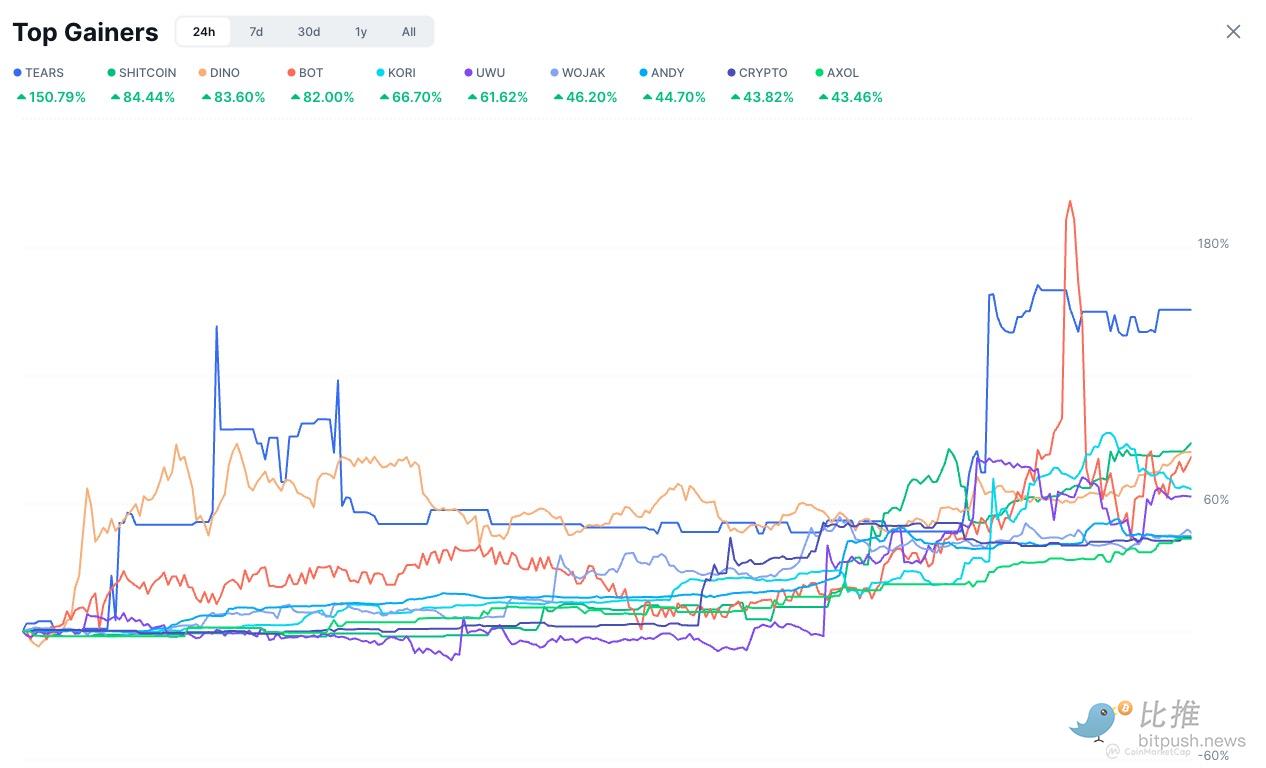
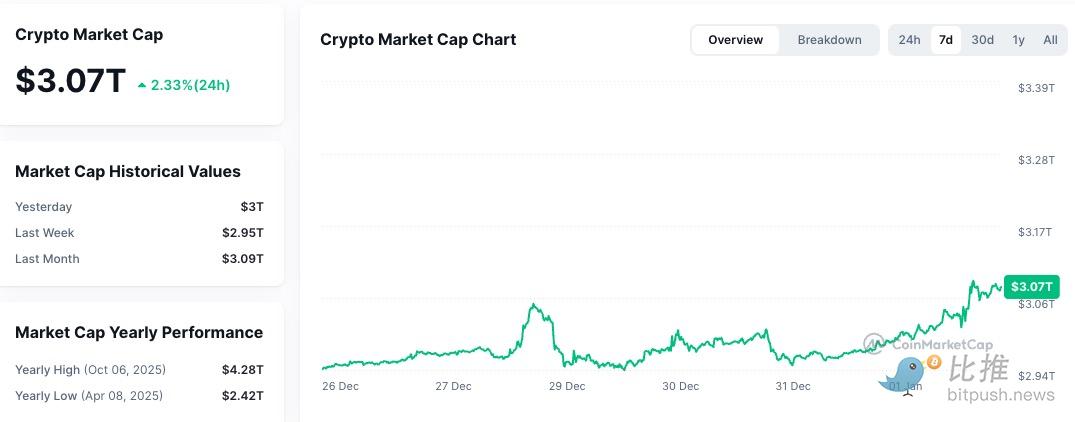
According to CoinMarketCap data, as of that day, the total market capitalization of all crypto assets was approximately $3.07 trillion, with a 24-hour growth of about 2.33%; overall market trading volume rebounded to over $120 billion. In terms of structure, Bitcoin's market share is about 57%, and Ethereum's is about 11.9%. Mainstream assets still dominate, but high-volatility sectors have already started to move first.
A Classic "Risk Appetite Test"

The meme coins leading this round of market movement is not an isolated event but the result of the combined effects of market phase, capital behavior, and narrative mechanisms. From a higher perspective, the current crypto market is still in a transitional phase before trend confirmation:

  • Bitcoin and Ethereum are rebounding moderately but have not yet broken through key structural levels;

  • Altcoins are generally in a repair phase, with no systematic rotation seen yet;

  • Trading volume has rebounded but remains below the levels seen during the initial stages of previous bull markets.

At this stage, capital is more inclined to test risk appetite with smaller costs rather than making long-term bets on "slow variable" assets.

Meme coins恰恰具备这种结构性优势:弹性大、反馈快、对基本面要求低,是风险情绪变化中最敏感的价格载体。

Meme's Role: The Risk "Thermometer"

In the cryptocurrency market, meme coins have long played a role similar to "high-volatility options":

  • Strong price leverage per unit of capital

  • Price increases are more driven by sentiment and traffic

  • Can form trends without improvements in fundamentals

Therefore, when the market shifts from "extreme defense" to "cautious offense," memes often become the first assets to be bought.

On-chain data also confirms this. According to CryptoQuant statistics, although meme coins have seen significant recent gains, their share of the total altcoin market capitalization remains at historically low levels and has not yet shown the structural expansion seen in previous meme seasons.

Year-Beginning Effect and Tax Factors Amplify Short-Term Buying

From a timing perspective, this rally occurred on the second trading day of the new tax year in North America, showing clear seasonal characteristics.

Several market participants pointed out that at the end of 2025, many U.S. investors sold losing assets through tax-loss harvesting to offset tax liabilities. After entering 2026, capital that remains bullish quickly re-entered positions, and meme coins, due to their deep declines, decent liquidity, and high volatility, became the preferred choice.
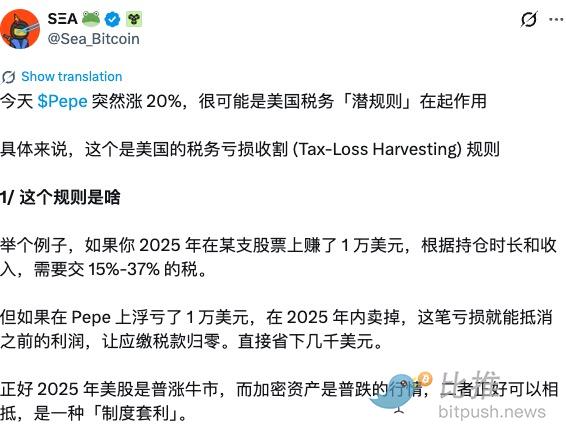
CoinGecko data shows that PEPE's 24-hour trading volume exceeded $1 billion that day, indicating clear concentrated buying back.

KOL Statements Accelerate the Rise

Unlike other sectors, the pricing mechanism of meme coins highly depends on KOL sentiment.

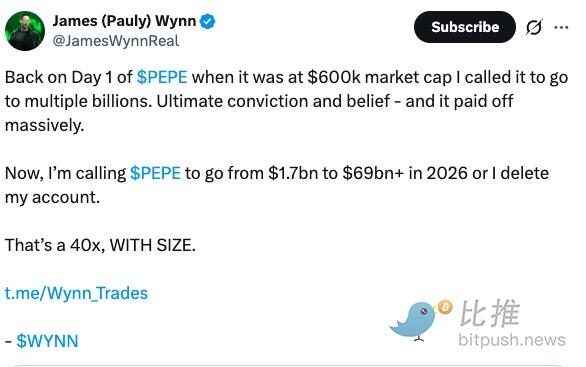
Famous Hyperliquid trader James Wynn released a 2026 prediction, stating that PEPE's market capitalization could surge from the current $2 billion to $69 billion, comparing it to SHIB from the last cycle (which surged from $3.5 billion to $41 billion). Wynn's "delete my account if it fails" vow greatly stirred community sentiment.
Can It Last? Analysts: It's a Signal, But Not the Answer Yet

Although meme coins performed well, the market remains restrained from a higher time dimension.

CryptoQuant charts show that the "dominance" of meme coins in the altcoin market is still near the low levels seen since 2022, with no trend of increase. This means retail speculation heat has not yet systematically returned.
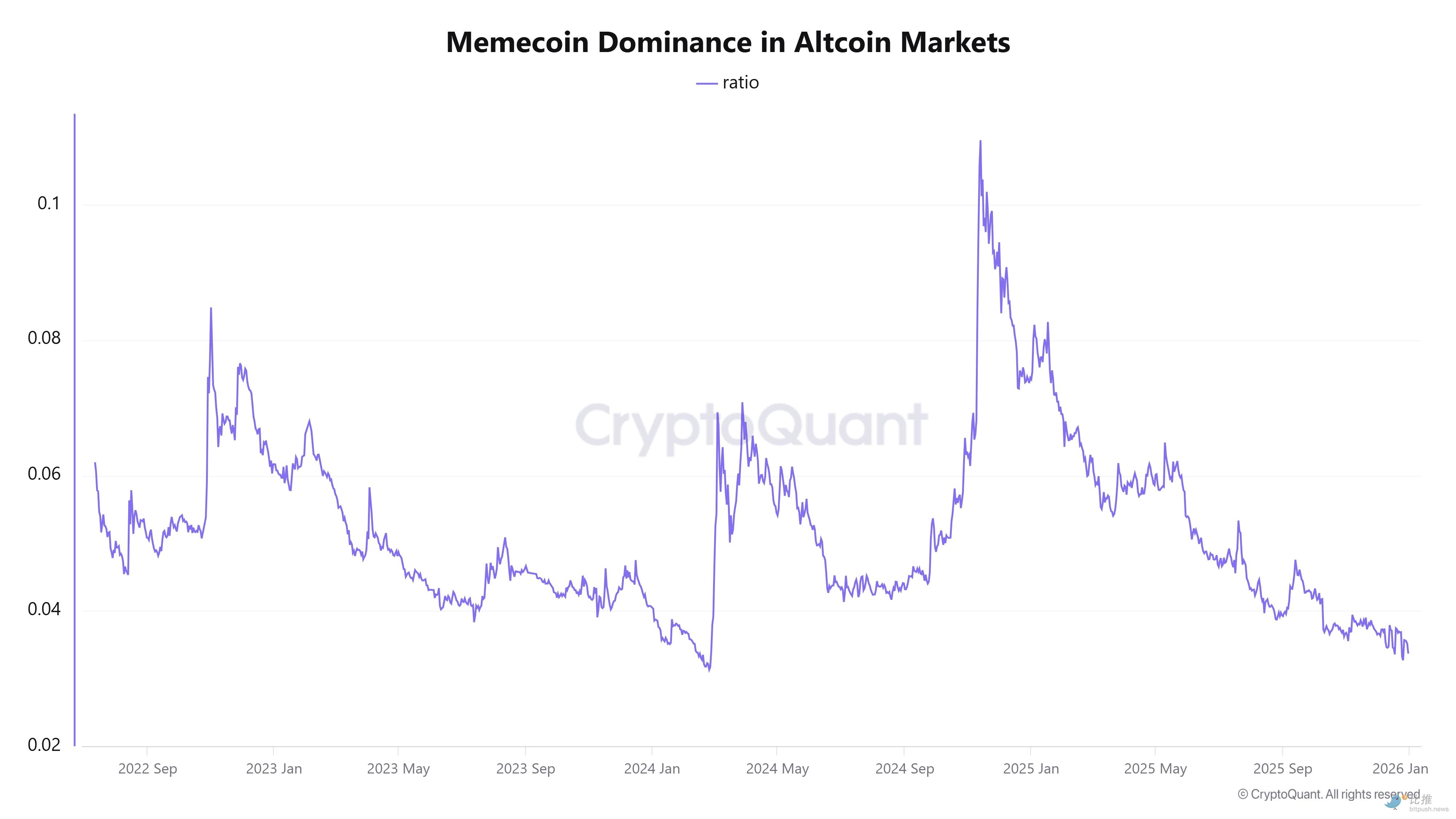
Jake Kennis (Senior Research Analyst at Nansen) pointed out:

"This rotation of年初资金 into large meme coins is more like a position adjustment after a long period of consolidation. To confirm a trend性上涨, structural confirmation is needed on higher time frames."

Kennis also emphasized that PEPE and DOGE are still down about 80% from their all-time highs, and the current rebound is more of a technical repair.

Institutional views are generally cautiously optimistic.

Neil Staunton (CEO of Superset) believes there is speculative anticipation in the market for a potential memecoin ETF in 2026:

"Even just the discussion of an ETF itself is enough to create a narrative at the psychological level: 'If it might be packaged by institutions, does that mean it's an investable asset?'"

However, he also noted that such expectations affect sentiment and valuation anchors more than they determine long-term trends.

Some analysts also warn that historically, memes have often been the fastest-rising but also the earliest-falling sector. If Bitcoin cannot maintain its structural strength, the rally in risk assets could quickly cool down.

综合盘面表现、链上数据与分析师观点来看,本轮 meme 币领涨释放的核心信号并非“牛市已来”,而是:

The market may be moving out of the extremely pessimistic phase and starting to take on risk again.

The rebound in meme coins is more like an early test of returning risk appetite. What ultimately determines how far the行情 can go is still Bitcoin's trend performance, sustained improvement in liquidity, and broader sector rotation. Until these conditions are clear, memes remain just a signal, not the answer.

Author: Seed.eth


Twitter:https://twitter.com/BitpushNewsCN

Bitpush TG Discussion Group:https://t.me/BitPushCommunity

Bitpush TG Subscription: https://t.me/bitpush

Original link:https://www.bitpush.news/articles/7599770

Crypto di tendenza

Domande pertinenti

QWhat was the performance of meme coins like PEPE and DOGE on January 2, 2026, according to the article?

AOn January 2, 2026, PEPE surged by more than 30% at one point during the trading session, while DOGE and other established meme coins also rebounded, driving a noticeable improvement in market risk appetite.

QAccording to the article, what role do meme coins typically play in the cryptocurrency market?

AMeme coins typically act as a 'high-volatility option' or a risk 'thermometer' in the cryptocurrency market. They have strong price leverage per unit of capital, are driven more by sentiment and traffic, and can form trends without requiring fundamental improvements.

QWhat seasonal factor is mentioned as amplifying short-term buying pressure for meme coins at the start of 2026?

AThe article mentions the 'year-start effect' and tax factors as amplifying short-term buying pressure. At the beginning of the new tax year in North America, investors who remained bullish quickly replenished their positions. Meme coins, due to their deep declines, decent liquidity, and high volatility, became a priority choice.

QWhat did analyst Jake Kennis from Nansen suggest about the meme coin rally?

AJake Kennis, a senior research analyst at Nansen, suggested that the rotation of funds into large meme coins at the start of the year was more like a position adjustment after a long period of consolidation. To confirm a trend-based rise, structural confirmation is needed on higher time frames. He also noted that PEPE and DOGE were still down about 80% from their all-time highs, indicating the current rebound is more of a technical repair.

QWhat is the core signal that the meme coin surge releases, according to the article's conclusion?

AThe core signal released by the meme coin surge is not that 'the bull market has arrived,' but that the market may be moving out of an extremely pessimistic phase and beginning to take on risk again. It is an early test of returning risk appetite. The ultimate factors determining how far the行情 can go are still Bitcoin's trend performance, sustained improvement in liquidity, and broader sector rotation.

Letture associate

After Three Consecutive Quarters of Decline, Can the Crypto Market Find a Window for Stabilization in Q3?

The cryptocurrency market has just concluded its worst-performing quarter since 2022, with total capitalization dropping 12.6% to $2.1 trillion. All core metrics indicate capital is leaving the sector, not just rotating within it. Bitcoin fell 14.2% and Ethereum dropped 25.4% in Q2, breaking their previous correlation with US tech stocks. A key driver is the reversal in US spot Bitcoin ETF flows, which saw a net outflow of approximately $4.67 billion in Q2, including a record monthly outflow near $4.5 billion in June. While recent data suggests long-term holders are accumulating again, sustained ETF outflows mean continued selling pressure. Market focus is now singularly on the Federal Reserve. The upcoming July FOMC meeting is seen as the most critical event for Q3. A dovish signal could support Bitcoin reclaiming a $68,000-$84,000 range, while a hawkish stance might establish a new trading band around $50,000-$56,000. Additionally, regulatory uncertainty persists, with the progress of the crucial *CLARITY Act* stalling in the Senate, reducing its perceived 2026 passage probability to 40-45%. Despite the broad downturn, a few sectors showed growth. Prediction markets saw nominal volume surge 48.7% year-over-year to $113.8 billion, and tokenized collectibles transaction volume rose 143% quarterly to $1.4 billion. The Real-World Asset (RWA) tokenization sector also continued steady growth, now representing ~$28.1 billion in on-chain value. The market's foundation for an extreme crash appears limited, with Bitcoin price hovering near its 200-week moving average. However, the trading paradigm has shifted from narrative-driven speculation to decisions based on price action, policy developments, and interest rate expectations, making a broad sentiment-driven rally unlikely in the near term.

marsbit1 h fa

After Three Consecutive Quarters of Decline, Can the Crypto Market Find a Window for Stabilization in Q3?

marsbit1 h fa

BIT Trading Moment: BTC Still Suppressed by Weekly 200 EMA, Rejection May Restart Decline; Storage and Semiconductors that Surged Last Night Begin Falling in Evening Trading

**Crypto & Stock Market Wrap: Bitcoin Tests Resistance, Stocks Retreat After AI Surge** Bitcoin consolidates around $66,000, facing key resistance near $68,000—an area seen as a major psychological and technical hurdle where previous rallies have failed. Analysts note the cryptocurrency is caught between its 200-week moving average (~$63,333) and 200-week EMA (~$68,328). A clear break above $68k is needed to signal a stronger bullish trend, while a rejection could lead to a retest of $63k support. Market sentiment remains cautious, with low futures open interest pointing to a low-liquidity rebound rather than a full bull market. Bitcoin spot ETFs saw another $203 million inflow. US stock futures pointed lower after a strong Tuesday session led by a massive rebound in semiconductors and memory stocks. The rally was fueled by renewed optimism about AI-driven hardware demand, with Micron, SanDisk, and SK Hynix surging. However, those gains reversed in pre-market trading. Super Micro Computer (SMCI) soared over 20% after hours on strong guidance and a record backlog. Other standouts included Rocket Lab and nuclear energy plays Oklo and X-Energy. Rising oil prices (Brent above $91) and climbing Treasury yields (10-year near 4.64%), however, are reigniting inflation concerns and acting as a headwind for equities. In Asia, markets were mixed. South Korea's KOSPI pared early gains to close slightly higher as semiconductor stocks like SK Hynix gave back initial surges. Japan's Nikkei edged lower as the yen hit a fresh 38-year low against the dollar, raising fears of potential market intervention. Key events to watch include the Samsung Galaxy launch, AMD's AI event, and a slew of major tech earnings from Alphabet, Tesla, and IBM after the close on Wednesday, followed by the ECB meeting and Intel's earnings on Thursday.

marsbit2 h fa

BIT Trading Moment: BTC Still Suppressed by Weekly 200 EMA, Rejection May Restart Decline; Storage and Semiconductors that Surged Last Night Begin Falling in Evening Trading

marsbit2 h fa

Former CFTC Chairman, Circle President Tarbert: Preaching Long-Termism While Cashing Out $30 Million Himself

Former CFTC Chairman and Circle President Heath Tarbert has consistently advocated for a long-term vision in public, urging patience from investors as Circle’s stock price has fallen significantly from its peak. However, it has been revealed that since Circle’s IPO, Tarbert has continuously sold his CRCL shares through pre-arranged trading plans, cashing out approximately $30 million, without making any public market purchases. This contrast between his public messaging and personal actions has drawn criticism. Tarbert joined Circle in July 2023 as Chief Legal Officer, leveraging his regulatory experience to help guide the company through its IPO and expansion. Despite promoting stablecoins as long-term infrastructure, he established a 10b5-1 trading plan just before Circle went public, leading to substantial stock sales over the following year. In March 2026, he initiated another plan to sell more shares. His career trajectory highlights a pattern of moving between high-level regulatory roles and influential positions in the financial sector. After resigning as CFTC Chairman in early 2021, he joined Citadel Securities as Chief Legal Officer just 27 days later, during a period of intense regulatory scrutiny for the firm. He later joined Circle, aiding its efforts to navigate regulatory challenges for its public listing. While Tarbert's expertise in policy and compliance is valuable to companies like Circle, his actions—advocating long-term confidence while personally divesting—raise questions about the alignment between his public statements and his private financial decisions, leaving investors who followed his advice to bear the market risks.

marsbit2 h fa

Former CFTC Chairman, Circle President Tarbert: Preaching Long-Termism While Cashing Out $30 Million Himself

marsbit2 h fa

Gate Research Institute: The 'Wall Street-ization' Wave of Crypto Financial Products – Competition or Integration?

The article titled "Gate Research Institute: Are Crypto Financial Products Sparking a 'Wall Street' Wave—Competition or Convergence?" explores the evolving relationship between the crypto ecosystem and traditional finance (TradFi). The piece begins by reflecting on Bitcoin's original 2009 vision of decentralization, disintermediation, and moving away from banks. It then contrasts this with the 2024 landscape, where key crypto assets like Bitcoin are increasingly held through Wall Street products like ETFs issued by giants like BlackRock. The article questions whether this signifies that TradFi is systematically taking over the rights to issue, price, custody, and distribute crypto financial assets. The core argument is that this is not a zero-sum takeover but rather a bidirectional convergence where each side addresses the other's weaknesses. Crypto offers 24/7 global markets, programmable settlement, and open access but lacks compliant channels, institutional-grade custody, deep fiat liquidity, and mainstream distribution. TradFi possesses these but is constrained by legacy systems, limited operating hours, and slow settlement. Two primary convergence paths are highlighted: * **Path A (CEX to TradFi):** Exemplified by Gate, which has progressed from offering tokenized stocks and CFDs to providing direct, real stock trading (US, Hong Kong, South Korea) within its platform, using USDT. * **Path B (TradFi to Crypto):** Exemplified by Robinhood, which has integrated crypto trading, acquired exchanges like Bitstamp, and is moving traditional assets like stocks onto the blockchain via tokenization and its own Layer 2. Both paths are ultimately competing to become the next-generation, unified financial account—a "super account" where users can seamlessly trade cryptocurrencies, stocks, ETFs, RWA (Real World Assets), and tokenized treasury products in one interface. The growth of RWA and tokenized treasuries (e.g., BlackRock's BUIDL) is presented as the asset-layer fusion, providing stable, yield-bearing assets on-chain and acting as a bridge between the two worlds. In conclusion, the "Wall Street-ization" of crypto is framed as a mutual transformation. Decentralized ideals persist in the protocol layer, while at the application layer, a more efficient, global, and accessible unified capital market is emerging from this convergence. The future competition lies not between crypto exchanges and stockbrokers, but between platforms vying to offer the most comprehensive asset coverage, liquidity, and user experience within a single account.

marsbit2 h fa

Gate Research Institute: The 'Wall Street-ization' Wave of Crypto Financial Products – Competition or Integration?

marsbit2 h fa

Trading

Spot

Articoli Popolari

Cosa è MEME 2.0

Memecoin 2.0: L'Ascesa di $MEME 2.0 nel Mondo delle Criptovalute Introduzione Nel panorama in continua evoluzione delle criptovalute, è emerso un nuovo contendente. Memecoin 2.0, simboleggiato come $MEME 2.0, porta il concetto di meme coin a un livello emozionante. Come prodotto derivato dal Memecoin originale, questo progetto ha catturato l'attenzione della comunità crypto spostando il focus da incentivi finanziari tipici a un'esperienza coinvolgente e divertente. Operando sulla blockchain di Ethereum, Memecoin 2.0 ridefinisce audacemente l'impegno della comunità nella sfera crypto. Che cos'è Memecoin 2.0, $MEME 2.0? Alla base, Memecoin 2.0 è un progetto di criptovaluta che dà priorità allo spirito di comunità e al divertimento associato alla cultura meme. A differenza delle criptovalute convenzionali, che si concentrano su casi d'uso pratici e benefici tangibili, Memecoin 2.0 si distingue abbracciando il lato più leggero della moneta digitale. Il progetto esiste senza promesse di utilità, una roadmap strutturata o ritorni finanziari, concentrandosi invece sulla creazione di una comunità vibrante incentrata sui meme e sul divertimento condiviso. Facendo così, attinge alla crescente tendenza della cultura meme nello spazio online, rendendola un giocatore unico nel mondo degli asset digitali. Creatore di Memecoin 2.0, $MEME 2.0 Nonostante ricerche approfondite sulle origini di Memecoin 2.0, l'identità esplicita del suo creatore rimane sconosciuta. Questa anonimità non è rara nella comunità crypto, dove molti progetti sono guidati da individui o gruppi che preferiscono rimanere dietro le quinte. La mancanza di informazioni pubblicamente disponibili sul creatore potrebbe essere vista come una mossa strategica, mettendo in evidenza l'impegno della comunità piuttosto che la notorietà individuale all'interno dello spazio. Investitori di Memecoin 2.0, $MEME 2.0 Le informazioni riguardanti gli investitori o il supporto finanziario per Memecoin 2.0 sono scarse. Questa assenza di dettagli potrebbe suggerire che il progetto sia autofinanziato o che il suo focus sulla comunità piuttosto che sulle strutture d'investimento tradizionali abbia attratto un tipo diverso di sostenitore. Poiché il mondo delle meme coin coinvolge tipicamente un maggior coinvolgimento di base piuttosto che investimenti istituzionali, questo approccio si allinea con l'etica dei progetti guidati dalla comunità. Come funziona Memecoin 2.0, $MEME 2.0? Memecoin 2.0 opera interamente sulla blockchain di Ethereum, capitalizzando le sue robuste caratteristiche di sicurezza e scalabilità. Sfruttando i punti di forza di Ethereum, Memecoin 2.0 può offrire un ambiente sicuro per le interazioni degli utenti garantendo che le transazioni siano sia efficienti che convenienti. Uno degli attributi unici di Memecoin 2.0 risiede nella sua struttura guidata dalla comunità. Il valore e la popolarità del token $MEME 2.0 derivano dalla partecipazione attiva dei suoi utenti, piuttosto che dalla utilità intrinseca. Questo design rinforza il focus del progetto sull'aspetto dell'intrattenimento delle criptovalute, implicando che la risata e l'impegno della comunità siano le vere monete che guidano il suo successo. Inoltre, il progetto si inserisce all'interno dell'ecosistema più ampio delle meme coin, dove il valore di ciascuna meme coin oscilla in base alla cultura, alle tendenze e all'impegno della comunità piuttosto che ai principi economici tradizionali. Cronologia di Memecoin 2.0, $MEME 2.0 Per comprendere meglio l'evoluzione e le pietre miliari di Memecoin 2.0, ecco una cronologia che evidenzia eventi significativi nella sua storia: 2024: L'inizio di Memecoin 2.0 è riconosciuto come un ramo del Memecoin originale, affermandosi all'interno del contesto fiorente delle meme coin mentre opera sulla blockchain di Ethereum. 13 luglio 2024: Memecoin 2.0 si posiziona ufficialmente come una meme coin incentrata sulla comunità sulla rete Ethereum, enfatizzando il suo approccio centrato sull'intrattenimento che invita gli utenti a impegnarsi e partecipare alla sua crescita. Punti Chiave su Memecoin 2.0, $MEME 2.0 Diverse caratteristiche critiche definiscono Memecoin 2.0: Approccio Centrico alla Comunità: La missione principale di Memecoin 2.0 è creare un'esperienza comunitaria divertente e coinvolgente, capitalizzando il piacere collettivo derivante dalla cultura memetica. Costruita su Ethereum: Operare sulla blockchain di Ethereum fornisce al progetto un'infrastruttura essenziale che garantisce sicurezza e scalabilità. Mancanza di Utilità o Roadmap: In una marcata deviazione dalle criptovalute tradizionali, Memecoin 2.0 non promette alcuna caratteristica utilitaria o ritorni finanziari, riaffermando il suo impegno per il coinvolgimento della comunità e l'impegno sociale. Focus sulla Cultura Memetica: Abbracciando gli aspetti umoristici e culturali del fenomeno meme, Memecoin 2.0 offre una piattaforma per gli utenti per interagire con la crypto offline e online. Ulteriore Contesto: L'Importanza delle Meme Coin Le meme coin sono emerse come una classe distinta di criptovaluta, spesso guidata dall'umorismo e da un approccio spensierato al trading. Queste monete generalmente mancano di significative utilità o roadmap di sviluppo, attirando gli utenti con la promessa di divertimento, interazione comunitaria e rilevanza culturale. Nel panorama del più ampio ecosistema crypto, le meme coin rianimano l'importanza dell'impegno della comunità, opponendosi ad approcci esclusivamente orientati al profitto. Progetti come Memecoin 2.0 danno il via a un'era in cui l'intrattenimento può armonizzarsi con le aspirazioni finanziarie, trasformando la blockchain in un parco giochi per la creatività e l'interazione sociale. Conclusione Memecoin 2.0, o $MEME 2.0, incarna una nuova ondata di criptovaluta che dà priorità all'impegno della comunità rispetto a rigidi strutture finanziarie. Con un focus sull'umorismo e l'interazione sociale, capitalizza sulla fascinazione circondante la cultura meme. Operando sulla blockchain di Ethereum, Memecoin 2.0 sfrutta le capacità della tecnologia mantenendo fermo il suo impegno per il valore ricreativo della valuta digitale. Mentre lo spazio delle criptovalute continua a evolversi, Memecoin 2.0 serve come testimonianza della nozione che il futuro degli asset digitali potrebbe ben dipendere da esperienze condivise, risate e solidi legami comunitari. Nel mondo imprevedibile delle crypto, forse la gioia può essere altrettanto preziosa quanto il guadagno finanziario tradizionale.

133 Totale visualizzazioniPubblicato il 2024.04.04Aggiornato il 2024.12.03

Cosa è MEME 2.0

Come comprare MEME

Benvenuto in HTX.com! Abbiamo reso l'acquisto di Memeland (MEME) semplice e conveniente. Segui la nostra guida passo passo per intraprendere il tuo viaggio nel mondo delle criptovalute.Step 1: Crea il tuo Account HTXUsa la tua email o numero di telefono per registrarti il tuo account gratuito su HTX. Vivi un'esperienza facile e sblocca tutte le funzionalità,Crea il mio accountStep 2: Vai in Acquista crypto e seleziona il tuo metodo di pagamentoCarta di credito/debito: utilizza la tua Visa o Mastercard per acquistare immediatamente MemelandMEME.Bilancio: Usa i fondi dal bilancio del tuo account HTX per fare trading senza problemi.Terze parti: abbiamo aggiunto metodi di pagamento molto utilizzati come Google Pay e Apple Pay per maggiore comodità.P2P: Fai trading direttamente con altri utenti HTX.Over-the-Counter (OTC): Offriamo servizi su misura e tassi di cambio competitivi per i trader.Step 3: Conserva Memeland (MEME)Dopo aver acquistato Memeland (MEME), conserva nel tuo account HTX. In alternativa, puoi inviare tramite trasferimento blockchain o scambiare per altre criptovalute.Step 4: Scambia Memeland (MEME)Scambia facilmente Memeland (MEME) nel mercato spot di HTX. Accedi al tuo account, seleziona la tua coppia di trading, esegui le tue operazioni e monitora in tempo reale. Offriamo un'esperienza user-friendly sia per chi ha appena iniziato che per i trader più esperti.

324 Totale visualizzazioniPubblicato il 2024.12.12Aggiornato il 2026.06.02

Come comprare MEME

Discussioni

Benvenuto nella Community HTX. Qui puoi rimanere informato sugli ultimi sviluppi della piattaforma e accedere ad approfondimenti esperti sul mercato. Le opinioni degli utenti sul prezzo di MEME MEME sono presentate come di seguito.

活动图片














