Matrixdock Releases Latest Semi-Annual Physical Gold Audit Report, Strengthening Transparency Practices for Physical Gold

marsbitPubblicato 2026-01-15Pubblicato ultima volta 2026-01-15

Introduzione

Matrixdock, the RWA platform under Matrixport, has released its H2 2025 semi-annual physical gold audit report for its XAUm token. The audit, conducted by an independent third party, verified 482 LBMA-approved 1kg gold bars held across Brink’s Hong Kong, Brink’s Singapore, and Malca-Amit Singapore vaults. The total reserve amounts to approximately 482 kg (15,595.336 oz), valued at around $71.75 million based on the audit date gold price. No discrepancies were found between the physical gold and recorded assets. Compared to the H1 2025 audit, an additional 61 gold bars were added to the reserve. Matrixdock employs a dual-verification mechanism, combining physical audits with on-chain validation tools, allowing XAUm holders to verify the gold backing their tokens via a Web3 wallet. Each 1kg gold bar corresponds to approximately 32.148 XAUm tokens. The platform emphasizes transparency and institutional-grade operations to build trust in digital gold assets.

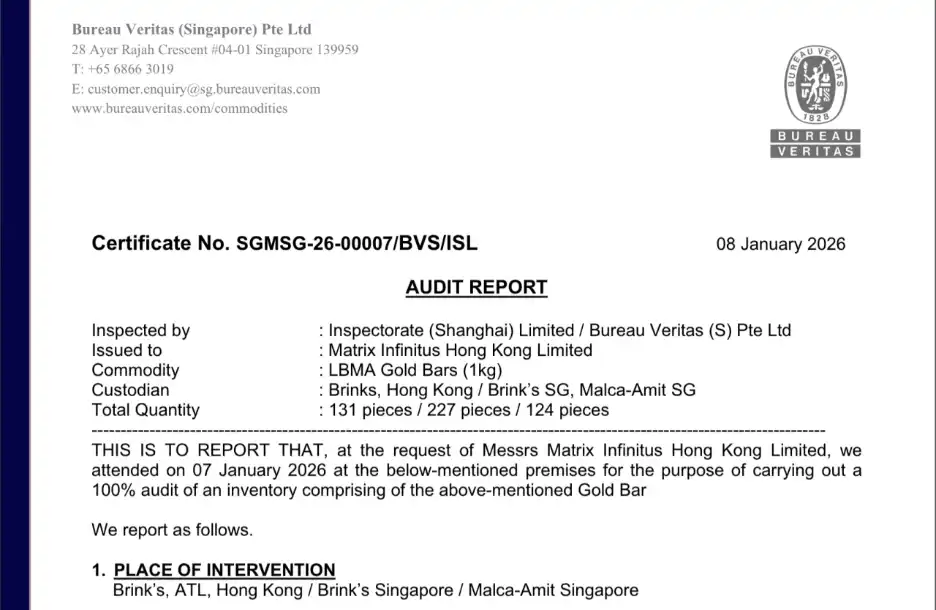
Matrixdock, the RWA platform under Matrixport, recently released its semi-annual physical gold audit report for the second half (H2) of 2025. The report discloses details about the physical gold reserves corresponding to the XAUm token, reflecting Matrixdock's ongoing commitment to physical asset verification and information transparency.

The audit was conducted by an independent third-party professional agency according to institutional-grade standards, providing a comprehensive inspection of the physical gold reserves corresponding to the XAUm token. The audit strictly followed leading industry standards for gold ETF audits, covering all elements including weight, purity, serial numbers, and vault custody information, achieving item-by-item verification of each physical gold bar.

Matrixdock's XAUm gold token employs a "dual-layer verification" mechanism: on one hand, it relies on an independent physical audit process; on the other hand, it combines on-chain real-time verification tools, enabling investors to transparently and continuously observe the mapping relationship between token supply and the corresponding gold reserves.

Audit Coverage and Key Data

● Audit execution date: January 7, 2026

● Physical gold reserves: 482 LBMA-approved 1-kilogram gold bars

● Total weight: 482 kilograms (approximately 15,595.336 ounces)

● Custody vaults: Brink’s Hong Kong, Brink’s Singapore, Malca-Amit Singapore

● Market value of the relevant physical gold, estimated at the audit time point: approximately $71.75 million

● The audit results showed no discrepancies between the physical gold and the related records.

Furthermore, compared to the audit for the first half of 2025, the number of physical gold bars covered in this audit increased by 61.
Enhancing the Verifiability of Tokenized Gold Through On-Chain Tools

Additionally, Matrixdock's gold allocation query tool allows XAUm holders to view the specific gold bar information corresponding to their tokens via a Web3 wallet. For example, one standard 1-kilogram gold bar corresponds to approximately 32.148 XAUm tokens, providing a more intuitive asset mapping method for tokenized gold.

As tokenized assets transition from innovation to infrastructure building, investor trust will increasingly rely on verifiable facts rather than verbal promises. Matrixdock stated that it will continue to advance reserve transparency and institutionalized operational standards, committed to providing global investors with more trustworthy and secure digital asset solutions for gold.

Audit report link: https://matrixdock.gitbook.io/matrixdock-docs/english/gold-token-xaum/physical-gold-vault-audit


Domande pertinenti

QWhat is the main purpose of Matrixdock's recently released semi-annual physical gold audit report?

AThe main purpose is to disclose the status of the physical gold reserves backing the XAUm tokens, demonstrating Matrixdock's ongoing commitment to physical asset verification and information transparency.

QHow many physical gold bars were verified in the audit, and what was their total weight?

AThe audit verified 482 LBMA-approved 1-kilogram gold bars, with a total weight of 482 kilograms (approximately 15,595.336 troy ounces).

QWhich independent third-party standards were followed for the physical gold audit?

AThe audit was conducted by an independent third-party professional agency according to institutional-grade standards, strictly referencing the leading gold ETF audit standards in the industry.

QWhat is the 'dual-layer verification' mechanism used for the XAUm gold token?

AThe 'dual-layer verification' mechanism combines an independent physical audit process with an on-chain real-time verification tool, allowing investors to transparently and continuously see the mapping relationship between the token supply and the corresponding gold reserves.

QHow can XAUm token holders verify which specific gold bars their tokens are backed by?

AXAUm holders can use Matrixdock's gold allocation query tool via a Web3 wallet to view the specific information of the gold bars corresponding to their tokens.

Letture associate

Day 6 of the rsETH Incident: DeFi United Secures Approximately $100 Million in Intentional Commitments, but a $50 Million Gap Remains

On April 18, Kelp DAO’s rsETH LayerZero bridge was exploited, resulting in the unauthorized minting of 116.5k rsETH (approx. $292M). The attacker borrowed around $190M on Aave V3. The Arbitrum Security Council froze 30,766 ETH linked to the incident. DeFi United, a cross-protocol rescue initiative led by Awe, was formed to cover a total shortfall of 112.2k rsETH ($258M). As of April 24, several protocols have pledged around $100M in support, though most commitments are still under DAO voting or discussion. Key pledges include: - Golem: 1,000 ETH ($2.3M) - Aave founder Stani Kulechov: 5,000 ETH ($11.5M) - EtherFi: up to 5,000 ETH ($11.5M) - Lido: up to 2,500 stETH ($5.75M), contingent on full coverage - Mantle: proposed a $69M loan to Aave DAO under specific terms The remaining shortfall is estimated at $50M. Aave’s treasury and safety module (~$236M combined) can cover the worst-case bad debt scenario ($230M). Three potential loss distribution paths were outlined by DefiLlama’s 0xngmi: 1. Uniform 18.5% haircut for all rsETH holders: Aave bad debt ~$216M 2. Only protect Mainnet, abandon L2: bad debt up to $341M 3. Repay only pre-attack holders: technically difficult, ~$91M net loss KelpDAO has not yet announced a specific plan. The success of DeFi United depends heavily on KelpDAO’s final decision on loss allocation.

marsbit23 min fa

Day 6 of the rsETH Incident: DeFi United Secures Approximately $100 Million in Intentional Commitments, but a $50 Million Gap Remains

marsbit23 min fa

Kicked Out of PayPal, Musk Aims for a Comeback in the Crypto Market

Elon Musk's X (formerly Twitter) has launched its "Smart Cashtags" feature, generating approximately $1 billion in trading volume within days of its April 2026 pilot launch. The feature allows users to click on stock or crypto tickers (or even full Solana token contract addresses) in posts to view real-time price charts and discussions without leaving the app. Initially available to iPhone users in the US and Canada, with a partnership in Canada enabling direct trading via the Wealthsimple app. This move is part of Musk's broader "Everything App" vision, spearheaded by the upcoming X Money platform. Analysts, such as Mizuho's Dan Dolev, see this as a potential disruptor to the US payments market, even prompting a downgrade of PayPal's stock. X Money's beta offers services like 6% APY on deposits, cashback, and P2P transfers, with speculation it may later incorporate crypto trading and stablecoin settlements for faster transactions. However, the ambitious plan faces significant regulatory scrutiny. Senator Elizabeth Warren has questioned the sustainability of the high 6% yield and raised concerns over X's banking partner, Cross River Bank, which has a history of regulatory violations. Additional risks involve the "GENIUS Act," which may create loopholes for stablecoin issuance without full FDIC insurance coverage, potentially leaving users unprotected. The integration of social trading on a platform with over 500 million users could inject new liquidity and retail interest into the crypto market. Yet, it also amplifies risks like herd mentality and the blurring of lines between entertainment and financial speculation. Musk's return to finance, after his ouster from PayPal, hinges on balancing innovation with regulatory compliance.

marsbit2 h fa

Kicked Out of PayPal, Musk Aims for a Comeback in the Crypto Market

marsbit2 h fa

Trading

Spot
Futures
活动图片




