Manufacturing's Share Drops Below 25%: Is Hangzhou Unconcerned?

marsbitPubblicato 2026-08-19Pubblicato ultima volta 2026-08-19

Introduzione

Hangzhou is entering a critical phase of industrial restructuring. While its manufacturing-to-GDP ratio has fallen below 25%, the city is not alarmed. Instead, it is strategically navigating a dual focus: advancing advanced manufacturing and expanding its service sector, particularly producer services. Recently, the city celebrated the IPO of a humanoid robotics company, seen as a milestone in moving beyond its e-commerce era. Simultaneously, it set an ambitious target for its service sector: to exceed 2 trillion yuan in value by 2030, with producer services making up over 60%. Data shows a clear trend: the service sector's share of GDP has risen to 75.3%, while manufacturing's share has declined to around 20.1%. This shift revives the debate on whether a strong service sector weakens a city's manufacturing "foundation." Hangzhou's approach challenges the notion of a fixed manufacturing "red line" near 25%. The city argues that the quality and integration of industries matter more than simple ratios. Its strategy is "using software to drive hardware," leveraging its core strengths in digital economy and producer services—like R&D, software, and supply chain management—to empower and add value to manufacturing. This is embodied by its emerging "AI era" companies, whose innovation in Hangzhou feeds into national industrial chains. The city believes that for a hub like Hangzhou, the key is not merely boosting visible manufacturing output, but strengthening the "invisible" co...

Hangzhou is entering a critical period of a new round of industrial adjustment.

On August 19, Unitree Robotics will list on the SSE Sci-Tech Innovation Board, becoming the "first humanoid robot stock" on the A-share market. The first of the "Six Little Dragons" to achieve an IPO is considered another milestone for Hangzhou in moving beyond the "e-commerce era."

Just a few days earlier, Hangzhou further deepened its commitment to its "traditional strength" in the services sector—setting a clear goal at a high-profile city-wide services industry conference: by 2030, the added value of the services industry will exceed 2 trillion yuan, with producer services accounting for over 60%.

On one side is manufacturing, on the other is services, bringing to light the long-discussed issue of Hangzhou's perceived "imbalance" in manufacturing.

In recent years, Hangzhou has continuously ramped up its emphasis on manufacturing, proposing to "rebuild a Hangzhou industry." However, from the data, the proportion of added value from large-scale industries in Hangzhou has been declining, accounting for only 20.1% of GDP last year.

The other side of the coin is the continuous growth of the services sector. In the first half of this year, the added value of Hangzhou's services industry reached 904.5 billion yuan, a year-on-year increase of 5.4%, the highest growth rate in two years; the services sector's share of GDP exceeded 75% for the first time, reaching 75.3%, second only to Beijing, Shanghai, and Guangzhou.

This "rise and fall" has brought an old question back to the surface: as the services sector climbs higher, will the "foundation" of manufacturing become thinner? Under the requirement to maintain a reasonable proportion of manufacturing, what kind of reference can Hangzhou provide for cities hoping to bet on the next "little dragon"?

"25%"

25% was once considered a "red line" for the proportion of manufacturing in a city's economy.

The most representative example is Shanghai, which, in the "Shanghai Three-Year Action Plan for Promoting High-Quality Development of the Manufacturing Industry (2023-2025)" issued in 2023, explicitly drew a red line: by 2025, the proportion of industrial added value in Shanghai's regional GDP should reach over 25%. This was also the first time in seven years that Shanghai re-emphasized this goal.

Authoritative validation comes from a report by a World Bank research team: for megacities like Shanghai, the proportion of manufacturing should be between 25% and 30%. Consistent with this, many cities have also drawn their own "red lines." For example, Shenzhen, a major industrial city, although its manufacturing share is still significantly above 30%, still proactively set a red line for the city, mandating that the proportion of industrial land should not be less than 30%.

Although Hangzhou did not explicitly state such a red line at the time, under the national overall requirement to keep manufacturing's share "basically stable," Hangzhou also made similar arrangements in its 14th Five-Year Plan outline, proposing to deeply implement the "New Manufacturing Plan" and advance the "New Factory Plan."

However, this did not prevent the continuous rise in the services sector share in many cities. Several years later today, the manufacturing "red lines" in more and more cities are showing signs of loosening.

Looking at data from the first half of this year, as most cities have not released specific manufacturing data, if we only refer to the proportion of services sector added value in GDP, among the trillion-yuan GDP cities, there are four where this indicator exceeds 75%. Particularly Shanghai, where this indicator reached 79.4%, an increase of 4.2 percentage points compared to 2023, second only to Beijing.
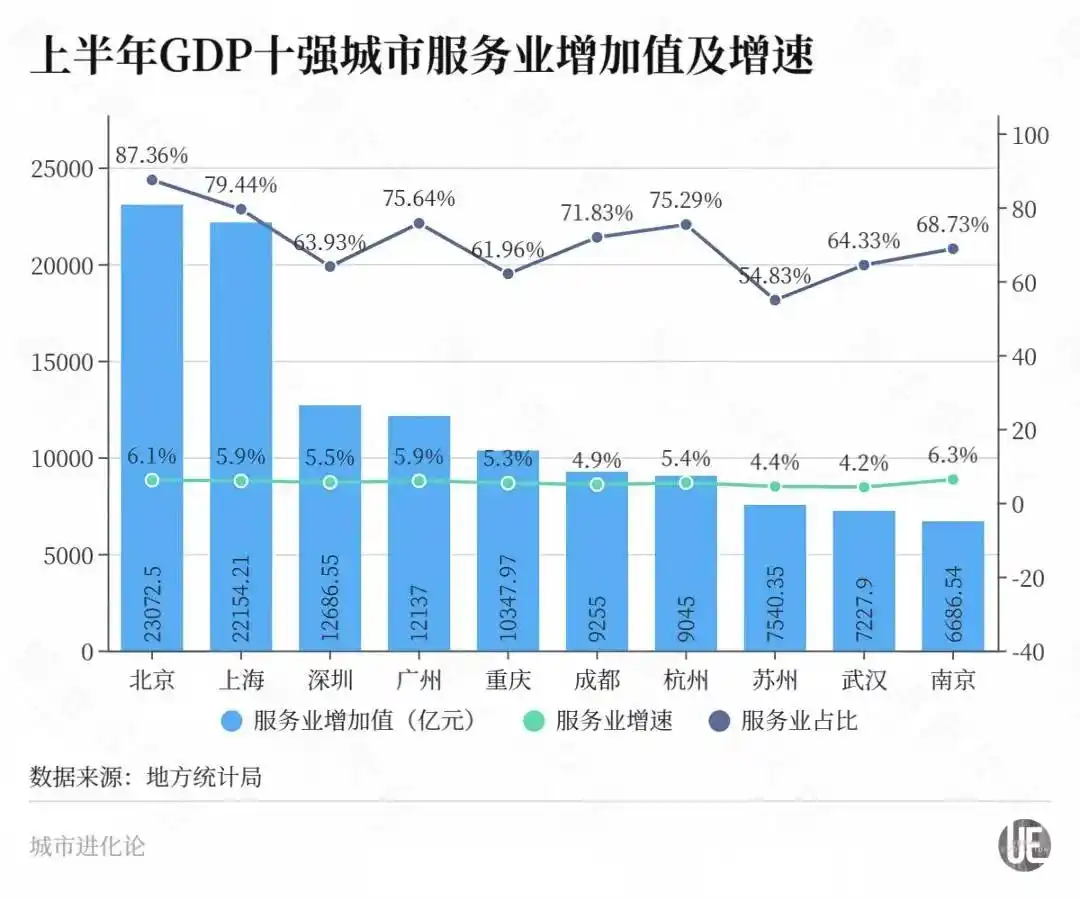
Hangzhou is one of them.

A set of data repeatedly cited by local media is that in 2023, after Hangzhou's services sector added value share exceeded 70%, it continued to rise, increasing by 5 percentage points in three years, and further broke through 75% in the first half of this year, with the gap with Guangzhou narrowing to 0.3 percentage points.

In fact, Hangzhou has not relaxed its emphasis on manufacturing. In the past few years, under the goal of building a "global advanced manufacturing base," Hangzhou has, on one hand, reshaped its industrial geography, creating the East Hangzhou Intelligent Manufacturing Corridor to synergize with the West Hangzhou Science and Technology Innovation Corridor, forming a "two corridors" linkage. On the other hand, it has restructured its industrial framework, building the "296X" advanced manufacturing clusters, aiming to break the "significant deficiencies" in manufacturing in terms of total volume, growth rate, investment, industrial level, and enterprise attraction capacity.

But at the same time, the services sector remains a key development direction for Hangzhou. Just from a policy perspective, starting in 2022, Hangzhou has held high-level conferences on the high-quality development of the modern services industry for three consecutive years, hoping to further promote the upgrading of the services industry.

At this year's services industry conference, Hangzhou Municipal Party Committee Secretary Liu Fei further pointed out that the services industry is the "driving force industry" for Hangzhou to promote economic and social development, concerning industrial development, economic circulation, and people's livelihood and employment. It is necessary to "take promoting the expansion, quality improvement, and efficiency enhancement of the services industry as a major task, continuously achieve new results, and continue to lead the nation."

"Dual 70%"

Why does Hangzhou continue to push for an increase in the services sector share while under the requirement to stabilize the industrial proportion? One reason is that Hangzhou experienced the debate between manufacturing and services very early on.

One consensus is that the year 2000 was the starting point for Hangzhou's new-era promotion of the "industry revitalizing the city" strategy. Subsequently, Hangzhou's total industrial output value grew at a pace of crossing a 100-billion-yuan threshold almost every year, reaching 800 billion yuan by 2007.

The 2008 financial crisis became a turning point in Hangzhou's development. For many years thereafter, Hangzhou's GDP growth rate once fell to the bottom among sub-provincial cities. Issues such as a lack of land resources and high production factor prices made it difficult for manufacturing to maintain its inherent development model. Also in 2008, Hangzhou officially proposed the "services first" development strategy, achieving a landmark "tertiary-secondary-primary" industrial structure transformation the following year, marking a new starting point for Hangzhou's development of the services industry.

The lever for the shift towards services was precisely what later became Hangzhou's pride: the electronic information industry. As Liu Ting, former Deputy Director of the Zhejiang Provincial Development and Reform Commission, pointed out, from the "industry revitalizing the city" strategy to the information economy as the "No. 1 Project," Hangzhou's economy underwent a strategic leap from industrial-led to information-led, from industrial economy-dominated to information economy-dominated. This became the major background for Hangzhou's leading development in the new economy.

And now, more than a decade of accumulation in the services sector has, in turn, become the key to Hangzhou's advancement in manufacturing.

Last year, the emergence of Hangzhou's "Six Little Dragons" was seen as a milestone marking Hangzhou's transition from the "e-commerce era" to the "AI era." But if we look closely at the "Six Little Dragons," peeling back the shell of "hardcore manufacturing," it is precisely the core of Hangzhou's services industry, represented by the digital economy, that provides support.

Among them, Game Science and DeepSeek, which gained attention earlier, are backed by Hangzhou's advantage in software and information services—in 2025, the revenue of just large-scale information services exceeded 1.3 trillion yuan. Even Unitree Robotics, which focuses more on hardware development, has in the past year "conquered" many cities across the country, integrating into the industrial chains of major manufacturing cities like Chongqing. However, as a research and development center, Hangzhou's focus remains on its advantages in the digital economy, technological innovation, and the integration of the digital and real economies.

As pointed out in an article published on the official WeChat account of the Hangzhou Investment Promotion Bureau, this essentially injects Hangzhou's innovation genes into the national industrial and innovation chains. Such a city "truly deserves the term 'national strategic force.'" To achieve this goal, Hangzhou's services must not be just the "human touch" of consumer services; more importantly, they must be producer services that act as an "accelerator" for manufacturing.

Looking closely at the composition of "Hangzhou Services," the keyword also falls on "producer services"—a set of data repeatedly cited by local media in Hangzhou is that as early as 2024, the share of producer services in Hangzhou's services sector added value reached 63.2%, surpassing Shanghai and second only to Beijing.

In Hangzhou's 5.3% services sector growth last year, revenue from information transmission, software, and information technology services maintained double-digit growth for 11 consecutive months, with a full-year growth of 13.4%.

Comparing with the internationally commonly used "dual 70%" indicator for observing urban economic development levels, Hangzhou's services sector share has already "crossed the line." The next step is to fill the gap in producer services.

"Imbalance"?

In this sense, for Hangzhou, a more fundamental question is whether it actually needs to maintain an unchanged proportion of manufacturing.

Last year, at a Hangzhou conference on producer services, Huang Qifan, former Mayor of Chongqing, raised an "Apple question":

Apple doesn't build factories, has no production lines, and doesn't engage in manufacturing, so why does it take the vast majority of the product's profit? The reason is that it firmly controls every link of producer services, including research and development, logistics and distribution, market access, inspection and testing, digital empowerment, financial clearing, sales, and after-sales service. These are the foundation of the industrial chain and the bestowers of its core value.

In other words, to increase added value, manufacturing must extend into links such as R&D design, industrial software, supply chain management, brand services, and financial services. It is precisely these producer services that ultimately determine the profit and industrial added value of manufacturing, determining the gold content of modern manufacturing.

Going further, industry insiders have summarized the development path of Hangzhou's "Six Little Dragons" as a "soft driving hard" development model with Hangzhou characteristics. Compared to the longboards of Beijing, Shanghai, and Shenzhen in computing infrastructure and talent density, Hangzhou's artificial intelligence industry, based on the advantages of the digital economy and the services sector, has the potential to carve out a distinctive path of promoting innovation through application and gathering resources through ecology.

It is difficult to fully reflect the quality of a region's manufacturing development simply by looking at the increase or decrease in numbers.

Liu Ting once recalled in an interview that a few years ago, Hangzhou's economic growth rate was once at the bottom within the province. The local government became anxious, wondering whether to invite back heavy and chemical industries to boost the manufacturing proportion. After debate, a sober judgment emerged: the root of Hangzhou's problem was not insufficient industry, but insufficiently strong producer services. Sacrificing invisible competitiveness for visible numbers was not worthwhile.

One reason is that, unlike the "visible" manufacturing, the manufacturing growth driven by producer services is relatively "invisible." Many places have already realized this issue. According to media reports, in order to make this part of manufacturing data visible, Jiangsu changed its assessment method for manufacturing, no longer isolating and assessing the secondary industry share, but instead looking at the combined proportion of manufacturing and producer services in GDP. "The former is the 'skeleton,' the latter is the 'muscle'; looking at either one alone will be distorted."

From a national perspective, policies are also changing.

In the outline of the 15th Five-Year Plan, the phrasing of keeping manufacturing's share "basically stable" was replaced with a "reasonable proportion." Xiao Rongmei, Deputy Director of the Policy and Economics Research Institute of the China Academy of Information and Communications Technology, and others once wrote in an article that this means "after fully considering various internal and external risk impacts and balancing development stages and industrial structure issues, allowing the proportion of manufacturing to fluctuate within a certain reasonable range," "not only pursuing the scale expansion of manufacturing, but more importantly striving to achieve a systematic improvement in quality."

Under the new round of adjustment, how should we re-examine the judgment of Hangzhou's services sector "imbalance"? Where exactly is the "reasonable proportion" for Hangzhou's manufacturing? Hangzhou has already made its judgment. According to the "Hangzhou Three-Year Action Plan for Accelerating Manufacturing Development (2025-2027)," by 2027, the total added value of large-scale industries will reach 530 billion yuan, with an average annual growth of over 6%, and the proportion of industrial added value in GDP will be over 22%.

This article is from the WeChat public account "City Evolution Theory," author: Yang Qifei

Crypto di tendenza

Domande pertinenti

QWhy is the service industry considered the 'main driving force industry' for Hangzhou's economic and social development?

AThe service industry is considered the 'main driving force industry' for Hangzhou's economic and social development because it is crucial for industrial development, economic circulation, and people's livelihoods and employment. Hangzhou aims to continuously promote the expansion and quality improvement of the service industry to maintain its leading position nationally.

QWhat is the significance of the '25%' manufacturing share threshold mentioned for major cities?

AThe '25%' manufacturing share threshold is a benchmark often discussed for major cities. A World Bank research team report suggests that for megacities like Shanghai, the manufacturing share should be between 25% and 30%. Many cities, including Shanghai and Shenzhen, have used or referenced this threshold in their planning to ensure a stable industrial foundation. However, the article notes that this threshold is becoming more flexible in many cities.

QHow does Hangzhou's development of 'producer services' relate to its manufacturing sector?

AHangzhou's development of 'producer services' is closely tied to and supports its manufacturing sector. Producer services act as an 'accelerator' for manufacturing. The high value-added segments of manufacturing, such as R&D, industrial software, and supply chain management, are embedded within producer services. Hangzhou's strength in the digital economy and information services provides the core support for its advanced manufacturing clusters, enabling a 'soft drives hard' development model.

QWhat was the strategic shift in Hangzhou's industrial policy around 2008, and what triggered it?

AAround 2008, Hangzhou shifted its strategy from 'industrial revitalization' to prioritizing the service industry ('service industry first'). This strategic shift was triggered by the 2008 financial crisis, which exposed challenges for Hangzhou's traditional manufacturing model, including a lack of land resources and high production factor costs. This marked the beginning of Hangzhou's transition towards an economy led by information and services.

QAccording to the article, how has the national policy perspective on the manufacturing share in GDP changed recently?

AThe national policy perspective on the manufacturing share in GDP has shifted from emphasizing the need to keep its share 'basically stable' to maintaining a 'reasonable share' or 'reasonable proportion.' This change, noted in the context of the 15th Five-Year Plan, indicates a more flexible approach. It recognizes that the manufacturing share can fluctuate within a reasonable range based on various factors, with a greater focus on achieving systematic quality improvement rather than just scale expansion.

Letture associate

The Philadelphia Semiconductor Index Tumbles Nearly 5% in a Single Night, Optical and Memory Sectors 'Collapse' Together: Surging U.S. Bond Yields Shake AI Belief

On the evening of August 18th, the US stock market saw a sharp sell-off concentrated in the AI hardware sector, with the Philadelphia Semiconductor Index plummeting nearly 5%. Leading AI infrastructure and components companies in fields like optical communication and memory chips experienced some of the steepest declines, such as Fabrinet (-19.38%) and Kioxia ADR (-13%). The sell-off was not broad-based but rather targeted the long-duration, high-momentum stocks previously driven by AI narrative optimism. This market shift is primarily attributed to a significant surge in long-term US Treasury yields, with the 30-year yield hitting its highest level since 2007. Rising yields increase discount rates, disproportionately impacting the valuations of growth stocks whose profits are projected far into the future—a category that includes most AI hardware plays. Additional pressure came from climbing oil prices due to Middle East tensions, which fueled inflation concerns. The article identifies three structural reasons for the severity of the drop in these specific subsectors: excessive prior gains and crowded positioning, high sensitivity to the sustainability of AI capital expenditure narratives, and inherent high volatility within the supply chain. Importantly, the sell-off appears to be a valuation and positioning reset rather than a fundamental repudiation of AI, evidenced by the relatively modest decline in a bellwether like Nvidia (-2.34%). Looking ahead, the direction hinges on three key indicators: whether the 30-year Treasury yield stabilizes, the trajectory of oil prices and geopolitical risks, and the market's pricing of new AI-related corporate debt. For related Asian and A-share markets, short-term negative sentiment spillover is expected, but medium-term drivers like domestic cloud capex may provide divergence. The episode signifies a market transition from pricing AI's "story" to rigorously evaluating its returns against a backdrop of higher financing costs.

marsbit33 min fa

The Philadelphia Semiconductor Index Tumbles Nearly 5% in a Single Night, Optical and Memory Sectors 'Collapse' Together: Surging U.S. Bond Yields Shake AI Belief

marsbit33 min fa

Ten Years, Wang Xingxing's Comeback: Unitree Valued at 400 Billion

Over a decade ago, Wang Xingxing, a 29-year-old with a passion for robotics but little funding, demonstrated his struggling robot dog to investors in Hangzhou. In 2019, with his company Unitree nearly out of cash, he captured the attention of Sequoia Capital China's managing director Li Yannan. Despite initial skepticism about the niche market for robot dogs, Wang's vision and deep technical conviction led Sequoia to make an initial seed investment. This marked a turning point. Following Sequoia's lead, a wave of prominent investors including Meituan, Tencent, Alibaba, and various venture capital and state-backed funds joined subsequent funding rounds. Wang's relentless focus and Unitree's technological advancements propelled the company to become a global leader in humanoid robotics. On August 19th, 2027, Unitree Robotics debuted on Shanghai's STAR Market as the first listed humanoid robotics company in China. Its shares skyrocketed over 500% at opening, reaching a market valuation of approximately 400 billion yuan. Wang Xingxing became one of the wealthiest individuals of his generation on the exchange, while Sequoia China, having invested across multiple rounds, remained a major shareholder. The story is celebrated as a classic outlier's triumph—a founder without elite credentials achieving success through pure belief and perseverance. Unitree's IPO is seen as a major milestone for China's embodied AI industry, providing a valuation benchmark and accelerating the sector's maturation. As Wang once stated, he aims to be "a small boat riding the mighty torrent of technology." His journey symbolizes the beginning of a new narrative for Chinese robotics on the global stage.

marsbit34 min fa

Ten Years, Wang Xingxing's Comeback: Unitree Valued at 400 Billion

marsbit34 min fa

SEC Suddenly Proposes "Regulation Crypto": U.S. Token Fundraising May Become Legal Again

On August 18, the U.S. Securities and Exchange Commission (SEC) proposed a landmark set of permanent rules, "Regulation Crypto Assets," specifically designed for crypto asset investment contracts. The 402-page proposal introduces two registration exemption paths and a groundbreaking safe harbor mechanism, representing the SEC's first dedicated crypto-specific regulatory framework. Two exemption tiers are proposed: a "Startup Exemption" allowing a one-time raise of up to $5 million within four years with basic disclosure requirements, and a "Financing Exemption" permitting raises of up to $75 million every 12 months with stricter obligations, including financial statements and ongoing reporting. Both paths require "principles-based narrative disclosure," a flexible approach distinct from traditional IPO forms. The most transformative element is the investment contract safe harbor. It provides a legal path for tokens to "graduate" from being classified as securities. If an issuer completes or permanently ceases its "essential managerial efforts" as promised in the investment contract and meets specific conditions, it can file with the SEC to have the token exit the securities framework. This creates a novel legal lifecycle where a token can begin as a regulated security for fundraising and later become a non-security asset as the network decentralizes. This move is seen as the SEC pragmatically filling a legislative vacuum, as the stalled CLARITY Act in Congress faces significant delays. The proposal aims to offer a compliant pathway for token offerings within the U.S., countering the trend of projects moving overseas. While currently a proposal open for a 60-day public comment period, it signals a major potential shift from an enforcement-heavy approach toward establishing clearer rules for the crypto industry.

marsbit1 h fa

SEC Suddenly Proposes "Regulation Crypto": U.S. Token Fundraising May Become Legal Again

marsbit1 h fa

Late Qing County Magistrates' 'Official Debt' and the Crypto World's 'Exchange Listings': The Cross-Temporal Truth of Financializing Power

This article draws parallels between financialization of power in late Qing Dynasty China and the modern cryptocurrency industry. It opens with a staggering contemporary corruption case involving billions, illustrating how official positions control massive cash flows, akin to toll booths. The core analysis focuses on Du Fengzhi, a late Qing county magistrate. His 22-year journey from passing the provincial exam to finally obtaining a post highlights how bureaucratic "qualification" (like a VC investment) doesn't guarantee immediate benefit. Crucially, upon receiving his appointment, Du had to borrow heavily—"official debt"—to cover travel and networking costs to actually assume his position. Lenders, seeing his future post as a revenue-generating asset, offered loans with exorbitant effective interest rates (e.g., borrowing 4000 taels but receiving only 2000), effectively discounting and financializing his future power. Once in office, Du faced immense pressure from both public tax quotas and his crippling private debt. His diaries reveal aggressive, sometimes extreme, tax collection methods (sealing ancestral temples, pressuring local gentry) to meet these demands. The article argues this created a system where public duty and private financial survival became indistinguishable, with corruption evolving from operational necessity to normalized practice. The piece consistently analogizes this to crypto: VC funding as mere "qualification," the costly "listing" process on exchanges, the role of market makers and KOLs as intermediaries akin to local gentry, and the relentless pressure on funded projects to deliver returns—often leading to perpetual pivots, artificial metrics, and ultimately, the extraction of value from retail liquidity. Both systems, it concludes, are driven by the financialization of future potential, trapping individuals in cycles of debt and obligation with limited alternatives for upward mobility.

marsbit1 h fa

Late Qing County Magistrates' 'Official Debt' and the Crypto World's 'Exchange Listings': The Cross-Temporal Truth of Financializing Power

marsbit1 h fa

Trading

Spot

Articoli Popolari

Cosa è $S$

Comprendere SPERO: Una Panoramica Completa Introduzione a SPERO Mentre il panorama dell'innovazione continua a evolversi, l'emergere delle tecnologie web3 e dei progetti di criptovaluta gioca un ruolo fondamentale nel plasmare il futuro digitale. Un progetto che ha attirato l'attenzione in questo campo dinamico è SPERO, denotato come SPERO,$$s$. Questo articolo mira a raccogliere e presentare informazioni dettagliate su SPERO, per aiutare gli appassionati e gli investitori a comprendere le sue basi, obiettivi e innovazioni nei domini web3 e crypto. Che cos'è SPERO,$$s$? SPERO,$$s$ è un progetto unico all'interno dello spazio crypto che cerca di sfruttare i principi della decentralizzazione e della tecnologia blockchain per creare un ecosistema che promuove l'impegno, l'utilità e l'inclusione finanziaria. Il progetto è progettato per facilitare interazioni peer-to-peer in modi nuovi, fornendo agli utenti soluzioni e servizi finanziari innovativi. Al suo interno, SPERO,$$s$ mira a responsabilizzare gli individui fornendo strumenti e piattaforme che migliorano l'esperienza dell'utente nello spazio delle criptovalute. Questo include la possibilità di metodi di transazione più flessibili, la promozione di iniziative guidate dalla comunità e la creazione di percorsi per opportunità finanziarie attraverso applicazioni decentralizzate (dApps). La visione sottostante di SPERO,$$s$ ruota attorno all'inclusività, cercando di colmare le lacune all'interno della finanza tradizionale mentre sfrutta i vantaggi della tecnologia blockchain. Chi è il Creatore di SPERO,$$s$? L'identità del creatore di SPERO,$$s$ rimane piuttosto oscura, poiché ci sono risorse pubblicamente disponibili limitate che forniscono informazioni dettagliate sul suo fondatore o fondatori. Questa mancanza di trasparenza può derivare dall'impegno del progetto per la decentralizzazione—un ethos che molti progetti web3 condividono, dando priorità ai contributi collettivi rispetto al riconoscimento individuale. Centrando le discussioni attorno alla comunità e ai suoi obiettivi collettivi, SPERO,$$s$ incarna l'essenza dell'empowerment senza mettere in evidenza individui specifici. Pertanto, comprendere l'etica e la missione di SPERO rimane più importante che identificare un creatore singolo. Chi sono gli Investitori di SPERO,$$s$? SPERO,$$s$ è supportato da una varietà di investitori che vanno dai capitalisti di rischio agli investitori angelici dedicati a promuovere l'innovazione nel settore crypto. Il focus di questi investitori generalmente si allinea con la missione di SPERO—dando priorità a progetti che promettono avanzamenti tecnologici sociali, inclusività finanziaria e governance decentralizzata. Queste fondazioni di investitori sono tipicamente interessate a progetti che non solo offrono prodotti innovativi, ma contribuiscono anche positivamente alla comunità blockchain e ai suoi ecosistemi. Il supporto di questi investitori rafforza SPERO,$$s$ come un concorrente degno di nota nel dominio in rapida evoluzione dei progetti crypto. Come Funziona SPERO,$$s$? SPERO,$$s$ impiega un framework multifunzionale che lo distingue dai progetti di criptovaluta convenzionali. Ecco alcune delle caratteristiche chiave che sottolineano la sua unicità e innovazione: Governance Decentralizzata: SPERO,$$s$ integra modelli di governance decentralizzati, responsabilizzando gli utenti a partecipare attivamente ai processi decisionali riguardanti il futuro del progetto. Questo approccio favorisce un senso di proprietà e responsabilità tra i membri della comunità. Utilità del Token: SPERO,$$s$ utilizza il proprio token di criptovaluta, progettato per servire varie funzioni all'interno dell'ecosistema. Questi token abilitano transazioni, premi e la facilitazione dei servizi offerti sulla piattaforma, migliorando l'impegno e l'utilità complessivi. Architettura Stratificata: L'architettura tecnica di SPERO,$$s$ supporta la modularità e la scalabilità, consentendo un'integrazione fluida di funzionalità e applicazioni aggiuntive man mano che il progetto evolve. Questa adattabilità è fondamentale per mantenere la rilevanza nel panorama crypto in continua evoluzione. Coinvolgimento della Comunità: Il progetto enfatizza iniziative guidate dalla comunità, impiegando meccanismi che incentivano la collaborazione e il feedback. Nutrendo una comunità forte, SPERO,$$s$ può affrontare meglio le esigenze degli utenti e adattarsi alle tendenze di mercato. Focus sull'Inclusione: Offrendo basse commissioni di transazione e interfacce user-friendly, SPERO,$$s$ mira ad attrarre una base utenti diversificata, inclusi individui che potrebbero non aver precedentemente interagito nello spazio crypto. Questo impegno per l'inclusione si allinea con la sua missione generale di empowerment attraverso l'accessibilità. Cronologia di SPERO,$$s$ Comprendere la storia di un progetto fornisce preziose intuizioni sulla sua traiettoria di sviluppo e sui traguardi. Di seguito è riportata una cronologia suggerita che mappa eventi significativi nell'evoluzione di SPERO,$$s$: Fase di Concettualizzazione e Ideazione: Le idee iniziali che formano la base di SPERO,$$s$ sono state concepite, allineandosi strettamente con i principi di decentralizzazione e focus sulla comunità all'interno dell'industria blockchain. Lancio del Whitepaper del Progetto: Dopo la fase concettuale, è stato rilasciato un whitepaper completo che dettaglia la visione, gli obiettivi e l'infrastruttura tecnologica di SPERO,$$s$ per suscitare interesse e feedback dalla comunità. Costruzione della Comunità e Prime Interazioni: Sono stati effettuati sforzi attivi di outreach per costruire una comunità di early adopters e potenziali investitori, facilitando discussioni attorno agli obiettivi del progetto e ottenendo supporto. Evento di Generazione del Token: SPERO,$$s$ ha condotto un evento di generazione del token (TGE) per distribuire i propri token nativi ai primi sostenitori e stabilire una liquidità iniziale all'interno dell'ecosistema. Lancio della Prima dApp: La prima applicazione decentralizzata (dApp) associata a SPERO,$$s$ è stata attivata, consentendo agli utenti di interagire con le funzionalità principali della piattaforma. Sviluppo Continuo e Partnership: Aggiornamenti e miglioramenti continui alle offerte del progetto, inclusi partnership strategiche con altri attori nello spazio blockchain, hanno plasmato SPERO,$$s$ in un concorrente competitivo e in evoluzione nel mercato crypto. Conclusione SPERO,$$s$ rappresenta una testimonianza del potenziale del web3 e delle criptovalute di rivoluzionare i sistemi finanziari e responsabilizzare gli individui. Con un impegno per la governance decentralizzata, il coinvolgimento della comunità e funzionalità progettate in modo innovativo, apre la strada verso un panorama finanziario più inclusivo. Come per qualsiasi investimento nello spazio crypto in rapida evoluzione, si incoraggiano potenziali investitori e utenti a ricercare approfonditamente e a impegnarsi in modo riflessivo con gli sviluppi in corso all'interno di SPERO,$$s$. Il progetto mostra lo spirito innovativo dell'industria crypto, invitando a ulteriori esplorazioni delle sue innumerevoli possibilità. Mentre il percorso di SPERO,$$s$ è ancora in fase di sviluppo, i suoi principi fondamentali potrebbero effettivamente influenzare il futuro di come interagiamo con la tecnologia, la finanza e tra di noi in ecosistemi digitali interconnessi.

409 Totale visualizzazioniPubblicato il 2024.12.17Aggiornato il 2024.12.17

Cosa è $S$

Cosa è AGENT S

Agent S: Il Futuro dell'Interazione Autonoma in Web3 Introduzione Nel panorama in continua evoluzione di Web3 e criptovalute, le innovazioni stanno costantemente ridefinendo il modo in cui gli individui interagiscono con le piattaforme digitali. Uno di questi progetti pionieristici, Agent S, promette di rivoluzionare l'interazione uomo-computer attraverso il suo framework agentico aperto. Aprendo la strada a interazioni autonome, Agent S mira a semplificare compiti complessi, offrendo applicazioni trasformative nell'intelligenza artificiale (AI). Questa esplorazione dettagliata approfondirà le complessità del progetto, le sue caratteristiche uniche e le implicazioni per il dominio delle criptovalute. Cos'è Agent S? Agent S si presenta come un innovativo framework agentico aperto, progettato specificamente per affrontare tre sfide fondamentali nell'automazione dei compiti informatici: Acquisizione di Conoscenze Specifiche del Dominio: Il framework apprende in modo intelligente da varie fonti di conoscenza esterne ed esperienze interne. Questo approccio duale gli consente di costruire un ricco repository di conoscenze specifiche del dominio, migliorando le sue prestazioni nell'esecuzione dei compiti. Pianificazione su Lungo Orizzonte di Compiti: Agent S impiega una pianificazione gerarchica potenziata dall'esperienza, un approccio strategico che facilita la suddivisione e l'esecuzione efficiente di compiti complessi. Questa caratteristica migliora significativamente la sua capacità di gestire più sottocompiti in modo efficiente ed efficace. Gestione di Interfacce Dinamiche e Non Uniformi: Il progetto introduce l'Interfaccia Agente-Computer (ACI), una soluzione innovativa che migliora l'interazione tra agenti e utenti. Utilizzando Modelli Linguistici Multimodali di Grandi Dimensioni (MLLM), Agent S può navigare e manipolare senza sforzo diverse interfacce grafiche utente. Attraverso queste caratteristiche pionieristiche, Agent S fornisce un framework robusto che affronta le complessità coinvolte nell'automazione dell'interazione umana con le macchine, preparando il terreno per innumerevoli applicazioni nell'AI e oltre. Chi è il Creatore di Agent S? Sebbene il concetto di Agent S sia fondamentalmente innovativo, informazioni specifiche sul suo creatore rimangono elusive. Il creatore è attualmente sconosciuto, il che evidenzia sia la fase embrionale del progetto sia la scelta strategica di mantenere i membri fondatori sotto anonimato. Indipendentemente dall'anonimato, l'attenzione rimane sulle capacità e sul potenziale del framework. Chi sono gli Investitori di Agent S? Poiché Agent S è relativamente nuovo nell'ecosistema crittografico, informazioni dettagliate riguardanti i suoi investitori e sostenitori finanziari non sono documentate esplicitamente. La mancanza di approfondimenti pubblicamente disponibili sulle fondazioni di investimento o sulle organizzazioni che supportano il progetto solleva interrogativi sulla sua struttura di finanziamento e sulla roadmap di sviluppo. Comprendere il supporto è cruciale per valutare la sostenibilità del progetto e il suo potenziale impatto sul mercato. Come Funziona Agent S? Al centro di Agent S si trova una tecnologia all'avanguardia che gli consente di funzionare efficacemente in contesti diversi. Il suo modello operativo è costruito attorno a diverse caratteristiche chiave: Interazione Uomo-Computer Simile a Quella Umana: Il framework offre una pianificazione AI avanzata, cercando di rendere le interazioni con i computer più intuitive. Mimando il comportamento umano nell'esecuzione dei compiti, promette di elevare le esperienze degli utenti. Memoria Narrativa: Utilizzata per sfruttare esperienze di alto livello, Agent S utilizza la memoria narrativa per tenere traccia delle storie dei compiti, migliorando così i suoi processi decisionali. Memoria Episodica: Questa caratteristica fornisce agli utenti una guida passo-passo, consentendo al framework di offrire supporto contestuale mentre i compiti si sviluppano. Supporto per OpenACI: Con la capacità di funzionare localmente, Agent S consente agli utenti di mantenere il controllo sulle proprie interazioni e flussi di lavoro, allineandosi con l'etica decentralizzata di Web3. Facile Integrazione con API Esterne: La sua versatilità e compatibilità con varie piattaforme AI garantiscono che Agent S possa adattarsi senza problemi agli ecosistemi tecnologici esistenti, rendendolo una scelta attraente per sviluppatori e organizzazioni. Queste funzionalità contribuiscono collettivamente alla posizione unica di Agent S all'interno dello spazio crittografico, poiché automatizza compiti complessi e multi-fase con un intervento umano minimo. Man mano che il progetto evolve, le sue potenziali applicazioni in Web3 potrebbero ridefinire il modo in cui si svolgono le interazioni digitali. Cronologia di Agent S Lo sviluppo e le tappe di Agent S possono essere riassunti in una cronologia che evidenzia i suoi eventi significativi: 27 Settembre 2024: Il concetto di Agent S è stato lanciato in un documento di ricerca completo intitolato “Un Framework Agentico Aperto che Usa i Computer Come un Umano”, mostrando le basi per il progetto. 10 Ottobre 2024: Il documento di ricerca è stato reso pubblicamente disponibile su arXiv, offrendo un'esplorazione approfondita del framework e della sua valutazione delle prestazioni basata sul benchmark OSWorld. 12 Ottobre 2024: È stata rilasciata una presentazione video, fornendo un'idea visiva delle capacità e delle caratteristiche di Agent S, coinvolgendo ulteriormente potenziali utenti e investitori. Questi indicatori nella cronologia non solo illustrano i progressi di Agent S, ma indicano anche il suo impegno per la trasparenza e il coinvolgimento della comunità. Punti Chiave su Agent S Man mano che il framework Agent S continua a evolversi, diversi attributi chiave si distinguono, sottolineando la sua natura innovativa e il potenziale: Framework Innovativo: Progettato per fornire un uso intuitivo dei computer simile all'interazione umana, Agent S porta un approccio nuovo all'automazione dei compiti. Interazione Autonoma: La capacità di interagire autonomamente con i computer attraverso GUI segna un passo avanti verso soluzioni informatiche più intelligenti ed efficienti. Automazione di Compiti Complessi: Con la sua metodologia robusta, può automatizzare compiti complessi e multi-fase, rendendo i processi più veloci e meno soggetti a errori. Miglioramento Continuo: I meccanismi di apprendimento consentono ad Agent S di migliorare dalle esperienze passate, migliorando continuamente le sue prestazioni e la sua efficacia. Versatilità: La sua adattabilità attraverso diversi ambienti operativi come OSWorld e WindowsAgentArena garantisce che possa servire un'ampia gamma di applicazioni. Man mano che Agent S si posiziona nel panorama di Web3 e delle criptovalute, il suo potenziale per migliorare le capacità di interazione e automatizzare i processi segna un significativo avanzamento nelle tecnologie AI. Attraverso il suo framework innovativo, Agent S esemplifica il futuro delle interazioni digitali, promettendo un'esperienza più fluida ed efficiente per gli utenti in vari settori. Conclusione Agent S rappresenta un audace passo avanti nell'unione tra AI e Web3, con la capacità di ridefinire il modo in cui interagiamo con la tecnologia. Sebbene sia ancora nelle sue fasi iniziali, le possibilità per la sua applicazione sono vaste e coinvolgenti. Attraverso il suo framework completo che affronta sfide critiche, Agent S mira a portare le interazioni autonome al centro dell'esperienza digitale. Man mano che ci addentriamo nei regni delle criptovalute e della decentralizzazione, progetti come Agent S giocheranno senza dubbio un ruolo cruciale nel plasmare il futuro della tecnologia e della collaborazione uomo-computer.

843 Totale visualizzazioniPubblicato il 2025.01.14Aggiornato il 2025.01.14

Cosa è AGENT S

Come comprare S

Benvenuto in HTX.com! Abbiamo reso l'acquisto di Sonic (S) semplice e conveniente. Segui la nostra guida passo passo per intraprendere il tuo viaggio nel mondo delle criptovalute.Step 1: Crea il tuo Account HTXUsa la tua email o numero di telefono per registrarti il tuo account gratuito su HTX. Vivi un'esperienza facile e sblocca tutte le funzionalità,Crea il mio accountStep 2: Vai in Acquista crypto e seleziona il tuo metodo di pagamentoCarta di credito/debito: utilizza la tua Visa o Mastercard per acquistare immediatamente SonicS.Bilancio: Usa i fondi dal bilancio del tuo account HTX per fare trading senza problemi.Terze parti: abbiamo aggiunto metodi di pagamento molto utilizzati come Google Pay e Apple Pay per maggiore comodità.P2P: Fai trading direttamente con altri utenti HTX.Over-the-Counter (OTC): Offriamo servizi su misura e tassi di cambio competitivi per i trader.Step 3: Conserva Sonic (S)Dopo aver acquistato Sonic (S), conserva nel tuo account HTX. In alternativa, puoi inviare tramite trasferimento blockchain o scambiare per altre criptovalute.Step 4: Scambia Sonic (S)Scambia facilmente Sonic (S) nel mercato spot di HTX. Accedi al tuo account, seleziona la tua coppia di trading, esegui le tue operazioni e monitora in tempo reale. Offriamo un'esperienza user-friendly sia per chi ha appena iniziato che per i trader più esperti.

1.6k Totale visualizzazioniPubblicato il 2025.01.15Aggiornato il 2026.06.02

Come comprare S

Discussioni

Benvenuto nella Community HTX. Qui puoi rimanere informato sugli ultimi sviluppi della piattaforma e accedere ad approfondimenti esperti sul mercato. Le opinioni degli utenti sul prezzo di S S sono presentate come di seguito.

活动图片