Lightning Strikes Big: Bitcoin Layer-2 Surpasses $1 Billion In Monthly Activity

bitcoinistPubblicato 2026-02-21Pubblicato ultima volta 2026-02-21

Introduzione

Bitcoin's Lightning Network, a layer-2 scaling solution, surpassed $1.1 billion in monthly transaction volume in November, processing over 5 million transactions. This growth is increasingly driven by institutional players like exchanges and trading desks, rather than small-scale hobbyist use. A notable example includes a million-dollar transfer between Secure Digital Markets and Kraken, demonstrating the network's capacity for large, rapid settlements. Network capacity also reached a high of 5,606 BTC in December, improving liquidity for larger transactions. Despite mixed market conditions and Bitcoin's price volatility, Lightning activity continued to grow independently of price action. The network enables fast, low-cost payments by processing transactions off-chain, settling only net balances on the main blockchain. While future growth may be fueled by AI-driven micro-payments, broader adoption still depends on increased exchange support, liquidity, and merchant integration.

A clear sign of more than hobbyist use: monthly Lightning activity climbed past a big mark late last year. According to a report from River, November saw about $1.1 billion flow over the Bitcoin network.

That money, according to a report shared by River’s marketing chief Sam Wouters, moved through over 5 million transactions, which shows both volume and movement. It matters because money actually changed hands on Bitcoin’s second layer, not just price bets.

Adoption Driven By Bigger Players

Reports say many of the biggest gains were not from tiny tips or in-app experiments this time. Exchanges and merchant integrations are carrying a lot of the load.

Back in 2023, monthly transactions peaked at 6.6 million as apps tried out micropayments in gaming and chat. Now the shape of use looks different. Average payment sizes appear larger and the profile of users has shifted toward trading desks and businesses.

Institutional Transfers Show Network Muscle

A striking example came when Secure Digital Markets routed a million-dollar Lightning Network transfer to Kraken. That move showed big sums can be shifted quickly without waiting for on-chain confirmation.

Network capacity, which measures BTC tied up to keep channels open, reached 5,606 BTC in December. That increased liquidity matters for larger deals because it lowers the chance a large payment will fail for lack of routed funds.
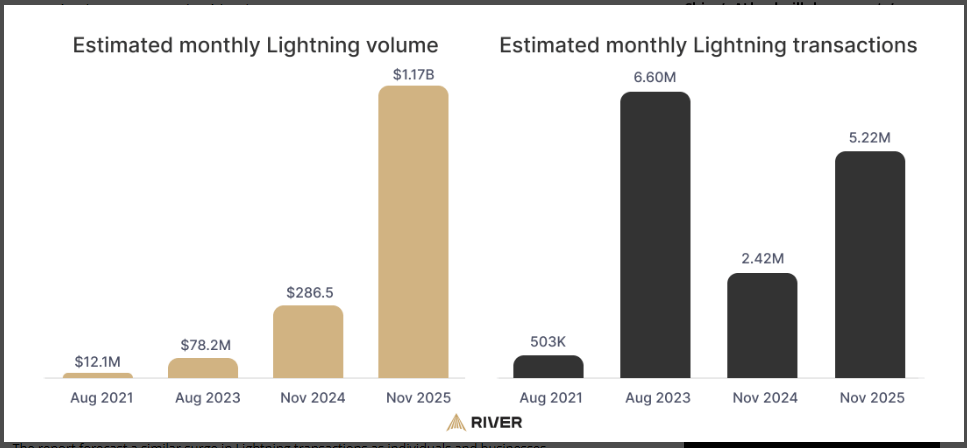
Estimated monthly Lightning transaction volume and number of transactions. Source: River

Bitcoin Price Action And Market Mood

Market conditions were mixed as the network grew. Bitcoin slid under key levels this week, and traders grew cautious as geopolitical headlines piled up.

Volume in spot markets has been muted at times, yet Lightning traffic rose despite that. Price swings still happen, and low trading days tend to amplify those moves, but the network’s payment activity did not simply mirror price spikes. In short, payments rose while BTC sometimes moved sideways.
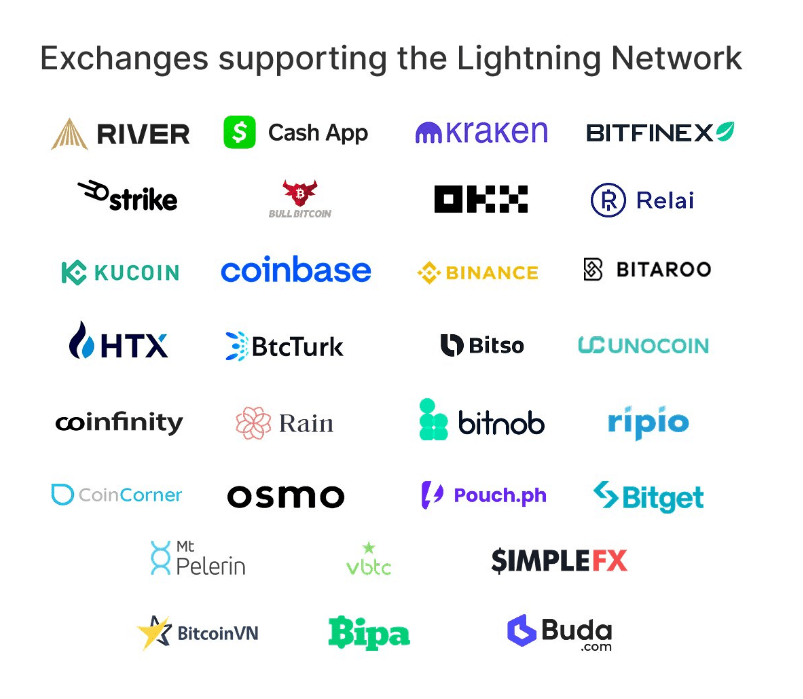
Some of the companies that provide Bitcoin Lightning Network services. Source: River

Why Lightning Is Different

The Lightning Network moves payments off the main chain by opening channels between parties. Transactions inside a channel settle almost instantly and at a fraction of the cost of a typical on-chain transfer.

Only the channel’s net balance is posted to Bitcoin when it’s closed. That design makes small and frequent payments practical, and it removes the 10-minute wait that can ruin buying something at a store.

BTCUSD now trading at $67,116. Chart: TradingView

Reports say Lightning transactions could climb if AI systems begin making automatic micro-payments for data and computing, but that shift still needs better software and clearer business models.

For the time being, the network’s growth signals progress toward everyday Bitcoin payments, though broader exchange support, deeper liquidity, and stronger merchant use will decide whether it becomes a common payment rail or stays a niche tool.

Featured image from Unsplash, chart from TradingView

Domande pertinenti

QWhat was the total value of transactions processed by the Bitcoin Lightning Network in November, as reported by River?

AThe total value of transactions processed by the Bitcoin Lightning Network in November was approximately $1.1 billion.

QAccording to the article, what is a key factor driving the recent adoption of the Lightning Network, as opposed to earlier experiments?

AThe recent adoption is being driven by bigger players such as exchanges and merchant integrations, rather than just small tips or in-app micropayment experiments.

QWhat was the significance of Secure Digital Markets routing a million-dollar transfer to Kraken on the Lightning Network?

AIt demonstrated that the network is capable of handling large financial transfers quickly without the need to wait for on-chain confirmations, showcasing its institutional utility.

QHow does the Lightning Network's design make it suitable for small, frequent payments compared to on-chain transactions?

AIt opens payment channels between parties, allowing for instant, low-cost transactions that are settled off-chain. Only the net balance of a channel is posted to the Bitcoin blockchain when it is closed, eliminating the typical 10-minute wait for on-chain confirmations.

QWhat does the article suggest is needed for the Lightning Network to evolve from a niche tool into a common payment rail?

ABroader exchange support, deeper liquidity, and stronger merchant adoption are needed for the Lightning Network to become a common payment rail.

Letture associate

Anthropic Cries Wolf: Is the AGI Threat Real, or Just an IPO Story?

Anthropic has published an article titled "When AI builds itself," discussing the emerging concept of "recursive self-improvement," where AI begins to actively participate in designing, training, testing, and optimizing its own subsequent versions. The company presents internal data showing that by May 2026, over 80% of code merged into its codebase was written by Claude, its AI model. Claude's capabilities have expanded to handling complex, open-ended engineering tasks, achieving a 76% success rate in such areas, and even contributing to research processes, such as optimizing code performance and conducting AI safety experiments. Anthropic outlines an evolution from human-driven development to AI-assisted workflows, culminating in the current stage where AI agents can autonomously write, run, and delegate code. The company cautions that the path toward a "closed loop," where AI continuously improves itself, is becoming visible. It calls for coordinated global mechanisms to potentially slow or pause frontier AI development to allow safety research and societal structures to catch up. However, the timing of this warning coincides with Anthropic's preparations for an IPO, framing the narrative not just as a safety concern but also as a demonstration of Claude's advanced capabilities and its integral role in accelerating Anthropic's own R&D—creating a potential "flywheel" effect for competitive advantage. This contrasts with OpenAI's recent, more policy-oriented discussion of the same risks, highlighting the competitive dynamics in the AI industry as companies position themselves in both the technological and regulatory landscape.

marsbit47 min fa

Anthropic Cries Wolf: Is the AGI Threat Real, or Just an IPO Story?

marsbit47 min fa

BIT Research: ETF Purchases Have Slowed, Strategy (MicroStrategy) Has Slowed, What Else Can Drive Bitcoin's Rise?

Market Refocus on Inflation and Rate Expectations Weighs on Bitcoin Currently, the market is in a phase of macro-repricing dominated by inflation and interest rate expectations. Bitcoin, which previously benefited from easy liquidity and low inflation, is seeing its core bullish drivers weaken. These drivers were market expectations for interest rate cuts and strong inflows from Bitcoin ETFs and institutions like MicroStrategy (referred to as "Strategy" in the text). The logic has shifted. Recent high inflation data (e.g., CPI hitting 3.8% in a May 2026 report) has caused the market to sharply reduce its rate cut expectations for 2025 and even price in potential hikes. This is a key constraint for Bitcoin, as it lacks cash flows and is highly sensitive to rate expectations. Concurrently, institutional capital flows have slowed significantly. Following the hot CPI data, Bitcoin ETFs saw accelerated outflows, with around $4.3 billion leaving over a period. MicroStrategy's ability to keep adding substantial Bitcoin to its balance sheet is also diminishing. Together, ETF and MicroStrategy holdings total roughly $110 billion, but their momentum as growth engines is cooling. In summary, Bitcoin's current pressure stems not from its own fundamentals but from a changing macro environment. As long as inflation stays elevated, Bitcoin is likely to remain in a consolidating phase. However, historically, inflation eventually peaks. Once it recedes and rate cut expectations rebuild, institutional capital could return, potentially fueling a new and more robust recovery phase for Bitcoin.

marsbit55 min fa

BIT Research: ETF Purchases Have Slowed, Strategy (MicroStrategy) Has Slowed, What Else Can Drive Bitcoin's Rise?

marsbit55 min fa

Earning 1000 Trillion in Half a Year, 'Pocketing' 20 Million per Capita: This Round of Wealth Creation in the Korean Stock Market is Unprecedented in Scale

The South Korean stock market is experiencing an unprecedented wealth surge in 2026, with household equity and fund asset values soaring by over 1,000 trillion KRW (~$730bn) year-to-date. This translates to an average per capita wealth increase of roughly 20 million KRW, fueled by a historic 109% rally in the KOSPI index. The boom is driven by three converging forces: an AI-driven semiconductor supercycle boosting giants like Samsung and SK Hynix; the government's "Value-Up" market reforms addressing long-standing corporate governance issues; and aggressive real estate regulations that have locked capital within financial markets, preventing profits from flowing back into property. This has triggered a wealth effect, boosting high-end consumption significantly. However, the gains are highly concentrated. The two semiconductor behemoths account for over half the index's value, but retail investors own relatively low stakes in them, systematically missing the biggest rallies. Wealth and consumption benefits are skewed towards luxury goods and imported cars, bypassing mainstream retail. Further risks stem from excessive leverage, with high trading volume in leveraged ETFs, and a market sentiment heavily reliant on the AI sector's fortunes and speculative rumors. While this cycle marks a potential shift from real estate to equities as a primary wealth generator for Koreans, its sustainability, amid structural imbalances and leverage, remains a critical test.

marsbit1 h fa

Earning 1000 Trillion in Half a Year, 'Pocketing' 20 Million per Capita: This Round of Wealth Creation in the Korean Stock Market is Unprecedented in Scale

marsbit1 h fa

Trading

Spot
Futures

Articoli Popolari

Come comprare LAYER

Benvenuto in HTX.com! Abbiamo reso l'acquisto di Solayer (LAYER) semplice e conveniente. Segui la nostra guida passo passo per intraprendere il tuo viaggio nel mondo delle criptovalute.Step 1: Crea il tuo Account HTXUsa la tua email o numero di telefono per registrarti il tuo account gratuito su HTX. Vivi un'esperienza facile e sblocca tutte le funzionalità,Crea il mio accountStep 2: Vai in Acquista crypto e seleziona il tuo metodo di pagamentoCarta di credito/debito: utilizza la tua Visa o Mastercard per acquistare immediatamente SolayerLAYER.Bilancio: Usa i fondi dal bilancio del tuo account HTX per fare trading senza problemi.Terze parti: abbiamo aggiunto metodi di pagamento molto utilizzati come Google Pay e Apple Pay per maggiore comodità.P2P: Fai trading direttamente con altri utenti HTX.Over-the-Counter (OTC): Offriamo servizi su misura e tassi di cambio competitivi per i trader.Step 3: Conserva Solayer (LAYER)Dopo aver acquistato Solayer (LAYER), conserva nel tuo account HTX. In alternativa, puoi inviare tramite trasferimento blockchain o scambiare per altre criptovalute.Step 4: Scambia Solayer (LAYER)Scambia facilmente Solayer (LAYER) nel mercato spot di HTX. Accedi al tuo account, seleziona la tua coppia di trading, esegui le tue operazioni e monitora in tempo reale. Offriamo un'esperienza user-friendly sia per chi ha appena iniziato che per i trader più esperti.

288 Totale visualizzazioniPubblicato il 2025.02.11Aggiornato il 2026.06.02

Come comprare LAYER

Discussioni

Benvenuto nella Community HTX. Qui puoi rimanere informato sugli ultimi sviluppi della piattaforma e accedere ad approfondimenti esperti sul mercato. Le opinioni degli utenti sul prezzo di LAYER LAYER sono presentate come di seguito.

活动图片













