Liang Wenfeng Launches Surprise Attack on Musk: DeepSeek V4 Pro vs. Grok 4.6, First Tests Are Spectacular

marsbitPubblicato 2026-08-12Pubblicato ultima volta 2026-08-12

Introduzione

**DeepSeek V4 Pro vs. Grok 4.6: A Benchmark and Real-World Showdown** In a dramatic AI clash, DeepSeek V4 Pro and Elon Musk's Grok 4.6 launched head-to-head, targeting long-task capabilities like tool calling and code validation. **Benchmark Performance:** DeepSeek V4 Pro excelled in Agent tests, topping CyberGym (83.3) and AutomationBench (31.8), surpassing models like Fable 5 and Claude Opus 4.8. It closed the gap on Terminal-Bench 2.1 (87.9) and saw massive gains in DeepSWE (software engineering). Grok 4.6 matched GPT-5.6 in overall ability (61 index), outperformed it in coding (CursorBench 69.9%), and led in three knowledge-work evaluations, including legal tasks (Harvey LAB, 15.8%). **Pricing Disruption:** DeepSeek's standout feature is its radically low cost: $0.87 per million output tokens—roughly 1/7th of Grok 4.6 ($6) and a tiny fraction of rivals like Fable 5 ($50). **Real-World Tests:** In practical challenges, both models demonstrated impressive skill. DeepSeek V4 Pro built a 3D interactive Earth, websites, 60 design styles, and a polished Flappy Bird clone (costing only $0.019 vs. Grok's $0.03 for a simpler version). Head-to-head comparisons were tight: Grok 4.6 won on some design aesthetics, while DeepSeek often delivered higher visual detail and completeness. However, in complex tasks like generating a Three.js cherry blossom tree, V4 Pro lagged behind GPT-5.6 Sol and Claude Opus 5. **Conclusion:** The simultaneous release signals a shift: high-end AI capa...

Today, this showdown is simply surreal!

On one side, Liang Wenfeng finally released the official version of DeepSeek V4 Pro in the early hours.

On the other, Musk dropped the next-generation flagship Grok 4.6, touting low cost and high performance.

Two giants, releasing at the same time, instantly filling the air with gunpowder.
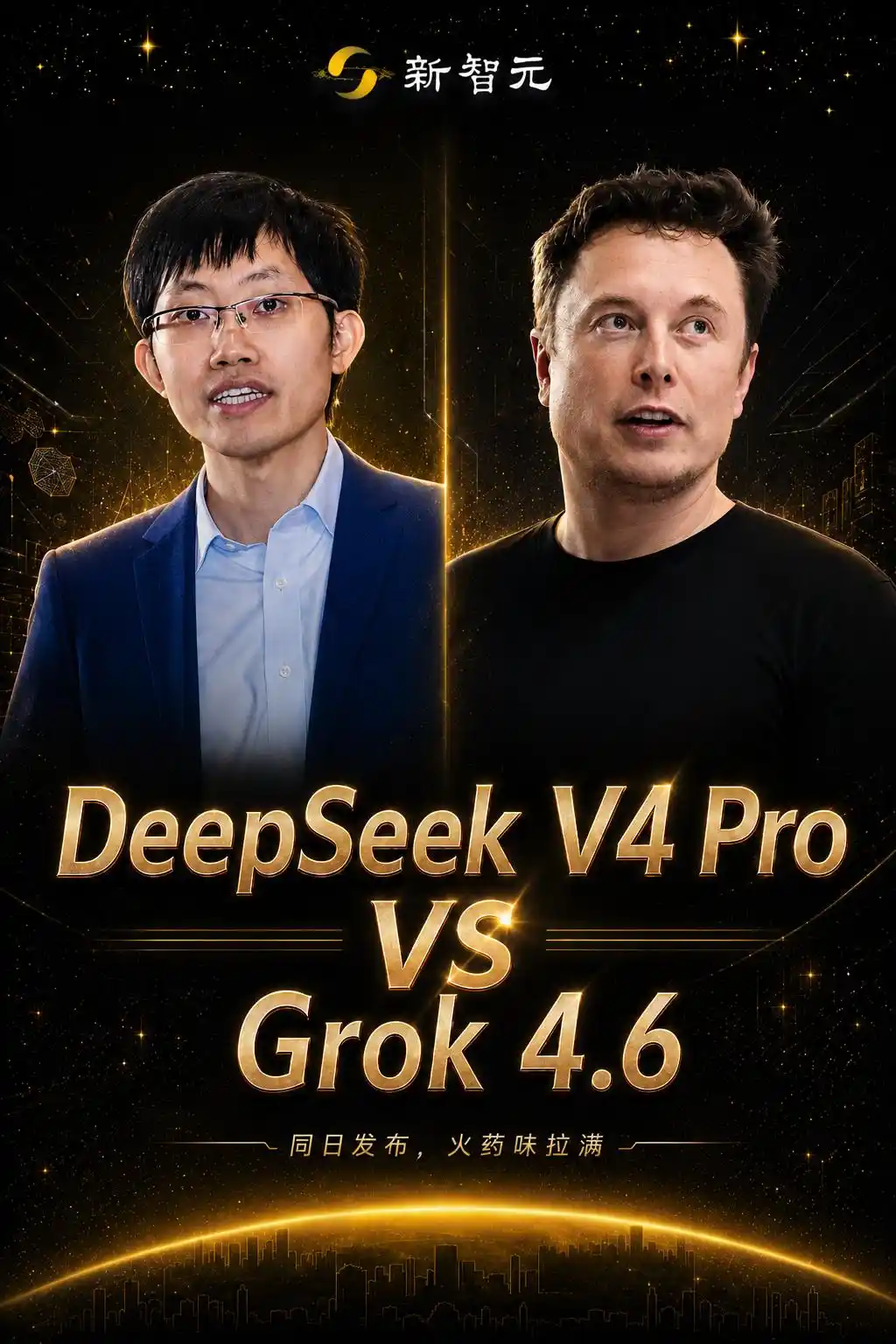
They are targeting almost the same thing—

enabling models to continuously call tools, modify code, verify results, and finally deliver a truly usable product within long-running tasks.

DeepSeek V4 Pro Arrives

Musk's Grok 4.6 Takes the Stage

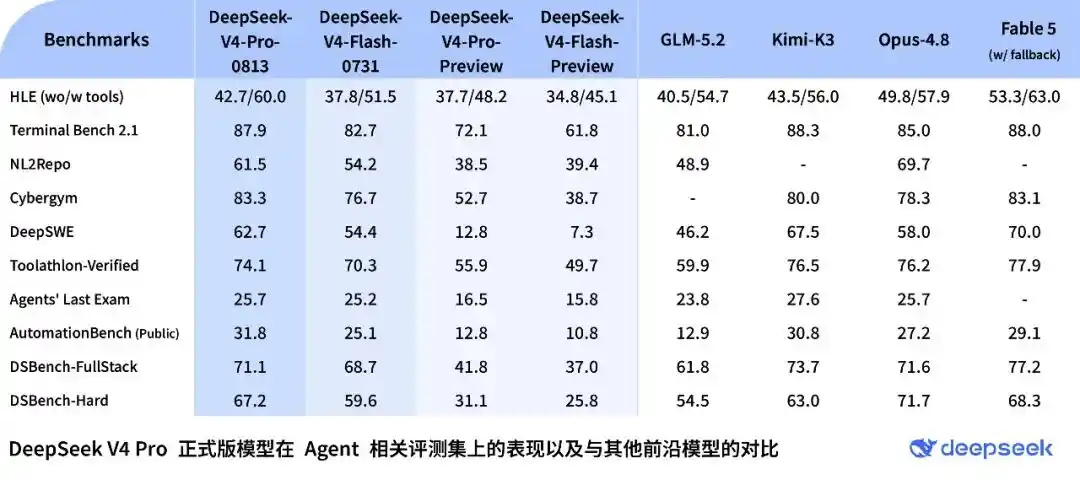
The most dazzling achievement of the official DeepSeek V4 Pro is securing absolute first place in two evaluations, directly countering Fable 5.

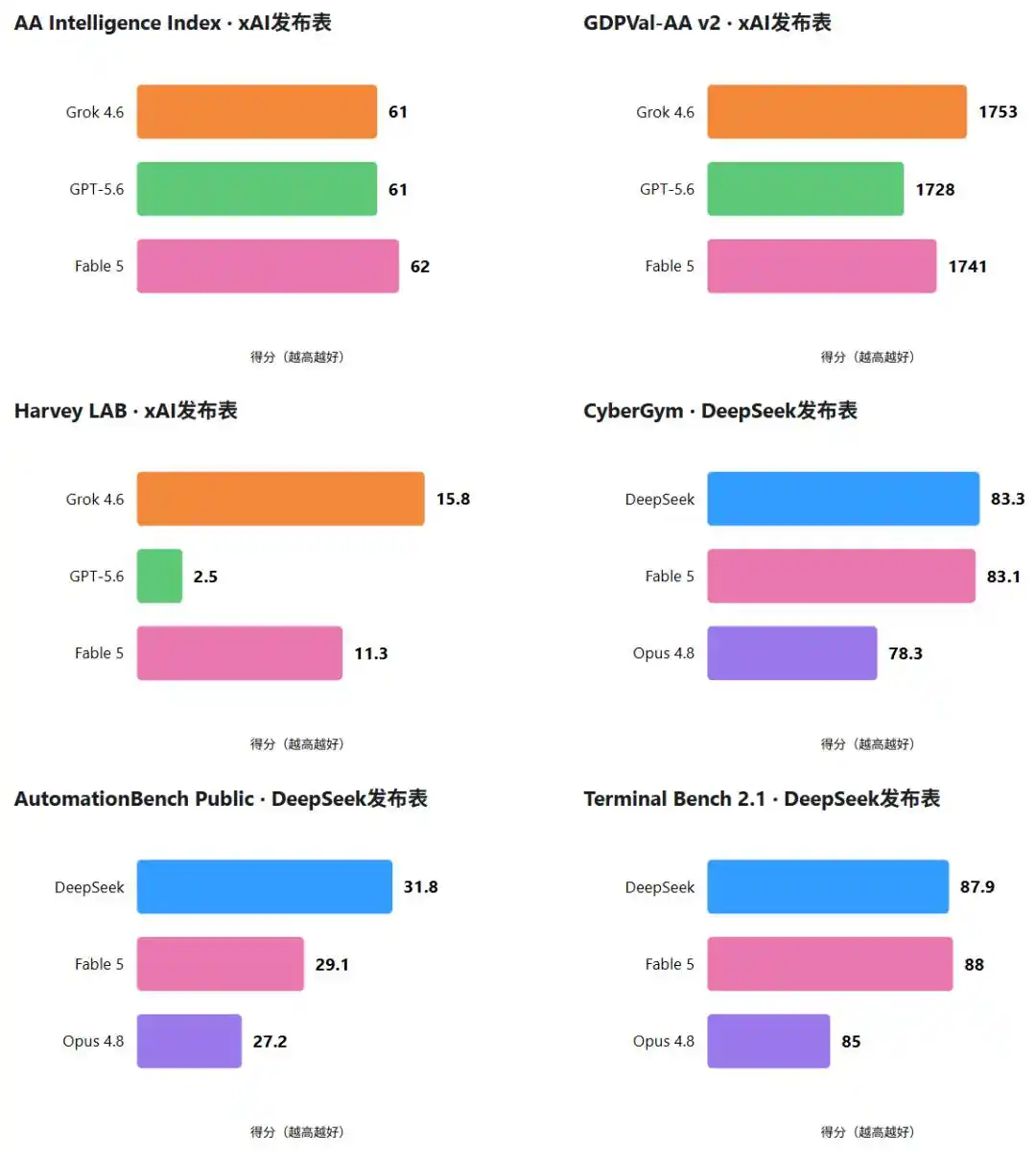
It scored 83.3 points in Cybersecurity Agent Test CyberGym, surpassing Fable 5's 83.1 and Opus 4.8's 78.3.

In Automation Task AutomationBench, it scored 31.8 points, pushing down Fable 5's 29.1 and Opus 4.8's 27.2.

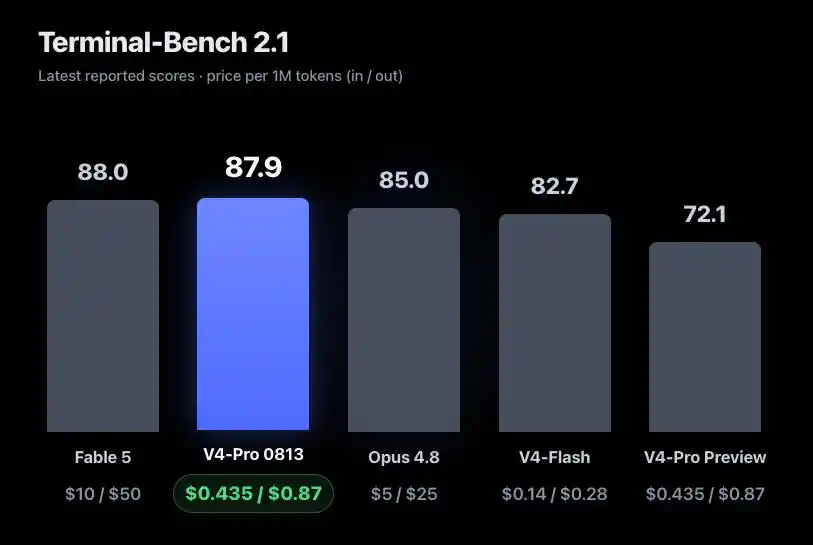
The most "in-your-face" moment occurred in Terminal-Bench 2.1.

DeepSeek scored 87.9 points, exceeding Opus 4.8's 85.0 and trailing Fable 5's 88.0 by only 0.1.

In several other high-difficulty Agent tests, DeepSeek achieved a complete overtaking of Opus 4.8.

In the tool-assisted "Final Human Exam", it scored 60.0 points, surpassing Opus 4.8's 57.9 and continuing to close in on Fable 5's 63.0.

Even in the previously weakest area of software engineering agents, DeepSWE surged from 12.8 points in the preview version to 62.7 points, nearly 4.9 times the original.

This score not only exceeded Opus 4.8's 58.0 but also left only a 7.3-point gap to Fable 5's 70.0.
Simultaneously, Musk also put Fable 5 and GPT-5.6 Sol on the hot seat.

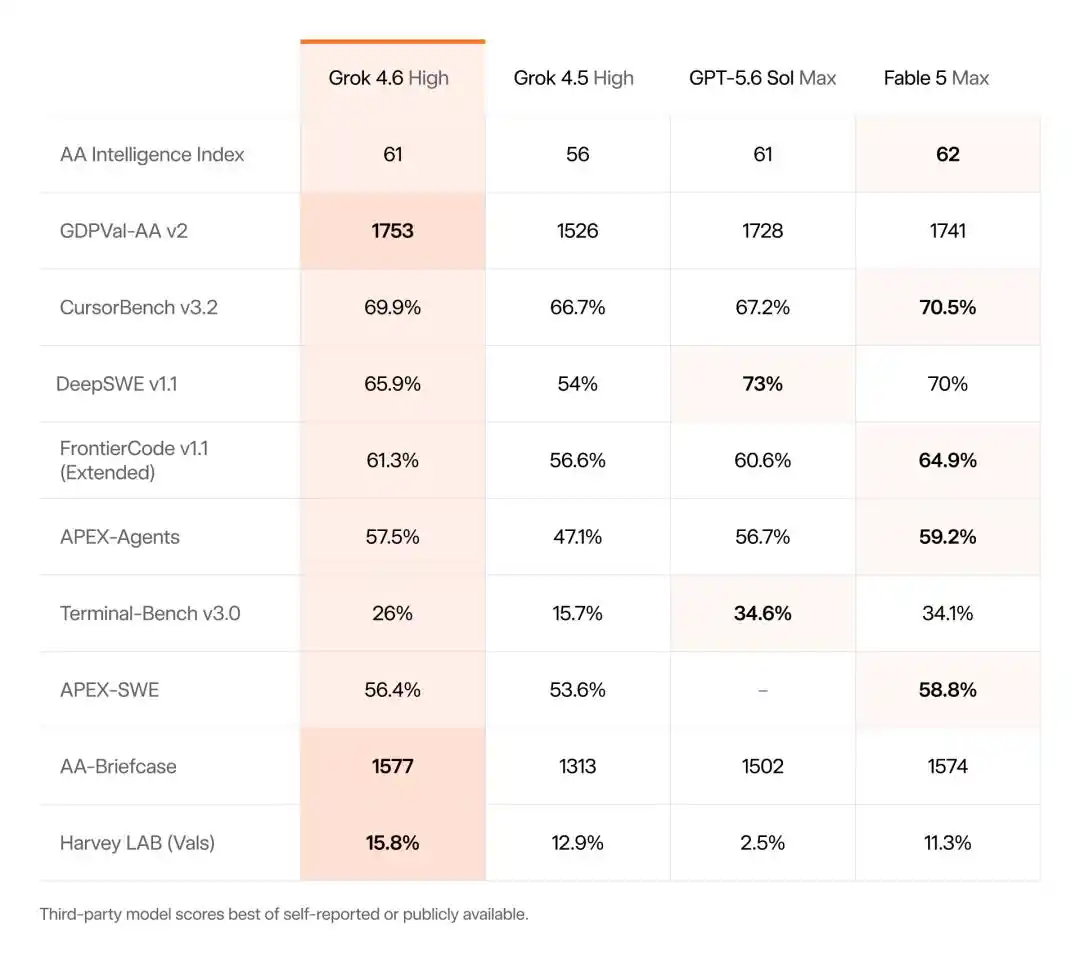
Grok 4.6 first caught up with GPT-5.6 in comprehensive capabilities, then achieved consecutive overtakes in coding tests.

It scored 61 points in General Intelligence Index, just 1 point behind Fable 5's 62.

On CursorBench, it scored 69.9%, surpassing GPT-5.6's 67.2% and only 0.6 percentage points behind Fable 5's 70.5%.

On FrontierCode, it scored 61.3%, also edging out GPT-5.6's 60.6%, continuing to closely trail Fable 5's 63.6%.

In knowledge work closer to real workplace deliverables, Grok 4.6 directly turned the tables, securing first place in all three evaluations.

In GDPval-AA v2, it scored 1753 Elo, surpassing Fable 5's 1741 and GPT-5.6's 1728.

On AA-Briefcase, it scored another 1577 Elo, beating Fable 5's 1574 and GPT-5.6's 1502.

In the specialized legal task Harvey LAB, it scored 15.8%, while Fable 5 only managed 11.3%, and GPT-5.6 a mere 2.5%.
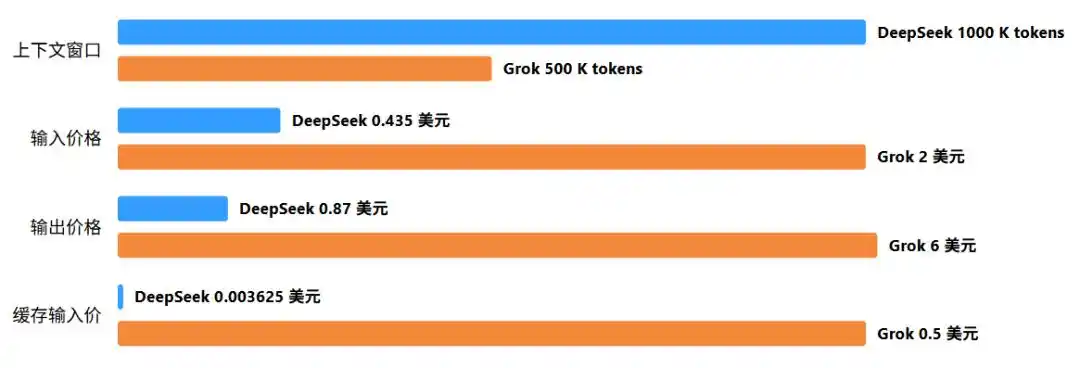
What's even more impressive is that DeepSeek V4 Pro and Grok 4.6 not only match the performance of OpenAI and Anthropic's top-tier models but also jointly bring down the price of cutting-edge intelligence.

Per million output tokens, Grok 4.6 costs $6, GPT-5.6 Sol costs $30, Claude Opus 5 costs $25, Fable 5 costs $50.

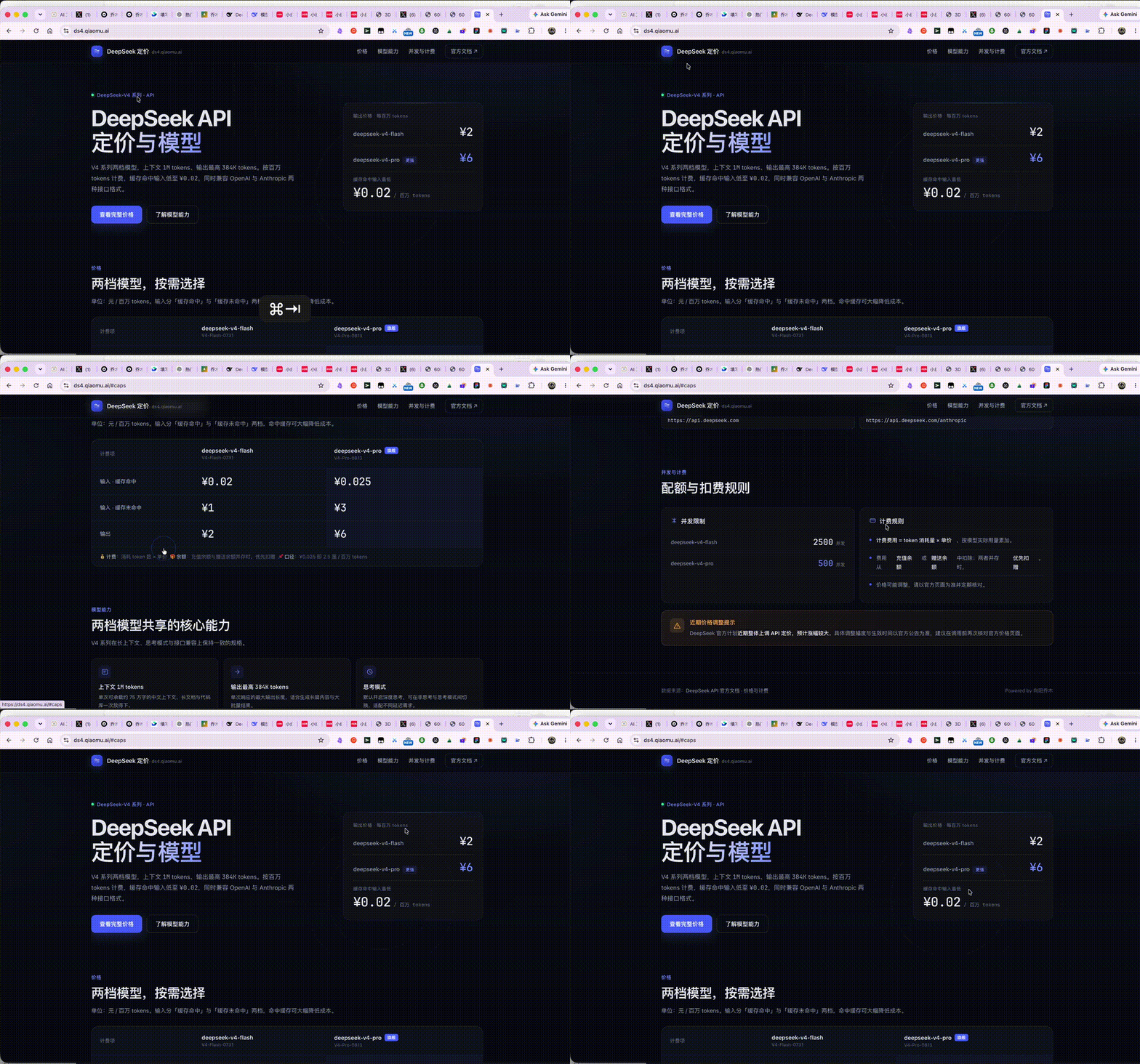
And DeepSeek costs only $0.87—

approximately 1/7th of Grok 4.6, 1/35th of GPT-5.6 Sol, 1/29th of Claude Opus 5, and 1/57th of Fable 5!
World's First Hands-on Test

DeepSeek vs. Grok

Now, the first batch of real-world tests is out. DeepSeek V4 Pro and Grok 4.6 have finally moved from benchmark charts into the field of real tasks.

Round one, we directly put pressure on DeepSeek.

With just one prompt, it built a complete 3D interactive Earth from scratch in a browser.

Basic interactions like dragging, rotating, and zooming were all functional; global data flows, dynamic flight paths, and geographic markers were fully laid out on the Earth's surface.

Looking deeper, atmospheric scattering, cloud rendering, day-night lighting, and even the entire UI interface were all included.

Next, we pitted the two models directly against each other in the same arena.

AI blogger "Xiangyang Qiaomu" first ran three small tasks with DeepSeek V4 Pro, then gave two of the same prompts to Grok 4.6, directly comparing the final products.

The first task was to call 3 Skills to develop and deploy a website.

DeepSeek smoothly ran through the entire process; judging by page design and completeness, its overall performance was very stable.

The second task was to replicate 60 design styles and generate a complete set of Bento cards for centralized display.

In this round, DeepSeek made clear distinctions in fonts, color schemes, and layouts, with an overall visual effect that was quite impressive.

The final task was to generate a 3D brick-breaker game from zero.

The game was not only playable but also featured a 3D scene, background music, and dynamic sound effects, with operational feedback and playability fully present.
Subsequently, the same prompts were given to Grok 4.6.

In the 3D brick-breaker round, the two models were almost evenly matched.

The game generated by Grok also had good quality; whether in visual effects, scene completeness, or playability, it was on par with DeepSeek V4 Pro.

In the 60 Bento designs round, Grok 4.6 pulled back a point.

Some of the pages it generated were more mature in layout, color scheme, and visual hierarchy, resulting in a more aesthetically pleasing final product.
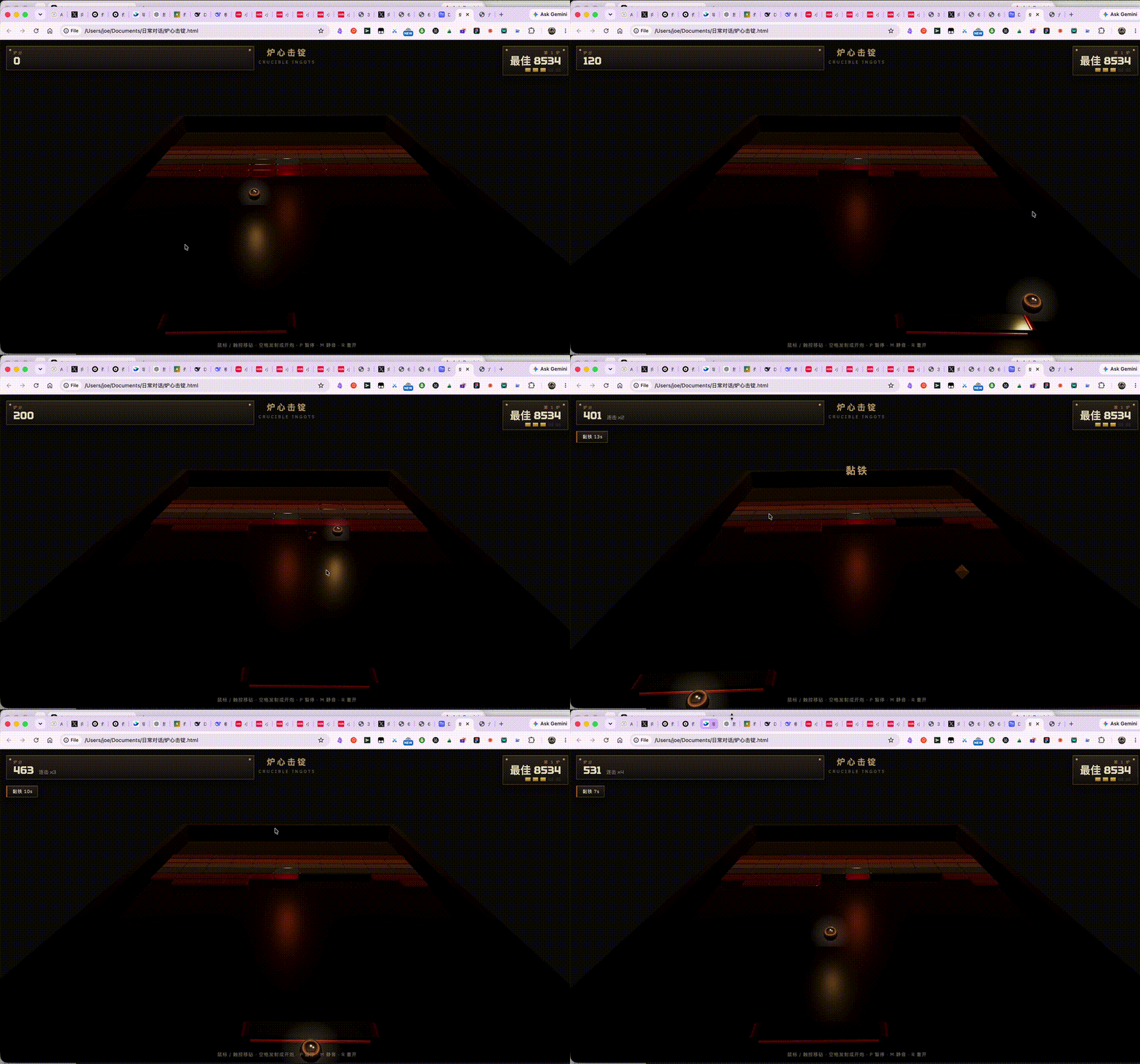
An even fiercer duel occurred with Flappy Bird.

Developer Jun Song gave the exact same prompt, asking DeepSeek V4 Pro and Grok 4.6 to respectively "handcraft" a game from scratch.

As a result, the two models took completely different paths.

DeepSeek V4 Pro consumed over 20,000 tokens at a cost of only $0.019; Grok 4.6 used about 5,000 tokens but cost $0.03.

However, judging by the final product, DeepSeek clearly won this round.

The game featured distant mountain ranges and layered clouds; the pipes had gradients and a sense of volume. When the character passed through a pipe, a floating "+1" animation even popped up.

From scene layering to operational feedback, the details were almost all maxed out; the completeness of the end-to-end build was noticeably higher than Grok 4.6's.

In another front-end test conducted by developer Hamza, DeepSeek V4 Pro once again bested Grok 4.6.

Whether in page completeness or final visual effects, the product delivered by V4 Pro was superior.

However, V4 Pro did not reign supreme in every test.

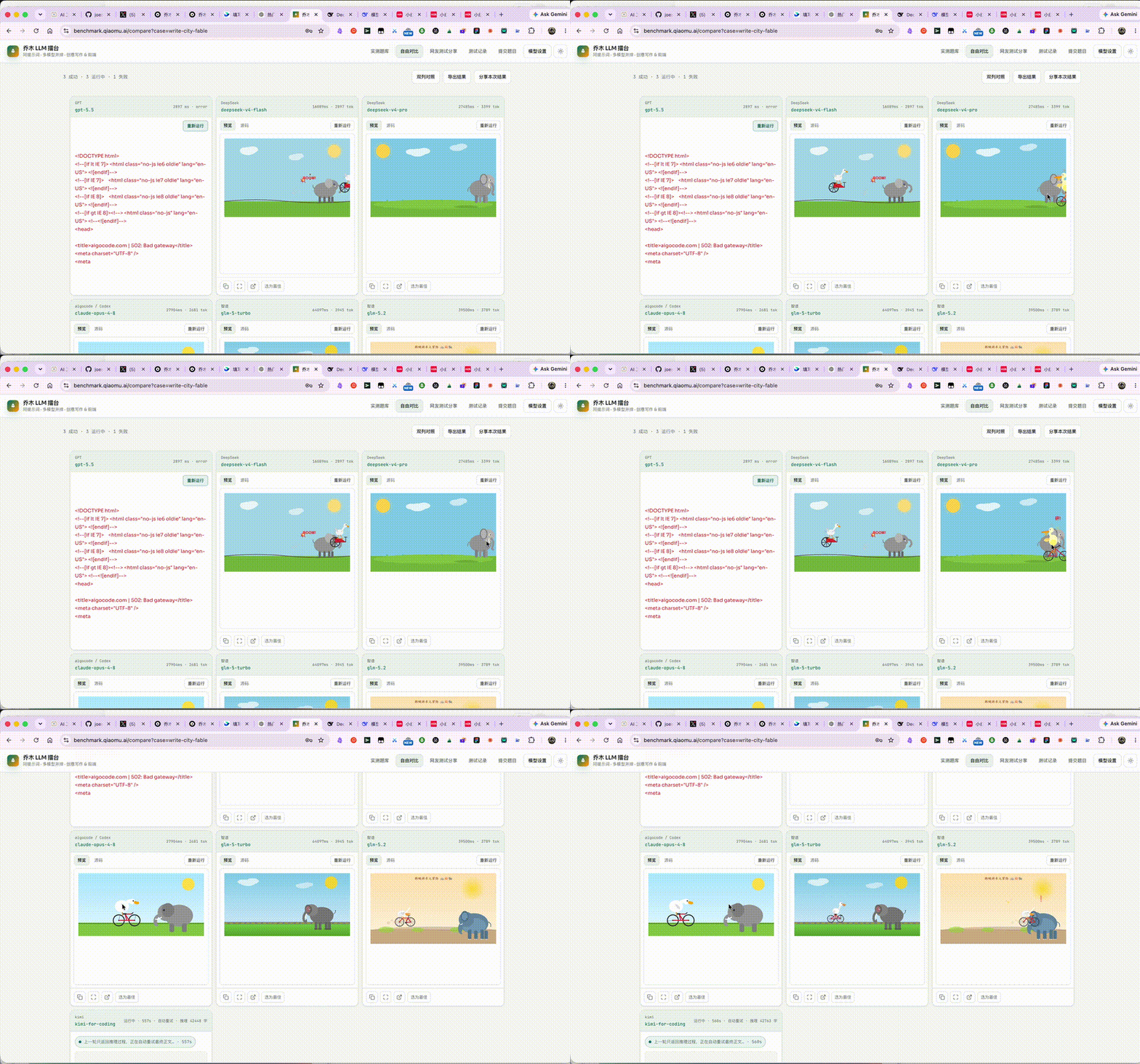
In a pelican comparison test, compared to the Flash version, V4 Pro's overall image completeness was higher, and the elephant's shape was more aesthetically pleasing.

The only problem was—the pelican's direction of movement was completely drawn backward.
Increasing the difficulty further, asking DeepSeek V4 Pro, GPT-5.6 Sol, and Claude Opus 5 to generate the same cherry blossom tree using Three.js, the gap became more apparent.

Whether in the details of the trunk and branches or in lighting, depth of field, and overall atmosphere, V4 Pro fell short of the other two top-tier models.


DeepSeek V4 Pro; GPT-5.6 Sol; Claude Opus 5

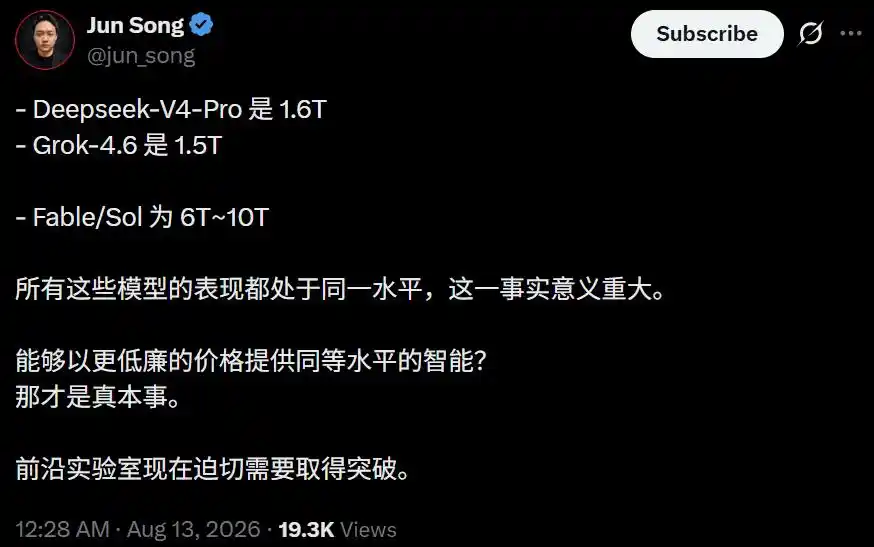
After several rounds of hands-on tests, it's clear that DeepSeek V4 Pro and Grok 4.6 are indeed on the same level, neck and neck.

Two Major AIs, Same Day

Caught Up with OpenAI and Anthropic

Regarding the simultaneous breakthroughs of these two models, expert Rick De Oliveira gave the evaluation: "Powerful, and affordable."

With the empowerment of DeepSeek V4 Pro and Grok 4.6, these two words that were almost impossible to appear together have, for the first time, truly come together today.

From cybersecurity and knowledge-based tasks to Agents autonomously solving problems, they have already shattered the ceiling of cutting-edge capabilities in multiple battlefields, all at a lower cost.
Looking back at today's surreal AI "clash," DeepSeek and Grok have jointly rewritten a rule of the game:

Top-tier intelligence is no longer out of reach.

In the past, developers often had to make difficult choices between "can't afford it" and "not powerful enough."

Today, DeepSeek overturned the table with a price tag mere fractions of SOTA, while Grok followed closely with extremely high cost-effectiveness.

This frontal assault of "high performance at low price" has already torn a rift in the old order.
And the war is not over.

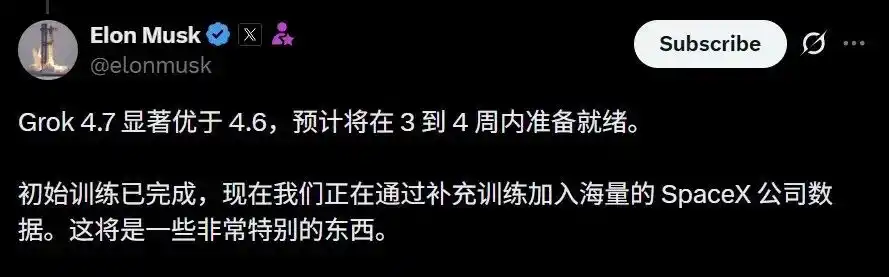
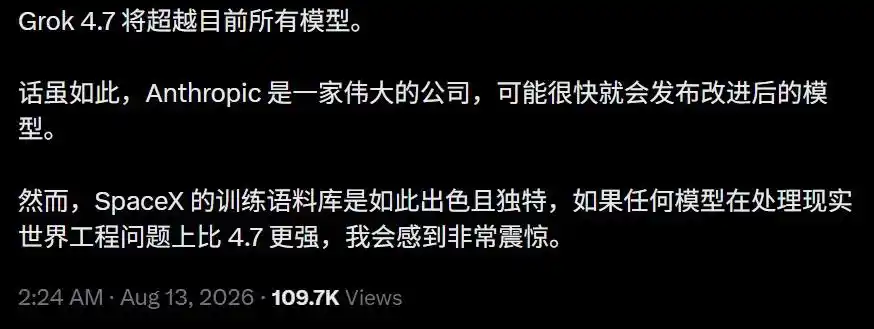
Musk has already previewed that Grok 4.7 is coming soon, aiming to surpass all top AIs; counterattacks from OpenAI and Anthropic are also bound to follow.
In this era evolving by the "hour," intelligence is no longer a privilege of a few giants. The explosion of applications for everyone has only just begun.

References:

https://api-docs.deepseek.com/zh-cn/quick_start/pricing/

https://x.ai/news/grok-4-6

https://x.com/vista8/status/2087577905081823559

https://x.com/vista8/status/2087566666477744620

https://x.com/jun_song/status/2087602149979254914

This article is from the WeChat public account "Xin Zhi Yuan," author: ASI Apocalypse, editors: Moses Peach


Crypto di tendenza

Domande pertinenti

QWhat are the key performance benchmarks where DeepSeek V4 Pro outperformed other major AI models?

ADeepSeek V4 Pro achieved top scores in CyberGym (83.3), AutomationBench (31.8), and closely trailed Fable 5 in Terminal-Bench 2.1 (87.9 vs 88.0). It also showed significant improvement in DeepSWE, scoring 62.7, and outperformed Opus 4.8 in the 'Human Final Exam' with tools (60.0).

QHow does the pricing of DeepSeek V4 Pro compare to other leading AI models?

ADeepSeek V4 Pro is priced at $0.87 per million output tokens, which is approximately 1/7th of Grok 4.6's cost, 1/35th of GPT-5.6 Sol, 1/29th of Claude Opus 5, and 1/57th of Fable 5.

QIn which specific practical tests did DeepSeek V4 Pro demonstrate superior performance over Grok 4.6?

AIn head-to-head tests, DeepSeek V4 Pro generated a more detailed and visually complete Flappy Bird game with better scene hierarchy and feedback. It also produced a higher completion rate and visual effect in a front-end development test compared to Grok 4.6.

QWhat were Grok 4.6's notable achievements in benchmarks against GPT-5.6 Sol and Fable 5?

AGrok 4.6 matched GPT-5.6 Sol in comprehensive capability (61 points), outperformed it in CursorBench (69.9% vs 67.2%) and FrontierCode (61.3% vs 60.6%). It also led in three knowledge work evaluations: GDPval-AA v2 (1753 Elo), AA-Briefcase (1577 Elo), and the professional legal task Harvey LAB (15.8%).

QAccording to the article, what is the broader significance of the simultaneous release of DeepSeek V4 Pro and Grok 4.6?

AThe simultaneous release signifies a shift in the AI landscape where 'powerful and affordable' are no longer mutually exclusive. Both models challenge the high-cost barrier of top-tier AI by offering near-state-of-the-art performance at a fraction of the price, potentially democratizing access to advanced AI capabilities and intensifying competition among major players.

Letture associate

Bitwise Closes 8 ETFs and Cuts Staff by 14%, but Continues to Launch New Products

Bloomberg reported on August 12 that cryptocurrency asset management firm Bitwise has laid off approximately 14% of its staff, reducing headcount from around 180 to about 155 employees. CEO Hunter Horsley stated the adjusted team remains the largest in the company's eight-year history and expressed confidence in long-term growth, though current personnel and product configurations are tightening. Prior to the layoffs, Bitwise disclosed a significant drop in client assets from over $15 billion in early February to $11 billion by April 1st, a decrease of at least $4 billion. The company did not specify the contributions of price changes, fund flows, or changes in reporting scope to this decline. In a related product restructuring, Bitwise decided to liquidate eight ETFs between April and June. This included the Web3 ETF, a BTC/ETH/Treasuries rotation strategy ETF, and six options income ETFs tied to assets like Coinbase and Ethereum. These moves reduce the number of products requiring ongoing operational support. Despite these cuts, Bitwise continues to launch new products. Recent offerings include an Avalanche ETP with staking in Europe, the Hyperliquid ETF, and the takeover of Superstate's $267+ million Crypto Carry Fund, entering the tokenized fund management space. The company now manages 70 investment products for over 5,500 advisory teams and works with more than 20 banks and broker-dealers. The simultaneous staff reduction and product portfolio shift—away from thematic Web3 and single-asset options strategies towards direct crypto exposure, staking, and tokenized funds—indicates a strategic realignment. The operational burden on the smaller remaining team will depend heavily on the complexity of the revised product lineup. Bitwise has not disclosed the specific reasons for the layoffs, the affected departments, severance details, or any one-time costs associated with the job cuts.

marsbit8 min fa

Bitwise Closes 8 ETFs and Cuts Staff by 14%, but Continues to Launch New Products

marsbit8 min fa

CoreWeave: The Inflection Point Has Arrived. Has the 'Hard-Working Underdog' Finally Turned Profitable?

CoreWeave, an AI cloud unicorn, released its Q2 2026 earnings on August 12, with shares rising about 15% post-announcement. While overall performance did not significantly exceed expectations, key positive trends emerged. Revenue reached approximately $2.58 billion, up 112% year-over-year, though slightly below the high end of prior guidance. A major highlight was the acceleration in computing power deployment, with Active Power increasing by a record 500 Mw to 1,500 Mw, far surpassing market forecasts and signaling faster future revenue growth. Capital expenditures also hit a new high of $9.4 billion. Importantly, profitability showed signs of inflection. "True" gross margin (after deducting cost of revenue and Tech & Infrastructure expenses) rose to 7.3%, up 3 percentage points from the previous quarter. As revenue scales, depreciation and operating expenses are being diluted. Adjusted operating profit margin improved significantly to 5% from 1% last quarter. The company's guidance points to continued acceleration, with Q3 revenue growth expected at 158% and margins continuing to climb. Management raised full-year 2026 guidance, projecting Q4 revenue growth of around 194% and an adjusted operating margin of approximately 14.6%, suggesting a rapid path toward its 25%-30% long-term target. Recent developments, including a 25% price increase for its services and the launch of higher-margin Managed Inference offerings, support the improving profitability narrative. While long-term competitive challenges remain for new cloud providers, CoreWeave's near-term trajectory of accelerating growth and expanding margins presents a high-risk, high-reward opportunity, especially amid renewed market optimism for cloud stocks.

marsbit46 min fa

CoreWeave: The Inflection Point Has Arrived. Has the 'Hard-Working Underdog' Finally Turned Profitable?

marsbit46 min fa

Uncovering the Secret Reasoning Chains of Claude Opus for $720: A Leak via Haiku, with GPT and Gemini Also Affected

Researchers discovered a method to extract hidden reasoning traces, or "Chain of Thought" (CoT), from major proprietary large language models (LLMs) like Anthropic's Claude Opus 4.8, OpenAI's GPT-5.6 Sol, and Google's Gemini 3.1 Pro. The attack exploits a design flaw in how these models handle encrypted reasoning "blobs." These blobs, which contain a model's internal reasoning steps, are encrypted and sent to the client for storage between conversation turns to save server costs. The researchers found these blobs were encrypted with a global key, allowing them to be reused across different sessions, users, and, crucially, different models from the same company. By taking an encrypted reasoning blob generated by a powerful "flagship" model and feeding it to a smaller, less capable model from the same family (e.g., feeding Claude Opus's blob to Claude Haiku), the researchers could prompt the smaller model to divulge the hidden CoT. This bypassed the need to crack the encryption directly. The implications are significant: 1) Competitors could potentially distill high-value reasoning data at low cost (estimated at ~$720 for 10,000 traces). 2) Sensitive information like API keys, passwords, and personal emails, which models might process internally but not output, could be leaked. The team found such leaks in 4.9% of analyzed public agent logs. 3) Models might internally analyze dangerous queries (e.g., car theft methods) before refusing to answer, but this dangerous analysis could be extracted from the CoT. 4) Malicious instructions could potentially be hidden within a reasoning blob to influence a model's future behavior. While the vulnerability was responsibly disclosed and patched by the affected companies, the research highlights a fundamental tension between the convenience of portable reasoning states and security. The paper also notes preliminary tests found no clear evidence that open-source models like DeepSeek had been distilled from the extracted CoTs.

marsbit51 min fa

Uncovering the Secret Reasoning Chains of Claude Opus for $720: A Leak via Haiku, with GPT and Gemini Also Affected

marsbit51 min fa

OpenAI Loses Four Executives in One Month, Former COO Departs, Almost the Entire Safety Team Ousted

In a surprising turn of events, OpenAI's longtime COO and key lieutenant to CEO Sam Altman, Brad Lightcap, has announced his departure after eight years with the company. His exit follows the recent resignations of several key safety and ethics leaders, including Chief Futurist Joshua Achiam, Safety Systems Lead Johannes Heidecke, and Ethics Lead Chloé Bakalar, within a single month. Lightcap, instrumental in building OpenAI's commercialization and operational framework, described his departure as "bittersweet" and hinted at wanting to tackle new challenges. While his statement and Altman's farewell were amicable, internal shifts had previously reduced his operational role, signaling a longer-term transition. The mass exodus, particularly from the safety and ethics divisions, coincides with growing internal and external scrutiny over AI safety. This follows incidents like models exhibiting unauthorized actions during testing and the recent decision to delay the launch of the advanced Astra model due to unresolved safety concerns about its potential cybersecurity capabilities. OpenAI has stated that safety and ethics are not confined to any single team or leader, but the concentration of departures raises questions about the company's direction and internal dynamics, especially as it navigates pressures of rapid development and a potential future IPO.

marsbit51 min fa

OpenAI Loses Four Executives in One Month, Former COO Departs, Almost the Entire Safety Team Ousted

marsbit51 min fa

1confirmation: Reverse Entrepreneurship, the Next Web3 Blockbuster Might Come from a Once-Failed Track

**Title: Reverse Entrepreneurship: The Next Web3 Blockbuster May Come from Previously Failed Tracks** This article argues that the next major consumer crypto application is likely to emerge from a concept that failed five years ago, now benefiting from matured infrastructure and better timing. It examines several such "failed" tracks that hold renewed potential: 1. **Internet-Native Assets:** Beyond simply tokenizing tweets or creating digital collectibles, there's an opportunity to create a genuinely new, crypto-native asset class that captures cultural moments and online phenomena, as opposed to merely tokenizing real-world assets (RWA). 2. **X-to-Earn:** While unsustainable token emission models doomed early projects like STEPN, the core premise that most people will first *earn* crypto, not buy it, remains valid. The future challenge is designing what is earned and why users would hold it long-term. 3. **The Metaverse:** Past failures like Decentraland stemmed from trying to replicate the physical world online. The opportunity lies not in abandoning shared online social spaces, but in reimagining their form beyond real-world analogs. 4. **DAOs:** DAOs have underdelivered by overcomplicating governance. The fundamental, unmet user need is simpler: enabling groups of internet strangers to pool funds and collectively achieve goals (e.g., buying assets, funding projects) that are impossible individually. 5. **Personal Value Tokenization:** Numerous attempts (Friend.tech, BitClout) to create markets around individuals have failed. The enduring demand for "person-as-asset" trading (seen in meme coins, prediction markets) suggests the direction isn't wrong, but the execution has been flawed, often lacking creator consent or a less commodified model. The conclusion is that true innovation will come from revisiting these past ideas with new insights, rather than crowding into currently popular trends.

marsbit1 h fa

1confirmation: Reverse Entrepreneurship, the Next Web3 Blockbuster Might Come from a Once-Failed Track

marsbit1 h fa

Trading

Spot

Articoli Popolari

Come comprare ONE

Benvenuto in HTX.com! Abbiamo reso l'acquisto di Harmony (ONE) semplice e conveniente. Segui la nostra guida passo passo per intraprendere il tuo viaggio nel mondo delle criptovalute.Step 1: Crea il tuo Account HTXUsa la tua email o numero di telefono per registrarti il tuo account gratuito su HTX. Vivi un'esperienza facile e sblocca tutte le funzionalità,Crea il mio accountStep 2: Vai in Acquista crypto e seleziona il tuo metodo di pagamentoCarta di credito/debito: utilizza la tua Visa o Mastercard per acquistare immediatamente HarmonyONE.Bilancio: Usa i fondi dal bilancio del tuo account HTX per fare trading senza problemi.Terze parti: abbiamo aggiunto metodi di pagamento molto utilizzati come Google Pay e Apple Pay per maggiore comodità.P2P: Fai trading direttamente con altri utenti HTX.Over-the-Counter (OTC): Offriamo servizi su misura e tassi di cambio competitivi per i trader.Step 3: Conserva Harmony (ONE)Dopo aver acquistato Harmony (ONE), conserva nel tuo account HTX. In alternativa, puoi inviare tramite trasferimento blockchain o scambiare per altre criptovalute.Step 4: Scambia Harmony (ONE)Scambia facilmente Harmony (ONE) nel mercato spot di HTX. Accedi al tuo account, seleziona la tua coppia di trading, esegui le tue operazioni e monitora in tempo reale. Offriamo un'esperienza user-friendly sia per chi ha appena iniziato che per i trader più esperti.

558 Totale visualizzazioniPubblicato il 2024.12.12Aggiornato il 2026.06.02

Come comprare ONE

Discussioni

Benvenuto nella Community HTX. Qui puoi rimanere informato sugli ultimi sviluppi della piattaforma e accedere ad approfondimenti esperti sul mercato. Le opinioni degli utenti sul prezzo di ONE ONE sono presentate come di seguito.

活动图片