Less Than a Year in Office and Leaving Again: Why Are Core Figures of the Ethereum Foundation Departing Once More?

marsbitPubblicato 2026-02-14Pubblicato ultima volta 2026-02-14

Introduzione

Tomasz Stańczak, the co-executive director of the Ethereum Foundation (EF), has announced his resignation, just 11 months after taking the role. He was appointed alongside Hsiao-Wei Wang in March 2025, replacing long-time leader Aya Miyaguchi amid community criticism that EF was too slow and disconnected. Stańczak, founder of core Ethereum client Nethermind, was brought in to make EF more decisive and execution-focused. During his tenure, he streamlined operations, refocused strategy on Layer-1 scaling, accelerated upgrade timelines, and pushed new initiatives in AI integration and privacy. His departure hints at internal tension. In his statement, Stańczak suggested his ability to operate independently within EF diminished as the leadership became more self-sufficient. He expressed a desire to return to hands-on product building, specifically in AI/blockchain convergence, echoing Ethereum’s early experimental spirit. He is replaced by Bastian Aue, a low-profile internal figure focused on "principled" decision-making aligned with "cypherpunk values," signaling a potential shift back towards a coordination-focused rather than execution-driven approach. This leadership change comes at a critical time. EF is preparing to release key proposals on "Lean Ethereum" and future roadmaps, while Ethereum faces intense competition, Layer-2 fragmentation, and market pressure—with its price risk falling below inflation-adjusted 2018 levels.

The Ethereum Foundation (EF) once again finds itself at a crossroads of personnel turmoil.

Tomasz Stańczak, the co-executive director of the Ethereum Foundation, has announced that he will step down at the end of this month. This comes just 11 months after he and Hsiao-Wei Wang jointly succeeded the long-standing leader Aya Miyaguchi in March last year to form a new leadership core.

He will be succeeded by Bastian Aue. There is very little public information about this individual; his X account was registered just eight months ago and has almost no record of posts. He will continue to co-lead this organization, which controls the core resources and direction of the Ethereum ecosystem, alongside Hsiao-Wei Wang.

This seemingly sudden personnel change is actually an inevitable result of the interplay of internal conflicts, external pressures, and strategic transformation within the Ethereum Foundation.

Stepping Up in a Crisis: A Turbulent Year

To understand Stańczak's departure, one must first return to the context of his appointment.

In early 2025, the Ethereum community was in a period of anxiety. At that time, the overall cryptocurrency market was rising after the U.S. election, with Bitcoin repeatedly hitting new highs, and competing chains like Solana gaining strong momentum. However, Ethereum's price performance was relatively weak, and the Ethereum Foundation itself became a target of criticism.

The criticism was directed squarely at then-Executive Director Aya Miyaguchi. The developer community complained that the Foundation was severely disconnected from frontline builders, had conflicting strategic interests, and was insufficiently promoting Ethereum. Some questioned whether the Foundation was too "passive," and in its gentle posture of acting as a "coordinator" rather than a "leader," was letting Ethereum lose its first-mover advantage.

As the "central bank" of Ethereum, the Foundation was being asked not to govern by inaction, but to strike out forcefully.

Amid this storm of public opinion, Miyaguchi stepped back into a board role. Stańczak and Wang were thrust into the spotlight to take charge.

Stańczak was not an outsider. He is the founder of Nethermind, a company that is one of the core execution clients of the Ethereum ecosystem, playing a key role in infrastructure construction. He understands technology, has entrepreneurial experience, and has a firsthand understanding of the community's pain points.

In his own words, the directive he received upon taking office was clear: "The community is calling out—you are too chaotic, you need to be a bit more centralized, a bit faster, to deal with this critical period."

What was done this year?

The combination of Stańczak and Wang did bring visible changes.

First, organizational efficiency. The Foundation laid off 19 employees, streamlined its structure, and attempted to shed its bureaucratic label. The strategic focus shifted from Layer 2 back to Layer 1 itself, with a clear statement prioritizing the scaling of the Ethereum mainnet over letting L2s operate independently. The upgrade pace noticeably accelerated, and the promotion of EIPs became more decisive than before.

Second, an adjustment in posture. The Foundation began publishing series of videos on social media, proactively explaining Ethereum's technical roadmap and development direction to the public. This "outreach" communication style contrasted with its previous relatively closed and mysterious image.

In terms of strategic layout, Stańczak promoted exploration in several new directions: privacy protection,应对量子计算威胁 (responding to quantum computing threats), and the integration of artificial intelligence with Ethereum. Particularly regarding AI, he explicitly stated he saw the trend of "agentic systems" and "AI-assisted discovery" reshaping the world.

Financially, the Foundation began discussing more transparent budget management and fund allocation strategies, attempting to address external doubts about the efficiency of treasury use.

Vitalik Buterin's evaluation of Stańczak was: "He helped greatly improve the efficiency of multiple departments within the Foundation, making the organization more agile in responding to the external world."

Reading Between the Lines of the Resignation Statement

Why leave after less than a year?
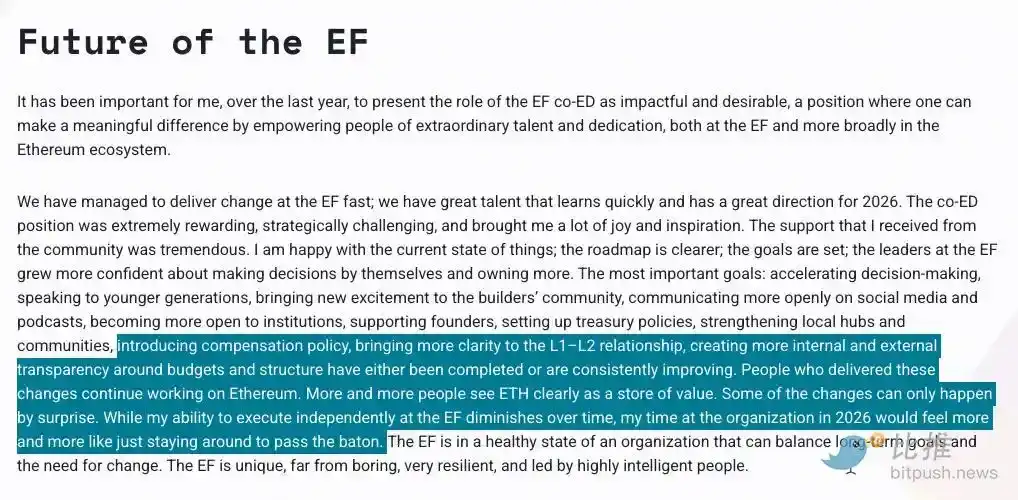
Stańczak's resignation statement was quite candid and somewhat thought-provoking. He provided several key points of information:

First, he believes the Ethereum Foundation and the entire ecosystem are "in a healthy state." The time for handing over the baton has come.

Second, he wants to return to being a "hands-on product builder," focusing on the combination of AI and Ethereum. He said his current mindset is similar to when he founded Nethermind in 2017.

Third, and most intriguingly: "The leadership layer of the Foundation is increasingly confident in making their own decisions and taking control of more matters. Over time, my ability to execute independently within the Foundation has diminished. If I stayed on, in 2026 I would mostly just be 'waiting to hand over the baton.'"

This sentence reveals two layers of meaning: first, the new leadership team has developed self-drive and no longer needs his involvement in everything; second, his actual sphere of influence may have been shrinking. For someone accustomed to getting hands-on and with a strong entrepreneurial temperament, this feeling was clearly not a good fit for him.

He also mentioned, "I know many current ideas about agentic AI might be immature, even useless, but it is this kind of playful experimentation that defined the innovative spirit of early Ethereum."

This statement carries a hint of implicit criticism of the status quo: as the organization becomes more "mature" and decisions become more "stable," will that wild, experimental spirit be lost?

Stańczak's departure,表面上 (on the surface) a personal choice,背后 (behind it) lies the long-standing dilemma faced by the Ethereum Foundation.

Since its inception, this organization has been in an awkward position. Theoretically, Ethereum is decentralized, and the Foundation should not be a command-and-control power center. But in practice, it controls significant funds, core developer resources, and has a coordinating voice in the ecosystem, objectively承担着 (bearing) the dual roles of "central bank" and "economic planning agency."

This identity paradox has long placed the Foundation in a double bind: doing too much draws accusations of centralization; doing too little invites criticism for inaction. The Miyaguchi era leaned towards a "coordinator"定位 (positioning), resulting in criticism of weakness; Stańczak attempted to shift towards an "executor" role, efficiency did improve, but the internal distribution of power within the organization naturally became more concentrated.

Stańczak's resignation statement恰恰暴露了 (precisely exposes) this tension: as the organization became more efficient and decisions more decisive, the personal maneuvering room for founding team members was反而压缩 (instead compressed). For an ecosystem that needs to balance "decentralized spirit" and "market competition efficiency," this internal friction is almost unavoidable.

What kind of person is Bastian Aue, who is replacing Stańczak?

There is extremely little public information. His own description on X is that he was previously responsible for "work that is difficult to quantify but crucial" at the Foundation: assisting management decision-making, communicating with team leaders, budget considerations, strategic梳理 (sorting), priority setting. This low-key style contrasts with Stańczak's distinct entrepreneurial气质 (temperament).

Aue said in his acceptance statement: "My basis for making decisions is a principled insistence on certain properties of what we are building. The mission of the Foundation is to ensure that truly permissionless infrastructure—the core is the cypherpunk spirit—can be built."
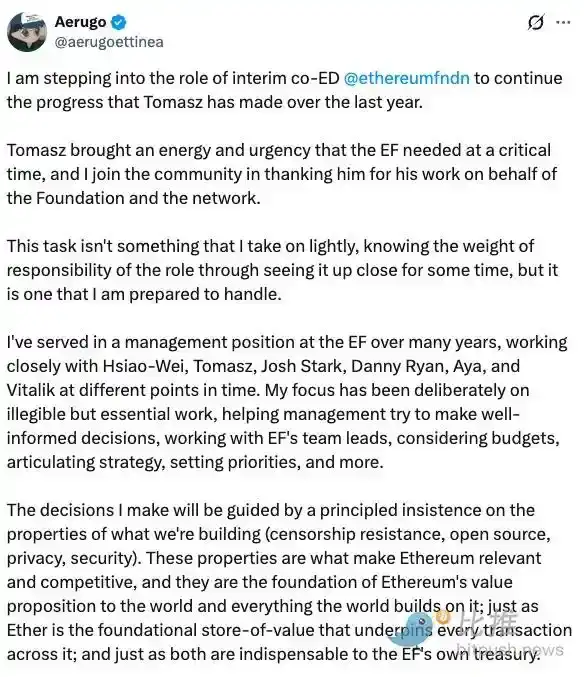
This language sounds more like the style of the Miyaguchi era: emphasizing principles, emphasizing spirit, emphasizing coordination rather than leadership.

Does this mean the Foundation will rebalance its direction, dialing back from "aggressive execution" to "principled coordination"? This remains to be seen.

Ethereum's Confusion

Stańczak's departure comes at a time when Ethereum is discussing a series of major proposals. According to him, the Foundation is about to release several key documents, including specific plans for "Lean Ethereum," the future development roadmap, and DeFi coordination mechanisms.

Among them, the "Lean Ethereum" proposal has been jokingly called "Ethereum's weight loss era" by some community members—intending to simplify the protocol, reduce burdens, and make the mainnet run more efficiently.

These directional documents will profoundly影响 (affect) Ethereum's evolution path in the coming years. Changing the core executive负责人 (person in charge) at this moment undoubtedly adds uncertainty to the implementation of these proposals.

The broader context is that Ethereum is facing challenges from multiple fronts: competition from high-performance chains like Solana, the fragmentation issue with Layer 2s, the new narrative window of AI and blockchain integration, and the impact of overall crypto market sentiment fluctuations on ecosystem funding and attention.

On the same day Stańczak announced his departure, ETH一度跌入 (once fell into) the $1800 range. If it continues to break below this level, an awkward fact will emerge: the comprehensive return on holding ETH may fall below the dollar cash interest rate.

Do the math for a more painful realization: In January 2018, ETH first stood above $1400. That $1400, adjusted for U.S. CPI inflation with compound interest, would be equivalent to approximately $1806 by February 2026.
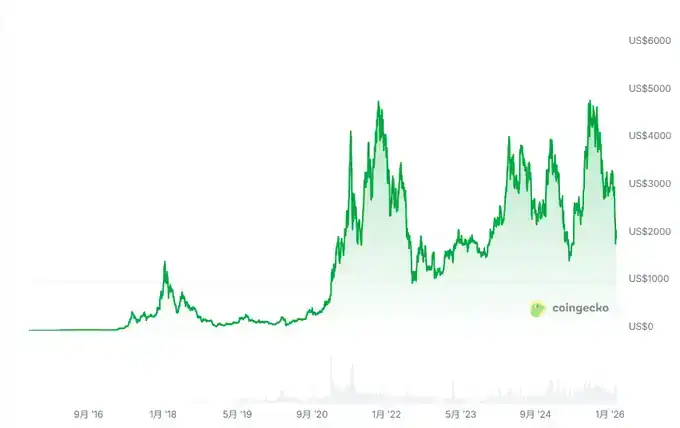
In other words, if an investor bought ETH in 2018 and held it裸持 (naked, meaning without staking) until now, after eight years, they not only made no money but even underperformed U.S. dollars left in a bank earning interest.

For the "Ethereum Guards" (E 卫兵, loyal supporters) who have believed all along, the real拷问 (questioning) might not be "who won the路线之争 (route dispute)," but rather: how much longer can this last?

The only certainty is: this core organization, which controls one of the most important ecosystems in the crypto world, is still searching for its定位 (positioning) in a rapidly changing industry, and this path is注定 (destined) not to be平静 (calm).


Domande pertinenti

QWho is leaving the Ethereum Foundation (EF) and after how long in the role?

ATomasz Stańczak, the EF's co-executive director, is leaving after just 11 months in the position.

QWhat were some of the key changes implemented during Tomasz Stańczak's tenure?

AKey changes included organizational streamlining with 19 employees laid off, a strategic refocus on Layer 1 scaling over Layer 2, faster upgrade cycles, more proactive public communication, and exploration of new areas like AI integration and quantum resistance.

QWhat reason did Tomasz Stańczak give for his departure from the Ethereum Foundation?

AHe stated he wanted to return to being a hands-on product builder, focusing on AI and Ethereum. He also implied his ability to execute independently within the foundation was diminishing as the leadership team became more self-sufficient.

QWho is replacing Tomasz Stańczak and what is known about his approach?

ABastian Aue is replacing him. Public information is scarce, but his statements suggest a leadership style that emphasizes principle-based decisions and a focus on 'cryptopunk spirit' and coordination, which contrasts with Stańczak's more execution-focused, entrepreneurial approach.

QWhat broader challenge for Ethereum is highlighted by the ETH price comparison from 2018?

AThe article highlights a significant performance challenge: an ETH bought in January 2018 and held without staking would be worth less in real terms (adjusted for inflation) than if the same amount of USD had been kept in a bank account earning interest, raising questions about long-term value retention for passive holders.

Letture associate

iQiyi Is Too Impatient

The article "iQiyi Is Too Impatient" discusses the controversy surrounding the Chinese streaming platform IQiyi's recent announcement of an "AI Actor Library" during its 2026 World Conference. IQiyi claimed over 100 actors, including well-known names like Zhang Ruoyun and Yu Hewei, had joined the initiative. CEO Gong Yu suggested AI could enable actors to "star in 14 dramas a year instead of 4" and that "live-action filming might become a world cultural heritage." The announcement quickly sparked backlash. Multiple actors named in the list issued urgent statements denying they had signed any AI-related authorization agreements. This forced IQiyi to clarify that inclusion in the library only indicated a willingness to *consider* AI projects, with separate negotiations required for any specific role. The incident, which trended on social media with hashtags like "IQiyi is crazy," is presented as a sign of the company's growing desperation. Facing intense competition from short-video platforms like Douyin and Kuaishou, as well as Bilibili and Xiaohongshu, IQiyi's financial performance has weakened, with revenues declining for two consecutive years. The author argues that IQiyi is "too impatient" to tell a compelling AI story to reassure the market, especially as it pursues a listing on the Hong Kong stock exchange. The piece concludes by outlining three key "AI questions" IQiyi must answer: defining its role as a tool provider versus a content creator, balancing the "coldness" of AI with the human element audiences desire, and properly managing the interests of platforms, actors, and viewers. The core dilemma is that while AI can reduce costs and increase efficiency, it risks creating homogenized, formulaic content and devaluing human performers.

marsbit17 min fa

iQiyi Is Too Impatient

marsbit17 min fa

Trading

Spot
Futures

Articoli Popolari

Cosa è ETH 3.0

ETH3.0 e $eth 3.0: Un'Analisi Approfondita del Futuro di Ethereum Introduzione Nel panorama in rapida evoluzione delle criptovalute e della tecnologia blockchain, ETH3.0, spesso indicato come $eth 3.0, è emerso come un argomento di considerevole interesse e speculazione. Il termine comprende due concetti principali che warrantono chiarimenti: Ethereum 3.0: Questo rappresenta un potenziale futuro aggiornamento volto ad aumentare le capacità dell'attuale blockchain di Ethereum, concentrandosi principalmente sul miglioramento della scalabilità e delle prestazioni. ETH3.0 Meme Token: Questo progetto di criptovaluta distinto cerca di sfruttare la blockchain di Ethereum per creare un ecosistema incentrato sui meme, promuovendo il coinvolgimento all'interno della comunità delle criptovalute. Comprendere questi aspetti di ETH3.0 è essenziale non solo per gli appassionati di criptovalute, ma anche per coloro che osservano tendenze tecnologiche più ampie nello spazio digitale. Che cos'è ETH3.0? Ethereum 3.0 Ethereum 3.0 è pubblicizzato come un aggiornamento proposto per la rete Ethereum già stabilita, che è stata la spina dorsale di molte applicazioni decentralizzate (dApps) e contratti smart sin dalla sua nascita. I miglioramenti previsti si concentrano principalmente sulla scalabilità, integrando tecnologie avanzate come lo sharding e le prove a conoscenza zero (zk-proofs). Queste innovazioni tecnologiche mirano a facilitare un numero senza precedenti di transazioni al secondo (TPS), potenzialmente raggiungendo milioni, affrontando così una delle limitazioni più significative della tecnologia blockchain attuale. Il miglioramento non è meramente tecnico, ma anche strategico; è volto a preparare la rete Ethereum per un'adozione e un'utilità diffuse in un futuro contrassegnato da un aumento della domanda di soluzioni decentralizzate. ETH3.0 Meme Token Al contrario di Ethereum 3.0, l'ETH3.0 Meme Token si avventura in un dominio più leggero e giocoso, combinando la cultura dei meme di internet con la dinamica delle criptovalute. Questo progetto consente agli utenti di acquistare, vendere e scambiare meme sulla blockchain di Ethereum, fornendo una piattaforma che promuove il coinvolgimento della comunità attraverso la creatività e interessi condivisi. L'ETH3.0 Meme Token mira a dimostrare come la tecnologia blockchain possa intersecarsi con la cultura digitale, creando casi d'uso che siano sia divertenti che finanziariamente praticabili. Chi è il Creatore di ETH3.0? Ethereum 3.0 L'iniziativa verso Ethereum 3.0 è principalmente propulsa da un consorzio di sviluppatori e ricercatori all'interno della comunità di Ethereum, tra cui Justin Drake. Conosciuto per le sue intuizioni e contributi all'evoluzione di Ethereum, Drake è stato una figura di spicco nelle discussioni riguardanti la transizione di Ethereum verso un nuovo livello di consenso, chiamato “Beam Chain.” Questo approccio collaborativo allo sviluppo significa che Ethereum 3.0 non è il prodotto di un creatore singolo, ma piuttosto una manifestazione di ingegno collettivo focalizzato sul progresso della tecnologia blockchain. ETH3.0 Meme Token I dettagli riguardanti il creatore dell'ETH3.0 Meme Token sono attualmente non rintracciabili. La natura dei token meme conduce spesso a una struttura più decentralizzata e guidata dalla comunità, il che potrebbe spiegare la mancanza di attribuzione specifica. Questo si allinea con l'etica della comunità crypto più ampia, dove l'innovazione spesso nasce da sforzi collaborativi piuttosto che individuali. Chi sono gli Investitori di ETH3.0? Ethereum 3.0 Il supporto per Ethereum 3.0 proviene principalmente dalla Ethereum Foundation insieme a una comunità entusiasta di sviluppatori e investitori. Questa associazione fondamentale fornisce un considerevole grado di legittimità e migliora le prospettive di implementazione di successo poiché sfrutta la fiducia e la credibilità costruite nel corso degli anni di operazioni della rete. Nel clima in rapida evoluzione delle criptovalute, il supporto della comunità gioca un ruolo cruciale nello sviluppo e nell'adozione, posizionando Ethereum 3.0 come un serio contenditore per i futuri progressi della blockchain. ETH3.0 Meme Token Sebbene le fonti attualmente disponibili non forniscano informazioni esplicite riguardo ai fondamenti o alle organizzazioni di investimento che sostengono l'ETH3.0 Meme Token, ciò è indicativo del modello di finanziamento tipico per i token meme, che spesso si basa sul supporto di base e sul coinvolgimento della comunità. Gli investitori in tali progetti sono tipicamente individui motivati dal potenziale per innovazioni guidate dalla comunità e dallo spirito di cooperazione trovato all'interno della comunità crypto. Come Funziona ETH3.0? Ethereum 3.0 Le caratteristiche distintive dell'Ethereum 3.0 risiedono nella sua proposta di implementazione della tecnologia di sharding e zk-proof. Lo sharding è un metodo di partizionamento della blockchain in pezzi più piccoli e gestibili o “shard,” che possono elaborare transazioni in modo concorrente piuttosto che sequenziale. Questa decentralizzazione dell'elaborazione aiuta a prevenire la congestione e garantisce che la rete rimanga reattiva anche sotto un carico pesante. La tecnologia delle prove a conoscenza zero (zk-proof) contribuisce con un ulteriore livello di sofisticazione consentendo la validazione delle transazioni senza rivelare i dati sottostanti coinvolti. Questo aspetto non solo migliora la privacy, ma aumenta anche l'efficienza complessiva della rete. Si parla anche di incorporare una macchina virtuale Ethereum a conoscenza zero (zkEVM) in questo aggiornamento, amplificando ulteriormente le capacità e l'utilità della rete. ETH3.0 Meme Token L'ETH3.0 Meme Token si distingue capitalizzando sulla popolarità della cultura dei meme. Stabilisce un mercato per gli utenti che desiderano partecipare al trading di meme, non solo per divertimento, ma anche per potenziale guadagno economico. Integrando funzioni come lo staking, la fornitura di liquidità e meccanismi di governance, il progetto promuove un ambiente che incentiva l'interazione e la partecipazione della comunità. Offrendo una miscela unica di intrattenimento e opportunità economica, l'ETH3.0 Meme Token mira ad attrarre un pubblico variegato, che va dagli appassionati di crypto ai semplici intenditori di meme. Timeline di ETH3.0 Ethereum 3.0 11 Novembre 2024: Justin Drake accenna al prossimo aggiornamento ETH 3.0, incentrato sui miglioramenti della scalabilità. Questo annuncio segna l'inizio delle discussioni formali riguardo l'architettura futura di Ethereum. 12 Novembre 2024: La proposta attesa per Ethereum 3.0 dovrebbe essere svelata a Devcon a Bangkok, preparando il terreno per un feedback più ampio della comunità e potenziali passi successivi nello sviluppo. ETH3.0 Meme Token 21 Marzo 2024: L'ETH3.0 Meme Token viene ufficialmente elencato su CoinMarketCap, segnando il suo ingresso nel dominio pubblico delle criptovalute e aumentando la visibilità per il suo ecosistema basato sui meme. Punti Chiave In conclusione, Ethereum 3.0 rappresenta una significativa evoluzione all'interno della rete Ethereum, concentrandosi sul superamento delle limitazioni riguardanti scalabilità e prestazioni attraverso tecnologie avanzate. I suoi aggiornamenti proposti riflettono un approccio proattivo alle future esigenze e usabilità. D'altra parte, l'ETH3.0 Meme Token incarna l'essenza della cultura guidata dalla comunità nello spazio delle criptovalute, sfruttando la cultura dei meme per creare piattaforme coinvolgenti che incoraggiano la creatività e la partecipazione degli utenti. Comprendere gli scopi e le funzionalità distinte di ETH3.0 e $eth 3.0 è fondamentale per chiunque sia interessato ai continui sviluppi nello spazio crypto. Con entrambe le iniziative che tracciano percorsi unici, esse sottolineano collettivamente la natura dinamica e multifacetica dell'innovazione blockchain.

170 Totale visualizzazioniPubblicato il 2024.04.04Aggiornato il 2024.12.03

Cosa è ETH 3.0

Cosa è ETHEREUM

HarryPotterTrumpHomerSimpson777Inu: Panoramica di un Progetto Crypto Web3 Introduzione Nel mondo in rapida evoluzione delle criptovalute e della finanza decentralizzata, progetti innovativi emergono frequentemente, catturando l'interesse della comunità degli investitori e degli appassionati di crypto. Uno di questi progetti è HarryPotterTrumpHomerSimpson777Inu, una criptovaluta che si trova all'incrocio tra cultura popolare e tecnologia blockchain. Questo token guidato dalla comunità mescola personaggi e figure politiche ben noti, con l'obiettivo di creare una piattaforma coinvolgente e promuovere un'adozione diffusa. Che cos'è HarryPotterTrumpHomerSimpson777Inu? HarryPotterTrumpHomerSimpson777Inu è un token costruito sulla blockchain di Ethereum, progettato per essere accessibile e divertente per un pubblico diversificato. L'unicità di questo progetto deriva dal suo approccio tematico, che intreccia elementi di fantasia, politica e intrattenimento. Sfruttando il fascino nostalgico di personaggi amati, il progetto cerca di creare un'esperienza di criptovaluta coinvolgente, incoraggiando il coinvolgimento e la partecipazione della comunità. L'obiettivo principale di HarryPotterTrumpHomerSimpson777Inu è stabilire un token che risuoni con gli utenti a livello personale, promuovendo sia il divertimento che il coinvolgimento nell'ambito crypto. Questo branding distintivo mira ad attrarre individui che in precedenza potrebbero non essersi interessati alle criptovalute, facilitando un nuovo punto di ingresso per utenti potenziali. Creatore di HarryPotterTrumpHomerSimpson777Inu L'identità del creatore dietro HarryPotterTrumpHomerSimpson777Inu rimane sconosciuta. Questa non è una pratica rara nel dominio delle criptovalute, dove l'anonimato è spesso preferito dai fondatori come mezzo di protezione della privacy e promozione di un ethos decentralizzato. Questa oscurità non diminuisce il valore del progetto; al contrario, riflette una tendenza più ampia all'interno del settore, dove molti progetti di successo sono emersi da origini anonime. Investitori di HarryPotterTrumpHomerSimpson777Inu Le informazioni pubbliche riguardo agli investitori di HarryPotterTrumpHomerSimpson777Inu sono limitate. La natura del progetto, incentrata sul coinvolgimento della comunità, suggerisce una dipendenza da investimenti di piccole dimensioni da parte di singoli appassionati piuttosto che da sostegni sostanziali da fondazioni di investimento consolidate o corporation. Questo livello di trasparenza nel finanziamento è tipico di molti progetti di criptovaluta guidati dalla comunità, dove il supporto spesso proviene da movimenti di base piuttosto che da investitori istituzionali. Come Funziona HarryPotterTrumpHomerSimpson777Inu? Operando sulla blockchain di Ethereum, HarryPotterTrumpHomerSimpson777Inu sfrutta la sua solida infrastruttura per facilitare transazioni e promuovere interazioni tra gli utenti all'interno della comunità. Ciò che distingue questo progetto è il suo posizionamento tematico: canalizzando il carisma di personaggi iconici provenienti da diversi ambiti culturali, crea un'identità di marca distintiva. Questo approccio non solo attrae gli utenti, ma coltiva anche una comunità fedele attorno al token. Le meccaniche operative del progetto si concentrano sul coinvolgimento della comunità. Adotta un modello decentralizzato che incoraggia la partecipazione, consentendo agli utenti di interagire attraverso vari canali mentre promuovono lo scambio di idee e esperienze. Inoltre, il progetto abbraccia i principi del Web3, privilegiando la sovranità degli utenti e la decentralizzazione, che sono i pilastri del futuro di Internet. Timeline di HarryPotterTrumpHomerSimpson777Inu La storia di HarryPotterTrumpHomerSimpson777Inu è segnata da diversi eventi decisivi: 12 agosto 2023: L'inizio di HarryPotterTrumpHomerSimpson777Inu, segnando il suo ingresso nell'ecosistema delle criptovalute. Fase di Sviluppo: Un periodo focalizzato sulla costruzione di una strategia completa per stimolare la crescita guidata dalla comunità e il coinvolgimento degli utenti. Listing sugli Scambi: Sebbene i dettagli specifici di listing non siano stati divulgati, il progetto è stato reso accessibile su vari scambi di criptovalute, migliorando la sua visibilità nel mercato. Coinvolgimento della Comunità: Sforzi continui per coinvolgere attivamente la comunità, stabilendo canali di dialogo e promuovendo la partecipazione attraverso varie attività, tra cui concorsi, discussioni e votazioni comunitarie. Aspetti Chiave di HarryPotterTrumpHomerSimpson777Inu Focus sulla Comunità Un tratto distintivo di HarryPotterTrumpHomerSimpson777Inu è la sua forte enfasi sul coinvolgimento della comunità. Il progetto incoraggia attivamente gli utenti a partecipare a discussioni, condividere idee e contribuire all'evoluzione del progetto. Questa interazione coltiva un senso di appartenenza e di ownership tra i membri della comunità, essenziale per la sostenibilità a lungo termine del token. Utilizzo della Blockchain di Ethereum La scelta di costruire sulla blockchain di Ethereum consente a HarryPotterTrumpHomerSimpson777Inu di sfruttare le sue caratteristiche di sicurezza ben consolidate e architettura decentralizzata. Questa base garantisce affidabilità per le transazioni e fornisce un framework affidabile su cui sviluppare varie funzionalità. Approccio Tematico Unico Fusione di elementi della cultura pop nella sua identità, HarryPotterTrumpHomerSimpson777Inu crea una narrazione coinvolgente che lo differenzia da altre criptovalute. L'amalgama di personaggi e temi genera riconoscimento e intrigo immediati, rendendo il token relazionabile a un'ampia gamma di utenti potenziali. Anonimato nello Sviluppo Il creatore anonimo del progetto rimane una caratteristica ricorrente in molte iniziative di criptovaluta. Questo aspetto evidenzia un ethos di decentralizzazione, introducendo anche un livello di mistero che potrebbe affascinare un segmento della comunità crypto, attirando l'attenzione sul progetto e invitando l'impegno da parte di utenti che supportano l'idea di un'iniziativa decentralizzata e gestita dalla comunità. Conclusione HarryPotterTrumpHomerSimpson777Inu si presenta come un'aggiunta distintiva al panorama delle criptovalute, combinando il fascino della cultura popolare con le meccaniche innovative della tecnologia blockchain. Sebbene i dettagli riguardanti il creatore e gli investitori specifici rimangano non divulgati, il focus del progetto sulla comunità e il suo approccio tematico lo contraddistinguono come un potenziale attore influente nel contesto del Web3 e delle criptovalute. Man mano che l'ecosistema delle criptovalute continua ad espandersi, iniziative come HarryPotterTrumpHomerSimpson777Inu ci ricordano le molteplici modalità in cui la blockchain può connettere le comunità globali attraverso narrazioni e valori condivisi.

720 Totale visualizzazioniPubblicato il 2024.04.06Aggiornato il 2024.12.03

Cosa è ETHEREUM

Come comprare ETH

Benvenuto in HTX.com! Abbiamo reso l'acquisto di Ethereum (ETH) semplice e conveniente. Segui la nostra guida passo passo per intraprendere il tuo viaggio nel mondo delle criptovalute.Step 1: Crea il tuo Account HTXUsa la tua email o numero di telefono per registrarti il tuo account gratuito su HTX. Vivi un'esperienza facile e sblocca tutte le funzionalità,Crea il mio accountStep 2: Vai in Acquista crypto e seleziona il tuo metodo di pagamentoCarta di credito/debito: utilizza la tua Visa o Mastercard per acquistare immediatamente EthereumETH.Bilancio: Usa i fondi dal bilancio del tuo account HTX per fare trading senza problemi.Terze parti: abbiamo aggiunto metodi di pagamento molto utilizzati come Google Pay e Apple Pay per maggiore comodità.P2P: Fai trading direttamente con altri utenti HTX.Over-the-Counter (OTC): Offriamo servizi su misura e tassi di cambio competitivi per i trader.Step 3: Conserva Ethereum (ETH)Dopo aver acquistato Ethereum (ETH), conserva nel tuo account HTX. In alternativa, puoi inviare tramite trasferimento blockchain o scambiare per altre criptovalute.Step 4: Scambia Ethereum (ETH)Scambia facilmente Ethereum (ETH) nel mercato spot di HTX. Accedi al tuo account, seleziona la tua coppia di trading, esegui le tue operazioni e monitora in tempo reale. Offriamo un'esperienza user-friendly sia per chi ha appena iniziato che per i trader più esperti.

2.7k Totale visualizzazioniPubblicato il 2024.12.10Aggiornato il 2025.03.21

Come comprare ETH

Discussioni

Benvenuto nella Community HTX. Qui puoi rimanere informato sugli ultimi sviluppi della piattaforma e accedere ad approfondimenti esperti sul mercato. Le opinioni degli utenti sul prezzo di ETH ETH sono presentate come di seguito.

活动图片