Lens and Farcaster "Change Hands": Can the Second Venture of On-Chain Social Break Through?

比推Pubblicato 2026-01-23Pubblicato ultima volta 2026-01-23

Introduzione

Two leading decentralized social protocols, Lens and Farcaster, have both undergone significant leadership changes this week. Lens, originally developed under Avara (Aave’s parent company), has transitioned to Mask Network, which aims to usher in a “product-centric” era for the protocol. Shortly after, Farcaster’s co-founder announced that infrastructure provider Neynar is acquiring Farcaster’s apps, protocol, and tech stack, with a renewed “developer-first” focus. While both Mask and Neynar possess deep expertise in their respective protocols, the broader challenge remains: achieving mass adoption and sustainable user engagement. Ethereum co-founder Vitalik Buterin commented on the shift, emphasizing the need for social tools that serve long-term user interests rather than short-term engagement. He advocates for decentralized social networks built on shared data layers with diverse clients and cultures. The success of these platforms hinges on creating overlapping “public squares” that foster innovation, community, and user agency. The new stewards now face the task of turning decentralized social ideals into engaging, daily-use realities—moving from theoretical potential to practical, culturally-rich ecosystems.

Source: Bankless

Author: William M. Peaster

Compilation and arrangement: BitpushNews


The landscape of Web3 consumer applications is undergoing dramatic changes.

Over the past few years, the two flagship on-chain social projects—Farcaster and Lens—both experienced a change in "leadership" this week.

A New Chapter for Lens

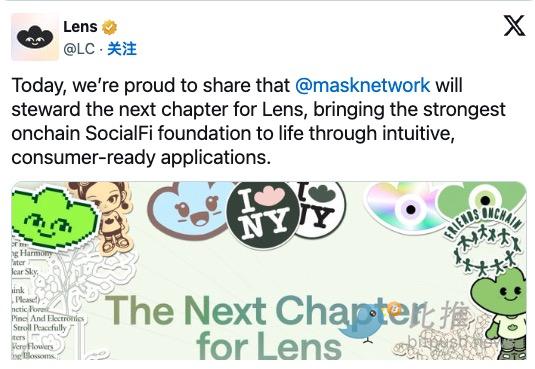
Avara (the parent company of Aave and Lens) just announced the transfer of the Lens protocol's management rights to Mask Network. The Mask team, with its rich experience, has previously developed on-chain social applications like Firefly and Orb. Avara will now focus entirely on DeFi business, while Mask's goal is to usher in a "product-centric" new era for Lens.
Farcaster Follows Suit

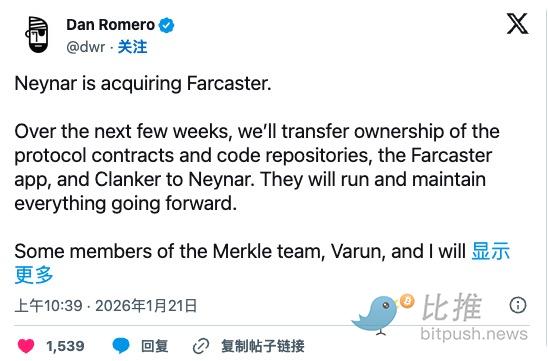
Just a day after the Lens news broke, Farcaster co-founder Dan Romero announced that Neynar, an infrastructure provider for Farcaster, is acquiring Farcaster's applications, protocol, and the Clanker tech stack. The original startup leadership team of Farcaster will not be joining the new company, but Neynar stated they are committed to reshaping the project into a "developer-first" social network.
Weighing the Pros and Cons

Mask knows Lens inside and out, and Neynar understands every detail of Farcaster. These two teams are undoubtedly among the top developers and thinkers in the on-chain social space. In the long run, Lens and Farcaster seem to be in the most capable hands.

However, the road ahead is far from smooth.

So far, on-chain social projects have struggled to become mass social networks with "gravitational mass." If this goal had been achieved, today's change of hands wouldn't have happened. Clearly, there are still some elements missing in the underlying structure, making some degree of "reboot" inevitable. Whether these changes can break through the bottlenecks and achieve lasting user retention remains to be seen.

Regarding the news of Lens's change of hands, Ethereum founder Vitalik Buterin (V God) shared his perspective. He wrote:

"What we need are social tools that serve the long-term interests of users, not just extract short-term engagement. [...] Decentralization is the way to achieve this: through a shared data layer, anyone can build their own client on top of it."

"But crypto social projects have tended to go the wrong way in the past. [...] Mixing 'money' and 'social' isn't inherently wrong: Substack has proven it's possible to build an economic system that supports high-quality content. But Substack's core is about subscribing to creators, not creating price bubbles around them."

"Decentralized social should be run by people who deeply believe in the essence of 'social' and are primarily driven by solving social problems. [...] I'm excited about Lens's development next year because I think the new team taking over is genuinely interested in 'social' itself."

"I encourage everyone to invest more time this year in Lens, Farcaster, and the broader decentralized social world. We need to move beyond the state where everyone is constantly tweeting in a global 'information war zone' and enter a reopened frontier where better, more novel forms of interaction become possible."

The Bigger Picture

For Lens and Farcaster, the key to this game lies in cultivating multiple overlapping "public squares"—connected by shared data but differentiated by different clients and cultures.

This diversity can foster innovation, innovation leads to more social interaction, social interaction attracts more users, which in turn drives more innovation, creating a virtuous cycle. Getting this "flywheel" spinning remains the core challenge.

Mask and Neynar seem ready to take on this task, and I am optimistic about their performance in their new roles. If you want to support their second launch and heed Vitalik's call, a great starting point is to try the Firefly application developed by Mask. It allows you to access platforms like X (Twitter), Farcaster, and Lens simultaneously without manually republishing content.

Looking Ahead

Crypto social is not dead. However, for the leaders of this new phase to successfully open a second chapter, they need to reflect on what worked and what didn't in the first chapter and iterate continuously based on that.

Overall, we have moved from the "what if" stage to the "what now" stage. In this sense, what Mask and Neynar have taken over is not just protocols, but also a mission: to transform decentralization from an abstract ideal into something many people are truly willing to spend time immersed in.

This is no easy task. But if these teams can continue to nurture lasting communities with unique cultures while empowering users with more agency in new ways, they have a chance to go far. Now, let's wait and see if they can truly realize this vision.


Twitter:https://twitter.com/BitpushNewsCN

Bitpush TG Discussion Group:https://t.me/BitPushCommunity

Bitpush TG Subscription: https://t.me/bitpush

Original link:https://www.bitpush.news/articles/7605336

Domande pertinenti

QWhat major changes occurred in the management of Lens and Farcaster this week?

AAvara, the parent company of Aave and Lens, transferred the governance of the Lens protocol to Mask Network. Simultaneously, Farcaster's infrastructure provider Neynar acquired Farcaster's applications, protocol, and the Clanker tech stack, with the original founding team stepping down.

QAccording to Vitalik Buterin, what is the core problem with past crypto social projects?

AVitalik Buterin stated that past crypto social projects often went wrong by mixing 'money' and 'social' in a way that created price bubbles around creators, rather than focusing on building an economic system that supports high-quality content, similar to Substack's subscription model.

QWhat is the key challenge for Lens and Farcaster in their new phase of development?

AThe core challenge is to get the 'flywheel' effect spinning: cultivating multiple overlapping 'public squares' connected by shared data but differentiated by different clients and cultures, which can drive innovation, more social interaction, user growth, and further innovation.

QWhich application is recommended as a good starting point to support the new initiatives of Mask and Neynar?

AMask's Firefly application is recommended, as it allows users to access platforms like X (Twitter), Farcaster, and Lens simultaneously without manually reposting content.

QWhat overall shift in phase does the article describe for crypto social projects?

AThe article describes a shift from the 'what if' phase to the 'what now' phase, where the new leaders must reflect on what worked and what didn't in the first chapter, iterate continuously, and transform decentralization from an abstract ideal into something people genuinely want to immerse their time in.

Letture associate

From South Korea to the United States: Blue-Collar Jobs Are Becoming Increasingly Popular, Thanks to AI

AI is reshaping the labor market's value proposition. The traditional four-year college degree is losing its appeal as a guaranteed career path, while skilled blue-collar trades like electricians, welders, and plumbers are experiencing historic demand and wage premiums. This shift is driven by dual pressures: AI's displacement of certain white-collar roles and a booming need for physical infrastructure and data center construction. Data confirms the trend. In the U.S., vocational school revenue surged, and a significant portion of recent layoffs are AI-related. Surveys show a majority of Gen Z adults plan to pursue blue-collar work, citing better job security against AI automation. Vocational education interest has exploded recently. Experts cite a psychological shift as younger generations seek tangible, AI-resistant careers and avoid high student debt. In many cases, salaries for skilled trades now match or exceed those requiring a bachelor's degree. In South Korea, semiconductor vocational high schools boast near-total employment, with graduates securing high-paying roles at companies like Samsung. The shortage is structural, exacerbated by a retiring baby boomer workforce and massive infrastructure projects. Companies like JPMorgan Chase, Meta, and Lowe's are investing heavily in training programs. However, overcoming historical stigma and a "perception gap" around trade careers remains a key challenge to closing the talent gap.

marsbit59 min fa

From South Korea to the United States: Blue-Collar Jobs Are Becoming Increasingly Popular, Thanks to AI

marsbit59 min fa

Qualcomm: AI Hype Subsides, When Will Smartphones Emerge from the Gloom?

Qualcomm reported its Q3 FY2026 results (ending June 2026), with revenue of $9.95B, down 4% YoY but above expectations. Gross margin declined to 53.1%, pressured by rising costs across manufacturing and memory. Key business segments showed mixed performance: Handset revenue fell 19.6% YoY to $5.09B, dragged by an 11% decline in non-Apple Android shipments and weaker high-end mix. Conversely, Automotive revenue surged 61% to $1.59B, and IoT grew 9% to $1.83B. Core operating profit dropped 41% YoY due to margin compression and higher expenses. Management's Q4 FY2026 guidance projects revenue of $9.7B-$10.5B, in line with consensus, but Non-GAAP EPS guidance of $2.05-$2.25 fell short of expectations. Amidst persistent weakness in its core handset market, Qualcomm is pursuing growth in AI, focusing on Edge AI (smartphones, PCs, automotive) and Data Center AI. Its data center strategy includes four pillars: AI accelerators (e.g., AI200), commercial CPUs (Dragonfly C1000), custom silicon, and connectivity solutions. While these initiatives initially boosted its stock, concerns over AI capital expenditure sustainability have since erased those gains. The company targets $5B in data center revenue for FY2027 and $15B for FY2029. The report concludes that with the traditional handset business still under pressure, the data center opportunity is currently viewed as a longer-term option, and a more conservative valuation based on core operations may be warranted until AI contributions materialize.

marsbit1 h fa

Qualcomm: AI Hype Subsides, When Will Smartphones Emerge from the Gloom?

marsbit1 h fa

From TPU to Self-Evolving Agents: How Jeff Dean Predicts the Next Step in AI

At the 2026 YC Startup School, Jeff Dean outlined his vision for AI's next phase, shifting focus from simply scaling models to building intelligent, autonomous systems. He believes AI's progress is no longer just about creating smarter models, but about integrating them into systems capable of long-term, iterative work, automated experimentation, and continuous learning. This evolution moves the competition from "who has the bigger model" to "who can best organize intelligence." Dean suggests AI capabilities are now comparable to a junior engineer, enabling the automation of complex workflows. However, the true challenge and opportunity lie in managing these AI "workers" at scale. He emphasizes the importance of **context engineering**—structuring tools, memory, and feedback loops—over raw model power. For startups, this means building deep expertise in niche domains where general models currently fail (near 0-1% success rates), leveraging proprietary data, specialized tools, and domain-specific evaluators. A recurring theme is re-examining fundamental constraints. Dean's past work, like moving Google's search index to memory or creating the TPU, stemmed from questioning outdated assumptions about hardware and cost. He sees similar inflection points today, particularly in **specialized inference hardware** to drastically reduce latency and energy consumption for real-time Agent operation. Notably, he points out that in modern AI systems, the dominant cost is often not computation but **data movement**. Reliable, long-running Agents require robust system design, borrowing concepts from distributed computing like checkpointing, state management, and parallel exploration to handle failures and maintain progress over days or weeks. As AI automates execution, the scarcest human skills will shift to **defining clear specifications**, **judging what problems are worth solving** (taste), and designing effective feedback loops. Ultimately, Dean's framework prioritizes understanding the problem deeply, identifying the true bottlenecks, and systematically building closed-loop systems where AI can not only perform tasks but also improve AI itself.

marsbit1 h fa

From TPU to Self-Evolving Agents: How Jeff Dean Predicts the Next Step in AI

marsbit1 h fa

Trading

Spot
活动图片





